Featured

Mafia Secrets (2025)– Gianni Russo – Book Review

I was picking up a package from my concierge when, to my surprise, he asked me to hold on for a moment as he looked to retrieve a second one. Momentary confusion gave way to curiosity. I don’t think I ordered anything else. I wonder what it could be, I thought to myself. After a few minutes, I was handed a smallish rectangular brown package. My eyes widened as I looked in horror that the package was addressed to ‘Mafia Book Reviews’ with my personal address written underneath. Great, now my concierge knows I’m a lame niche internet blogger. Of course, the scarier part was trying to remember who I had given my address to in personal correspondence. The wait for the elevator felt like an eternity. Finally, I stepped into my apartment, dropped everything, and proceeded to rip open the packaging. Is this a book? Who would send me a book? In a sight of relief and mild annoyance, I saw Gianni Russo’s shushing face greet me. Mafia Secrets, huh? The first secret I wanted to know was how he got my address. Well, I never thought I’d live to see the day when I review a Gianni Russo product, but it’s finally here. I got a free advanced copy, might as well make some use out of it.

I’m not sure what the purpose of this book is. In my brief review of Hollywood Godfather’s index (Gianni’s previous memoir), I noticed many of the same characters and events reappearing. It seems several of the so-called ‘Mafia Secrets’ haven’t been so since at least 2019… In any case, I must give credit where it is due; it is a fairly entertaining book. A short, light read, I read it during a flight to Colorado and back.  The cast of characters is notable, the events described seemed [almost] fantastical, and Russo is someone who can tell a fun story. The underlying rags to riches tale about a child suffering from a crippling illness achieving success in their chosen field is even somewhat inspiring. However way he made his supposed fortune, it seems he is spending it on admirable causes (even with the implied vanity of the Marlyn Monroe Museum project). This is the book equivalent of a mindless popcorn film. Readers are warned to turn off their brains. One ill-timed synapses firing a semblance of a thought will ruin the experience.

Mafia Secrets falls apart under any critical examination, and one doesn’t have to be a historian to figure out the glaring errors plaguing the book. Now my copy explicitly states, “typographical and layout errors will not be present in the final book available to consumers,” so I’m not exactly sure what mistakes are present in the final version. However, even beyond the simple mistakes, there are internal time inconsistencies, such as the one involving Joseph Colombo’s demise in relation to the making of The Godfather, logical oversights, and things that just straight up do not make any sense. Take, for instance, Russo’s supposed involvement with Moe Dalitz and the collection of unpaid gambling debts. In the past, apparently, it was forbidden for Nevada casinos to collect losses from gamblers once they crossed state lines. Seeing all these unpaid markers, Russo concocted the brilliant scheme of buying up the face value of the debt for pennies on the dollar and collecting it himself with some hired goons. And who was his target demographic? Doctors and lawyers… You know the ones that would be presumably aware of the law stating it was a crime for Russo to try and collect. The timeline of Howard Hughes’s involvement in Las Vegas was similarly all messed up and didn’t make sense within the story.  

What can be verified? A brief scan of the newspaper record confirms his minor celebrity status. Journalists covering the entertainment section took his words and stories at face value, so there was little in the way of serious fact-checking or pushback made on claims of fame and fortune. His meeting with Pablo Escobar warrants no discussion. That meeting, in turn, was facilitated by an alleged sit-down with John Gotti, the Gambino Boss. Yet, despite probably being the single most surveilled man on the planet at the time, no record of it exists. Kennedy conspiracies, the Vatican plot, and the Iranian revolution affair similarly strain credulity. His witnessing of the Spilotro brothers’ brutal demise is likewise unlikely to have occurred, given that he weirdly fingers Frank Cullotta at the scene. This is despite the fact that Cullotta cooperated years earlier (a fact that is acknowledged by the book and explained away in a laughable way) and has never mentioned it once in either his biography or numerous interviews. Maybe Cullotta just forgot to talk about it, alongside Nicholas Calabrese, when he testified in Operation Family Secret (having been one of the ones to actually carry out the murders).

To me, the story that stood the most potential of being interesting was Gianni Russo’s involvement in the development of the failed Renaissance Hotel-Casino near the Las Vegas strip, simply because it seemed plausible. The book describes Russo’s ambition of building a $54 million 650-room hotel featuring 18,000 square feet of playing space filled with 750 slot machines, twenty-one blackjack tables, a Big Six Wheel, baccarat, and keno. All this would be bankrolled by hardworking Americans courtesy of the Teamsters pension fund via a $30 million loan. To top it all off, Nick Civella, Kansas City’s mob boss, and Joe Agosto, head of the Tropicana’s Folies Bergere show, were caught discussing it all on tape! Gianni mentioned his previous relationship with Civella, giving him a million dollars to shylock, and Civella did have influence with the Teamsters. Unfortunately, there are a couple of issues. First, I looked at the Las Vegas Review-Journal archive, typed in a million different keyword combinations, and have not been able to locate the article with the transcript in question. Second, by November 1978, Civella had a hard time getting loans that he wanted approved by the Teamsters, and so it makes one question how Gianni supposedly secured his. Having recognized the problem of the complete capture of the Teamsters pension fund by racketeers, The Federal government forced the union to undergo structural reforms that took away the power to approve new investments from corrupt trustees to a third party. Thus, sadly, this promising story seems to be as real as all the rest.

I can’t blame Gianni Russo for this effort. He’s unapologetically a hustler through and through. Blurring fact and fiction is what all good storytellers do (to what extent is sensible is up to you to decide). However, the cover of the book states, “with Michael Benson,” and I hold him a bit more accountable. As one of the more prolific “Mafia authors” through his series of books with Frank DiMatteo, he should hold himself to a higher standard. As much as those books may lack in value and effort, they still strive to get to the truth. Of what value is the “Sources” section at the back of Mafia Secrets if you cannot verify anything besides the boilerplate biographies of random members and associates of organized crime that had nothing, if anything, to do with Russo that served to just pad out the page count (such as the Alan Dorfman bio). I’m not sure how you can put your name and stand behind a product you know is not true.

Mafia Secrets is akin to The Lion King 1 1/2. Like Timon and Pumbaa, Russo is present at every important event, witnessing history altering consequences, and yet playing no role in actually furthering them. As Tony Soprano aptly put it, “Did she ever exist?”

Featured

The Folly of Relying on Mafia Books Written by Journalists

The “Russian” Mafia captured the attention of the media, news headlines, and true crime enthusiasts alike to become the second most widely known organised crime group. Despite this, I don’t think many people have stopped to think about what is known and where that information comes from. In an era of “fake news”, “alternative facts”, and muddying narratives, pinpointing the original source, the foundation upon which entire world views and beliefs are built, becomes increasingly hard and ever more important. It is in this light that I want to talk about what is known about “Russian” Organised Crime (“ROC”) in New York, who we know it from, and why we shouldn’t blindly believe everything we read.

The entire historiography, persona-driven narrative, and the foundational myth of ROC in New York (and America more broadly) have all been built upon the work of one man, Robert I. Friedman. The seminal essay, ‘Brighton Beach Goodfellas’, published in the January 1993 edition of Vanity Fair, summarised his approach to this history. The focus was on larger-than-life personalities and dramatic stories. Murders and excess, rumours and innuendo filled the pages. Important events get condensed into sentences that almost dismissively urge the reader to move on to the next vivid anecdote. The truth does not get in the way of a good story. Friedman would follow up this essay with a sequel titled, ‘The Organizatsiya’, published in the November 1994 edition of New York Magazine. More of the same followed. Rounding out the story and giving, to date, the most complete “history” of ROC in America, Friedman published his crowning long-form literary achievement, Red Mafiya: How the Russian Mob Has Invaded America, in 2000. Unfortunately, interest in the subject quickly waned following the final major wave of arrests of ROC members in the wake of the stock scam busts of the late 20th century into the early 2000s. Writers are a fickle folk, always in search and drawn to the next hot topic like moths to a flame, and the fires fueling ROC’s rise in America were quickly fading. The few academic books written on the subject primarily concerned themselves with theoretical frameworks, the structure of networks, and case study analyses. In the rare event that authors wished to chronicle some of the main characters and plot points, they largely deferred to Friedman’s account of the story, impressed with his personal connections to some of the major figures. Academia, being underpinned by his account, only further lent credence to his version of the story and garnered him further legitimacy and trust from mainstream sources and hobbyists alike. Thus, the story spread far and wide into a variety of genres, from books concerning themselves with New York’s ever-changing immigrant landscape to Trump-Russia conspiracies. The most recent popular work about the “Russian Mafia” in America was Douglas Century’s biography of Boris Nayfeld, and it, too, largely upheld the Friedman Orthodoxy. I find this quite problematic.

Now I admit, I have been suspicious of Friedman’s for quite a while now, at times feeling like a lunatic who may have gone off the deep end. After all, everyone trusts him. He’s widely cited. Who am I to question that? The very title of this rant is hypocritical. Robert was at least a professional journalist and writer who interacted with law enforcement and criminals alike. I’m just some “dude” on the internet with too much time to spare. And yet, I’ve gotten a nagging feeling ever since I took a close look at his body of work when writing my Mafia Gas Tax essay. Although I, regrettably, cited his works numerous times in that article, I was immediately upfront about some inconsistencies I noticed. I tried hard to reconcile all the competing narratives and points of view into a timeline that made sense. In my defence, I had far fewer primary sources to rely upon at the time, and so out of necessity, I had to defer to Friedman to plug my knowledge gaps. I was quite surprised about the level of trust Friedman’s work enjoyed, given the outcome of one of Anthony Morelli’s legal proceedings. The Gambino captain, in charge of overseeing John Gotti’s share of the gas tax scheme, filed an appeal over an event that happened to one of his trial’s most important witnesses, David Shuster. Friedman described Shuster’s curious return to the United States from Moscow as being a product of a kidnapping by Russia’s security apparatus, with threats being made against him should he not return to the U.S. and cooperate with the FBI. Long story short, the Court was not convinced of the truth of the Red Mafiya account, finding it to be discredited by witnesses’ testimony in both the original trial and subsequent hearing. It was also curious that Friedman’s widow was unable to produce the original tape or transcript upon which their account of the story was written. This was a huge red flag. Ever since reading that appeal, alarm bells went off in my head. If Friedman could, and that’s me being generous towards him, “exaggerate” small, of no-consequence anecdotes such as these, what else is not all that it seems? Recently, a curious FBI report hit my inbox from NARA.

The murder of Evsei Agron, the first “Godfather” of the Russian mob in New York, on May 4th, 1985, is considered a pivotal moment in the history of this group. A thuggish, brutish tyrant was overthrown, replaced by a technocrat criminal in the name of Marat Balagula, who unleashed the full might of the ‘Organyzatsia’ by bringing sophistication and white-collar crime expertise. Or so would Friedman have you believe. This, despite admitting that even during Agron’s tenure, this crime group dabbled in more than just street-level extortions and petty crimes. Alliances with other criminal groups, the Dunes hotel scams, hell, even the gas tax scheme, all predate Balagula’s reign. I have already proven in the past that Marat Balagula did not originate the scheme and wasn’t even the first “Russian” to do it. More recently, I found out the name of Fima Nezinsky (Фима Нежинский). According to Leonard Lev, a Brighton Beach businessman with a sketchy background, it was from Fima that Marat first learned of the scam. As such, I find the characterisation of the Organyzitsa pre- and post-Balagula to be heavily exaggerated, a narrative peddled by Friedman to aggrandise Marat into mythical proportions, given he was a central character in his magazine essay and one of the Russian criminals he seemed to interact with the most. We cannot forget that Robert was clearly biased towards Marat, and that clouded his judgement and seeped into his portrayal of the man.

Anyways, Agron’s murder remains unsolved to this day, and several theories have been put out as to the underlying cause. Brighton Beach’s Russian-printed newspaper, Novoe Russkoe Slovo, theorised that it had to do with Evsei’s demand for a bigger piece of the gas tax loot. Friedman implied that it was Balagula who caused his “mentor’s” untimely demise, as the former was trying to get a bigger cut of Balagula’s criminal proceeds. With the Leningrad-born thug out of the way, Friedman portrayed Balagula as neatly stepping into the former’s shoes and assuming control of Brighton Beach’s organised crime scene. But what if this were not the case? Enter the FBI’s investigation titled ‘Operation Santiago’.

According to an FBI memo written in July 1986, Evsei Agron’s homicide was a result of a power struggle over a cocaine distribution network that smuggled drugs from Brazil, through Canada, into the United States. The front company used to facilitate it was The Gold Star Smoked Fish Company, run by Eugene Dozortcev and his son Nicky. Nicky was dating the daughter of Lev Persits and was the liaison between the “Russian” émigré criminal network and the Colombo Crime Family. Nicky was indicted in Florida alongside Michael Franzese and Lev Persits in December 1985 on state racketeering charges stemming from their gas tax operation there. Subsequently, Nicky was then indicted in late July 1986 on grand larceny charges in the state of New York alongside Sheldon Levine, Joseph Galizia (Genovese soldier), Igor Roizman, and Igor Porotsky. Despite being so well connected, the Dozortcevs are conspicuously absent from Friedman’s account… The Dozortcevs were “with” Lev Persits, who seemingly oversaw the operation and Agron’s interference was punished. As such, Agron was not killed by Balagula for meddling in the latter’s affairs, nor over gasoline taxes. Lev Persits was the one who ordered his murder. In fact, contrary to Friedman’s portrayal of a smooth leadership transition with Balagula’s takeover of the mantle, the FBI noted a violent power struggle between Lev Persits and Marat for the top position. This was not in Red Mafiya, and one has to wonder why… Perhaps Friedman thought this put chinks in the armour of a man he so carefully and craftily built up. Anyhow, Persits did go on to lose the battle after being shot and paralysed in 1987. This was not, however, before being linked to three, possibly up to six, homicides and seemingly ordering around heavyweight gangsters in of themselves like Boris and Benjamin Nayfeld, Vladimir Reznikov, and Michael Vax. Who knew someone barely mentioned in obscure Eastern European crime blogs written in semi-coherent Russian and Ukrainian, in books, and the media was a key figure in the Brighton Beach underworld? And this is when it dawned on me. A gangster’s significance cannot and should not be determined by Friedman’s page count allocation towards them. Entire chapters are dedicated to random and/or overhyped criminals like Ludwig “Tarzan” Fainberg or Monya Elson, seemingly only because they gave Friedman the time and day to do extensive interviews. Boris Nayfeld completely debunked Robert’s narrative on the infamous Vyacheslav Ivankov, “Yaponchik”, who was not a crime Tsar sent by the “Russian Mafia” to organize Brighton Beach’s disparate gangs and lord over them as was put by Friedman, but as a criminal who left his home as a way to get away from his enemies. He set up shop in America and was treated “as equals” by other gangsters. Friedman “rewarded” criminals with whom he had personal connections by granting them notoriety (which they relished) by writing a lot about them and inflating their stature. Michael Vax was the head of a racketeering enterprise, partly operating out of Tarzan’s Porky “Nightclub”, and yet he is only mentioned once in the entire book. Elson, who was an important gangster in his own right, similarly gets tons and tons of “screentime”, maybe deservingly so. But it cannot be discounted that he also got this attention from Friedman due to the former’s frequent newspaper appearances as a result of his shooting wars with rival gangsters and their extensive interviews. And yet, for all the talk about Elson’s stature and creating “one of the most powerful Russian mob families in the world”, no mention is given to the guy who didn’t care what it meant to be under Monya’s “krysha” by going after him and his cash cow, Victor Zilber. Alik Magadan (Oleh Asmakov) was that man, a prominent criminal with his own crew and connected to other prominent gangsters such as Igor “Jerry” Grafman. Grafman’s own absence is an indictment against the book as an authoritative source. Arkady “Kadik” Shteinberg, Jacob Dobrer, Alex Skolnik, to name a few more. These were all important gangsters who never made it into the “official history” of the Russian mob in America.

My conclusion is this: just because someone appeared in Red Mafiya extensively, it doesn’t mean they were important. Conversely, just because someone was mentioned once, or better yet, never appeared in the narrative, doesn’t mean they weren’t central to its shaping. I believe Friedman omitted many facts and twisted many more to suit his narrative. I don’t think everything that transpired happened by the people outlined for the reasons outlined. Let us not forget that up until fairly recently, the Italian Mafia’s history was full of myths and tropes that only really started to be debunked and rewritten in the 2010s. Thus, in fifteen years or so, the historiography of Italian American organised crime was almost completely refreshed and now bears little resemblance to the orthodoxy that filled up history and biography books for some 50 years. I hope, over time, the FBI and NARA are responsive so that the history of the Russian Mafia in America can be set straight and corrected.

P.S. I received the following document after filing for a FOIA request on Marat Balagula with the FBI. When I was punted to NARA with a certain request number, the archivist there identified Boris Nayfeld as the subject of the records. It is curious that a biography on the man came out, and yet the author never mentioned a single claim mentioned in this document.  A curious case indeed…

Featured

Cleveland Correctional Officer Gets “Inducted” into the Gambino Crime Family

Having just finished Season 2 of Prison Break (several years late, I realize) the dynamics and relationships between the guards and the guarded were fresh in my mind. Spoiler alert, Red Fox Penitentiary had its fair share of corrupt correctional officers (“COs”) willing to look past crimes, or worse, actively participate in them. There was even a business relationship between one of the COs, the crooked and detestable Brad Bellick, and fictional Chicago mob boss John Abruzzi. Well, after telling JoePuzzles about the fake Floridian induction of Anthony and Robert Finno (an ex-cop) into the Genovese Crime Family, he told me about a similar event that occurred on the opposite side of the county almost 10 years later. What started as an FBI money laundering investigation into some Cleveland/Detroit mob hangers-on, turned into a corruption sting that brought down 44 law enforcement officers. And yes, it did include a taped fake induction ceremony.   

Part 1 – Organized Crime Angle

For those for whom being a mobster constituted their primary occupation, the 1980s proved to be years with little job security. Indeed, one of the hardest-hit crime families was the one that called the City of Champions home. The family’s hierarchy was all but decapitated in the first half of the decade with James Licavoli’s incarceration and Angelo Lonardo’s turning. [1] Middle management was not faring any better. One of Cleveland’s more industrious captains, Joseph C. Gallo, found himself besieged on all sides by four indictments in 1981 on charges of narcotics trafficking, labour racketeering, and gambling. [2] Gallo’s start in organized crime was a bit lacklustre. His insurance company failed forcing him into bankruptcy and he couldn’t even manage the $85-a-week support payment to his ex-spouse. Yet, around the Danny Greene debacle in the late 1970s, Joseph turned his luck around and moved into a $200,000 home built by Beachwood developer Sam Vecchio. This man was among those atop the FBI’s target list when they launched their 1995 investigation. [3]

James Licavoli, Angelo Lonardo, Danny Greene

By the late 1980s, organized crime in Cleveland had been effectively dismantled and the FBI was keen on keeping it that way. [4] Law enforcement feared that mobsters across the nation would reconstitute and regroup as those put away by RICO in the first wave of indictments of the early 1980s started regaining their freedom. At the same time, federal officials noticed a concerning pattern of increased activity in Las Vegas by mob figures from Chicago, Los Angeles, Buffalo, and other locales. One set of characters and their adventure can be read about here (Herbie Blitzstein’s Murder). Another character that intrigued police was Ronald Marrazzo, a seemingly elderly restaurateur. Operating the cheekily named establishment, Vicious Rumors, the FBI suspected he sold things consumed with the nose rather than a mouth. After all, in 1982, he was busted as part of a massive East Harlem heroin ring connected to individuals described as members of the Purple Gang, labelled as a Genovese associate, and eventually sentenced to 25 years after they found $100,000 in cash and heroin stashed in his luxury condo. [5] Instead of offering to buy or sell drugs, however, FBI agents took a different approach to their investigation. Working undercover as “John Calabria” and “Johnny Amico”, the two approached Marrazzo and asked for his help to launder $25,000 in proceeds from the sale of “stolen” jewellery. Not one to refuse help to strangers, the restaurateur did them one better by introducing the duo to a disjointed network of Clevelander and other Midwestern criminals connected to the bygone era of 1970s-1980s organized crime. The agents paid Ronald $1,500 to put in a good word for them with his old cellmate Richard Viccarone, a Cleveland area criminal with an explosive history. [6]

Between 1973 and 1976, “The Mistake on the Lake” experienced some 60 bombing events associated with organized crime and organized labour. [7] Because the incendiary devices all featured similar construction, federal authorities figured the same one or two individuals were involved in their manufacturing. Tapping into their network of informants, the ATF became aware of two individuals affiliated with the Licavoli crime family that practised such a trade: Theodore Ricci and Richard Viccarone. An undercover ATF agent obtained an introduction to the duo who informed him that they were professional “hit men” and travelled the U.S. in such capacity. Further surveillance showed the men meeting organized crime individuals and travelling to Youngstown and Rochester. The undercover agent eventually purchased two remote-controlled devices, an act that landed the two bomber criminals 10-year sentences. Getting out of prison, Viccarone switched his focus away from bombs to something even more destructive, drug trafficking. Initially selling the agents a kilogram of cocaine in February 1997, on May 7th, 1997, the three discussed a 1,100-pound coke deal which would later prove his undoing. [8] Through Viccarone, the agents also became acquainted with a certain Frank Velotta, another Cleveland area criminal with historical ties to Licavoli’s criminal organization.

Frank was the son of the same named father, Frank “Skinny” Velotta. [9] Skinny was a proficient burglar and an associate of organized crime in both Cleveland and later California where he acted as James Fratianno’s driver. [10] Velotta managed to survive the fallout that came with “the Weasel’s” cooperation and hooked up with another low-ranking Clevelander criminal, Alfred S. Calabrese. [11] Calabrese himself was a Licavoli associate and escaped justice (and death) in the early 1980s despite being an active participant (bomber) in the Danny Greene war. He had a loose crew around him, but like so many Cleveland hangers-on, lacked the strength to re-organize crime in his image. Calabrese required funding, and much like Viccarone, realized that selling drugs was the key ingredient to success, and thus formed a partnership with the elder Velotta. Skinny apparently developed some connections with Colombian narco-traffickers and, together with Calabrese, were involved in (crack) cocaine transactions. The duo even briefly interacted with professional FBI informant Bill Breen. An account (using transcripts of their recorded conversations) can be read in his book, The Insider by Donald Goddard. I would caution against giving much credence to Velotta Sr.’s identification as the alleged underboss of the San Francisco crime family. In 1995, Calabrese was arrested once again, this time alongside Licavoli made member (and another convicted cocaine dealer) Joseph J. Iacobacci Jr. for conspiring to defraud New Jersey banks out of $3 million by using a variation of a check-kiting scheme. [12] Those two got taken off the board early, or else would have likely featured in the undercover agents’ journeys.

Richard Viccarone, Frank Velotta Jr., Alfred Calabrese

At that meeting to discuss the prospective 1,100-pound cocaine transaction, Richard Viccarone introduced the undercover agents to Frank Velotta Jr. for the services he could provide, money laundering. [13] Jr. would later be charged with money laundering and selling crack cocaine to the undercover agents. [14] Although it was never clarified how exactly Samuel Vecchio was roped into the FBI’s investigation, he and his associates became a focus for the government agents. As mentioned, Vecchio was another relic from Cleveland’s organized crime days, and although never charged, law enforcement suspected he played a role in Joseph C. Gallo’s narcotics operation. Although never tied together on the public record, Vecchio was likely familiar with either Viccarone or Velotta (or probably both) given their participation in the same network.

During the day, Samuel Vecchio was a respected Midwestern entrepreneur and owner of Development Systems and Development Unlimited, a general partner or officer in some 15 real estate partnerships, and the patriarch of the family business for which his sons and nephew worked for.[15] Since he led a double life as a criminal, however, it also meant that some family businesses were used as money laundering fronts to wash and hide proceeds of crime. This is exactly what the undercover agents had in mind when they approached Samuel and his son, James, on June 13th, 1996, to launder $10,000 in cash. [16] The criminals charged the agents a grand as their fee and issued a check for $9,000. At least $10,000 more was laundered in this way. Besides laundering what they believed were profits earned from illegal gambling and the sale of drugs and weapons, the Vecchio family also transacted in illegal slot machines with the agents. This enterprise entangled a fellah named Joseph A. Immormino of Toledo and leads us to the final interesting organized crime figure that got entangled in this case: Silverio Vitello.

Before Silverio Vitello became a drug dealer, he was an extremely successful waste hauler out of Detroit. [17] Owner of several trash cartage companies and garbage terminals specializing in steel disposal, Vitello was “partners” with Detroit organized crime leader Vito “Billy” Giacalone and even at one point employed his son Giacamo (Jack) as a manager. Indeed, Vitello would later testify that over a period of about 15 years, he paid Giacalone about a million dollars in protection money, at first because it was useful in his aggressive dealings with a local branch of the Teamsters Union, and later out of fear after Billy threatened execution. [18] When Vito went to jail in 1989 on a racketeering conviction, he referred Silverio to Jack Tocco (who in turn referred him to Tony Lapiana) to help solve labour troubles and thus had dealings with the city’s top brass. [19] The waste hauling industry in Detroit warrants a dedicated look in the future. 

Anyways, at some point in the mid-to-late 1990s, Vitello became involved in drug trafficking and together with William Kisseberth, were ready to sell the undercover FBI agents ten kilograms of cocaine beside a Lake Township restaurant. [20] When talking to “John Calabria” and “Johnny Amico” in January 1998, Silverio claimed that he had been an inducted member of the Detroit mafia for over 20 years and even described his initiation ceremony, showing the agents a scar on his thumb from the occasion. [21] When Vitello was arrested that same month alongside the Immormino brothers, who brokered a $1.25 million diamonds for (fake) cocaine swap with the agents, he offered to turn state’s evidence and confess to everything he knew. Prosecutors were intrigued given they were busy trying Jack Tocco and four other men on racketeering charges, and his testimony could be groundbreaking given he’d be the first made member of the Tocco organized crime family to testify in open court. Unfortunately, his story was too good to be true and he admitted to lying to the agents to impress them. And now with Nove Tocco’s revelation that he wasn’t actually inducted, it seems we will never have an authentic Detroit songbird. 

Samuel and James Vecchio, Angelo Santamaria (Samuel’s nephew)

To conclude this portion of the story, Samuel Vecchio and his sons did go to prison on money laundering and illegal firearm charges. Cleveland’s petty criminals were beaten down once again, sapped of the strength to reorganize the area’s underworld. But something unexpected happened and the FBI’s investigation branched off into areas the top brass did not imagine. They were now investigating fellow lawmen. As The Wire’s Lester Freeman once said:

“You follow drugs, you get drug addicts and drug dealers. But you start to follow the money, and you don’t know where the fuck it’s gonna take you.”

Part 2 – Police Corruption

Michael W. Joye, aka “Guido”, was in his mid-20s and worked as a correctional officer in Cuyahoga County Jail. [22] Unfortunately for the prisoners, much like Brad Bellick, he was not a kind man and confessed on tape to altering incident reports to hide his abuses. Clearly unsatisfied with his $20,000-per-year job, Joye sought other ways to make money and like so many of the folks discussed previously, realized the drug trade was the path for him. [23] In one instance he arranged for an informant inside his prison to get threatened with assault for telling on a drug dealer Guido protected. Besides protecting services, however, Joye dabbled in straight-up drug dealing. “Johnny Amico” worked as a manager at a seedy club known as Tiffany’s, where Michael worked as a bouncer. [24] After getting to know each other, on October 14th, 1996, they arranged their first “business deal” outside a Cleveland deli where Joye sold the undercover FBI agents crack cocaine. Compared to “John Calabria” and “Johnny Amico”, however, Guido was small potatoes and, besides, he had a much more powerful service to offer. Michael bragged about his many contacts in law enforcement, and for the right price, would function as a rent-a-cop agency that would help guard narcotics shipments and keep law enforcement away. In his own words, “My guys take care of business. If someone touches you, they’re gonna get the hand snapped off… When the cops come, they say what happened, and we show ‘em our badges… They’ll listen to a badge.”[25] Testifying to their skill and professionalism, Joye said, “This is something we do it right. We do it precise… military type. We’re in. We’re out. It’s all over… covert operation”.[26] In addition he wanted to reassure the agents of his men’s loyalty to each other, saying, “We’re family… and not one of us wants to get busted… Nobody wants to get caught… These guys I have working for me… We’re like a speciality… like a goon squad… run around…”.[27] Interested in what he had to offer, Gooner Michael began recruiting his pals for their first big protection job in November of that year. His primary confidant and recruiter was his friend John J. Evanish III, aged just 23 when this whole ordeal went down. Evanish was one of Michael’s references when he was first hired for the jailer position. [28] Together, they began to assemble a squad and prepare for their first job.

Michael W. Joye, John J. Evanish III, Freddie L. Cody Jr.

On November 13th, 1996, Joye and six Cuyahoga correctional officers “guarded” and unloaded 20 gambling machines from a truck into a storage locker on W. 117th St. in Cleveland. [29] The men were told the machines secretly contained cocaine. It all went off without a hitch and the FBI watched attentively. For this risk, Michael and his crew got a measly $5,200 in cash. The next deal didn’t occur until February of next year which incidentally made corrupt law enforcement even more eager to help out. “The one guy’s… all freakin’ out… he’s like ‘anything for money, man. Let’s go!’’’.[30] The holiday times, as it turned out, were a testy time for cash-strapped guards and a similar occurrence happened the following year:[31]

Evanish: “J man! Hey, Kashubeck called me and said he’s got five [officers] plus set up for the 15th

UCA-1: “You sure about these guys?”

Evanish: “Uh huh, you know what? You know why he called? They’re all goin’ to Vegas for a Super Bowl party. They wanted some extra spendin’ cash.”

Ever the helpful “drug dealers”, the agents finally allowed the COs to earn on February 27th, 1997. [32] This time, the “transaction” took place at Lost Nation Airport in Willoughby where 600 pounds of marijuana was traded for fake bearer bonds and cocaine. Joye assured the agents that any police problem en route would be gone once they flashed their CO badges. And indeed, up until that point, Guido only brought along jailers to these deals. When Evanish initially suggested extending employment opportunities to police officers, Guido disagreed, saying that COs were preferable given that they were, “gung ho… [and] shoot an [expletive] five times as fast.[33] Eventually, Michael acquiesced and by May 1997, police officers started getting on protection details. It was also in this year that Guido became serious about this opportunity as he was fired from his job in January for not showing up.[34]

On May 7th, 1997, two East Cleveland police officers accompanied Joye and the undercover agents to a Pizza Hut where an 11-pound phoney cocaine transaction took place. They utilized their city-issued marked patrol vehicles. Just three weeks later, a 44-pound phoney cocaine transaction took place, this time escorted by four East Cleveland police officers. One of the patrolmen, L. Cody Jr., was late to the meeting because earlier that day, he delivered an anti-drug speech to school children. [35] While Joye may have been an embellisher, his deep connections within law enforcement proved to be quite real. For instance, he and Evanish boasted about their connection to an FBI agent who they alleged had given them information in the past. [36] Detroit agent Joseph Callahan was apparently a childhood acquaintance of Guido but luckily was not charmed or tempted into joining the drug ring, despite Joye’s repeated attempts. He also claimed to know a DEA agent, but it is unknown if he ever tried to contact him regarding this scheme. While his hopes of getting federal agents on their side did not pan out, Michael’s recruitment efforts among Cleveland’s local law enforcement were bearing fruits. By August 1997, he had at least one Cleveland cop and two Cleveland Heights policemen on his protection roster and by September two more from Brooklyn (Ohio) joined in. The first Cleveland cop recruited, Joseph Longo, expressed that getting more of his colleagues to join in would be difficult as they were more careful and wary of getting involved in narcotics. [37] The FBI agents were clever and scheduled the transactions in different areas as a means of encouraging Joye and Evanish to hire cops from different parts of the city. Over time, Guido’s behaviour would become more erratic as his addiction to alcohol and cocaine got worse and Evanish became the primary point man and recruiter for the organization. [38]

The group performed their most complex transaction on September 3rd, 1997, with the help of thirteen police escorts. [39] Officers were told that the deal involved 160 pounds of cocaine. One group escorted one million dollars worth of purportedly stolen diamonds from Burke Lakefront Airport to the Cuyahoga County Airport. Another team accompanied 55 pounds of cocaine from a nearby hotel to the county airport. A third squad covered $100,000 in fake bearer bonds from another hotel and a final fourth crew convoyed yet another 110 pounds of yeyo. Everyone converged in an office at the airport and “John Calabria” and “Johnny Amico” paid the guards $19,000 for their troubles.

The drug ring was almost busted prematurely but was saved by what a veteran cop perceived as incompetency. [40] A barber phoned Detective Leonard Podolak to check out what he suspected was a drug deal taking place at Biddulph Plaza. Arriving at the scene alongside another cop, Leonard watched from a barber’s chair as a “big blond guy with lots of jewellery” walked back and forth from nearby Boomer’s Grille to a parked Mercedes-Benz. [41] That was Evanish, and the Mercedes was driven by the undercover agent. Lo and behold, Vincent A. Mastri and Michael L. Radike popped into the barbershop to see what was going on. Unbeknownst to Leonard, the two were in cahoots with the drug dealers and were there to make sure the deal went off without a hitch. Podolak told the two to stick around as he called in more police to stop and inspect the Mercedes. Hearing all that, FBI cameras caught the two crooks trying to wave the undercover agent off the parking lot before police arrived, but to no avail. The honest cops were to search the car, while the crooked cops were tasked with holding Evanish. The car was clean and when Leonard turned around to talk to Evanish, the corrupt CO was gone. Poof! Mastri and Radike played their best impression of Dumb and Dumber by saying they didn’t understand that they needed to detain him. Podolak chalked this up to inexperience. The crooked Brooklyn cops would continue to aid the undercover agents by tipping them off about drug stings.  

The drug deals continued throughout 1997 into the beginning of 1998, pulling more and more corrupt law enforcement into the FBI’s net. To entice Michael and (ironically) keep his violence in check, “John Calabria” and “Johnny Amico” honoured Guido with an elevation few criminals ever got to experience. On November 12th, 1997, Michael W. Joye became an inducted member of the Gambino crime family. [42] And just like with Anthony Finno, it was all caught on tape! [43] Brought into a Lakewood apartment lit by candles, two “mobsters” were waiting for Joye and his “sponsor” “Amico” to perform the ceremony. One of the men sat in a corner in a commanding position, claiming to be the Gambino’s secret street boss in Cleveland. Back in New York, they claimed the family was ruled by boss “Don Harpini” and underboss “Crazy Joe the Persecutor”. This should have been an immediate red flag for Michael, but he was swept up in the gravitas of the occasion. He was sadly completely out of his depth. After the phoney street boss proclaimed Cleveland to be a free city, he asked Joye if he knew what it meant to which he replied by saying, “There’s a lot of money to be made?[44] “No… No one family controls Cleveland,” the Mafioso replied. [45] For supposedly being part of an extremely violent organization, the fake mobster went on an anti-violence tirade, urging the young hoodlum to temper down on violence and drug use. Satisfied with his PSA, Joye was ordered to his knees before being told to swear a solemn oath: “This family comes before everything. I will accept death for the family. I will never betray the family.”[46] Joye was anointed with oil and had hot wax dripped on his hand. “If you disappoint me one time, he dies; you die,” one of the participants in the ceremony proclaimed, pointing towards Joye and his “sponsor” who replied, “I promise you; you [Michael] go first.”[47] Guido was now officially part of the Gambino crime family, even if at one point he was so nervous he was offered a shot of whiskey by his new friends in “the Life”.

The last transaction took place on January 15th, 1998, involving yet another diamond-for-cocaine exchange at a motel in Brook Park. [48] In total, the protection ring received $120,000 for their work. A week later, on January 21st, 1998, the FBI concluded its sting operation and began to arrest the suspects en masse. When the final tally was counted, 19 police officers and 24 corrections officers were ensnared in this sting. That is 4% of Cuyahoga County’s jailers were arrested. Out of 19 policemen: 3 were from the Cleveland Heights department, 2 were from Brooklyn, 6 were from East Cleveland, 7 were from Cleveland, and one was from the Deputy Sheriff’s office. It was a massive stain on the reputation of local law enforcement. Everyone was charged with conspiracy to possess with intent to distribute cocaine, a charge that carries a minimum penalty of 10 years in prison. [49]

When news first broke out of this mass arrest, neighbours and people who had known Michael Joye in his “civilian life” were in disbelief about his portrayal by law enforcement as a criminal mastermind behind such a sprawling drug protection ring. [50] To them he was a regular kid from the neighbourhood who frequented bars and boasted about tall tales to his friends. Sensing his impending doom, shortly before his arrest, Michael cleared everything out of his apartment and moved out. He was not the only one to suspect the law was after them shortly before the end and multiple people in the ring at one point or another felt “Johnny Amico” to be a policeman. In late November 1997, Evanish was heard asking a co-conspirator if he thought “Johnny Amico” was a cop, a notion that was replied to with doubt and without a concrete answer. [51] A more “astute” individual, Joseph Longo, that first Cleveland cop to join the ring, noticed that the undercover agents would always explicitly say to their hired security guards what they were protecting. “Why does he mention the word [cocaine]?”, was a question Longo posed to Evanish. [52] Longo, it seemed, was resigned to his fate and remarked his acceptance at the fact that he would be indicted for working with “Amico”. Evanish brushed it off saying, “Who cares, dude, it’s only one year in the federal pen,” to which Longo replied, “Dude… I’ll kill myself before I go there. I would never go to jail”.[53] Evanish’s words would prove to be somewhat prophetic; Longo’s were not…

When the dust settled all pled guilty and everyone but two agreed to a universal agreement that saw each criminal get sentenced to the shortest or nearly the shortest time allowed under the plea agreement. [54] For most, that meant prison sentences ranging between two to three years. Michael W. Joye and John J. Evanish III both received 9 years and change for their role as leaders and facilitators of the corrupt law enforcement for hire protection ring. Some tried to initially fight and resist the case, claiming entrapment or deception following the reveal of Guido’s fake induction into the Gambino family that came with threats of violence for misbehaviour. However, at the end of the day, the evidence was overwhelming, and it was their own voices that buried them.

It was a beautiful undercover job executed by the Federal Bureau of Investigation and one that became more successful beyond their wildest imagination. Not only did they keep organized crime in Cleveland (and the Midwest in general) at bay, but they also cleaned up house and took badges away from those that disrespected their role in society. I did a pretty thorough scan of the newspaper archive, and it seems this was the last time law enforcement orchestrated an undercover induction ceremony to ensnare criminals. Shame it was not used more often, otherwise we’d have more entertaining stories to read about.

[1] John Grifith, “Licavoli, racketeers denied new trial,” The Plain Dealer, September 13, 1984, 10-A; Ronald Koziol, “Ex-Mafia Boss Says Testimony Deal Struck,” The Akron Beacon Journal, November 26, 1985, A1 and A3.  

[2] Peter Phipps, “A budding crime empire foiled,” The Akron Beacon Journal, July 5, 1981, A1 and A8.

[3] Michele Fuetsch, “Original targets were 4 relatives, affidavit says,” The Plain Dealer, January 23, 1998, 17-A.

[4] Mark Rollenhagen and Michelle Fuetsch, “Keeping local mob off balance aim of interstate sting,” The Plain Dealer, March 8, 1998, 1-B.

[5] M.J. Zuckerman, “13 arrested in major heroin raid,” The Star-Standard, December 11, 1982, A-1 and A- 10; United Press International, “Drug Mastermind Gets 40-Year Term,” Newsday (New York). May 2, 1984, 37.  

[6] Mark Gillispie, “Man snared in FBI drug sting extradited from Italy,” The Plain Dealer, August 28th, 1999, 1-B.

[7] U.S. Senate, Permanent Subcommittee on Investigations of the Committee on Governmental Affairs, Organized Crime and Use of Violence: Hearing (Washington, D.C.: Government Printing Office, 1980), 405-406.

[8] Mark Gillispie, “Man snared in FBI drug sting extradited from Italy,” The Plain Dealer, August 28th, 1999, 1-B; Mark Rollenhagen and Michelle Fuetsch, “Keeping local mob off balance aim of interstate sting,” The Plain Dealer, March 8, 1998, 1-B.

[9] Mark Rollenhagen and Michelle Fuetsch, “Keeping local mob off balance aim of interstate sting,” The Plain Dealer, March 8, 1998, 3-B.

[10] Organized Crime Control Commission, First Report of the Organized Crime Control Commission, State of California, 1978, 81.

[11] John Griffith, “65-year term sought for Mayfield man,” The Plain Dealer, September 21, 1984, 2-C; “Man arrested on drug, weapons charges,” The Cincinnati Enquirer, March 22, 1984, B-8; Donald Goddard, “The Insider: The FBI’s Undercover “Wiseguy” Goes Public, 1992, 274-296.  

[12] Mark Rollenhagen, “FBI arrests 3 in bank fraud scheme,” The Plain Dealer, August 9, 1995, 1-B.

[13] Mark Rollenhagen and Michelle Fuetsch, “Keeping local mob off balance aim of interstate sting,” The Plain Dealer, March 8, 1998, 1-B and 3-B.

[14] Michele Fuetsch, “Original targets were 4 relatives, affidavit says,” The Plain Dealer, January 23, 1998, 17-A.

[15] Mark Rollenhagen and Michelle Fuetsch, “Keeping local mob off balance aim of interstate sting,” The Plain Dealer, March 8, 1998, 1-B and 3-B.

[16] Michele Fuetsch, “Original targets were 4 relatives, affidavit says,” The Plain Dealer, January 23, 1998, 17-A.

[17] U.S. Senate, Permanent Subcommittee on Investigations of the Committee on Governmental Affairs, Profile of Organized Crime: Great Lake Region: Hearing (Washington, D.C.: Government Printing Office, 1984), 509-510.

[18] Ibid; Tim Doran, “Toledo businessman tells court of payments to avoid mob trouble,” Detroit Free Press, April 1, 1998, 6B.

[19] U.S. v. Tocco, 200 F.3d 401 (6th Cir. 2000).

[20] Chris Miller, “FBI expects more arrest in drug ring,” Sentinel-Tribune, January 21, 1998, 2.

[21] Tim Moran, “Prosecutors propose a surprise witness,” Detroit Free Press, March 31, 1998, 3B.

[22] Mark Rollenhagen and Mark Gillispie, “44 law officers, others arrested in FBI drug sting,” The Plain Dealer, January 22, 1998, 1-A.

[23] Christopher Quinn, “The man who caught the cops,” The Plain Dealer, January 22, 1998, 10-A.  

[24] https://groups.google.com/g/alt.prisons.officer/c/X9Wx7EeGISQ

[25] Ibid.

[26] Ibid.

[27] Ibid.

[28] Mark Rollenhagen and Mark Gillispie, “44 law officers, others arrested in FBI drug sting,” The Plain Dealer, January 22, 1998, 1-A.

[29] Christopher Quinn, “The man who caught the cops,” The Plain Dealer, January 22, 1998, 10-A. 

[30] Ted Wendling, “Agent says jailer boasted he could ‘handpick’ security,” The Plain Dealer, January 22, 1988, 12-A.

[31] Lou Mio, Voices of the sting,” The Plain Dealer, January 23, 1998, 16-A.

[32] Christopher Quinn, “The man who caught the cops,” The Plain Dealer, January 22, 1998, 10-A. 

[33] Ted Wendling, “Agent says jailer boasted he could ‘handpick’ security,” The Plain Dealer, January 22, 1988, 12-A.

[34] Mark Rollenhagen and Mark Gillispie, “44 law officers, others arrested in FBI drug sting,” The Plain Dealer, January 22, 1998, 1-A.

[35] Ibid, 12-A.

[36] Mark Gillispie, “FBI agent refused to help sting suspects in taped calls,” The Plain Dealer, January 23, 1998, 17-A.

[37] Margaret Newkirk, “FBI describes ‘goon squad’,” The Akron Beacon Journal, January 23, 1998, B4.  

[38] Mark Rollenhagen, “Last suspect in FBI sting pleads guilty,” The Plain Dealer, May 16, 1998, 6-A; Ted Wendling, “Friends, tapes tell of erratic behaviour by suspect in FBI sting,” The Plain Dealer, January 25, 1998, 13-A.

[39] Christopher Quinn, “The man who caught the cops,” The Plain Dealer, January 22, 1998, 10-A. 

[40] Tom Breckenridge, “Detective says he was betrayed by arrested officer,” The Plain Dealer, January 23, 1998, 16-A.

[41] Ibid.

[42] Associated Press, “Man says FBI acted like Mafia,” The Akron Beacon Journal, July 10, 1998, B2.

[43] Christopher Quinn and Mark Rollenhagen, “FBI agents staged fake induction into Mafia,” The Plain Dealer, July 9, 1998, 1-A and 13-A.

[44] Ibid.

[45] Ibid.

[46] Ibid.

[47] Ibid.

[48] Christopher Quinn, “The man who caught the cops,” The Plain Dealer, January 22, 1998, 11-A. 

[49] Mark Rollenhagen, “U.S. grand jury indicts 59 in FBI inquiries” The Plain Dealer, February 6, 1998, 4-B.

[50] Ted Wendling, “Friends, tapes tell of erratic behaviour by suspect in FBI sting,” The Plain Dealer, January 25, 1998, 13-A.

[51] Lou Mio, Voices of the sting,” The Plain Dealer, January 23, 1998, 16-A.

[52] Christopher Quinn, “The man who caught the cops,” The Plain Dealer, January 22, 1998, 11-A. 

[53] Ibid.

[54] Mark Rollenhagen and Christopher Quinn, “49 sentenced in police sting,” The Plain Dealer, August 20, 1998. Pages 1-A and 10-A. 

Featured

Blood & Volume (2016)- Dave Copeland – Book Review

Continuing my non-Italian streak, I figured there might be synergies to reading Blood & Volume by Dave Copeland about the Israeli “Mafia” after finishing Mark G’s book outlining Russian Organized Crime given the former largely hailed from the Eastern Bloc. I could not have been more wrong. If the cover gives you some reservation, it is for good reason. It too made me nervous when I saw it feature the author in his Goodfellas Halloween costume. As you might guess by now, this was Dave’s freshman debut, and it showed. In solidarity with the book, I will also keep this review nice and short.

 One cannot knock this book down completely and some credit is warranted given to date this has been the only long-form attempt at a narrative describing the (brief) history of Israeli organized crime in New York City. You just wouldn’t be able to piece together anything close by just organizing and summarizing available newspaper accounts. Another interesting angle the book offers is that beyond just basing the account primarily on the main subject’s recollections (in this case Ron Gonen) supplemented by other interviews, primary, and secondary sources, a fair amount of the narrative came from Ron’s wife, Honey Tesman and as such provides a more fleshed out account of the home lives of criminals, and their destructiveness. There is also a pretty decent photo section showing a lot of their family photos together. Finally, the book is really short and an easy read. I basically knocked it out in one sitting and so if you have a goal/resolution on how many books you want to read this year, this is a good option to pad the count with.

Blood & Volume’s biggest downfall is the person Dave chose to anchor the narrative on, Ron Gonen… Simply put, he was just the most uninteresting criminal who got his own book. Some mob biography “protagonists” such as Phil Leonetti or Alfonse Al D’Arco exhibit a certain tragedy that one can emphasize with. Others, on the complete opposite end of the spectrum, such as Anthony Casso, who despite having no redeemable qualities, still evoke a visceral reaction from readers from their malice and remorselessness. In all cases, they make you feel something. Ron Gonen, however, left no discernible impression. An anthropomorphic wet mop. His entire story is that, after a short stint as a burglar in Germany, he became a mid-level cocaine dealer in New York, peddling grams and eventually kilograms to the city’s upper-middle class and other wholesalers. That’s pretty much it. A criminal mastermind, he used an elderly lady living in social housing as a drug mule. Oh, he was also addicted to crack for a couple of years in the midst of his drug trafficking career. Oops almost forgot, his wife was the one who got him addicted to crack and continued to be a crack addict for the duration of their tumultuous marriage. That was Ron Gonen’s life in the 1980s.

The title of the book is also somewhat misleading. There was not a lot of “inside” (insight) into the Big Apple’s Israeli Mafia. After all, Ron wasn’t technically even in it, he was just a peripheral character who mostly interacted with one of its members, Ran Ephraim.  The organization itself consisted of maybe a dozen members and was overhyped by the author. There was no chance it would supplant the Italians as the preeminent organized crime group in the Tri-State area (due to sheer demographics alone). At some point he claimed that they were some of the largest heroin traffickers, only to then say they shipped 4 kilograms at a time… Yeah, the Southeast Asian gangs, Italians, and even the Russians were moving quantities far beyond that. Speaking of “Russians”, there was a complete lack of any discussion addressing the Israeli’s relations and interactions with Soviet/Eastern Bloc organized crime, despite the fact that many in the gang hailed from there. Ron himself came to Israel by way of Ukraine (with Polish heritage) and Brooklyn/Brighton Beach was not lacking in criminal Jewish Ukrainians at the time. At least the Italian Mafia was mentioned on occasion, although seemingly their only concrete interaction came via Frank Sciortino, a Colombo member. This was all a bit puzzling to me since by the end of the book, you came to the impression that half the gang cooperated. Maybe the lack of details is just indicative of how thin the organization really was. Seems it hardly qualified as a Mafia.

Maybe the author was fresh off watching Death Proof and feeling inspired by Quintin Tarantino, because he kept jumping around the timeline. Yet unlike the director, Dave hasn’t at that point mastered the art of non-linear storytelling and certain sections of the book felt jarring due to it. I’m not even going to bother with some of the errors found in this book, but to give you a hint, Michael Franzese appeared as Michael Luchese in the book…

Well, if you must read about the Israeli Mafia, I guess you can go ahead and read Blood & Volume. But be forewarned, this book will be unsatisfying and leave you with more questions than answers. Ron was not a compelling criminal character (although kudos to him, it seemed he adjusted very well to the WITSEC life). The Israeli Mafia was not very interesting, just a group of short, hot-headed Israelis bickering over drugs. I was not impressed.

Featured

Mapping out California’s Fuel Scam Crime Rings

When it comes to organized crime, and especially the Italian and Soviet flavour of it, California takes a back seat to the personalities that roamed New York and the history that took place on the East Coast. While I complained before about the lack of a long-form narrative on the Mafia Gas Tax Scheme in the Tri-State Area, there were at least enough newspaper articles, books, and academic essays available to piece something together. Now that I have turned my attention to California to try to put together a preliminary timeline and note down the major players, I realize I can barely even do that. Unlike New York, none of the California informants turned biographers ever participated in fuel schemes, so their books were of no help. The late professor Alan A. Block never got around to writing a dedicated paper on California, after mentioning a few cases in passing in his seminal essay Racketeering in Fuels: Tax Scamming by Organized Crime. While his follow-up in Phil William’s study on Russian Organized Crime focused much more on the Soviets’ start in the business, mention of the Golden State was conspicuously absent (even though they had a much more dominant role in perpetrating it). As such, this essay had to largely rely on a scant collection of newspaper accounts from the time, augmented with a few court case appeals, and some other reports. Unfortunately, this means this is more of a collection of notes than a proper article. Doing my best!

It’s pretty easy to see why California never garnered the same interest as New York from past authors when it came to fuel tax scams; the scale of the problem was simply incomparable. In 1985, when California was contemplating a bill to change the point of taxation from the 22,400 or so service stations dotting California to shift responsibility onto refiners, a state senator’s office estimated the government was being cheated out of $150 million annually, while some industry participants placed the figure closer to $500 million.[1] A more realistic number was shown in a 1987 U.S. Treasury report presented to Congress, which put California’s state gasoline tax evasion at an annual $30-50 million loss.[2] This was a paltry sum considering the same report estimated New York’s leakage at $173-254 million per year. This scale of theft was reiterated in 1993 when officials claimed that scrupulous diesel dealers cost the state $50 million annually.[3] Not an insignificant amount, but also just not the same level of opportunity that was present in New York.

Background

It is also worth exploring a bit of why it never became such a problem. After all, in 1975, California had the highest total highway gasoline sales, at 10.2 billion gallons.[4] There seem to have been three major reasons for this development. The first has to do with the taxes themselves, or rather how they were collected. In 1983, California hiked their state gasoline excise taxes to 9 cents from the previous 7 per gallon and coupled with the federal hike to 9 cents, and an accompanying state sales tax (ranging from 6-7%), drivers were charged ~24 cents worth of taxes per gallon on a 15-gallon fill-up.[5] This is comparable to the taxes charged in New York (~27 cents) and Florida (~21 cents) and so on paper should have been extremely lucrative for potential criminals. However, prior to 1986, both the state gas excise and sales tax were collected and remitted back to the government on the retail level.[6] This was the exact same system that was employed in New York prior to mid-1982 that gave gasoline bootleggers their start.[7] However, as pointed out in New York, it was only when the point of collection was changed to the wholesale level (i.e. the middleman between gas stations and refiners/terminals) that gasoline bootlegging reached its peak and started to alter industry-wide economics. California, however, seeing what was happening in New York, changed their collection point on July 1st, 1986, to a “first sale in state” system, requiring a prepayment of 4 cents of tax by the distributor.[8] As such, daisy chain schemes were rendered less effective and without them, large quantities of fuel could not be “burned” to reap the type of profits seen on the East Coast. This was confirmed in a 1986 investigation done by the government in California which concluded that neither daisy chain operations nor organized crime involvement had been found on the West Coast.[9]    

Another contributing factor must have been the weakness of organized crime itself. The 1980s were famously a tough time for California’s indigenous families. A series of indictments and convictions in 1980-1981, 1984, and 1987, sent most of Los Angeles’s top brass to prison for different stretches of time, disrupting any potential to sink their hooks into dishonest dealers.[10] Other families had a minimal presence there. Between 300,000 and 600,000 immigrants from the Soviet Union arrived in California in the 1980s and 1990s, although criminal groups gestating in Brooklyn would not arrive in large enough numbers until 1986-1987 to start racketeering in fuels.[11] In terms of other ethnicities, the only other ones to have played a role in fuel tax excises besides the conventional Italian and “Russian” ones were Indians (Sikhs especially) and Mideastern (Turkish and Lebanese) migrants, and neither were present in large quantities on the West Coast.[12] As such, even if there were criminally minded fuel station owners and wholesalers, there was a lack of a unifying force that could compel them to come together to form a cartel as was the case in the Tri-State Area.

Finally, one cannot discount sheer luck and Great Man Theory to some extent in the form of Lawrence Iorizzo and his network (including the likes of George Kryssing, Ronald Weiner, and Sheldon Levine). Iorizzo was a serial fraudster who masterminded his way into owning the largest non-branded gasoline chain on Long Island. He made a lot of money during the 1979 Oil Crisis, and with the backing of the Colombo crime family, was ready to take advantage of New York’s law change in 1982 to form a consortium with virtually every independent marketer/wholesaler on Long Island. Their impact on the market was so profound that extremely large legitimate companies, such as Power Test (Getty Oil), SOS Petroleum, ATI, and Oil City (essentially all the largest station owners/wholesalers that didn’t own their refineries) were forced to cooperate and buy from (or sell to) their group, furthering their reach and influence. There was also some pure luck in the form of Phillip Moskowitz, a petty crook with ties to the Franzese family, who happened to be at attorney Marvin Kramer’s office when the latter took a meeting with Romanian bootlegger Michael Markowitz, connecting the Italian/independents with the Russian/Warsaw Pact criminals. One cannot also discount the impact of quality journalism done by Newsday who blew the whistle on gasoline bootlegging in the first place in 1981. They were ahead of the curve and were the first to sound the alarm about scrupulous dealers and their successful exposé created such a buzz that it prompted law enforcement investigation and legislative action. While well-intentioned, unfortunately, their series of articles titled ‘The Gasoline Bootleggers’ partly caused the taxation point to move to the wholesale level which ballooned the illicit profits generated by the criminals to levels even beyond their initial calculations. No such investigations/similar articles were written in California. Such luck doesn’t repeat twice, and it is no wonder that a similar development did not happen in parallel on the West Coast; some of the ingredients just were not there.    

Early California Schemes

When the law to change California’s tax collection point was being debated, an official of the Board of Equalization (the state tax administrator) mentioned that the problem of tax cheats began to show up in 1983.[13] Indeed, I did a pretty thorough scan of Newspaper.com for gasoline, diesel, and fuel tax fraud since 1979 and I could not find a single criminal case until 1986. The first “victim” of the board’s new pilot program to combat sales tax cheats was Charles Nathan Shooster, who was indicted, alongside his wife, on 22 counts for violating four sections of the California Revenue and Taxation Code.[14] Authorities alleged that Shooster, who ran 17 service stations across Los Angeles through his companies Sunny Gas and Good Cents Gas, underreported gross sales by $34 million over a 5-year period between 1980-1985, which meant he stole $8.2 million in taxes.[15] The fraud was revealed after an audit was conducted on 7 fuel distributors supplying his stations with gasoline. At the time, authorities believed it was the largest sales tax fraud case since the inception of sales tax 50 years prior to the indictment. Ironically, Shooster was a member of the Serve Yourself and Multiple Pump Association, sponsor of the aforementioned bill that changed the point of taxation to combat bootlegging. A factor that led to his criminality was the cutthroat pricing in the industry and razor-thin profit margins (similar motivating points that were also present on the East Coast). In 1988, he was sentenced to serve 18 months in prison and fined $34,000.[16] Over the course of the next couple of years, several more people were indicted as part of the state’s enforcement program targeting small chains and even single station owners.[17] Overall, the frauds uncovered were fragmented, small in scale, and lacked the sophistication of what was going on on the East Coast.  

Oleg Yasko – The First “Butterfly” Bootlegger

While the exact first progenitor of the bootleg gas scheme involving daisy chains and burn (or butterfly) companies in New York is hotly debated, authorities were very sure about its originator in California. Oleg Yasko, born in either 1952 or 1953 in the Soviet Union, sought refuge or riches (or both) when he made his way over to the United States and like so many of his brethren, settled in New York. When or precisely who first introduced him to the (bootleg) gasoline business is something I don’t have an answer to (as in so many cases, unfortunately). However, I do know that by mid-1984 he was in the game. Marvin Kramer, an attorney who figured prominently in the fuel tax scams up through the 2000s, incorporated Jolana Enterprises in June of 1984, of which Yasko was made the president and Oleg Schumin was named the secretary-treasurer.[18] In the latter part of 1984, Jolana purchased a gasoline terminal in Hudson, New York, becoming known as Jolana Terminal. Where they acquired the money to buy it, I do not know, but some wiretap transcripts I have access to make reference to some unnamed partners. By the end of 1984, the duo’s participation in tax evasion became known to law enforcement as a routine audit conducted by the NY State Tax Department in December revealed that it purchased and stored 800,000 “tax paid” gallons of gasoline from Rappaport Fuel. This is pure speculation on my part, but I would guess that Oleg was likely initially associated with the Franzese-Markowitz faction because of his aforementioned registration through Kramer, who was initially associated with Markowitz/Moskowitz, and the connection to Rappaport which was taken over by the Colombo family at the end of April 1984.[19] Over time, however, it seems he and Schumin migrated closer to the Galizia-Levine-Balagula faction as they were overheard discussing new partnership arrangements and novel evasion techniques in 1985. This is not the appropriate time to discuss all that went on at Jolana in New York, as that warrants a separate focused piece.   

Fast forwarding to February 1986, law enforcement conducted a massive raid across New York and Long Island, targeting nine locations to gather evidence on gasoline bootlegging conducted by organized crime and Soviet immigrants.[20] This phase of the investigation focused specifically on Sheldon Levine and Joseph Galizia’s faction and immediate associates after Michael Franzese’s faction was brought down in a double indictment just a couple of months prior. While Jolana Terminal was one of the targeted facilities, Oleg Yasko and his partner Schumin were not indicted in the case that took down Levine and Galizia.[21] Facing police pressure, Jolana Terminal was leased to a group of private investors put together by a senior banker named Mark Stahl working for Shearson Lehman Bros.[22] This has been a big break for me since for a while now I could not find any direct connection between Stahl and his future bootleg ring to that of the main ones run by Italian and Soviet organized crime. I first learned of his existence from Alan Block’s brief mention in his essay, but he did not connect him to the main bootleg fuel rings. I was convinced that Mark could not operate alone in a vacuum, and this was a first step in connecting him to the wider New York conspiracy. The Shearson Lehman Bros connection is also interesting because in parallel to Stahl’s scandal and fraud at the bank, Nichalos Uccio, Manos Sarantopoulos, and Shearson employee Gregory Barton attempted to defraud the bank out of $7.4 million in 1988.[23] Nicholas Uccio was also a defendant in a Long Island gas tax case with Leon Uzdin, Jeffrey Broner, and Vladimir Zack, which operated under the protection of organized crime.[24] Apologies for the tangent, it is time to refocus on Oleg.

Evidently, law enforcement was relentless and even though Oleg Yasko was never indicted in New York, federal authorities claimed that they forced him out of the state, making him to flee to Los Angeles in 1987.[25] For some reason, his partner Oleg Schumin didn’t go along. It didn’t take long for Yasko to find a new crew and get back to doing what he did best, gasoline bootlegging. By the summer of 1987, he’d set up a new daisy chain after obtaining a federal tax exemption certificate for the butterfly company named Janice Ventures.[26] Using his old company Jolana Enterprises, Yasko would “sell” gasoline tax-free to Janice, who would accrue the tax liability, and in turn, sell it to three distributors that would then sell to legitimate wholesalers. Between May and August 1987, 14 million gallons were washed through this chain, pocketing Yasko and his cronies $1.3 million in excise taxes. This was the chain that ended up being prosecuted, and so the total amount stolen by the ring could potentially have been much higher. Apparently, their pricing was so aggressive that rival dealers complained to authorities after which the IRS took notice and began its investigation.[27] Janice Ventures, the dummy corporation used in the scheme, was also a burn/butterfly corporation found in the Marat Balagula/Joseph Macchia conspiracy and showed up in book transfer records in June 1986, indicating that much like Jolana, it was incorporated and used in New York fuel schemes before being transported by Yasko to California.[28] This indicates that Yasko continued to work with Balagula after the Levine/Galizia indictment. Anyways, he and his crew had a fairly short run and in December 1990, Oleg Yasko, Boris Lomazov, Lieb Yarmolkin, Feliks Rozen, Jeffrey Torgan, and Roman Raskin, were indicted on federal fraud charges. Going to trial and losing, Yasko wound up with a 10-year sentence in prison.[29] Co-conspirator Lomazov’s residence was in San Francisco, indicating that the scheme might not have been just concentrated in the Los Angeles Metropolitan area.[30] With this case, the first bootlegging crime ring went down, but not before they were able to teach others their ways.

The Talkative Bunch – Abram Egyazarov and Eugene Slusker

As the Yasko case was concluding, a Grand Jury in California was getting ready to indict their next set of players in the form of Abram Egyazarov, Eugene Slusker, Mark Sertich, and Samuel Lehtzer.[31] For some reason, this case went completely unnoticed by the media. This eclectic bunch are notable for the fact that prior to coming to California, some of them participated in other fuel schemes located in New Jersey and in the Midwest (something that warrants its own look at some point in the future).[32] Out of all of them, Eugene Slusker is the most interesting. Like so many “Russian” criminals operating bootleg fuel scams, Eugene was actually Ukrainian, hailing from the port city of Odes(s)a and immigrated to the U.S. in 1977.[33] As in so many cases, he first settled in Brighton Beach, Brooklyn where he almost definitely learned about fuel bootlegging.[34] He was involved in scams selling diesel fraudulently to truck stops as far west as Ohio in 1990, before moving to California to orchestrate a similar scheme. During one of his two stints in prison in the 1990s for tax frauds, Eugene apparently met and socialized with Vyacheslav Ivankov, the notorious vor v zakone (‘thief-in-law’). After getting out of prison, he was indicted in a penny stock pump-and-dump scam that was affiliated with the Colombo crime family, specifically with John “Sonny” Franzese.[35] He fled to Russia before getting arrested and resurfaced years later as a bank entrepreneur in Crimea following Russia’s seizure of the peninsula in 2014.[36] Mark Sertich, is also interesting because prior to his arrival to California, he participated in a fuel scam of his own with Richard Allen in Indiana.[37] Instead of a classic daisy chain, Seritch and Allen profited from the exchange of diesel fuel for gasoline and illegally manipulated the federal and state motor fuel tax on each. The duo would be reunited in the Golden State in the summer of 1991. Now let’s discuss the actual Californian conspiracy.

Eugene Slusker and Abram Egyazarov contacted Richard Allen in December 1990 to rent tank space for diesel at his storage terminal company called Mark Diamond, Inc.[38] At around this time, Mark Sertich joined Allen’s company in California after working as a construction manager in Florida.[39] In February of the following year, Slusker and Egyazarov came back to reclaim their stored diesel fuel, only to find out that it wasn’t there. Angered at this revelation, the two forced Allen at gunpoint to sign over documentation turning over his storage terminal to them. Alongside his company, they stole his car, claimed his diesel transport trucks, and took over the office. Mark Diamond Inc. was renamed Mark Investments, Inc. and the terminal now stored diesel fuel being used in Slusker and Egyazarov’s daisy chain schemes. Allen reportedly observed Abram in possession of at least 5 fraudulent Form 637s intended to be used to accrue tax liability in his own schemes, after they had already been used in prior daisy chains. Who Abram/Slusker were collaborating with and purchasing these tax exemption certificates from is unknown. However, we do get a clue from an acquisition by the criminals in late summer of 1991. Meanwhile, Lehtzer’s job was to take cash derived from fuel sales to banks to convert them into cashier’s checks and pay refiners for the fuel. Sertich, continuing to work for Egyazarov, was in charge of the accounting, keeping the books/records tidy, and setting up the paperwork to create the burn companies. How much the ring stole is unknown.

Evgeny Dvoskin, a.k.a. “Eugene Slusker”

After the takeover of his company, Richard Allen was forced to work for a different fuel corporation and started to suffer financial difficulties. He met with Eugene to explain his troubles, and the latter offered him to head up a wholesaler with a valid Form 637 that he was planning to buy. On August 1, 1991, Slusker and Allen met up with Sarkis Parsegian to purchase Boland Petroleum for $50,000.[40] Parsegian would later be indicted in September 1995 as a member of an Armenian-Russian crime ring headed up by Hovsep Mikaelian.[41] Given their involvement in unspecified daisy chains schemes and this specific connection to Mikaelian, it can be reasonably assumed that Abram and Eugune were connected to the wider Russian-Armenian fuel crime networks operating in Southern California. This pattern of collaboration follows the development of what happened in New York. Once Boland was purchased, the Soviet criminals made Allen sign an agreement identifying him as the president of the company and over the next two weeks began to purchase diesel tax-free from refineries. Unfortunately for Allen, he made a mistake, and three loads of fuel were diverted to truck stops not authorized by Slusker to receive fuel. After learning of this error, Slusker and Egyazarov assaulted Allen as punishment. At the same time, the diesel refineries informed Allen that they were going to confiscate prepayment funds made by Boland to secure tax-free diesel because the company was still using Form 637 which was registered under the previous owner, which cannot be passed alongside a change of ownership. As such, the Soviets compelled Allen to file for a new certificate under his own name and threatened that he should, “Get his ex-wife to set a date for the funeral,” if he were to fail.[42] On October 10th, 1991, Allen called Sertich and Egyazarov to inform them about Boland’s approval for a new certificate, elating the duo who called for a meeting the following day and a celebratory bottle of cognac. The following day, all four criminals and Allen met to discuss the next steps. Egyazarov informed Richard that Boland Petroleum would now be involved in a big deal whereby they would buy diesel from refiners to sell tax-free to another distributor that Abram would provide the name of and for which he possessed a Form 637. To make their point, Eugene would tell Allen, “If you make another time wrong, I kill you. Trust me, believe me”.[43] Egyazarov doubled down on the death threat. Later during the day, as Eugene wanted to look at a box of files, he discovered a transmitter device hidden on Allen’s leg and disconnected it. Richard Allen was wired for sound and had been a cooperating witness since his assault at the hands of Abram and Eugune. After his revelation as a police informant, Federal law enforcement agents burst onto the scene and arrested the four defendants. Their scheme was over. Eugene Slusker would plead guilty and receive a 27-month prison sentence.[44] During sentencing, it was revealed that he cooperated with the government but failed to provide substantial information that would warrant a downward departure. It did not stop him from continuing his involvement in criminal activities and seemingly both Italian and Russian organized crime were unaware of this deed.[45]   

Operation Diesel Storm – A Lot of Unknowns

Combating what seemed like an unending red wave sweeping America’s fuel industry and pilfering the government’s precious tax coffers, the IRS launched its most ambitious crackdown on the fuel industry yet, titled ‘Operation Diesel Storm’.[46] Unfortunately, California’s lacklustre journalism lets us down once again. While the raids in Western Pennsylvania are documented in intricate detail by the Pittsburgh Post-Gazette which helped me establish Russian Organized Crime and more importantly Cosa Nostra’s involvement in them, the same can’t be said about the quality of The Los Angeles Times’s or The Fresno Bee’s account of events of the same operation in California and the complete lack of follow-ups.[47] All that was said of the operation was that on Tuesday, March 2nd, 1993 just after 6 AM, IRS agents arrested Lazar Kumpan, Meir Itaev, Grigor Termendjian, and his younger brother Levon.[48] It was never reported what companies were involved, when the fraud took place, or about any potential links to other crime groups/fraud rings operating in the area. All that was said was that the fraud involved more than $1 million.[49] Given this, it is hard to even analyze or contextualize this particular ring within California’s network. All I can speak to are some of the individuals themselves.

Meir Itaev was supposedly a criminal of significant stature within the “Organizatsiya” (less a rigid organization and more of a loose network of ex-USSR criminals founded by Evsei Agron in Brighton Beach, Brooklyn).[50] A convicted cocaine trafficker, he led his own brigada (“crew”) and operated out of Los Angeles. Together with Igor Grafman, another leader within the same network in Brooklyn, he was involved in a failed attempt to assassinate Monya Elson, a rival Russian gangster who was part of a separate criminal network.[51] Police speculated that the conflict was over a struggle to dominate drug trafficking. This is me reaching, but fuel tax evasion could have also contributed to the tensions. As part of Elson’s “protection” services, he provided krysha (“roof”) to Victor Zilber and his gasoline/diesel operation. In rivalries that even the Italian Mafia could not contain at times, despite all Russian/Soviet bootleggers ostensibly being members/under the protection of the Association, Zilber was in an on-again/off-again conflict with Joseph Reisch and Victor Dobrer, who ran a separate but intertwining tax evasion scheme with Zilber. This faction of the gas scheme was likely more closely associated with the Organizatsiya for historical reasons, and given Grafman and Itaev’s membership in it, would put them at odds with Elson.

Levon Termendjian

Grigor Termendjian and his younger brother Levon, especially, are also fascinating. Immigrating from Armenia to Los Angeles in 1980, the brothers became acquainted with the fuel business as teenagers working at a gas station at night.[52] Levon would go on to own a string of petrol stations and truck stops under his company NOIL and vertically integrate by coming to own a fuel-transport corporation called Lion Trucking. The FBI and other Federal agencies believed that all his businesses were criminal in nature and took a run at him in that 1993 indictment. Unfortunately for them, both Levon and Grigor were acquitted of all charges. Grigor would later boast to associates that they secured their acquittal with a $10 million bribe. I’m not sure of Kupman or Itaev’s fate regarding that case. Before long, Levon would become a billionaire by the age of 30 and in 2017 became a naturalized citizen under the name of Lev Aslan Dermen. If you haven’t caught it by now, Levon has a fascination bordering an obsession with lions. Lev means lion in Russian, Aslan means lion in Turkish, NOIL is lion spelt backwards, and the trucking company’s name goes without saying. Lev would go on to play a prominent role within Armenian organized crime, forge connections with the Turkish state apparatus, corrupt federal law enforcement, and engage in a $1 billion biofuel scam with Mormon polygamists out of Utah. For more information, please read Michelle McPhee’s brilliant account about the man in the Los Angeles Magazine.

Operation Diesel Storm also yielded another case involving Joseph Yosi Ezra and Leah Isaac who pled guilty to their involvement in a scheme which stole almost $2 million in federal excise taxes in just two months.[53] Due to the lack of media coverage, I am not sure how this case is related to the Itaev one, if at all.

Operation Gas Gangster – The West Coast’s Answer to Red Daisy

Despite all these indictments, fines and doled-out prison sentences, fuel tax scams still dogged the state. Taking a page out of the Operation Red Daisy investigation in New York-New Jersey, which effectively broke organized crime’s hold over the bootleg industry and led to the demise of the industry itself (barring one or two exceptions), investigators in California took a similar approach. Operation Gas Gangster involved the creation of an undercover FBI fuel dealer named Magnum Oil used to root out the industry’s criminal element.[54] In total (or at least that’s what I gathered from my newspaper scan) this operation was able to uncover two supposedly separate but related criminal fuel rings. The common denominator among most fuel scams in Southern California was Youssef Kamel Keroles.[55] On August 30th, 1995, he was indicted alongside 9 individuals (the ‘Keroles Syndicate’) on 31 counts of criminal conspiracy and various frauds in connection with the purchase of $8 million worth of diesel through his company California Oasis Products over a three-month period.[56] The group evaded the state’s 18-cents-per-gallon excise on diesel as they sold it to retail stations and truck stops.[57] As part of this scheme, Keroles, Magdi Sabry Youssef, and Edward Adib Henein also set up a bogus Long Beach wholesaler called First and Last Oil Distributors Inc. which helped them evade $1.4 million in excise taxes.[58] Soon after they were indicted on the tax fraud case, the aforementioned trio were facing related money laundering charges and the government indicated that Keroles had been involved in these types of schemes before. Magdi Youssef was also said to have been facing bribery charges in New York, although the article never mentioned the cause and I couldn’t find another source for the claim. Keroles was also involved with a company called Hiway Enterprises, which was used to fraudulently sell diesel to retailers without remitting the tax back to the government.[59] This seems to have used a different daisy chain than the aforementioned California Oasis Product and First and Last Oil scheme. Another article (admittedly confusingly written) might suggest that Hiway was also related to the $1 million federal diesel tax fraud perpetrated by Dana P. Brewer and Petroglobe Inc. in 1993.[60] There is also a reference to Keroles’s involvement in a 1993 scheme that led to a tax avoidance of $925,000, although who were his associates or what companies were involved is unclear.[61] Finally, Keroles and his associates were involved in defrauding the FBI’s undercover fuel company. Through a series of deals whereby Magnum Oil acted as the middleman (and presumably, the burn company used to accrue tax liability), Keroles’s ring was supposed to deposit $135,000 into its account.[62] Despite faxing over a deposit slip as proof of payment, the criminals only wired $135 and ended up ripping off the FBI. The law caught up with Youssef and he was sentenced in December 1996 to 27 months in prison for the HiWay case.[63]

One of the key confederates in one of Keroles’s many schemes was Akop “Apy” Hakopian, owner of Pegasus Transportation.[64] Apy was one of the many fuel brokers employed by Keroles and helped arrange transactions between retail stations to purchase tax-free fuel from Keroles’s company, and helped facilitate transportation for some of that fuel through his corporation. Apy was indicted on 56 counts of fraud, money laundering, and other charges, went to trial, and was found guilty by a jury of his peers after less than two hours of deliberation. He was sentenced to 7 years in prison for his role in the scheme in 1996.[65]

The other major fuel crime ring busted in Operation Gas Gangster was one headed by self-proclaimed Armenian “Godfather” Hovsep Mikaelian.[66] On September 13, 1995, he and 13 other associates were indicted on racketeering and extortion charges with the main underlying scheme consisting of running a black-market diesel fuel network to supply retailers and truck stops with tax-free and “cocktailed” diesel. The make-up of the ‘Mikaelian Organization’, as the government dubbed it, consisted predominantly of Armenian and Slavic ex-USSR members, although Americans like Ronald Gerald Rushing contributed to the group as enforcers. Besides fuel scams, the group also engaged in narcotics trafficking through a New York contact, human trafficking of women from the ex-Soviet bloc, extortion of wealthy emigree from the Armenian business community, and the cloning of phones.[67] Certainly an entrepreneurial bunch. In terms of the specifics of the diesel scam, there is not a whole lot to write about since the details are far and few. Mikaelian and his group used threats of force and sometimes actual violence to gain control of a “large segment” of independent fuel wholesale and retail service stations as well as truck stops.[68] That characterization seemed to be somewhat of a hyperbole given elsewhere I’ve seen this “network” being described as consisting of two dozen stations or so.[69] The group was also able to fraudulently obtain permits to buy and sell tax-free diesel for off-road purposes and purchased large amounts of fuel through Magnum Oil, the undercover FBI company.[70] The aforementioned Parsegian, an owner of truck stops himself, was described as a lieutenant in the organization, exhibiting a great deal of autonomy in carrying out the frauds.[71] He was also instrumental in helping the group defeat a new Federal law put in place to combat diesel tax evasion that required the fuel to be dyed red, making frauds easier to detect. Instead of purchasing diesel, Parsegian arranged for the group to purchase tax-free jet fuel that was cocktailed (“mixed”) and sold as diesel. In just one year, the group was able to avoid paying $3.6 million in taxes.[72] The lucrative nature of the scheme was seen in the way Mikaelian behaved. A boast captured on tape by an undercover agent had him saying, “I’m well known in the Armenian community. Remember the movie, ‘The Godfather’, when they all go to the Godfather, they cry and he helps everybody? This is me”.[73] He apparently owned two Rolls-Royces, had a boat parked in the Marina Del Rey, and lived in a Spanish-style home in North Hollywood. He also claimed to have connections to John Gotti and the Russian Mafia, only the latter of which I personally believe.[74] In 1997, he was convicted and sentenced to serve 14 years in prison and pay $2.2 million in restitution.[75]

The amounts stolen by these fraud rings don’t really inspire much awe, especially when compared to the eye-popping figures found on the East Coast. Thus, it is time to discuss the final case in this series, the largest criminal conviction for violation of air pollution laws in the United States and the largest state gasoline tax fraud in California (as of 1995).[76] Gary and his wife Divine Grace (ironic name in hindsight) Lazar at one point owned up to 200 service stations, a mix of both branded and independent stations, all across Southern California in the 1980s and early 1990s through a maze of corporate entities used to hide their ownership. Unfortunately for consumers, the Lazars had a bad history of cheating their customers out of quality gasoline, mixing and blending different octane types of gasoline to sell at a premium already in the 1980s.[77] Perhaps a factor giving their criminal behaviour extra justification was the growing power of major oil companies in local gasoline markets, and the squeezing of independent wholesalers and retailers by refineries over time, a problem Gary even spoke to The Los Angeles Times about in 1990.[78] Around the same time, an investigation started on the “too good to be true” results of their underground storage tank tests.[79] Robert James Harrington, who coordinated construction projects for the Lazars from 1986 to 1988, first brought law enforcement’s attention to their faked test results. Normally, underground tests showed that 20% or more of the tanks tested had leaks and needed to be replaced, but the Lazars’ results were always suspiciously squeaky clean. In reality, their tanks were quite leaky… This investigation spiralled into a tax evasion investigation that determined that the Lazars secretly sold their customers cocktailed fuel, gasoline mixed with kerosene and diesel (“transmix”) that produced a dark, foul-smelling sludge that gummed up car engines and became the bane of vehicle motorists throughout the state. As mentioned previously, diesel and kerosene were available to purchase in a tax-free transaction, provided you had the right exemptions. As a result, the couple were able to avoid at least $10 million in sales tax and $13 million in state gasoline tax, not to mention the $1.6 million in avoided cigarette tax payments to boot. Eventually indicted on 54 felony counts of fraud, the couple received an 8-year prison sentence and a $162 million fine.[80] Well, what is the organized crime angle? Assistant Los Angeles County District Attorney Tony Patchett said, “They [the Lazars] are not Russian immigrants themselves. But they are associated with a large number of people who are Russian organized crime members”.[81] Patchett claimed the couple used a high-ranking ROC group member as their “chief enforcer”. Unfortunately, that person’s name remained unsaid as they were not indicted alongside the Lazars. Patchett added, “The Russian Mafia really controls a lot of the transportation of fuel for the independent dealers in this state. Anybody involved in the gasoline business in the way the Lazars were just has to have those contacts”. This alludes to involvement with one of the aforementioned fuel crime rings, either Keroles’s or Mikaelian’s. We just don’t know which one at this point.

Operation Gas Gangster was an unequivocal success for law enforcement and a testament to the fruitful collaboration between federal, state, and local agencies. Since January 1997, 33 people in the greater Los Angeles area were convicted of trying to evade fuel taxes and the operation netted the government more than $6 million in property and $3 million in restitution.[82] Subsequently, based on the drop-off in articles reporting on the topic, much like Operation Red Daisy, Gas Gangster had the intended effect of reducing the size of the bootleg fuel industry and breaking its connection to organized crime groups.

Almost completely absent from this piece is the Italian Mafia. Were they involved in California? I haven’t found evidence of the Milano Family’s involvement. As for New York? The Association, the Mafia’s governing body overseeing the illicit fuel bootleg sector of the Tri-State area, did extend its “protection” to fuel operators across the country. David Shuster, a prominent Soviet/Ukrainian criminal leader in New York, did travel to California in mid-1990 with Jefferey Pressman to encourage an unnamed individual to become involved in their scheme. Pressman, in fact, did start selling bootleg fuel in California under the protection of Anthony Morelli (the Gambino representative to the Association) and paid up to $40,000 at a time for sales made there. Pressman also ran into conflict with local Californian bootleggers. There is more to say about this subject, but it is best left for another time.

Thank you for reading! If you want to learn more about California’s indigenous Mafia family, please see JoePuzzle’s site here. Join our Discord.

[1] Carl Ingram, “Gas Stations Cheat State Out of Millions in Taxes,” The Los Angeles Times, September 26, 1985, 1 and 31.

[2] U.S. Department of the Treasury, Office of Tax Policy, “Report To The Congress On Evasion Of The Federal Gasoline Excise Tax”. December 1987. 13.

[3] Dan Bernstein, “State probes Russian crime families in fuel scam,” The Modesto Bee, October 19, 1993, B-3.

[4] David L. Green, “Econometric Analysis of the Demand for Gasoline at the State Level,” Prepared for the Department of Energy, July, 1978, 1.

[5] Stephen Green, “Many Taxes And Fees Changing But Their General Direction Is Up,” The Sacramento Bee, January 2, 1983, A22; U.S. House of Representatives, Committee on Ways and Mean, Subcommittee on Oversight, Compliance with Federal Gasoline Excise Tax Provisions: Hearing (Washington, D.C.: Government Printing Office, 1987). Page 122.

[6] U.S. House of Representatives, Committee on Ways and Means, Subcommittee on Oversight, Compliance with Federal Gasoline Excise Tax Provisions: Hearing (Washington, D.C.: Government Printing Office, 1987). Page 120.

[7] Please see my prior article on gasoline bootlegging in New York here: https://mafiabookreviews.com/2022/01/08/mafiagastaxscheme/.

[8] U.S. Department of the Treasury, Office of Tax Policy, “Report To The Congress On Evasion Of The Federal Gasoline Excise Tax”. December 1987. 13; U.S. House of Representatives, Committee on Ways and Means, Subcommittee on Oversight, Compliance with Federal Gasoline Excise Tax Provisions: Hearing (Washington, D.C.: Government Printing Office, 1987). Page 120.

[9] U.S. House of Representatives, Committee on Ways and Means, Subcommittee on Oversight, Compliance with Federal Gasoline Excise Tax Provisions: Hearing (Washington, D.C.: Government Printing Office, 1987). Page 99.

[10] Kim Murphy, “The L.A. Mob: Eking Out a Living Working Streets,” The Los Angeles Times, June 29, 1987, 18; “FBI sweep ‘decapitates’ Los Angeles mob,” The Tribune, May 23, 1987, 2/A; “5 Southland Mafia bosses are sentenced to prison,” Ventura County Star, January 21, 1981, B-8.

[11] Boris Dralyuk, “Taking stock of the vanishing landscape of ‘Russian Hollywood’,” The Los Angeles Times, November 16, 2022.

[12] Turkish involvement in gasoline bootlegging can be noted in both the Tri-State area (Turk Ozen) and the Midwest. Indian migrants (and especially Sikhs) were usually part of downstream chains in fuel schemes in Pennsylvania, Ohio, and West Virginia during the early 1990s that were ultimately sourced out of New York.

[13] Carl Ingram, “Gas Stations Cheat State Out of Millions in Taxes,” The Los Angeles Times, September 26, 1985, 31.

[14] Terry Pristin, “Pair Accused in What May Be Biggest Sales Tax Fraud in State,” The Los Angeles Times, July 31, 1986, 14.

[15] Ibid.

[16] Tracy Wood, “Man Sentenced in Gasoline Sales Tax Fraud,” The Los Angeles Times, March 16, 1988, 3.

[17] David Hall, “Gas tax cheaters get four years,” News-Pilot, June 25, 1988, A5; Jant Rae-Dupree, “Gas Station Owner Given 3-Year Term for Tax Fraud,” The Los Angeles Times, September 17, 1989, 9.

[18] County Court of the State of New York, County of Suffolk, The Application of Detective Investigator Peter M. Calabrese for warrants authorizing the search of…, Application and Affidavit for Search Warrants, February 11th, 1986, 46.

[19] Selwyn Raab, “A.K.A Trial Is a Study In Evasion Of Gas Tax,” The New York Times, February 20, 1989, B2.

[20] Robert E. Kessler, “Bootleg-Gas Ring Probed in NY,” Newsday (Nassau Edition), February 27, 1986, 1 and 27.

[21] Tom Renner and Joshua Quittner, “7 Indicted in Scheme To Sell Untaxed Gas,” Newsday (Suffolk Edition). July 24, 1986, 2 and 25.

[22] Ransdell Pierson and Paul Tharp, “Mob Gas ‘Timebomb’ Poses Threat To Update Village,” The New York Post, July 18, 1986.  

[23] U.S. v. Uccio, 940 F.2d 753 (2d Cir. 1991).

[24] Department of Justice, “Press Release: Jury Convicts Two Men and a Women in Gasoline Tax Evasion Conspiracy,” November 23, 1993.

[25] Lori Schweitzer, “IRS agents raid fuel facilities,” News-Pilot, March 4, 1993, A3.

[26] Jim Herron Zamora, Gasoline Dealer Gets 10 Years in Scam,” The Los Angeles Times, November 9, 1991, B5.

[27] Robert E. Kessler, “6 Convicted of Transporting Scheme,” Newsday (Suffolk Edition), July 26, 1991, 33.  

[28] “Compilation of New York Fuel Terminal Book Transfer Records Used To Evade Federal Gasoline Excise Taxes”

[29] Jim Herron Zamora, Gasoline Dealer Gets 10 Years in Scam,” The Los Angeles Times, November 9, 1991, B5.

[30] Robert E. Kessler, “6 Convicted of Transporting Scheme,” Newsday (Suffolk Edition), July 26, 1991, 33.  

[31] United States of America v. Abram Egyazarov, Eugene Slusker, Mark Sertich, and Samuel Lehtzer: Indictment, October 29, 1991.

[32] U.S. v. Sertich, 95 F.3d 520 (7th Cir. 1996); “Man pleads guilty in fuel conspiracy,” The Lima News, October 2, 1994, B3; Peralte Paul, “Grand jury indicts oil operator over failure to pay diesel tax,” The Jersey Journal, February 7, 1995, 2; Robert Ruth, “Federal Case Possibly Tied to Organized Crime,” Columbus Dispatch, January 2, 1995, 2B.

[33] Evgenia Pismennaya and Irinia Reznik, “Tax fraud, jail terms no barrier to riches in Crimea,” The Salt Lake Tribune, April 9, 2016.

[34] Robert Ruth, “Federal Case Possibly Tied to Organized Crime,” Columbus Dispatch, January 2, 1995, 2B.

[35] Robert E. Kessler, “10 Charged in Stock Swindle,” Newsday (Nassau Edition), February 7, 2003, A22.

[36] Evgenia Pismennaya and Irinia Reznik, “Tax fraud, jail terms no barrier to riches in Crimea,” The Salt Lake Tribune, April 9, 2016.

[37] U.S. v. Sertich, 95 F.3d 520 (7th Cir. 1996).

[38] United States of America v. Abram Egyazarov, Eugene Slusker, Mark Sertich, and Samuel Lehtzer: Arrest Affidavit, October 15, 1991.

[39] U.S. v. Sertich, 95 F.3d 520 (7th Cir. 1996).

[40] United States of America v. Abram Egyazarov, Eugene Slusker, Mark Sertich, and Samuel Lehtzer: Arrest Affidavit, October 15, 1991.

[41] Aldrin Brown, “2 county men among group arrested in fuel-tax scam,” The San Bernardino County Sun, September 13, 1995, 1 and 2.

[42] United States of America v. Abram Egyazarov, Eugene Slusker, Mark Sertich, and Samuel Lehtzer: Arrest Affidavit, October 15, 1991.

[43] Ibid.

[44] U.S. v. Slusker, 97 F.3d 1453 (6th Cir. 1996).

[45] Robert Ruth, “Claims by Bootlegger in Dispute; Russian Mafia Case,” Columbus Dispatch, August 15, 1995, 4C.

[46] Mathis Chazanov, “IRS Agents Arrest Four in Fuel Tax Fraud Ring,” The Los Angeles Times, March 4, 1993, B3.

[47] For an account of diesel fuel bootlegging in Western Pennsylvania please see: Mike Bucsko, “IRS raids Coraopolis firm in fuel-switch probe,” Pittsburgh Post-Gazette, March 29, 1993, A-1 and A-8.

[48] Mathis Chazanov, “IRS Agents Arrest Four in Fuel Tax Fraud Ring,” The Los Angeles Times, March 4, 1993, B3.

[49] “IRS probe leads to arrest of 4 in fuel tax fraud investigation,” The Sacramento Bee (reprint of The Associated Press), March 4, 1993, Page B8.

[50] U.S. Senate, Permanent Subcommittee on Investigations, Russian Organized Crime in the United States: Hearing (Washington, D.C.: Government Printing Office, 1996). Page 87; Department of The Treasury United States Customs Service, “Russian/Eurasian Criminal Network Threat Analysis: Organizatsiya/New York,” Undated.

[51] Department of The Treasury United States Customs Service, “Russian/Eurasian Criminal Network Threat Analysis: Organizatsiya/New York,” Undated; Greg B. Smith, “Russians fight over U.S. tuf,” Daily News, October 17, 1993, 34.

[52] Michelle McPhee, “Bleeding the Beast: Crooked Cops, an Armenian Mob Boss, a $500M Scam and an Unlikely Love Story,” Los Angeles Magazine, October 18, 2022; Matthew Ormseth, “Man is indicted in biofuel scam,” The Los Angeles Times, May 8, 2023, B1 and B5.

[53] U.S. Senate, Permanent Subcommittee on Investigations, Russian Organized Crime in the United States: Hearing (Washington, D.C.: Government Printing Office, 1996). Page 148.

[54] U.S. v. Mikaelian, 168 F.3d 380 (9th Cir. 1999).

[55] Matt Krasnowski, “San Pedran pleads guilty in ‘Gas Gangster’ sting,” News-Pilot, December 14, 1995, A1.

[56] Paul Lieberman and Frank B. Williams, “FBI Arrests 11 in Black Market Diesel Fuel Network,” The Los Angeles Times, September 13, 1995, B3 and B7; “Russian crime ring busted,” UPI Archives, September 12, 1995.

[57] Efrain Hernandez Jr., “Jury Convicts Glendale Man in Fuel Tax Fraud,” The Los Angeles Times, August 15, 1996. B4.

[58] Thomas J. Lewis, “Money laundering charges expected,” News-Pilot, September 18, 1995, A1 and A12.  

[59] Matt Krasnowski, “San Pedran pleads guilty in ‘Gas Gangster’ sting,” News-Pilot, December 14, 1995, A1.

[60] Pam Kragen, “Sentencing closes case involving Poway man,” North County Times, January 15, 1997, D-1.

[61] Matt Krasnowski, “San Pedran pleads guilty in ‘Gas Gangster’ sting,” News-Pilot, December 14, 1995, A1.

[62] Paul Lieberman and Frank B. Williams, “FBI Arrests 11 in Black Market Diesel Fuel Network,” The Los Angeles Times, September 13, 1995, B3 and B7.

[63] “2 Men Sentenced for Roles in Fuel Excise Tax Fraud,” The Los Angeles Times, December 10, 1996, B4.  

[64] Efrain Hernandez Jr., “Jury Convicts Glendale Man in Fuel Tax Fraud,” The Los Angeles Times, August 15, 1996. B4.

[65] “2 Men Sentenced for Roles in Fuel Excise Tax Fraud,” The Los Angeles Times, December 10, 1996, B4.  

[66] Paul Lieberman and Frank B. Williams, “FBI Arrests 11 in Black Market Diesel Fuel Network,” The Los Angeles Times, September 13, 1995, B3 and B7.

[67] Ibid; U.S. v. Mikaelian, 168 F.3d 380 (9th Cir. 1999); Reuters, “Feds Arrest 11 in ‘Russian-Armenian Mafia’,” Newsday (Nassau Edition), September 14, 1995, A17.  

[68] Jeff Meyer, “Soviet mafia runs out of gas,” Santa Maria Times, September 13, 1995, D-2.

[69] Steve Ryfle, “Three Plead Guilty in Scam to Avoid Fuel Excise Tax,” The Los Angeles Times, December 15, 1995, B12. 

[70] U.S. v. Mikaelian, 168 F.3d 380 (9th Cir. 1999).

[71] Aldrin Brown, “2 county men among group arrested in fuel-tax scam,” The San Bernardino County Sun, September 13, 1995, A1 and A2.

[72] U.S. House of Representatives, Committee on International Relations, The Threat from Russian Organized Crime: Hearing (Washington, D.C.: Government Printing Office, 1996). Page 99-101.

[73] Paul Lieberman and Frank B. Williams, “FBI Arrests 11 in Black Market Diesel Fuel Network,” The Los Angeles Times, September 13, 1995, B3 and B7.

[74] [74] Aldrin Brown, “2 county men among group arrested in fuel-tax scam,” The San Bernardino County Sun, September 13, 1995, A2.

[75] Michael Baker, “Convictions Numerous for Illegal Mixing of Fuel,” The Los Angeles Times, July 5, 1998, B3.

[76] Michael Parrish, “Couple Face Prison, Huge Fines in Gas Station Fraud,” The Los Angeles Times, February 10, 1995, B7.  

[77] Dan Weikel, “Executive is charged with cutting octane of gasoline,” The Daily Breeze, March 4, 1983, A3.  

[78] Patrick Lee, “Independent Refiners Pumping Up Gas Prices,” The Los Angeles Times, June 15, 1990, D2.

[79] “O.C. Couple Arrested in Hazardous Material Case,” The Los Angeles Times, May 22, 1992, A3.

[80] Michael Parrish, “Couple Gets 8 Years, $162-Million Fine in Fuel Fraud Case,” The Los Angeles Times, February 23, 1995, B6.

[81] Bill Wallace, “The Next Red Menace,” The San Francisco Examiner, March 19, 1995,4.

[82] Michael Baker, “Convictions Numerous for Illegal Mixing of Fuel,” The Los Angeles Times, July 5, 1998, B3. 

Featured

Little Vic and the Great Mafia War (2025) – Larry McShane – Book Review

Hmm… Where do I even begin? I was excited for this book to come out and the year-long wait was painful to bear.  After all, the Colombo crime family is my favourite organized group to read about and I am quite partial to the era this story takes place in (the late-80s to mid-90s).  John and Andrew Orena, Victor Sr.’s sons, both contributed to its making. It should have been perfect! But then I woke up at 2:58 AM EST on February 25th and quickly glanced at my phone to see if the book was finally available on Kindle. It was. Curious, I searched for keywords to see if the topics I was most excited to see were covered. They weren’t. Frustrated, I turned over and tried to fall asleep. Secretly, I hoped this was all part of some lucid nightmare. The next morning brought with it the realization that it wasn’t, and the thinness of the book was quite real. Shirking my responsibilities at work that day, I laid low and began to read the book stealthily. Given how short it was, it didn’t take me long to finish. I even had a few extra work hours to begin collecting my thoughts. Well, here they are.

This book may be called Little Vic and the Great Mafia War, but there was very little of the former and little new about the latter. It would be more appropriate to say that Andrew Orena was the main character, as the war is largely told through his perspective (with a much smaller contribution coming from John Orena). While Andrew knew a lot about Vic’s personal history and home life, his unmade status hampered his ability to give any differentiated insight into Mafia protocol and the inner workings of the organization. John, on the other hand, was made. Yet, despite “walking away from the Life” and being presently shelved by his crime family, he was clearly uncomfortable sharing any truly inside information, sticking to telling harmless anecdotes about his dad and himself. This lack of focus on the title “character” was best exemplified by the simple fact that Vic Sr.’s pre-1988 “mob career” was summarized in half a chapter. It was a very short chapter, mind you. Yeah, there were some nice stories about his childhood, his attitude towards the Roman Catholic Church (and its stark contrast to that of his wife’s), and his start in the mob. However, Orena Sr. goes from meeting Sebastian Aloi to being made in half a page. The given date of his induction, 1973, is also quite suspect. Unfortunately, there was nothing about Vic’s involvement in Resource Capital Group and the Robert Stone murder, nothing about the beef with Luchese member Frank Manzo, and virtually nothing on my beloved Gasoline Tax Scheme. There wasn’t much on Orena’s interactions within the Colombo family or relations with members from other families pre-Colombo war. There just wasn’t a lot of substance or depth to the book.

The bulk of the book dealt with the Third-Colombo War and the many resulting deaths. It was an adequate summary, I suppose, as we got the context, set-up, and impacts of each murder on the wider course of the conflict. However, I didn’t find myself learning anything new and in fact, many key players such as Joseph Tomasello were completely absent from the narrative. By the time Chapter 23 rolled around, Larry McShane had already wrapped out the war and the legal fallout which resulted in Victor Orena Sr.’s imprisonment for life and the relatively short prison sentences for Victor Orena Jr. and John Orena after they successfully used the Greg Scarpa/ Lindley DeVecchio rouge mafioso-FBI cabal defense to fend off against the main RICO charges. After their victory over the government, Vic Jr. and John (and Andrew) “walked away from the Life” which presumably meant no more mob stories. Thus, with 25% of the book remaining, I wondered what direction the author would go in. Unfortunately, the last quarter of the book became a Lindley DeVecchio legal courtroom drama which I didn’t really care for. It’s not what I signed up to read about. The book was short enough as it was; the precious page count should not be wasted on such distractions.

The book was also badly edited and littered with errors large and small. There were grammar and punctuation mistakes everywhere and it was very clear from the beginning that not much thought went into the editing of the manuscript. There were factual errors as well, such as in the case of Paul Castellano being described as Carlo Gambino’s son-in-law. For a book that short, it was replete with repetition. And not just in the sense that the same ideas or points were repeated (there were plenty of such cases), entire sentences word-for-word were repeated, sometimes twice on the same page! Not to mention how jumpy the narrative was. We’d go from reading about the aftermath of the failed hit on Vic Sr. by Carmine Sessa and team to exploring Joe Profaci’s days as the Olive Oil King (why do we need that again?). It wasn’t a pleasant reading experience.  

Little Vic and the Great Mafia War had few redeeming qualities, if any. The picture section at the back only featured a couple of new photos of the man under the spotlight. While it was nice to hear firsthand quotes and recollections from John and Andrew Orena, in totality they don’t amount to much new information on the inner workings of the Colombos. The wonky and error-prone narrative served largely as a propaganda vehicle used to disseminate an Orena favourable portrayal of the war that absolved Vic Sr.’s responsibility and shifted all sin on the shoulders of Scarpa and DeVecchio. A “Guilt for the Guiltless” Colombo edition if you will.

Featured

The Vory (2018) – Mark Galeotti – Book Review

When one reads about the Italian Mafia, one can’t help themselves but come across the world’s second most famous Mafia, the Russian one. Whether indirectly, through the likes of Meyer Lansky and Louis Buchalter, whose parents left Tsarist Russia to Michael Varzar and others like him of the stock scam era in the early 2000s, all have been shaped in one way or another by the evolving conditions of Russia (and its predecessor states) and the vorovski mir it gave birth to. Naturally, the first series of books trying to describe this phenomenon came out in the 1990s when American and European law enforcement, and the public and native organized crime groups alike, first encountered these patronymic gangsters. The quintessential book exemplifying the mood of the time was probably Red Mafiya by Robert Friedman, who described Russian (or Eastern European, more broadly) organized crime as washing over the West in a crimson tide after being unleashed by the Russian security apparatus following the fall of the Berlin Wall and the Iron Curtain. With the benefit of hindsight, we now know that it was not to be the case; ROC simply became another network plying its trade in an ever globalizing and homogenizing world. As such, I wanted to see if there was a book out there that laid out the general history of Russian organized crime, how it came to be, help explain the semi-mythical vory z zakone and contextualize it in the new millennium. Thankfully, that book exists, and it is called The Vory: Russia’s Super Mafia (2018) by Mark Galeotti.

The Vory is exactly the type of book I look for. Written by an academic, it nonetheless maintained an accessible narrative, one that was easy to get into even by a layman like me. Flipping through the notes and bibliography, it was quite clear just how much background reading was necessary to establish a coherent picture of the primordial soup out of which the vorovski mir (Russia’s underworld) came about. As such, it was a bit of a slow burn as Mark dedicated the initial chapters fleshing out the economic state of the Russian Empire, the state of law enforcement and the difficulty it posed to govern such a large country, and the divisive urban environment that literally split cities into the haves and have nots. From there, the book was able to argue with quite a conviction, that unlike the Sicilian (or all Italian) Mafia, which saw its genesis in the countryside, Russian organized crime was byproduct of the squalor and lawlessness that characterized the Empire’s large urban centers such as Moscow, St. Petersburg and Odes(s)a. The vorovski mir represented a rejection of “conventional” society of the middle and upper class, and the poor inner-city enclaves that largely governed itself created the criminal stratification and specialization which led to the organization of crime itself. While Stalin’s Gulag system created the crucible for the birth of the vory themselves, the environment which birthed them pre-dated the Man of Steel, facts that are absent from the vory’s Wikipedia page.

For me, the only mild criticism I can even think of would be about the last quarter of the book, and some of it was through no fault of the author. As capitalism brutally seeped (often violently and through much misery) into every aspect of Russia during the awful years of the 1990s, the role of the vor diminished in the face of a new class of criminals, the avtoriteti, educated criminal-businessmen that blended between the under and upper worlds. Therefore, while the book was titled The Vory, they become sparingly mentioned as the chapters went by and some people might take issue with that. There were also issues around some repetition on the intersection between the modern Russian state and organized crime, to what extent one depended on the other and the role Russia’s security apparatus played into that. It didn’t help that the same people/examples were brought up over and over again. Finally, judging by Mark Galeotti’s other written works, it is clear he has a (un)healthy fascination with President Vladimir Putin and the modern functioning of the Kremlin. As such, speculation slowly started to replace facts, perhaps isolated incidents were exemplified as the general state of things, and increasingly more biased sources were used, especially about events post-2014 as Western scholarly research dropped off a cliff. The last chapter was especially painful to read in light of the many predictions he made that in hindsight did not come true. There were no mob wars, no changing of the guards, and certainly any speculation about Putin’s loosening grip on power have become moot in light of his ever-increasing dominance over the country. But as I said, these are minor complaints and don’t take away from the quality of this work.

Overall, this is an excellent book about Russian organized crime that I would recommend to anyone looking to get an introductory, but thorough, history of this phenomenon, explaining it from the very beginning all the way until 2018. Speakers of Slavic languages, I think, would especially get a kick out of it, and it was surprising to see how many “criminal” words (those borrowed from the once secret language of the thieves, Fenya) seeped their way into everyday use by myself and those around me. The bibliography was certainly inspiring, and I have already picked up a book from there to read next.

Thank you for reading. 

Featured

Johnny “Red” Russo and the Fake Induction Ceremony in Florida

Johnny “Red” Russo

There to support the protagonist, side characters are naturally relegated to the sideline and often serve superficial roles of that of comedic relief, an exposition dumper, or as a vehicle to move the plot along. A few, however, rise above their station and become so interesting to the audience that they get a chance at their own spinoff. Just like Saul Goodman got his own show, I realized Johnny “Red” Russo, from the Joseph Pata piece, deserved his own chance at the limelight following some prodding and conversation with u/II-Norte-II. Although his own story is somewhat brief, it does serve as a vehicle for a memorable moment in Floridian law enforcement history and as a cautionary tale about putting associates on a pedestal as an information source just because they hung around “the life”. 

Born in 1939, “Red” Russo’s childhood was shaped by his upbringing in Manhattan’s Little Italy.[1] According to an interview done later in life, Johnny claimed that his father was an alcoholic, and this instability resulted in temporary homelessness for his family after they were evicted from their home when he was just 14 alongside his mother and sister. Lacking a support system at home, Russo did not excel in school and dropped out. As is often the case in situations like these, “Red” wound up in a street gang committing armed robbery for which he was arrested and convicted for at the young age of 17. He was given a five-year sentence for robbing 23 establishments, including supermarkets, jewelry, and liquor stores, but got out in just 30 months. Despite his first child being born a year after his release from prison, Russo remained steadfast in his criminal ways and by 1970 he was back in front of a judge, this time convicted of gunrunning. Luckily for him, the court was merciful on that day, and he was let go with just probation. In 1975, he left the hustle and bustle of New York for sunnier days in Florida. Before moving on to the Sunshine State, I do feel it is important to say that I couldn’t find contemporary newspaper accounts describing either the armed robbery conviction or the gunrunning one. While I’m sure they occurred as the Associated Press wouldn’t publish anything without fact checking, the downfall is that I can’t see who “Red’s” accomplices were and figure out when he started to associate with organized crime figures. Did his connection to the Genovese Crime Family sprout in New York or did he cultivate it in Florida with the arrival of Joseph Pata?

While Johnny “Red” Russo’s main saga in South Florida concerned the bust-out of Friendly Checker Cab company, he was evidently active in loansharking and other business ventures. For instance, in 1977, Mort Doppelt, owner of a medical center in Broward County, was seeking liquidity via a quick sale of his business to someone with cash on their hands.[2] Sheila Clevely, his bookkeeper, introduced him to Johnny Russo and over lunch at Bobo Chinese Restaurant in Hollywood, hashed out the details of the sale. Although Mort assessed the value of the business’s assets at $27,000, he merely asked Johnny for $10,000 to take it over. While Russo offered the full $27,000 amount, he ended up only paying Mort $1,000 before taking over the business and using it as a vehicle to incur debt from a local bank. In mid-1977, at the same restaurant, Russo met with Flagship Bank of Aventura VP and loan officer, Robert J. Oakie, to negotiate a $10,000 bank loan. Ultimately, Oakie exceeded his authority and over a series of transactions, extended $353,000 worth of credit to companies linked to Russo. With Johnny’s conviction in the cab bust-out case, the bank had to eat their loss after the medical center was taken over by new ownership. Oakie was forced to resign.

Although sentenced to serve five years in prison, Johnny only did about 14 months, and for six of those he was in federal custody, working on a special project with the Florida Division of Law Enforcement.[3] It is unclear what information he provided, but he went free and went back into business with Ed Wasco. What follows is a pretty bizarre but unique story about an ex-cop and his brother’s fake induction ceremony into the Genovese Crime Family orchestrated under the watchful eye of the police .

South Florida is known for its nightlife and there are establishments catering to almost every need. Serving those among a seedier crowd, stood VIP Men’s Club near Pompano Beach. Opened in 1979, the business presented itself as a gentlemen’s club, but behind closed doors in the four private bedrooms located in the back, nothing was off limits.[4] At the time, Broward County was full of houses of ill fame masquerading as legitimate businesses. This joint, in particular, was founded and ran by a Colombian and his partner Michael McNaboe, a man of ill repute who had numerous arrests from manufacturing and distributing PCP to managing bordellos.[5] The sheriff’s department knew exactly what was going on and even raided the place in 1984, leading to the unfortunate arrest of three women, instead of the owners responsible for this conduct. Yet, the police largely ignored the club and McNaboe attributed this to his policy of refunding a disgruntled customer’s money and offering his clientele free drinks, stating, “I always thought if nobody complained, [the Broward Sheriff’s Office had] no reason to come around”.[6]

Now while the cops may have looked the other way, criminal activity attracts mobsters like moths to a night lamp and by the mid 1980s, Michael was getting knocks on his door from some unscrupulous individuals. In what was likely a staged event to gain a foothold in the joint, some New York tough guys “threatened” violence upon the place unless they received a payoff. McNaboe told of this problem to his casual friend, Joseph “Boca Joe” Fofone (or Fafone), from New York, and suddenly Michael’s problems disappeared.[7] Subsequently, Fafone and his buddy “Joe Diamond” bought out the Colombian’s interest in the club and assured Michael that he would not have to fear any more strong-arm attempts again. Who were these guys? Well, “Boca Joe” was a Gambino associate, and he would be later indicted federally with his son, Fafone Jr., and Gambino soldier Frank “the Bear” Basto for conspiring to distribute cocaine and Oxycontin and by the state for running an illegal gambling ring based out of Costa Rica.[8] Diamond’s real name was Joseph Tole and he was part of a drug ring that smuggled more than a million pounds of marijuana into South Florida between 1980 and 1988.[9] By early 1987, McNaboe had effectively lost control of his club to his two new partners and the duo refused to buy him out or sell their half-interest.[10] At an impasse, one of VIP’s employees had a solution for Mike. He made the introduction to Anthony Finno and for a share of the profit, Anthony and his brother Ralph would help McNaboe regain control of the club.

Ralph Finno was a decorated lawman, a 27-year veteran of the Fort Lauderdale police department.[11] A graduate of the FBI academy, he was even the leader of the Broward County Anti-Racketeering Unit for 18 months. Retiring in 1986 to pursue a political career, Ralph was unsuccessful in being elected County Commissioner in 1986 or Sheriff in 1988 against Nick Navarro. This will be brought up later. His brother Anthony, on the other hand, was the city of Margaret’s chief electrical inspector.[12] He also friendly with organized crime figures and it is because of their perceived collective juice that McNaboe sought out their help.[13] Hilariously, when the trio was introduced, Anthony made it seem like he was an initiated member of the Gambino Crime Family, with John Gotti himself administrating the ceremony![14] This was probably not the only time he misrepresented himself as news of his supposed membership reached Gotti who was not too pleased with this situation. John DiGiorgio, the Dapper Don’s father-in-law, was a frequent visitor of VIP Men’s Club and his friendship with Anthony gave credibility to the latter’s claims of his organized crime connections according to the club’s former shift manager Pasquale Caprio. Rightfully skeptical of the claim, the manger phoned a mobster buddy of his in New York to verify Anthony’s claim. His contact confirmed that the Finno brothers had nothing to do with the Gambino Family and this whole ordeal even got DiGiorgio in trouble as he was put on the carpet for it. At one point there was even a rumor that Gotti put a contract on both brothers, but it later turned out to be false.

Anyways, McNaboe thought these two could help him with his problems. Michael offered the brothers a piece of the joint for $75,000 and on March 1st, 1987, a sales agreement was signed.[15] No money, however, changed hands and on a subsequent meeting held on March 14th with VIP’s corporate accountant and attorney, the brothers used their police clout and guns to seize financial records and take over the club for themselves.[16] Afterwards, the Finnos closed the club for eight days and to ensure a smooth grand re-opening, beefed up security by hiring four muscle-bound goons. Although Mike remained a nominal partner, a month into new management, he was thrown out because he complained he was not getting his fair share of the club’s proceeds, which generated $18,000 in its first three weeks. There were allegations of skimming on McNaboe’s part, but the bottom line was that he was out, and the club’s incorporation papers were forged to install a new president, Debbie Jordan, Anthony’s girlfriend. Control over the club proved lucrative, and the brothers were reportedly making over $30,000 a month.[17] The Finnos were making good money and enjoying life. The scorned parties, however, did not take their outsting too well and were plotting in the background. In the fall of 1987, Fofone was back and forged an alliance with Mike to take the club back. Their plan was simple. On a Friday night, they stormed the establishment and changed the locks. Ralph Finno heard about this situation through one of VIP’s managers, and phoned the Sheriff’s office who shut down the club until the dispute was resolved. Their plan was foiled. On Monday, the club reopened under the Finno banner once more. Their control, however, was not secure and they kept receiving threats from the Fofone faction which even made Anthony question the value of continuing to deal with the hassle that was the ownership of VIP Men’s Club. A month after their failed takeover, McNaboe threatened litigation. The brothers’ reply was simple yet brutal; Mike was doled out a vicious beating that sent him to the hospital. This conflict carried on until December 21st, 1987, when the club was firebombed, never to operate again.

While this conflict was taking place, the police were closing in on Johnny “Red” Russo and his partner Ed Wasco on wire fraud charges.[18] The two ran a phony Hallandale firm that sold goods such cars and stereo equipment to overseas businessmen who were getting swindled out of millions in the process.[19] When the Feds informed Russo about his upcoming indictment, he asked the agents if they knew a man by name of Ralph Finno. Red informed the authorities that he first met Ralph when the latter came by his business to seek donations for his 1988 bid for Sheriff. The political aspirant expressed his dislike for Nick Navarro and wondered if there was a way to get rid of him. With this nugget of information, Russo and Wasco began to work with the Florida Department of Law Enforcement to investigate the nefarious activities of the Finno brothers. The duo posed as members of the Genovese Crime Family and began to introduce undercover agents to the brothers who they were eager to enter into loansharking deals with, accepting their cash at a usurious rate of 260% per annum (or 265% depending on the source).[20] Their criminal involvement would deepen and at some point Finno was caught on tape giving the fake mobsters a gun with instructions on how to use it without getting caught. Although the potential murder of Nick came up several times, the conversations were always initiated by Russo and Wasco, and the brothers were careful enough with their words for this talk to never cross the line to become a criminal charge.[21] However, Ralph made it clear that if Navarro was “gone”, he’d be the next Sheriff and that he would not turn his back on guys like Russo and Wasco.[22] Later on, law enforcement would make it seem that with a hypothetical ascension to Sheriff, Ralph would make it open season for mobsters to operate in Broward County.[23] To see how far the Finnos would go with the ruse, investigators raised the stakes and orchestrated their induction into the Genovese Crime Family with the help of Russo. And it was all videotaped to boot.

On May 22nd, 1989, Anthony Finno became a wiseguy in the Genovese Crime Family.[24]  One of the informants told Anthony, “What I’m doing now is very rare… because of what you’re doing now… you have no other family than us”.[25] Both Anthony and one of the informants slit their respective fingers and mixed their blood together as part of swearing a blood oath.[26] Classically, there was a gun on the table that one of the informants said would be used on Anthony if he ever talked about the ceremony. He also explained to him about a 30-day probation period for new mob members. A second sort-of ceremony was held on June 9th, whereby Anthony selected his brother Ralph to become his consigliere. The elder brother was made to swear allegiance to the Genovese Crime Family and bite down on a bullet. “This is your bullet, capisce? If you double cross us or hurt us, this will be the bullet that kills you”.[27] What a farce!

The charade came to an end on August 10th, 1989, when Ralph and Anthony Finno were arrested on racketeering, extortion, loansharking, and a slew of other charges.[28] The case was marred with trouble and legal setbacks for state prosecutors. The first time the case was brought to trial in 1990, jurors had trouble discerning grainy surveillance footage and a key witness for the prosecution made damaging remarks that eventually led the judge to declare a mistrial.[29] Then the state attorneys tried to divide the trial into two, breaking down the initial indictment piecemeal, with one focusing on the brothers’ alleged takeover of VIP Men’s Club and the other on their loansharking ring. To add to their woes, Johnny Russo could not keep out of trouble and was indicted in August 1992 for defrauding a man into investing $257,000 into a phony scheme to export Harley-Davidson motorcycles to Germany.[30] He was arrested alongside Joseph Philbin and Joseph “Joey” Crapella. Interestingly, Joey Crapella would go on to have a flourishing criminal career in Florida and at one point be involved in a time-share scheme that had connections to a Sicilian Mafia contact and the Gambino Crime Family.[31] With one of their chief witnesses compromised, the case was all but ready to fall apart. The final coup de grace came when a Broward judge dismissed a series of racketeering and loansharking counts in the indictment, concluding that the brothers were improperly entrapped in a flawed scheme by the Florida Department of Law Enforcement and that the slew of video and audio recordings “depict a situation of a lot of talk, abject stupidity and other ramblings”.[32] The state’s case against Ralph Finno finally fell apart completely on June 14th, 1994 as the judge dismissed the last counts against him, while Anthony went to trial and was found guilty for aggravated battery.[33] The government did get their pound of flesh when both were convicted for illegally possessing a silencer for a gun in federal court; both were sentenced to 21 months behind bars.[34] Throughout the ordeal, the brothers maintained that they knew the initiation ceremony was fake and played along to recover some $30,000 owned to them by Russo and Wasco.[35]  

Well, this was certainly a strange blip in Floridian organized crime history. Importantly, this story outlines that we should always be cautious about taking information from associates at face value just because they “hung around” that life and personally knew of made members. Despite committing crimes with Genovese soldier Joseph Pata and being allegedly linked to Vito Genovese, Meyer Lansky, and Santo Trafficante, by the design of the two-part ceremony, it is clear Red Russo had no idea what a real initiation ceremony looked like. There was no probation, no biting bullets, and certainly no appointment of a consigliere for a newly minted member.

Thank you for reading and until next time.


[1] For the story of his youth, please see the following article: John Platero, “Racketeer aims to try to talk kids out of crime”. The Grand Rapids Press (reprint from the Associated Press). August 24th, 1987. Page C6.

[2] Al Messerschmidt, “Bank drops suit to recover $353,000 lent to swindler”. The Miami Herald. January 17th, 1981. Page 2B.

[3] “Parole OK’d for prisoner who aided mob probe”. South Florida Sun Sentinel. August 26th, 1982. Page B1.

[4] Stephen Wissink & David Uhler, “Despite ads, arrests in ’84, prostitution thrived at club”. Fort Lauderdale News. August 27th, 1988. Page 4B.

[5] Tracie Cone & Fawn Germer, “Candidate for Broward sheriff is target of probe”. The Miami Herald. August 28th, 1988. Page 7B.

[6] Larry Keller, “Finno case keeps club in news”. South Florida Sun Sentinel. December 26th, 1989. Page 5B.

[7] Ibid.

[8] Monica Rhor, “Reputed mobster gets 65 months in BSO drug sting”. The Miami Herald. May 25th, 2002. Page 3B.

[9] Tom Dubocq, “BSO figure in hot seat at drug trial”. The Miami Herald. January 6th, 1991. Page 4B.

[10] Larry Keller, “Finno case keeps club in news”. South Florida Sun Sentinel. December 26th, 1989. Page 5B; Tracie Cone & Fawn Germer, “Candidate for Broward sheriff is target of probe”. The Miami Herald. August 28th, 1988. Page 7B.

[11] Stephen Wissink & David Uhler, “Sheriff’s candidate investigated in extortion”. Fort Lauderdale News. August 27th, 1988. Page 4B.

[12] David Uhler, “Experience failed ex-officer held in plot”. South Florida Sun Sentinel. August 12th, 1989. Page 14A.

[13] Tracie Cone & Fawn Germer, “Candidate for Broward sheriff is target of probe”. The Miami Herald. August 28th, 1988. Page 7B.

[14] Larry Keller, “Finno case keeps club in news”. South Florida Sun Sentinel. December 26th, 1989. Page 5B; Larry Keller, “Mob reportedly gave warning”. South Florida Sun Sentinel. December 16th, 1989. Pages B1 & B8.

[15] Stephen Wissink & David Uhler, “Sheriff’s candidate investigated in extortion”. Fort Lauderdale News. August 27th, 1988. Page 4B.

[16] Tracie Cone & Fawn Germer, “Candidate for Broward sheriff is target of probe”. The Miami Herald. August 28th, 1988. Page 7B; Larry Keller, “Finno case keeps club in news”. South Florida Sun Sentinel. December 26th, 1989. Page 5B.

[17] Larry Keller, “Finnos’ lawyers criticize police as trial opens”. South Florida Sun Sentinel. March 14th, 1990. Page 9B.

[18] Scott Higham, “After two years, Finno case limps back into court”. The Miami Herald. August 11th, 1991. Page 5BR.

[19] Scott Higham, “Racketeering case features mob, money”. The Miami Herald. March 14th, 1990. Page 6BR.

[20] Ibid; Larry Keller, “Finnos’ lawyers criticize police as trial opens”. South Florida Sun Sentinel. March 14th, 1990. Page 9B; David Uhler, “Experience failed ex-officer held in plot”. South Florida Sun Sentinel. August 12th, 1989. Page 14A.

[21] David Uhler, “Experience failed ex-officer held in plot”. South Florida Sun Sentinel. August 12th, 1989. Page 14A.

[22] David Uhler, “Bail denied for 2 held in extortion”. South Florida Sun Sentinel. August 16th, 1989. Page 10B.

[23] David Uhler, “Ex-sheriff candidate, brother charged with racketeering”. South Florida Sun Sentinel. August 11th, 1989. Page 8B.

[24] Michael Casey, “Videotape shows Finno oath-taking”. Hollywood Sun. March 16th, 1990. Page 1A.

[25] Ibid.

[26] David Uhler, “Bail denied for 2 held in extortion”. South Florida Sun Sentinel. August 16th, 1989. Page 10B.

[27] Ibid; Michael Casey, “Videotape shows Finno oath-taking”. Hollywood Sun. March 16th, 1990. Page 1A.

[28] David Uhler, “Ex-sheriff candidate, brother charged with racketeering”. South Florida Sun Sentinel. August 11th, 1989. Page 8B; Scott Higham, “After two years, Finno case limps back into court”. The Miami Herald. August 11th, 1991. Page 1BR.

[29] Scott Higham, “After two years, Finno case limps back into court”. The Miami Herald. August 11th, 1991. Page 1BR.

[30] Lisa Ocker, “Finno case informant faces fraud rap”. South Florida Sun Sentinel. August 7th, 1992. Page 2B.

[31] Jon Burnstein, “Timeshare resale a ‘naked fraud’, feds say”. South Florida Sun Sentinel. September 4th, 2011. Page 5A.

[32] Joseph Williams, “Racketeering cases dismissed against ex-police captain”. The Miami Herald. March 19th, 1993. Page 1BR.

[33] Trevor Jensen, “Ex-police captain cleared of remaining state charges”. South Florida Sun Sentinel. June 15th, 1994. Page 5B.

[34] “Ex-city official sentenced”. South Florida Sun Sentinel. February 7th, 1995. Page 3B.

[35] Scott Higham, “After two years, Finno case limps back into court”. The Miami Herald. August 11th, 1991. Page 5BR.

Featured

No Haven (2024) – Paul Bleakley – Book Review

I recently discovered that I could use the online version of my Kindle on my work computer and so now any dead time not spent raiding our common kitchen for snacks has been put to good use, knocking out my holiday reading list. Being so New York-centric, No Haven by author Paul Blakey intrigued me, given that on the surface, it had several things going for it. While not being set in the Big Apple, New Haven, Connecticut is close enough that I figured maybe some of gangland’s usual suspects could make an appearance to provide some level of familiarity, while still technically learning a new geography and reading about a mostly fresh set of characters. Seeing Ralph “Whitey” Tropiano featured prominently on the book cover particularly piqued my interest. Tropiano, a wiseguy in the Colombo Family, was someone I wanted to write about a while ago during my garbage phase, but one I never got around to. I was pleased to see that seemingly all the hard work was already done for me, and I could read his biography at my leisure, instead of being the one to craft it. Finally, the author’s credentials looked promising given I usually rail against journalistic hacks trying to make a quick buck by publishing lazily researched books. I figured that if Paul could strike a balance between crafting an accessible narrative while maintaining academic rigour, it would be exactly the type of book that I look and advocate for. With all these checkmarks ticked off, it was all the more painful when I couldn’t shake the feeling of disappointment after finishing the last page. For now, let’s start with the positives.

Centering the book on three main mobsters: Genovese soldier Salvatore “Midge Renaut” Annunziato, the aforementioned Colombo mobster Ralph “Whitey” Tropiano, and Patriarca underboss William “The Wild Guy” Grasso was a great narrative choice. Obviously, there was not enough to fill a book about any one of those individuals, but when brought together, it made for a captivating story about the rise and falls, alliances and betrayals, the changes and ultimate endurance of the Mafia that mirrored the history of the very city those rouges called home to. Just as organized crime adapted to the times and had to constantly reinvent itself through the personification of those three characters (and others), so did New Haven itself, and that made for very clever and compelling storytelling. Though some may consider it filler content, I actually found the background history of New Haven provided in the introduction, the chapter focused on law enforcement as well as some of the social and environmental justice pieces to be very well done and certainly rounded out and gave context to the stomping ground those gangsters found themselves in. At its core, this was a story about New Haven, and it was only right that it is treated as a character unto itself. Paul’s background as a journalist worked as a strength in this case and he succeeded in this not being a mere academic recount, but something more fulsome.  

Compelling characters help make for interesting stories, and Paul’s life was made just that much easier given that Annunziato, Tropiano, and Grasso led exciting lives. From union and industry racketeering to run-ins with questionable police tactics, tapping the Federal funds faucet, and intra and inter-family political manoeuvres, the experiences of the main trio and their supporting cast made it so that I finished reading this book in just a couple of sessions. At the end of it, I found it quite ironic that despite having three completely different approaches to organized crime, all met the same predictable end. Makes one think of Karr’s words. 

Something absent in more casual efforts, this book actually had proper citations and endnotes. So many times, I would read other books where some outlandish facts or claims were made that made me sit back and scratch the back of my head wondering where they were getting their stuff from. Needless to say, my scalp is quite irritated at this point. Luckily, further dandruff production was kept to a minimum during the making of this review since every fact is properly sourced. I put Kindle’s ability to jump back and forth between the main text and the endnotes to great use and found that function to be super handy. Unfortunately, it was in the endnotes section where the book’s problems became apparent.

Already sketched out by some of the history being told, I rolled my eyes when I saw The New York Mafia’s Frank Piccolo regime leadership chart being cited in the endnotes. Simply speaking, the author placed his trust in the wrong sources and ended up quoting books like Carl Sifakis’s The Mafia Encyclopedia or Murder Inc. by Burton B. Turkus and Sid Feder, which are quite outdated or have been otherwise debunked by modern scholarship. I scrunched my face like I had just swallowed a spoonful of vinegar when I saw a professor of criminal justice writing that Salvatore Maranzano created the Five Families (Page 27). What made this error in judgment all the more puzzling was that the book’s endnotes featured David Critchley’s The Origin of Organized Crime in America and the author was clearly aware of Informer’s journals. Those sources clearly debunk the many myths that found their way into this manuscript about the origin of the Mafia in America, and other scholarship such as Alan A. Block’s helped put to rest the matters of Murder Inc. I know I sound like a broken record (especially if you recently read my Mafia Takedown review), but I guess I will have to keep repeating this until they stop showing up in books. It is one thing for “journalists” and corporate 9-to-5’ers moonlighting as Mafia authors to get it wrong, but in my opinion, it is unforgivable for a professor and an academic who is supposed to expand our body of knowledge. Yet therein lies the other big problem. I just spent ~200 words writing about New York-centric Mafia myths, which should give you an indication of how much New York content made its way into a story seemingly about New Haven, Connecticut. As I mentioned in the very beginning, I, for once, tried to not read about NYC.

I’m not sure if Paul was struggling to hit a contractual word count, but there were large chunks of the text that were not centered on Connecticut at all or really had anything to do with it. It was one thing when the story concerned itself with Tropiano’s Brooklyn upbringing, and the deep dive into New England was somewhat warranted given Grasso’s position in the administration. But wasting time on things like the background of the machinations in the Genovese Family that had basically zero impact on Annunziato’s largely independent operation or anecdotes on how Carmine Persico acquired his nickname seemed very irrelevant and took focus away from the three central characters. Instead of this filler, I’m sure the author could have expanded on things like Tropiano’s garbage association just to name one. I don’t have all the answers, but anything other than another New York retelling.

No Haven was at its best when author Paul Bleakley stuck to Connecticut’s local history, drawing on the mobsters’ FBI files and other sources to deliver a grounded tale of the transformation of New Haven from a place once inhabited by Indigenous people to becoming the playground of three Mafiosi locked in a struggle for dominance full of drama and intrigue. For me, the book fell apart when the author zoomed out and started talking about mob history and events in New York that had a tangential (at best) connection to the main characters, and at worst, the filler used to pad out the word count that was laced with myths and falsehoods which stubbornly refuse to die. I’d check out Christopher Hoffman’s series of articles on this topic published by the New Haven Independent first, and if you are still interested in more, then give this book a try. 

Featured

In Our Blood (2023) – Justin Cascio – Book Review

In Our Blood by Justin Cascio has been sitting on my shelf for about a year before I finally managed to get through it. I actually got halfway through it last January, intending to write a review, only for my free time to get derailed by work and life in general which made me put a pause on this “hobby”. My activity level dropped to zero and that is the reason why I haven’t published all year until very recently. Hot after finishing Mike Campi’s book, I was in the mood for more reading and having stared at it for so long (and to satisfy my completionist urge), I picked up Justin’s book again, this time in Kindle form (more on that later). In most ways, this book was almost the complete opposite of Campi’s. Whereas Mafia Takedown focused on recent Mafia history, In Our Blood took us to the beginning. The former was written informally, while the latter was an academically styled study. In all, this was a very thought-provoking book that challenged a lot of commonly-held beliefs about what the Mafia really is. The focus on genealogy, and not criminality, was a unique and fresh angle not commonly discussed in most mainstream publications, and together with Critchley’s book and some of the Informer journals continued to stress the importance of families, kinship, and heritage as foundations for the flavour of organized crime founded in Sicily. I did have my issues with it, but we can talk about it later.

The effort Justin put into the book was evident from the get-go. Having to sift through thousands of birth certificates, marriage licenses, baptismal records, and ship charters, an untold number of hours had to be put into piecing together a cohesive data set to detect the patterns that form the bedrock of this book. The reward of all that hard work was the dozens of detailed family trees of the most important Corleone-rooted mafiosi that stretch back centuries, revealing the familial and ritual kinship that underpinned the Mafia and which allowed it to endure, expand, and ultimately thrive on two continents. Compiling such a detailed ancestry base helped further narrow down the timeline and origin point of the Mafia, its interaction/role in revolutionary Italy, and why the leaders of Corleone’s Fratuzzi were who they were. Turned out it’s not randomness, and there was a method to the madness. I think people interested in the origins of the Mafia, both in Sicily and the U.S., will find this very interesting, especially as Justin dedicates chapters to explore elements of the early Mafia in cities other than just New York, such as New Orleans, Byron (and Texas as a whole), Los Angeles, and Chicago. Given the establishment of a distinct set of prominent Mafia families (as in personal families/clans), the author also put the Navarra-Leggio war (precursor to the establishment of the Corleonesi as the leaders of the Sicilian Mafia) in a new light of inter-dynastic struggles between different lineages vying for dominance.

This is not an easy book to read. Given its academic nature, it was dense with facts, scholarly literature summaries, and analysis. Given its genealogical angle, the book was also essentially a list of names with small biography blurbs for minor characters, and longer sections for more important characters. Speaking of all the names, it was hard (at least for me) to keep track of everyone, and how they related to each other, especially when a name popped up of a person from previous chapters in a different city. Justin did his best by including genealogical trees, providing short reminders of recurring characters, and referencing the chapters where you could read about them again to refresh your recollection, but still, it was a struggle at times. I originally got this book in hardcover, and I found myself having to flip pages back and forth to keep track of the narrative. I usually don’t recommend or talk about the exact platform I read the book on, but given my initial difficulties, my second go at the book came in the form of a Kindle version on my computer. I found this suited me much better, as I could quickly hit the search button whenever I encountered a name I knew I was supposed to know, but couldn’t remember why. If you want to get this book, at least get a copy of it in a Kindle version due to the search function and because the book has working hyperlinks that can take you straight to WikiTree.

Given the book’s reliance on certain foundational theories about the nature of the Mafia, I think readers would benefit from some background reading to get more out of this book, especially Herner Hess’s work. I’m saying this without actually having read Hess’s book, but without that, I felt like I came away with some confusion and in some ways understood less of what makes someone a Mafioso. One of the big driving points of the book was that instead of being intrinsically a hierarchy, the Mafia is a flat (or flat-ish) network of men connected through blood, marriages, or ritual kinship and that these men also happen to have large personal networks which they can leverage to become brokers and middlemen. On top of trying to grasp the foundational material, Italian words were used such as “cosca” and “cosche”, interpreted through an academic lens, and it all became a bit messy for me. Is “cosca” equivalent to a “capital F crime family”? Sometimes they were used interchangeably, but at times the Frattuzi which I understand to be essentially the “Corleone Crime Family” was not really described as a cosca. If a Mafioso is essentially a padrone that comes from a family with Mafia heritage, would Guisseppe Morello be considered a Mafioso even if he wasn’t formally inducted in the Frattuzi? He would still have the same birthright and network (at least initially).

It is a minor gripe, but I also took a bit of an issue with the constant use of rankings. If the Mafia is not inherently a hierarchical organization, why were so many people described as having positions in a hierarchy that shouldn’t be there? Paolino Streva was described multiple times as a lieutenant or capo, all the way back in the 1880s, which shouldn’t have been the case since I came away with the assumptions that those terms were imposed on the organization by the McClellan Committee/law enforcement. I thought the author’s constant use of these titles somewhat undermined a key point of their conclusion. Finally, while the genealogical research is awesome, I did groan at obvious errors such as a reference to the formation of a “National Crime Syndicate”. Given the meticulousness and rigour of the primary research, it is a disservice to the book and the author’s effort to include errors and dubious myths such as these.

Critchely’s book paved the way for Informer Magazine’s 2014 edition, which really put on the map this idea that the small “f” family mattered in the Mafia and one’s heritage was instrumental. Justin’s efforts with In Our Blood continued to reinforce that message and he has done us all a great favour by undertaking the Herculean effort of putting so many important members of the early Mafia and their families on ancestral trees to help us understand how it is all connected. This book makes you wish someone would undertake a similar project with Palermo and Castellammare del Golfo. 

Featured

Joseph Pata – The Pagano’s Connection to the Gas Scheme?

Obsession is a curious thing. It provides focus, drive, and clarity of vision. And yet it can create a dangerous narrowness that can make you forget anything outside of that one thing. When I wrote my original Gas Tax essay, I was obsessed with proving two things: the precise origin of the scheme and that Marat Balagula was part of the wider Franzese-led crooked gasoline cooperative, contrary to popular narratives found on Wikipedia, sensationalist books, and lazy v/bloggers uncritically repeating what they read. Filling out the background and discussing the scheme post-Balagula were secondary aspects, done for the sake of completion, and I can admit that the essay got progressively lazier towards the end as I tried to wrap things up. In writing that article, I completely exhausted all forms of secondary sources and every single text or word that has ever been written on the subject was either cited directly or consulted. In search of more, I started to purchase cases on individuals indicted for the crime of gasoline bootlegging in New York, a resource-consuming and painfully slow endeavour. Over the summer, I received the full Federal case of US vs. Sheldon Levine (86-cr-00304), and a small passage there (more on that later) sparked my curiosity again. It made me think back on Anthony Casso’s account and how a seemingly trivial fact can be quite interesting to explore.

In Anthony Casso’s biography of questionable quality, we are told that Genovese Boss, Chin Gigante, appointed Daniel “Danny” Pagano as that Family’s bagman to collect gasoline bootleg proceeds earned by their “Russian” associates.[1] This marked a changing of the guards since Genovese soldier Joseph “Joe Glitz” Galizia had been shepherding the scheme since 1983. I paid no mind to this information as it was not central to proving either of my two obsessions. It was taken for granted and any cursory curiosity would be quickly quenched by their Wikipedia articles, giving now the much unsatisfactory answer of a vague connection between Galizia’s incarceration and Pagano’s promotion to a captain.[2] Another great reminder of why we were told to not cite it as a reliable source during school. Among many of the questions my article couldn’t answer was why Victor Orena Jr. became the Colombo liaison following Franzese’s untimely exit. While that warrants a separate discussion, suffice it to say there was continuity there that has not been discussed in publicly available sources, but I’ll wait for Larry McShane’s new book on Vic before I talk about that. That connection made me think more about Galizia’s and Pagano’s situation. As conspiratorial as it sounds, “randomness” seems to be rarely a thing when it comes to Cosa Nostra. This is an organization that is rooted in tradition, precedent and lineage. So then how were these two people, Joseph and Danny, connected when seemingly the only thing that unified them was burning a saint and swearing an oath to the same man? That small passage in US vs. Levine provided a partial answer. Am I satisfied with it? No, but it’s better than what we have to go by from currently available sources (looking at you Phil Carlo and Wikipedia).

Joseph T. Pata Jr. was born on January 14th, 1938, in New York City, New York to Joseph Pata Sr. and Mildred Longo Pata.[3] His grandfather was Pasquale J. Pata, born in 1884 in Campofelice di Roccella, Palermo, Sicily.[4] While the Genovese Family originated out of a primarily Corleonesi-based network driven by Guiseppe Morello, there is an interesting pattern of some members hailing from the many villages dotting the far eastern side of Palermo province and Joseph Pata’s eventual induction is another addition to this trend.[5] Campofelice di Roccella is also a town out of which a number of Chicago Outfit members trace their ancestry which is also interesting given the special connection between the two Families.

Joseph Jr. was the 2nd oldest child among four siblings with Nancy Pata being one year older and Patrick “Bobby” Pata being two years younger with Frank coming in later into the picture. I couldn’t find any reference to either Pasquale or Pata Sr. being affiliated with organized crime, although the latter was a petty criminal in his youth, being arrested in July 1931 for assault and robbery of Jack Burnstein alongside another accomplice.[6] Curiously, the victim recanted his identification of Pata Sr. as the assailant which might carry certain implications with it. Anyhow, by the time the 1950 census rolled around, Joe Sr. was described as a drill machine operator in the radio-television industry.[7] The long and storied criminal career of Pata Jr., however, carried no doubts as he climbed the ranks of the underworld, going from a stick-up kid to a drug trafficker and everything in between.

In 1961, Joseph Pata Jr. and Thomas Burgio were arrested for attempting to steal a $3,500 (~$37,000 in today’s money) payroll belonging to Fielder Waterproofing Co.[8] The duo bungled the heist as the secretary screamed during the robbery, attracting a crowd which forced them to drop the money, only to be arrested by a patrolman a couple of streets away. Apparently, Pata learned from his mistakes and a decade later it was revealed that he became part of one of the largest burglary rings operating on the East Coast. The “Dinner Set” gang targeted wealthy residences in New York, New Jersey, and Connecticut and over a period of about one and a half years hit a hundred homes yielding over a million dollars in loot consisting of jewelry, paintings and other valuables.[9] Apparently, the thefts would occur at dinner time when families were dining, while the burglars were upstairs doing their thing. The New York Organized Crime Task Force surveilled this gang for 10 months before busting four of its members on October 20th, 1971, after they were caught leaving a crime scene. They were Raymond Seney, his wife Dolores, Milton Marlow(e), and Joseph Pata. Although Pata gave a Manhattan address, police believed he resided in Poloma, NY. Not surprisingly, police said that the ring members were known to have ties to the “Gerardo Catena” crime family in New Jersey (aka the Genovese Family). The case had several legal twists and turns, but I did not see that Pata got any jail time for it.

The latter half of the 1970s proved to be a bit more “fruitful” for the mobster as he relocated (at least partially) to Florida, joining the exodus of Mafia figures seeking warmer weather in the Sunshine State. 1977 marked a special year for him as Joseph became an inducted member of the Genovese Crime Family, possibly sponsored by Joseph Pagano.[10] The good times would temporarily grind to a halt on May 25th, 1979, when a sealed indictment was handed down by the Broward County Grand Jury charging Joseph Pata and four other accomplices for violating the state’s anti-racketeering statutes in connection with a bust-out of a cab company.[11] Other named members of the ring were Charles Peter Fontana, Edward “Wasco” Waskowitz, Morton Fromberg, and Johnny “Red” Russo.

Operating in Hollywood, Florida since the early 1960s Friendly Checker Cab company (comprised of four corporations) was initially founded by Harold G. Kieley before he turned over the business to his once treasurer Harold Gerber in December of 1977.[12] Before entering the taxi business, Gerber was a supermarket owner/operator out of Long Island who got swindled out of money by his then partner before he cashed out to try his luck in Florida. Gerber’s wife said he was too young to retire and with experience of turning around failing businesses, joined Kieley’s cab company after being introduced to him sometime after April 1976. One of their early attempts to boost business was to win a contract to serve Fort Lauderdale-Hollywood International Airport through the help of one Meyer Lanksy… Apparently, through a middleman named “Mr. Gordon” and a $10,000 “fee”, they would learn how much they would need to bid in order to win the concession. In the end, the duo did submit the highest bid, but they were not selected to proceed because they lacked the necessary permits to operate each taxi. According to Gerber, Kieley continued to funnel money out of the company and the turn-around expert was in need of restructuring experience himself. Ed Wasco, one of the cab drivers, offered his boss some help and introduced him to Johnny Red, a purported taxi expert excelling in helping troubled businesses. Johny Red himself then got Thomas Lipson, another taxi business expert involved and in December 1977 Gerber bought the business out completely from Kieley for $145,000, a price point that Russo dictated. Needless to say, Kieley didn’t get the money… The Mafia? It had infiltrated the business.

Robert Cohen, in testifying against Russo at trial, claimed that Johny Red said to him that he belonged to a family that operated out of New York and New Jersey that was interested in controlling “the turkey”. Apparently, turkey meant tourists and this “family” intended to control every type of business that tourists interacted with on trips, including cab companies. That’s a very interesting piece of testimony and I’ve never before read that the Genovese Family had any conscious strategy to dominate and profit from a certain consumer profile. In all likelihood, Russo was simply talking about his own (or Pata’s) personal ambition and aggrandizing it. Cohen also explained that Geber was afraid of Russo because the latter threatened him with mutilation should he try to challenge him. Anyways, throughout 1977 and early 1978, the company was driven into incurring half a million dollars worth of debt as office equipment and taxi permits were sold off. The bust-out was further augmented by sprawling a complimentary loan shark operation whereby the money to buy permits and the cabs themselves were loaned to drivers at usurious rates. One employee of the loan shark operation, Herb Prignano offered the following bizarre story about his time in the organization. Prignano initially shylocked for Russo and Joseph Pata before he became a keeper of “the book”, the ledger used to keep track of all the debts made out by the ring. Prignano testified that Pata, whom he hugged and kissed on each cheek like a scene out of The Godfather, was “the boss” of the New York family and, after successfully completing his duties one day, was offered a position on the family’s tree. Pata asked Prignano if he was ever associated with a similar family in Chicago, reminding the hood that he could only be part of one group. After reassuring Pata, the latter shook his hand and said, “Now you’re with us”. Now one can almost mistake this event for an induction ceremony, but it is more likely that Prignano just became an on-the-record associate with Pata. It is interesting, though, that Pata asked about a possible affiliation with Chicago, not concerned if Prignano was on-record with any of the other Five Families in New York.

By mid-1978, the company was teetering on financial ruin and Gerber was forced to sell the company to get away from the racketeers. The crime ring was indicted in May of 1979, but the trial didn’t begin until August 6th, 1980, as Pata was fighting extradition to Florida. The racketeering trial ended on August 30th, with Joseph and three others being acquitted of all charges (Johnny Russo was convicted on one count). Amused at all The Godfather references brought up during trial, Pata apparently said, “I told Vinikoor [the prosecutor on the case] that if we won this case, I’d kiss him, because he brought out all that kissing”. Joseph Pata started the 1980s with a big victory.

Wanting a change of pace, Joseph Pata and business associate Herman Bart DeHarth opened up “Fun and Games For All” arcade in December 1992.[13]  I guess the two thought it would be the perfect cover, but while kids packed the establishment after school, Pata was caught red-handed selling bricks in an FBI undercover sting. And this was after they were facing trial on drug-related money laundering charges… On October 27th, 1993, Joseph Pata was driving to the Metropolis Café in Manhattan alongside Herman, Jorge Rivero, Paul Badamo, and New Jersey police officer Keith Sisco to discuss laundering “Colombian” narcotics profits with an undercover FBI agent.[14]  Pata and his associates agreed to buy $250,000 of narcotics proceeds for $220,000 spread over four cheques issued by DeHarth’s paper corporations, in addition to charging the traffickers an extra $3,500 for this service.[15]  All four were arrested on the spot, although the judge later dismissed the money laundering charges against the cop. Not dismayed by this setback, Joseph and Rivero continued to dabble in drug trafficking, this time trying to use home court advantage. On February 25th, 1994, the duo sold a kilogram of cocaine to an FBI informant for $23,000 (with a street value of $100,000) at their arcade and were arrested three days later.[16] Pata agreed to a plea deal where he faced 10 years in prison and up to two million dollars in fines.[17] Newspaper reporting on this debacle continued to emphasize Joseph Pata’s relations with Joseph and Daniel Pagano of the Genovese Crime Family.

Joseph Pata passed away on March 15th, 2002. 

The Gasoline Connection

In November of 1985, a bug in Sheldon Levine’s office picked up an interesting conversation between Joseph Galizia, Lawrence Centore Jr. (son of Genovese captain Lawrence Centore Sr.), Patrick “Bobby” Pata, Joseph Pata, and someone named “Sam” (identity unknown to me at this time).[18] While Joseph Galizia was the main Genovese watchdog overseeing the bootleg gasoline racket, Centore Jr. seems to have had a sizable role in the scheme by mid-1985, and helped distribute gasoline in Westchester County, New York.[19] How or when Lawrence actually got involved remains a mystery to me, although I do know that he operated a pair of gas stations since at least February of 1984.[20] Why his involvement seemingly dropped off post-1986 is also a great question and one I don’t have an answer to.

Anyhow, Shoreline (also known as Shore Line Oil Company) was a fuel oil distributor founded in 1948, and by the 1980s, it was operated by Louis Capossela.[21] Prior to the mid-80s, the firm primarily sold heating oil (#2 fuel) to homes and residences, before entering the gasoline wholesale distribution business and coming to possess a fuel terminal in Mount Vernon, New York. Shoreline (and sister company Westchester Hudson Petroleum Corporation) employed a certain salesman by the name of John Barberio.[22] This man would be later indicted twice alongside Marat Balagula in the A. Tarricone and Macchia daisy chain conspiracies. Capossela himself would be granted immunity in return for testifying in Balagula’s first trial, declaring that he did purchase gasoline from bootleggers (of course without knowing that they were bootleggers) and that his company was more or less pushed out of the gasoline business by those criminals.[23] Given Shoreline’s geographic proximity, it is reasonable to assume that this was one of the companies that was either controlled by or worked with Pata’s group. How big, or what other companies were involved with Pata’s group is another unknown at this point (or even when he got involved in gasoline in the first place). Baisley Park Neighborhood Center was a licensed burn-out company used to accumulate tax liability and was closely associated with gasoline distributors affiliated with Sheldon Levine, including Ridge Rich, R.B. Labs, and the ‘Green Star Conspiracy’.[24] It was also used in a daisy chain involving Hamilton Oil Brokers, controlled by Marat Balagula, and one of the 18 licensed companies used by New York Fuel Terminal Corporation (NYFT) to obscure the flow of product via series of fictitious book transfers.[25] Dino Oil was another gasoline wholesaler that did business with Sheldon Levine’s group, but I’m not sure the extent of their control over it (I have seen it as part of book transfer chains in NYFT’s books as well). Hamilton was used in daisy chains between April and July 1985 and purchased 93% of its products from R.B. Labs (a Levine company) and Baisley Park. Since the conversation took place sometime in November 1985, Baisley Park was “burned-out” at that point (by Balagula according to Galizia), hence Levine’s group telling Pata to not use it anymore. This communication timeline is interesting as it sheds light on the difficulty of coordinating such a large and diverse conspiracy involving so many players within the bootleg cartel, showing how mistakes can arise which can lead to stronger law enforcement scrutiny and the cartel’s detection. It might also imply Pata’s stature within the scheme as that of lesser importance given the delay in which he found out this information. Finally, while Joseph Pata has been identified as a Genovese member, his brother Patrick has largely avoided the limelight. Given his inclusion in discussing this business with two other made members, perhaps he was inducted at some point as well and his possible membership status warrants a further look.

Well, that’s about as much information as I could extract from this passage and to date this remains the only reference to the Patas’ involvement in the gasoline bootleg scheme. If Joseph Pata was sponsored by Joseph Pagano and was part of his crew, it explains how the Paganos were connected to this scheme and gives a reason as to why Daniel was chosen to represent their Family in the Association. After all, he would have already been familiar with how the scheme worked, knew the players involved, and would be in a good position to pick up the pieces after the Levine/Galizia indictment. In my mind, this provides a better explanation than mere chance. But right now, this is only my best guess and there are still quite a few gaps to fill in. I hope further files can shed light on when Pata’s group got involved, who they were involved with, and if they continued to participate post-1986 when Pagano and Anthony Palumbo arrived on the scene from the Genovese side.   

That is it from me and as always thank you for reading if you have managed to get this far down the page. Please visit The Family discord, the Black Hand Forum, and JoePuzzles’s Western LCN-focused site.  


[1] Phillip Carlo, “Gaspipe: Confessions of a Mafia Boss”. 2008. Page 120.

[2] Wikipedia contributors. (2024, October 1). Daniel Pagano. Wikipedia. https://en.wikipedia.org/wiki/Daniel_Pagano

[3] Joseph Pata, Legacy.com, https://www.legacy.com/obituaries/name/joseph-pata-obituary?pid=149050885.

[4] Pasquale J Pata, Ancestry.ca, https://www.ancestry.ca/genealogy/records/pasquale-j-pata-24-7wp7v5.

[5] Limited, “The Genovese & Eastern Palermo Province”. The Black Hand Forum, posted by B.. January 17th, 2024.  

[6] “Victim of Holdup Recants, But Judge Holds Suspect”. Daily News. July 7th, 1931. Bklyn. Sec. Page 5.

[7] U.S. Census Bureau. (n.d.) “1950 U.S. Federal Population Census”. Retrieved from Archives.com

[8] “Her Yells Foil 3.5G Heist”. Daily News. September 21st, 1961. Page 5.

[9] Tom Renner, “Four Arrested In Jewel Thefts”. Newsday (Nassau Edition). October 22nd, 1971. Page 15; Linda Greenhouse, “4 Held as Members of a Burglary Ring”. The New York Times. October 22nd, 1971. Page 41; “Jewel ‘Gang’ Broken”. The Herald Statesman. October 21st, 1971. Page 12; Myra Dembrow, “Arrest of 4 was illegal, judge says”. The Journal News. April 8th, 1975. Page 15.

[10] “Genovese Family Ceremonies (1970s)”. LCNBios. August 7th, 2022.

[11] George McEvoy, “Racketeers Bled Cab Firm Owner Dry – State”. Fort Lauderdale News. May 25th, 1979. Pages 1B and 7B.

[12] For the following story please see the following articles: George McEvoy, “Racketeers Bled Cab Firm Owner Dry – State”. Fort Lauderdale News. May 25th, 1979. Pages 1B and 7B.; Heather Langan, “Taxi ‘bustout’ trial opens”. Fort Lauderdale News. August 7th, 1980. Pages 1B and 9B.; Heather Langan, “Alleged taxi firm racketeers like ‘Godfather’, witness says”. Fort Lauderdale News. August 12th, 1980. Page 5B.; Heather Langan, “Ex-owner: Mafia helped firm”. Fort Lauderdale News. August 8th, 1980. Page 6B.; Heather Langan, “Loanshark victim tells grim story”. Fort Lauderdale News. August 26th, 1980. Page 2B. Heather Langan, “4 cleared in alleged bid to take over taxi company”. Fort Lauderdale News. August 30th, 1980. Page 2B.   

[13] Henry Frederick & Steve Lieberman, “Arcade owner, associate to answer drug charges”. The Journal News. March 10th, 1994. Page A8.; Jamie Kempton, “Suspended Haverstraw cop hit with violations”. The Journal News. December 7th, 1993. Page B3.

[14] Ironically, officer Sisco was in charge of teaching Drug Abuse Resistance Education (DARE) to Haverstraw Middle School students. He pled guilty to providing his 9mm gun to Pata and his associates. See Jamie Kempton, “Controversial cop returns to duty”. The Journal News. December 21st, 1993. Page B6.

[15] Steve Lieberman, “Pre-trial to begin in conspiracy case”. The Journal News. January 17th, 1994. Page B1.

[16] Henry Frederick & Steve Lieberman, “Arcade owner, associate to answer drug charges”. The Journal News. March 10th, 1994. Page A1.

[17] Henry Frederick & Steve Lieberman, “Two plead guilty to drug-sale conspiracy at Haverstraw arcade”. The Journal News. October 4th, 1994. Page B2.

[18] County Court of the State of New York, County of Suffolk, In the matter of…, Affidavit in Support of Application for Order of Extension of Eavesdropping Warrant.  December 15th, 1985. Page 18.

[19] County Court of the State of New York, County of Suffolk, The Application of Detective Investigator Peter M. Calabrese for warrants authorizing the search of…, Application and Affidavit for Search Warrants. February 11th, 1986. Page 62.

[20] Donna Greene, “O’Rourke and Albanese give mobster’s son parkway license”. Tarrytown Daily News. February 27th, 1984. Page 5.

[21] In the Matter of the Petition of SHORE LINE OIL COMPANY, INC. DETERMINATION, State of New York, Division of Tax Appeals, November 30th, 1995. Link.

[22] U.S. v. Macchia, 845 F. Supp. 953 (E.D.N.Y. 1994).

[23] In the Matter of the Petition of SHORE LINE OIL COMPANY, INC. DETERMINATION, State of New York, Division of Tax Appeals, November 30th, 1995. Link. Pages 3-4.

[24] Ewe Distributors Inc. v. Chu, 629 F. Supp. 1527 (E.D.N.Y. 1986); U.S. v. Uzdavines et al., Cr-91-0641. Indictment, Page 3.  

[25] Ibid.; U.S. v. Macchia, 845 F. Supp. 953 (E.D.N.Y. 1994).

Featured

Mafia Takedown (2024) – Mike Campi – Book Review

It’s been a while since I’ve done one of these, but Mafia Takedown by Mike Campi seemed worthy enough to dust off my login information and write something. The book had a troubled rollout. Initially born out of an earlier collaboration between former FBI Agent Campi and ex-Genovese associate Michael “Cookie” D’Urso, that promised a full suite of media products including movies and TV shows based on their story; their relationship broke down following a mysterious lie that D’Urso insisted on inserting. Unfortunately, we never get to find out what it was. Campi pressed on with a new iteration of the story, now co-written with Dan Dorsky with the duo even going through a whole press tour and appearing on VladTV to promote their joint effort. Yet due to another mysterious circumstance, Dorsky dropped out of the project with Campi having to “refresh” the manuscript, once more, now under a solo effort. Ultimately, it was well worth it, and we should all be glad Campi persevered to deliver this book to us. Though not without its flaws, the book does contain a wealth of new and fresh information on the 1990s and early 2000s mob and helps fill in gaps in the now slightly less mysterious Genovese Crime Family. I think for anyone interested in this topic, this book would make for a nice addition to this year’s holiday reading list.

In terms of books and other reading material, the 1990s does feel like a lost decade, being overshadowed by the 80s and with more recent cooperators picking things back up in the new millennium. The ever-shadowy Genovese Family, as always, suffers most acutely from this problem due to a lack of turncoats. This book helps fill in some of those gaps, because even before Cookie cooperated in the late 90s, Mike Campi, as part of FBI squad C-5 covering Vito’s Family, was intimately familiar with the hierarchy and was knee-deep in an investigation that sent the active administration of the time away. In fact, the book can be divided into two sections: Mike’s initial investigation and arrest of the Genovese hierarchy in 1996 and Campi’s and Cookie’s (sounds like an ice cream flavour) collaboration to repeat that feat (on a much grander scale) in 2001. The latter, naturally, made up the majority of the book, but really the entirety of the 1990s was covered and we learned about induction dates and ceremonies, who was in the administration when, inner and outward politicking, as well as the Genovese’s relationships with other Families. Even though the story was largely told by D’Urso’s relationships through Sammy “Meatballs” Aparo’s crew, Vincent “the Chin” Gigante was the main character of the book, with Barney Bellomo almost acting as the side-villain/apprentice and it was at times quite entertaining.

The best thing going for this book is that for decent portions of it, the stories were told through the words of the wiseguys that experienced it. There were endless quotes and transcripts of conversations from mobsters themselves, as they were caught on wires or bugs, telling their perspectives on events, motivations, and other characters. From word choices and answers, it really helped add depth to their character and made it feel like you got to know them a little bit better, not just in a factual way, but on a more human level. Given how hard and expensive it is to get transcripts from the FBI/DoJ/NARA, I’m glad he gave us so much for a comparatively small price.

While this book was rather longer than usual (hate the 200-page book trend these days) it was really easy to read, and I breezed through it in just a couple of days. The prose and writing style were very informal, casual, and relatable. In between tales of heroic Mafia investigations, Campi dropped small anecdotes of managerial incompetence that plagued his professional life that rang too close to home. It helped break down the main story beats into more digestible sections.

One nuisance that persistently haunted this book was just how preachy Mike Campi was. The first ~15% or so was filled with what seemed like an unending rant on the rotten nature of the mob, how it is full of lies, hypocrisy and betrayal. The author beat up on a straw man that he created and lamented how people viewed the mob as this honoured bound group, men following a code of their own who don’t harm society and blamed the media and Hollywood for perpetuating these stereotypes that brainwash young men into joining these gangs. The Godfather was, of course, brought up to support this argument, conveniently ignoring how the most popular portrayal of this phenomenon in the last 25 years and what young people might actually be familiar with was The Sopranos which hit our heads over and over with the message of how ruinous this lifestyle is and how at the end of the show (spoiler alert!) everyone basically died. This tirade made the initial part of the book annoying to read and I kept wondering when we we’re going to get to the actual good stuff, aka real mob stuff. To its benefit, Mike toned down the preachiness as the book went on and kept it to a minimum which made any further flashes of it more tolerable. I’d honestly recommend starting the book on Chapter 5 to avoid this irritation and the following problem.

Another flaw this book has is that Campi wasted time recounting ancient history which took focus away from the present. In certain cases, it worked, such as when he recounted George Barone’s history within the Genovese Family, his importance regarding the ILA, and inter-Familial politics. All of that set the context and helped readers understand Barone’s situation in the 2000s and the significance of his eventual cooperation. What didn’t work, was when the word count was wasted on such things as the origin of the Five Families or the Castellammarese War. It’s not just that we read those things a million times before, it’s that some of the basic facts mentioned as part of those recountings were wrong, such as the suggestion that Joe Gallo had anything to do with Albert Anastasia’s murder (Edmond Valin debunks that here). Those basic errors unfortunately take away from the credibility of this book and the expertise of Mike Campi. I do not doubt that the information regarding the 1990s and early 2000s is probably all correct, but the further he goes back in time, the more readers have to question the reliability of the information they are reading. It just sucks to see that some of these stubborn myths refuse to die and that even successful FBI Agents like Campi who have firsthand knowledge of organized crime repeat them.

Overall, this is a pretty good book that I would recommend adding to one’s collection. Campi is a solid professional with an interesting life story and we’re all the better for it that he had a chance to share it with us. While it’d be great to hear from Cookie D’Urso himself and get his perspective on the story, I feel like between his trial testimony and this book, we’re in good shape if he decides to go the way all those Bonanno cooperators went (Joe Massino, Frank Coppa, Lino, etc.) and not put his pen to paper. Now with great patience, I await the new Vic Orena book by Larry McShane…

That is it from me and as always thank you for reading if you have managed to get this far down the page. Please visit r/Mafia discord, the Black Hand Forum, and JoePuzzles’s Western LCN-focused site.  

Featured

MAFIA CONFESSION: “King of Bootleggers” Murder (2023) – Guisseppe “Joseph” Parisi – Book Review

This book was not originally on my radar, and it wasn’t until the author reached out to me that I took notice. This was a good thing because when I first looked at the cover, it seemed like one of those cheesy fiction Mafia books. Mafia Confessions, however, is a true story based on the lived experiences of Guisseppe “Joseph” Parisi, a Calabrian immigrant involved in the bootlegging racket of Springfield, Massachusetts. As the cover suggests, Parisi was involved in the murder of Carlo Siniscalchi, the “King of Bootleggers” in Springfield proper, and the book revolves around the intrigues that led up to the event and the subsequent trial. There is a lot to like about the book, but there are a few short comings and small tweaks that I thought could make it that much better.

Among the most compelling things going for this book is that it largely relies on the diaries and journals of the subject at hand, Joseph Parisi, augmented by trial transcripts and contemporary newspaper accounts. For an area of study that is veiled in secrecy, getting one’s hands on a primary source like that is pretty awesome. Parisi in his diaries goes into painstaking detail of his thoughts, emotions, and reflections on Siniscalchi, his murder, the gang war that followed and the atmosphere of the trial. One thing that surprised me was Parisi’s fear of prison and having to spend time in it. Maybe a post-RICO world has perverted my world view, but when you see a seven year sentence imposed on a mobster these days, I think to myself, “Hmm… That doesn’t seem too bad…Could’ve been a lot worse.” By the end, I think we get a really good insight into what was going on in Parisi’s mind at the time, and really peel back the curtain on the emotional side of a high-level Italian criminal. With that being said, while extremely beneficial, primary sources do have their own shortcomings, and I’ll talk about it in a bit.

Springfield, although a hotbed of criminal activity up until today, has largely gone under the radar for organized crime literature and this book helps fill in that void. Focused on the Prohibition-era, the book shines a light on the earliest Italian-American criminal groups active in the city and helps bridge the gap between the Albano gang of the 1910s and the modern Genovese Crime Family. I like how the book stressed familial connections, heritage, and ethnicity as the building block that underpinned the two rival factions. “Mafia Families” were actual families, consisting of in-laws or cousins at best, and as such murders and revenge were felt deeply by all. I think anyone interested in Prohibition-era gangland, Springfield, or the early formation of the Italian-American organized crime phenomenon (or all three!) will get their itch scratched by this book.

When I said that this book is about the “lived experiences” of Joseph Parisi, I chose those words deliberately. You can’t really call this book a biography or a complete life story of Guiseppe. Instead, this book is on Parisi’s murder trial of Siniscalchi. This is not a knock on the book, as the trial was covered in great detail and I thought the author executed (no pun intended) the emotional side of it well. Strangely, I kept thinking of The Shawshank Redemption as I read this book as the audience are kind of meant to root for Parisi, even though he was a criminal himself. It is clear why Guiseppe would not want to go into great detail about his own criminal enterprise, but I found it disappointing that we didn’t get to learn how Joseph got into the bootleg racket and how he rose to lead his own gang. We essentially go from a young men escaping the poverty and misery of Southern Italy to an established criminal in West Springfield fighting over alcohol transactions with a rival faction across the Connecticut River.

My other major gripe with the book is regarding the “Mafia” itself. The book is titled “Mafia Confessions” and the Amazon page for it is littered with that particular word. And yet, we never actually find out if Joseph Parisi was part of the Mafia, be it Sicilian or any other one. For that matter, we don’t know if Carlo was part of one either. Really, the only known Mafia figures show up at the end of the tale in the form of the Miranda brothers. Unfortunately, in his journals Joseph never wrote down which, if any, secret society he was part of and the author never interjects to give his own educated guess based on the evidence they compiled while researching and writing this book. The strength of evidence as to whether Joseph Parisi was part of or knew of the Mafia also depends on the way his journals are recounted and incorporated into the text. You see, Parisi’s diaries are almost never quoted directly and instead form the basis of the first person narrative found in the book. Sometimes jarringly, I presume Joseph is writing in the third person when adding context to events and in other instances it seems it is Nick the author that is writing in the third person. It is also possible that Joseph wrote in the first person exclusively, while Nick himself wrote all the third person passages (although that would make certain paragraphs read weird in retrospect). Maybe it is just my lack of reading comprehension skills, but I found it pretty confusing at times.

The first-person text that was exclusively written by Joseph Parisi is laced with Mafia-charged language. Phrases like “friend of mine”, the explicit distinction between friends and associates and the use of “button-man” all evoke a certain connotation. Perhaps I’m reading into it, but it is certainly interesting… At another point it seems Parisi wrote in his journal about the ‘Ndrangheta and wrote the word “mafia”. I could be mistaken, of course, and it might have been an insert by the author, but Joseph writing that would certainly add the possibility that he was part of one of those societies. A clear distinction between what Joseph Parisi wrote (perhaps in italicised font) and when and what Nick has added himself would be most beneficial to clear up any confusion. On the back of that, while the bibliography was helpful, direct footnotes/endnotes would have been more valuable to trace where certain quotes came from. A newspaper at one point declared that Parisi was a leader of the Camorra in West Springfield. His chief rival Carlo was said to be connected to the Camorra of Navy Street in Brooklyn. Both were accused of being part of the “Black Hand” (although not a synonym for the Mafia, perhaps a reference to one of the numerous secret societies that were rife in the early 20th century). The Parisi family was close to the Pugliano family, a name that rang out in gangland in the 1990s when Frank and Louis Pugliano of West Springfield were arrested alongside members of the Patriarca Crime Family. I know it is extremely difficult to pinpoint membership in those early periods, but I feel like a bit more research into archives compiled by Federal agencies (such as the Secret Service which surveilled Mafia figures quite aggressively at the time) might have been beneficial. Maybe the author did do that, I’m not sure, but I would have been interested in his opinion on the matter.

Overall, Mafia Confessions is an interesting book on Joseph Parisi, an Italian criminal who indirectly helped cement Genovese control over Springfield, Massachusetts. It is a story of racketeering, vendettas, and corruption.  It is also the story of successful assimilation, as the young immigrant started a business, got rid of his competition, and largely got a way with it to live out the American Dream.

You can find out more about this book on Nick Parisi’s website and I encourage you to check out his interview with Justin Cascio. Apparently, this is the first book in a trilogy covering Springfield to the present day and some of the questions I raised will be answered…

Featured

The Life We Chose (2023) – William “Big Billy” D’Elia – Book Review

Books about Mafia Bosses are a dime a dozen, but it’s not every day that you see one written with the assistance of the guy on the cover. Prior to the publication of The Life We Chose by author Matt Birkbeck, only two other English books were written with the help of the title character in question. A Man of Honor about Joseph Bonanno was pretty good but flawedThe Last Don about Ralph Natale was well… you can read about it here… How did William D’Elia’s book stack up? Unfortunately, the third time wasn’t the charm. The issue was not with “Big Billy”. He came off very truthful and I thought answered to the best of his ability as long as it stayed away from the topic of violence. And that’s not a knock against him, we don’t know the nature of his cooperation agreement. The main issue that arises with this book is how Matt chose to structure it and which “plot points” he leaned into. There is a couple of ways I would use to describe this book. In many ways, it reminded me of Michael Franzese’s Blood Covenant, where a lot of surface-level anecdotes were told that hint at bigger and better stories that never get explored. It also felt like a typical Mafia-related writing check-the-box exercise. Bootlegging? Check. Cuba/Fidel Castro/CIA? Check. JFK? Check. Jimmy Hoffa? Check. The Godfather? Check. Unfortunately, few if any of these had anything to do with Billy or had any impact on his “mob career”. And now we come to the biggest structuring problem and why those events take up so much of the word count. This book contains 21 chapters. Spoiler Alert! Russell Bufalino dies in Chapter 14. As a result, much of this book isn’t even about D’Elia, it’s about Russell with Billy just hanging around at the scene, literally driving the plot forward by getting Bufalino from one place to the next. Akin to The Godfather, it’s not really a book (or movie) about the Mafia, rather it is a story of a father-son-like relationship between two individuals and their (personal) family dynamics. After completing the book, it is clear the intentions were all wrong. Billy wanted “to correct” Russell’s image after his portrayal by Joe Pesci in Martin Scorsese’s The Irishman. For Matt Birkbeck, this was an opportunity to expand Bufalino’s story, a man the author is clearly fascinated with. Between these goals, there was little room for D’Elia’s own story, and it gets squeezed between the sidelines, almost an afterthought left to the very end of the book. In this way, the jacket cover is brilliant as William remains in the shadows of his own mentor.     

Let’s start with a few positives because there are some things that the book did very well. The picture section at the back is brilliant, probably the best one I have ever seen. There are only a couple of stock photos taken from newspaper archives and the rest were sourced courtesy of the Bufalino and D’Elia families’ personal collections. There were countless pictures of William with Russell at various stages of their lives, showcasing the deep bond the two men enjoyed. It was well selected and it’s honestly worth to the grab the book just for them. Birkbeck is also a good writer. His prose is easy to read, and he made even the more mundane activities sound pretty exciting. This all helps make for a quick read and I was able to knock out the book in just a couple of afternoons. Lastly, William came off as a pretty likeable individual who didn’t embellish his stature too much and answered the questions posed to him in a thorough way. We get a good grasp of his personal relationship with his family and how the mob life impacted his household dynamics. We also get a very thorough understanding of his relationship with Russell Bufalino and the evolution from being complete strangers to that of a father and son duo. The best parts of the book are those little stories and moments of dialogue that help characterize Bufalino and D’Elia and bring them to life. We also get a great look at interactions between Bufalino’s inner-core group of friends, namely his cousin Angelo, his underboss Dave Osticco and soldier Casper Guimento. One gets the sense of friendship and loyalty they exuded to Russ. However, that’s where the positives end, I’m afraid.     

The biggest problem is that the book focused way too much on Russell Bufalino and that impacted the story selection and pacing. The text lingers on Jimmy Hoffa and Cuba for way too long. These were (perhaps) important events for Bufalino, but they hardly affected Billy’s life – he was inconsequential at that point. Thus, some years get outsized focus and before you know it the book is about to end and it’s only the 1990s, the time William truly got to be his own man. Maybe Matt was about to hit his contractual word count limit, but we breezed through two decades in only a short bit which left an unsatisfying account of Billy’s reign as the Boss. Besides his involvement in Philadelphian mob politics and settling hip-hop contracts, we really get nothing about his time as the leader. D’Elia was repeatedly described as a mob powerbroker with numerous contacts, but we really get nothing from the text to substantiate that. It’s not that it was made up, we do know he maintained relationships with other smaller Midwest and West Coast families deep into the 1990s and yet we get nothing about the meeting he helped set up between the Los Angeles and Pittsburgh families. We have FBI reports as to why that meeting happened for example, but it would’ve been nice to get his perspective on the event. For a Mafia diplomat, we really don’t get too many stories that reflected that. Hardly anything is written about Billy’s criminal enterprises, union activities, garbage rackets, and other ventures. Was he involved in the coal scams of the 1970s? I don’t know. Billy is a secondary character in his own book and that’s just not right. Birkbeck could’ve just published a revised version of the Bufalino book containing Billy’s new information and given D’Elia’s story room to breathe in a dedicated manuscript.     

The other main problem with the book is the spotty research, carelessness about protocol, and the inability to distinguish which facts were supported by corroboration from Big Billy. Basic and small mistakes litter the book that detracts from its credibility. For instance, Matt wrote that Nicky Scarfo appointed John Stanfa as his successor when it is well known that the latter usurped that position after Nicky Jr. and Scarfo’s loyalists were unable to maintain their grip over the family. Sometimes titles are thrown out in a confusing manner. For example, Joseph Zito was described as a “Bufalino soldier”, but based on contemporary newspaper articles and the Pennsylvania Crime Commission, he was likely an associate. At another time,  Ellis Klepfer was depicted as both a “member” and “associate” of the Bufalino family in the same sentence! The distinction might be pedantic to a casual reader, but those two words mean two very different things. Without a bibliography or endnotes, however, it makes it really hard to understand where he got some of the more questionable details. Relatedly, it is sometimes unclear when Matt’s facts are corroborated by Billy and to what extent he agreed or supported them. The biggest instance of that was when Matt claimed that at one point Russell Bufalino was running the Magaddino (Buffalo) and Genovese families during their times of uncertainty. Now that is a big, big claim. Billy somewhat meekly and implicitly acknowledged that Russell was involved in the leadership of the Genovese but didn’t offer much detail or really explain what it mean practically and how it manifested politically. At other times, Matt missed the chance to push Billy to explain his characterization of certain individuals. Billy called Tino Fiumara the Boss of the Genovese crime family. Fuimara was, at one point, on a ruling panel in the late 2000s, but that was well after Billy was off the streets. So, why did he call him that and what did he base that off? Were Vincent Gigante and Liborio Bellomo the “Front Bosses” all along, covering for Tino? I don’t know because we are not told. The facts, dates, titles, and people needed to be polished up.     

Perhaps I’m being punitive because I bought this book with the expectation that it would answer a singular question that was ultimately left unanswered. In the United States, there were about 26 (give or take) Mafia families, dotting metropolitan cities and rural villages alike. Today fewer than 10 remain (and even fewer are criminally active). Why is that? RICO, demographic changes, and a host of other reasons are perfectly valid explanations, but none of those can explain why Thomas “Sonny” Ciancutti from Pittsburgh couldn’t make a few Italians. Clearly, there are Italians in the Steel City area that are willing to commit crimes with the recent Robert Iannelli case coming to mind. Why didn’t Pete Milano make a few guys before checking out – just to keep “this thing” going? These men swore oaths to commit murder on behalf of their secret society, their brotherhood to preserve their unique way of life. William D’Elia was in a meeting with Salvatore J. Profaci, a Colombo captain, who exclaimed, “[La Costa Nostra] is a beautiful way of life if we respect it”. D’Elia agreed, replying “The way it’s supposed to be, it’s not an instrument to make money.” If he liked the Mafia so much, why did he never induct anyone? Why did he not make new soldiers and keep the Bufalino crime family going, to be passed down to the next generation? Why let this thing you love so much wither away and die? I really, really wanted to know this, to understand his thought process and reasoning. Why let your legacy die? Why let Russ’s legacy die? Why contribute to the death of the Mafia? 

I remain hopeful and optimistic. Perhaps Big Billy will jump on the YouTube circuit and give us the time of day to find out more about his life. There is still time… Anyways, where’s Joe Massino?

With that being said, thank you for reading this review. As always shout out to the R/Mafia Discord. Please check out JoePuzzles234’s website on California’s Cosa Nostra and The Black Hand Forum for the most well-researched Mafia information.      

Featured

Waterfront Racketeering – An Imagined Threat?

A bit of Marlon Brando’s legacy died the day the Supreme Court upheld New Jersey’s right to unilaterally withdraw from the Waterfront Commission. Although much more famous for playing Vito Corleone in The Godfather, his role as Terry Malloy in On the Waterfront was, in my opinion, much more powerful. It brought attention to the plight of dock labourers toiling hard under crooked gang leaders and gave hope that workers may one day unburden themselves from the shackles of a corrupt union. The Waterfront Commission of New York Harbor, pre-dating the movie by one year, was enacted to give that hope and be the means, in part, for their salvation by policing the ports and “eliminating various evils on the waterfront”. Unfortunately, while the Commission did a lot of good, it also failed to stem the racketeering activities of mobsters, union leaders, and businessmen at the port[1] and it wasn’t until the RICO Act, structural changes of port terminal ownership, and a changing economy that racketeering was finally largely eliminated. Now that the Waterfront Commission is gone, will the ports of Newark and Bayonne go back to the conditions of the 1950s? To those found during the FBI’s 1970s UNIRAC investigation? What about the ports of the early 2000s that were menaced by mob characters such as Anthony Ciccone or Andrew Gigante? The answer is an emphatic no. Waterfront racketeering can never come back.

Overview of the Relationship between Union and Industry Racketeering

Before the topic of waterfront racketeering can be fully discussed, it is necessary to establish several important background points. First, it’s important to understand what racketeering means in the context of a port. As explained in Ports, Crime and Security: Governing and Policing Seaports in a Changing World, “the intrinsic complexity of port activities has multiplied the number of existing organizations and has facilitated multiple conflicts to emerge… [which] can decrease rules-based compliance”.[2] If a certain critical mass is reached and institutions start accommodating adverse overlapping between licit and illicit spheres, this can incentivize extra-legal governance and raise security problems. Extra-legal governance and “conflict resolution” is a speciality of La Cosa Nostra and it is no surprise that this group was able to fill this void in the early 20th century to become a potent force on the docks of New York/New Jersey. By acting as a conduit between labour and industry, the Mafia was able to both steal from union coffers and extort money from shipping companies, terminal operators, stevedores, container repair firms, and trucking companies by promising labour peace, contracts and the ability for corrupt owners and executives to make extra money. Overtime, however, the power dynamic changed and that has made the Mafia obsolete and unable to provide “contract enforcement” in the face of a weakening labour movement and the entry of private equity into the industry. Thus, for “waterfront racketeering” to take place, extra-legal governance and contract enforcement must take place. The simple extortion of ILA labourers cannot by itself meet the definition. That is not waterfront racketeering, that’s labour racketeering of a union that just happens to be near a shoreline.  

The chaotic birth of the American urban labour movement was a time of violent conflict between labourers seeking better working conditions and industrial capitalists. Amidst this turmoil, racketeers became intermediaries by using their violent skills to control locals to hold down costs for employers.[3] Overtime, they evolved from being strike-breakers to those of extortionists preying on either union members, employers, or oftentimes both. In this manner, they could sell out their members through sweetheart contracts with industry or use the threat of strikes to coherence labour peace payoffs. After World War II, this type of “leg-breaking” racketeering was in large parts supplanted by the extortion and pilfering of union pensions or health and welfare funds.[4] Thus, a Mafia-controlled local can be either used to try and control or extort the industry it represents, or it can be simply used to defraud its union members. A union can be “mobbed up” and not be used to influence or extort industry participants. For instance, the Hotel Employees and Restaurant Employees Union (HERE) Local 226 in Las Vegas was clearly influenced by the Mafia and yet it was not an instrumental tool used by the mob to control Nevada’s casino industry.[5] In fact, the Chicago Outfit’s main objective with that union was to fold it into the International, controlled by their alleged associate Edward T. Hanley, to gain access to its Health and Welfare Trust Funds.[6] In an example closer to New York, Colombo mobster Michael Franzese used his influence over the Allied Union of Security Guards and Special Police to loot its Health & Welfare Fund through an insurance kickback scheme rather than extort individual businesses.[7] There was no indication that the union was used as a vehicle for any wider industry extortion. On the other hand, a union was not necessarily required for mobsters to exert tremendous control over industries and their business participants. For instance, Lucchese captain Salvatore “Sal” Avellino was caught on tape multiple times complaining about the lack of help he received from the mobbed-up Teamsters Union Local 813 in his attempt to maintain a cartel over the garbage business on Long Island, New York.[8] Instead of a union, the primary means of controlling the industry came through the Private Sanitation Industry Association of Nassau/Suffolk (PSI), an employer association. While a union can be a powerful tool used by mobsters to infiltrate and dominate industries, it is not a sufficient condition in itself as other factors must be present for it to monopolize or cartelize .[9] The conclusion here is that even if the International Longshoremen’s Association (ILA) is mobbed-up, one cannot jump immediately to the conclusion that waterfront racketeering is taking place.

Snapshot of the port value-chain

UNIRAC – The FBI’s Mafia Takedown before “Takedown Day”

UNIRAC was one of the most successful investigative operations conducted by the FBI that helped take down hundreds of unscrupulous businessmen, corrupt union officials, and conniving mobsters. I will keep this section brief because it is ancient history at this point, and I am more interested in looking at the mob’s activities at the dock in the 21st century given its relevance to determining if waterfront racketeering is truly a threat in this day and age. 

UNIRAC (short for union racketeering) was an investigation launched by the FBI in 1975 to eradicate La Cosa Nostra’s influence in the maritime industry of America.[10] A four-year investigation resulted in the conviction of 117 people including leading ILA officials, businessmen, and mobsters such as Anthony Scotto, George Barone, and Michael Clemente. The investigation uncovered that the entire port value chain was complicit. Shipping companies like Prudential Lines, Zim American Israeli Shipping Company and Netumar International were either systematically extorted or complicit in kickback schemes with the mob.[11] Furthermore, terminal operators and stevedores were also shaken down such as Nacirema Operating Co., United Terminals, Inc., and Pierside Terminal Operators Inc. with their owners being complicit in the schemes to enrich themselves.[12] Using this control and participation from corrupt businessmen, the mob was also able to extort secondary service providers such as container repair firms and trucking firms operating at the piers. Worse, the Port Authority itself was compromised due to its close relationship with Gambino captain Anthony Scotto which enabled the corruption of the entire port ecosystem. UNIRAC’s investigations showed that the mob functioned as a conduit between management and labour, extracting payoffs for peace. It also demonstrated that businessmen were more than happy to cooperate with the Mafia as it enabled them to win new contracts and gain a competitive edge over their peers. Thus, by being in the nexus between both management-labour and corporate-corporate relationships, the Mafia was able to provide “extra-legal” governance at the port by creating and enforcing contracts between the various participants. It provided “order” to a chaotic environment. Although a prosecutorial success, UNIRAC ultimately failed to stem corruption at the ports of New York/New Jersey and as such, waterfront racketeering persisted into the new century. 

Waterfront Racketeering in the 2000s

The new millennium brought new headlines about ongoing corruption on the docks of the East Coast. Despite the success of UNIRAC in the 1970s/1980s and the civil RICO trusteeship cases against the New York/New Jersey locals in the 1990s, racketeer influence on the docks seemed to be as pervasive as ever. Sensationalist headlines made it seem like businessmen and dock workers alike couldn’t breathe without the express permission of Vincent Gigante or Peter Gotti, much less conduct their business in a fair manner. What was reality actually like on the waterfront in the early 2000s? Did the scope and scale of organized crime’s control match that of the UNIRAC days or was there meaningful progress? To tackle this, the Gambino and Genovese cases must be examined separately.

Following John J. Gotti’s (Sr.) and John A. Gotti’s (Jr.) convictions on various racketeering charges in the early and late 1990s, respectively, Peter A. Gotti took the helm as the new leader of the Gambino crime family. First serving as an Acting Boss, Peter became the official don either shortly before or upon his brother’s death. His reign would be short-lived as the government filed a massive 91-page racketeering indictment against him and members and associates of his family.[13] Two sets of charges stood out. The first, and the one that got the most media traction, was the Gambino’s attempted extortion of past-his-prime Hollywood “star” Steven Segal.[14] The other set of charges were sensationally summarized in articles such as the one written by Jim Callaghan and Tom Robbins in The Village Voice ascribing the Gambino family “with continued control over much of the city’s waterfront.”[15] The predicate RICO acts concerning the docks can be broken down into six broad sections: 1) Control over ILA Local 1814, 2) Control over ILA Local 1, 3) Control over the Management – International Longshoremen’s Association Managed Health Care Trust Fund (MILA), 4) Extortion of the Howland Hook Container Terminal, 5) Extortion of a waterfront trucking company, and 6) Control over job allocations and extortion of individual waterfront employees.[16] I will tackle the first three sections in the Genovese focused portion because it relates to their schemes. The last point does not need to be addressed because the extortion of any one individual cannot constitute “waterfront racketeering” in its truest sense as the Mafia is not providing contract enforcement or “extra-legal governance” between conflicting actors in a port setting. Thus, I will discuss in more detail points 4 and 5 as they show, more than even the Genovese indictments, clear indications of “conventional” waterfront racketeering reminiscent to that of the UNIRAC days and highlight the “facilitation services” of the Mafia.

Surveillance Photo of Peter Gotti and Anthony Ciccone

Carmine Ragucci was a politician and a businessman, often a lethal combination that afforded one great influence. Plugged into borough and state politics, Ragucci enjoyed many friends in high places, in no small part due to his ability to contribute generously to political campaigns. In 2001, he became the chairman of the Staten Island’s Conservative Party aided by ally and borough president James Molinaro.[17] One of the sources of Ragucci’s financial capital came from his part-ownership and position as CEO of the Howland Hook Container Terminal Inc. which operated out of the Howland Hook Marine Terminal on Staten Island, New York (GCT New York).[18] Ragucci had long-ties with that particular marine terminal, as he was a former manager of it before it was shuttered in the early 1990s.[19] The terminal began operating again in 1996 and starting in 1997, Ragucci began to payoff Gambino Captain and former ILA Local 1814 official, Anthony “Sonny” Ciccone, for “labour peace”.[20] What’s interesting is that neither the indictment, the appeals, or the testimony featured in newspapers indicated that Ciccone or any other member of the Gambino’s “asked” Ragucci to pay tribute to avoid labour problems. It was simply ingrained into the mentality of companies operating in the port setting and a testament to the mob’s continuing implicit role as an arbitrator of disputes and facilitator of transactions/services. The government’s theory was that payments from Ragucci were intended to solidify Ciccone’s influence over ILA Local 1814.[21] That local represented unionized maintenance workers and longshoremen at Howland Hook Container Terminal and Red Hook Marine Terminal in Brooklyn. ILA Local 1 represented checkers of containers at both terminals.

Anthony Ciccone began accepting these payments through Frank “Red” Scollo, then president of ILA Local 1814 and ordered the official to comply with Ragucci’s wishes regarding labour issues at the terminal.[22] Scollo delivered the tribute to either Ciccone or Gambino soldiers Anthony Pimpinella and Primo Cassarino and Ciccone would get upset when they were not paid on time reminding Scollo to tell Ragucci, “to do the right thing”.[23] Payments were usually done on a quarterly basis and sometimes the envelopes contained as much as $9,200. In total, the payoffs lasted between 1997 and June/July of 2001. Assuming payments started at the beginning of 1997 and taking the maximum reported payment as the average, a total of $165,600 (~$313,000 in today’s money) was paid over 18 quarters. This is a paltry sum considering that well-run container terminals can yield EBITDA margins of ~20-40%. The Gambino’s extortion of Howland Hook Container Terminal ended after Ragucci left his position with the company, supposedly due to disagreements with his (non-mob) partners.[24] This terminal is now run as ‘GCT New York’ and owned by the Ontario Teachers’ Pension Plan (OTPP), IFM Investors (IFM), and British Columbia Investment Management Corporation (BCI), sophisticated infrastructure private equity investors. OTPP acquired the terminal alongside GCT Bayonne from Ragucci’s old Asian partners for $2.4 billion in 2006. The company generated $444.3 million in revenue and $99.8 million in EBITDA according to CapitalIQ… But I’m getting ahead of myself.

The second main business Anthony Ciccone was accused of extorting was Bridgeside Draydage, a trucking company owned by Frank Molfetta.[25] Molfetta entered into a contract with Carmine Ragucci in 1994 and 1995 that would result in Bridgeside becoming the exclusive broker-dispatch at the Howland Hook Marine Terminal.[26] In return, Molfetta would pay Ragucci an initial sum of $150,000 and $100,000 later. In 1994, Ragucci received his $150,000 but went back on the agreement in 1996 after he allowed another trucking firm to encroach on Molfetta’s turf.[27] While Bridgeside Draydage continued to perform trucking services at the terminal, Molfetta refused to pay the additional sum given the breach of contract and because he did not even recoup his initial $150,000 “investment”. Fast-forward to late 1999 or 2000, Ragucci informed Frank that Anthony Ciccone wanted to see him. At the initial meeting between the two men, Molfetta described the terms of the contract to the Gambino captain with the latter instructing the former to not pay the initially agreed-upon contractual sum. Instead, at a second meeting, Molfetta agreed to pay Ciccone $1,500 per month (after haggling down from a $2,500 monthly payment). During grand jury proceedings and later at trial, Molfetta offered two motivations for the payment. Testifying before the grand jury, Molfetta explained that he paid Ciccone out of fear due to the power that men like him wielded. At trial, however, Molfetta stated that he offered monthly tribute to Ciccone because the latter got him out of the contract with Ragucci. Molfetta was later indicted for perjury.[28] Regardless of the exact reason, this example is yet another clear demonstration of the Mafia’s continued role of being able to provide “extra-legal” governance at the port whereby Ciccone was able to intervene in a dispute between two port actors and resolve their issue. The Anthony Ciccone trial demonstrated that even in the year 2000, the mob was able to function at a “high level” at the docks and indeed still conduct “waterfront racketeering” in its truest sense. However, the hyperbolic assertions of Jim Callaghan and Tom Robbins and other journalists at the time were indeed hyperbolic. The “control” this indictment proved was a marketable step down from the influence the mob displayed during the days of UNIRAC. The government did not contend that any shipping lines were extorted. Furthermore, as soon as Ragucci was booted from his post, the Gambino family and the ILA were unable to continue their extortion schemes. Finally, the Gambino’s short-lived dominion over Staten Island’s terminal did not afford them control over much of the city’s waterfront given the fact that by this time New Jersey handled much of the container volume entering New York’s harbor. At the end of the day, simply fewer players were extorted along the port value chain which crystallised the waning influence of the mob over the docks with the passage of time. The Genovese indictment highlighted even less waterfront racketeering!

Antony “Sonny” Ciccone

In January 2002, the government announced another massive indictment targeting the Genovese crime family. Among the catches were imprisoned Boss, Vincent Gigante, Acting Boss Ernest Muscarella, former Acting Boss Liborio “Barney” Bellomo, Andrew Gigante, and several others.[29] Its waterfront charges boiled down to rigging elections to control high-ranking ILA officials and rigging contracts to service various ILA-affiliated funds.[30] In of itself, neither of the two can be considered “waterfront racketeering” and are simply examples of “generic” union racketeering that happened to a union that represented port workers. Through pre-trial motions and subsequent government filings, however, more information came out regarding the Mafia’s extra-legal governance services. I will now tackle both the ILA-fund frauds and extortion of port businesses separately.

The Genovese collaborated with the Gambino’s to rig the MILA Pharmacy Benefits Manager (PBM) contract to award it to their associates in exchange for a kickback. In May 1997, MILA narrowed down two candidates, Express Scripts and GPP/VIP to administer their prescription drug plan for its members. Express Scripts was a large, professional, and experienced company, one that was preferred by both the fund’s actuarial consultants and management trustees.[31] GPP/VIP was a start-up run by Dr Vincent Nasso, an associate of Anthony “Sonny” Ciccone, and Joel Grodman. For a $400,000 payment, Ciccone agreed to help Nasso secure the contract. Sonny utilized the help of Genovese members Larry Ricci and George Barone to help “lean on” alleged Genovese associate Harold Daggett to support the GPP/VIP bid in exchange for $75,000. In a compromise solution, MILA awarded the mobbed-up company a contract to administer the plan for the North Atlantic ports from Massachusetts to Virginia, while Express Scripts was awarded a contract to oversee the South Atlantic ports from North Carolina to the Mexican border. However, despite Express Scripts receiving better reviews, its contract was terminated on January 1st, 2000, and GPP/VIP now serviced the entire East Coast. In the summer of 2001, the company requested to raise prices and as a result, MILA sent out an RFP (request-for-proposal) soliciting new bids for the contract. Ciccone didn’t want to give up the lucrative venture and again tried to rig the tender process. This time it was to no avail. GPP/VIP was going up against Advance PCS, the largest private PBM in America, and MILA would save $4 million over a three-year period using the latter over the former. MILA’s trusteeship was split as to the selection of their next vendor. GPP/VIP’s contract was extended until the summer of 2002, but after an arbitration process, Advance PCS became the sole PBM provider for MILA. The mob’s influence can only do so much…

Similar conspiracies were enacted to control the MILA Mental Health Benefits Contract (MHBC) as well as various Metro-ILA fund services including fund investment advisory, PBM and MHBC contracts as well as the ILA Local 1922’s MHBC contract.[32] For instance, the MILA MHBC contract was rigged in favour of Compsych, which paid James Cashin $5,000 per month as a “consultant”, despite some actuaries proclaiming their bid expensive and non-competitive. James Cashin was an associate of the Genovese family, and after George Barone’s consent, ILA trustees such as Daggett were “particularly vocal” about its approval and contract extension. Compsych was similarly awarded Local 1922’s contract after Barone directed ILA official Arthur Coffey to give it to them. Finally, Compsych was also given the Metro-ILA MHBC contract after “a push” from Daggett. Metro-ILA also awarded GPP/VIP its PBM contract in the summer of 1998 at the direction of Daggett, who allegedly knew, of its relationship with organized crime. Liborio Bellomo, Peter Tarangelo, and Thomas Cafaro also conspired to get Metro-ILA’s fund advisory contract in 1995-1996, but this particular scheme fell apart after Barney’s arrest in June 1996. Regardless of success or failure, these schemes constitute union fund racketeering, but these contracts will become important shortly to compare and contrast the Mafia’s influence on the union in the present day.

George Barone

Far more interesting were the details surfacing around the Genovese’s relationship with the Metropolitan Marine Maintenance Contractors’ Association (MMMCA or Metro) and Andrew Gigante’s waterfront activities. Containerization radically altered port activity and fundamentally changed the Mafia’s approach to waterfront racketeering from the On the Waterfront days. George Barone, the Genovese’s eyes and ears on the docks of New York and then Florida, apparently had the foresight to understand the future value chain at port terminals and realized the ancillary services containers would require.[33] To capitalize on this development, he helped negotiate favourable and profitable union contracts with large corporations that leased and repaired containers and placed his underworld associates in key labour and management positions. All told there were millions of dollars in opportunities for the Mafia and vendors that “played ball”. To control the corporate side of this arrangement and serve as a conduit between industry, vendors, and labour, the Genovese and their Gambino allies used Metro, an association that included two dozen businesses repairing containers and providers of other needed services to maintain a functioning port ecosystem.[34] The government maintains that this organization was used to strengthen the mob’s grip over the ILA, but it functioned as much more than just that. It was another tool in the Mafia’s “toolkit” to be able to provide extra-legal governance and order at the port. After all, if it can control both the corporate and labour side, it can execute its contract enforcement role and provide “value” to all players.

Andrew Gigante

When googling the Metro today, the first name on the ‘Member Contractors’ tab is A.G. Ship Maintenance Corp. The firm was founded by Albert Guido and by the 1970s, his son Bert, had a near monopoly on New York/New Jersey’s container repair business.[35] Bert also led the MMMCA and in 1990 got into trouble as a trustee of the Metro-ILA benefits fund which forced him to relinquish control of his companies to Christopher Guido. Police described Bert as an alleged associate of the Genovese crime family and on his payroll, one could find the name ‘Andrew Gigante’. Gigante worked at the port since the mid-70s and was the owner of two firms, Portwide Cargo and Bay Container, from which he drew an annual salary of $350,000.[36] According to the government, the younger Gigante also secretly controlled Guido’s company. At one point, Guido handed over a $50,000 extortion payment to his mob benefactors, signifying their influence over his firm. At other times, Guido would funnel extortion payments through Local 1804-1 officials.[37] Another Genovese plant at Metro was soldier, Pasquale “Patty” Falcetti, a vice president with the organization in charge of negotiating contracts between the association and ILA Locals 1804-1 and 1814, further facilitating contract enforcement. Gigante sought to use George Barone’s influence on the Miami waterfront to win a big container-repair contract for Guido’s firm, but this situation spiralled into a conflict between the mobsters. Instead, Barone’s Miami ILA local pulled a slow down on Guido and Gigante’s company.[38] George was later arrested, flipped, and blew the cover on the Genovese’s control over the East Coast’s waterfront. With the unsealing of the indictments, prosecutors proclaimed that the Genovese family won “extortionate control of the New York, New Jersey, and Miami piers”.[39]

As with the Peter Gotti/Anthony Ciccone indictment, this statement proved to be somewhat hyperbolic. The meat and potatoes of charges dealt with the Genovese’s control of the ILA and their various schemes to defraud its membership. From all the information that came out it’s hard to quantify the Genovese’s control over Metro and its individual members to determine the degree of influence that they had. Gigante’s attempted use of an ILA local to help win a contract suggests that some of the ‘extra-legal’ governance the mob provided still existed in its ability to affect business and commerce at the port. But we also get clues as to the limitation of the influence exerted by the Genovese family. The biggest evidence for that comes from the fact that management-appointed trustees at the Metro-ILA fund seemed to always resist “mobbed-up” vendors proposed by union-appointed trustees. This disagreement, for instance, is what led GPP/VIP to lose their contract in the arbitration with Advance PCS.[40] Logically speaking, if the mob truly controlled employers and their corporations, this wouldn’t have taken place. Thus, at best, their influence was piecemeal and limited to certain companies that did not allow for monopolistic or even cartel-like control of the docks. When taken together, the Anthony Ciccone and Liborio Bellomo cases, the so-called ‘Waterfront Enterprise’ proved to be a remarkable step-down when compared to UNIRAC.[41] The mob was moving away from the core components of the port ecosystem and forced to migrate down the value-chain and extort more and more periphery service providers in the network. Things at the port settled down for a while and the next update wouldn’t come until the following decade.

Waterfront Racketeering in the 2010s

A new decade brought with it new racketeering indictments alleging that the docks of New Jersey and New York were still under the thumb of organized crime. On January 20th, 2011, the FBI arrested some 127 Mafiosi and their associates up and down the East Coast in what was dubbed as “Mafia Takedown Day”.[42] Buried in the FBI’s press release was the following quote: “In the union case involving the ILA, court documents allege that the Genovese family has engaged in a multi-decade conspiracy to influence and control the unions and businesses on the New York-area piers”.[43] The relevant indictment centred on Genovese soldier Stephen “Beach” Depiro, the latest mob-appointed overseer at the port working on behalf of familiar characters like Tino Fiumara and Mike Coppola.[44] The indictment charged that the Genovese family dominated ILA Locals 1, 1235 and 1478 from about December 1982 up until January 2011 and through the use of actual and perceived violence, extorted longshoremen and dockworkers into paying tribute around Christmas time (Christmases) from the labourer’s “container royalty fund” checks. In addition, the Mafia was able to control hiring at the docks and deprived union members of their rights to a free and democratic institution that served their best interests. Alongside Depiro, a slew of ILA officials and representatives were indicted including the president of Local 1235, the vice president of Local 1478, a Local 1 checker, and several delegates, foremen and stewards. Now these charges certainly proved control over the unions on the New York-area piers, but they don’t prove control over waterfront businesses. Two corporations were mentioned in the indictment and detention memorandums, Maher Terminals in Newark and Port Newark Container Terminal (PNCT). Concurrently to the indictment that charged Depiro and his ILA associates, a separate indictment was unsealed against Patrick Cicalese, Chief Planning Clerk at Maher, Robert Moreno, ILA Local 1478 shop steward, and Manuel Salgado, a “Gang Boss” for PNCT, for obstruction of justice relating to their contact with Depiro. As it turned out, both Cicalese and Salgado, were under Depiro’s influence and Salgado was explicitly described as having conversations with others about making mob payments around Christmas time. However, it is clear from their perjury indictment that any talk of payments was regarding other union members, not the corporations they represented.[45] Therefore, the conclusion of this case inconclusively backed the government’s original assertion in its press release. The unions were still infested, but it seems the Mafia’s influence was very much dampened, and it was relegated to victimizing dock workers. There was no indication of the Mafia providing ‘extra-legal’ governance on the port, no suggestion that employers of any sort themselves were extorted. If anything, this case showed that there was no ‘waterfront racketeering’ at the piers of New York and New Jersey.

Stephen Depiro

Around the same time, Stephen Depiro’s superior, Michael Coppola was having a bad time in the neighbouring Eastern District of New York.[46] He was awaiting trial for a racketeering case that alleged his participation in the murder of fellow Genovese member Johny “Coca Cola” Lardiere and his extortionate activities at the waterfront. The racketeering activities were more limited in scope but ranged over a longer period of time. Coppola was charged with dominating the affairs of ILA Local 1235 between January 1974 and March 2007 and using it as a vehicle to extort monthly and Christmas tribute from union members and businesses alike. That piqued my attention as it could demonstrate continued mob-provided ‘extra-legal’ governance should the extortion of waterfront businesses extend well into the late 2000s. Alas, that was not the case. The government’s prime witnesses such as George Barone or Michael “Cookie” D’Urso recounted ancient history during the trial, telling the jury stories of mob dominance during the heyday of the Mafia. In fact, examples of corporate extortion were the ones from the UNIRAC days, such as stevedore Quinn Marine paying Christmas tribute or Fiumara’s tax on Robert Delaney’s undercover trucking firm. The most recent instance of business extortion was D’Urso’s recorded conversation with Thoms Cafaro regarding Barone’s demand for a $90,000-$100,000 “Christmas” payment from Andrew Gigante. That doesn’t count for obvious reasons. Instead, the trial showed that the Genovese’s influence in the present day only extended over the port union which enabled them to extort ILA members and control hiring practices. The freshest evidence pointed to this conclusion which overlapped with the facts presented in the Depiro case. Once again, the statement that mob racketeering on the waterfront was alive and well proved to be premature. This brings me to the final and as far as I am aware, the latest case involving the Mafia, the ILA, and alleged nefarious activities at the ports of New York/New Jersey.

When I first read about this case in Ports, Crime and Security I couldn’t believe I didn’t hear about it before. Cases against the ILA involving the extortion of their own members are one thing, but this lawsuit alleged Mafia power on an almost UNIRAC level. Unfortunately, any excitement died down rather quickly once I started reading about the background situation and putting everything into context.

American Stevedoring Inc. (ASI) was founded and run by Sabato “Sal” Catucci, a port executive with deep political connections in the Brooklyn community. Different sources differ, but ASI became the operator of Red Hook Container Terminal in either 1992, 1993 or 1994.[47] The once mighty Brooklyn waterfront was in a decrepit shape in the 1990s as containerization, access to railway logistics and Port Authority (PA) attention made the Port Newark – Elizabeth Marine Terminal the premier gateway for goods entering the East Coast of the US.[48]  Thus, Catucci and ASI kept the dream of a “viable Brooklyn waterfront” alive, operating its only container terminal throughout the 1990s and well into the 2000s. But beneath this façade, it was well understood that Brooklyn’s role as a centre of commerce was long gone and that any grandiose illusions were just that, illusions. Operating Red Hook was an uneconomical decision for the Port Authority as they spent over $5 million per year subsidizing the terminal.[49] Other sources say the cost could have been as high as $25 million.[50] In total, Red Hook and Brooklyn Marine Terminal together cost the PA $518 million from 1991 to 2016.[51] As anyone who has followed Brooklyn’s real estate prices, the borough’s land has gotten very expensive, and the waterfront was a prime target for redevelopment to reinvigorate decades of urban decay. Well, Red Hook and adjacent city-owned properties could fetch upwards of $2.7 billion if rezoned for luxury housing, condominiums, and other uses. In fact, former New York mayor Michael Bloomberg long coveted the space and in 2002 planned to take over the port for “development czar” Charles Gargano to transform it into hotels, beer gardens, and other complexes.[52] Catucci had to enlist the help of his own political muscle in the form of Congressmen Jerrold Nadler and city council member David Yassky to fend off Bloomberg’s ambitions and protect the few hundred remaining good blue-collar jobs still left in Brooklyn.[53] After a contentious battle and a “will they, won’t they” type drama, ASI’s lease was renewed with the PA for another 10 years in 2008.[54] Catucci promised to pay $41 million in rent over the life of the lease and an additional $29 million to operate the container cranes in exchange for $5.6 million in subsidies. Despite the renewed lease, tensions between ASI and the port flared soon thereafter.

In 2013, Sabato Catucci filed a bombshell civil RICO lawsuit against the ILA, ILA president Harold Daggett, the NYSA-ILA Pension Fund, the Port Police Union, and a host of other union officials and businessmen alleging the group (‘the Waterfront Group’) of committing racketeering offences against American Stevedoring to drive it out of business.[55] ASI accused ILA president Daggett of threatening and strong-arming Catucci to either comply with their illegal activities or relinquish control of the container terminal to a company more amendable to the Waterfront Group. Criminal rackets such as phoney workers’ compensation insurance schemes, no-show/low-show jobs, gambling, and loansharking were replete on the docks of Brooklyn and were all run with approval from mob-linked ILA and business executives. Any resistance from Catucci was allegedly met with stern warnings about his standing with the Mafia and ILA Local 1814 secretary-treasurer Louis Pernice threatened to take him out of the terminal “in a box”.[56] The Waterfront Group wanted Catucci to comply and participate in these joint-criminal activities, but he supposedly refused them at every turn. After years of resisting the mob, things came to a head in August of 2011.

By 2011, Catucci’s company was supposedly in dire financial straits. ASI was owned $241,506 in demurrage fees by Phoenix Beverage Co. owned by father-son duo Gregory and Rodney Brayman.[57] MTC Trucking acted as the “house trucker” for Phoenix and it was owned by defendant Michael Farrino and Daggett “forced” ASI to drop its attempt at collecting those fees. Further adding to Catucci’s woes was that the Port Authority and Daggett joined into a “conspiracy” to put further pressure on ASI by no longer subsiding its barge handling facility. Finally, as a result of ASI withdrawing from the ILA and PPGU pension benefit funds, Daggett and other union officials ordered a port-wide strike to shut down Catucci’s operation on September 23rd, 2011. With no resolution in sight, Sal Catucci was “forced” to sign a succession agreement just three days later and on September 27th, 2011, to allow Red Hook Container Terminal LLC (RHCT) to take over operations at the port. The Mafia and corrupt labour won. Catucci became just another name on a long list of proud entrepreneurs of Italian heritage that fell victim to the evilness of the mob.

Sal Catucci

If the allegations were proven to be correct, then this would be an extraordinary showcase of the continued influence of the Mafia and its staying power on the docks of New York and New Jersey. Not only were they able to arbitrate disputes between different waterfront businesses, but they were also able to have a say in the running of the terminal itself. Such power over a container port, however small, would overshadow Ciccone’s “control” over Howland Hook and harken back to the days of UNIRAC. Fortunately for us, Catucci seems to be an eccentric individual who might have embellished a thing or two. First, it’s important to examine what were Catucci’s actual mob connections and examine in full the circumstance of his departure and the aftermath of his eviction from Brooklyn’s waterfront.

Allegations of Catucci’s association with the Mafia largely stem from statements made by Assistant District Attorney Paul Weinstein during tax evasion proceedings against Joseph Perez in 2004.[58] Perez was a director of sales and operations for American Maritime Services (AMS), a large ship cleaning firm that was a member of MMMCA/Metro. During his time with the firm, the Waterfront Commission stated that he hired questionable employees including Genovese associate Robert Santoro who was allegedly around Genoese captain Salvatore “Sammy Meatballs” Aparo. As part of Perez’s trouble with the law, assertions came out in court that Joseph Perez, Ronald Catucci (treasurer at AMS), and his brother Sal Catucci (ASI) all participated in a scheme to divide control of the docks between the Genovese and Gambino crime families. Specifically, Weinstein told a judge that they had evidence that Ronald and Sal Catucci were, “Gambino associates who do business primarily out of Brooklyn”.[59] While neither Sal’s or Ronald’s connection with organized crime was proven in court, it is logical to assume they had contact with mobsters considering their long history on the docks and the fact that as a “small business”, ASI would be a prime target for extortion. Finally, we must examine the real reason for Sal Catucci’s untimely exit from Red Hook Terminal and why the Mafia probably had nothing to do with it.

As mentioned previously, Red Hook’s viability as a container terminal was a highly contentious matter during Michael Bloomberg’s administration and as a result, the Port Authority only renewed ASI’s lease in exchange for some steep terms.[60] ASI started its new lease already $2.6 million in arrears and apparently didn’t pay any rent during its last few years at the port. As a result, it was likely simply evicted from the terminal for non-compliance with its agreement. Furthermore, Catucci’s lawsuit mentions a “port-wide strike” whereas contemporary newspapers characterized the action as an impromptu protest. If there was an official strike action or anything of that magnitude that threatened to shut down the port’s operation, it would have been reported as such. Finally, the Waterfront Group’s “preferred” operator RHCT was not even guaranteed to run the terminal after ASI’s departure. French shipping giant CMA CGM temporarily took over as the stevedore for the port and there were rumors that the Mediterranean Shipping Company (MSC) was in contention to take over. The Port Authority and ASI settled in 2014 for $25 million, with all of it being used to either cover unpaid rent or other outstanding debt.[61] The Manhattan District Attorney’s Office even investigated the deal, but nothing seems to have come out of it. And this is the crux of it. If something truly shady was going on and with how vocal Sal Catucci was regarding Mafia activity on the docks of Brooklyn, the government would have surely investigated it and produced indictments. With hindsight, Catucci’s lawsuit seems to have been nothing but one last attempt at a cash grab now that his trucking company “racket” at Red Hook was gone with ASI’s exit from the terminal operating business.[62]

The Kings of Capital

Immortalized in a book and a movie sharing the same name, Barbarians at the Gate, the acquisition of RJR Nabisco by Henry Kravis and George R. Roberts (KKR) marked the coming-of-age of the leveraged buyout (LBO) as a distinct asset class within capital markets. Since then, private equity’s importance in Corporate America has grown exponentially and today global dry powder (committed but uninvested capital) sits at almost USD$2 trillion dollars.[63] Although initially focused on corporate buyouts, private equity shops have morphed into asset gatherers and as a result have outgrown their initial mission. These days, most private equity shops (think Blackstone, Apollo, KKR, etc.) manage dozens of strategies and the bulk of their AUM (assets under management) sits in real estate or credit strategies. It is precisely the entry of private equity and the corporatization of ports around the world that has changed the power structure at the docks which has resulted in the diminishing need for the Mafia’s extra-legal governance services.

Infrastructure as a modern asset class was born in Australia during the late 1990s and early 2000s with the key privatizations of certain airports. The value proposition for investors was simple, infrastructure assets provided GDP/inflation-linked revenue growth with considerable downside protection due to their essential nature and monopoly-like characteristics. For cash-strapped governments, privatization of public assets was an easy and quick way to monetize dormant assets to plug gaps in growing budget deficits and punt maintenance and capital expenditure obligations to the private sector. A “win-win” situation. Early on, both Australian public asset managers (think IFM and the Queensland Investment Corporation) and private general partners (think Macquarie Group and Babcock & Brown Infrastructure Group) thrived and were the key infrastructure investors around the world. Playing a secondary role were large insurance companies like AIG and banks like Deutsche that held these investments on their balance sheets. During the 2008 financial crisis, many large infrastructure investors got into trouble due to high fund leverage and as a result, Australian firms were superseded by large North America-based investors. For instance, Canadian giant Brookfield got its big break in infrastructure after purchasing a substantial portion of Babcock & Brown’s assets during its period of distress in 2008-2009. After the Great Financial Crisis, fund managers like Global Infrastructure Partners (GIP) and Stonepeak Infrastructure Partners came to dominate the field with Canadian pension funds and classic private equity GPs in tow.

In the early 2000s, terminal ports and stevedoring firms were orphaned assets, not prioritized or really cared for by the insurance firms or banks that owned them. For instance, Ports of America provides a quintessential example of the journey these assets went through before ending up in the hands of private (public) equity. DP World, a UAE-based port investor acquired P&O Navigation, a British shipping and logistics company in 2006. However, as investors know, things can become politically tricky when a Gulf-backed investor (like ADIA) tries to invest in a strategic infrastructure asset. The U.S. was sensitive to this transaction and as a result, AIG’s Highstar Capital acquired P&O’s core North American assets that would form the nucleus of Ports America Inc. AIG was famously rocked by the Great Financial Crisis and eventually Highstar sold Ports America to Oaktree Capital in 2014. Ports of America is now owned by CPP Investments, a Canadian-based pension fund. Today, 3/5 of New York-New Jersey’s container terminal operators are owned by private capital.

Unlike small business owners or neglected assets operating with little oversight from upper management, private equity is not susceptible to systematic extortion. Container terminal operators these days are vertically integrated businesses that are their own stevedores in most cases. Due to the high demand for their services (especially at gateway ports like NY/NJ), they have captive customers and secondary service providers. As such, contract enforcement services became less and less of an issue negating the need for the Mafia. Furthermore, these are multi-billion-dollar organizations with armies of lawyers and investors, the political connections, and the IQ necessary to operate businesses without the need for the Mafia’s services. Investment banks serve as key relationship intermediates in connection to large financial transactions. Simply put, the power imbalance is just not there anymore. Former Lucchese Acting Boss Alphonse “Al” D’Arco’s failed attempt to shake down cosmetics giant Estee Lauder is a classic example of the mob’s inability to extort large corporations.[64] As former UFC champion Daniel Cormier once said, “There are levels to this game”. Above all, however, private equity is the quintessential steward of Milton Friedman’s ethos and association with the Mafia would be bad for long-term profits due to the reputational damage they would suffer. While investors acknowledge that there are shady characters employed at the docks, personally I have not seen the Mafia come up as a key risk or an item to be concerned about during due diligence. Patsy Parisi said it best on The Sopranos when he tried to extort “Starbucks” by saying it’s over for the little guy.

Further evidence of the corporatization of the docks can be seen in the composition of the board members representatives of the New York Shipping Association. A summary can be seen below:

Without exception, all board members represent companies that are owned by private equity, large publicly traded companies, state-owned corporations, or wealthy families.  The only real weak link on this list is the aforementioned Red Hook Container Terminal LLC owned by the Brayman family.[65] Two mitigants, however, exist that make mob involvement with them seem unlikely. First, the Brayman family’s primary source of wealth is their ownership of Phoenix Beverages, a publicly traded company that is one of the largest beer distributors in America. Alcohol manufacturers and large-scale distributors are highly regulated, and it seems unlikely that the family would risk their crown jewel for some port extortion with the Mafia. Second, the ILA local in charge of Red Hook is Local 1814. While historically it was the largest local on the East Coast and the crown jewel of the Gambino family, membership declined by over 40% between 2002 and 2019. A failing local would mean a weakening power base (and that’s assuming it’s still mobbed up) and a declining ability to provide “labour peace” and contract enforcement services. Regardless, Brooklyn is simply meaningless in the context of the NY/NJ waterfront, handling just 100,000 containers per year versus New Jersey’s six million.[66]

Another factor in the unlikeliness of the Mafia exhibiting any real influence over the docks of the Tri-State area has to do with the weakening of the labour movement, both real and perceived. Below is a summary of ILA locals that have played a role on the waterfront and have a history of mob infiltration:

 As one can plainly see, since the start of the 21st century, overall, ILA membership declined by approximately 6%. The hardest hit locals have been the ones located in Manhattan and Brooklyn and overall New York membership is down ~37%. On the other hand, New Jersey membership has grown since 2002. A couple of conclusions can be drawn from this chart. The first is that the Gambino locals have been the hardest hit with the Genovese’s Manhattan locals not doing too well either. This is largely a reflection of the local economy. While cruise terminals have stemmed some of the pain in Manhattan, the slow conversion of the Brooklyn waterfront into condominiums and parks has led to the decline of dock activity in that region. While the Genovese (if they still have control) locals have gained overall membership, their ability to exert leverage has theoretically diminished since the early 2000s since they must deal with the most corporatized terminal operators. Furthermore, there’s almost no economic gain to be had. Between nine locals, the combined assets add up to just under $50 million, a paltry sum in today’s economy. As the adage goes, great risk requires great reward, and these figures just don’t justify the racketeering sentences mobsters would get from trying to loot them. That’s of course unless the “Ivy League” has stooped down to the desperation level of the Colombo’s.

With the current political climate, the threat of a labour strike is more imagined than real in America, especially for something so vital to the economy and logistics as container ports. While in the past the Mafia could threaten business owners with slowdowns and work stoppages to extort “labour peace” payoffs or use it to win or perform dispute resolution on contracts, these days it’s just not really feasible. A recent example of this was the railroad strike this past December. Despite a labour “friendly” party at the helm, President Joe Biden signed a bill to block a U.S. railroad strike by workers from four locals who rejected their tentative contracts due to lack of paid sick days.[67] And it’s not just this administration, the government has been extremely sensitive about strikes disrupting major transportation nodes since President Ronald Reagan’s Air Traffic Control debacle in 1981. Ports on the West Coast of America seem to be in a striking mood, but it remains to be seen how effective it really is and if/when the federal government intervenes.[68] Without the ability to strike, a big tool in the mob’s toolkit disappears. This all means that there is even less of a chance that the Mafia can provide extra-legal governance.

Finally, diversity hiring practices are a fact of life in Corporate America and even though the ILA long resisted such efforts, it is slowly being implemented nonetheless.[69] The last real “waterfront racket” the mob still seems to possess is the ability to give sweetheart jobs to their preferred candidates. However, as the union becomes more diverse and hires more women and dock workers from other ethnicities, the mob’s grip will weaken. This can be seen in practice with Newark’s Local 1233. During the UNIRAC days, its local president Carol Gardner was connected to corrupt businessmen and the likes of Tino Fiumara and Michael Coppola.[70] Nowadays, it is deemed a “Black” local as the majority of African American dockworkers are placed there.[71] While that may be done to protect the “good jobs” for “preferred candidates” it also has the effect of diminishing the mob’s influence over it given the lack of potential ethnic solidarity/kinship/family relationship. This can be seen in the fact that this local was not named in either Michael Coppola’s trial or in Depiro’s Christmas shakedown case. With a better-represented membership reflecting the make-up of the surrounding neighborhoods, the last vestiges of the Mafia’s presence will start to slip away.

All that is to say, container terminals are owned by corporations that cannot be intimidated or shaken down and the one ace-in-the-hole (labour unions) that the Mafia processes (or possessed) have structurally declined to reflect the realities of the modern economy.

The weak link in this line of thinking, however, remains Metro or the Metropolitan Marine Maintenance Contractors’ Association. I started to compile company information for each respective member as I did the NYSA, but quickly realized I was getting very little on either CapitalIQ or Google. Some of the websites looked very suspect like they haven’t been updated in years. From the little data I could gather, it was evident that these businesses were privately owned and on the smaller side (<100 employees). The lack of size and corporatism would make them ideal targets for mob infiltration. And indeed, the record does reflect that with both Andrew Gigante’s and Joseph Perez’s involvement with Metro members into the mid-2000s. It also fits the Mafia’s MO to a tee. The mob seems to go down the value chain or geography whenever it is booted from a key market. This has been seen in construction, where investigators noticed in the late 1990s that the Mafia was concentrating on medium-size renovation jobs worth less than $10 million rather than the large commercial and residential projects worth $50 million or more.[72] A similar pattern emerges in waste management following the dismantling of the Mafia’s New York garbage cartel in 1995. An indictment came down in 2013, showcasing the mob’s continued presence in the waste industry, but showed that its operation centred around the edges of New York’s metropolitan area including Rockland and Westchester counties.[73] The same logic can apply here. With an inability to extort container terminal operators or stevedores directly, the Mafia might have moved downstream and started influencing periphery service providers in the port ecosystem. Now I can’t necessarily prove directly that the Mafia is not involved with any Metro members, but there is indirect evidence showcasing that whatever mob presence is there, it can’t be that substantial. To do that, we have to turn our attention back to the ILA-Metro fund.

As discussed previously, the 2000s waterfront indictments largely focused on the Mafia’s attempt to control the various ILA funds, chiefly among them being the Metro-ILA through contracts doled out to mob-associated vendors.  Looking at their website, one can see that their benefit and healthcare providers including Aetna, Cigna, and The Hartford among others which are all giant S&P500 publicly traded companies with zero Mafia affiliations. Metro-ILA’s fund manager is Sage Company, a Texas-based asset manager that oversees billions of dollars in AUM. All service providers to Metro-ILA’s funds are large, corporatized entities exhibiting none of the traits of the “fly by night” companies the mob has used in the past to siphon money out of unions. This coupled with management-appointed Metro trustees’ pushback against signing off on Mafia vendors in the early 2000s makes it difficult to believe that the Genovese and Gambino families have any degree of control or influence over Metro members. Thus, even at the weakest link of the armour, one can hardly see a trace of the mob’s presence.

What does this all mean? I’m not saying that there are no crimes being committed at the ports of New York/New Jersey. That is all very likely happening, and mob members and associates are probably responsible for some of it. I’m not saying that the ILA is free of Mafia influence and some locals could very well still be under the unfortunate paws of organized crime. I’m not saying there are no corrupt middle managers at a stevedore or a container terminal operator that allows criminal entities to sneak through drugs and other contraband. That is probably taking place. What I am saying, however, is that waterfront racketeering is not taking place. Neither La Cosa Nostra nor any other organization is providing extra-legal governance services at the port by helping enforce contracts. The mob is too weak for that. The unions are too weak for that. The docks of the 21st century are ruled by private equity and today’s Mafia is no match for them. What are my final thoughts on the Waterfront Commission’s demise? I think Roman Emperor Decius said it best:

“Let no one mourn; the death of one soldier [government agency] is not a great loss to the republic.”

As always shout out to the R/Mafia Discord. Please check out JoePuzzles234’s website on California’s Cosa Nostra and The Black Hand Forum for the most well-researched Mafia information. 

Photo credits: Courtesy of Newsday, New York Post and Black Hand Forum, members Eboli, richard_belding, and JoePuzzles234.


[1] James B. Jacobs with Coleen Friel and Robert Radick, “Gotham Unbound: How New York City was Liberated from the Grip of Organized Crime”. 1999. Page 13.

[2] Sergi, A., Reid, A., Storti, L. and Easton, M. “Ports, Crime and Security Governing and Policing Seaports in a Changing World”. 2021. Chapter 1.

[3] Alan A. Block, “Space, Time, and Organized Crime”. 1994. Page 52.

[4] Ibid. Page 53.

[5] Peter Reuter, “Racketeering in Legitimate Industries: A Study in the Economics of Intimidation”. Prepared for the National Institute of Justice (Santa Monica, California, Rand Corporation, October 1987). Page 67.

[6] Alan A. Block, “The Business of Crime: A Documentary Study of Organized Crime in the American Economy”. 2019. Page 181.

[7] Phil Mintz, “Lawyer Indicted In Embezzlement”. Newsday (Suffolk Edition). November 5th, 1987. Page 29.

[8] Peter Reuter, “Racketeering in Legitimate Industries: A Study in the Economics of Intimidation”. Prepared for the National Institute of Justice (Santa Monica, California, Rand Corporation, October 1987). Page 41.

[9] Other factors include the size and sophistication of the industry racketeers seek to dominate, elasticity of demand, market structures, regulatory oversight, political alignment, among others.

[10] U.S. Senate, Permanent Subcommittee on Investigations, Organized Crime: 25 Years After Valachi: Hearing. (Washington, D.C.: Government Printing Office, 1988). Pages 373-374. Link. 

[11] Alan A. Block, “The Business of Crime: A Documentary Study of Organized Crime in the American Economy”. 2019. Chapter 6; Charles R. Babcock, “Dockworkers’ Boss Indicted In Fraud and Racketeering”. The Washington Post. January 18th,1979. Link.; Arnold H. Lubasch, “11 Indicted in Dock Inquiry”. The New York Times. March 7th, 1979. Link.

[12] Ibid.; U.S. v. Local 1804-1, Intern., 812 F. Supp. 1303 (S.D.N.Y. 1993).

[13] United States v. Gotti, et al. No. 02 Cr. 606 (E.D.N.Y.). See an online copy here.

[14] New York State Attorney General, June 4th, 2002, 17 Associates Of The Gambino Organized Crime Family Indicted [Press Release]; Anthony M. DeStefano, “Dish Caught on Tape: Feds make mob shakedown case”. Newsday. December 23rd, 2002. Page A5.

[15] Jim Callaghan & Tom Robbins, “Island in the Schemes”. The Village Voice. June 18th, 2002. Link.

[16] United States v. Gotti, et al. No. 02 Cr. 606 (E.D.N.Y.). See an online copy here; U.S. v. International Longshoremen’s Ass’n, 518 F. Supp. 2d 422 (E.D.N.Y. 2007).

[17] Jim Callaghan & Tom Robbins, “Island in the Schemes”. The Village Voice. June 18th, 2002. Link; John Marzulli, “Pol trashed at Gotti trial: Say he delivered mob cash”. Daily News. January 29th, 2003. Page 21.

[18] U.S. v. International Longshoremen’s Ass’n, 518 F. Supp. 2d 422 (E.D.N.Y. 2007); John Marzulli, “Pol trashed at Gotti trial: Say he delivered mob cash”. Daily News. January 29th, 2003. Page 21.

[19] The Journal of Commerce, “In Trade and Shipping”. The Miami Herald. October 18th, 1994. Page 3B.

[20] U.S. v. International Longshoremen’s Ass’n, 518 F. Supp. 2d 422 (E.D.N.Y. 2007); John Marzulli, “Pol trashed at Gotti trial: Say he delivered mob cash”. Daily News. January 29th, 2003. Page 21.

[21] Anthony M. DeStefano, “S.I. Pol Paid Off Mobsters, DA Says”. Newsday (New York). February 6th, 2003. Page A22.

[22] U.S. v. International Longshoremen’s Ass’n, 518 F. Supp. 2d 422 (E.D.N.Y. 2007); John Marzulli, “Pol trashed at Gotti trial: Say he delivered mob cash”. Daily News. January 29th, 2003. Page 21.

[23] Ibid.

[24] Jim Callaghan & Tom Robbins, “Island in the Schemes”. The Village Voice. June 18th, 2002. Link.

[25] The New York Post described Molfetta as being a one-time driver of Gambino underboss-turned-informant Salvatore “Sammy the Bull” Gravano. See Kati Cornell Smith, “2 Accused of Lying at Gotti Trial”. The New York Post. July 8th, 2004. Link.

[26] U.S. v. International Longshoremen’s Ass’n, 518 F. Supp. 2d 422 (E.D.N.Y. 2007); Link.

[27] Ibid.

[28] Kati Cornell Smith, “2 Accused of Lying at Gotti Trial”. The New York Post. July 8th, 2004. Link.

[29] Anthony M. DeStefano, “Chin to Stick Neck Out For Plea on Robe Ruse”. Newsday (Nassau). April 7th, 2003. Page A14; John Marzulli, “Mob son says he’s out of job”. Daily News. July 6th, 2002. Page 7.  

[30] U.S. v. International Longshoremen’s Ass’n, 518 F. Supp. 2d 422 (E.D.N.Y. 2007); Link.

[31] Ibid.

[32] Ibid.

[33] Tom Robbins, “Secrets of the Mob”. The Village Voice. May 8th, 2007. Link.

[34] Jim Callaghan & Tom Robbins, “Island in the Schemes”. The Village Voice. June 18th, 2002. Link.; Tom Robbins, “They Cover the Waterfront”. The Village Voice. February 26th, 2002. Link.

[35] Ibid.

[36] John Marzulli, “Mob son says he’s out of job”. Daily News. July 6th, 2002. Page 7; Jim Callaghan & Tom Robbins, “Island in the Schemes”. The Village Voice. June 18th, 2002. Link; Tom Robbins, “They Cover the Waterfront”. The Village Voice. February 26th, 2002. Link.

[37] United States v. Coppola, 671 F.3d 220 (2d Cir. 2012). Link.

[38] Tom Robbins, “Secrets of the Mob”. The Village Voice. May 8th, 2007. Link.; Tom Robbins, “They Cover the Waterfront”. The Village Voice. February 26th, 2002. Link.

[39] Tom Robbins, “They Cover the Waterfront”. The Village Voice. February 26th, 2002. Link.

[40] U.S. v. International Longshoremen’s Ass’n, 518 F. Supp. 2d 422 (E.D.N.Y. 2007); Link.

[41] A third waterfront case came to my attention after I wrote that section. In March 2002, Genovese associate Nicholas Furina and six other co-conspirators were arrested for extorting dockworkers. Furina alongside ILA officials at Local 1588 used their position to extort kickbacks from longshoremen in exchange for better jobs that carried higher earning potential. Furina also enlisted the help of unnamed management employees at Global Terminal to collect payments from longshoremen at Local 1588. Despite this, there was no allegation of any direction extortion of Global Terminal or their stevedore P&O Ports. See Mitchel Maddux, “7 charged with extorting dockworkers”. The Record. March 8th, 2002. Page A-4.

[42] John Marzulli & Cory Siemaszko, “Rats sink mob ship: Colomobos in cage”. Daily News. January 21st, 2011. Page 19; Federal Bureau of Investigation, “Mafia Takedown: Largest Coordinated Arrest in FBI History”. Press Release. Link.  

[43] Federal Bureau of Investigation, “Mafia Takedown: Largest Coordinated Arrest in FBI History”. Press Release. Link. 

[44] United States v. Depiro, et al. No. 10 Cr. 851 (D.N.J.). See an online copy of the indictment here; Memorandum of Detention.

[45] United States v. Cicalese, et al. No. 11 Cr. 0027 (E.D.N.Y.) See an online copy of the indictment here.

[46] United States v. Coppola, 671 F.3d 220 (2d Cir. 2012). Link.

[47] George Fiala, “American Stevedoring Gone From Red Hook Terminal”. The Red Hook Star Revue. August 27th, 1994. Link.; American Stevedoring, Inc., Plaintiff V. – International Longshoremen’s Association [2013] Case 1:13- cv- 00918- UA, United States District Court Southern District Of New York. Link.; Rich Calder, “Piers ‘king’: Port Authority, dock union ‘colluded’ against me”. New York Post. September 10th, 2013. Link.

[48] See “Shipped Out: A single industry once dominated Brooklyn’s waterfront. Where did it all go?” for a great article on the history of Brooklyn’s port throughout the centuries. Link.

[49] Benjamin Sutton, “Shipped Out: A single industry once dominated Brooklyn’s waterfront. Where did it all go?”. BKLYNR Issue 7. July 4th, 2013. 

[50] Elizabeth Hays, “Keep marine terminal open, says Nadler”. Daily News. July 30th, 2003. Page 33.

[51] Daniel Geiger, “Brooklyn’s last port is clinging to a site coveted by developers”. Crain’s New York Business. January 21st, 2018. Link.

[52] George Fiala, “American Stevedoring Gone From Red Hook Terminal”. The Red Hook Star Revue. August 27th, 1994. Link.

[53] Ibid. Elizabeth Hays, “Keep marine terminal open, says Nadler”. Daily News. July 30th, 2003. Page 33.

[54] Charles V. Bagli, “Lease Ends Uncertainty for Red Hook Cargo Docks”. The New York Times. April 25th, 2008. Link.

[55] American Stevedoring, Inc., Plaintiff V. – International Longshoremen’s Association [2013] Case 1:13- cv- 00918- UA, United States District Court Southern District Of New York. Link.

[56] Ibid.

[57] Ibid.

[58] Tom Hays, “Feds Link N.Y. Man to Organized Crime”. Associated Press. May 26th,2004. Link; John Marzulli, “Authorities to go after mob ‘On The Waterfront’ for the first time in 60 years”. Daily News. August 5th, 2013. Link.

[59] Tom Hays, “Feds Link N.Y. Man to Organized Crime”. Associated Press. May 26th,2004. Link.

[60] George Fiala, “American Stevedoring Gone From Red Hook Terminal”. The Red Hook Star Revue. August 27th, 1994. Link; Eliot Brown, “American Stevedoring Sticking Around Red Hook After All”. Observer. April 24th, 2008. Link.

[61] Shawn Boburg, “Port Authority dock deal probed”. The Record. August 27th, 2014. Link.

[62] Rich Calder, “Piers ‘king’: Port Authority, dock union ‘colluded’ against me”. New York Post. September 10th, 2013. Link; Jamie Schuh, “American Stevedoring Ousted From Red Hook Terminal”. Patch. October 18th, 2011. Link.

[63] Dylan Thomas, “Global private equity dry powder approaches $2 trillion”. S&P Global. December 21st, 2022. Link. For more information about private equity, please read Bain’s annual global private equity reports. Link to their 2023 report can be found here.

[64] Jerry Capeci & Tom Robbins, Mob Boss: The Story of Little Al D’Arco, The Man Who Brought Down The Mafia. 2013. Page 139.

[65] Gary Buiso, “New hook brew – Beer distributor eyes move to nabe”. Brooklyn Paper. November 19th, 2008. Link; Daniel Geiger, “Brooklyn’s last port is clinging to a site coveted by developers”. Crain’s New York Business. January 21st, 2018. Link.

[66] Daniel Geiger, “Brooklyn’s last port is clinging to a site coveted by developers”. Crain’s New York Business. January 21st, 2018. Link.

[67] David Shepardson & Nandita Bose, “Biden signs bill to block U.S. railroad strike”. Reuters. December 2nd, 2022. Link.

[68] Lisa Baertlein, “US West Coast port workers shut some terminals in showdown over pay”. Reuters. June 2nd, 2023. Link.

[69] Ted Sherman, “Agency finally releases long-hidden reports citing mob ties and corruption at NY/NJ ports”. NJ.com. March 23rd, 2021. Link; Patrick McGeehan, “Told to Diversify, Dock Union Offers a Nearly All-White Retort”. The New York Times. November 30th, 2011. Link.

[70] Thomas J. Salerno & Tricia N. Salerno, United States v. Scotto: Progression of a Waterfront Corruption Prosecution from Investigation through Appeal, 57 Notre Dame L. Rev. 364 (1982). Available at: http://scholarship.law.nd.edu/ndlr/vol57/iss2/6

[71] “Longshoremen’s Association Linked to Lack of Diversity, Crime, and Corruption”. LabourPains. April 1st, 2021. Link.

[72] Selwyn Raab, “Investigators Detail a New Mob Strategy on Building Trades”. The New York Times. August 8th, 1999. Link.

[73] USA v. Carmine Franco, et al. No. 13 cr. 015 (S.D.N.Y.). See an online copy here.

Featured

The Cigar (2023) – Carmine Galante – Book Review

The Cigar: Carmine Galante, Mafia Terror (2023) by Frank Dimatteo and Michael Benson can be only described as a long-form Wikipedia article. It’s a light read that makes you feel like you got a pretty good grasp of Carmine Galante’s career and yet it leaves you wondering if you actually learned anything new. Unfortunately, the authors didn’t seem to care all that much about their book and seemingly slapped something together to fulfill a contractual obligation – it lacks effort from cover to cover. I made a comment about two months ago saying that in order for this book to be valuable it needed to shed more light on the Bonanno Montreal decina’s early history prior to Galante’s arrival and the politics of the reorganization under the Bonanno flag, sketch an up-to-date succession between Joseph Bonanno and Phillip Rastelli’s reign, and include sourced endnotes with an extensive bibliography. Did it do any of it? No…

The first thing I do when getting a new book on organized crime is flip to the back and look at the bibliography to get a feel as to what I have in store. I was not impressed with what I saw. The book is essentially a summary of Selwyn Raab’s Five Families, Andy Petepiece’s collection of notes on the Bonanno’s, and Galante’s file found on the FBI Vault site. In terms of court cases, only three are cited in their appellate version (aka the free ones you can find online). To me, that said everything I needed to know about the authors’ intentions. If they are not willing to invest in their book by obtaining the actual court cases and sifting through trial testimony and other discovery materials, why should readers spend their money on this book? The authors didn’t believe or didn’t care about this book, and it showed.[1] Relying on so few sources impacted the book in two major ways. First, the authors were clearly struggling to hit their contractual word count or page count because at least a good quarter of this book is not even about him, it’s filler. It is shocking that one would have a problem filling up pages when talking about one of the most infamous Mafioso of all time, but at times the premise felt thin. This, unfortunately, impacts the book’s credibility because there are certainly a few instances of made-up dialogue. Furthermore, the expletive filled “street style” prose detracts more than adding an aura of authenticity around the text. Such style might work when you are narrating your own life and events, but when you are talking about a person who you’ve met twice, it gets annoying. A biography written by a third person warrants more objectivity and Frank Dimatteo’s personal opinions on Galante are of secondary importance and at times unnecessary.

The biggest issue from using so few and frankly outdated sources, is that it repeats myths, misconceptions, and outright false information. I’m not going to go paragraph by paragraph pointing out each and every single mistake, but I wanted to include some of the ones that caught my attention so that hopefully any person reading this would be mindful of these in the future or maybe even learn something new.

  • The book’s early history on the Mafia in the United States is very suspect. For instance, they say ‘the Black Hand’ was the name of Italian organized crime circa 1910. That, of course, cannot be true. The Black Hand was not an organization, but rather it was a form of extortion. More importantly, the Black Hand was fundamentally an anti-Mafia activity as explained by Professor David Critchley.[2] The Black Hand undermined the authority of the Mafia in Italian neighborhoods and case studies show a weak association between Mafia membership and Black Hand racketeering. Critchley states in his book, “Sicilians did mount Black Hand forays, but almost always acting on an individual basis and before joining an organized crime Family” and, “Black Handers hardly ever progressed into other forms of organized crime that yielded larger profits with less risk” thus indicating that, “the Black Hand could not be viewed as representing a “stage” in the evolution of U.S. organized crime, or a “training ground” for prohibition era Mafiosi.”
  • Despite citing Joseph Bonanno’s book, somehow the authors continued to repeat the myth that Charles “Lucky” Luciano set-up the “Five Families” system. We know that cannot be the case because Joseph Bonanno himself notes that five separate families existed in New York before the dawn of the Castellammarese War. The best resource on understanding the formation of the early Mafia in New York has to the 2014 Informer Journal. If you are going to spend money, buy that instead of this this.
  • The book suffers from multiple internal inconsistencies. The first major one comes early on in the form of the tragic Carlo Tresca murder. The book emphatically states that Carmine Galante killed him as a favor for Vito Genovese and yet the rest of the chapter goes to explain how police and law enforcement suspected that Frank Garafolo of the Bonanno’s had the most to gain from the murder. You cannot claim something as a fact, without providing evidence for it. Professor Alan Block, who also covered Tresca’s assassination, postulated that the murder could’ve been ordered by Generose Pope and Frank Garafolo over politics and the ILGWU (garment) union.[3]
  • Another internal inconsistency came in the form of who was Consigliere after Joseph Bonanno’s exile to Tucson, Arizona in 1968. At one point the book states that Anthony Spero was the Consigliere since 1968, when preceding and succeeding chapters mentioned that it was Stefano “Stevie Beef” Cannone. So, was it Spero or was it Cannone? (It was Cannone).
  • The book repeated the misconception that Joseph Bonanno made Carmine Galante his Consigliere and that he functioned as practically his underboss. That falsehood was taken straight from Five Families. We know that’s not true based on contemporary FBI reports that listed John Tartamella as the Bonanno Consigliere in 1960, the time Carmine Galante was supposed to serve in that capacity.[4]  Furthermore, in his own book, Bonanno states that he couldn’t just “appoint” someone to the Consigliere position. Instead, it was an elected role.  
  • Then there are moments of inflating Charles Luciano’s position as the person who filled the void of the infamous French Connection once one of its leaders died or how Luciano set-up Genovese who thought of using the Appalachian meeting to crown himself as the Boss of Bosses. Again, just by reading Bonanno’s book (which the authors did, allegedly) they would see that the Appalachia happened to resolve the turmoil in the Gambino crime family following Albert Anastasia’s murder.

I think that’s enough “negativity” and I’ve made my point clear. On a brighter side, I do want to give the authors props for being a little bit intellectually honest regarding Carmine Galante’s position/status post prison release in 1974. They didn’t try to claim he was the Bonanno Boss or the “Boss of Bosses” in an effort to inflate his status and make him sound more grandiose for the purpose of selling more copies. They also emphasized the Castellammarese character at the heart of the Bonanno family early on, even mentioning more obscure figures such as Sebastiano DiGaetano, an early Boss. But they were not able to fully think through it and stated that the Five Families were related by activity rather than common ancestry. Thanks to the 2014 Informer Journal, we now know that not to be the case. Instead, the early Families were formed around a nucleus of core network connections via paisans. For instance, the Corleonesi nature of the Lucchese and Genovese crime families, the Castellammarese core of the Bonanno family, or the Palermitani identity of the Gambino and Colombo families was central to their early history and formation.

Ultimately, this book is useless to all audience types. Anyone who has read anything about the Mafia will find little value in this book due to a lack of new information. For the novices, this book is of no use due to the many misconceptions and myths it reprints. I finished the book still not knowing when Carmine Galante was likely inducted and that’s a big issue after you read 300 pages dedicated to the guy. If you have a few dozen bucks to spare, buy the 2014 Informer Journal (not sponsored) instead.

Thank you for reading. If you want to learn more about the Bonanno crime family, I suggest clicking the following links to get the latest research from the Black Hand Forum:

Bonannos 1960s Chart – An attempt to chronicle the complete family make up of the Bonanno crime family in 1963.

Bonanno Family Lineage Chart – An attempt to chart a lineage of Bonanno leaders in Castellammare del Golfo and New York.

Asaro Clan Info + Early Castellammarese Mafia – Compilation of information of an important clan in the Bonanno family with great historical information.

The 1960s Bonanno War & the Fall of Joe Bonanno – The Mob Archeologists is the best YouTube channel covering the Mafia’s history. 

As always shout out to the R/Mafia Discord. Please check out JoePuzzles234/Mythy’s website on California’s Cosa Nostra. His next few ones should be very enlightening.   


[1] I noticed that this is part of a wider trend within the mob genre. Authors cheapen their books by just utilizing the free appellate decisions of court cases instead of buying the original thing. Personally, I have purchased two cases (USA v. Pagano, et al. 96-cr-517 WGB and USA v. Macchia, et al. 92-cr-1147 LDW) and from firsthand experience I can say that appellate decisions only scratch the surface of the information and details contained in the actual indictments, exhibits, discovery materials, and court testimony. These authors are doing a disservice to themselves and their audience.  

[2] David Critchley, “The Origin of Organized Crime in America”. 2009. Chapter 2.

[3] Allan A. Block, “Space, Time, and Organized Crime”. 1994. Chapter 5.

[4] FBI, La Cosa Nostra, New York Office. April 8th, 1969. NARA Record Number: 124-10226-10143.

Featured

The Good Rat (2008) – Burt Kaplan – Book Review

Guest Post by TonyStrayVideo

Anthony Casso (L) was a guest at the wedding of Burt Kaplan’s (R) daughter

Of all the Mafia books I’ve read, there’s only one that I felt was objectively improved in its conversion to audiobook format: Jimmy Breslin’s rambling 2008 Mafia Cops book The Good Rat.

When you’re dealing with someone with a reputation like Breslin, it doesn’t feel right for the first review you write to cover something that was, to put it bluntly, phoned in.

I should explain; in 2005 retired NYPD detectives Louis Eppolito and Stephen Caracappa were arrested and charged with, among other things, selling information to and carrying out a hit for mobster Anthony Casso of the Mafia’s Lucchese family. They’d first been accused in 1994[1] when Casso tried to cut a deal to get out of jail, but prosecutors couldn’t build a case until 2004, when the Cops’ handler Burton Kaplan was finally persuaded to cooperate after serving years in jail himself.

Even before the “Mafia Cops” case came to trial in 2006 the scandal detailed in the indictment was enough to get book deals started. Two NYPD detectives who’d helped make the case, William Oldham and Tommy Dades, got to work on what would become The Brotherhoods and Friends of the Family. The New York Daily News’ Greg B. Smith was preparing his Mob Cops for release the same year as the trial.[2]

Breslin himself was reported in a 2005 Vanity Fair article to have made a broader book proposal on the history of the American Mafia, with the Cops’ trial as its centerpiece.[3] But as the author himself explained in the final product, what he saw in early court proceedings wasn’t promising. For one thing the case had serious statute of limitations issues; most of the Cops’ crimes took place over a decade prior with only a largely unrelated drug case to show for the “continuing criminal enterprise” required to prosecute a racketeering case. Breslin wasn’t even sure if the case would go to trial at all, and when it did he found Eppolito and Caracappa so odious he had to question if there was a story worth telling.

And then star witness Kaplan took the stand with his own rich history, criminal and otherwise, and our author decided he would be the main subject instead. When he talks about a busted attempt to convert a hair cream production facility to a drug lab Breslin proclaims “Marvelous! He should be teaching at Harvard Business School, but instead these lessons come to us free of charge.”

The testimony of Burton Kaplan, as laid out under direct examination by prosecutor Robert Henoch, is the framework the book is laid upon, as well as a large chunk of its 270 pages. Through this, the reader is told the story of Kaplan’s dirty deeds with Eppolito and Caracappa. Unfortunately, in the book, it’s rendered in a dull transcript format, with Breslin’s prose only occasionally interjected for context or a snide comment. His admitted lack of early enthusiasm for the project shows through with how heavily he relies on the transcripts to fill pages.

Thankfully, while the book is lacking, the people who recorded the audiobook went the extra mile to make it presentable. Two additional readers were brought in to reenact Henoch and Kaplan’s revelations, and by far it’s Richard Mover’s portrayal of Burton Kaplan that makes it all work out. Following the description of the witness Breslin provides, Mover’s Kaplan is generally cold and nonchalant as he recalls the murders that were enabled by the Cops’ corruption, frequently irritated when Henoch fails to comprehend the intricacies of his crimes, and at times, completely deflated.

Part of Kaplan’s appeal, as a character and a witness, was that he was one of the last mobsters of his time to stick to the mob code of silence despite not even being eligible for Mafia membership because he was Jewish. Arrested in 1996 for trafficking marijuana, leading to a conviction and effective life sentence, he still refused to cooperate for years. And when he finally did – becoming the book’s title character, as Breslin explained in an interview, for finally doing the right thing[4] – he hated himself for it. But the way Kaplan told it, if he didn’t, Eppolito and Caracappa would cooperate against him when the government finally found a way to make a case against them.

I’ll repeat that. Kaplan asserted that prosecutors would cut a deal with two of the most corrupt cops in NYPD history to make a case against an old man who would never get out of jail anyway.

Jimmy Breslin was probably the only person in the world who took Kaplan’s official reason for cooperating at face value. Far more likely is William Oldham’s interpretation: this was simply the only way Kaplan could rationalize what he was doing to himself.[5]

The exchanges between Henoch and Kaplan provide the basis for a good audio drama of sorts, and the testimony is broken up with stories to fill in details of the crimes. Here, Breslin applies himself and makes the book worth a read. Usually these segments show the perspective of those who were hurt as a result of the crimes. Sometimes this can be as abstract as the misfortune of Timmy Byrnes, an NYPD detective turned funeral director, who saw his legacy tarnished. After he was promoted in the force, his detective shield badge number was inherited by the vanglorious, corrupt Louis Eppolito, who would go on to participate in the murder of mobster Eddie Lino on Casso’s behalf. Ironically, and conveniently for Breslin’s narrative, Byrnes would be one of the first responders to the Lino murder.

Usually, however, the harm inflicted is much more tangible, such as in the case of “Good Nicky Guido” – aka “The Wrong Nicky Guido.”

After the cops tracked down and abducted a mobster who’d tried to kill Anthony Casso, and turned him over to his would-be victim, Casso set out to eliminate the rest of his would-be killers – one of whom went by the name Nicky Guido. Breslin then gives us a brief biography of a good, caring, hard-working young man by that name who wanted to become a firefighter. This is “Good Nicky Guido” – roughly the same age as the failed hitman “Bad Nicky Guido” – which leads to Stephen Caracappa confusing the two when he tries to track down the assassins on Kaplan and Casso’s behalf.

Casso subsequently refuses to pay the Cops to confirm their results, fingers “the Wrong Nicky Guido” in his own haphazard investigation, and puts a hit out on him – executed Christmas Day 1986.

As described by Breslin, Nicky Guido is a naive goody-two-shoes to the nth degree, but he doesn’t dare make fun of the victim of such a senseless crime. He instead tries to find a silver lining; sitting in his car with his uncle and seeing gunmen approach, Good Nicky Guido’s final act is to shield his passenger with his own body. Breslin thus declares “he died the hero he wanted to be.”

In a few chapters, Breslin sets the trial aside to tell stories giving a short course on the history of the American Mafia. These can be loosely grouped into two themes; first is autobiographical tales of Breslin’s coverage of the mob. The author doesn’t focus too heavily on major events because that’s Selwyn Raab’s job, but instead gives us slices of everyday mobster life. He recalls, for instance, visiting the formidable grandmother of Crazy Joe Gallo and being gifted with a valuable writing prompt when she berates Larry Gallo (“Larry, what’s the matter? You no can shoot straight?”) after complaing to Breslin about another member of the gang stupidly fumbling a bank robbery.

Breslin’s history is far from perfect. He prematurely reports the death of reputed Paul Castellano hit MVP[6] John Carneglia Discussing one of the acquittals of John Gotti, Castellano’s successor as Gambino boss, he says the prosecutor was hampered by not knowing one of Gotti’s co-defendants, Willie Boy Johnson, was an informant. In reality said prosecutor, Diane Gaicalone, was the one who outed Johnson to try to get him to cooperate. By far the worst error he makes is claiming that the Gambino family mobsters who arranged the attempt on Casso’s life were retaliating for him trying to blow up Gotti. In and of itself this isn’t the worst in terms of deviating from reality. This problem is, while Anthony Casso was guilty of this, the Gambinos didn’t actually know this at the time; they simply threw that claim out there as an excuse.[7] The real story would’ve better served Breslin’s narrative – painting the Mafia as incompetent thugs who’ve never lived up to their pretensions of being “men of honor.”

The second theme is the decay of Omerta – the Mafia’s code of silence – beyond the Kaplan case study. Specifically Breslin shows us the betrayal of Bonanno boss Joseph Massino by his brother-in-law underboss Sal Vitale, which in turn motives Massino to cooperate to avoid the death penalty. When we return to the Bonannos they’re still recovering with their elderly new acting boss “Tony Cafe” Rabito getting pickpocketed and presiding over a table of codefendants in a gambling case complaining of their age-related health woes. Tony Cafe blames the flashy John Gotti for provoking a government crackdown on the mob after he beat a racketeering case by bribing a juror. This lets Breslin segway into talking about how Gotti was done in by his own underboss, Sammy Gravano, testifying against him.

I wish The Good Rat could’ve dug deeper into the decline of Omerta – if only to live up to its title. Breslin, for example, includes an encounter he had with Lufthansa heist mastermind Jimmy Burke, but doesn’t say anything about the associate who sold Burke out to save himself. I dunno – maybe someone else covered it.

Around the same time I started thinking of The Good Rat as an audio drama rather than a book I realized what its most glaring omission was: Jimmy Breslin leaves out Burton Kaplan’s cross-examination. Defense lawyers Eddie Hayes and Bruce Cutler weren’t able to do much to mitigate the damage the star witness did, but the latter did question Kaplan’s stated reason for cooperating, which would have given him more angst for Breslin to write about.

Continuing on that thought I ask myself: if this is a drama, and Burton Kaplan our protagonist, who exactly would we consider our antagonist? As far as I’m concerned it should have been Bruce Cutler, Eppolito’s attorney. He’d been John Gotti’s lawyer in his three acquittals as Gambino boss, so his background and earlier antics would have been easy enough to squeeze into Gotti’s own chapter. If only the book included the cross-examination.

The Cops themselves? Unfortunately, Breslin wasn’t able to dig up any telling details on Stephen Caracappa that I didn’t already read in The Brotherhoods, so he’s not developed well enough for that role. And our author tears down Louis Eppolito at every opportunity, painting him as a petty thief, pathological liar and unconvincing tough guy as well as a dirty cop. He’s not a credible threat.

Ironically, the closest I saw to a credible antagonist in The Good Rat is one of the good guys, and someone Breslin spoke of highly: presiding Judge Jack B. Weinstein. Breslin praises his merciless sentencing of mobsters, but also for not bending the law. At the very start of the story he makes it clear he doesn’t think the new charges against the Cops can be connected to their old crimes to bypass the statute of limitations, but lets the trial go ahead anyway. Then, after the Cops have been convicted on all charges, he threw out the verdict on said statute of limitations issues.

The verdict was reinstated on appeal in 2008,[8] and Eppolito and Caracappa died in prison.[9] The Good Rat was released shortly before this decision, leaving Jimmy Breslin with the same problem Oldham and co-author Guy Lawson had when they rushed out The Brotherhoods in 2006: how do you give this a satisfying ending?

But, Breslin found a way.

Among other things, the final chapter of The Good Rat includes a speech Louis Eppolito gave at his initial sentencing hearing. There’s nothing of substance in it – just denials and self-aggrandizement. The only reason it holds any significance is for what happened when he was talking: he was interrupted by one Barry Gibbs, a man he’d framed for a murder by intimidating a witness.

Though Breslin couldn’t find the time to speculate on a motive for this particular act of corruption, he does point out Gibbs’ case only came under review when the relevant files were found in a search of Louis Eppolito’s home – something that would never have happened if Burton Kaplan hadn’t flipped. This is brought up in the final scene of The Good Rat, at a hearing where Kaplan’s original sentence for his marijuana conviction was reduced to time served in return for his testimony.

And so Burton Kaplan, who died a year after The Good Rat was published,[10] got a happy ending. And Jimmy Breslin assures us he’d earned it.

Disclaimer: I am a big fan of Tony’s book reviews and I uploaded this review so that he can hopefully get even more visibility.


[1] Jerry Capeci, “A Closet Full of Turncoats,” New York Daily News, April 26, 1994. As reprinted in Jerry Capeci’s Gang Land (Alpha Books, 2003, pages 151-152.)

[2] These three pre-trial projects, among others, are listed by Oldham and co-author Guy Lawson in The Brotherhoods: The True Story of Two Cops Who Murdered for the Mafia (2007 Pocket Books edition, page 607.)

[3] Howard Blum and John Connolly (not that one,) “Hit Men in Blue?” Vanity Fair, August 2005.

[4]City Talk: Jimmy Breslin, author, The Good Rat: A True Story,” (9:00) CUNY TV via Youtube. Uploaded June 14, 2011.

[5] Lawson and Oldham’s The Brotherhoods, page 621.

[6] Though never charged, of the four designated shooters of the December 16 1985 hit, Carneglia is named as the one who killed Castellano personally. (Jerry Capeci, “20 Years Later, a Mob Hit Reverberates,” New York Sun, December 1, 2005.) One witness also said he finished off Castellano’s driver and short-lived underboss Thomas Bilotti. (Arnold H. Lubasch, “Witness Describes Scene At Murder of Castellano,” The New York Times, February 27, 1992.)

[7] Jerry Capeci and Gene Mustain, Gotti: Rise and Fall (1996 Onyx, page 198.) Sammy Gravano also told biographer Peter Maas in Underboss (1997 HarperCollins, pages 209-210) that he was blindsided by the news of Casso’s involvement.

[8]Conviction Of ‘Mafia Cops’ Stands,” Associated Press / CBS News, September 18, 2008.

[9] Ed Shanahan, “Louis Eppolito, Police Officer Turned Mob Hit Man, Dies at 71,” The New York Times, November 7, 2019.

[10] Greg B. Smith and John Marzulli, “Gangster who ratted out ‘Mafia Cops’ dies,” New York Daily News, July 21, 2009.

Featured

Space, Time, and Organized Crime – Alan A. Block Book Review

For me, Space, Time, and Organized Crime written by Alan A. Block in 1994 was a game changer and it remains my favorite book on organized crime. Staying faithful to the historical method and grounding the contents in their sociological context, Block played both the role of a critic and journalist to write incredibly detailed essays on all manners of topics intersecting organized crime, the American labour movement, Big Business, and politics. This was the first academic book that I read on “the mafia” and it changed my understanding of how great literature can be in this genre. I was not longer stuck having to read books written by journalistic hacks (cough cough Larry McShane cough cough Phillip Carlo) and even respected authors like Jerry Capeci and Scott Burnstein failed to meet my desire for rigour. Although a niche subject, some scholars and academics did not treat this topic as an amusing novelty and dedicated a great deal of time and effort in trying to inject some much-needed standards and accuracy. Block was one of them. Yet, it wasn’t just the lack of quality that I lamented; reading this book I realized just how narrow biographies are in their scope. Although that should have been readily apparent, the limited nature of the popular (auto)biographical books was not apparent until it dawned on me that I was reading about a tree and missing the forest around it. What Alan A. Block’s book did for me was place people, things, and events into context, both from within organized crime and the surrounding sociological setting.

My initial ambitions with Space, Time, and Organized Crime were very limited at first. The sole purpose for my purchase was to read chapter 10 entitled, “Racketeering in Fuels: Tax Scamming by Organized Crime”. At that time, I was desperate and determined to find an overarching history and explanation of fuel racketeering only given in bits and pieces by popular books. What I read was astonishing to me; the butterfly effect was real. It was never explained in any book (or video for that matter) that the seeds for this racket were sown a decade before any Italian got involved due to geopolitics in the Middle East (Yom Kippur War and the subsequent 1973 oil crises) and the success of which was enabled by the gutting of the Internal Revenue Service (IRS) Intelligence Division because of internal battles in the backdrop of the Watergate Scandal. Smarmy criminals bragged in their books about how clever they were only to forget to mention how their exploits were only possible because Richard Nixon was an angry and vindictive man that the IRS took until 1982 to recover from. What made this chapter so compelling to me was the ability of Block to place this criminal endeavor into what was going on in America at the time. The irony is that the criminals that executed the scheme and now write or talk about it make it seem much smaller and more boring than what truly took place. Getting towards the end of the chapter I was disappointed because I didn’t want it to end and then I started scrolling through the notes to hit upon a key strength of the book. First, so much wonderful and crucial information is tucked away in the endnotes, details that enrich the characters and events Block wrote about. More crucially, however, they indicated the richness of the book’s bibliography. His research skills and ability to sift through documents to extract key information were bolstered by his access to important primary sources, including affidavits and other crucial files. It’s hard for other authors to match this kind of quality because Block simply had people outgunned with the wealth of information he had. The foundations of the book are great because of the author’s academically skeptical approach backed by vast amounts of resources to draw upon for data.

Rejecting the commonly held view of the “alien conspiracy theory”, Block stressed throughout the book that organized crime in America was not synonymous with “La Cosa Nostra” or “the Mafia” despite the claims made by law enforcement and preceding historians/sociologists. In fact, the opening chapter of the book is dedicated to debunking popularly held myths (that, unfortunately, persist to this day) about the supposed purge of “Mustache Petes” following Maranzano’s murder or Murder, Inc. in the heydays of Albert Anastasia. Seeking to improve upon the historiography of organized crime, he corrects the record on several key events and instead promotes the notion that modern organized crime was born from the marrying of machine politics, vice entrepreneurs, and waves of Southern and Eastern European immigrants in a mixing pot of a rapidly urbanizing prejudiced industrial society. Supporting the notion that organized crime =/= Italian organized crime, Block highlighted that modern drug racketeering was popularized by criminals of Jewish heritage in which Italians played second fiddle. It was only through the tragedy brought upon by World War II and the shattering of international Jewish networks, that Italians finally became dominant players in opiate importation. The in-depth coverage of so many varying topics is what I feel makes this book so great; there is something for everyone.

The sections that stood out the most to me were Part IV: New Ventures and Part V: Dilemmas and Ambiguities in Crime Control. Those chapters are filled with such meticulous detail and intricate research that in many cases it feels like you are reading a mystery thriller novel. Every page uncovers some new connection between politicians, criminals, and business executives highlighting an intricate web of relationships that permeated the fabric of American society and outlined mind-boggling conspiracies. From Florida judges using the Watergate Scandal to deflect their alleged connection with organized crime to alleged Lucchese associates sitting on the same board of directors as Britain’s Prime Minister’s husband, the connections uncovered were just fascinating. Of course, there is so much more as well from the League of Nations’ failed policy that led to the creation of the modern illicit drug market to deflating organized crime’s inevitable march towards bureaucratization as purported by some academics. As wonderful as the book was, it isn’t without some flaws, and I will comment on two particular grievances I had.

First, the biggest issue I found with the chapter on fuel racketeering is the fact that it was not brought to a satisfying end. This is strange in the view of preceding and subsequent chapters where Block makes an effort to methodically chronicle all major characters, corporations, and dates to sketch out a complete understanding of the evolution of conspiracies. This is more of an individual complaint, but Block dedicated a whole book to LCN’s infiltration of the garbage industry and two books on organized crime within the global financial system yet he only managed to produce two essays on fuel racketeering. Come on man… Finally, the main criticism has to do with chapter two regarding the testimonies of Cleveland underboss Angelo Lonardo and the issue of the Commission at large. It seems most academic scholars (including James B. Jacobs) dismiss the regulatory powers of the Commission and its perceived ability to meaningfully direct La Cosa Nostra affairs across the country. By noting Scalish’s ignorance of national affairs and important mafiosi and Licavoli’s lack of knowledge about proper protocol, Block concluded that it meant the Commission was fairly if not entirely irrelevant in the running of the various crime families. And yet Block ignored a major aspect of Lonardo’s recollections, specifically concerning a request for the Genovese “boss”, Anthony Salerno, to permit Cleveland to make ten individuals since the Commission banned the induction of new members after 1957. Clearly, the Commission was influential enough for families to follow this important policy and decades later Cleveland wanted the permission of the Genovese family (which was a proxy for the Commission since it represented them) to enlarge the size of their membership, a vital function for the success of any organization. The national significance of the Commission at large was yet still dismissed from the revelation of a certain Italian document that outlined how New York-centric its composition was. Block determined that this showed how the Commission, if really functional, was largely just a New York affair in its ability to exert any significant influence. Of course, a simple alternative explanation could be that while “the mafia” was a national criminal network, it was most concentrated in the urban areas of America’s East Coast and the make-up of the Commission reflected that fact. Proportional representation, if you will. Finally, Block used the chaos of the Philadelphia organized crime family starting with Angelo Bruno’s death in 1980 to highlight how utterly powerless the supposedly powerful Commission was at regulating violence, the very purpose of its origin. I thought that was a weak example for two reasons. First, by the 1980s, the Commission was losing national relevancy and did become the local affair Block assumed it was from the very beginning and so its ability to enforce its edicts was unravelling in the face of sustained law enforcement attacks and general attrition of the smaller families that impeded the networks that underpinned this national criminal fraternity. Second, many of the murders done in the wake of Bruno’s death were done on either the Commission’s (or proxy) orders or as a way to instill discipline into members or associates who broke the rules that underpinned the organization. Thus, what might look like general chaos and breakdown of the family was just waves of new leadership trying to bring the perpetrators of “unlawful” murders to “justice”. As such, I feel like using and analyzing the events of “the Bannana War” or either the First or Second Colombo War might have served as a more relevant example for the type of analysis or conclusion Block was trying to deliver. With all that being said, these minor nitpicks pale in comparison to the great material one can find and learn from reading this book.

Alan A. Block was my introduction to academic writing on organized crime and maybe he can be yours too. A link to his obituary.

Featured

Garbage, Dentists, and Mobsters – Resource Capital Group’s LCN Connections

“They could go to jail if anyone knew what they were doing.”[1] These words, forever immortalized in a Manhattan courtroom, were said by Joseph Biasucci, secretary-treasurer for the International Brotherhood of Teamsters (IBT) Local 531.[2] His union pension fund invested about $100,000 into Resource Capital Group, a loansharking ring masquerading as a legitimate leasing and financing firm in Lake Success, New York.[3] The principals running the firm, and the men Biasucci referred to on tape, were Melvin Cooper and Dr. Jesse Daniel Hyman.[4] These two men had a long history of rubbing shoulders with individuals connected to organized crime and are the focus of this piece. Before coming together to create Resource Capital Group, Melvin Cooper was the waste industry’s loanshark and involved with some of the most prominent carters and mobsters controlling the garbage industry of New York, New Jersey, Long Island, and Florida. Jesse Hyman, on the other hand, was involved with labor racketeering and organized crime’s infiltration of union dental care plans in Buffalo, Cleveland, and New Jersey. These associates helped connect La Cosa Nostra families from coast to coast.

Cooper Funding and the Mob’s Soft Power

Cooper Funding Ltd. was incorporated on January 1st, 1973, and jointly owned by Melvin Cooper, his father Samuel Cooper, and uncle Jack Cooper.[5] Sister and affiliated companies included Etna Leasing Services, Cooper Equities, M. Cooper Motor Leasing, Keelntainer Inc., and Cooper Tank and Welding.[6] On the surface, Cooper Funding was in the business of manufacturing, selling, leasing, or purchasing, refuse containers, trucks, truck chassis, compacting equipment, and other items in the waste industry.[7] An assistant Vice President to Banker’s Trust Company explained that Cooper Funding acted as a “lease broker”, which, “entered into equipment leases with companies in need of financing and then arranged financing for the purchase of the equipment with banks or other lending institutions by selling the lease paper at a discounted rate”.[8] In theory, the bank received lease payments directly from the company with Cooper Funding taking a commission for bringing them the deal.[9] It is worth mentioning that Banker’s Trust would eventually stop doing business with Cooper Funding, although inexplicably it continued to do so with Cooper Tank & Welding.[10] In reality, however, the firm was in the business of arranging fraudulent leases for waste companies connected or controlled by organized crime.[11] In plainer terms, a report on organized crime’s involvement in the waste hauling industry described the company as the, “loanshark of the garbage industry”.[12] In essence, Cooper would lend companies money on non-existent or overpriced equipment on a leaseback agreement.[13] Harold Kaufman, former assistant administrator to the president of the Sanitation Union, Local 813, and FBI informant said if companies could get a loan without security then they would do it because the rates at the time were between 20% and 25%.[14]

It is worthy giving a few examples to make sense of how it all worked and what the businessmen did with the money. In one instance, a waste hauler out of Babylon, Long Island, who purchased containers from Cooper’s company in 1974 needed $10,000 the following year.[15] Cooper Funding loansharked the money by arranging a phony lease for the same containers at an inflated price.[16] In the fall of 1976, a cooperating New York carter described to the FBI their experience with Melvin Cooper’s services. The carter, desperately in need of capital, ended up dealing with one of Cooper’s salesman, Joseph Gluck.[17] The owner received an invoice reflecting the order of a jet brine injector costing $25,000 to be used as a collateral for a loan provided by the National Bank of North America.[18] Of course no such equipment existed and the bank officer handling the loan knew it.[19] By making sure his deals weren’t bust-outs and spreading out Cooper Funding’s paper across numerous lenders, Melvin protected both his ongoing loansharking operation and its legitimate agents in the banking world.[20] Cooper’s money was put out on the streets and carters would use that money to buy additional routes and expand.[21] By servicing friendly solid and toxic waste firms and arranging loans in at least nine states and the District of Columbia, Cooper Funding spread organized crime’s influence in the industry across the nation, providing the mob with an added layer of soft-power over the garbage sector.[22]

Melvin “Mel” Cooper

Besides loansharking, however, Cooper also engaged in numerous other financial frauds and schemes as a service for the Mafia or just to enrich himself. For instance, on October 13th, 1976, the FBI filed a report noting that Cooper Funding was involved in fraudulent leases for use by a “notorious” organized crime figure in the carting business for the purpose of bankrupting a third party.[23] It seems then that besides given Mafia connected carters a financial advantage, Cooper was also used to financially harm their competitors. Another one of Cooper’s schemes involved a trucking scam pulled on victims supplied by the East Coast Truckers Association, Roadmasters Incorporated, and the Independent Truckers Association.[24] The scam worked by leasing trucks of poor mechanical quality at high rates to individuals who were “encouraged” to form their own trucking businesses.[25] When they inevitably failed to keep up with payments, their trucks were repossessed, and the scam was repeated.[26] Richard and Marge Cornelius are the quintessential case study of a scam of this nature. The couple saw an ad placed in the Asbury Park Press, by the International Truckers Association (ITA), offering their services to people attempting to get into the trucking business.[27] With the ad offering earnings of up to $100,000 per year, the couple paid $11,063 for ITA’s services that promised to obtain jobs, work, and contracts for the couple.[28] After authorizing the ITA to secure financing for the equipment, they were referred to Etna Leasing Services, which fraudulently misled the couple into thinking they signed a lease-purchase agreement, when in reality it was just a lease agreement.[29] Although the fair value of the truck was only $18,000, Etna required a $10,000 “security fee” to Cooper Equities, an $8,113 down payment and $73,458 in “interest” over the 66-month period.[30] Etna, also falsely led the couple to believe that they would pay for repairs, yet no such provisions existed in the contract.[31] The company ended up repossessing the truck on February 11th, 1981[32] after Cornelius failed to make the monthly payment of $1,100, even though Cornelius claimed Cooper gave him permission to lapse the payment to repair the truck.[33] When this case became public Lou Acinapura, President of the ITA would tell the press that while some truckers did earn $100,000 per year, 70% of drivers failed.[34] It really was a self-perpetuating scheme. Finally, Cooper’s operation also included other complex financial scams such as “advance fee” and “add-on” fee schemes, false billing, and theft of services.[35] Phil Gentile, another Cooper Funding salesman, executed such a scam when he arranged a lease for Briggerman Sanitation in Los Angeles for 10 garbage truckers in November 1975.[36] George Briggerman was told that the bank approved the leases, and he subsequently made the initial advance payment to Cooper Funding.[37] Unbeknownst to him, however, the bank rejected the leases and Cooper Funding just pocket the money that was advanced to him about which George could do nothing.[38] Cooper Funding’s office in California also employed as a salesman one Jerome Zimmerman.[39]

Melvin Cooper operated organized crime’s largest loansharking operation in the waste industry and enjoyed a financial relationship with even the largest legitimate firms.[40] Consider the fact that he arranged a sizable loan in the mid-1970s for Waste Management with the Chemical Bank of New York.[41] Waste Management was already an $800 million a year multi-national operation then; today it is the largest trash hauler on earth.[42] As such, during the firm’s operations there was hardly a significant carting firm linked to organized crime that did not work in some shape or form with Cooper’s corporations and his ability to get financing was indispensable to organized crime’s ability to exert control and spread their influence all over the country. Here is a list of some of the garbage companies Melvin lent to:[43]

Sanitary Haulage, Inc. – Controlled by Anthony Ricci[44] (Genovese member)[45]

Carmine Franco and Co. – Controlled by Carmine Franco (Genovese associate)[46]

Schaper Disposal Works, Inc. – Controlled by Carmine Franco[47]

Anthony Rizzo Carting – Controlled by Anthony Rizzo (Associate of Carmine Franco)[48]

Rapid Disposal Service, Inc. – Controlled by the DiNardi Family[49] and connected to Carmine Franco through the New Jersey Waste Trade Association

Middlesex Carting Co. – Controlled by the DiNardi Family[50]

Coney Island Rubbish Removal – Controlled by Michael Morea[51] and connected to the Brooklyn Waste Trade Association[52]

Rosedale Carting Corp – Controlled by Angelo Paccione[53] (Gambino member)[54]

Round Lake Sanitation – Affiliated with Mario Gigante (Genovese member)[55]

Mongelli Carting – Tied to Mario Gigante and Thomas Milo (Genovese members)[56]

Andrew Fiore & Sons – Tied to Tino Fiumara (Genovese member)[57]

The Brooklyn Trade Waste Association and Cooper Funding’s Secret Owner 

In August 1976[58], Mel Cooper was working Joe Lombardo and Salvatore Sindone, an officer in the Brooklyn Trade Waste Association, in putting together shylock loans for a number of waste hauler companies.[59] Putting together these criminals and loansharking enterprise was Tommy Lombardi, a relative of Carmine Persico, whose restaurant on Avenue X in Brooklyn hosted monthly meetings for organized crime members.[60] Another official of the Brooklyn Trade Waste Association connected to Mel was Sam Galasso Sr. who was both a salesman for Cooper Funding (and a secret owner) and the vice president of the Association.[61] Galasso Sr. (sometimes spelled Calasso)[62] was also an associate of the Colombo Crime Family[63] and part of John “Sonny” Franzese Sr.’s crew.[64] In fact, Sonny Franzese enjoyed the loyalty of this family for generations as both Sam Galasso Jr. and Sam Galasso III were involved with him[65] and committed a litany crimes that included stock fraud as part of a crew under his protection.[66] Given Cooper’s close relationships with the Association, it is important to discuss its history and contextualize the garbage rackets of Brooklyn.

The extent of organized crime’s control over the carting industry would not be possible without political and criminal justice corruption.[67] One has to look no further than the guestlist attending Thomas R. Abatemarco’s, president of the Brooklyn Trade Waste Removers Association (as it was known at the time), dinner honoring his third term in 1941.[68] The star-studded guest list included: Supreme Court Justice Charles L. Lockwood, Municipal Court Justice George J. Joyce, Federal Judge Matthew T. Abruzzo, District Attorney William O’Dwyer, with the Toastmaster being Deputy Sanitation Commissioner Matthew J. Deserio.[69] A little over a decade later, Mayor Wagner would speak at the Commodore Hotel in November 1954 for a testimonial dinner hosted in Sam Galasso Sr.’s honor. A similar testimonial dinner was held in 1956 for Patsy D’Avanzo, president of the Brooklyn Waste Trade Association, which was attended by Mayor Impelliterri and commissioners of the Department of Sanitation.[70] This political clout was beneficial in numerous ways. For instance, in 1956 License Commissioner Bernard O’Connell failed to report a bribe offered to one of his employees to the district attorney until a newspaper published the story.[71] The incident involved president Pasquale “Patsy” D’Avanzo, offering in a not so round about way, “a shiny new Cadillac” if the maximum rate for garbage disposal were lifted.[72] The official being offered this new Cadillac served on the committee that set-up the maximum rates carters’ could charge New York’s 122,000 businesses.[73] After the telephone call ended, the official sent an official report to O’Connell with the latter ignoring it after he decided that Patsy offered the Cadillac, “in a joking matter”.[74] Later when this incident got public O’Connell remarked that the incident, “seemed rather silly to have brought it to my attention” and further went on to say that D’Avanzo was, “hardly the one from whom such an offer would come.”[75] It should not surprise anyone that later reports would come out saying that Patsy D’Avanzo was associated with the Joseph Colombo Mafia Family.[76]

(L:R): Sam Galasso Sr., Pasquale “Patsy” D’Avanzo, and James “Jimmy Brown” Failla

By 1974, the Brooklyn Trade Waste Association, was overseeing a $60 million a year private carting industry, which included approximately $20 million a year worth of overcharges resulting from “collusive practices in the industry”.[77] Running the association were members or associates of the Gambino, Genovese, and Colombo crime families. D’Avanzo and Galasso, as mentioned above, were Colombo associates with Patsy being responsible for assigning most of the routes.[78] James “Jimmy Brown” Failla helped arrange collections and was said to be “influential” in its running.[79] Joseph Schipani, improperly identified as a Lucchese captain[80], was actually a Genovese member and served as a mediator between the carters and approved sales of stops.[81] The last significant Association official and member of the board was Joseph D’Antuono who was associated with the Gallo faction of the Colombo Family.[82] Them and others would gather every Wednesday at the Gondola Restaurant or their penthouse offices in the Granada Hotel above the restaurant to dispense mob rule over the waste industry of Brooklyn.[83] In 1955, the Association represented 120 members[84], but by 1974 it has been consolidated to 89 haulers which represented almost every carter operating in Kings County (Brooklyn).[85] As with other Associations, the Brooklyn system was based on the concept of property rights or a customer allocation agreement. The Brooklyn Trade Waste Association allocated carters the right to service a particular establishment or route and prohibited rival firms from competitively bidding for that customer.[86] This created a monopolistic control whereby it was almost impossible for customers to change their waste hauler if they were unhappy with their services.[87] The Association acted as the exclusive broker for carters seeking to purchase or sell commercial accounts.[88] Carting companies seeking additional business had to pay large fees to the Association for this right which usually amounted to 30 times the customer’s weekly carting costs.[89] In some cases, the Association had, “taken in fees of $100,000 or more for assigning private carters their territories in the borough.”[90] In one instance, the District Attorney’s office caught an official of the Association in the cookie jugger. In December 1957, an unnamed official was taken before a grand jury probing a connection between private cartmen, hoods, and racketeers.[91] The official, “accounted rather shakily for $4,000” and produced a receipt for a purchase of a $3,000 diamond ring for his wife.[92] Of course, it was a lie since the seller of the ring actually died in 1954, with the DA suspecting that the money was used to pay off racketeers or union men.[93]

Speaking of unions, the Association had its fair share of run-ins with it over the course of its history. In the summer of 1946, for instance, both the Greater New York Trade Waste Removers Association and the Brooklyn Trade Waste Removers Association were involved in a dispute with Teamsters Local 27.[94] The union sought a reduction in the work week from 48 hours to 40 hours and elimination of Sunday work.[95] All sides ended up agreeing to an undisclosed deal right before the union was about to organize a strike.[96] In the winter of 1953, Local 813 organized a strike after seeking a $10-a-week wage increase and other benefits from the three major Associations at the time.[97] 2,000 private sanitation workers went on a strike and city of New York’s Sanitation Department had to pick up the slack.[98] In late November of 1966, Local 813 was ready to call for another strike after the Brooklyn Trade Waste Association and others “refused” the union’s demand for a $30 increase to the weekly wage.[99] However, these ploys were not necessarily about Adelstein’s wish to improve the lives of the “working man” and rather any benefits were incidental to his real goals. As it turns out these types of strikes demanding wage increases ultimately assisted the Associations in lobbying the city to raise the maximum allowed collection rates.[100] The city determined the maximum rates that cartmen were allowed to charge customers under the principles that there would be “a fair and reasonable return to the licensees”.[101] As such the increased costs were dumped on the customers in a “routine pass-through of costs”.[102] The union enriched itself with a fatter benefits and a fuller pension fund at the expense of Brooklyn businesses and their consumers, not the Mafia.

(L:R): Patsy D’Avanzo, Joseph Schipani, and James Failla

The final lever of power the Mafia had was good old-fashioned intimidation and violence over both its clients and upstart competitors. The profit margins in the waste industry were phenomenal. In 1974, carters would charge an average of $3.5 a square yard for collecting garbage and in turn pay $2.85 a square yard to dispose of it in the city dumps.[103] However, trash haulers would insist that the garbage would be “loose” and measure the volume on that basis, compact it to one-fifth its size and pay a dumping fee of only 75 cents per square yard.[104] Thus, carters that were part of the Brooklyn Waste Trade Association strongly supported the organization’s policies as it greatly improved their economics and they wanted to keep it that way.[105] Given the lucrative nature of the industry it was estimated that a value of a trash removal route for a small carting company might be as high as $250,000 to $300,000.[106] Thus, they were very keen on protecting their margins and the Association would even go after the city whenever it raised dumping prices. For instance, in 1971, the Associated obtained a court order that temporarily stymied an increase in dumping fees of compacted trash from $2.15 to $3.35 per cubic yard.[107] Despite the city raising the maximum price to $4.9 in March of 1973, most cartmen charged less than that to gain leverage over their customers.[108] This way if a client asked for a new trash hauler due to being unhappy with their current carter’s services, they would be quoted the maximum allowed price to discourage them from switching.[109] Patsy D’Avanzo tried to explain that this system protects the customer, because if they switched to a new cartman, and then tried to go back to their old cheaper hauler, the old one would be in the “driver’s seat”, have more leverage and could charge a higher price than the one found in their original agreement.[110] In reality the customer was always the loser in this arrangement with the “property rights” impeding on their ability to get quality service. For instance, one store owner was dissatisfied with his hauler Lomangino Brothers because of soaring prices and subpar service.[111] For six months, he couldn’t find another carter to pick up his trash and had to go back to paying Lomangino.[112] In another instance, new business owner was approached by Angelo Mondrone, of Bay Ridge Carting, explaining that they had property rights to this stop with a monthly charge of $75 regardless of how much garbage was put out.[113] Another businessman, fed up with the services provided by his carter ABC Rubbish, stopped paying them and started dumping his own trash.[114] Several days later, a “representative” of ABC explained to the store owner that, “if you keep dumping your own trash, we’re going to blow your business up”.[115] It wasn’t just the customers that were threatened and intimidated, rival businesses who were not part of the Association experienced arson and violence. Consider Tom Pugliese’s experience in the Brooklyn carting industry in 1970.[116] Pugliese’s grandfather left Calabria by 1910 after getting tired from constant harassment for tribute money from Messina, Sicily Mafiosi.[117] He immigrated to New York like so many other Italians, and started a carting business that would become a family business for generations.[118] Unfortunately for Tom’s grandfather and many Italians, the Mafia followed them over the Atlantic Ocean to Brooklyn and started demanding protection money or face reprisals for disobedience. Pugliese ran American Salvage Company (ASC) using three trucks and owned a garbage yard and a paper-balling plant in Brooklyn.[119] By salvaging the waste paper instead of just dumping it, Pugliese had a financial advantage over mob run carters and could serve a stop for $400 and still make a $100 profit.[120] The mob would charge $800 dollars for those stops and so waste-paper men like Pugliese were specifically targeted by the racketeers to either join “the club” or get out of Brooklyn.[121] By 1970, the pressure was turned up and ASC was one of the few remaining independent carters in Brooklyn with Pugliese lamenting that previously independent haulers joined the Association and started paying them fees.[122] The Association then started taking stops from Pugliese by either offering to do pick-ups for cheaper or using their influence with Teamster Local 813 to threaten the picketing of Pugliese’s customers lest they drop him.[123] This happened in spite of the fact that ASC’s drivers were card carrying members of the union.[124] After Tom took over some of the Association’s stops, thing got violent as the “mob’s firebomb squad” set fire to his plant and damaged trucks by either burning them, slashing tires or ripping out the wiring.[125] The mob seemingly had pull in the Department of Sanitation as they refused to help once when one of Tom’s truck was on fire, and in other instances sanitation “cops” would harass his business.[126] Doing business in Brooklyn was hazardous it seems to those that didn’t play ball with the Mafia.

A picture containing text, person, newspaper, posing

Description automatically generated

It was long rumored that the Brooklyn Trade Waste Association was mobbed and yet periodic investigations into it were small in scale and ultimately ineffective. As far as back 1955, Commissioner of Investigations Charles H. Tenney was investigating a “great many complaints” made by customers about monopolistic practices exhibited by private sanitation companies across New York, including Brooklyn.[127] These complaints ranged from rate-hiking to customers’ inability to switch carters if they were dissatisfied with their services.[128] Jack Kenny, treasurer of the Brooklyn Trade Waste Association, denied the characterization of the industry and went to say that, “there is no situation like that – we just wouldn’t tolerate it” and added that if it was going on it was, “just one or two fellows.”[129] Arnold Roseman, attorney for the Greater New York Cartmen’s Association back up Kenny and said that these complaints were, “planted calls by people who want to make trouble for us.”[130] Although now we know these complaints were valid, nothing concrete came from these investigations and the private sanitation industry continued in its nefarious ways. A year later, Brooklyn District Attorney Edward Silver declared “all-out war” against racketeers and hoodlums that took over the carting industry in the borough.[131] Judge Samuel Leibowitz organized a Kings County grand jury to sift through the charges of shakedowns and intimidation and hear testimony from several witnesses.[132] Among those who testified were two editors of the Brooklyn Daily who recounted to the grand jury about threats made against their lives by hoodlums as a result of a series of expose articles on Brooklyn’s garbage rackets.[133] A couple of days before their testimony, one editor was warned to lay off and an another was visited by three goons who suggested that the articles should be dropped if the editor wanted to remain “healthy”.[134] Patsy D’Avanzo was also among the individuals brought before the grand jury who testified about his dislike for the new Refuse Law and stressed how his organization fines their members $100 if there is any evidence of an overcharge.[135] The president then announced this organization would open the books to law enforcement and proposed a plan that would make it more suitable for local dealers to do business with private cartmen than the city.[136] He hoped that the New York public wouldn’t judge all cartmen by the actions of a few.[137] In a predictable fashion, nothing ever came from these investigations. In 1970, the government once again started investigating racketeering in the waste-removal industry in Brooklyn and Long Island.[138] The FBI and a Federal strike force convened a special Federal grand jury to investigate the Brooklyn Trade Waste Association, a Teamster Local, and a Brooklyn organized crime family to look for charges relating to restraint of trade, conspiracy, and violation of labor laws.[139] Simultaneously, a Kings County grand jury was investigating allegations of assault, arson, and coercion partially involving the experiences of the aforementioned Tom Pugliese.[140] Inevitably, nothing came from those immediate investigations and it was time for the government to go undercover.

Eugene Gold, Brooklyn’s District Attorney was determined to break the power of the mob over his country’s waste hauling industry. In March 1972, Eugene met with former Deputy Commissioner William McCarthy to set-up their own carting business using undercover cop “John Green” to infiltrate the Brooklyn carting business.[141] They ran it as a legitimate business to avert any suspicion, bought a used truck for $3,800, spent $225 on license plates, put up $1,500 for workman’s compensation, paid $226 in New York taxes to set up the business, and got a certification from the Department of Consumer Affairs.[142] The undercover business was publicly known as Green Carting Inc. and it was staffed by a rotating crew of cops that acted as John Green’s helpers.[143] By late June 1972, the undercover company was officially in business in the Cooney Island area.[144] Over the course of the investigation, Green solicited over 2,000 customers to do business with him, but only got 19 clients even after he offered a 30% reduction of all charges.[145] One merchant told Green, “Are you kidding? I could get killed if I changed my carter”.[146] The operation never broke-even and on Green’s best month he grossed a measly $600.[147] The operation, however, was never about making money and throughout the course of the investigation, Green got more and more tips about the nature of the industry, the shady characters that inhabited it, the Brooklyn Trade Waste Association, and where it met.[148] Gold even directed to Green to apply to it, but his membership was denied and he was followed and threatened by hoodlums.[149] Finally, by September 1973, Gold had enough information to start a grand jury investigation.[150] This time it would yield some results. The Association’s board members were among those called to testify before the grand jury and unsurprisingly, no one knew anything. [151] Here are some funny exchanges that resulted in perjury charges[152]:

Joseph D’Antuono’s Testimony

Q: Has Mr. Schipani discussed sanitation with you?

A: No Sir.

Q: What do you discuss with Schipani when you run into him?

A: How is the family and things like that.

Patsy D’Avanzo’s Testimony

Q: With reference to that Key Food stop, in any of the discussions you have ever had with any of the carters involving that stop, did you ever say that Mr. Murraya (one carter) sold his rights to Mr. Vulpis (another carter)?

A: Did I ever say that Murraya sold his rights to Vlupis?

Q: Yes.

A: What rights, what rights?

Q: I am asking you.

A: I don’t know what ‘rights’ is. I never knew we had rights to any stop.

These exchanges resulted in perjury charges, because the Association’s meetings were bugged.[153] As a result of this investigation, Eugene Gold announced on March 28th, 1974, an indictment charging 55 individuals and firms on charges of conspiracy and restraint of trade.[154] This was significant as the 55 carters indicted represented over 60% of the trash haulers in Brooklyn.[155] Nine men were indicted on perjury charges which included Patsy D’Avanzo, Sam Galasso, Joseph Schipani, Joseph D’Antuono, Salvatore Sindone, Sabino Colluci, Dominick Colluci, Michael Russo, and John Cassillo.[156] Despite testifying before the grand jury, James “Jimmy Brown” Fialla escaped perjury charges and the indictment as a whole.[157] Very lucky guy! Gold thought this indictment would purge the mob’s control over Brooklyn’s waste industry.[158] Most of the carting companies pled guilty alongside two officials, Sam Galasso and Michael Russo.[159] They should have waited because the charges against those who didn’t cop plea were thrown out because of a technical error made by law enforcement officials when building the case![160] New York’s Division of Consumer Affairs (DCA) fined the carters $500 per truck, which is laughable since this represented less than 1% of the extortion revenue calculated by the District Attorney’s office.[161] This ought to teach the racketeers and hoodlums a lesson! Justice Milton Mollen of the State Supreme Court also ordered the Brooklyn Trade Waste Association dissolved in September of 1975.[162] Despite Gold’s best efforts his hard work proved futile as all it all unravelled over the course of two years.

(L:R) Eugene Gold and ‘The Big N’ truck used in the undercover operation

Despite their indictment, all the cartmen received “unusual” temporary extensions to their old licenses to continue servicing their clients.[163] As part of this investigation, the grand jury recommended that the Sanitation Department take over refuse collection from commercial establishments as a way to put an end to organized crime’s control over the garbage industry.[164] A new municipal administration, however, became much less interested in taking over the private sector and a high source within the Consumer Affairs Department said that, “everybody [in the Mayor’s office] wishes it would just blow over. Can you imagine the private carting industry just sitting by and waiting to be driven out of business, especially if it is controlled to organized crime?”[165] Following the indictment, the city conducted a study showing that they would be able to do the job more cheaply, despite the higher labor costs, than the private sector but the conclusions of it were minimized and it seems it was pretty much shut lost amidst all the paper pushing.[166] The DCA was delaying renewing licenses to the cartmen during this confusing time because it didn’t want to make it seem like they were condoning criminal activity.[167] Of course at the same time Patsy D’Avanzo denied that the city could do a better job and was highly critical of the grand jury’s recommendation stating, “what does a Tom, Dick, and Harry on a grand jury know about the business?”[168] One former high Sanitation official summarized it best by saying, “private cartmen are considerably more efficient, getting 20 to 30 percent more productivity than the city. But whether the costs to the citizens are any less depends on how much the gang siphons out and how much goes to political contributions to protect their business.”[169] In what must have devastated Eugene Gold and any legitimate cartmen still left in Brooklyn, the DCA finally issued permanent renewals to the licenses of the guilty cartmen.[170] Just a year after the grand jury exposed the violence and intimidation that was happening in Brooklyn, Consumer Affairs Commissioner, Elinor C. Guggenheimer, said that, “we have no evidence now that the industry is ridden with crime.”[171] Leo Pollack, who headed the department’s Trade Waste Division added that he had no evidence strong-arm tactics were now being used in normal operations.[172] The $500 fine really scared the Mafia away… To add insult to the matter the Brooklyn Waste Trade Association, which was ordered to be dissolved months before, was deeply involved in contract negotiations with Teamster Local 813 in December 1975.[173] Eventually, the Association was disbanded, only to immediately reappear as the Kings County Trade Waste Association[174], this time under Genovese control.[175] However it is now that our attention changes from Brooklyn to the chaos of Long Island’s carting industry.

Mob Wars: Attack of the Wastemen – Long Island Edition

The Colombo’s aren’t exactly the first Mafia Family one thinks of when talking about the mob’s garbage rackets. Indeed, the Genovese, Gambino, and Lucchese families were much more famous for their involvement in this business and yet for a brief period of time, the Colombo’s were operating at a fairly high level. We have already seen associates of the Colombo Crime Family exerting some influence in Brooklyn, but through various other individuals they controlled numerous firms across Long Island’s two counties. Andrew “Mush” Russo, another cousin of Persico and a captain in the Family, owned A&S Carting Co. of Valley Stream.[176] By 1978, it seems he divested from the business as he was described as a “former” owner of the firm.[177] Just because he didn’t have a carting company under his own name didn’t mean he wasn’t powerful anymore and law enforcement witnessed Russo host other top mob figures at parties in his five-acre estate and meet with Aniello Mancuso to rule on carting disputes.[178] In fact, federal sources described Russo as being part of the mob’s “national council for the waste disposal industry” alongside James Failla, Paul Vario Sr., and Joseph Schipani.[179] The council’s purpose was to coordinate the Mafia’s efforts on a national scale to takeover the garbage industry across America.[180] I’m very skeptical that such a panel existed, but nonetheless it highlighted Russo’s influence within the garbage rackets of Long Island. Additionally, Russo was also involved with Hickey Carting of Central Islip, a prominent trash hauler operating since 1960 worth $2 million in 1979 (about ~$8 million in today’s money).[181] It’s owner, Dennis Hickey was described as an industry insider who acted as a broker in arranging the sales of routes among carters.[182] Miraculously, despite not having a Smithtown permit for 9 years, a Brookhaven permit for 5 years, and never having a North Hempstead license, the firm was collecting garbage for years at all three towns![183] The municipal corruption and/or incompetence was astonishing back in the day. One example of this was an auto supply store in Central Islip getting “inherited” by Hickey Carting as its private carter for $25 a month, even though it was entitled to a tax-funded free pick-up service by the municipality.[184] More about municipal fraud, “ghost” stops, and unholy alliances between local politicians and mobsters will be talked about shortly. Anyways, Hickey was also involved with disposing toxic waste and illegal dumping. In early June 1978, the company picked up 60 to 70, 55-gallon drums, filled with carcinogenic chemicals that were supposed to be disposed at safe site off Long Island.[185] Instead, the company dumped it in the Hauppauge landfill that threatened groundwater servicing dozens of households.[186] It was also convicted 14 times in 1970 for illegal dumping in Smithtown and yet it continued to illegally dump trash well into 1979.[187] Andrew Russo was still involved with the firm through 1995 in a conspiracy to use front companies to retain routes in Islip after Hickey Carting was banned from operating there due to its role in a bribery scheme.[188] One of the people involved in that scheme was Frank Carione, another prominent Colombo garbage racketeer and a brother-in-law of Andrew Russo.[189] Elsewhere, Frank has been described as Russo’s cousin and owned Riteway Sanitation and Quickway Sanitation.[190] He was also questioned and released in connection with a Suffolk bombing incident involving two waste management firms.[191] Frank also had a brother Anthony, who owned Grand Carting in Babylon and had marquee carting contracts for the State University at Stoney Brook and Nassau County buildings in Mineola.[192] Andrew Russo was also a business partner of Pasquale DiMatteo in a refuse container corporation.[193] DiMatteo also owned Haulage Enterprise Corp. which won the contract to haul away all the ash and other wastes produced by Hempstead Town’s $110-million garbage recycling plant.[194] A federal strike force was probing whether payoffs or political influence were involved in the awarding of the contract and others involving the plant’s construction[195] that involved unusually high labor costs as a potential price for labor peace.[196] Anthony Carione, alongside Carmine Persico and Andrew Russo were also identified as active racketeers in Florida’s garbage industry.[197] Another pair of Colombo affiliated sibling garbage racketeers on Long Island were the Garafalo brothers. Angelo “Fat Angelo” Garafalo, who operated Royal Sanitation, was described as a central figure in garbage industry troubles that included arson, territory takeovers, beatings, and sugared gas tanks.[198] His brother Vincent operated ABC Sanitation Co., V. Garafalo Inc., and V&D Carting Inc.[199] Unfortunately for the Colombo’s, Angelo turned informant after pleading guilty to possession of hijacked goods and fingered various Colombo soldiers like Anthony “the Gawk” Augello in a hijacking case.[200]

(L:R): Andrew “Mush Russo, Angelo Garafalo, and Vincent Garafalo

The Colombo’s influence in the waste management industry did not end there, and John “Sonny” Franzese Sr. was another individual who had interests in it. Besides his connection through Sam Galasso Sr., the man enjoyed quite a direct relationship with Melvin Cooper and was identified to be his secret controller.[201] Another Franzese associate was Felice “Philly” Vizzari, a soldier in the Colombo Family, who was described by authorities as an influential individual in Nassau and Suffolk’s garbage carting industry.[202] His power derived from Standard Commercial Cartage Inc., a company that had Philly on its payroll as a solicitor of business.[203] When asked how a mob figure could end up working as a salesman in his firm, John P. Haynes, Standard’s owner, replied, “He asked me for a job. He said he could do well on selling… He could solicit new work. I didn’t have anyone at the time who was soliciting, and we weren’t brining in any new work.”[204] Well Vizzari sure could work, and one of Standard’s marquee contracts was servicing the municipal Suffolk County office building complex in Hauppauge.[205] They company had that contract since the complex was first opened in the late 1950s and it continued to win bid after bid until 1977 due to big rigging.[206] After almost twenty years another company dared to compete for the contract and Jet Sanitation owned by Pat DiMatteo offered to service the complex for just $10,692 per year.[207] This was an unacceptable for the mob and soon after DiMatteo won, he began receiving threats and was told that the complex “belonged” to Standard.[208] The cost of doing business must’ve gotten up tremendously because when it bid again for the contact the next year, Jet said it would charge the county $24,760.[209] Standard’s bid clocked in at $22,284 but the county actually split up that route and awarded it to both Newport Carting and C&C Carting whose yearly price totaled just $10,968.[210] Officials with the county were flabbergasted to discover in April 1978 that neither company was picking up its trash, Standard was![211] Vizzari had a “talk” with one of the companies and explained to the man that he should back off and the other company’s owner soon “realized” that he didn’t have the necessary license to do business with the Town of Smithtown.[212] After the third lowest bidder refused to take the contract, the town had no choice but to contract out waste pick-up, officially this time, to Vizzari’s company.[213] I guess he was a pretty good salesman after all. Another Colombo garbage associate was Joseph Morea, owner of Coney Island Rubbish Removal and Long Island Rubbish Removal, who also did business with Melvin Cooper.[214] An affiliated company, Morea Carting, and Coney Island Rubbish Removal were part of the 55 carters group that was indicted by DA Gold in Brooklyn.[215] But the most interesting individual affiliated with the Joseph Colombo Mafia Family on Long Island was Salvatore Spatarella, and as it turned out Melvin Cooper got caught up in a mob war.
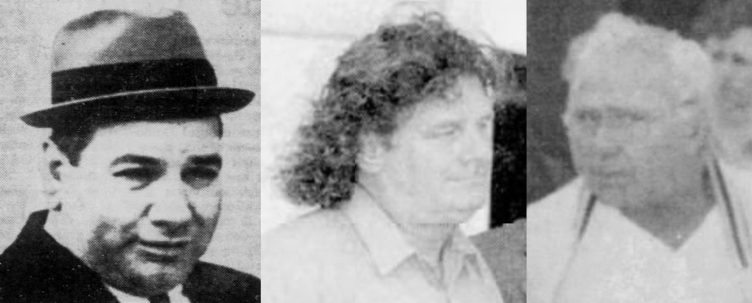
(L:R): Felice “Philly” Vizzari, Dennis Hickey, and Joseph Carione (Anthony’s son)

In a July 1977 memo drafted by the Suffolk county police, it was reported that Joseph Petrizzo and Aniello Mancuso were “incensed” over Melvin Cooper for lending money to the late Sal Spatarella.[216] There is a lot to unpack from this one statement alone, and it is thus imperative to outline the history of Long Island’s garbage industry after the 1957 McClellan hearings and see how the Lucchese’s beat both the Gambino’s and Colombo’s to take it over. Unfortunately, the chronology between the Inter-County Cartmen’s Association of Vincent Squillante’s time and the Private Sanitation Industry Association of Nassau/Suffolk (PSI) is a bit confusing and at times conflicting.[217] The Inter-County Cartmen’s Association of Nassau went defunct in May 1956 after Squillante left the county that spring as result of intense legal pressure.[218] To fill the void, Long Island carters formed two smaller organizations. The first group was called the Nassau-Suffolk Trade Waste Association (NSTWA) and its original president was John Casagrande.[219] The second group was known as the Waste Removal Institute of Nassau and Suffolk (WRI), headed by John Licausi and Umberto Velocci, came into existence in March 1958 and characterized itself as a “clean” organization.[220] This dual association was quickly upset by the “newly” formed Suffolk County Cartmen’s Association.[221] Finally, after a mob war for control of Long Island’s garbage rackets, PSI was formed in 1978-1979 by Salvatore Avelino through which the Lucchese syndicate gained control.[222] This was the sequence of organizations presented by Alan A. Block, and while his research is outstanding, it did leave me somewhat confused. First, I cannot find a single reference in contemporary newspapers or government reports about the NSTWA and John Casagrande does not appear in records until after he already joined the Waste Removal Institute in 1967 (which made no mention of his prior position).[223] Then there is the characterization of the Suffolk County Cartmen’s Association as a “new” organization when, in fact, it appears in newspapers to have existed concurrently with the Inter-County Association and Squillante himself was asked about his association with it.[224] To Block’s credit, however, The New York Times did report that Spatarella’s ‘Suffolk County Cartmen’s Association’ was formed in 1965.[225] As such, I’m not sure if this was the same organization that Squillante interacted with, or simply a new organization that chose to resurrect its name. Moreover, there was a mysterious organization called the ‘Nassau-Suffolk Carters’ Association’ (NSCA), that only appeared in newspapers for the year of 1974 in relation to a strike organized by Local 813.[226] It purported to represent 96-members that collectively accounted for about 75% of Long Island’s garbage collection.[227] Neither the Waste Removal Institute nor the Suffolk County Cartmen’s Association were reported to have had problems with the union in 1974 and so I’m completely puzzled as to what the NSCA was meant to be or if it was involved with organized crime. Finally, Peter Reuter described that the PSI was a successor organization to the ‘Nassau-Suffolk Cartmen’s Association’.[228] Sadly, outside of his wonderful report, only one other reference exists to such an organization featured in a November 1957 article written in the Daily News that said Carmen DeCabia was president of that association.[229] This was likely a mistake since Carmen DeCabia confirmed in the McClellan hearings that he was president of the Inter-County Cartmen’s Association.[230] Confusion all around. Luckily for me, Mel Cooper’s lending activities on Long Island were centered around the Waste Removal Institute and the Suffolk Cartmen’s Association and so I will focus on those two institutions.

On March 12th, 1958, eleven-chapter members created the Waste Removal Institute of Nassau and Suffolk, an organization “above reproach” and free from mobster elements.[231] Ten out of eleven members belonged to the Inter-County Cartmen’s Association (ICA), while nine were due paying union members of Adelstein’s Teamster Local 813.[232] The new group vowed that it had no connection to the defunct mobster controlled ICA or the hoodlum ridden union and its attorney Sol Gordon assured the media and citizens alike that after his thorough investigation, the Waste Removal Institute was a legitimate organization filled with legitimate businessmen.[233] Former members of the ICA could join the organization so long as they severed their association with mobster, followed the letter of the law, and most importantly, followed the spirit of the law as well![234] Carters could also join regardless if they were part of the union.[235] John Licausi was named the president of the organization, Salvatore Giordano its first vice president, and Umberto Velocci its second vice president.[236] By 1962, Giordano succeeded as the organization’s president.[237] In 1966, the Institute lobbied the Town of North Hempstead against raising refuse disposal rates from 80 cents a ton to five dollars citing their reluctance to increase prices for consumers by 50% to bear this cost growth.[238] The town was trying to fight the smuggling of trash collected from nearby towns like Oyster Bay that charged $2/ton, a real problem if you recall from the aforementioned Hickey situation.[239] Considering the nefarious nature of the Institute, it is likely some of their very own members practiced in trash smuggling and so had a vested interest in keeping dumping costs low. There was also an interesting dynamic developing between the Local 813 and the Institute. Harry W. Rosenberg, who was WRI’s lawyer, also represented Donno & Co., a large refuse collector that fought a unionization effort of its workers.[240] Donno, which was once part-owned by Nunzio Squillante, openly alleged in 1959 that Adelstein’s local was a phoney institution that served as nothing more than a vehicle for extortion used to shake-down legitimate businesses.[241] Given that such a large carter was able to openly defy Adelstein and the WTI’s acceptance of non-union drivers highlights the temporary waning of the local’s power and the racketeer’s ability to use it to influence Long Island’s carting industry.[242]

A group of men in suits

Description automatically generated with medium confidence

Whatever “clean” image the Institute attempted to maintain was shattered on December 22nd, 1967 when Nassau District Attorney Cahn began to probe allegations of a link between key Cosa Nostra figures and the county’s carting industry.[243] Specifically, Cahn’s detectives observed some officers of the Institute consort with major underworld figures including Colombo captain Carmine “the Snake” Persico and Gambino soldier Aniello “Wahoo” Mancuso.[244] The investigation was trying to determine whether the Mafia was “taking over” private carting companies and sought to dominate the membership of the Institute.[245] As part of the investigation, John Casagrande (who must have left the mysterious NSTWA by 1967), president of the WTI and Five Counties Carting, and institute vice president Umberto Velocci were summoned to answer questions before Cahn’s Rackets Bureau Chief Norman Levy.[246] Besides some basic answers, the duo refused to cooperate with law enforcement which earned them a grand jury subpoena.[247] It was also revealed that U.S. Attorney Robert Morgenthau’s office was conducting a simultaneous federal probe into both the WRI and the Suffolk Cartman’s Association by examining their records and attempting to link both groups in an overarching conspiracy that was bonded together with mob figures.[248] A couple weeks later, right before their scheduled appearance before the grand jury, Casagrande and Velocci had a change of heart and decided to “cooperate” with Cahn’s investigation.[249] Of course it was all make belief and they were not really cooperating. By April of 1968, Cahn had interviewed about 500 carters, businessmen, homeowners, and others in his investigation and while nothing was brough forth to a grand jury he did make recommendations to Nassau’s municipalities about making certain regulatory changes.[250] Chief amongst those were to create carting licenses, fingerprint all garbage industry operators serving their areas, and set maximum collection rates to prevent monopolistic price fixing.[251] Later that month, the five leaders of the Waste Removal Institute proposed a five-point model to Nassau’s three towns that in Casagrande’s words would, “keep undesirable elements out of the industry.”[252] The proposals were: full disclosure of corporate structure and financial assets when applying for a license, fingerprinting of applicants, bonding of licenses, establishment of maximum prices, and establishment of a commission in each town to administer the law.[253] Why would crooked carters insist on stricter regulations? Well for one they knew none of these changes would actually be effective in combating garbage racketeering. All these measures were already in place in Brooklyn, and that didn’t stop those businessmen from running a successful and long-lasting cartel under the nose of the government. Second, this helped alleviate some of the public stink created by Cahn’s investigation and cultivated some political and public goodwill by making it seem like they were ready to help. Some of the proposed changes such as licensing requirements were eventually approved in 1970 in the Town of Hempstead.[254] Neither Peter Reuter or I were able to find references in Newsday or elsewhere of indictments resulting from either Cahn’s or Morgenthau’s investigations.[255] What is interesting is that District Attorney William Cahn accepted $1,500 (~$12,000 in today’s money) in campaign contributions from eight carters that he was actively investigating prior to his 1968 election…[256] Two officials of the WTI also personally donated $425 (~$3,500 in today’s money) to his campaign.[257] In his defense, Cahn said, “There were no indictments, no charges, nothing that came out of that investigation which would warrant me not accepting support from people in the industry”.[258] I guess that explains why I couldn’t find any follow-up stories about any tangible results from his investigative efforts.

After Cahn’s public investigation of WTI’s leading officers, the organization decided to shakeup its leadership, and by 1972 its new president was Joseph Petrizzo and Nicholas Ferrante was its vice president.[259] Not to worry though, we will re-visit the subsequent adventures of John Casagrande very soon. Besides brand image troubles, another major issue plaguing the WTI was around price increases and labor disputes. In 1968, 1971, and 1972, the WTI raised prices charged for waste collection in all of Nassau County, Oyster Bay Town, and then all of Nassau County again, respectively.[260] In Babylon, carters got their last hike in April 1970, but demanded more because cost of fuel, equipment and insurance dramatically increased by late 1971.[261] Joseph Petrizzo contended that the last rate hike actually occurred in 1969.[262] As of September 1971, Local 813 negotiated an additional pay increase of $20 a week with the unionized carters of Long Island, another cost increase carters sought to pass down to consumers.[263] Things finally came to ahead in summer of 1972 when carters and the Town of Babylon clashed over their refusal to give the carters more. On August 20th, 1972, the WTI representing 15 carting companies that serviced most of the town, announced that they would halt garbage collection services to more than 25,000 homes.[264] Joseph Petrizzo justified the move by saying, “We have found that the former administration under Supervisor Joseph Stabile had bargained in bad faith because while we were given a 49 cent increase from $3.65 to $4.14 per home, per month the town incinerator fees jumped from 25 cents to 90 cents per yard”.[265] In his words the carting industry of Babylon was facing an existential crises if the town did not give them a $1 hike from $4.14 a month to $5.14 to pay for increased labor costs[266] As such the carting companies began to pick up garbage later in the day and less often per week and Nick Ferrante commented on how 15-20% of the town’s 100+ sanitation workers would be laid off and that the situation could result in a strike.[267] On August 24th, the Town of Babylon rejected the carter’s demand, but it was overshadowed by Bernie Adelstein’s announcement that Local 813, representing 75% of private cartmen in Nassau and Suffolk, would go on strike on September 1st, if his union’s demands were not met.[268] It is likely Adelstein’s tough rhetoric was meant to add weight to the carter’s justification for a rate hike, but relationships between the union and the racketeers was not always collaborative on Long Island as we will soon see and it is possible that this threat against the carters was legitimate. On August 25th, the carters ended the four-day slowdown as negotiations heated up between the garbagemen and the sanitation commission and hopes for an amicable resolution increased.[269] By September 8th, 1972, negotiations broke down again after the town only offered a 30-cent increase which Petrizzo found unacceptable stating that the cartmen would now only pick-up organic waste, leaving residents stranded with an ever-growing pile of rubbish.[270] Unfortunately I was unable to find in either Newsday or the Daily News any follow-up articles describing a resolution of this specific incident and references to the WTI disappeared until March 1974.

(L:R): Aniello “Wahoo” Mancuso, Richard H. Wyssling, and Joseph “Joe Mooney” Petrizzo

On March 17th, 1974, Newsday broke a story tying Joe Mooney, Suffolk County’s personnel commissioner, Richard Wyssling, and Edward Waldman, a powerful GOP politician involved in town affairs, in a series of shady business transactions.[271] Besides being a political figure, Edward Waldman was also the president of Babylon Carting Inc.[272] That corporation acquired a once-acre parcel on Gleam Street across Babylon’s garbage incinerator for $20,000.[273] After Waldman disposed of his garbage interests in 1969, he then “sold” that parcel of land to Wyssling for a “consideration less than $100” on December 11th, 1973.[274] There was clearly something not right about this transaction because the value of the land was appraised at $50,000.[275] The following day Wyssling transferred the property to Bi-County Bale & Trash Corp. in which Petrizzo was a secret owner with a 50% stake that was given to him at no cost![276] The purported purpose of the company was to operate in the automobile salvage industry, but the town denied a special exception from the zoning code to allow for the salvage operation to commence.[277] While this transaction was technically not illegal, it was highly questionable and Wyssling resigned after the attorney’s office began to investigate this business transaction.[278] It was Edward Waldman who originally recommended Wyssling, then director of labor relations for Babylon Town, for the newly created $24,000-per year personnel director’s job.[279] Curiously on the day after Waldman signed over his Gleam Street lot over to Wyssling, he also signed over his $36,500 water-front house in Amityville to Joseph Petrizzo for a “consideration less than $100”.[280] Two weeks before this scandal broke out, a witness who saw Waldmen described the politician as looking injured saying, “He got out in a hurry. He came into his office, picked up some papers and took off. I think he is hiding out in Florida”. This certainly demonstrates a peculiar relationship between carters and town officials and there is more to come. Yet why was Wyssling’s relationship with Joe Mooney so scandalous?

In 1978, Joseph “Joe Mooney” Petrizzo was described by law enforcement and industry officials as the single most powerful carting executive on Long Island.[281] Salvatore Avellino was quoted saying, “Peterizzo is a big operator, a giant of the industry”.[282] Resembling actor Anthony Quinn (famous in mob circles for playing Gambino Underboss Aniello Dellacroce in HBO’s 1996 film Gotti), Petrizzo’s complex and extensive garbage operations were run from his 311 Winding Rd. headquarters.[283] He owned at least six garbage companies in the 1970s which included: Mooney Riteway Carting, Ace Garbage and Rubbish Removal, Long Island & Paper Stock, P&P Operating, Mets-Rolloff[284] and P&P Recycling.[285] He controlled major garbage routes in both Nassau and Suffolk servicing at least 6,000 residential customers in Islip Town, at least 6,000 in Massapequa Park, and at least 1,000 in East Farmingdale.[286] His companies also held major public contracts including those for Central Islip State Hospital, the Wyandanch Head Start program, Oyster Bay Town’s metal recycling program, the Deer Park and Massapequa Park post offices and public schools in Amityville, Copiague and Massapequa.[287] In the Town of Babylon, he and his associate Sidney Fenster essentially maintained monopoly control over its four municipal garbage districts.[288] Commenting on his well-deserved reputation, Petrizzo had this to say, “[the police] have built me into a god, and I’m not a god… I just want to leave my business to my kids”.[289] Some of Joseph Petrizzo’s power derived from his extensive connections with key local politicians and town officials that helped him get preferential treatment (corruption really) mixed with good old public sector incompetence.

Police reports indicated that Nassau County’s assistant director of labor relations, Salvatore Giordano, frequently met with Joseph Petrizzo.[290] As you will recall Giordano was one of the original founders of the Waste Trade Institute. Their relationship is especially interesting in the face of suspected bid-rigging when it came to the awarding of public contracts for refuse hauling from Nassau’s government buildings.[291] Ever since the county began to award those contracts, starting in early 1972, the same three companies Grand Carting, Westbury Rubbish Removal Co. and East Meadow Sanitation Service kept coming out on top during the bidding process.[292] Grand Carting was owned by Anthony Carione, a Colombo associate, and an executive with the Waste Removal Institute.[293] East Meadow Sanitation Service was owned by John Montesano, the garbage carter who testified before the 1957 McClellan hearings about Squillante’s infiltration of Long Island’s garbage industry.[294] Curiously, despite his testimony he continued to operate at a high level in a Mafia riddled industry, and associates of organized crime freely interacted with him. In fact, he would play an important role in the upcoming mob war. Finally, Westbury Rubbish was an affiliate of one of Long Island’s major carting firms, Jamaica Ash & Rubbish Removal Co.[295] Jamaica Ash was owned by John Casagrande’s brother-in-law, Emedio “Mimi” Fazzini who was identified in hearing held by President Reagan’s Commission on Organized Crime in 1985 as an associate of the Lucchese Crime Family.[296] Salvatore Giordano owned his own carting firm, the Nassau and Suffolk Rubbish Removal Co., which subcontracted its work out to Jamaica Ash after he got his county post in 1971.[297] A public official directly working with the Mafia… In 1975 the three firms’ contracts expired with the county, and it solicited bids from multiple firms in an attempt to have a competitive and fair bidding process.[298] Nassau’s yellow pages book listed 83 carting companies, and yet not a single competitor submitted a bit.[299] Only those three firms submitted bids, and won a new contract, at higher prices, running into 1980.[300] Grand Carting got $2,257 a month to service the county’s courthouse (the irony) and other buildings in its main complex in Mineola.[301] East Meadow Sanitation Service got $7,290 a month for the East Meadow complex and Westbury Rubbish (Jamaica Ash) got $10,982 a month to service Nassau County Coliseum, the county’s children shelter, and other buildings.[302] In November 1978, the country tried to solicit new bids on the contracts to see if they could get a better deal.[303] The move completely backfired as only the same three companies bid again with Grand Carting seeking a 45% price increase and Westbury bidding for a 19% increase.[304] Thomas F. Darcy, the county’s deputy general service commissioner in charge of buildings had the following to say, “When I saw those bids, I said to myself ‘These guys are off the wall’. I’ve sent them letters saying, in a gentlemanly fashion, ‘This defies understanding – what are you talking about’. We’re very concerned about it.”[305] Unfortunately, the county was at the mercy of bid-rigging orchestrated through Long Island’s industry trade associations which carved up territory and dictated who can bid on what jobs.[306] This is not the only example of shenanigans happening between municipal officials and private carters, and Petrizzo personally had a few “funny” encounters.

(L:R): Joseph Petrizzo, Edward Waldman, and Sidney Fenster

No license? No problem. That was the case for Joseph Petrizzo in the Town of Huntington. Petrizzo took over carting service at the Big H Shopping Center in Huntington from fellow racketeer Salvatore Spatarella, then under indictment for extortion in 1970.[307] Problem was that Metts Roll-Offs didn’t have the required license necessary to operate in the town, something Donald Dilworth, the town’s code compliance officer, noticed.[308] He issues several summonses to Petrizzo’s company both for operating without a license and for dropping garbage on the streets.[309] To remedy the situation, Petrizzo filled out a license application, but lied that he had no criminal convictions (he had one for a gun procession) and that Metts already held a license in Brookhaven.[310] After hearing that the town clerk approved of Petrizzo’s license, he complained to town officials who began an official license revocation proceeding to be discussed on February 23rd, 1971 in a town board meeting.[311] This was becoming a real problem for Joe Mooney first because there was now a chance his license would be revoked and second, the press regularly reported on such meetings which could generate even more unwanted publicity for Long Island’s ‘Godfather’ of garbage.[312] Joseph Petrizzo got the town’s Democratic chairman, Lawrence Delaney to intervene on his behalf with Rep. Jerome Ambro (D-East Northport), Huntington’s supervisor.[313] In an interview Delaney freely admitted that he got involved with town officials to help Petrizzo avoid losing his license saying, “He needed a favor, and he got it… I got it fixed up.”[314] Not only did Ambro respect Petrizzo’s wish to disallow the press’s attendance, but the public meeting was also held behind close doors in Ambro’s office.[315] A stenographic transcript revealed the town meeting was nothing more than a charade as Ambro’s promise to hold a town board vote on the issue of Petrizzo’s license never happened.[316] Instead, an internal town memo showed that Petrizzo got his license without a public vote ever happening and for their help, Joe Mooney gave the Huntington Democratic organization a $1,000 (~$7,000 in today’s money) campaign contribution.[317] In the immortal words of William Rawls from The Wire, “American democracy. Let’s show those Third World fucks how it’s done.”

Whereas Huntington Town had no problem giving out licenses to anyone willing to grease the wheels a little bit, Babylon Town was extremely restrictive to the point of stifling the competitive process of capitalism. Since 1966, Babylon enforced a highly restrictive licensing system preventing new companies from operating in the town.[318] Actually between 1966-1977, the town maintained a moratorium against issuing new licenses and in 1977 changed its policy to allow the granting of a license only if a carter buys a route worth more than $150,000 from an existing licensed Babylon carter.[319] Thus, not only did this policy prohibit small carting companies from ever getting a license, but it enabled racketeers to effectively dictate who could enter the county by allowing friendly companies who would not disrupt the status-quo to buy routes from them. This created situations where Petrizzo’s Ace Garbage held an effective monopoly on Babylon’s East Farmingdale district since 1962.[320] His company got $78,936 a year in public funds to service 871 single-family homes, 51 two-family homes, and ~100 apartment units year after year since instead of awarding contracts through competitive bidding, the Town of Babylon simply kept voting to award him with contract renewals.[321] Since 1962, Ace received bizarre overpayments totaling $14,689 and the company was allowed to bid on contracts without a performance bond (which was against the rules).[322] In 1973, another company, Pan Carting, bid $150,264 to Petrizzo’s $205,200, and yet Ace Garbage won nonetheless because Babylon denied Pan a carting license even though it would have benefited the taxpayer.[323] Raymond Allmendinger, Babylon Town supervisor, and who previously served on the sanitation commission and as town councilmen, defended this policy saying that, “The licenses protect the little guys, one-man truck operations. If we opened it up, the big guys would run the little guys out.”[324]It shouldn’t surprise anyone that Allmendinger has a special relationship with carting executives and Edward Waldman. Waldman, a GOP zone leader and the town’s deputy highway superintendent was then Babylon GOP’s chief fundraiser from carting companies.[325] Remember his real estate dealings with Petrizzo and Wyssling? Well in 1976, both Joe Mooney and Waldman pled guilty to attempted contempt as a result of a grand jury investigation.[326] Bizarrely, Waldman also amended his will to disinherit his 13 children and made Petrizzo and Wyssling the chief beneficiaries of his estate.[327] Waldman’s close relationships with Petrizzo and other carters came in handy when it came to campaign and political finances. For instance, allegedly $20,000 was raised from carters to contribute towards the Republican organization’s Lincoln Day Dinner in February 1977.[328] That same year Raymond Allmendinger was campaigning for election to become town supervisor when a Republican dissident accused him of planning to grant a rate hike for garbage collection in exchange for political contributions.[329] It never became a campaign issue because Allmendinger only received a few meager contributions from the garbagemen.[330] Once supervisor, however, Allmendinger almost immediately co-sponsored a legislation approving higher carting rates that cost town homeowners an extra $435,000 per year alongside a 30% dumping fee reduction to the town’s landfill that was already operating at a $100,000 deficit per year.[331] Eight days after Allmendinger voted to approve the bill, 31 out of the town’s 36 carting firms contributed $16,900 (~$80,000 in today’s money) to the town Republican organization, helping pay back an earlier loan used finance the campaign.[332] They barely tried to hide the obvious corruption. I could go on and on about the town of Babylon and other instances of shadiness such as when Petrizzo’s associate Sidney Fenster, who sat on the town’s sanitation commission, promptly won the contracts for two new municipal garbage districts right after the commission created them.[333] If municipal corruption wasn’t enough, the taxpayers and businessmen of Long Island also had to suffer from their incompetence which enriched the trash haulers even more.

I promised to elaborate on Hickey’s ghost stops and the Town of Islip, Long Island provides a case study of how racketeers turned a $693,000 a year commercial contract business into one that paid ~$1,200,000 per year.[334] Generally, Long Island’s towns were divided into garbage districts and non-garbage districts. Within garbage districts, homes and businesses would receive garbage pick-up services that was negotiated on their behalf by the town through a municipal contract and paid via property taxes.[335] In non-garbage districts, businesses and homeowners would individually set-up garbage pick up services with a carter of their “choosing” and pay them a direct monthly fee. Municipal contracts were considered highly lucrative and more desirable than private routes because a carter’s income was guaranteed, and they would not have to potentially deal with the hassle of delinquent clients.[336] A quarter of Islip’s area and ~45% of its 315,000 population was situated in the town’s garbage districts.[337] Unfortunately for the town’s residents, their officials’ incompetence would make them pay. In District 35, for instance, officials estimated the number of stops to be 1,410 and tendered a contract based on that amount.[338] It took the town over a month to discover its error as the actual number of stops was just 696 which resulted in $16,778 worth of overpayments to Detail Carting.[339] The town did not try to recover that amount, instead it re-negotiated the contract with Detail at a higher rate for each house.[340] Residents were paying more due to the town’s ineptitude. In fact, the town used interns to try and come up with an accurate map of their garbage districts and concluded that, “Analysis indicated that there are residents paying tax in districts in which they do not reside…”[341] In 1977, the town changed its contract design by awarding separate contracts for houses and businesses within a garbage district.[342] The increases in prices witnessed by the town were staggering and in 17 districts costs more than doubled, with some districts experiencing a tripling or even a quadrupling of prices.[343] In Bay Shore, Islip, a major lucrative contract, was won by Justice Carting, a firm with next to no equipment, that bid just $743,040 for four years which came way under the next lowest bid of more than $2 million.[344] As it turned out Justice couldn’t fulfill its contract requirements properly, meaning that shops which were entitled to free pick-ups (paid for by their taxes) had to contract a different carter to remove their garbage and effectively pay twice for the service.[345] Thus cartmen in the area were collecting about $500,000 extra per year from businesses in Islip that shouldn’t have been paying.[346] Thus, Long Islanders either paid for “ghost stops” which did not exist or double-paid for services they should have gotten for free. This was a problem experienced across Long Island as everyone was getting ripped-off by the Mafia.

(L:R): Joseph Pagano, Joseph Petrizzo with his 800lbs pig, and Aniello Mancuso

While connections with politicians certainly helped accentuate Joseph Petrizzo’s reputation, a great deal of his power derived from the people who stood behind him. For instance, one of Petrizzo’s partners was John Pagano, brother of Joseph Pagano, a member of the Genovese Crime Family.[347] While the Genovese were involved in garbage racketeering in Weschester and New Jersey, their influence in Long Island appears to have been limited. As it turned out, the real source of power behind the Waste Removal Institute and Joseph Petrizzo was Aniello “Wahoo” Mancuso.[348] Already in 1969, he was identified as active in garbage rackets, and as a nephew of the deceased Albert Anastasia lieutenant Vincent Squillante, Mancuso was a soldier in the Gambino Crime Family.[349] Joseph Valachi identified Wahoo as one of the members brought into the Family by Gambino underboss Frank Scalice implying that he paid his way into Cosa Nosta.[350] Police surveillance often spotted Mancuso at Petrizzo’s Bethpage complex, meeting with influential carters like Sidney Fenster, and sitting in on policy meetings.[351] On paper, Mancuso was Petrizzo’s employee, working for Mooney Riteway Carting, although by 1967 he had told a grand jury he was fired.[352] However, when he was arrested for drunk driving in March 1973, Wahoo gave Petrizzo’s office address as his own business address.[353] Drunks don’t lie. Petrizzo later described his relationship with Mancuso by saying, “He worked for us for a while as a salesman. The law would bother us because of him, so we let him go. He’s the best hunting partner I ever had. He taught me how to hunt”.[354] He also described Mancuso as a, “friend… he’s a broker, that’s all”.[355] We will revisit Mancuso’s relationship with one other organized crime figure in Long Island shorty.

By 1975, Nicholas Ferrante was bumped up to be the WTI’s president and was in the news again after being subpoenaed to appear before a grand jury investigating a $3,000 secret cash contribution that related to a $6,000,000 bond issuance by Oyster Bay Town authorizing the buying of a 65-acre property to be used as a site for a new dump.[356] Apparently the WTI, among other organizations, was an important source of political contribution funding that helped Republicans in Long Island outspend their Democratic opponents during various local elections and made local Democratic candidates quite bitter.[357] In 1976, the Republicans of Oyster Bay Town appointed Nick Ferrante to the town’s sanitation committee that was in charge of adjudicating on customer complaints.[358] The town’s sanitation department handled trash pick-up from ~67% of the homes, with private carters servicing the remainder.[359] Ferrante’s two companies, Paragon Carting (ironic name) and Unique Sanitation, both serviced the town, and yet a spokesman for supervisor John Burke claimed there was no conflict of interest.[360] Add in another price increase here and there and this bring the timeline for the Waste Removal Institute of Nassau and Suffolk, Joseph Petrizzo, and Aniello Mancuso up to 1977.[361] It is now time we go back in time to discuss the parallel developments of the Suffolk County Cartmen Association and its principal racketeer, Salvatore Spatarella.

(L:R): Edward Waldman, Joseph Petrizzo, and lawyer Kenneth Rohl

As mentioned before, despite the Suffolk County Cartmen Association existing during Vincent Squillante’s time, for our purposes, we will treat Spatarella’s organization as having been started in 1965, as corroborated by The New York Times.[362] The association was formed in 1965, as a response to an unsuccessful effort by the Teamsters Union to organize private carters in Suffolk.[363] In 1965, there was a joint-alliance between William DeKoning Jr., boss of Local 138, International Union of Operating Engineers, and Bernard Adelstein, boss of Teamsters Local 813, to organize workers publicly employed by Nassau and Suffolk’s counties.[364] Unsurprisingly DeKoning and Local 138 was also affiliated with organized crime by being under the yoke of the Lucchese Crime Family.[365] The unionizing drive initially focused at highway department employees of both counties.[366] Starting in the summer of 1965, however, Local 813 pivoted and had the ambition to unionize all of Suffolk’s private sanitation firms and began the process by attempting to organize 11 carting firms in Smithtown and Huntington, which serviced 15,000-20,000 homes between the two towns.[367] Among the firms being targeted was Angelo Ugenti’s North Shore Sanitation, Jerry Kubecka, and ABC Sanitation.[368] This is one of the first indications mob racketeers and the union were not always aligned, as ABC Sanitation was owned by Colombo associate Vincent Garafalo. This would not be the last time, either, that a mob-controlled carting firm was pressured by the Teamsters local. By May 25th, 1965, the local claimed to represent more than half of the ~50 workers employed by the 11 firms but was delayed in calling a strike.[369] Ultimately, the union organization drive faltered, and Suffolk carters formed the Suffolk County Cartmen Association or Suffolk Cartmen Association. Yet the two organizations would soon find themselves working together to punish those who were stepped out of line. Scores of carters were required to pay $25 per truck per month to the Association.[370] In return, the Association promised its members, “good commercial routes without the problem of competition.”[371] The emphasis on commercial stops is relevant because that’s where the carter’s customer allocation agreement was strongest, and most easily enforced. I could not find who the first president of this Association was, but in 1966, Frank Carione was the vice president of the organization and was slated to takeover as the president in January 1967.[372] In the late 60s, fugitive dumping of out of town garbage in Islip was a major concern, but the issue was downplayed by Frank Carione who indicated that his Association would kick out anyone caught in garbage smuggling from his 60-70 members strong organization.[373] Another problem plaguing the sanitation sector and one which was on the mind of both government officials and mob connected cartmen was that of dwindling space.[374] As Suffolk’s population grew, there was less and less land available for garbage dumps and incinerators causing concerns around garbage overflowing the streets.[375] As of 1967, officials said, “Smithtown is going to run out of dumping ground in five years” while Babylon had, “enough land for 10 to 12 years of dumping.”[376] Frank Carione, now the president, was also featured in the newspaper and said, “The garbage is overflowing and there’s no place to put it.”[377] The supply crunch would resurface in an interesting way in the future for garbage racketeers.

(L:R): Robert Kubecka, Jerry Kubecka, and Nicholas Ferrante

Jerry Kubecka, father of Robert Kubecka, got into the garbage industry as an evolution of the milk delivery business he started in the early 1950s.[378] It is significant that in an industry dominated by businessmen of Italian descent, Kubecka’s heritage hailed from Poland and as such other carters frequently commented on his ethnicity and referred to him as the “Polish ham”.[379] In 1967, he personally experienced the extreme lengths racketeers went to protect the customer allocation agreement in a battle against Salvatore Spatarella. The two fought over stops in Huntington and Spatarella threatened the Polish carter’s commercial customers by breaking their windows and warning of union picketing.[380] One of Kubecka’s drivers quit because the mob threatened to break his legs and his other drivers refused to cross picket lines.[381] As further punishment, Kubecka’s supermarket stops in Huntington and Northport were raided by another carter that promised to give the stops back if Kubecka “went union”.[382] It didn’t end there as all of Kubecka’s trucks had their windows broken and some had their gas tanks filled with sugar and honey.[383] Finally, a gas station owner saw Spatarella and an organizer for Local 813 call Robert and say, “Get in line or we’ll rub you out.”[384] Kubecka had no choice but start hiring union members and began attending Association meeting, although he never did get those stops back.[385] This example demonstrated the strength of the customer allocation agreement and that multiple sources of power, the association and the union, were willing and able to enforce it. This also showed that a Colombo associate was able to leverage a Gambino controlled local to maintain mob control over carting stops, but also served as a somewhat contradictory example to the often-complex relationship between the racketeers and the union. We’ve already seen that the union’s motives didn’t always align with racketeer interests, and this relationship will only get more complex from here. If you thought Spatarella had a good relationship with Local 813 in 1967, just give it a decade’s time.

In September of 1967, Suffolk District Attorney Aspland began an investigation into mob influence in the county’s multi-million garbage industry.[386] The investigation was parallel to the federal probe mentioned earlier and was triggered after multiple complaints from private citizens and garbage collectors who alleged assaults on trucks, route take-overs, and coercion by underworld figures.[387] The investigation centered on the western half of the county where town official downplayed any possible mob control, with Smithtown supervisor John Klein saying, “You always have rumors of the mob moving in, but if I had any evidence at all, I would have gone right to the DA.”[388] The county investigation targeted a similar list of individuals as the concurrent federal probe and included Aniello “Wahoo” Mancuso and Angelo “Fat Angelo” Garafalo.[389] Garafalo, introduced before, was described by authorities as an influential figure in the Suffolk Cartmen’s Association, and troublemaker both within and outside the garbage industry, reputed to have been involved in arsons, loansharking, and burglary.[390] He served as a key member of grievance committees and was an organizer for the organization.[391] The Association itself, which boasted 70 members and represented 60% of the garbage collectors in the five West End towns, including 90% in the towns of Brookhaven, Islip, Smithtown, and Huntington, was subpoenaed by a federal grand jury.[392] Frank Carione, when asked about the investigations, commented, “We are a good organization. The public benefits. It isn’t like years ago, like that Nassau racket. We keep getting harassed.”[393] That was not the opinion of disgruntled carters in the region. One operator who had the nerve of infringing upon the territory of a mob-connected carter had his trucks damaged and was told that his wife and children would be “taken care off” if he broke the customer allocation agreement.[394] Another operator said that connected carters were able to illegally dump garbage in town dumps because they “knew the right people”.[395] That operator described a common tactic used by mobsters to pressure legitimate competitors. Company A, a legitimate firm, would be approached by Company B, a mob front, who serviced customers in the same vicinity as A to be bought out at a price of 10-1 ($10 dollars for each dollar collected from a customer per month).[396] Company C, another racketeer run company, would appear and start to undercut collection prices in A’s area, doubling the amount of services at a lower price, and would offer a solution: either sell-out or join the Association to get rid of all your troubles.[397] Apparently, this was quite persuasive, and most joined forces with the mobsters.

The Suffolk County Cartmen’s Association also periodically tangled in protests and disputes with local towns regarding their evolving garbage policies and guidelines. Harry Rosenberg, the lawyer that represented the Waste Removal Institute, was also the attorney for the 71-member (1968) Suffolk Association and publicly complained about Huntington’s new garbage ordinance that required carters to post $1,000 performance bonds, set maximum rates, and allow the town to step in 24 hours after a private cartmen failed to meet their collection schedule, among other things.[398] The law was used for the first time in April, 1968 after Angelo Ugenti, owner of North Shore Sanitation Co., failed to collect.[399] Interestingly Rosenberg said the Association would only intervene if an investigation showed that Ugenti was being wronged by the town, implying he was part of it.[400] The Association had to be careful in situations like these because the customer allocation agreement was weakest in the residential sector precisely because homeowners could complain about price increases (as they couldn’t pass on the extra cost to anyone else) to their elected officials causing issues for the carters.[401] In July 1968, the Town of Islip finally instituted dumping fees in its town landfills which caused cartmen to raise their monthly rates an average of $1.5 per house, with some residences paying $5.1 per month from the previous average of $2-2.5.[402] Residents obviously complained about the hike and town supervisor Harry J. Kangieser said that, “unless they [carters] got reasonable about their fees,” the town would investigate setting up its own municipal garbage collection department.[403] This is partly why racketeers had less influence in the residential collection market as charging an obvious extortionate rate allowed by the set-up of the cartel could draw the ire of residents and municipalities alike and take away their ability to profit of this sector in the first place. Similarly to Brookhaven, Islip in September 1968 was considering implementing maximum rates on collection fees after numerous complaints by residents, which Harry Rosenberg once again publicly opposed.[404]

That same news story about Ugenti also reported that the Town of Brookhaven considered eliminating their dumping fees in favour of increasing residential property taxes after owners complained that private cartmen raised prices by $1-1.5 per month as a response to the town’s own 50 cent dumping fees hike.[405] Frank Carione, who was reported as the president of the Brookhaven Cartmen’s Association representing 70 members, said he’d welcome the town’s new plan.[406] My God, is this another garbage association that we need to start tracking? Thankfully, no since it was only ever mentioned once and considering it had the same number of members (and the same president) as the Suffolk Cartmen’s Association, it was the latter organization it was likely referencing. In May 1968, Brookhaven suspended their dumping fees after carters threated to halt services in some areas.[407] Salvatore Naggio, an official with the Suffolk Cartmen’s Association, commented on this developed by saying, “Although the cartmen are not making much money anyway, we hope that we can work something out as far as fee reduction goes,” and promised to look into cutting private carting fees.[408] The year 1970 would be monumental for the Association, and frankly changed the trajectory of organized crime’s control over Long Island’s waste hauling industry forever.

Salvatore Spatarella was organized crime’s leading figure in Suffolk County during the 1970s.[409] He was also an associate of the Colombo Crime Family. Unlike Aniello Mancuso, who (probably) did not have any direct carting interests, Spatarella owned All-American Refuse Removal Corp. and the Gallagher Sanitation Co. with his business partner James Griffin.[410] This would have an interesting possible implication later on. Sal Spatarella also owned multiple garages in Brooklyn where he stored some trucks for himself and the Lucchese Crime Family.[411] He was described as “an aggressive enterpriser” who wielded a lot of influence in the trash hauling industry.[412] In 1965, he was accused by Riverhead Town officials of trying to muscle in on local cartmen by cutting prices and taking over commercial stops, tactics that caused the town to deny him a permit to operate there.[413] I cannot find what his initial title was with the Suffolk County Cartmen’s Association, but by 1968 he was the vice president of the organization[414] and by 1970, its president.[415]

(L:R): Salvatore Spatarella and James Griffin

Spatarella’s companies serviced private residences in Smithtown[416] and commercial stops in the Town of Huntington including the Walt Whitman, Cold Spring Hills, and Big H centers.[417] All-American Refuse Removal also held marquee municipal contracts, thanks to bid-rigging, with Stoney Brook University.[418] In fact, between 1967-1977, the university carting contract was awarded on the basis of a single bid, alternating between Spatarella and Frank Carione, the two leading figures in the Association.[419] As one carter put it, “Every government bid in both counties results in collusive bidding”.[420] The Suffolk Cartmen’s Association served as the vehicle for this, and rigging of municipal contracts were regularly discussed during meeting.[421] One former associate member said there were two tiers of discussions during gatherings, “At the general meeting only so much comes out. The talk is, you know, ‘What’s the problem, can you get bonds? Which contract can you take?’. They want to make sure that nothing is left on the table – that there aren’t any districts without bids. After that meeting there are other meetings to set things up. I’m not part of the other meetings. They make deals on the big-money jobs.[422] Who held the ultimate decision-making power on Long Island?

The relationship between Sal Spatarella and Aniello Mancuso was extremely interesting. Mancuso served as a ‘consultant’ to the Suffolk County Cartmen’s Association, receiving regular paychecks for his services.[423] He was also seen either driving a car leased by Sal’s All-American Refuse Removal[424] or a luxury vehicle registered to the Association.[425] Although Alan A. Block described Spatarella as “organized crime’s prime controller” in Suffolk County, I think the evidence points to the fact that he was ultimately the junior partner in their relationship.[426] Such was also the opinion of contemporary carters who dealt with both men. A former member of the Suffolk Cartmen’s Association who was familiar with the Stoney Brook University contract described that Spatarella and Carione always won the bids because, “that’s the way Wahoo [Mancuso] said it was going to be. It was a reward. No one in the association was allowed to bid against them.”[427] Another illuminating example of their distribution of power was highlighted by the recollection of another carter. There was a dispute over a Suffolk North Shore school district and a route comprised of 500 residential stops between Spatarella’s partner and a business associate of Joseph Petrizzo, Wahoo’s loyal associate.[428] As a result, Salvatore Spatarella was summoned to a sit-down (really just a grievance meeting) by Petrizzo to resolve this issue.[429] The two feuding cartmen sat on one side of the table, and Spatarella, Petrizzo and Mancuso sat on the other making the decisions.[430] Despite Spatarella arguing on behalf of his partner’s right to the stops and the school district, Petrizzo shook his head and dictated his own decision, “I’m going to tell you, Sal, how it’s going to be. He [Petrizzo’s associate] gets the school district, and he keeps the 500 stops. Wahoo will agree with me that that’s the way it’s going to be.”[431] Spatarella’s friend tried to argue, but Sal shut him up – the ruling was final.[432] Thus it seems to me that Spatarella was part of a three-men panel dispensing mob rule over Long Island’s carting industry where each man had an equal vote. The problem, for him, was that the Colombo vote was simply outnumbered by the Gambino’s and thus in major disputes Sal was outmatched. It probably didn’t help Sal’s case that despite his power and influence, he was still just an associate while Mancuso was card carrying member of the Mafia, not to mention the Gambino’s sway over the major private sanitation union. I guess in a way Block’s statement can be true if a caveat is added; Spatarella was organized crime’s prime control in Suffolk County, but Mancuso ruled over Long Island.

Unfortunately for Sal, he wouldn’t get to enjoy his position of power for long as the early 1970s brought a whole slew of indictments and he was no Teflon Don. On June 22nd, 1970, a Suffolk grand jury handed down a 16-count indictment charging Salvatore Spatarella and his business partner James Griffin with varying degrees of grand larceny, criminal mischief, coercion, and conspiracy.[433] The heart of the indictment had to do with a business dispute between the racketeer and Angelo Ugenti Jr., a non-Association member.[434] Ugenti Jr. tried to set up a route in Huntington for his firm, Suffolk Community Sanitation, that was infringing on Spatarella’s stops.[435] Among the commercial contracts he won to service were at three shopping centers which included Walt Whitman, Cold Spring Hills, and Big H centers.[436] While the value of the contracts were not disclosed, District Attorney Maurice Nadjari disclosed that just a single bakery paid $3,600 per month to have its trash collected and a restaurant paid $700 to $800 a month in collection fees.[437] That were some profitable stops and you could see why Sal got mad. As a result of Ugenti’s infraction upon the scared customer allocation agreement, Spatarella threatened to put him in the hospital.[438] Sal and Griffin also stole and destroyed one of Ugenti Jr.’s trucks on June 6th and a pick-up truck owned by Ugenti Jr.’s father, Angelo Ugenti Sr.[439] In all, these charges carried a total maximum sentence of 82 years in prison.[440] The funny thing is that apparently Spatarella was already awaiting a separate grand larceny charge and so things were getting serious for him, legally speaking.[441] Initially, bail was set at $150,000 by Judge Gordon M. Lipetz, but after Spatarella’s lawyer, George Rockman, appealed the enormous sum, State Supreme Court Justice Joseph Pfingst reduced it to $35,000.[442] Spatarella’s lawyer also asked to a change of venue in Sal’s trial, but was denied.[443] Now before those charges could even be sorted, Sal Spatarella and James Griffin were re-indicted by the Suffolk DA on February 11th, 1971 on new charges concerning their possession of a tractor section of a tractor-trailer owned by Gerocki Trucking Co. of Newark, New Jersey.[444] The partners apparently contracted a body shop to repaint and stretch the tractor’s body so that it could be used for trash hauling.[445] If that wasn’t enough, in March he appealed a six-month jail sentence for driving without a license, an offense Spatarella had three prior convictions for, not to mention seven more traffic charges.[446] Luckily for Sal, he received a fine of $1,660 after pleading guilty to twelve traffic charges which cleared up most of his minor legal troubles.[447]

Salvatore Spatarella and James Griffin’s trial finally began in April 1972 and proved to be a comedic affair with some of the remarks made in court.[448] The prosecutors stated that the duo threatened bodily harm, even death, to Ugenti Jr. unless he stopped soliciting their customers.[449] The threats did actually work as Ugenti stopped servicing one of All-American Refuse Removal’s old customers and also gave up a second customers to Sal and James.[450] Ugenti Jr. then took the stand during the trial and testified that he recovered two big waste containers he said Spatarella stole from him and, as revenge, Sal and James stole and damaged one of his trucks and a pick-up truck belonging to his father.[451] Salvatore took the stand in his own defense and testified that it was Ugenti Jr. who stole the containers that he (Sal) went to repossess them after Ugenti Sr. pleaded with Sal not to complain to the cops and have his son arrested as a thief.[452] Harry Rosenberg, Spatarella’s attorney, summed up their case by saying that Ugenti would have been the defendant, “if Sal didn’t have such a big heart.”[453] The 12-day trial ended with a mixed verdict for the defendants.[454] The jury acquitted Spatarella of nine charges and Griffin of ten, but Sal was still convicted of grand larceny by extortion first degree, criminal mischief second degree, unauthorized use of a motor vehicle, and petty larceny.[455] They both remained free pending appeal.[456] In late June 1972, Salvatore Spatarella was sentenced to a seven-year prison term and James Griffin to a three-year bid, but both still remained free on a $35,000 bond.[457] During the bail hearings, it came out that Sal offered Ugenti $20,000 to change his testimony and that he was no longer the president of the Suffolk County Cartmen’s Association.[458] Unluckily for Sal, 1973 brought no legal reprieve. On March 27th, 1973, Sal was indicted on charges of failing to file returns for nine quarters, failing to file annual unemployment tax returns for 1968, 1969, and 1970; and with failing to file quarterly annual employer’s federal tax returns for All-American Refuse Removal for the third quarter of 1968, a total of 13 counts.[459] In December 1973 he was sentenced by Judge Jacob Mishler (the very same one who presided over Sonny Franzese’s bank robbery case) to a year in prison and dished out a $90,000 fine.[460] Mishler showed him some mercy and allowed him spend his Christmas at home as Sal was ordered to begin serving his prison term on March 1st, 1974.

Despite his legal troubles, Spatarella continued his work in the trash hauling industry of Suffolk. For instance, during the summer of 1971, the DA investigated the Town of Islip’s garbage bids after existing contracts expired and the community was temporarily left without any carting services.[461] Spatarella blamed town officials saying, “The whole situation would never have arisen had the town acted properly.”[462] The new bids raised the town’s total cost of garbage collections from $1.4 million to $1.8 million, representing a ~29% increase.[463] The fishy situation arose from the fact that 22 of the 36 garbage districts received only one bid.[464] Spatarella, despite his legal troubles, continued to engage in bid-rigging, using the Association as a tool to facilitate the customer allocation agreement. That summer, Spatarella also sent a letter to Smithtown’s board and other western Suffolk towns about issues plaguing the waste hauling industry.[465] As president of the Suffolk County Cartmen’s Association representing 86-members, Sal asked that bond requirements for sanitation licenses were raised to $5,000 from the then-$1,000 and to deputize two cartmen who would issue warning notes to cartmen operating without a license or engaging in illegal dumping.[466] A higher performance bond requirement would further increase barriers to entry, advantageous for a group operating an illicit cartel, and what amounted to self-regulation would only aid in maintaining their property rights system. Huntington’s supervisor wasn’t a particular fan of Spatarella’s suggestions, and it seems these letters didn’t get much traction from municipalities.[467] One of Sal’s companies, A&M Carting Enterprise, got into a dispute with the village of Asharoken when it took over the route in May of 1973, and doubled the collection rates for residents.[468] Villagers got angry at this move and the Mayor began to negotiate with other carters who refused to service the route because they were threatened.[469] Looks like Spatarella’s reputation in 1973 was still strong enough to deter most competitors, although not all. In 1976, Sal was once again indicted, this time for allegedly embezzling $20,000 from his own company, All-American Refuse Removal.[470] The issue arose that after selling some collection stops, that included a supermarket, to another carter in May 1973, Sal didn’t turn over the proceeds to his company and instead used the twenty grand to buy himself some property.[471] That was illegal and was a dumb move that just piled-up (pun intended) his legal woes.

By January 1975, Salvatore Maggio was the new (and most likely final) president of the Suffolk County Cartmen’s Association.[472] A great part of his reign would be defined by his battle with Lake Grove, a village in the Town of Brookhaven that again demonstrated the vulnerability of their garbage cartel in the private residential pick-up subsector. The town was served by 11 carters, each of which served ~3,000 customers, and represented by the Suffolk Cartmen’s Association.[473] The carters wanted to raise monthly pick-up rates by one dollar to $6 per month, but in December of 1974, the town only approved a fifty-cent hike.[474] This resulted in a dispute that forced trash haulers to stop picking up trash on New Year’s Day after the town’s mayor Alex Pisciotta told residents not to pay their carting bills.[475] Pisciotta criticized the carters for their constant demand for more money, poor service, and aggression and according to Salvatore Maggio, the mayor claimed the carters were involved with the Mafia.[476] To counter the carters, the village began collecting its own garbage and planned to covert itself into a municipal garbage district whereby only one contracted cartmen would service the entire community.[477] In February 1975, the private cartmen were dealt a blow when the State Supreme Court ruled against their suit that claimed the village had no power to make garbage collections.[478] Another blow came in March when the court allowed the town to accept bids for municipal garbage service.[479] The mayor claimed that they received seven bids ranging from $3.25 a month to $5.50 a month, figures that were far lower than what the cartmen demanded.[480] The three-year contract was finally awarded in April to CGI Sanitation Inc. of Amityville.[481] Although I could only find two newspaper mentions of this mysterious firm, it does appear in Melvin Cooper’s records as a garbage company Cooper Funding lent too and so was probably connected to the racketeers.[482] I didn’t forget about him, we’ll get back to Cooper eventually. Municipal garbage districts were not a cakewalk either, sometimes, due to excessive charges and obvious collusion. For instance, Brookhaven rejected bids in October 1975 because garbage collection rates would have increased by 350% in some areas.[483] Only two companies submitted bids for the three-year contract, with Tony’s Sanitation Service offering their services for an annual sum of $252,000 and Taurus Waste Disposal bidding $239,000.[484] Tony’s, which was then the current contractor, previously charged $66,000 for the district’s 2,800 homes.[485] It is worth mentioning that both firms were associated with the Colombo’s and Sal Spatarella.[486] Less egregiously, the Suffolk County Cartmen Association merely advocated for a 26% increase in refuse collection rates for Smithtown private residential customers, citing rising in-put costs as their justification.[487] Bud Maggio continued to be the Association’s president into 1977, but it seems like at that point he, and the organization at large, were puppets of Aniello “Wahoo” Mancuso.[488] This brings the timeline of the Suffolk Cartmen’s Association to 1977 and we can finally discuss the conflict that took place, the players and organizations that participated, and how an unlikely garment trucker became Long Island’s new Garbage Don.

(L:R): John Montesano’s firm, Damaged Garofalo trucks, and Local 813 members on strike in 1977

The Long Island garbage war of 1977 was a complex and layered conflict that was fought across several arenas. One of the factors was purely economical; the jockeying for control over valuable garbage routes.[489] Contemporary sources noted that various garbage factions angled for dominance over major new carting routes that would be formed as a result of new waste recycling programs springing up across Suffolk County.[490] One such project was the $75+ million (~$330 million in today’s money!) Tri-Town Waste Disposal Project planned by the towns of Babylon, Huntington, and Islip.[491] The project, which sought to raise $30.5 million in state aid and $45-55 million from revenue bonds, would recycle materials such as aluminum and glass and burn other waste to generate electricity.[492] Smithtown was originally part of this multi-town project, but pulled out in 1971 and built their own $5 million garbage compacting plant that began operating in July of 1977.[493] This was another lucrative operation various crime groups wanted to get their hands on.[494] Besides a feud over new and existing garbage routes, another potential source of the conflict may have derived from the desire of some carters to expand their share of the market by neutralizing the power of the private sanitation union.[495] Contracts between Teamsters Local 813 and private cartmen representing 75% of Long Island’s garbage pick-ups, were set to expire on September 1st, 1977 and that year presented the perfect opportunity to try and make the union weaker.[496] As mentioned previously, the relationship between the union and the carters was not always straight forward and loosening its powers would be advantageous for garbage haulers. There is also reason to believe that the local’s leader, Adelstein, received money independently of the mob racketeers (Mancuso) likely through his own agents from carters.[497] A weaker local meant more favourable terms for employers and less power for mob or union racketeers to extort them. Finally, the conflict was also the reflection of a struggle between three organized crime families for control of Long Island’s garbage industry as the Colombo’s were being pushed out by the Gambino and Lucchese families.[498] What’s interesting about this statement is that it was only realized in hindsight as contemporary accounts of the war painted it as a struggle between factions aligned with either the Colombo’s or the Gambino’s.[499] In the infamous words of Tony Soprano, Sal Avellino was, “a come-from-behind kind of guy”.

To better understand the conflict, it is important to understand the composition of the various factions. Broadly, I categorized participants in three categories: the Colombo/Rebels faction, the Gambino faction, and the Lucchese/Others faction. For the Colombo’s, I noted every single individual/carter/organizer that was explicitly stated to have backed either Sal Spatarella or the rebel union. For the Gambino faction, I noted every single individual/carter/organizer that was said to be an associate of the Family and/or ultimately followed its orders. Finally, while the Lucchese/Others faction was allied with the Gambino’s, I noted it down separately and categorized Lucchese carters into it, as well as victims of arson campaigns, since the media highlighted that they formed a somewhat “independent” group.[500]

The Colombo/Rebels faction was composed of mobsters, union organizers, and businessmen. The initial primary leader of the group was Salvatore Spatarella, the noted associate of the Joseph Colombo Mafia Family. Andrew Russo, by then a captain, also backed this faction in their struggle for control, although his contribution to this conflict is highly questionable and he was partially responsible for the demise of any extensive Colombo influence over Long Island’s carting industry.[501] Next, Daniel Cunningham (initially), Rubin Gonzales, and Raymond Aponte were aligned with the Colombo faction and spearheaded the creation of a new union to counter Local 813 and undercut Gambino power.[502] In terms of businessmen, John Montesano of Taurus Waste Disposal, Joseph Tuozzo (son of Tony Tuozzo) of Tony’s Sanitation, Clyde Thweatt of C&C Refuse Removal and Frank Carione of Riteway Carting formed the core group of rebels that supported Sal Spatarella and the new union.[503]

(L:R): Rubin Gonzales, Raymond Aponte, and Daniel Cunningham

The Gambino faction anchored on soldier Aniello “Wahoo” Mancuso and associate Joseph Petrizzo of Mooney Riteway Carting.[504] Dulio “Danny” Cagnoli of Justice Carting was also described as an associate of Wahoo.[505] In terms of union muscle, Bernard Adelstein the secretary-treasurer of Teamsters Local 813 was also aligned with this faction as he nominally answered to the Gambino’s and wanted to maintain his monopoly as the only union able to represent garbagemen.[506] Daniel Cunningham eventually switched over to the Gambino side at the behest of its leaders.[507] I think it is safe to assume that Petrizzo’s partner Sidney Fenster was also aligned with this faction. There were probably a lot more carters and mobsters (such as James Failla) that aligned with this group, but I have not seen any other names/firms explicitly identified.

Finally, the Lucchese/Others Faction was really just a collection of carters targeted by the Colombo faction and comprised of independent carters that happened to cross Sal Spatarella. One of the early victims happened to be Salvatore Avellino Jr., owner of Salem Sanitary Carting with other targets including Joseph Viccardo of Jolin Refuse Removal, J. Cannistra Carting, J.T. Carting and Vincent and Ralph Garofalo of Royal Sanitation & Rubbish Removal.[508] It is also interesting that there were many other prominent carters that had no reported involved in the conflict. Paul Vario Sr. and Peter Vario of the Lucchese Crime Family were described as prominent men within the carting industry, holding sway over Sun Mar Carting and Crest Sanitation, and yet had no recorded involvement in the conflict.[509]

The conflict, at first, began as a result of a very cliché vendetta carried by an Italian man. Salvatore Spatarella was furious that other carters took advantage of his legal troubles and grabbed numerous routes that previously belonged to him.[510] It was reported that Spatarella had fallen out of favor with the mob combine that dominated the industry and was being pushed out by Mancuso and other carters.[511] This began as early as 1970, when Joseph Petrizzo took over garbage collection at the Big H Shopping Center, the route that led to Spatarella’s initial conviction.[512] Thus, Sal began plotting his revenge with Rubin Gonzales, a violent individual who served time with him, promising to “take care of” those who moved in on routes his company controlled.[513] Gonzales was previously involved in a burglary and safe cracking ring in the New York metropolitan area and was ultimately convicted of a 1975 robbery of a LILCO office in Central Islip.[514] Spatarella was serving time in Fishkill, NY and that was probably where they met.[515] Another visitor to Spatarella’s prison cell was John Montesano, a businessman that helped the toppled garbage czar with his conspiracy to regain power over those who wronged them.[516] These two men were instrumental in enacting Spatarella’s dream of creating a fresh association and a brand new employer-friendly Gambino-free union. However grand Sal’s plans were, however, he would never live to see them executed (or fail) as he died from a heart attack in March 1977, just several weeks after he was released on parole.[517] Spatarella was at the height of his power in the late 1960s when the books were closed and so he never had the opportunity to get straightened out. Would his influence over an important industry be warrant a potential sponsorship into the Colombo Crime Family? What if he just lived for a several more years, would that have changed the outcome of this conflict? Maybe the 1989 civil RICO case would have been directed at another family (although I’m sure the Colombo’s in retrospect were glad to dodge that bullet).

In spite of Sal Spatarella’s premature death, his allies carried on with their vision to reorganize the power dynamics within Long Island’s trash hauling industry. One avenue of attack was through arson campaigns meant to terrorize rival carters. Although they had been used in prior years, their intensity picked-up in 1977. Prior to Spatarella’s death, in 1975 and 1976, J. Cannistra Carting and J.T. Carting, respectively, experienced arsons attacks that targeted their garbage trucks.[518] A Spatarella associate (likely Tony Tuozzo) was behind those arson campaigns.[519] J. Cannistra Carting was associated with Dulio “Danny” Cagnoli who had a business dispute with Spatarella over a loan.[520] Several years prior to 1977, Danny loaned a large sum to Spatarella who promised to give a house in Commack in return.[521] However, due to Sal’s legal troubles and subsequent prison sentence, Cagnoli never got the house and in retaliation took over a large commercial stop belonging to Sal.[522] As a counter retaliation, in November 1975, three trucks belonging to J. Cannistra were burned down as they were parked in a yard belonging to another company Danny ran.[523] Subsequently Cagnoli sold Spatarella’s stop to Jolin Refuse Removal, which soon got a taste of Sal’s flames.[524] Between March 13th to April 4th, 1977, fourteen garbage trucks worth $500,000 ($2.3 million in today’s money) belonging to three carting firms were damaged or destroyed on the orders of the Colombo faction.[525] V. Garofalo Inc. was the first company to be hit on March 13th which resulted in the destruction of one truck and serious damage to five others including one owned by Vincent Garofalo’s nephew Ralph Garofalo of Royal Sanitation & Rubbish Removal.[526] The motivation for this attack stemmed from the fact that he operated garbage routes in some areas of Huntington formerly controlled by Spatarella.[527] This event is interesting given that just a year later police and industry sources identified Vincent as a Colombo associate.[528] Spatarella, it seems, was hitting anyone and everyone that wronged him, irrespective of their affiliation although I’m not sure how he would be able to explain it to the Colombo higher-ups had he lived longer. About a week late on March 21st, six trucks valued at $250,000 were torched at Salem Sanitary Carting’s facilities. Like Garofalo, Salvatore Avellino Jr., owner of Salem, had taken over routes once held by Spatarella and one of his associates (likely Tuozzo of Tony’s Sanitation) in Brookhaven and Islip.[529] By 1977, Salvatore Avellino was already on record as an associate with the Lucchese Crime Family and given he was made that year, it is possible he was already a member when these attacks took place.[530] These were certainly bold choices of attack from Spatarella and the last arson strike he would live to see.[531] On April 4th, after Spatarella died, an arson that damaged two trucks took place at Jolin Refuse Removal, the firm that acquired an old stop Spatarella used to service from Danny Cagnoli.[532] A later newspaper article, however, claimed that four trucks were burned during the arson strike and that it had actually taken place on March 13th.[533] This campaign of arson terror was carried out by Sal’s cellmate, Rubin Gonzales.[534] John Montesano was also suspected by other carters of being behind the “hated” arson campaign[535], which is slightly hypocritical since it turned out a score of carters contributed $40,000 to Gonzales’s arsons and union organization attempts.[536] A month later, on May 18th at 9:30, Dulio “Danny” Cagnoli was shot three times by two men as he approached a Long Island Railroad overpass.[537] One bullet hit his shoulder, while the rest struck his pick-up truck and he managed to survive the murder attempt.[538] Police suspected that Gonzales was the triggerman.[539] On August 7th, another Garofalo truck was burned with evidence that the perpetrators tried to burn two more.[540] Enemies of the Colombo faction struck back the following day as three trucks parked in a yard belonging to Tony’s Sanitation were burned.[541] Police suspected that Rubin Gonzales was behind the arson on Tony’s trucks.[542] This doesn’t make sense at first since Gonzales was aligned with the Colombo faction, but as it turned out for a period of time he jumped over to the Gambino side and then back to the Colombo side.[543] This duplicity would come back to haunt him. Overall, the arson campaigns of 1977 destroyed 22 trucks and caused over a million dollars worth of damages to Long Island’s carting industry.[544] Besides being a prolific pyromaniac, Rubin Gonzales also aspired to become a union boss and the creation of a new union was another way the Colombo/Rebels carters used to fight Gambino dominance.

(L:R): Emedio Fazzini, Thomas Rogna, and Salvatore Avellino Jr.

The relationship between Local 813, New York garbage racketeers, and Long Island garbage racketeers was a fascinated one. Harold Kaufman, in his testimony, painted the relationship between the Gambino’s, James “Jimmy Brown” Failla and Bernard Adelstein as very close with Bernie at one time reporting directly to Carlo Gambino.[545] The New York racketeers and the union seemed to coordinate quite a bit with each other, especially when it came to conducting strikes.[546] This seems to be in stark contrast to what was happening in Long Island. The union’s reluctance to carry through forcefully on some of Sal Avellino’s requests caused considerable irritation to Avellino and his associates.[547] Whereas strikes in New York were done to the mutual benefit of the union and racketeers, in Long Island it was done almost to their detriment. For instance, when Avellino and his carters prepared to negotiate with Local 813 and Adelstein they appeared very distraught with Avellino caught on tape saying, “He [“Tony Ducks” Corallo] said don’t let [Adelstein] get away with anything. You tell him no, this is it, this is what you want and that’s it. Stick to your guns about it”.[548] In fact here is a lengthy conversation between Avellino and Thomas Rogna (another carter) about the relationship between the union and the racketeers:[549]

Salvatore Avellino: No, we’re, we’re gonna have an understanding now. We, the only thing is we gotta make him under or whatever. We can’t give away the store ’cause there’s no store to give away. Things are very bad. The men are all complaining, bosses are all complaining. We got a few Indians out there robbing all kinds of work, which is not your problem, Bernie. That’s our problem, that’s an association problem, but in the meantime we got Indians, they’re work, losing work. The union is not, can’t do nothing to stop them. The union doesn’t do nothing to help it. We have in Brookhaven, in Islip, in Smithtown, nine out of ten of the, of the garbage men are non-union. So when municipal bids come up, county bids come up, they’re in there bidding away. This, oh, ah, this, ah, prevailing rate don’t mean a fucking thing to them. Nobody abides by it. So when you get a guy that is, uh, uh, that’s a, a union man, and he toes the line, he hasn’t got a chance to win the bid.

Thomas Rogna: Got his hands tied.

Salvatore Avellino: You’re, you’re completely ineffective. You’re completely ineffective. We can work, we can work with a strike. We can work with a strike. Now we don’t wanna do that. We wanna do this thing in a, in a friendly manner. But we can’t give away the store. Now we wanna give the people.

This certainly doesn’t paint the picture that the Long Island racketeers had a great deal of influence over the Teamsters local. In fact, the carters talked about whether it was in their best interests to offer Adelstein a bribe to bargain less aggressively with Avellino saying, “He [Adelstein] wants to talk envelope, we can talk envelope… Instead of you brining us an envelope, I’ll bring you an envelope.”[550] The following conversation between Avellino, Ronga, and Emedio Fazzini (Lucchese associate and prominent carter) further illuminated the strenuous relationship between the carters of Long Island and Bernie Adelstein:[551]

Salvatore Avellino: We’re higher than a, than a, the city.

Thomas Ronga: Sal, what I can’t understand, Sal, all these fuckin’ years how they made him [Adelstein] get away with that.

Salvatore Avellino: I don’t know.

Thomas Ronga: (Inaudible.)

Salvatore Avellino: I know.

Thomas Ronga: He gets very little of that. We get more from the garbage than what he gives up, Sal.

Emedio Fazzini: Why do they sell?

Salvatore Avellino: Why they let him get away with it.

Emedio Fazzini: Yeah.

Salvatore Avellino: Cause they don’t really control. What do ya that a that.

Emedio Fazzini: Who controls?

Salvatore Avellino: Nobody anymore.

Salvatore Avellino: I says, Jimmy, you guys claim him but you don’t control him. In other words, I, I’m a firm believer, you can’t claim anybody unless you control him. If you can’t say to this guy stop, you don’t have him then.

In fact, to outside observers, Adelstein enjoyed a reputation for negotiating excellent contracts from the garbage workers’ point of view.[552] This, of course, didn’t jive with racketeers who suffered worse profits as a result of actions undertaken by a union that went rouge to an extent. So why did carters and racketeers have to put up with Adelstein and why was the creation of a rival union so momentous? Salvatore Avellino, once again, kindly spelled it out:[553]

Thomas Ronga: Different society we live in today, different society, different society.

Salvatore Avellino: See, they made a deal many, many years ago that no other union –

Thomas Ronga: Could take this.

Salvatore Avellino: — would come into the garbage. And they’re honoring the deal.

Thomas Ronga: Yeah.

Salvatore Avellino: Cause we have a Teamster local that could come out here.

Thomas Ronga: 522.

Salvatore Avellino: 522. Break his fuckin’ crawler. You, you know what I’m bring out? And, and take all these house guys, another different contract, and really stick it up his ass. Then he would come to us. That’s what he needs.

Thomas Ronga: (Inaudible)

Salvatore Avellino: But he’s the only game in town.

Thomas Ronga: That’s what he needs.

Teamsters Local 522 represented lumber drivers, warehousemen and handlers in the New Jersey and Greater Metropolitan Area.[554] Anthony Di Lapi, a cousin of Lucchese underboss Salvatore “Tom Mix” Santora, was a business agent for the local and presumably could have been used to come into Long Island to represent garbagemen given the chance.[555] This hard stance against a rival union to Local 813 is somewhat contradicted by the retellings of Daniel Cunningham, the infamous president of the Allied International Union of Security Guards. Rubin Gonzales and Raymond Aponte approached Cunningham to assist them in organizing the carting industry in Long Island.[556] His testimony, however, made it seem like the ‘Mafia Bosses’ didn’t mind their organizing efforts in Nassau and Suffolk, only drawing their ire when they breached ‘the rules’ by attempting to organize carting workers in Brooklyn and Queens, an effort forbidden by the mob.[557] Further backing this notion that the Gambino’s would let a rival union in Long Island slide is the following conversation that Salvatore Avellino had with other carters:[558]

Salvatore Avellino: This is what I’m looking for, see. Ah, let’s designate somebody. I don’t want 813. You notice how I threw in 813A.

Salvatore Avellino: Then it’s our fuckin’ union. Not that it’s Jimmy Brown’s union, not that it’s Paul Castellano’s union. It’s, it’s, it’s, theirs and ours, in other words, you understand?

Salvatore Avellino: Let Bernie have all the five boroughs, Nassau/Suffolk is “A”.

Thomas Ronga: What them two rebels [Gonzales and Aponte] wanted to do.

Salvatore Avellino: Right.

Thomas Ronga: Could do it now.

Salvatore Avellino: Right.

Thomas Ronga: Could put it in the package.

Salvatore Avellino: Right, and I can get, and believe me, I know I didn’t want to say nothing, I can get permission from Joe Tarantolla (phonetic).

Thomas Ronga: I know it, I know it.

Salvatore Avellino: Joe Tarantolla will say don’t worry about it, you know what I mean.

Emedio Fazzini: Start talking, Sal.

Teamsters Local 813 “A” never materialized because they all got hit with indictments, but it seems from this conversation and Cunningham’s testimony that the Gambino leadership were more or less fine with another private sanitation union in Long Island as long as it stayed away from New York City. Thus, with the context of the union out of the way, we can finally discuss the Colombo/Rebels faction’s attempt at forming their own union and garbage association that would try to chip away at Gambino power.

The torching of trucks belonging to rival carters was part of Salvatore Spatarella’s plan to organize a new union to rival Local 813.[559] This was a deliberately employed in an attempt to wrest power away from Adelstein by committing arson against uncooperative companies.[560] Apparently, the rebel carters approached Salvatore Avellino to lobby for his support for the breakaway union, and the torching of his trucks was their way of trying to punish him for his refusal to join them.[561] After Spatarella’s death in March, a number of meetings took place during the months of May and June at the Hostway Inn in Hauppauge between carters and their employees where Rubin Gonzales, Spatarella’s ally and cellmate, was the most vocal proponent for the formation of a new union.[562] Gonzales expressed to multiple persons in the industry about his desire to become a union boss and in August his dreams became a reality when the Brotherhood of Cartmen (Carters) and Haulers of North America union was formed.[563] Rubin Gonzales earned a fearsome and violent reputation within the industry, and alongside his bodyguard Raymond Aponte, went to work in trying to build up the union. On August 17th, 1977, the U.S. Labor Department in Washington was notified that the Brotherhood of Cartmen and Haulers of North America union was formed with Buffalo, NY serving at its headquarters.[564] Officially, Ismael Arce was its secretary-treasurer.[565] In reality though, many carters within the industry suspected that John Montesano, Spatarella’s friend and prison visitor, was the real “behind-the-scenes” boss of the union.[566] A rival union also needed a rival association and John Montesano was also the principal founder of the Suffolk Solid Waste Association, an organization meant to replace the Suffolk Cartmen’s Association dominated by Aniello Mancuso.[567] Montesano said this of Wahoo, “We didn’t want to be associated with him”.[568] As for Adelstein, he was much less kinder saying, “I told them the new union was more advantageous… This Bernie Adelstein had been raping them over the years”.[569] The new Suffolk Solid Waste Association came to existence on August 23rd, 1977, which was registered by Joseph Tuozzo (Tony’s son) of Tony’s Sanitation.[570] The fate of Long Island’s waste industry would be decided in just two short weeks.

Most of the carters on Long Island signed a contract with Teamsters Local 813 that was effective from March 17th, 1975, to August 31st, 1977, via their employer associations.[571] A great deal of animosity existed between the local and carters like John Montesano sought to avoid dealing with it via the formation of this new union.[572] On August 19th, Montesano, the chairman of the Suffolk Solid Waste Association (sometimes called the Suffolk County Solid Waste Institute) invited ~30 Nassau carters to a meeting at the Hostway Motor Inn in Hauppauge to discuss the new union and the advantages it could bring to the employers.[573] On the same day, the rebel union distributed literature and filed a petition with the National Labor Relations Board (NLRB) for union elections to represent Jolin Refuse’s seven employees, a firm that was non-union at the time.[574] If you recall this was one of the victims of Gonzales’s arson campaign and as such made for an interesting first target. Local 813’s attorney rightfully saw through this effort and said, “We’re convinced it is an employer dominated union”.[575] He was right. Gonzales and Aponte used Montesano’s Taurus Waste Removal office for several months as a base for their unionizing efforts.[576] On August 24th, Local 813 filed charges with the NLRB accusing Taurus and Tony’s Sanitation of unfair labor practices for allegedly backing the new union by arranging organizational meetings for the new union with their employees, and for refusing to bargain with the Teamsters for a new contract.[577] Ismael Arce said these bold words in response to this situation, “This man [Adelstein] can come up with anything he feels like because he lost. The employees don’t want him.”.[578] Of course the charges made by Local 813 were very much real as Montesano was a driving force behind the union and Tony Tuozzo supported the rebel’s efforts as both Gonzales and Aponte were former employees of his firm.[579] On August 30th, the carters and Local 813 were still deadlocked in their negotiations for a new contract.[580] Agusto Rodriques, recording secretary of the Cartmen, claimed that his union organizers had membership pledges from 60% of the 300 member strong Teamsters local as well as an additional 680 pledges from workers in non-union garbage firms.[581] These claims were obviously bogus, but Local 813 and Adelstein were shaken enough that they enlisted the support of Teamsters Joint Council 16 which seldom got involved in strikes.[582] Nicholas Kisburg, a representative for the Joint Council which represented all the Teamsters local in the New York Metropolitan Area, said, “If I recognize fear, these guys are really scared”.[583] On the eve of the strike, the Cartmen union claimed that between 25-30 non-union firms signed on to bargain with it and Ismael Arce commented, “If there is a company on strike, we will supply the workers and pick up their route”.[584] By this point in time, it seems like the Suffolk County Cartmen’s Association ceased to exist or became dormant because only the Nassau Waste Removal Institute (Nassau Solid Waste Disposal Institute) and the Suffolk Solid Waste Association (Suffolk County Solid Waste Institute) were reported to be negotiating with Local 813.[585] One goal of the Colombo/Rebels faction seemed to have at least been achieved, but as it turned out their position was much weaker than they projected.

The strike finally happened on September 1st, and by 6 A.M. picket lines were drawn up at most town dumps and incinerators in both counties.[586] The struck firms collected garbage from 10,000 homes and 75% of businesses in Nassau and western Suffolk, but overall, the strike had little impact on garbage collection across the region.[587] One major player that was expected to make a splash didn’t show up; the Brotherhood of Cartmen and Haulers of North America union was nowhere to be found.[588] Adelstein commented, “We haven’t seen hair or hide of them. Our men haven’t seen them. Their phony statements are as phony as their union.”[589] Although the Brotherhood didn’t show up, violence did. For instance, a watchdog guarding a truck garbage was killed on September 2nd, and a shotgun blast destroyed a door of a garbage truck belonging to a struck firm.[590] The dog belonged to Carl Montesano of Monbro Sanitation.[591] This company was owned by Anthony Montesano, John Montesano’s brother.[592] The police also arrested a group of three men carrying rifles (one of them was stolen) to a Brookhaven landfill site where a large group was picketing.[593] One of the men arrested was Steven Cannistra of J.T. Cannistra and J&S Sanitation Service, the firms targeted by Spatarella and his associates.[594] Naturally, both the union and carters denied inciting violence.[595] There were three primary points of contention between the carters and Local 813 that led to the strike, with the major once centering on weekly pay raises.[596] The union wanted a $65 increase in weekly wages over a three-year period, while the WRI was willing to increase wages by $33 from the $286 average salary at the time.[597] The WRI caved first and on September 2nd, after an all-night bargaining session, Nicholas Ferrante announced that an agreement was reached between Local 813 and the 26-member association he headed.[598] The total agreed upon weekly wage increase was $51, much closer to the union’s demands.[599] By September 8th, the Suffolk group acquiesced and signed a similar agreement.[600] Although carters like Clyde Thweatt companied about the agreement, Teamsters Local 813 and Bernard Adelstein won.[601] The dream of a viable rival union led by the Colombo and rebel carters was dead.

(L:R): Anthony Montesano, John Montesano, and Andrew Russo

So why did the Brotherhood of Cartmen and Haulers of North America fail? To be honest, I have not been able to find an exact concrete and definitive answer, but I can speculate it was due to a combination of several factors. First, I think the Colombo/Rebels group simply underestimated the complexity, resources, and the capabilities it took to create a union that would be able to rival an established incumbent. While the group talked for months about the need for a new union, the Brotherhood was not established until two weeks before the strike. It took another week before the union actually started to distribute literature and attempted to organize carting firms. I honestly think they just didn’t have enough time to set up the proper infrastructure in place to lead the union to success. It also didn’t help that its chief organizers were career criminals with no background or experience in the labor movement. The right people were not in place and that crippled their efforts from the jump. Furthermore, according to contemporary industry sources, many carters hated Gonzales’s arson campaign and his involvement in the union tainted its reputation.[602] This negative stain rubbed off on John Montesano who overestimated the power of his new Association. It is true that the Suffolk Solid Waste Association boasted anywhere between 47[603] to 60 members, depending on who you asked, but its actual influence was very limited.[604] Martin H. Scher, WRI’s attorney, said that the Suffolk organization held only a handful of representation cards from Suffolk firms, and that other companies would not be bound by an agreement approved by the Suffolk Association.[605] This new organization also lacked sway over Local 813, since their firms only employed about 50 unionized sanitation workers, compared to the WRI’s 250.[606] WRI’s swift negotiations with Local 813 probably had the added effect of knocking a lot of wind out of Montesano and the Brotherhood’s cause. The WRI was obviously a lot more influenced by Mancuso, Local 813, and the Gambino’s since Joseph Petrizzo was part of it. A final nail in the coffin was that Montesano and Tuozzo couldn’t get the ball rolling on the unionization of their own workers by the rebel union as to set an example for other carters.[607] Of course that doesn’t fully explain by the core Colombo/Rebels carters didn’t simply hold out and unionize with the Brotherhood at a later time, but I guess they realized pretty quickly that their gambit failed. The Brotherhood of Cartmen and Haulers of North America was effectively dead, but Rubin Gonzales and Raymond Aponte didn’t give up that easily on their union boss aspirations.

Despite originally being intended to organize garbagemen in Nassau and Suffolk, Gonzales and Aponte had the bright idea of trying to organize sanitation workers in Brooklyn and Queens.[608] When their failure to raid sanitation workers failed, Gonzales and Aponte turned on their ally Daniel Cunningham by attempting to raid his security guard union.[609]As Cunningham could not stop Gonzales and Aponte’s “unauthorized” unionization attempts, he helped lure them into a diner in Queens, where they were grabbed.[610] A different account of the events following the failed union plot somewhat undermines Cunningham’s testimony. Newsday reported that their industry sources claimed that once the Brotherhood’s efforts fizzled out, Gonzales and Aponte ran to mob powers within the industry to make amends.[611] Among the people they sought to placate were Joseph Petrizzo and a “Lucchese family associate” (almost certainly referring to Salvatore Avellino Jr.).[612] The two rebels essentially “ratted out” their former allies and gave Petrizzo and Avellino a complete list of carters who contributed $40,000 to their arson campaign and unionization efforts.[613] A week after seeing Petrizzo, the two rebels were dead and Mancuso, Petrizzo, and Avellino promised retribution against all those who supported the Colombo/Rebels faction.[614] The bodies of Gonzales, 31, and Aponte, 33, were found in an abandoned 1978 Pontiac registered to Aponte’s brother-in-law at a long-term parking lot at Kennedy Airport on December 12th, 1977.[615] They were estimated to have been in that trunk since December 6th.[616] Shortly after their murders, their union was dissolved and the Brotherhood of Cartmen and Haulers of North America was officially dead.[617] Violence, however, still persisted and the Colombo/Rebels ranks thinned out over the next couple of years.

Shortly after the dual murders of Rubin Gonzales and Raymond Aponte, on December 6th, 1978, Nathanial Morgan, a driver for Tony’s Sanitation died after spending 12 days in a hospital following a shooting.[618] Morgan was previously employed by Justice Carting, Danny Cagnoli’s firm, before he jumped over to work for Tony Tuozzo, a leader in the carter rebellion.[619] What complicated the motive for his murder was that Morgan was apparently close to Adelstein’s subordinates and functioned as an unofficial spokesman for Local 813 at Tony’s Sanitation.[620] Regardless, that was a third employee of the company that murdered and troubles for Tony’s Sanitation intensified.[621] On December 1st, 1979, Joseph Tuozzo was arraigned on a 197-count indictment that alleged Tony’s Sanitation falsely billed the Town of Islip $614,780 between January 1977 an August 1978 since he only served half the stops he was actually contracted to service.[622] Shortly after, on May 3rd, 1980, Clyde Thweatt of C&C Carting and C&C Refuse Removal, died of a heart attack.[623] Just a couple of days later, on May 7th, 1980, Joseph Tuozzo died as well after he went to an after lunch nap that he would never wake up from.[624] In February 1981, the Colombo/Rebels faction suffered another blow when Frank Carione suffered a heart attack and was reportedly trying to sell his garbage company.[625] Finally on April 14th, 1981, John Montesano met his end when he was gunned down in front of his home.[626] After the failure to create a rival union, conflicting reports describe Montesano’s position in Long Island’s garbage industry. One newspaper article reported that his organization, the Suffolk Solid Waste Association, folded shortly after the double murder of Gonzales and Aponte.[627] However, a more contemporary piece said that his fledgling organization survived well into 1978, while Mancuso’s Suffolk Cartmen’s Association continued to remain dormant.[628] Montesano had no illusions about where he stood in the carting industry, telling Newsday, “You know there is a contract on me? I heard it from the feds. I heard it from friends… I hear they’re going to whack me out – leave my brains on the street”.[629] Not only did he try to defy Local 813 and (Gambino) mob rule, he also testified against the Mafia before the 1957 Senate Committee.[630] He continued to be cautious, erecting a 7-foot fence topped by barbered wire around his company lot and installed powerful floodlights.[631] He even joined the new industry association, the Private Sanitation Industry Association of Nassau/Suffolk, about six months before his death.[632] He was lulled into a false sense of security and suffered at the hands of the Mafia. With his death, the last vestiges of a Colombo dominated garbage industry died, their role forever relegated to that of a mere background player. This leaves me with just one question. Where the heck were Andrew Russo, Felice “Philly” Vizzari, and others and why did they allow Colombo power to unravel so spectacularly on Long Island under their watch? Now Andrew Russo reportedly backed the rebel carters and “bucked orders” from Gambino family representatives.[633] It’s unclear what he actually did, but by all accounts, I didn’t get the impression that he was that hands on in his involvement with either the rebel carter union or the new Suffolk Association. Russo tried to help garbage owner Steve LoMiangino of Adak Carting with the fixing of a tax case by introducing him to an undercover IRS agent that played the role of a “rouge agent” for hire.[634] Sure I guess he was pre-occupied with trying to get Carmine Persico out of prison and his involvement with the undercover IRS agent came back to haunt him in November 1980, but that doesn’t excuse or explain his inaction in 1977-1978.[635] Felice Vizzari was involving in arbitrating garbage disputes for Standard Commercial Cartage in 1977 and 1978 and was with the company until his death in 1984.[636] He was neither in prison nor under indictment during the garbage war and again begs the questions as to why he was uninvolved in a conflict that directly impacted the Colombo Family’s trash interests in his territory. This almost complete apathy from captains and soldiers within the Colombo Crime Family was just bizarre. The waning of Colombo influence can be seen in reports and indictments that dropped during 1980s. In 1983, the Private Sanitation Industry Association board of directors consisted of Nick Ferrante, Fiore Persichilli, Fenster, John Casagrande, Sal Avellino, Emedio Fazzini, and Frank Carione.[637] I guess in such a capacity Frank served as a bridge between the old regime and the new Lucchese-dominated Association, truly one of the last Colombo Mohicans. Frank Carione and his garbage company would be named in a suit by New York Attorney General Robert Abrams in 1985, alleging he was involved in a conspiracy to control the garbage industry of Long Island through bid-rigging.[638] In 1986, when Dennis Hickey got in trouble for bribing landfill workers, he was identified as a close associate of Andrew Russo who was described as a major figure in the carting industry in the past tense.[639] The real testament to the irrelevance of the Colombo Family in the garbage industry after 1978 came in 1989 when the Eastern District of New filed a massive civil racketeering suit against 112 defendants that sought to eliminate organized crime’s stranglehold over Long Island’s carting industry.[640] First, the suit didn’t bother naming the Colombo Crime Family as a defendant, like it did with the Lucchese’s and the Gambino’s.[641] Second, going through the individuals and corporations listed, only Hickey’s Carting/Dennis Hickey can be definitively identified as a Colombo influenced company.[642] After that, John Haynes of Standard Commercial Cartage could maybe be assumed to have retained some residual Colombo influence since Philly Vizzari only died in 1984, but it’s doubtful.[643] Then you have, Glenn Thweatt of C&C Refuse Carting, the son of Clyde who supported the Colombo/Rebels faction; maybe he retained some sort of Colombo influence?[644] The same logic could be applied to Anthony Montesano of Monbro Sanitation, brother of John Montesano, who was also involved with Hickey in the 1986 case.[645] Thus, at best you have four firms under Colombo influence out of the 44 corporations named in the indictment, representing a measly ~9% of the total. It is still baffling as to why Andrew Russo & Co. dropped the ball so hard.

 -

Now just because the Colombo’s lost, doesn’t mean the Gambino’s won. This begged the question that irked me for a while, how did the Lucchese’s emerge as the victors and new overlords of Long Island when on paper, the Gambino’s and Local 813 prevailed? Once again, I could not find a concrete answer and it seems to be an accumulation of numerous factors and just a good ole’ right place at the right time situation. First, let’s start on the Gambino side by focusing on Aniello Mancuso and Joseph Petrizzo. One fact industry sources kept stressing throughout the conflict was the indecisiveness both individuals displayed by characterizing them as sitting on the sidelines watching the feud unfold.[646] That would not inspire confidence from carters watching their industry leaders do nothing as their sector experienced multiple murders and violence that caused a million dollars worth of equipment to go up in flames. Another aspect it seems was that Wahoo wasn’t really that well liked towards the end and was aggressive in his dealings with (mostly) legitimate businessmen. Now we already read about Montesano and his breakaway group’s opinion on Mancuso, but it’s probable others felt that way too. It was said that one of Avellino’s predecessors (almost certainly a reference to Wahoo since he never directly owned a company) made, “a partner out of everybody that he bumps into”.[647] Since he never owned a company directly, he relied on extortion money for all his income from the carting industry and people generally don’t like being extorted. The fact that he acquired this reputation probably did not help him in his standing among Long Island’s refuse haulers. Finally, Mancuso seemed to have also been stretched thin during the late 1970s as he was reportedly busy spreading Gambino carting influence in Florida, Arizona, New Mexico, and California.[648] It is also clear from sit-downs and general industry sentiment that Mancuso relied greatly on Petrizzo, who served as his primary associate/liaison, to maintain Gambino power over other carters. Well, the late 1970s was a bad time for Joe Mooney which probably contributed to the deteriorating position of the Gambino Crime Family in Long Island and its ability to directly influence its carting industry. According to two garbage industry investigators, Petrizzo’s operations diminished after the garbage wars that engulfed the region in the late 1970s to early 1980s.[649] He went from controlling substantial residential and commercial routes across Nassau and Suffolk in the early 1970s to being relegated and geographically confined mostly to the Town of Babylon.[650] Further compromising Petrizzo’s position of authority were legal troubles brought forth from his dealing with Leo Ucchiuto.[651] In June 1979, Joseph Petrizzo was charged with two counts of first-degree usury, one count of first-degree extortion and one count of conspiracy over a $2,100 loan given to Ucchiuto.[652] He was convicted in October of 1980, but won an appeal in March 1982 since the trial judge had erred by allowing jurors to take notes without instructions on how to use the notes.[653] As with Spatarella a decade earlier, the time and energy spent by Petrizzo to keep his freedom must have sapped away at his position within the carting industry. Therefore, the opening left by Aniello Mancuso and Joseph Petrizzo created a gap of opportunity that Salvatore Avellino Jr. was in a prime position to exploit.

Salvatore Avellino Jr. entered the garbage industry in 1974, having bought a small residential carting firm from a Colombo associate.[654] The company was called Star Refuse, and he purchased it for $400,000 using money loaned from a Philadelphia firm that listed him as an employee.[655] He was previously an owner of a garment manufacturing firm, a Lucchese staple.[656] Avellino’s family was well-connected with organized crime, as it is likely his father was a made member of the Lucchese Crime Family, and his uncle was a captain in the family.[657] Yet despite this prestigious pedigree, he had no connection with Local 813 or other carters and seemingly did not enjoy any advantages over otherwise legitimate operators.[658] Indeed, during the mid-1970s, he was subjected to intense pressure from Local 813 to unionize his workers.[659] One of the curious aspects about Avellino was the route in which he built up his business. In the 10 years since he transformed Star Refuse into Salem Sanitary Carting, Avellino purchased at least twelve routes from other carters paying market prices.[660] It is curious his carting business specialized in servicing private residential customers, a segment were the racketeers’ customer allocation agreement and the union were least powerful.[661] Likewise his connections to organized crime did not prevent him from being a target of Salvatore Spatarella nor preclude him from being able to buy routes at a discount to market valuations.[662] By 1978, he was already recognized by peers as a prominent carter, showing that the arson campaign did not slow down his meteoric rise within the industry.[663] As mentioned previously he was made sometime in 1977, and that undoubtedly boosted his ability to become the industry’s next Mafia overlord. He became Anthony Corallo’s chauffer and grew close with Salvatore Santoro, the Boss and underboss of the Lucchese Crime Family, respectively, putting two powerful individuals in his corner.[664] He also networked extensively with other, more experienced, and more prominent garbage executives, further increasing his connections within the industry.[665] Furthermore, Avellino was also a very charismatic and dynamic individual who stood out amongst his peers and this helped grow his prestige with the other garbage businessmen.[666] Part of the growing respect for him came from the way he carried and conducted himself with other carters. As stated before, Mancuso was seen as more aggressive and extortive whereas Avellino was able to persuade others that he sought an almost altruistic arrangement that benefitted them all.[667] Multiple carters made repeated references as to how everyone’s lives improved after Avellino entered the industry. On one of the tapes Avellino mentioned how a carter by the name of Freddy came one day to talk with him about his newfound prosperity:[668]

Salvatore Avellino: [Freddy] Came to my house one Sunday with a brand new Mercedes, the small one, the fifty thousand dollar one, so I walked out, it was a Sunday morning and I said, “Congratulations, beautiful, beautiful.” He says, “I just wanted you to see it, cause this is thanks to you and to PSI that I bought this car”.

In another conversation, again Avellino portrayed his fair character in what must have felt like a breath of fresh air for carters who had been dealing with the likes of Sal Spatarella and Aniello Mancuso for over a decade:[669]

Salvatore Avellino: Ya see, out here, Frank, in Nassau, Suffolk County . . . we don’t shake anybody down, we don’t steal anybody’s work, we don’t steal it to sell it back to them like they do every place else, in five or six years… whenever I got a stop back for a guy because somebody took it, never was a price put on it, because if it was his begin with and he was part of the club and he was payin’ every three months, then he got it back for nothin’ because that was supposed to be the idea… So I never let them think that we were interested or that I was interested in just taking money from them.

Thus, by the end of the decade, Salvatore Avellino had strong connections within the Mafia through his membership in the Lucchese Crime Family and an extensive network with incumbent garagemen who viewed him in a more favourable light compared to his Long Island predecessors. This coupled with the weaking of the Gambino’s, who sole strength now derived from its influence over Local 813, and the decimation of Colombo-affiliated carters meant that the Lucchese were in a prime position to takeover via the formation of a new garbage association. On March 7th, 1979, the Private Sanitation Industry Association of Nassau/Suffolk, was born under the nominal direction of James Corrigan.[670] Avellino helped organize this new Association that also served as a symbolic transition with the Lucchese’s succeeding the Colombo’s as the principal controllers.[671] Initially the Association consisted of about 40 members,[672] but by 1983 it had 142 members which represented at a minimum ~71% of all carters on Long Island.[673] With Avellino’s rise as the new garbage czar, Aniello Mancuso really dropped off the radar. By 1986, he was described as a major figure in the carting industry in the past tense, highlighting his lessened or non-existent status.[674] The story of the Mafia’s control over the garbage industry of Suffolk and Nassau is well-known after Avellino’s takeover and it is not worth repeating. The final piece of this transition that is interesting to me is the nature of extortion after Avellino’s takeover. With the creation and growth of the PSI, police and carters said that the hierarchy of the Lucchese and Gambino crime families tightened their grip on the Long Island carting industry.[675] The following conversation between Sal Avellino and Thomas Ronga showcased Avellino’s bitterness for not getting the recognition he thought he deserved from the Bosses for his stellar performance:[676]

Salvatore Avellino: Yeah, well, you know, he and I told him that. Now the other guy, he bet it’s double already and he more than double, he more than double, more than double from the beginning, more than double. He, now, ah, you want to know the fuckin’ thing, Tom. Never says a word like doesn’t even say.

Thomas Ronga: Thank you.

Salvatore Avellino: Yeah, forget thank you, thank you. I don’t expect, I’m not expecting, but he doesn’t even say Jesus, you know, this is really getting then, you know, like I mean it went from —

Thomas Ronga: Thank you.

Salvatore Avellino: — two thousand, five thousand, ten thousand, twenty thousand, thirty thousand, fifty thousand. Now when you give him these (inaudible) I can’t even fuckin’ carry them, they, they, they (inaudible), hey, you know, cause you gotta most of the time, it’s in a restaurant when you gotta (inaudibleJ like, you know, it doesn’t say how much. It’s all sealed up, and the accounting is inside, all the notes are inside, you know. But you would like, say Jesus, is there a mistake, like the next time.

Thomas Ronga: Yeah.

Salvatore Avellino: Like would they say is there a mistake over here?

Thomas Ronga: Take five dollars out and see if they find it, Sal.

Salvatore Avellino: But, ah, so they all, everybody’s doing good, knock on wood, everybody doing good.

Thomas Ronga: Can’t complain … yeah.

Salvatore Avellino: Let’s hope that we can keep it going for the next fifteen to twenty years.

(L:R): James J. Corrigan, Salvatore Avellino Jr., and Bernard Adelstein

Paul Castellano, chief of the Gambino Family, was extremely pleased with the way Avellino handled the garbage industry since he took over, and the continued flow of ever more money probably eased any potential hard feelings over the Gambino’s effectively losing direct control over the industry.[677] As long as the money kept rolling and the Lucchese’s honored the deal the Gambino’s made with Adelstein and Local 813, I guess Paul didn’t mind the new arrangement or Mancuso’s absence from the dealings on Long Island. By 1984, Avellino was giving each family $200,000 annually. What’s interesting is that Avellino claimed he more than doubled the extortion money that was being funnelled to the respective administrations, meaning that prior to his involvement less than $200,000 total was given to the Bosses.[678] This, however, doesn’t necessarily mean that the total amount extorted from the industry increased, it could have just meant that more of it found its way to the top.[679] Previous racketeering representatives (mainly Aniello Mancuso) who were less directly involved in the industry may have taken more extortion money for themselves since they received no income from operating a carting business like Avellino.[680] Thus, it could have simply been the case that more was being delivered to the senior members of the families under Avellino, while the total extortion amount stayed the same. While it is clear that both the Gambino’s and Lucchese’s received direct extortion money from the garbage industry, with the Colombo’s it is more ambiguous.[681] If you recall, the old Suffolk County Cartmen Association charged $25 per month per truck. In the late 1960s, it had between 60-70 members, so we will take the lesser number to be conservative. In 1983, there were ~200 firms carting firms with ~500 garbage trucks, yielding a ratio ~2.5 trucks per firm.[682] Thus, assuming that truck ratio was similar to the old Suffolk Association, the organization pulled in ~$45,000 per year from its members in 1969 dollars which would be worth ~$127,000 dollars in 1984. This organization was jointly controlled by the Colombo’s/Gambino’s and so theoretically profits would be split evenly, meaning that the Colombo’s could have conceivably received direct extortion money from the industry in addition to the firms that members/associates owned. Just for fun, the Waste Removal Institute, which was almost certainly fully controlled by the Gambino’s, represented 26 members and assuming identical assumptions used in the Suffolk Association case, yielded about ~$19,500 in 1969 or ~$55,000 in 1984 dollars. That means from the two organizations the Gambino’s could have been pulling ~$118,500 in 1984 dollars, meaning that Avellino did indeed just about double the amount of money that the Gambino Family received from its Long Island garbage rackets. Finally, it is also curious to see who benefited the most from the customer allocation agreement enforced by the Mafia: the racketeers or the cartmen? According to Peter Reuter’s brilliant study, he estimated that the customer allocation agreement conspiracy yielded a return of $13.6 million in 1984.[683] Therefore, the Mafia Families extracted only ~3% of the money that their conspiracy generated, meaning that carters were overwhelmingly the benefactors of this arrangement. The relative passiveness of organized crime’s involvement in Long Island’s carting industry coupled with the extraction of a relatively low share of the excess profits generated by the customer allocation agreement were some of the factors that contributed to the stability of the cartel, enduring for decades even as occasional conflicts and disputes flared up within the industry.[684] While Mancuso and Petrizzo were mad that Cooper lent money to Sal Spatarella, ultimately their opinions didn’t matter and Melvin went on to work with the ultimate winners of the conflict, the Lucchese’s and their many carting associates.

Casagrande/Velocci Garbage Clans and the Pursuit of Warmer Weather

One unique aspect of the Mafia’s involvement in the garbage industry was the sheer scale of it. While La Cosa Nostra exercised dominance over numerous industries, its influence was usually contained to the Northeast region of the U.S. The garbage rackets, however, were truly operated on a national scale as mobsters began to spread their influence south. This section will deal with the migration of garbage racketeering activities to the sunbelt states, Florida, and Melvin Cooper’s dealings with members of the Casagrande and Velocci garbage clans.

Harold Kaufman remarked, “New York is pouring out into the southwest sunbelt because of the influx of industry and they are worried sick in New Mexico and Arizona and New York garbage companies are buying in there like it’s going out of style”.[685] Yet New York mobsters were not the only ones that were interested in Arizona’s waste management industry. Louis M. Sarko was the owner of Sarko Demolition. Co and chairman of the executive board of the National Demolition Contractors Association.[686] While he mostly specialized in wrecking homes, he handled some marquee contracts such as demolishing the Majestic building in Detroit and the Indianapolis courthouse (must have been a cathartic experience).[687] He was also a high-roller patron of Caesar’s and travelled to Las Vegas about three times per year.[688] In the late 1960s, Sarko decided to diversify and tried to enter into the incinerator business. Incineration, Inc. which was owned by William Dee and Louis and Harold Sarko, sought to build an $18 million (~$148 million in today’s money) private incinerator in Detroit.[689] They wanted a minimum 10-year contract with the city to burn 2,000 tons of refuse daily for $5 a ton.[690] The hitch to the project, however, stemmed from its possible connections to organized crime. Allegedly, on July 5th, 1967, William Dee, Louis Sarko, and an unnamed public official sat down with Anthony Giacalone to discuss the construction of the incinerator at the foot of Lycaste in Detroit.[691] Anthony and his brother Vito Giacalone were repeatedly referred to as two-high ranking leaders within the Detroit Partnership and Anthony’s associations with this project were curious.[692] As the plans were examined by public officials, the city asked the Attorney General’s Organized Crime Division to probe any potential links between the underworld and the firm due to their suspicion that Anthony Giacalone held an interest in Incineration, Inc.[693] In an effort to spruce up their reputation and shake off any organized crime connections, the company reorganized itself to Thermal Conversion Co. removing William Dee and Harold Sarko and brining Richard Ankerson in as an officer.[694] The company even had several wins in the approval process after an engineering consultant expressed Detroit’s need for such a facility.[695] Any positive progress, however, were negated after Louis Sarko and Giacalone’s attorney were indicted on tax evasion charges in December of 1969.[696] That certainly didn’t go as planned, but Sarko would try again, this time in Arizona.

(L:R): Louis M. Sarko, Anthony Giacalone, Vito Giacalone

Louis Sarko moved to Arizona with his two sons and stepbrother to buy a 23-acre property for a million dollars.[697] Chemcon Inc. was founded by the family in 1981 and proposed to use this property to recycle electroplating-waste solutions to recover reusable metals.[698] Remarkably on September 23rd, 1983 the Environmental Protection Agency (EPA) issued the plant a license to built the facility because according to their policies mob involvement did not constitute grounds for denying or revoking a hazardous-waste-disposal permit.[699] Equally troubling was that the permit was issued after a federal-state public hearing that no one attended because an EPA employee advertised the meeting in the wrong newspaper.[700] A second properly advertised meeting attracted 200 concerned citizens that voiced their opposition to the project.[701] Not only was Louis M. Sarko involved with the company, Allen Sarko (his son) was also a vice president at Chemcon Inc. which was worrying since he was charged with giving $20,000 worth of bribes to a Laborers’ Union official to exempt Sarko’s firm from contributing to the union’s health and welfare fund.[702] Leonard Sarko (Louis’s other son), the president of Chemcon, eventually dropped the bid to build the toxic-waste treatment facility in South Phoenix after realizing the insurmountable opposition from residents and the bad publicity generated by alleged connections to organized crime.[703] Leonard tried again in February 1984, this time trying to correct for previous mistakes by using a new company I.R. Industries that did not have Louis or Allen listed as corporate officers.[704] It was too little too late and regardless of the name of the company, the location, and potential benefits (or drawbacks) the Sarkos had too much baggage with them to proceed with this project anywhere in Arizona.[705] Detroit organized crime ultimately was unable to gain a foothold in Arizona’s waste management industry through this project. And yet where some fail, others succeed, and New York mobsters pursued a more conventional route; set-up carting companies and bully the competition.

It was 1974 and in neighbouring New Mexico, Peter Marcello arrived with $200,000 to fulfill the American Dream by becoming a refuse entrepreneur.[706] Marcello was no rookie in the garbage business as he was a relative and former partner of Joseph Petrizzo.[707] His uncle Ralph Mondrone owned a carting firm called Atomic Carting in West Babylon and as such Marcello was well versed in New York’s way of doing business.[708] Marcello’s firm, A-1 Disposal Service, got to work by taking over garbage routes in the Rio Rancho development (just north of Albuquerque proper) and a nearby landfill.[709] Rio Rancho was a rapidly growing suburb and New Mexico authorities began to notice Marcello putting pressure on local carting firms to either sell their business to him or get out of his way.[710] Uncooperative competitors began to receive threats, had their equipment stolen, or sugar put into gas tanks.[711] Through aggressive expansion, A-1 Disposal, became the state’s most lucrative carting company and Petrizzo came down to visit Marcello in New Mexico.[712] In March of 1977, Marcello began to move into Santa Fe through a company jointly owned by him and Joseph Jarvies creatively called Waste Disposal Inc. The company got 34 customers in just a couple of months, but had its license revoked for breaching the city’s ordinance by hauling food wastes.[713] Only the city was allowed to collect rubbish considered “wet garbage” like food waste, and Waste Disposal was barred from doing business in the city.[714] The city and the firm battled it out for a bit and the company even obtained a district court restraining order that allowed them to continue their operations until a final resolution was concluded regarding the license, but the firm gave up on September 8th, 1977 and existed Santa Fe.[715] Peter Marcello didn’t just limit himself to New Mexico and the mob began to move into Colorado.[716] “We know the mob is moving in”, said an investigator as three carting firms became victims of sabotage.[717] The violence first began in Denver and then started spreading out to the western part of the state as the racketeers did their thing.[718] One paper recycling plant, Friedman & Sons Inc, in Denver suffered an arson caused by an explosion that killed one person and injured eleven others on September 10th, 1974.[719] Marshal Friedman, the owner, received a call from Peter Marcello after the violence began demanding more money from the deals he was involved in with the company.[720] If he didn’t get what he wanted, Peter threated to have “friends” from back East including P&P Recycling take care of the situation.[721] P&P, of course, was a Joseph Petrizzo company. The tentacles of the mob were spreading.

(L:R): Peter Marcello and Joseph Jarvies

Peter’s hopes and dreams in Albuquerque collapsed over a petty scheme. On October 23rd, 1976, a Crane Carrier truck was stolen from South Bay Sanitation Co. in Lindenhurst, NY. The company’s owner, Michael Antonacci, purchased the truck for $66,000 in August of 1976.[722] Peter Marcello, flew out to New York the next day and on October 27th entered New Mexico driving that stolen truck.[723] To disguise the fact that it was stolen, the truck carried a 1973 Peterbilt truck serial numbers that came from a burned salvage truck Marcello purchased from the city of Albuquerque.[724] When caught, Marcello played dumb and claimed he didn’t know that the truck was stolen and invented a story involving “gypsy” drivers and such as his defense.[725] The first trial ended in a mistrial after the jury became hopelessly deadlocked.[726] The case was tried again and on May 10th, 1978 and Peter Marcello was found guilty of interstate transportation of a stolen garbage truck.[727] Marcello asked the judge for leniency promising to return to New York after which he was sentenced to a maximum term of five years in federal prison.[728] Back in New York, Peter went to work as a general manager for uncle’s firm, Atomic Carting, for several years before a “family feud” turned in a state indictment.[729] Marcello demand “half of the business” from Mandrone who refused and this led to a pattern of thefts involving forged checks that helped Peter siphon $50,000 from the firm.[730] The money was used to pay Peter’s mortgage, taxes and contractors that were doing work at his home.[731] Eventually the two split and Peter founded a new carting company called Metro Waste with his son Peter Marcello Jr. that began to aggressively compete with Atomic Carting and landed sizable accounts such as the Bethpage School District.[732] Peter Jr. allegedly even tried to run over Mandrone with a truck.[733] A 1987 audit of Atomic turned up all of Peter’s financial discrepancies and he was indicted in February 1988 on a 33-count indictment that included forgery, grand larceny, and criminal possession of a forged instrument.[734] In February 1989, however, Peter was acquitted of all charges by a jury.[735] Later that year Peter Marcello and his firm were indicted as part of the massive civil RICO suit against Long Island’s garbage industry.[736] What is really interesting is the choice of target by Peter Marcello, South Bay Sanitation. It’s owner, Michael Antonacci, was the brother of Frank and Thomas Antonacci, who were officers in John Casagrande’s Five Counties Corp.[737] In a Suffolk police memo dated November 17th, 1976, that concerned itself with the movement of Long Island carters to the Albuquerque, NM area, an informant described Frank Antonacci as the “mob’s contact man to get loans” from the Chemical Bank.[738] Chemical Bank was frequently used by Mel Cooper for many of his phoney leases and as such Antonacci was either working with Cooper or ran a Cooper-like operation.[739] They both worked directly with Casagrande and used the same bank so it is likely they at least knew of each other. What is weird is that Peter Marcello was a potential beneficiary of Antonacci’s services and so it’s puzzling as to why he was involved in stealing his brother’s truck. Joseph Petrizzo and the Casagrandes both worked together for decades and so the friction between their respective associates is puzzling.

Just because Peter Marcello was now out of the game didn’t mean that the Mafia gave up on its carting interests in New Mexico. Gary Curreri and Joseph Capone Jr. became interested in Marcello’s A-1 Disposal Service after discovering that it was for sale in a tradeshow magazine.[740] Travelling form New York to New Mexico, they purchased the business on October 1st, 1978, for $317,500.[741] At least that’s the story they gave to a commission investigating organized crime in the garbage-hauling business in New Mexico. A New York police intelligence report painted a different story however, claiming that the duo was sent to the ‘Land of Enchantment’ by Nicholas Stilo, an associate of Joseph Pagano, the Genovese carting executive in Westchester County.[742] Further intelligence reports said, “Stilo… told associates in New York that he had gone to New Mexico to arrange for the take over of carting firms… and to control carting operations.”[743] This transition could have also represented a transition from Gambino influence in New Mexico in favor of the Genovese Crime Family. Curiously after the duo purchased the company, they renamed it to A-1 Carting Services, the same name used by one of Nick Ratteni’s firms who also happened to be Joseph Pagano’s superior.[744] Capone Jr.’s father was an active carter in Brooklyn and at one time an active member of the Brooklyn Trade Waste Association.[745] The firm continued to expand under new management and even secured a $500,000 contract for Kirtland Air Force base, the state’s biggest missile testing site.[746] In the summer of 1980, a commission was set-up to investigate organized crime in the state and among the areas being looked at was the private hauling business.[747] Joseph Capone Jr. responded to this “harassment” by saying, “It’s our last name. Because we come from the East Coast and have Italian names they think Mafia.”[748] Silvio Dante would be proud. The hearings outlined close relationships and numerous transactions between the major carters operating in the area.[749] Two interesting facts came from the hearings. One, the New York carters brought with them at the very least a proto-customer allocation agreement to New Mexico that while had no formal agreement between companies concerning territories and services, did have a general understanding on which companies would focus on commercial or residential clients.[750] A-1, for instance, specialized in picking up commercial waste while Action Disposal Service concentrated on servicing residential pick-ups.[751] Now they probably downplayed the extent of the “general understanding” between carters since they wouldn’t want to incriminate themselves by admitting to promoting restraint of trade and so the customer allocation agreement was probably stronger than what they alluded to in their testimonies. It is also made clear from the testimony that the agreement predated the arrival of Gary Curreri and Joseph Capone Jr. and as such it was very likely originally introduced to the region by Peter Marcello in 1974.[752] Speaking of Marcello, his former partner Benjamin Lee Dante made it clear that prior to the sale of A-1 to Curreri and Capone Jr., the firm experienced several instances of vandalism.[753] Perhaps this was retribution for its role in the theft of a truck from South Bay Sanitation and their connected owners or punishment from his own people for brining in a lot of heat or simply a conflict between local New Mexico carting firms jockeying for lucrative routes. Whatever minor inconvenience the crime commission presented, the firm continued to expand and landed other marquee contracts such as the State Fair in 1983.[754] They also had disputes with another local refuse hauler Mark IV (owned by Joseph Jarvies) and national waste giant Browning-Ferris Industries Inc.[755] 1985 marked a change in the carting landscape of New Mexico as intense consolidation was experienced. Consolidated Environmental Services, Inc. (CSI) was incorporated on February 28th, 1985, by Benjamin Lee Dante, Joseph Capone Jr., Reginald Woodward, and Matthew D’Aveiro.[756] CSI was established to merge A-1 Carting, Action Disposal, and American Waste Disposal which resulted in Gary Curreri getting bought out while Capone Jr. alongside D’Aveiro and Dante stayed on as principals in the new parent corporation.[757] In January of 1988, CSI was purchased by the nation’s largest carting company, Waste Management Inc., right after Rio Rancho allowed for an 11% increase in residential garbage collection rates.[758] Thus, it seems mob influence in the garbage industry ceased to exist in New Mexico after 1988. Afterall Waste Management wouldn’t sully its corporate reputation by working with mobsters, right? Well maybe not in New Mexico, but they sure did in Florida.

New Mexico wasn’t Joseph Petrizzo first out-of-state foray, as in 1972 he helped Joseph Messina and a group of associates takeover three carting captains (and open a restaurant) in New Port Richey on Florida’s west coast.[759] The Messina brothers were experienced garbage entrepreneurs having owned interests in carting firms in New York and Ohio.[760] Two of those carting companies were called West Pasco Disposal Company and Community Disposal Services.[761] Messina leased land for this carting operation and restaurant from corporations owned by Petrizzo.[762] Newsday reported that Gambino “soldier” Peter Modica became involved in the operation, further solidifying Gambino influence over those companies and the carting industry in Florida.[763] Newspapers sometimes got overzealous with who they identified as a made member of the Mafia, and so I assumed he was just an associate/enforcer that looked out for Petrizzo’s /Gambino interests in Florida. However, Bill Feather’s site Mafia Membership Charts does indeed list Peter Modica as a soldier in the Gambino Organized Crime Family, active during the 1950s-1970s.[764] Peter Modica was unable to supervise the operations for long because Bill Feather states he died in 1972 and so couldn’t have been in Florida for more than a couple months to look over Joseph Messina.[765] Another connection node between organized crime and the Messina brothers flowed through James Failla, the Gambino captain/garbage czar of New York.[766] In fact, the Florida Department of Law Enforcement noted that Jimmy Brown and Phillip Modica (Peter’s brother) visited the Messina’s in New Port Richey and as such probably did exercise some influence over their garage operations.[767] By 1974, Messina served about 7,000 people and charged customers $3 per month, a sizable operation.[768] Unfortunately for Petrizzo, his associates seemed to have a knack for getting into trouble. First, one of their businesses, Disposal Service Garbage Co., had a third partner named Joseph Campanelli.[769] Campanelli claimed he put $90,000 into the business and was entitled to shares in the corporation, but alleged that Joseph and Salvatore kept him in the dark about how the money was spent and the general accounting of the firm’s finances.[770] Joseph alongside his brother Salvatore also owned a landfill on Orchid Lake Road that would cause them much trouble.[771] Community Disposal Service operated the dump and was fined $5,000 for violating a December 18th, 1973 court order that forbade future pollution violations.[772] However, fires kept persisting on the property and the landfill was plagued with controversy.[773] As part of his defense Joseph Messina claimed that someone deliberately started another fire on April 24th, 1974 and that his landfill was unfairly targeted by the government because he undercut the county-owned landfill.[774] He charged 35 cents per yard for dumping compared to the county’s $1 and argued that the municipal government concocted a plot aimed at forcing all county garbage service to pay the high-cost dumping at their landfill.[775] This would not be the last time private businessmen alleged such accusations against officials in Florida. The brothers also defaulted on a $35,947.25 promissory note issued by Holiday Sanitary Services Inc.[776] Finally, the brothers were also at the center of reported violence and equipment sabotage.[777] Creating a real headache for everyone involved, James “Jimmy” Acquafredda, another associate of Joseph Petrizzo, was sent to takeover their garbage operation in 1977[778] and he bought Joseph Messina’s Gulf Coast Disposal Service.[779] The New York “way of doing things” was finally introduced to Tampa, Florida.

(L:R): James “Jimmy” Acquafredda, Joseph “Jo Jo” Fitapelli, and Joseph Messina

It is interesting to speculate why certain geographies developed garbage cartels in the form of customer allocation agreements and others didn’t. Racketeers were not a perquisite condition for its creation, as Los Angeles developed an analogous system without the outside influence of organized crime.[780] While relevant unions may have been helpful or even necessary to establish a customer allocation agreement, it was certainly not needed to perpetuate the conspiracy in New Jersey according to Peter Reuter.[781] Thus, it seems that there had to have been other factors involved as to why the garbage industry in every locale didn’t develop a property rights system. Mexico didn’t seem to have any agreements before Marcello’s arrival and neither did Tampa before Acquafredda. It’s not like regional carters had not heard of such a system either since the 1957 McClellan commission was extremely well publicized and exposed that such a cartel was possible. And as we have seen from Long Island, it was the carters themselves who reaped most of the reward, not the gangsters enforcing it. Thus, why didn’t all major cities develop a customer allocation agreement organically? Who knows? I sure don’t.

Jimmy Acquafredda, alongside his wife, operated Gulf Coast Carting during the mid-and-late 1970s, at one point serving 300 homes and 200 businesses in the Port Richey area.[782] Acquafredda took over the Gambino Florida carting operation under the supervision of a mysterious Gambino enforcer named Thomas DeSousa.[783] DeSousa was an associate of the very same Phil Modica mentioned previously, who was part of Jimmy Brown’s regime.[784] Based on wiretaps DeSousa was intimately familiar with the west coast Florida scene, having been involved with Joseph Messina’s Community Waste Disposal by giving instructions on price-fixing.[785] Acquafredda was previously an organizer for the sanitation union in New York.[786] He served the role of an enforcer, intimating non-cooperating firms and keeping both union and non-union workers in line.[787] He also ran a “renegade” garbage truck that would steal stops from union members’ routes on behalf of the mob that would then “protect” its members by moving Acquafredda to another route.[788] After getting “caught” for this scam by the union and its angry membership, the Gambino’s sent him to Florida to run the same scam with their blessing and assistance.[789]

Anyhow in 1978, the carters of Tampa attempted to organize at the initiative of Kenneth Faircloth, who funnily enough wasn’t Italian.[790] He hosted a meeting, attended by Acquafredda and others, where the carters decided to raise their prices by $1 per month and discussed the practice of stealing stops.[791] However, it wasn’t until 1979 that the garbagemen really got together and got their customer allocation agreement going. In 1979, Joseph “Jo Jo” Fitapelli, a New Yorker and an old friend of Acquafredda, moved to New Port Richey and became the president of a newly formed group called the West Coast Cartmen’s Association.[792] Jimmy Acquafredda took out a $60,000 loan from one of his family connections to set up this institution.[793] Joseph Fitapelli was himself connected to the Lucchese Crime Family through his cousin and made member Anthony DeMeglia (DiMeglio).[794] Anthony DiMeglio later pled guilty in 1993 after being indicted for murder, loansharking, and extortion alongside fellow Lucchese members Anthony “Bowat” Baratta, Anthony “Curly” Russo and others.[795]

A group of people standing outside a building

Description automatically generated with low confidence

(L:R): Anthony Baratta, Anthony DiMeglio, and Vincent Ciraulo

This means the Lucchese’s, to a degree, were also involved in trying to control carting companies in Florida and perhaps split the association fees (extortion really) amongst each other. On tape Acquafredda said that Mafia members in New York decided that any organized crime family can operate in the Florida garbage business.[796] This was in line with the policy that Miami and Florida in general were “open” territories as long as the Tampa Family was made aware of it and were cut in on the action when appropriate. As mentioned before, the Colombo’s were also present in Florida’s garbage rackets, although apparently, they played no role in Acquafredda’s operation or dealt with the Casagrande/Velocci clans. Now Acquafredda and Fitapelli were not just friends who met through their daughters as Fitapelli claimed,[797] as they were previously partners in New York in a truck scam.[798] Another man employed by the Association was Bernard D. Agostino, also described as a Lucchese associate, who later became a member of that borgata.[799] State and federal investigators also claimed that a third Family was involved in the setting-up of a profitable garbage monopoly through intimidation and violence in booming sections of the state, the Bonanno Crime Family.[800] The Bannanas in Florida? That could only mean one thing: Operation Donnie Brasco. Indeed, this garbage conspiracy was uncovered in part due to the work of the undercover agents at the infamous lounge: The King’s Court.[801] While some Bonanno members such as John Cerasino (Cerasini) and Frank Foggia (couldn’t confirm Foggia’s membership in other sources) were indicted as part an 11-men group alongside Acquafredda, Fitapelli, Lucchese solider Vincent Ciraulo and, Tampa Boss Santo Trafficante Jr., that conspired to seize control of garbage disposal, not one Bonanno member or associate was indicted in the state’s civil antirust suit to break up the customer allocation agreement imposed by garbage racketeers.[802] Thus, to me that indicates that the Bonanno’s were only peripherally involved in the garbage conspiracy and their involved in Florida was mostly as a result of Dominick “Sonny Black” Napolitano’s push into the Sunshine state’s gambling rackets. Both crews were operating their illegal businesses out the same place (The King’s Court) and involved some of the same co-conspirators.[803] Plus it is hard to imagine the Bonanno’s as industry racketeers given their almost complete absence from labour and garbage racketeering in New York. Finally, the Trafficante Crime Family were paid a percentage of the profits generated by the participants in return for “peace of mind”.[804]

(L:R): Santo Trafficante Jr., John Cerasani, and Bernard Agostino

Now back to the West Coast Cartmen’s Association… the cartmen agreed to “get tough and operate as in New York.[805] The agreement to manipulate garbage lasted from January 1979 to the end of June 1983.[806] During this timeframe, the group agreed to fix prices, carve up territory, rig bids to eliminate competition, created bi-laws that dissuaded members from stealing each other stops, and enforced control through extortion, violence, and threats.[807] Some members resisted the idea they were engaged in price-fixing with Donald Flower getting caught on tape saying, “We’re not price fixing nothing. We’re just trying to make a buck, right?”[808] Another conspirator, Vito Signorile took the bi-laws quite seriously and told another co-conspirator (Kenneth Faircloth) that if he stole his customers he, “will kill your children and burn your [Faircloth] house.”[809] The following companies were part of the conspiracy: American Disposal Systems, Bellamy Garbage, Solar Sanitation, Timely Sanitation, D&J Carting, Clarence Henry Sanitation, Imperial Carting Associates, Mid-County Sanitation, Miele Disposal, Eagle Sanitation, Suncoast Disposal, and Suncoast Sanitation.[810] All together the companies controlled 50% of all private garbage collection in Pinellas County.[811] Acquafredda and others planned to extort fees paid by Association members to be part of the cartel, [812] which included a $150 initiation fee and $35 monthly dues per-truck.[813] Now I couldn’t find exactly how many members were part of the Association, but when the hammer of the Justice Department finally struck down the racketeers, 12 garbage firms were indicted.[814] Assuming an average of 3 trucks per firm like on Long Island, that comes out to ~$15,000 per year which is pretty small potatoes. The scale of this cartel was no where close to the ones found in New Jersey or New York. The West Coast Cartmen’s Association also for some reason later changed its name to the Suncoast Contractors Association Inc.[815] Now since this cartel did not have multiple avenues of enforcement like the one found in New York (politicians and a friendly union), order and stability were maintained through the implied threat of violence. The first main enforcer for the group was the previously identified Lucchese connected Bernard Agostino.[816] The second enforcer was a “thug” on the “lam” from Pittsburgh named Tony Rossi.[817] Fitapelli reached out to a mob contact in New York, the father of Dominick and Gerlard DeViVo who vouched for Rossi.[818] Satisfied, Acquafredda promised to present Rossi to other garbage haulers, “as somebody he brought down from the North to scare the shit out of them.”[819] Tony Rossi, was actually FBI special agent Edgar S. Robb and he was vital in the penetration of the mob-conspiracy to infiltrate Florida’s garbage industry.[820]

Now apparently Tony Rossi was given permission by Vincent “Jimmy East” Ciraulo, a Lucchese guy, to take over the Association from Acquafredda before it even really got going.[821] Now I’m not sure how a Lucchese member had the authority to takeover a Gambino backed operation and why Ciraulo thought the Gambino’s would be fine with it. Unfortunately, the juicy politics of such a transition never happened due to FBI protocol forbidding agents from assuming a leading role in a criminal enterprise.[822] Anyways the Association finally had its first meeting on July 2nd, 1979, with 8-garbage firms initially attending alongside Acquafredda, “Jo Jo” Fitapelli, Bernie Agostino, and Rick Mazzenga at a Holiday Inn conference room in Clearwater, FL.[823] Tony Rossi became the Association’s secretary and its legal charter was drafted by Henry Gonzales, Santo Trafficante’s lawyer.[824] The initial meeting itself outlined the previously mentioned mission of the Association, although its success in fulfilling it was questionable. Apparently, the organization itself was viewed as a joke, members didn’t want to pay their dues and it had trouble growing past its initial 8 members.[825] It got so bad that Ciraulo got New York mobsters to call Association members and reassure them the organization was still backed by the Mafia.[826] Interestingly, despite Kenneth Faircloth originally initiating the idea of closer cooperation among garbage executives in 1978, he resisted joining the Association and was seen as a major obstacle in forming the monopoly desired by the mobsters.[827] In order to get out of messy situation that could have resulted in Rossi’s cover getting blown, Faircloth ended up join the Association as a police informant for Pinellas county.[828]

A group of people in a car

Description automatically generated with low confidence

(L:R): Donnie Brasco, Benjamin “Lefty” Ruggiero, and Tony Rossi

The dysfunctionality of the Association was evident right away when on August 6th, 1979, Acquafredda assaulted fellow carter Sylvester Hutchins.[829] Acquafredda put up the money for Hutchins to bid on the City of Oldsmar’s garbage collection contract who won after several other garbage contractors agreed to put in bids higher than his.[830] Hutchins later claimed that he and Acquafredda agreed to each put up a $10,000 investment into the partnership for the contract to collect garbage in Indian Rocks beach and that the latter ended up only putting in $2,000 which was later repaid with $600 in interest.[831] On that fateful August day, Hutchins was first pistol-whipped and then threatened with death when the barrel of a gun was put under his chin by Acquafredda and his lackey Vincent “Frank” Ferrovechio unless Hutchins gave them $11,000.[832] They later confronted Hutchins again and gave him a choice: give him the $11,000 or sell to them his company, Environmental Sanitation, for $22,000 (which was worth $160,000 and had $60,000 in debt).[833] On May 30th, 1980, Acquafredda pled no contest to charges that he and Ferrovechio threatened Hutchins and after swearing before a Pinellas judge that he had no organized crime connections a finding of guilt was withheld and he received four years’ probation.[834] Hutchins lost the contract a few months after he got it due to lack of pickups and it was instead awarded to Imperial Carting Associates, a member of the cartel.[835] The biggest impediment to the cartel’s success was the competitive strength of Wells Brothers Inc., a firm that dominated Pinellas’ private garbage collection industry and one that members of the Association complained about.[836] The cartel, a private landfill associated with the cartel, the county and Wells Brothers would be all intertwined in a four-way legal battle that brought down the mob’s attempt to control garbage along Florida’s west coast.

On August 27th, 1979, Paul Windisch, owner of the only private landfill in the county, filed a suit against local officials accusing them of shutting down his dump to eliminate competition for the two county-owned landfills.[837] After years of legal drama, the county revoked Windisch’s dump permits in 1979 because he did not follow regulations even after multiple hearings.[838] Windisch sued the county and Wells Brothers of a conspiracy to run him out business so that they could monopolize garbage dumping.[839] Wells Brothers was a titan among the smaller garbage firms controlling about half of private collections in the county and, most importantly, was not part of the Association.[840] The company also ran Bridgeway Acres for years, one of the county-owned landfills, which allegedly allowed it to illegally dump there for free.[841] The county built a $160-million incinerator and had the legal “authority” to eliminate competition from other dumps.[842] Further sketchiness came from a 1977 memo by the county’s garbage disposal chief that said, “In summary, if we can convince Dunedin [a city that used Windisch’s landfill for its disposals] to return to the fold, then the total income at the county landfill will be improved to the point where the county at last has the upper hand with dealings with Windisch according to our terms and according to our time tables”.[843] The next wrinkle in the legal drama happened on October 15th, 1982 when ten garbage companies sued the county and Wells Brothers for “bullying” competition out of the garbage business.[844] They alleged that the county allowed Wells Brothers to operate one of the county landfills for years without putting the contract up for bids that allowed it to pay less for dumping fees which meant that Wells could charge lower collection rates that hurt the competitiveness of other businesses.[845] On June 28th, 1983, the state of Florida filed an anti-trust suit against 12 garbage companies and 20 officials accusing them of trying to bully competition out of business.[846] Among them were the 12 firms mentioned above alongside Acquafredda, Fitapelli, Agostino, Signoile, Esposito, Carlo DiNardi and the rest of the Association members.[847] Windisch and other carters initially dismissed the suit saying it was filed by the county as a retaliation for their suit.[848] The final suit in the drama was filed by Imperial Carting Associates (Association member) and three other carters against Wells Brother on August 15th, 1983, accusing it of cheating the county by dumping the trash that they collected for free.[849] The relationship between Wells and the county was also alleged to be very intimate, as government employees were given free gasoline and personal services for their cars.[850] It should be noted that Imperial itself was accused of cheating the county dumps and in a civil suit they agreed to pay $36,000 in damages.[851] So how was all this mess resolved? Donnie Brasco happened. Jimmy Acquafredda ended up pleading guilty to federal racketeering charges and was sentenced to 5 years in prison in December of 1985.[852] Others like Fitapelli also pled guilty and others still like Santo Trafficante were able to skirt indictments entirely by getting their trials delayed indefinitely.[853] The entire garbage racket (and the Sonny Black operation in Florida) was blown up as a result of a wave of indictments spurred on by the Donnie Brasco and Toni Rossi undercover operation that led to the purging of mob influence.[854] That is pretty well known and so there is no need to elaborate on it. Now even without the undercover FBI agents, the Association was really not going anywhere and its doubtful the Mafia was in a position to replicate its Northeast success in Tampa. One of the defendants in the Florida anti-trust suit, Don Esposito, concluded that the cartmen’s association was a joke because it failed to help the carters compete against Wells Brothers.[855] Not only it is clear that the mob didn’t send their MENSA members/associates down to Florida, but they were going up against a company that already had an entrenched and powerful position in the market with a home court advantage thanks to its strong municipal and county connections. The customer allocation agreement was doomed as long as they couldn’t get the cooperation of Wells Brothers. But just because one large company didn’t want to work with the mob, doesn’t mean another one didn’t elsewhere in Florida. Time to refocus on the Casagrande’s, Velocci’s and yes, Melvin Cooper.

(L:R): Joseph Laratro, Salvatore Rizzo, and Frank Sinatra

Salvatore Rizzo was a notorious racketeer from New Jersey who became a real estate developer in Florida.[856] A well-connected individual, Rizzo said he knew Frank Sinatra for 15-20 years, although the latter claimed he only met the fellah once, raising the issue of perjury over their conflicting testimonies.[857] One of his business interests included Naranja Sanitation Service which was bought out by Daniel and Thomas Laratro.[858] This purchase was financed via loan provided by the Teamsters Union.[859] Their father was Joseph Laratro, identified as, “a top ranking lieutenant in the New York Mafia family headed by the late Thomas Lucchese.”[860] Laratro, who was said by police to have ties to shylocking, gambling, extortion, and strongarming activities, and was part of a wave of Lucchese members that moved to Florida to establish new rackets for the Family.[861] One of the sons, Daniel Laratro continued in his father’s footsteps and allegedly became a member of the Lucchese Family according to Bill Feather.[862] The Laratros were operating Naranja Sanitation since at least 1972,[863] and were acquired by Industrial Waste Service (IWS) in 1978 alongside another sanitation company Joseph Laratro controlled.[864] The company’s officers were A. Casagrande, Jack Casagrande, and Ralph Velocci,[865] and IWS was going to become a force of nature in Florida, and star in scandals centered around price-gouging hospitals, bribing mayors, taking a county’s landfill hostage, and involvement from Margaret Thatcher’s husband.

Now before we go on with the story, some background must be established. There were four key Casagrande/Velocci sanitation corporations that all had role to play in the events that unfolded in Florida. The two garbage clans were huge, and the web of relationships were complicated due to the many cousins and in-laws involved in the businesses. There was Industrial Waste Service, World Sanitation, Five Counties, and Urban Waste Disposal. As you will recall John Casagrande was the owner of Five Counties and a leading member of three succeeding garbage associations on Long Island. IWS’s officers were Albert Casagrande, Jack R. Casagrande, Ralph Velocci, and John Lawson (a brother-in-law to one of the Casagrande’s).[866] In an interview Lawson also said that, “we are World Sanitation”.[867] World Sanitation of Nassau Inc. shareholders list included Rocco Velocci, John Lawson, Jack R. Casagrande, Albert Casagrande, and others.[868] Five Counties’s officers included: John Casagrande, Frank Grillo, Thomas Antonacci, and Vito Leone.[869] Finally, Urban Waste’s officers included: Les Erber, Rocco Velocci, Perry Constantinou, Jack R. Casagrande, and Mort Robson.[870] World Sanitation was the company that bridged Five Counties and IWS (and Urban Waste) and established a corporate relationship by brining all the family players together. Besides the companies listed above, the Casagrande and Velocci clans also had interests in: World Ash and Rubbish Removal, RocMar Carting, Roman Carting, Southside Carting, Star Carting, V&J Rubbish, and Green Bay Sanitation.[871] The Casagrande’s and Velocci’s were feeling some heat in the late 1960s due to their leadership roles with the Waste Removal Institute and the clans set their sights on the sunny weather of Florida.

Industrial Waste Service Inc. was incorporated in Miami on December 23rd, 1970.[872] It began after the Casagrandes’ took over a garbage-hauling business from a terminally ill man and by late 1971 it was operating in Dade County (Miami).[873] In 1972, its officers Albert and Jack Casagrande as well as John Lawson were arrested on misdemeanor charges as part of a campaign by the Dade County Organized Crime Division to force trash haulers to identify their true owners.[874] Over the next ten years the company rapidly expanded across Florida by buying 15-20 small hauling companies and by 1983 it operated in Pasco, Dade, Broward, Marion, and Pinellas counties.[875] IWS expanded into Pasco, funnily enough, by buying James Acquafredda’s Pasco garbage permit in 1981 and retaining his two sons as garbage truck drivers.[876] Not linked to Acquafredda’s garbage sting, IWS winded up being much more successful. In 1981, it also started operating in Broward County where it served 5,000 customers by 1983.[877] Over its first ten years of existence, the company grew from a small operation to be one of the two major firms serving Miami and the surrounding area and spread across the entire state.[878] Ron Tucker of the Florida Department of Law Enforcement said this about IWS, “Very heavy out of the Miami area. We have been watching them for years. They’re in Ocala and Orlando. Pretty soon, they’ll be all over.”[879] The police had indeed been watching them for years, and to their great frustration they were unable to do anything to the company as it engulfed the Sunshine State’s garbage industry. IWS and their officers were already noted by Florida’s investigators as a company to watch-out for in 1973 as the company had financial backing from New York state and were associated with “questionable individuals in Dade County”.[880] The Metro Dade County Organized Crime Bureau’s Intelligence Division conducted an extensive investigation into the company in the mid-1970s which resulted in nothing.[881] The 1980s would see the company again come under intense legal scrutiny and finally get caught with its hands in the cookie jar.

IWS encountered minor legal troubles and procedural troubles here and there during its operating history in Florida. For instance, an audit showed that the company overbilled a city for commercial waste collection by a net amount of $29,659.07 in December of 1982.[882] The company also acquired a corporation owned by a Fred Dunlap in Hernando County, but the transfer of franchise rights to operate a garbage business was later reconsidered in summer of 1983.[883] Around the same time, the company had trouble getting a license transfer to operate in Polk County after it was disclosed that the company was a potential target of a federal grand jury investigation.[884] What was being investigated? Antitrust violations by garbage hauling firms.[885] A federal grand jury based out of Fort Lauderdale was convened in 1982 to investigate South Florida’s carting industry and on July 27th, 1984, they got their first big catch, David Hoopengardner of United Sanitation Services who was indicted on a single conspiracy charge for scheming to divide and allocate waste disposal customers.[886] Some municipal officials, like those from Coral Gables, were surprised to hear about the indictment given they were comfortable enough to renew United Sanitation’s license and even expanded its area of service after talking to the state attorney’s office about the grand jury investigation.[887] The company was founded in 1954 by Lewis Goodman[888] and its history was filled with allegations of hazardous waste dumping and political corruption.[889] United Sanitation Service was actually a subsidiary of Sanitas Services who was investigated between 1973-1974 by the SEC for securities violations which uncovered a slew of alleged criminal activities.[890] Following testimony (which included the company’s vice president), the SEC uncovered that senior officials of the company attempted to conceal more than $1.2 million in political payoffs, kickbacks, and contributions.[891] Among the allegations was that the company gave cash payments to Boston Mayor Kevin White to secure lucrative dumping contracts, $18,000 per month to landfill operators to get lower rates, dumped prohibited toxic wastes, funnelled cash payments for an illegal dump near Wayland, Massachusetts, and bribed officials to obtain a contract at Harvard University.[892] Furthermore, there were revelations about the company’s practices in Indiana which reportedly included threats against smaller independent carting companies and that organized crime figures were operating on behalf of the firm in Arizona and Indiana.[893] The SEC’s findings were turned over to U.S. attorney out of Boston, James Gabriel, who dropped criminal investigations after determining that a full probe would require too much manpower and time.[894] In 1977, the public caught wind of this scandal after the newspaper, The Star, picked up the story which led to the company’s demise and breakup.[895] In 1980, the firm was sold to Waste Management, the world’s largest garbage hauler and Lewis Goodman continued to operate United Sanitation under the wider corporate umbrella.[896]

What were these alleged organized crime connections? The relationship is somewhat convoluted, but probably members or associates from the Chicago, Detroit, and Cleveland families. In 1972, there were three meetings at a home of an Indianapolis attorney over control of sanitary landfills in Marion County, Indiana that Sanitas Services would come to control at the same time.[897] Among the attendees was Norman Z. Flick, a bail bondsman who was identified in 1975 as an organized crime figure by the FBI.[898] Flick was connected to a lot of different individuals, including having direct business dealings with a former associate of Detroit’s Purple Gang, Samuel “Sam the Moustache” Norber.[899] Flick was also a silent partner in the ‘Las Vegas Strip’ nightclub in Indianapolis alongside Thomas Sinito of Cleveland, Ohio.[900] Sinito was actually a captain with the Cleveland Organized Crime Family of La Cosa Nostra.[901] Norman Flick also paid the premium on William E. Wright’s bond at the urging of a high ranking Mafia “hoodlum” from Chicago.[902] One of Norman’s close friend, according to police, included one Leo Louis Miroff who conducted criminal and business activities with and on behalf of the Chicago “syndicate”.[903] Finally, Sanitas Detroit official Ronald Cohen’s apparent “suicide” in 1974 also presents a connecting avenue to organized crime.[904] Cohen was subpoenaed by a grand jury that was investigating the murder of Harvey L. Leach, chairman of the board of a Detroit furniture company.[905] Leach’s body was found stuffed in the truck of his Mark IV after he was on route to meet with Leonard “Lennie” Schultz, an associate of Detroit Mafia heavyweight Anthony “Tony Jack” Giacalone.[906] Shortly after his grand jury summon, Cohen was shot to death.[907] Coincidence? Not sure, but it is suspicious.

(L:R) Lewis R. Goodman, Norman Z. Flick, and Thomas Sinito

Anyways by November 1985, the full scope of the conspiracy between United Sanitation and IWS was revealed through an indictment that charged Lewis R. Goodman, CEO of United Sanitation Services, John E. Lawson, Industrial Waste Service’s former secretary-treasurer, and IWS itself as a corporation with keeping trash collection fees in Dade and Broward counties artificially high.[908] On March 20th, 1987, Florida’s Attorney General filed charges against five South Florida trash-hauling firms for overcharging customers by millions of dollars in an illegal price-fixing scheme.[909] In a suit filed in Dade Circuit Court, the following companies were named: Waste Management of Florida, Industrial Waste Service, United Sanitation, Imperial Sanitation Services, and World Sanitation.[910] A separate civil suit was filed on the same day accusing Waste Management of Florida, Industrial Waste Service, United Sanitation, and Lewis R. Goodman of violating federal anti-trust laws.[911] Finally, a class-action lawsuit was filed by a Miami tour operator in Winter of 1986 against 19 garbage collection companies operating in Florida which included IWS, Waste Management Inc. of Florida, Imperial Sanitation Services, A-1 Carting Corp. (suspicious name) and others for overcharging customers via restraint of trade within the industry.[912] These indictments and suits present an illuminating picture of the state of the garbage industry in Florida’s East Coast.

The indictments alleged that Industrial Waste Service began price-fixing efforts as early as 1971 with co-conspirators.[913] However, prosecutors were able to more definitively establish that a customer allocation agreement ran between at least 1979 to 1984 with up to 20 Miami carters involved in the cartel.[914] The result of this illegal conspiracy resulted in an estimated 10% overcharge to customers and poorer services due to stifled competition.[915] As a comparison, Peter Reuter estimated that the customer allocation agreement on Long Island yielded a 50% overcharge in the commercial sector and a 15% overcharge in the residential sector.[916] Unliked Long Island or even Tampa, Miami garbage racketeers did not seem to use an industry association as a vehicle for extortion or to maintain the property rights system (at least there was nothing I could find). Instead, the carters held monthly meetings to sort out their issues in order to maintain stability within cartel and trade accounts to even out any temporary market share gains.[917] IWS had a leading role in this conspiracy because the company alongside United Sanitation controlled 40% of Dade County’s private garbage collection market with United serving 6,755 customers and IWS serving 6,080 customers.[918] In certain cities, the company had an outright monopoly such as its servicing of 90% of private homes in Wilton Manors.[919] Waste Management (United Sanitation) and its affiliates themselves were gargantuan, controlling all but one of Palm Beach County’s major trash haulers as well as all contracts with Broward’s 14 major hospitals.[920] IWS also served hospitals in Miami such as Mercy Hospital and the Veterans’ Administration Hospital.[921] The VA contract itself was won through deceit as the contract was reserved for small companies and so when World Sanitation bid on it, it failed to disclose its relationship with IWS.[922] Anthony Caparelli, a former sales manager at United Sanitation had this to say about his former boss Lewis R. Goodman, “I think Mr. Goodman is the most powerful man in the garbage business [in South Florida].”[923] Coupled with John E. Lawson becoming president of Imperial Sanitation Services after leaving IWS in 1981,[924] the leading alliance between Waste Management, IWS and Imperial allowed them to be the leaders of the scheme and effectively control pricing in significant parts of Florida.[925] The strength of the customer allocation agreement (and how much they could overcharge) paled in comparison to Long Island because unlike there, competition did emerge from time to time such in the form of Browning-Ferris Industries beginning in 1979.[926] While municipal officials were fairly happy with the garbage companies, Florida’s legal minds got to work and handed down the series of indictments and suits that I mentioned before. David Hoopengardner from United Sanitation Services was convicted for price-fixing in spring of 1985 and sentenced to probation and a fine of $10,000.[927] IWS pleaded no contest to its 1985 indictment paying a $375,000 fine. Lewis R. Goodman and John Lawson were both found guilty of conspiring to fix prices and supress competition in December 1986.[928] Goodman was sentenced to 60 days in a halfway house, fined $20,000, and ordered to perform 1,200 hours of community service.[929] To the anti-trust suits, the companies pled ‘no contest’ and Waste Management paid $595,000 in damages and $130,000 in fines, IWS paid $45,000 in damages and $100,000 in fines, and Imperial Sanitation paid $35,000 in fines only.[930] That of course paled to the $45 million of revenue generated by Waste Management and its co-conspirators in Dade and Broward Counties alone.[931] Waste Management was also selected to build a $200 million garbage burning plant in Broward County at the same time, so the gravy train was set to roll regardless of these minor inconveniences.[932] Finally, the class action lawsuit filed against more than a dozen carters was settled for a total of $2.5 million in September 1988.[933] That was it for the legal troubles IWS faced, right? Well, no…

John Riley was the Mayor of Opa-Locka, a small city just north-west of Miami, and had a reputation for shady dealings.[934] Earning a measly $6,600 salary as Mayor of this small town, Riley supplemented his income by serving as a “multifamily housing consultant”, a gospel singer, and a public speaker.[935] Another stream however involved criminality and he was alleged to have been involved in more than one bribery scandal, including one involving the town’s flea market.[936] The “housing consultant” angle was also used by IWS and Jack Casagrande to allegedly bribe the mayor to encourage the renewal of IWS’s exclusive contract to haul rubbish from commercial clients and secure the town’s residential garbage sector.[937] Essentially the scheme worked like this: Jack Casagrande and other “investors” paid $10,000 in two installments to Mayor Riley under the guise that the latter helped advise the group on buying flats in the city, help them get government grants to remodel the flats, and help manage them once they were ready for low-income tenants.[938] Casagrande later admitted that a payment was made in part to keep Riley “sweet” while renewal of the contract was under consideration.[939] Meanwhile, the Miami police department and state attorney’s office believed that Mayor Riley was corrupt and were granted permission from a judge to wiretap two of his phones.[940] Between November 6th to 8th, 1985, the police intercepted calls between Riley and Casagrande discussing the garbage contract and then intercepted another call on December 4th. That evening, the City Commission, “voted to issue only Industrial Waste Service a license for commercial trash hauling.”[941] A police memo regarded this incident stated that, “The possibility of criminal violations was patently clear, and an inquiry into that possibility began”, yet nothing ever came of this issue due to the difficulty of proving bribery under Florida’s state laws which makes it hard to prosecute anyone unless they basically confess to the deed.[942] More trouble came to the Casagrande and Velocci families when on December 11th, 1986 they were indicted alongside other individuals, and Urban Waste, for stealing the right to operate the Marion County landfill and for failing to deliver a pyrolytic convertor.[943] In order to understand this indictment, its imperative to go back ten year in time and see what Melvin Cooper, Salvatore Avellino, and Hollywood actor John Wayne were up to.

(L:R): Mayor John Riley, Jack R. Casagrande, and Ralph Velocci

IWS procured Melvin Cooper’s services on more than one occasion. The FBI noted that there were two leases that Cooper Funding turned over to authorities involving IWS including one for “wide-mouth compactors” from a vendor called Florida Municipal Sales Company located in Opa Locka and for 99 containers in various sizes from Anrose Steel Containers in Miami.[944] The FBI also noted another Cooper lease with a Mafia controlled carting firm out of New Jersey with the vendor for the lease being the Cartman’s Container Corporation, an entity that had the same exact New York address as John Casagrade’s Five Counties.[945] Their most interesting business venture, however, was B&W Energy and the garbage-to-oil miracle machine.

As noted, landfill overflow was a real problem across America and public officials and businessmen alike pondered what to do with all that garbage? Recycling and resource recovery plants didn’t always go as planned. Remember the $135-million Hempstead Town recycling plant? Well, it was closed on April 1980 because of fee disputes with the town, was beset by labor and equipment problems, and there was a concern it emitted the toxic chemical dioxin.[946] With the plant’s closure, the city resumed dumping in its landfills.[947] So what was the solution? Enter the pyrolytic converter, a machine so scientifically advanced it promised to solve two issues at once: energy and landfill scarcity.[948] The process is fairly simple: the converter first grounds the waste, then separates glass, ferrous and nonferrous metals from the waste stream, and finally “cooks” the garbage at extreme temperatures to siphon off oils, gases, and carbon char.[949] The end product would be No.2 oil or home-heating oil.[950] Theoretical development for this wonder machine were undertaken by the Duke Engineering Company of Santa Ana, California or DECO.[951] The company was supported by Hollywood star John Wayne, the “Duke”, who invested more than $3 million into DECO, holder of the patent on the pyrolytic (non-oxygen) converter, invented by R. W. Chambers.[952] Apparently the actor was very concerned about America’s foreign oil importation dependence[953] and his investment would generate a royalty on every barrel of reconstituted oil that was sold using this machine.[954] Given the amount of money invested by Wayne, I’m sure he was well-intentioned about the idea and luckily he died before things really got out of hand. In 1974, Orval Gould, was tasked with building a pilot DECO system and handle future manufacturing needs.[955] A year later, however, is when things got really interesting. In 1975, two shady entrepreneurs, Perry Constantinou and Les Erber teamed up with Melvin Cooper and two of his employees, Phil Gentile and Edward Vanasco, to establish BW Energy Systems which got the marketing rights for the DECO system.[956] The technology was endorsed by New Jersey’s Department of Energy as a means of solid waste disposal[957] and in December 1975, a test was conducted of a modified DECO for the benefit of Los Angeles County Sanitation Districts.[958] The test “successfully” produced a 41 pounds of oil from 100 pounds of waste and although impressed, the chief engineer and general manager for the LA county districts remained guarded in his conclusions.[959] The event was also used to market the system to guests and prospective clients as Gould claimed that he had a contract to design and construct a DECO system capable of processing 150 tons of garbage per day with a New York based carter at a cost of just $5 million that was guaranteed to be operational within six months.[960] Who was the contract with? John Casagrande’s Five Counties.[961] The scam worked like this: Gould would attempt but fail to build a proper DECO system while Cooper and his salesmen turned to fundraising and marketing this miracle machine to prospective buyers or investors.[962] Within a year BW raised $610,000 from the Casagrandes and their associates who formed F&W Energy Resources to handle the pyrolysis.[963] F&W was incorporated on November 25th, 1975, a month before the LA demo test, and owned 44% of Urban Waste Disposal, with Rocco Velocci serving as president, Carl Casagrande as vice-president, and John Casagrande (Five Counties/PSI board member) serving as secretary.[964] Other investors representing Long Island garbage racketeers included Frank Antonacci, Jack R. Casagrande (of IWS), Ralph Velocci (of IWS), Michael Perna (of Long Island Rubbish Removal)[965], Fiori L. Persichilli (PSI board member/ of Long Island Rubbish Removal)[966], Frank Grillo, Thomas Antonacci, Vito Leone, and others.[967] Curiously, there was a host of overlap between the investor group and members of the Queens Trade Waste Association dominated by Gambino Crime Family soldier Nicola Mellilo.[968] Mort Robson, who was a shareholder in the firm, told years later in a deposition that he was concerned whether the DECO protype worked at all and hoped that it was not a fraud because “these Italians” in the garbage industry might then strongly object.[969] This suggests the possibility that Melvin Cooper, Perry Constantinou, and Les Erber might have initially duped the Italian racketeers, but in all likelihood everyone knew what was up from the get-go. The machine was, of course, a complete sham and the science behind it was bum.[970] There was a history of failures in trying to get such technology to work including projects constructed by giants of the industry such as Monsanto in Baltimore or Ray-O-Thon in Milwaukee by Union Carbide.[971] Science, however, was not going to stop them from attempting to sell their fantasy.

(L:R): Perry Constantinou, Les Erber, and Jack R. Casagrande

The scammers got to work right away and by November 1976 they were already looking into installing pyrolytic converters in Inwood, Long Island.[972] The company also sought interest in New Jersey from the Northern Hudson Council of Mayors to get install such a plant and receive a 20-year contract.[973] By 1979, the unit was being considered in Camden, New Jersey and Freeport, Long Island. New Jersey would not work out for the racketeers, but Freeport was a lot more promising although its commissioner of public works was skeptical about the feasibility of such a facility.[974] Freeport’s Mayor, William White, was supportive of B&W’s DECO system saying, “It’s an exciting concept” and authorized the town’s attorney to negotiate a contract with the racketeers for the $10 million machine in April of 1980.[975] As it turns out, however, some of Freeport’s officials were “financially encouraged” and the necessary analysis for the plant was conducted by a son of an important town official who studied chemistry in high school and thought the machine looked good.[976] Luckily, intense civic opposition by residents, businessmen, and groups pressured the village board to reject B&W’s project.[977] The Mayor tried to save face by claiming the board rejected the garbage-to-oil plant because they feared giving B&W a zoning variance would encourage other prive enterprises to build recycling plants in the village to serve other communities.[978] The racketeers also tried to sell the dream machine to officials in Smithtown, Long Island, this time with Salvatore Avellino’s help and influence. Sal Avellino helped set-up a meeting with Smithtown officials in April 1980 to discuss erecting a DECO system in the town on a 2.5 acre plot of land for $15 million that would be funded with private capital.[979] Avellino pushed for the potential of the machine in a meeting with Patrick Vecchio, Smithtown supervisor, who kicked out both Avellino and Rocco Velocci out of his office after Avellino made an implied threat to him about “getting on the right side of this issue”.[980] Publicly Vecchio said the pyrolysis offer, “sounded too good to be true” and said that the project was under study.[981] This too went nowhere. It is hard to determine the extent of Avellino’s knowledge and involvement in the scam as he wasn’t listed as an explicit shareholder of the project through F&W Energy Resources. Sal Avellino’s motivation for backing projects like these likely stemmed from greater ambitions than just to make a few quick bucks. The PSI and private carters opposed an initiative called the Multi-Town Solid Waste Management Authority, a proposed regional resource recovery facility for Babylon, Islip, and Huntington believing it would infringe on their monopoly over the waste industry of Long Island.[982] Babylon Supervisors Anthony Noto selected an engineering firm to draw on an alternative to Multi-Town on the recommendations of Sal Avellino and it was Noto who stuck the final blow to kill the project which left his town and Huntington saddled with an extra $8 million worth of debt in 1983.[983] As such with this context in mind, it is far more likely that Avellino was just using the DECO system as a way to prevent the Multi-Town project from going live despite being quoted in the newspaper saying, “We’re not doing this as a bluff against Multi-Town. This is not something we invented last night. I feel we can do a better job.”[984] Anything to stall or outright strike down Multi-Town was Avellino’s goal, which he eventually accomplished without the DECO system playing any role. His involvement from 1980 onwards was minimal at best, further reinforcing this notion.

 -

With town after town rejecting B&W/F&W’s DECO system for the sheer fact of its nonexistence, not a lot of money was coming in for those on the marketing end.[985] As such the racketeers decided to rebrand the company and took B&W’s successor ‘Waste Technology’ public.[986] The company was polished by getting “experienced” executives to join the board, such as the founder of SCA Services Inc. and a former member of the Department of Energy, that allowed the group to sell four and a half million worth of stock in this worthless company.[987] The racketeers powered through their set-backs and in 1982 tried to sell their machine to Franklin, Ohio, which once again failed.[988] In 1981, the racketeers began to talk to Marion County about the DECO system, its virtuous qualities, and their experience as skilled landfill managers.[989] Impressed with the possibilities it could entail, the racketeers continued to give false information to the county until April 15th, 1982, when it won a 25-year contract to operate Baseline landfill.[990] Urban Waste Removal was to pay the county all the revenue derived from operating the landfill and 95% of the money earned from selling oil produced by the DECO machine.[991] Officials fell for this scam because Casagrande, Erber, and Velocci told the county that over $10 million was invested into the development of this machine, that that the gas produced would be “pipeline grade”, and they failed to disclose the relationship between Urban Waste and B&W Energy.[992] Soon after getting the contract, Urban Waste subcontracted its duties to Industrial Waste Services of Marion County, a subsidiary of the parent firm headquartered in Miami that also held all of Urban’s stock.[993] The machine was really just an elaborate excuse to get their hands on the landfill which allowed, “numerous people on a daily basis to come upon the landfill with thousands of gallons of raw, stinking, untreated sewage from septic tanks, much of each contains human feces, urine and other deleterious substances and to dump the same openly on the ground.”[994] The ground water was severely polluted as a result of these activities.[995] Not only did the company not uphold its end of the bargain by delivering the pyrolytic converter, it failed to pay more than $275,000 in franchise fees to the county or pay back $107,000 it owned for leasing county-owned landfill equipment.[996] Enough was enough for officials and on December 11th, 1986, Urban Waste’s officials and executives were indicted each with one count of grand theft in excess of $20,000 and one count of conspiracy to commit grand theft in excess of $20,000.[997] In 1987, Marion County filed a civil suit against the scammers with the end result being that in 1991 both criminal and civil cases were settled and Marion County was paid $2.2 million by the defendants to avoid further litigation on the condition of not admitting any liability on their part.[998] One again, the racketeers escaped justice by opening up their pocket books. In fact, IWS made the Casagrande and Velocci families fabulously wealthy after IWS was bought out for either $22[999] or $24 million (~$61 million in today’s money) by British multi-national Attwood’s in 1984.[1000] Denis Thatcher, the husband of British Prime Minister Margaret “the Iron Lady” Thatcher, was a director of the firm that caused much hysteria in the media regarding the possible Mafia connections as a result of Jack R. Casagrande and Ralph Velocci joining Attwood’s board.[1001] Regardless of this negative publicity, the Casagrande and Velocci families continued to be players in the waste management industry for decades with Ralph Velocci joining Waste Management and becoming its head of Florida in the late 90s.[1002] Anyways, its time to head back to the Tri-State area to see what Melvin Cooper was up to in New Jersey and his relationships with Carmine Franco, the New Jersey Trade Waste Association, and the murder of Alfred DiNardi.

New Jersey – Corporate America Meets Organized Crime

Based on Cooper Funding’s lending activities, it is clear he had extensive relationships with New Jersey based carters and union officials including leading figures like Carmine Franco, Louis Mongelli, and Anthony Rizzo. Organized crime’s involvement in New Jersey’s garbage industry was extremely interesting but given how well covered it is I hesitate to see the need for me to do much of a deep dive. As such I will limit this part to talking about two aspects which I find intriguing that relate somewhat directly to the story, IBT Local 945 and the early life of the New Jersey Trade Waste Association.

The role of Local 945 in New Jersey’s waste management industry is especially fascinating when compared to its New York counterpart Local 813. Bernard Adelstein, Local 813’s ruler, was able to play off the Gambino and Lucchese Families off each other to give himself a modicum of independence, and despite his reluctance to cooperate with certain racketeers like Sal Avellino, was able to rule his union until 1992 when he finally retired just before he was stripped of his Teamster membership.[1003] While the 1957 McClellan hearings showed evidence that Adelstein misappropriated union funds, from the 1960s onwards the local’s pension and health/benefits funds seemed to have operated in a legitimate manner since the government didn’t produce any complaints about potential abuses.[1004] Thus the local’s power seemed to have only been used to enact and maintain (to varies degrees) the customer allocation agreement created by Cosa Nostra racketeers with only indirect evidence that suggested that Adelstein extorted individual carters directly for payoffs. By contrast, Local 945’s leadership was very turbulent as leaders disappeared on more than one occasion. Absence of other competing families or union swaps meant that the local was much more tightly controlled by the Genovese Crime Family, especially from the 1960s onwards when compared to the Gambino’s hold over Local 813. This fact probably contributed to Local 945’s higher leadership mortality rate as individual union leaders did not have the longevity necessary to cultivate a powerful enough independent power base. More differences arose when it came to Local 945’s lack of apparent participation in enforcing New Jersey’s customer allocation agreement, massive embezzlement and abuse of the union’s fund, and direct extortion of carting executives. It is finally time to sketch out Local 945’s history and its involvement with various notorious racketeers.

New Jersey’s lucrative garbage industry stemmed from its geography and politics. Out of the Garden State’s 4.4 million residents living in its seven most northeastern counties in 1982, only about ~18% lived in cities with a population larger than 75,000.[1005] As such, most folks lived in small dense towns that aimed at keeping taxes low and so had to outsource government services like garbage pick-ups to private carters.[1006] These lucrative residential municipal contracts coupled with a large demand for garbage service from government, commercial, and industrial customers created a lucrative economic environment for racketeers to influence the industry.[1007]

Professor James B. Jacobs’s must-read book Mobsters, Unions and the Feds: The Mafia and the American Labor Movement highlights how in many ways the history of La Cosa Nostra (especially after prohibition) is the history of organized labor in America.[1008] Unfortunately, Jacobs did not cover Local 945 in his case studies. Anyways, the unionizing movement from the 1860s through the 1930s was marred with ‘labor wars’ between private enterprises and their workers and the unions that attempted to represent them.[1009] It is in this violent labor environment where John V. Serratelli cut his teeth and built his mettle. In July 1939, the Congress of Industrial Organizations (CIO) launched the United Construction Workers Organizing Committee (UCWOC) led by A. D. “Denny” Lewis to unionize construction workers that established trades ignored.[1010] Denny was the brother of John L. Lewis who started the CIO and used it in an effort to create a “new labor empire” whose organization (basically from the start) was shown to employ ex-convicts, and utilize shady union tactics and ‘gun play’.[1011] In fact, it was common gossip among union halls that mobsters had a foot in the UCWOC, although who they were exactly is not very clear.[1012] One thing that was clear was the there was a complete breakdown in leadership and accountability within the different locals and efforts to “clean-up” the organization should’ve came with a hazard sign. James Murphy was a regional director of the CIO in New Jersey and regularly balked at orders from higher-ups, even at the cost of his men’s bargaining position.[1013] In March 1941, for instance, Local 10 of the UCWOC elected a new financial secretary and a committee of six individuals to audit the books of the local.[1014] When the auditors appeared at UCWOC’s headquarters in Newark, they were greeted by James Murphy, Carmen Serratelli (Murphy’s right-hand man) his brother John Serratelli (then treasurer of Local 127).[1015] When the committee made known its purpose one of its members, Teddy Adams, was immediately attacked and suffered a fractured jaw and two broken ribs.[1016] In another instance, when a CIO representative visited a picket line, John Serratelli stuck a gun in his mouth and warned him to leave.[1017] Carmen was purged from the union by police efforts as he was sentenced to a 10 to 14 year state prison bid for taking part in a payroll robbery.[1018] John stayed and continued to flourish within the labor movement. Interestingly, James B. Jacobs characterized the CIO as being harder to infiltrate by labor racketeers given the union’s emphasis on organizing factory workers who were much more ideologically committed to the ideals of the organized labor movement and had greater ties to their employer.[1019] By 1949, John Serratelli was the business manager for CIO Local 45 of the Retail Workers & Department Store Union.[1020] Don’t let the name fool you, however, as Serratelli was already representing sanitation workers and elsewhere the union was called Local 45, Affiliated Retail, Wholesale and Department Store Union or Local 45, CIO Sanitation Workers.[1021] In 1955, the American Federation of Labor (ALF) and the CIO merged to form the AFL-CIO.[1022] As a result of this merger, Serratelli’s local was transformed into Teamsters Local 945 authorized to represent warehousemen, industrial, and sanitation workers in Northern New Jersey.[1023] Mysteriously, this varied representation overlapped with the jurisdiction of several other Teamsters locals in the Garden State.[1024] Part of that had to do with the fact that mobsters and their associates were probably purposely granted vague Teamsters charters to permit added extortion opportunities and by representing a diverse economic and geographic group of workers, limit the ability of possible rebels to successfully reform corrupt locals.[1025] Now that the background of this union has been established, it is time to talk about how New Jersey contractors quaked in their boots at the prospect of dealing with ‘dictator’ John Serratelli.

(L:R): John Serratelli, Crescent Roselle, and A.J. Lippman

John Serratelli was described as the undisputed czar of New Jersey’s garbage industry, a man who threatened terror on uncooperative carters, who decided which contractors would be favored with preferential union treatments, and who allocated carters their territories and told them how much they would bid.[1026] He began to organize sanitation workers as far back as 1939 and 1940 forcing companies to comply with threats and intimidation.[1027] One of New Jersey’s largest contractors, Alfred Lippman, relayed this amusing anecdote.[1028] In 1939 or 1940, John Serratelli and man who described himself as a bodyguard for the late beer baron “Waxy” Gordon came into Lippman’s office and told him that they were going to organize his sanitation workers.[1029] The bodyguard then dropped a nearly foot long pipe on his desk and told Lippman, “These are my credentials”.[1030] Needless to say, these labor pioneers were very persuasive and Lippman shortly signed several contracts with the union.[1031] This organizational drive was part of Serratelli’s plan to dominate the garbage industry. One independent carting executive, A. J. Maitilasso, testified that, “Serratelli started the whole thing and they [garbage executives] knew it… He went out and organized labor first, then he organized all of these contractors in an Association”.[1032] He went on to say, “Then he controlled all the dumps, and he got a complete monopoly on the entire industry, and after he did that he set up jobs, and they all know it, and he set up jobs for certain contractors – ‘this is your job and that is yours, and you get the figure you want on it,’ – and these other guys go in and give complimentary bids, and that is going all over the state of New Jersey”.[1033] Asked when these practices began, Maitilasso said he personally experienced it since 1956, but knows it went back further than that.[1034] It is obvious then that a customer allocation agreement was present in New Jersey’s garbage industry since at least the 1950s and that it was jointly enforced by the union and garbage Association. It is also evident that the union was the driving force behind the formation of both Association(s) and the customer allocation agreement, something that was not the case in New York. Curiously, even though we will see that LCN racketeers were present in the union, none of the contractors testified to the explicit involvement by organized crime in either setting up or enforcing the customer allocation agreement through dispute settlement. That responsibility laid directly with John Serratelli. It is then worthy to explore New Jersey’s two garbage Associations, how they interacted with each other, and the role Serratelli played in settling disagreements.

In 1955, a small independent carter by the name of Frank A. Miele Jr., helped form the Private Scavenger Business Association of New Jersey (PCBA).[1035] The goal of the Association was to end price-cutting between the various competing firms.[1036] The PCBA was formed at the suggestion of Serratelli who urged contractors “not to fight each other”.[1037] Frank Miele Jr. explained the benefits that could be derived from gaining Local 945 dictator’s friendship by saying, “He [Serratelli] said that if any major problems that we could not solve ourselves, go to him, he would helped us straighten it out – that he could pick up a telephone and he could have anybody stopped from dumping…”[1038] If only Miele Jr. knew how prophetic those words would be. Serratelli’s friendship didn’t come cheap, however, and he forced the PCBA to put his man on the payroll, even though the Association didn’t believe it could afford it.[1039] Efforts by the PCBA to fire the individual failed and in one instance Miele Jr. got a call from Serratelli saying, “Pay him, even if you have to do it out of your own pocket.”[1040] Serratelli’s power was further demonstrated in a classic grievance hearing between two rival carters. Crescent Roselle won a municipal contract to service residential customers in Union Township.[1041] As the previous contractors, Iommetti and Sons, finished up their services, a foreman employed by the compny sold a number of accounts (commercial and industrial customers) along Route 22 to Andrew Arace.[1042] Roselle didn’t appricate this and asked Arace to relinquish accounts on Route 22 which caused Andrew to complain about this situation to the PCBA.[1043] A meeting to resolive their disagreemnt was held in early Fall of 1956 and attented by Miele, President of the PCBA, its executive board, Arace and Roselle.[1044] Crescent’s position was that as long as he had to pay for the rights to dump Union garbage in the City of Elizabeth’s dump, he was justified in having all of the accounts in Union ownship, whether they were residential or commerical in nature.[1045] Andrew’s position was simple: he purchased the accounts from its previous holders, Iommetti, and if Roselle wanted them, he should either reimurbe Arace’s payment for Route 22’s accounts or trade him for accounts of the same value.[1046] Miele Jr. and the exeuctive board sided with Arace to the disatisfaction of Roselle who said he only attended the meeting out of repsect for the organization, to help it build and gain strength.[1047] Cresent Roselle said he would not abide by the PCBA’s ruling and appealed to John Serratelli.[1048] The new meeting took places seven to ten days later at Seratelli’s union office.[1049] Again both Arace and Roselle pled their case and after 16 seconds of delibiration Serratelli turned to Roselle and said, “All right, Cush [Roselle], what is it that you want me to do?”.[1050] Roselle explained that he wanted Arace either off Route 22 or allow Arace to service those customers only if he paid Roselle to dump their garbage in the Elizabeth dump.[1051] In effect, Arace would be paying two dumping fees since the Elizabeth dump was actually owned by Fereday and Meyer, Alfred Lippman’s company.[1052] Serratelli gave Andrew Arace the choice to do one or the other with the latter choosing option B to continue to pick-up garbage along Route 22.[1053] After the meeting Arace and Miele Jr. both agreed that the decision was unfair, but they also couldn’t do anything since, “Mr. Serratelli’s word was law”.[1054] The union, it seems then, had power over this particular Association and was the highest authority when it came to settling disputes. Arace and Roselle’s business relationship following this meeting was quite rough, as the latter stopped the former from dumping in Elizabeth on several occasions leading to Arace coming to Miele Jr. in tears, begging Miele to help him find a place to dump.[1055] Control of dump sites was a large element of organized crime’s control over the garbage industry in New Jersey and John Serratelli collaborated with garbage contractors to make this precious commodity scarce.[1056] In July and August, the big municipal contractors raised fees for the use of their landfills to independent carters with Miele Jr.’s fees rising from $50 per month to $360.[1057] This particular dump was located in Kearny and one which Miele was using for some time.[1058] To remedy this situation and gain agency over their businesses, Miele and a couple of other carters decided to try and lease their own dump site from the Borough of North Arlington.[1059] The borough’s attorney, Milton Schleider, asked for a $7,000 bribe to which Miele acquiesced; the attorney was later acquitted of this charge.[1060] A few days after seeing the attorney, Miele was called down by John Serratelli to Local 945’s headquarters.[1061] At the meeting were Miele Jr.’s father, Frank Miele Sr., Cresent Roselle, Joseph Cassini Jr., Michael Signorelli, and Serratelli.[1062] Miele Sr. was summoned after he received a call denying him the right to use the dump at Kearny as a penalty for his son’s audacity to search for a new landfill to avoid paying higher fees.[1063] The hoods told Miele Jr. that they would be dead and that they would be knocked out of the box if he leased the dump threatening to put both him and his father out of business for noncompliance.[1064] Miele signed the contract for higher dump fees at Kearny and made out checks to North Jersey Disposal Co. and East Coast Associates Inc.[1065] Nevertheless, he continued to buck orders from the racketeers, and started using the North Alington dump site, against Roselle’s wishes and even won a bid for North Caldwell despite Roselle indicating the job was set for another contractor, Louis Pinto.[1066] After winning the contract Miele Jr. was barred from using a dump near North Caldwell and Roselle even tried to buy out Miele Jr.’s firm unsuccessfully.[1067] Roselle later told him, “We don’t want you in the garbage business any longer” and Miele Jr.’s business was significantly impacted as he went from employing four trucks to one after losing his job with his father’s contracting firm.[1068] Amidst that, he was forced to resign as the PCBA’s president and in 1956 Serratelli put his own slate of officers in charge.[1069] Now it is time to look at the other major garbage Association.

As a response to the creation of the PCBA by small independent carters, the larger contractors who owned the all-important garbage dumps formed the North Jersey Municipal Garbage Contractors Association (NJMGCA) in 1955.[1070] Out of eighty municipalities analyzed by authorities, 61 had contracts with members from the Association, worth $18,611,037 ($186 million in today’s money) or nearly 93% of the funds appropriated for municipal garbage collection in New Jersey that served two-thirds of the state’s population.[1071] The success of this Association was partly attributed to Serratelli who colluded with the organization to enact a “reign of terror” used to squeeze out independent contractors that led to the near-monopoly enjoyed by the NJMGCA.[1072] “Dumps were set on fire; sugar was put in gas tanks; brake hose was cut” according to a report put together by NJ’s Attorney General.[1073] In actuality the date of this association’s formation is not quite right. Lippman testified that an earlier version of this organization was put together in 1943, but it petered out soon after as he and its members were having considerable problems with manpower and other issues.[1074] According to Lippman, the newest incarnation of the NJMGCA was created for the purposes of getting fair and uniform treatment from the union and help boost public perception of the garbage industry amongst the general public.[1075] Lippman lamented that the NJMGCA was unable to present a strong unified front against Serratelli because of his close ties with some major contracts which undercut the Association’s bargaining power against the union.[1076] Now Lippman in his testimony came across as pretty bitter towards Serratelli, making him look a bully while downplaying his own criminality and questionable business practices.[1077] Lippman implied that his wages were on average 10-20% higher than the prevailing industry rate because Serratelli favored some contractors over others.[1078] This unequal treatment led to Alfred losing the Elizabeth municipal contract that he held for 24 years in 1958 because he had to pay his workers $114/$104 (drivers and helpers, respectively) while Crescent Roselle paid much less according to rumor, just $88/$80.[1079] Of course Lippman forgot to tell the committee that the longvity of his winning streak for the Elizabeth contract had to do with bid-rigigng. In January 1955, for example, Miele Jr. testified that John Cassini told him that everything was set-up for Alfred Lippman and his company Fareday & Meyer to win the bid.[1080] In return for not posting a competitive bid, Lippman gave Cassini $25,000 and Fareday & Meyer ended up winning the Elizabeth contract for $1,215,000.[1081] For all his bitterness, Lippman ended up employing Serratelli’s wife paying her $400 per month starting in 1953 and dimissing her in 1954.[1082] At first Lippman testified that she got a contractor named Michael Scatourchio to dump at his site, but later changed his story to say that Scatourchio called him directly.[1083] This transcation indirectly helped bring $150,000 worth of business as Scatourchio was unable to service his contract with Hudson County, subcontracing out the work to Lippman’s Fareday & Meyer.[1084] After firing Seratelli’s wife, Lippman began carrying a gun and even hired Phillip Kovolick as a bodyguard.[1085] Kovolick was tied to the infamous and semi-fictitious Murder Incorporated.[1086] We will revist Lippman’s activties with Seratelli shortly.

(L:R): Vincent Ippolito, Frank A. Miele Jr., and George Katz

Elizabeth’s new garbagemen Roselle, owner of Peter Roselle & Sons,[1087] testified still more about the relationship between the carters and North Jersey’s union boss. First, Roselle facilitated bid-rigging and another carter, Vincent Ippolito, testified that Roselle offered him $500 to not bid on an East Paterson, NJ job that was fixed for another memer of the NJMGCA.[1088] Ippolito bid anyways, but lost despite coming in with the lowest offer, because Pompeo Iommetti, the winner, fixed the deal for $6,700.[1089] Ippolito confronted Mayor John Yuhas about it, but the latter replied that him and Iommetti were very close friends and that their wives baby-sat for each other; there was nothing to be done.[1090] In fact, municipal corruption was abundant in this time period, surpassing the fraud documented on Long Island. Frank Stamato boasted to the Ippolitos how he could get the Lodi Borough Council to reject all bids and readvertise if anyone but his firm got the contract.[1091] In fact, Stamato spent $100,000 in payoffs to secure a Hoboken municipal contract and factored those costs into his bid, thereby passing on the costs of corruption to ordinary citizens.[1092] Going back to Roselle’s relationship with Serratelli, it did paint a picture of it being very one-sided. Roselle served as the liaison for the N.J. State Municipal Contractors Association for 18 months between 1956 through 1957 and “quit” after the organization failed to provide a unified front against Serratelli.[1093] The 38-year-old witness was described by newspapers as sometimes reluctant and at other times cooperative during his testimony before the commission.[1094] He, like Lippman, had motivation to downplay his power and shift any industry irregularities on Serratelli, even though he benefited from Serrtalli’s favorable selective union wage enforcement described above and at other times contradicted Miele Jr.’s testimony. Even still, the Association went out of its way to appease Serratelli. For instance, the group of carters gave Serratelli’s brother-in-law, Emil Attanasi a $30,000 mortgage in hopes it would create “good feelings” during the 1957 contract negotiations.[1095] Roselle himself gave presents to Serratelli’s wife and hired Serratelli’s son as a lawyer twice.[1096] Roselle also dined out other contractors in the Association at the Colonial Inn in Asbury Park to steer a little business to Serratelli’s brother who owned the place.[1097] In spite of these generosities, and a further highlight of his power, Local 945’s boss was able raise the wages of garbage workers by an average of 50% to 100%.[1098] At other times, he was able to coerce carters to buy products from his friends like in the case of tire purchases from George Katz.[1099] Katz testified how he sold 4 to 6 month tire supply to each of the Association’s 17 members in 1957, an order worth $40,000 (~$411,000 in today’s money).[1100] Serratelli’s friendship came at a price and Katz acknowledged that he lent his sports car to the union boss for 4 or 5 days a week.[1101] Serratelli also advised Katz to invest into Jersey Sanitation Company of Lodi in 1957, in which he purchased 50% of the company’s stock for $3,100.[1102] The investment came after the firm won a $239,988 contract to haul garbage in New Brunswick, and Katz became partners with Frank and Vito Stamato in this venture.[1103] Katz also had a number of direct business relations with Serratelli, including partnerships in several municipal garbage hauling jobs.[1104] Among his other reputed associates, Robert Greene reported that Katz was friendly with Meyer Lansky and Peter LaPlaca.[1105] In another instance of the political corruption aiding organized crime’s stranglehold over the industry, Katz told Mel Weinberg that he had paid a number of elected officials in order to obtain his municipal garbage contracts.[1106] Weinberg was the infamous conmen involved in the ABSCAM scandal and in fact Katz’s name was tied to Senator Harrison A. Williams Jr. during the undercover operation investigating political corruption.[1107] Serratelli made money in other ways as well with the carters. He picked up a $7,000 score while acting as a broker for Lippman in the purchase of two trucks.[1108] Most interesting, however, is that according to Miele Jr. there were “rumors” that Serratelli directly received kickbacks from municipal contracts awarded to carting firms.[1109] Therefore, the union not only helped enforce the customer allocation agreement, it also directly benefited from it by extracting the excess profits created by the conspiracy directly. Besides helping the Association maintain their cartel, Serratelli also helped them inflate their (and his) profits. For example, the union would send community letters to contractors advising that they would demand higher wages, and this added cost would be factored into the justification for higher bids.[1110] The municipalities would acquiesce, not knowing that those higher wages would only be enforced at a later time, allowing the owners and Serratelli to reap underserved profit.[1111]

Serratelli’s garbage empire started to collapse in 1959 after Senator Walter H. Jones of the New Jersey State Senate Committee began to hold hearings investigating the waste industry.[1112] As a result, John V. Serratelli was indicted three different times. Twice he was indicted for taking a $10,000 and $4,000 bribe from Lippman to secure labor peace, respectively.[1113] The $4,000 bribe had to do with the grand jury considering the wage Lippman paid, $400 per month to Serratelli’s wife, a bribe since those checks were cashed in an account over which the union boss had power of attorney.[1114] The $10,000 bribery charges stemmed from Serratelli flipping three cars with Lippman for prices that the grand jury deemed unreasonable.[1115] On February 24th, 1959, a grand jury indicted Serratelli and five garbage contractors for conspiring to rig the $629,500 five-year contract with the Town of Belleville.[1116] The five carters charged with conspiracy to cheat and defraud were Joseph Cassini of James Petrozello Co., Thomas Viola of Thomas Viola & Sons., Crescent Roselle of Peter Roselle & Sons, Andrew Miele of Miele Bros., and Lorenzo Pucillo.[1117] The indictment charged that Serratelli told each contractor what amount to bid for Pucillo to win the contract.[1118] With all these investigations unfolding, law enforcement found that the union chief deposited $130,000 (~$1.4 million in today’s money) in his checking account between 1954 to 1956, despite only making a yearly salary that ranged between $8,000 to $10,000.[1119] Serratelli would never see the end of these judicial proceedings as some people took extra-legal measures to settle his cases for him. On March 1st, 1959, Local 945’s black Cadillac was found abandoned along the Garden State Parkway in Union.[1120] It is ironic since Serratelli forced industry members to contribute money each year to buy him new cars.[1121] A later congressional report indicted that Serratelli was kidnapped, and assumed to be murdered, “for failing to go along with the directions of organized crime leaders who warned him against cooperating with authorities in any way”.[1122] Tragically a few months later, Serratelli’s wife, Helen, was also reported to be missing.[1123] Before I move on, I wanted to mention one more point regarding this phase of the customer allocation agreement and the interaction between the union and private carters. Multiple contractors testified that Serratelli’s word was law in regard to major industry decisions and that he was the one to arbitrate any major disputes. Yet the contractors were aware that Serratelli was, in fact, not the final boss and that he too answered to someone.[1124] Despite this knowledge, however, no testimony pointed to any of the contractors trying to appeal to that higher authority and presumably try to overturn unpopular decisions issued by Serratelli. This unnamed higher authority was almost certainly an organized crime individual and points to the fact that at least up until the 1960s racketeers were not directly involved in either the set-up or enforcement of the property rights system via grievance meetings. Perhaps their implied threat and the carte balance they seemed to afford to an already powerful union official with a powerful base was enough to keep contractors in line. The value racketeers would come to extract from Local 945 would come to change over time from industry domineering to union fund embezzlement.

After Serratelli’s disappearance, Local 945 was leaderless and in chaos. As a result, on June 3rd, 1959, Teamsters President Jimmy Hoffa put the local under international union trusteeship, transferring control over the local to the international union.[1125] John English, the union’s general secretary-treasurer explained that, “The trusteeship was established June 3rd, 1959 at the request of the local due to the loss of the services of the business manager, who disappeared after the indictment, and the vice president, who resigned, and the partial loss of the president to illness. The hearing on trusteeship shows the local had been the subject of critical attacks by newspapers. Trusteeship was necessary for stability and security”.[1126] Who was appointed by Hoffa to oversee Local 945’s reorganization? The most honorable and righteous of labor leaders, Anthony “Tony Pro” Provenzano.[1127] Tony Pro was appointed president of Teamster Local 560 in 1958 and subsequently became president of Joint Council 73 and an international vice-president in 1961.[1128] He was also a captain in the Genovese Crime Family and a ruthless labor racketeer.[1129] This was a very ironic appointment since during the time of Tony Pro’s trusteeship over Local 945, he was indicted for taking bribes to ensure labor peace as part of his leadership over Local 560.[1130] The 13,000 member strong Local 560 supported Local 945 in unionizing efforts on multiple occasions, including efforts to represent warehouse workers.[1131] The trusteeship over Local 945 by Provenzano lasted until March 1st, 1961, after which Michael Ardis became its new president.[1132] In 1964, Ardis appointed John “Johnny Coca-Cola” Lardiere as the union’s business agent.[1133] This appointment starts to shed more light on which racketeers exerted influence over the union and who Serratelli’s mysterious boss could have been.

(L:R): John “Johnny Coca-Cola” Lardiere, Michael Ardis, and Louis C. Ostrer

Johnny Coca-Cola was a made member of the Genovese Crime Family active in the New Jersey area.[1134] Lardiere had extensive union credentials given that prior to his involvement with Local 945, he acted as a business agent for Retail Clerks Local 1262 in Newark.[1135] Local 1262 was part of a network of organized-crime controlled locals formed back in the late 1940s and 1950s that belonged to Abner “Longie” Zwillman and Gerardo “Jerry” Catena of the Genovese mob.[1136] Eventually the Genovese family controlled a series of unions that allowed them to exert influence over the entire food supply chain. International Longshoremen’s Association (ILA) Local 1235 unloaded products on the docks, Teamster Local 863 loaded the trucks, meat was processed by Meatcutters Local 464, food was placed on store shelves by Retail Clerks Local 1262, on tables by HERE Local 4 and in vending machines by Teamster Local 575.[1137] Eugene “Gene” Catena, brother of Jerry Catena, was a caporegime in New Jersey who supervised labor racketeering activities for the Family in the Garden State, judging by how Tony Pro would seek his approval before issuing new IBT charters.[1138] Lardiere was described as being very close to Gene Catena who acted in the capacity of a liaison between Catena and Provenzano.[1139] Lardiere, while being an officer at Local 1262, was also employed by Best Sales Co., a company owned by Gene that at the time was pushing consumer products like detergent and other household goods on supermarket chains across New Jersey and New York.[1140] Ardis claimed he hired Johnny Coke because of the latter’s experience,[1141] but it is more likely that Catena put him there. First, Local 945 was part of the network of Catena influenced food-industry locals described above per testimony from Senate Commerce Committee hearings and it was said that by the early 1960s Gene took over the labor racketeering operation.[1142] Gene also took over a portion of Jerry Catena’s crew after the latter was promoted to the underboss position in 1957 and thus Jerry was likely the power behind New Jersey’s garbage industry during Serratelli’s reign and was his boss.[1143] Further evidence of the Catena’s involvement in the garbage industry came from the DeCarlo tapes which revealed that Jerry Catena controlled Stamato & Iommetti, a carting company that serviced cities and large communities in North Jersey.[1144] Stamato and Iommetti and their links to municipal corruption was previously discussed. Furthermore, in April of 1964, Sam “the Plumber” DeCalvacante sent for John Lardiere to seek assistance from Gene Catena regarding helping a friend of Sam’s to secure a contract renewal with the City of Rahway.[1145] Catena angrily sent word back for Sam to mind his own business stating that Catena’s group handled this city for the past 25 years and would not help jeopardize their position.[1146] This could either mean that the Catena’s were involved in the garbage industry since at least 1939 or that companies now aligned with the Catena’s serviced them for that long. Either way, given Catena told Sam to go and suck an ice cube regarding the garbage business, it demonstrates the Genovese’s enormous authority in New Jersey’s garbage industry. Thus, to me it very likely that either Jerry or Gene Catena were Serratelli’s boss and a direct appointment of a Genovese soldier as the local’s business agent was just them tightening their grip over Local 945.

In terms of the continuation or enforcement of the customer allocation agreement, and the general collusion between unions and carters, the decade-long reign of Ardis and Lardiere presents somewhat of a dark period. There aren’t any explicit instances (that I could find) of extortion of carters or anecdotes of municipal contract collusions facilitated by the union and that mostly had to do with the fact there were no major investigative initiatives by the government or law enforcement. The closest thing to that was the New Jersey State Legislature creating a special commission probing the solid waste disposal industry in 1969 that highlighted how little the industry changed between then and Serratelli’s time.[1147] Trade associations were still powerful, dump sites remained a weaponized scarce commodity, and many of the same shady characters continued to exude a powerful presence in the sector.[1148] In fact, one of the carters testifying in front of the commission was Alfred Lippman who maintained that, “we have seen comments in the press about either the lack of bidders or the small number of bidders on many jobs, with the implication that there might be some sinister reason for that condition. Within the field of my knowledge of municipal contracting for the collection and disposal of solid waste, this is wholly without foundation. The question lies entirely in the field of economics, geography, and availability of equipment and labor.”[1149] Thus, it is likely that the customer allocation agreement continued to exist although its strength and even length of operation/enforcement can be questioned given some data points that will come in the 1970s. Regardless of the union’s active involvement in policing garbage companies, Adris and Lardiere’s reign marked a shift towards greater emphasis on white-collar crime by exploiting the union’s various capital pools.

The study of the intersection between the insurance industry, unions, and organized crime is truly fascinating, but that is something way beyond the scope of this piece. As a starting point, I would recommend reading Chapter 8 of The Business Of Crime by Alan A. Block and the Mafia’s plot to take over the Hotel Employees and Restaurants Employees Union’s insurance plan across the nation. One of the characters from that saga was Louis Oster, president of Foundation Life Insurance of New Jersey and a businessman that worked on a 50-50 commission basis with Edward T. Hanley (HERE International president and Chicago Outfit pawn) and who associated with the likes of Tony Salerno (Genovese de-facto Acting Boss) and Bernie Rubin (associated with Santo Trafficante Jr.).[1150] More importantly, Oster was convicted with John “Johhny Dio” Dioguardi in the early 1970s of stock manipulation after which his insurance license was revoked by the State of New York.[1151] A Senate investigating committee began to probe Ostrer’s insurance business and discovered that he plundered Teamster Local 295’s insurance fund by collecting $800,000 worth of commissions that should have totalled no more than $10,000.[1152] This probe was later expanded and discovered that more than $5 million went to pay excess fees and commissions for administrating twelve severance pay-life insurance plans managed by Ostrer for twelve Teamster locals.[1153] The plan offered union members severance pay and life insurance benefits that employers contributed up to $40 per week.[1154] The scam, however, laid in how the payout formula for the funds worked. Essentially, Ostrer’s other firm, Modern Agency, received up to 90% of the plan’s life insurance premiums as commission fees, a detrimental outcome for union members since this plan cost them significantly more than a more common and cheaper group term life plan.[1155] Michael Ardis pushed for the implementation of the Ostrer plan and Local 945 used its service from 1969 to 1972.[1156] Furthermore, in the same year that the local adopted the insurance plan for its employees, a severance pay plan was also implemented for Local 945’s officers, managed by Ostrer, which diverted $220,000 in members’ dues to fund it.[1157] This would not be the last time Local 945 dabbled in such financial schemes.

The final interesting development that occurred under Ardis’s reign was the relocation of Local 945’s headquarters to a swanky $1.5 million ultra-modern complex in West Paterson,[1158] financed by a Teamster Central States Pension Fund loan.[1159] The HQ’s grand opening was attended by numerous politicians and community leaders signifying the kind of political capital union control gave racketeers.[1160] Michael Ardis’s reign as union boss over Local 945 came to an end on June 18th, 1971, when he mysteriously disappeared while being investigate by the Internal Revenue Service.[1161]. In the weeks prior to his disappearance, Ardis became increasingly fearful of the “wiseguys” and even indicated that he needed a gun to an informant.[1162] He wanted to step down as the president of the local and take over the welfare-pension fund instead but was pressured to stay put by Tony Provenzano and Sal “Sally Bugs” Briguglio.[1163] John “Johnny Coca-Cola” Lardiere was linked to Ardis’s disappearance, although he would share his fate.[1164] In the same year, Lardiere went to jail for refusing to cooperate with the New Jersey State Commission of Investigation in its probe of racketeering and the garbage industry.[1165] Other mobsters jailed in 1971 for refusing to testify in front of the SIC were Ralph Napoli, Nicodemo Scarfo, and Robert “Bobby” Manna.[1166] The following year, Lardiere’s wife, Carolyn, died after drinking a soda that contained enough arsenic to poison and kill 50 people.[1167] Lardiere sued Coca Cola (which is how he got his nickname) deeming them responsible, but it was thrown out of court in 1973.[1168] Lardiere joined his wife in 1977 after being gunned down mere hours after his release from prison outside the Red Bull Inn in Bridgewater.[1169] The story goes that the triggerman’s gun initially jammed which caused Lardiere to laugh and mockingly say, “What’re you gonna do now, tough guy?”[1170] Michael Coppola, the alleged hitman, dropped his .22 pistol and shot Lardiere with a .38 caliber gun a total of five times.[1171] The motivation for the killing is somewhat unclear. Articles state that Lardiere pissed off a lot of people in prison including Ralph “Blackie” Napoli[1172] and he even got into a fight with future Genovese Consigliere Bobby Manna in 1975.[1173] But, he was not a cooperating witness and didn’t help the government in any way, so eliminating a squealer could not have been the motivation either.[1174] Scott M. Dietche wrote that Lardiere also pissed off Jerry Catena in prison by telling the Mafia elder statesman to “fuck off”, implying that this was the likely cause of his death.[1175]

(L:R): Tino Fiumara, Ernest Palmieri, and Peter “Lodi Pete” LaPlaca

Peter LaPlaca or La Placa was a made member of the Genovese Crime Family and inducted in the same year as Gene Catena (1947).[1176] Being placed in Catena’s crew, LaPlaca was described by his caporegime as being a very independent soldier who entered deals without notifying his superior.[1177] With Catena’s death, LaPlaca took over the crew in 1967 and oversaw it until 1979.[1178] According to Scott M. Dietche, LaPlaca was a powerful New Jersey mafioso who had a knack for dealing with stolen securities and bank fraud.[1179] He was also involved in the labor movement, inheriting the union racketeering tradition of the Catena crew. For instance, his nephew Joseph Tarantino was the secretary-treasurer of Teamsters Local 418.[1180] Yet, according to New Jersey state police officials, LaPlaca’s primary function in New Jersey was to, “control the garbage industry for the mob.”[1181] After Ardis’s disappearance, Joseph Campisano served as president who was a holdover from the days of the Provenzano trusteeship.[1182] It’s secretary-treasurer was Vito Cariello, a felon previously convicted of conspiracy as a bookkeeper for Teamsters Local 819 in New York.[1183] The real power in the local was business agent Ernest Palmeri or Palmieri, who came from a family of “hoodlums”.[1184] While government documents usually described Palmeri as an associate of organized crime, Bill Feather maintains that he was in fact a made member of the Genovese Crime Family.[1185] Regardless of his status, Ernest Palmeri was appointed to his position by Peter La Placa in 1969 and the union took a turn to be even more violent and coercive than ever before.[1186] The activities undertaken during his reign make him quite possibly the most interesting leader of Local 945.

The union continued to be a tool of organized crime in maintaining its customer allocation agreements across both the municipal and industrial-commercial garbage sectors. Control of the industry was maintained through “selective unionization” where he used union force on uncooperative carting companies that were competing with favored companies, thus giving mobbed up companies a competitive edge.[1187] For instance, between 1971 to 1974, the Newark office investigated seven instances in which Palmeri and Local 945 enforced the will of mob-backed companies.[1188] The mob’s reputation terrified businessmen and even the most promising investigation fell apart due to a witness’s refusal to testify in front of a grand jury.[1189] Palmeri’s reign over Local 945 was marked with general violence and corruption as on one occasion in 1976 he threated death to an uncooperative cartman who would meet his demise two years later.[1190] Further demonstrating his power, Local 945 sent a letter in 1976 to municipalities in Northern and Central New Jersey stating, “The following is a list of members of the New Jersey Municipal Contractors Association whose employees are members of this Local Union. We are not concerned as to which company collects refuse in your city. What we are concerned with is that the job be done with Union help and under Union conditions.”[1191] Thus, the union continued to be the main tool used by the Mafia to enforce the cartel conspiracy plaguing New Jersey’s garbage industry across both the municipal and non-municipal garbage sectors. As one government witness put it, “… Palmeri was a very powerful man in New Jersey… nothing ever goes on in the state, in the garbage industry, without his blessing one way or another.”[1192] There is also evidence to suggest that Palmeri demanded tribute from carters to remain free from union harassment.[1193] Furthermore, a confidential SCI source maintained that when garbage vehicles were bought or sold, their prices would be artificially inflated and the difference between its real and artificial values were paid as kickbacks to the union.[1194] But besides continuing Serratelli’s tradition, Palmeri and his associates began to use Local 945’s powers and facilities in new creative ways to derive additional benefits at the expense of the rank-and-file members.

While the 5,000 strong local was by no means a small one, it was certainly dwarfed by the ones found in Chicago and Cleveland that allowed union officials to draw huge compensation packages.[1195] This, however, didn’t prevent Local 945’s leaders from giving themselves generous salary packages that were often 3x greater than the wages the rank-and-file members received.[1196] Enriching corrupt officials through salaries and fringe benefits was the easiest and least risky method of using a union’s financial resources and Palmeri and Campisano used this approach to the fullest. Close to $75,000 in union dues were contributed to fringe benefit funds for the exclusive use of union officials and employees, which were much more lucrative than the benefits available to ordinary members of Local 945 which among other things guaranteed sound pensions and even two life insurance payments to its senior officers.[1197] The financial burden experienced by these unsound and corrupt policies forced the local to borrow $20,000 in 1976 whose payments were ultimately shouldered by blue-collar workers.[1198] Union officials further enriched themselves with lavish pension, severance, and dental packages that were unavailable to most members. Despite the local having a pension plan since 1962, only eight retirees were receiving any type of benefit and out of 1,860 participants, none were entitled for future pension benefits.[1199] The union made it exceedingly hard to qualify for a pension so that more money could be kept for investment purposes that ultimately furthered the interests of organized crime.[1200] The result of all of this was that Local 945’s sanitation workers were paid below the national average which gave evidence of the existence of possible sweetheart contracts and wage contract collusion between the local and carters that were members of the Municipal Contractors Association (MCA).[1201] Further proof of that can be seen with the fact that none of the members of the MCA had been signed onto the local’s severance plan giving favoured garbage companies additional financial advantages.[1202] Corrupt union officials got richer on the backs of the members they were supposed to protect. Yet high salaries and other compensation schemes where not the only ways racketeers used to siphon money out of the union.

The union also used two establishments, the ‘Roman Forum’ and ‘Nero’s Den’, located inside its West Patterson headquarters to further manipulate the local’s funds. Coterie Inc. was a front company organized by Neil Batelli that Palmeri helped get loan for from a bank he held hostage (more on that in a bit) and in return was granted operational control of the Forum and its liquor license.[1203] Proceeds from the nightclub (Forum) and the bar (Nero’s Den) were supposed to go into Local 945’s Welfare Fund, but through some creative accounting, state investigators found that large sums of money were being diverted into the pockets of organized crime.[1204] In one instance, $7,000 from a thirty thousand dollar loan given to the Forum by a bank went “unaccounted for” and in another case, $10,000 of money lent from 945’s pension fund to Coterie went missing.[1205] George Franconero (brother of singer Connie Francis), a mobbed up lawyer who helped Palmeri set up deals with the Forum installed his man Comillo Molinaro as the Forum’s manager who took money out of the register at will and helped steal another $10,000.[1206] Molinaro is probably one of the most intriguing characters I have encountered and a whole section on him will be dedicated shortly. The nightclub was also host to Palmeri’s daughter’s wedding reception where a $6,000 bill probably went unpaid; in fact, the venue was host to many mob weddings and represented further drainage on Local 945’s Welfare Fund.[1207] Eventually, the liquor authorities caught on and revoked the Forum’s license, only for the club to be turned into a BYOB establishment that featured such celebrity attractions as Frankie Valli (Rusty Millio from The Sopranos).[1208] The final interesting tidbit was that the Forum was rumored to be a possible casino site in 1974 during the state’s failed referendum on the legalization of gambling.[1209] Now just because a casino never panned in West Patterson does not mean Local 945 did not try to get into the gambling business and it is time to see how the union and Mafia racketeers infiltrated New Jersey’s small banking sector in the mid 1970s thanks to new government legislation and regulation.

The mob apparently began to move in on financial institutions in New Jersey beginning in 1969 after a new law made it easier and more profitable to open a bank.[1210] Previously, NJ law restricted banks from opening branches in municipalities serviced by an existing financial institution.[1211] By 1973, the last geographical barriers were removed, enabling banks and savings and loan associations to merge and expand freely within the state in an attempt to build up New Jersey’s banking industry and make it more competitive versus the larger New York and Pennsylvania financial corporations.[1212] These new laws resulted in spawning 40 new state-chartered and 22 nationally chartered banks that were usually small and suburban with less than $10 million in assets.[1213] Their small size coupled with their cash crunch as a result of the 1973/1974 recession made these type of institutions extremely susceptible to organized crime and union locals flush with pension cash.[1214] It is by using Local 945’s burgeoning pension fund that union racketeers were able to effectively take over several New Jersey banks. The scheme centered around certificate of deposits or CD investments, a short-term security that counted as assets for the bank and gave its holders a steady income from colleting interest rate payments.[1215] For small New Jersey banks, easy access to CD investments was the chief way to grow their ability to lend and build-up their loan book since their ability to give out credit was determined by the amount of deposits they had.[1216] Similarly, CDs were attractive investment opportunities that offered steady guaranteed interest rate income to meet future liabilities for small pension and welfare funds that lacked the ability to hire professional money managers.[1217] Organized crime was able to weaponize CDs given the leverage the funds had over bank lending operations because if a fund had a sizable amount of deposits in a bank and threatened to yank out their money, it would put the lender under serious liquidity pressure.[1218] This factor coupled with malleable banking executives allowed racketeers to pressure banks into given them low-interest, under or un-collateralized loans or forgive past loans for union officials and their friends.[1219] The end result was that banks were saddled with bad debt and pension funds invested in low interest CD that worsened their ability to meet future pensioner obligations. This was the mechanism used by the Genovese and Bonanno crime families to enrich themselves and their associates in the mid-1970s and Local 945 was at the center of the scheme.

While Local 945 eventually helped cause four banks to fail, three particular institutions and their leaders were most important to this narrative.[1220] The State Bank of Chatham was controlled by Alexander Smith, Robert Prodan ran the Bank of Bloomfield, and Arnold Daner was the president of U.S. Funding.[1221] The scheme actually began when Frank Rando’s Local 1262 (Lardiere’s old local) gave $20,000 to the newly created State Bank of Chatham in April of 1972.[1222] Eventually $120,000 more in CDs were purchased with Rando stating, “I came to an agreement with Smith. I would put CD’s in the Chatham bank, that him (Smith) in turn would supply loans to friends, relatives, myself.”[1223] In November 1973, Alexander was introduced to Palmeri and the two discussed Smith’s interests in obtaining deposits from Local 945 in exchange for favourable lending policy to Palmeri and his friends.[1224] Over the next year Local 945 increased their deposits in Smith’s bank and by summer 1974 demanded a 2% kickback on their deposits that Smith had to acquiesce after threats were made against his life.[1225] Smith made good on his word and his bank lent over $110,000 and $22,000 to loansharks Anthony Cilli and Patrick Rizzo, respectively, $23,194 as a fifth mortgage to Palmeri’s son Paul, $200,000 to George Franconero and his partner, mortgages to both Palmeri and Rando and the bank even refinanced a loan to Newark longshoreman boss Vincent Collucci.[1226] Daner, who owned $90,000 to loansharks and helped finance the ‘Forum’ nightclub at Local 945’s headquarters, was also given $25,000 to help him finance a stock manipulation scheme.[1227] The fund ended up redeemed their CDs from Chatham after Smith left the bank in May 1975.[1228] In a similar fashion, it was Rando who introduced Palmeri to Prodan in the spring of 1974 and the two began their crooked business relationship.[1229] As generous as the State Bank of Chatham was, the lending policy at the Bank of Bloomfield was even more charitable and over the course of its run it lend $3.8 million to Bonanno leader Carmine Galante, major Detroit heroin traffickers Raffaele Quasarano and Peter Vitale as well as Genovese associates and members such Jimmy Fiorillo (Matthew “Matty the Horse” Ianniello’s associate), carting executive Thomas Milo, and Anthony Ferro.[1230] Daner later revealed in court the close relationship Palmeri enjoyed among New Jersey’s financial circles. When Central Sanitation Services of Detroit (Quasarano and Vitale’s company) fell behind on its payments to U.S. Funding, Daner was able to leverage Prodan’s connections with Palmeri to resolve that issue who was powerful enough to straighten things out.[1231] Ernest’s racketeering services did not come for free and Daner paid him anywhere from $500 to $5,000 for his help for either securing delinquent payments or as kickbacks for brokering new loans.[1232] After Daner got cleaned out by a stock manipulation involving a bank stock, Palmeri was able to secure a deal with Alexander Smith’s bank to help U.S. Funding out and keep Daner going financially.[1233] All this power came from the fact that Local 945 had about $1,335,000 invested in CDs and was working with both Local 1262 and Local 863 to exercise control.[1234] Besides just giving their friends and families favourable loans, Daner’s firm was also used to negotiate the sale of more than 100 equipment leases to garbage and landfill firms that was approved by Prodan’s bank knowing that they were based on false or inflated data.[1235] This was eerily similar to what Melvin Cooper was doing. Eventually indictments alleged that more than $5.4 million was bilked in mob-related schemes from banks held hostage by Local 945.[1236] This figure was dwarfed by a deal that almost happened.

(L:R): Carmine Galante, Charles Musillo, and Ernest Palmeri

The most outlandish conspiracy hatched by Local 945, and the Bank of Bloomfield was a plot to skim millions of dollars from the Tropicana Hotel and Casino in Las Vegas alongside self-proclaimed Bonanno Boss Carmine Galante and his crony Charles Musillo.[1237] The mechanism of this skim was different than the ones classically used by organized crime as it did not involve stealing cash from the count room or through slot machines like at the Stardust. Instead, Charles Musillo would use shell companies to launder dirty Bonanno money obtained from loansharking and narcotics trafficking to be pulled together with money from the Bank and Daner’s U.S. Funding to extend a $23 million loan to the Tropicana.[1238] The loan would be lent under a high interest rate that would later be re-financed at an even higher rate and this refinancing was necessary because Daner would inflate construction costs by setting up excessive equipment leases and Galante’s labor contacts would slow down construction efforts at the Tropicana.[1239] These actions would delay construction, drive up costs, and eventually require a new loan agreement with the proceeds from this complicated scheme split up between Galante, Musillo, Prodan, and Daner.[1240] In the spring of 1975, Musillo, Prodan, and Daner met with Tropicana officials to hatch-out an agreement while Galante waited at a nearby motel.[1241] Unfortunately for Galante, he was picked up by police for failing to register as a felon and Musillo had to break-up the meeting to bail his Boss out.[1242] The deal fell-apart and this scheme went no where. On its own, it is a fascinating little anecdote and represents one of the few instances after 1970 when East Coast mobsters tried to get involved in Las Vegas casinos again. But these actions are especially curious because, at the same time as the Bonanno’s tried to skim from the Tropicana via construction, the Kansas City Crime Family was in the process of its own attempt to infiltrate the casino and skim the joint’s untaxed and unreported winnings. What’s most amazing is that the two groups seemed to be totally unaware of each other’s plan! Thus, I will deviate a bit from the garbage industry of New Jersey to discuss the casino industry of Las Vegas and the Tropicana Hotel and Casino.

I will once again reference Peter Reuter’s exceptional study that examined racketeering in four distinct industries that had a reputation for Mafia influence. Now while the bulk of the paper dealt with the garbage industry of Long Island, Reuter did dedicate a small section to the casino gaming industry in the U.S., focusing mainly on Nevada.[1243] After some analysis, Reuter concluded that racketeer’s deep involvement in the casino industry did not amount to “control” as entry into the industry was not restricted, prices were not set, and that individual casinos were not subjected to either uniform extortion or individualized extortion such as the one present in the stevedoring (shipping) industry.[1244] Furthermore, unlike in the garbage or stevedoring industry, union corruption was used a source of funds rather than a tool used to extort or control the industry.[1245] Afterall, Nevada was an inhospitable state for unions as efforts by the Teamsters to organize failed and the only union with any degree of influence over the casino industry that did materialize was a HERE local.[1246] However, based, on testimony from Joseph Hauser who was intimately involved with HERE and the Mafia, organized crime was more interested in looting Local 226’s Health and Welfare Trust Funds than using it as a vehicle for casino extortion.[1247] While on the whole I agree with Reuter’s assessment, I would like to push back specifically on his statement regarding the ability to enter the casino industry as the Tropicana Hotel and Casino provided an a counter-example to that particular conclusion.

The casino gaming industry for the longest time had been considered a pariah industry with some banks refusing to lend money to this sector out of moral reasons.[1248] As Skolnick’s excellent book on casino gaming regulation pointed out, pariah industries attract pariah lenders and in the case of the Nevada gambling industry that lender was the creature of Jimmy R. Hoffa’s creation.[1249] The creation of pension plans for laborers began in earnest during the waning years of the Second World War and ironically despite its later size and reputation, the Teamsters did not begin to negotiate their first plan until 1955, a decade after their peers.[1250] Thus, the Teamsters Central States, Southeast, and Southwest Areas Pension Funds was created with Hoffa shunning professional bankers or investors in favor of allowing trustees to select loans and investments made by the vehicle while also advocating for direct investments in shopping center developments, race tracks, and Nevada hotel-casinos.[1251] The very first deal Hoffa wanted to do was to purchase the Sands Hotel in Las Vegas with the deal falling through due to insufficient cash to consummate the transaction.[1252] Hoffa was able to dominate the fund’s management trustees and control its affairs from 1955 to 1967, and after the latter’s imprisonment, Allen Dorfman and his protégée, Alvin Baron, became the fund’s most influential loan arrangers.[1253] Another important trustee within the IBT Pension Fund was William “Bill” Presser, head of IBT Joint Council 41 and president of the huge Ohio Teamsters Conference.[1254] While typical pension funds had between 5-10% of their assets in real estate, the Teamster’s Central Pension Fund had invested more than 70% of its assets in real estate, much of it in mob-sponsored Las Vegas casinos.[1255] This gave the pension fund immense power in Las Vegas as it held 56.1% of all loans in Clark County casinos grossing annually more than $96 million.[1256] By 1978, the fund had more than $247 million invested in Nevada casinos out of $1.5 billion in total assets.[1257] This type of money silenced Nevada officials who couldn’t publicly criticize the pension fund lest they criticize the gaming industry itself.[1258] Furthermore, the Teamsters Central States Pension Fund’s reptation declined because of its association with the Nevada gaming industry, whose reputation was in turn worsened by its associated with the IBT.[1259] Thus, Skolnick’s argument about Teamster-racketeer involvement in the industry can be summarized in six linked propositions, “ (1) the pension fund’s investment policy; (2) coupled with organized crime domination of Teamsters Union locals nominating trustees to the fund; (3) generated kickbacks to those controlling the fund; (4) who in turn controlled casino management to permit kickbacks involving (5) skimming and embezzlement of casino revenues (6) deposited with organized crime families who influenced the nomination of trustees”.[1260] Thus, by controlling the only real means of financing within the industry, the racketeers were able to largely control entry to the gaming sector. A 1975 Labor Department study of the Central States Pension Fund revealed a total of eight loans made to hotels, casinos, and other development in Las Vegas consisting of:[1261]

Landmark Hotel – $8 million

Circus Circus – $22 million

Caesar’s Palace – $20 million

Chris Jo, Inc – $1.5 million

Carousel Casino – $2.4 million

Aladdin Hotel – $3 million

Argent Corporation (Stardust and Fremont Hotels) – $75 million

The Dunes Hotel – $6 million

All of these hotels were in one way, or another connected with racketeers, signifying that one couldn’t get invaluable access to funds and thus entry or expansion within the industry without some sort of involvement from the Mafia. For instance, Nick Civella (Boss of the Kansas City Crime Family) and Allen Dorfman were instrumental in Frank Carroll’s acquisition of a $5.5 million loan from the Teamsters to help build the 31-story needle-shaped building that characterized the Landmark Hotel.[1262] Although there were no allegations of skimming or outright extortion, Civella did receive a $30,000 finder’s fee for his efforts which would have enhanced racketeering reputation within the industry.[1263] Circus Circus was another mob influenced hotel and casino that was built buy Jay S. Sarno, a figure connected to Anthony “Fat Tony” Salerno, the future de-facto Acting Boss of the Genovese Crime Family.[1264] In February 1968, Allen Dorfman acquired the option to buy 6.3% of Circus Circus stock for $75,000 with the payment to be made entirely from dividends from the same stock.[1265] The options were seemingly exercised because in 1969, Dorfman was described as part owner of the resort.[1266] In 1971, Circus Circus’s hotel jewelry concession was also given to infamous Chicago Outfit solider, Anthony “Tony the Ant” Spilotro, thus further tying the complex to organized crime.[1267] According to convicted-turned-informant casino executive Carl Thomas, his skimming career began at the Circus Circus casino in 1969 after Dorfman had asked him to handle this operation.[1268] Thomas testified that, “He [Dorfman] told me there were obligations to fulfill and he wanted my help in fulfilling them. It was my understanding that a fee had to be paid for the loans, and I was to do the skimming [to pay the fee].”[1269] Assuming Circus Circus was not an isolated coincidence (and based on other examples of casinos with Teamsters loan being implicated in skimming it doesn’t seem likely) then any casino that entered the industry via Teamster backing had to pay the mob for it via skimming, which would in effect constitute individualized extortions such as the ones found in the stevedoring industry. Thus, while maybe the entire industry was not systematically extorted as Reuter presents, it seems that a substantial number of casinos within were if one equates skimming to effectively amounting to extortion, and thus a portion of his conclusion would be wrong. Caesar’s Palace was another joint that was mob infested from the get-go. In 1966, it was revealed that Sam “Momo” Giancana, Raymond Patriarca, and Gerardo “Jerry” Catena each held a 10% secret interest in the casino.[1270] Furthermore, it was alleged that $3 million was skimmed in 1969, right before the casino was to be sold to the Perlman family.[1271] Even under new corporate ownership, the Perlman family continued to maintain relationships with organized crime associates that resulted in a bizarre deal and almost resulted in the sale of Caesar’s Palace itself. Caesars World sold two of its Pennsylvania honeymoon resorts for $15 million to Cove Associates of Miami which included Alvin Malnik and two sons of Sam Cohen, a Meyer Lansky associate convicted for skimming $36 million from the Flamingo.[1272] After the acquisition, Malnik leased the casinos back to Caesars under a long-term lease.[1273] Malnik was also described as a close associate of Lansky.[1274] Although writing about this situation under a code name, Skolnick calculated that just for arranging this Teamsters financing, he and his associates were to net $20,012,000 over 20 years and assume ownership of the two Caesars properties after the 20-year lease expired.[1275] The auditors overseeing this peculiar transaction suspected that this was a pay-off for a hidden interest by Lansky and releveled continued involvement of organized crime with Caesars well into 1975.[1276] In fact, a similar arrangement was proposed by Malnik in 1975 to buy the Caesars Palace in Las Vegas and lease it back to the company but management claimed that this proposal was not “seriously considered”.[1277] The more likely reason nothing came of it is because Nevada gaming officials began to investigate Malnik’s relationship with the company and no one wanted to transact given all the scrutiny and law enforcement heat such a deal would bring.[1278] The Carousel (Club) Casino was also connected to Meyer Lansky and thus the Genovese Crime Family.[1279] The Aladdin Hotel was influenced by Mafia members from Detroit and was later convicted for its concealed interests in 1979.[1280] Likewise, the Dunes Hotel had allegations of secret mob ownership via Morris Shenker, a St. Louis attorney.[1281] The Argent Corporation was famously under the thumb of organized crime controlling the Stardust, Fremont, Hacienda, and Marina casino-hotel complexes.[1282] Thus, all casinos that benefitted from Teamster funding were in one shape or another involved with organized crime and all were extorted in one way or another for access to that financing. One famous mob-dominated casino missing from the above list is the Tropicana Hotel and Casino and its exclusion partially demonstrates that the racketeers were able to restrict entry into the industry under certain circumstances.

RETRO LAS VEGAS: Early 1970s Tropicana Hotel Photo | Flickr

The Tropicana Hotel was mobbed up from inception. After Vincent “the Chin” Gigante’s infamous 1957 botched hit on Genovese Crime Boss Frank Castello failed, police found a slip of paper that had the figures of the Tropicana’s gross receipts for its first three weeks of operation indicating his hidden ownership.[1283] Johnny Roselli bitterly complained to Jimmy “the Weasel” Fratianno, self-proclaimed Acting Boss of the Los Angeles Crime Family, that this discovery cost him $5 million since Roselli also had a piece of the casino.[1284] Informants confirmed Roselli’s involvement with the casino as one reported to the FBI that he believed Johnny had something to do with the management of the hotel and that he was instrumental in obtaining several contracts with the complex that included production of the Tropicana floor show Folies Bergère.[1285] Sam Giancana was said to have passed on an opportunity to invest in the Tropicana later down the line because its new operator J.K. Houssels ran it with an iron hand and presumably wouldn’t be interested in the Mafia’s funny business.[1286] The Mafia would not return to Tropicana until 1974 when Joseph Agosto crossed paths with its new owner Deil Gustafson.

According to Joseph Agosto, he was born out of wedlock to a lady of the night in Cleveland on August 30th, 1921, and to cover up this “embarrassment” he moved to Italy with his grandparents who tried to conceal the circumstances of his birth by fabricating reports to Italian authorities to indicate he was born there.[1287] The government contended, however, that Agosto was actually Vincenzo Pianetti born in 1927 in Agrigento, Italy who illegally entered the United States in the late 1940s by using the passport of a dead man.[1288] In the end the matter was dropped by the U.S. Immigration and Naturalization Service after Agosto’s mother was found and who confirmed Agosto’s story.[1289] Agosto spent his life basically as a conman, wheeling and stealing as he made his way around the United States while befriending powerful friends. After spending most of his early life in Italy, Agosto came to Kansas City in 1951 with “15 cents in his pocket” and stayed a short while with his first cousins, the Porrello family.[1290] He then moved to Alaska to work as a food supervisor for U.S. military post exchanges after which he was infected by the “real estate bug” and got into the construction business.[1291] Success followed and he made several lucrative commercial and residential deals in Alaska and Washington states that were to good to be true since in 1966 he pled guilty to filing false statements in a land deal involving the Department of Housing and Urban Development.[1292] As it turned out, a certain Salvatore Pisciotta was a partner with Agosto in an Alaskan construction company.[1293] Undaunted he continued his real estate career developing commercial, office, and residential real estate in Washington as well as in Las Vegas.[1294] He continued in his shady dealings as two commercial properties he owned went up in flames mysteriously and he was subpoenaed to testify before a Washington grand jury investigating a $1.7 million embezzlement at a savings and loans firm Agosto was an investor in.[1295] He even survived an assassination attempt in 1972![1296] In 1973, he briefly returned to Kansas City to be introduced to Nick Civella by his cousin to ask for help in getting the Teamsters approval for the sale, through the union, of legal defense insurance.[1297] Although he paid Civella $75,000 to get the project off the ground, it was ultimately nixed by IBT VP Roy Williams because police and newspapers started investigating allegations about kickbacks and the involvement of organized crime.[1298] Undaunted by his set-back, Joseph Agosto then hoped to build a hotel-casino in Las Vegas in the mid-1970s, although several attempts fizzled out.[1299] As luck would have it, he was introduced by Las Vegas businessmen to Diel Gustafson, the owner of the financially troubled Tropicana Hotel and Casino, and realized that he could become partners with the struggling casino owner.[1300]
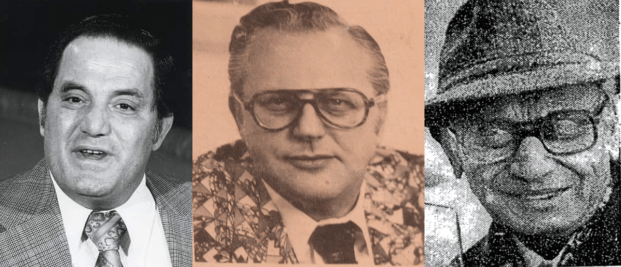
(L:R): Joseph V. Agosto, Diel Gustafson, and Nick Civella

Diel “Dale” Gustafson was a millionaire banker from Minnesota owning six banks and an assortment of other businesses and real estate holdings.[1301] Gustafson’s Las Vegas tenure began after he bought the Tropicana Hotel and Casino from Texas International Airlines which to him seemed like a perfect potential turnaround story.[1302] The 500-room hotel was fairly small by comparison to other Las Vegas giants, but Gustafson entertained a dream of building up the hotel into a fabulous 3,000-room monster complex that could outcompete any other Sin City staple.[1303] A company that promised $131 million for the necessary financing of such an undertaking went bankrupt, and the 1973/1974 recession as well as Detroit gamblers walking off with $400,000 of Tropicana’s cash sparked serious financial stress on the property.[1304] In September 1974, Gustafson sold 50% of his interest to Ed and Fred Doumani, rival casino operators, who then went scouting for more capital.[1305] Gustafson was in further negotiations with the Doumani brothers and other Las Vegas investors about a proposed joint-venture that would bail out the Tropicana which was contingent on a $50 million loan from the Teamsters pension fund.[1306] While this was happening, Agosto later testified that in late 1974 he was negotiating with Gustafson to also acquire an interest in the Tropicana using Agosto’s associate Nick Tanno as the front man in that transaction.[1307] Gustafson brought Agosto on in an effort to stave off a takeover by the Doumani brothers.[1308] Thus, Agosto made a “special trip” to Kansas City and told Nick Civella that it was not in his interest for that Teamsters loan to be approved since he was in negotiations with Gustafson to be included in the ownership and management of the Tropicana.[1309] At that same meeting it was agreed that Agosto would infiltrate the casino and skim it and in return the Kansas mob would use their influence in the pension fund to finance the expansion of the Tropicana and finance its operation to enable the skim.[1310] It was also during the same time frame that Tropicana officials (presumably Gustafson) were also negotiating with the Galante/Bank of Bloomfield group for their proposed loan package. Yet the financial position of the Tropicana was still weak in the midst of these competing negotiations, and the Nevada Gaming Control Board forced investors in the casino to come up with a suitable refinancing package or risk closure of the establishment.[1311] The approved $12.5 million plan included a $6.4 million investment from heiress Mitzi Stauffer Briggs, one of the investors recruited by the Doumani brothers, that gave her control of 80% of the casino with Gustafson retaining the rest.[1312] Via influence with the Teamsters, the mob was technically able to effectively restrict entry to the Doumani brothers and insure that the uncooperative casino owners did not receive their loans and thus unable to hold on to their interest in the casino.[1313] Agosto’s deal (which was supposed to give him control of 18% of Tropicana’s stock) with Gustafson fell apart after a $53 million Teamster loan of his own was not approved later down the line .[1314] Sadly no amount of influence was able to get around a new federal law which forced pension fund investments to be diversified and the Teamsters with their saturated Las Vegas loan book could do nothing to help its Mafia friends.[1315] Agosto and the Kansas mob had to find another way, especially with Briggs now in the picture.

As a temporary solution, Agosto was appointed by Gustafson as VP of Tropicana Construction Co., so that his continued presence at the casino would not be questioned by the Nevada Gaming Control Board (since Agosto was not licensed) which allowed the conman to attend management meetings.[1316] Joseph was finally able to make headway as Tanno loaned Tropicana $900,000 and Agosto himself bought the Production & Leasing Co. that put on the famous Folies Bergère show for $850,000.[1317] The casino paid the company $60,000 per week to deliver the show and Agosto later claimed that he could skim a million dollars from the shows alone.[1318] The skimming scheme developed slowly because the conspirators just didn’t have a big enough stake in the hotel.[1319] To add further complications, Tropicana’s new owner Mitzi did not trust Agosto at first and curbed his role in running the casino.[1320] By 1977, however, she would come around and became increasingly reliant on Agosto’s advice in running the gambling joint, despite warnings from federal authorities.[1321] She sent a telegram to Agosto reading “I love you. Mitzi” after he hired an attorney to get her out of a psychiatric treatment center that she was committed to by her children.[1322] She later signed over documents giving Agosto power to act over her.[1323] By 1977, Agosto had succeeded in effectively running the casino and told his Kansas partners that he was in a position to begin the skim in earnest.[1324] Carl Thomas, another close associate of the Kansas mob and former manager of the Tropicana, designed the skim operation and with the help of casino manager Donald Shepard (hired in May 1975) began to steal $40,000 per month from June-October 1978.[1325] The group paused briefly to check if the skimmers were themselves being skimmed before resuming and in totality the whole skim operation lasted only 11 months.[1326] While the group was charged for skimming $280,000 in total, the monthly run-rate suggested they could steal approximately half a million per year.[1327] While some money was probably skimmed from the Folies Bergère production and the government was unable to determine how much money in total disappeared from the gaming tables during Agosto’s tenure with the Tropicana, at the end of the day, the choice of target was very poor.[1328] The hotel was always financially troubled and Agosto and Gustafson had to run a $4 million check-kiting scheme to bolster the casino’s financial position.[1329] Ultimately, everyone involved (barring the front owners) received heavy time with both Carl Thomas and Joseph Agosto agreeing to become informants.[1330] Thus, there is one potential example of the Mafia effectively restricting entry into the Nevada gaming industry. I will admit it’s pretty weak, but it’s something. Ultimately, what hampered the Mafia in controlling the industry was that frankly there were too many families involved that did not allow for the coordination and discipline necessary to rule it as effectively as the garbage industry. While one or two families exerted control over a given garbage territory (Gambino for Queens or Lucchese/Gambino on Long Island) there were almost a dozen families involved in Las Vegas in one shape or another and that spells disaster for managing an effective and coherent illicit cartel strategy. The concrete club or the gasoline tax panel were managed by just four neighbouring families and think about how often they had to meet to coordinate and manage the racket properly. Nothing of the sort existed in Nevada and it ultimately proved their undoing (alongside all the legal tools the government acquired). Anyways, it’s time to get back to New Jersey from this detour.

In the winter of 1975/1976, the weight of the bad loans began to be felt by the financial institutions as their deals began to fall apart and the scheme was uncovered.[1331] As a result Daner met with Prodan and two of Galante’s associates to discuss strategy and Daner was eventually forced by Prodan to sign a confession taking full blame for the bank losses[1332] Daner who turned state’s evidence to save himself from almost certain doom testified that Prodan threatened him by stating, “Mr. Prodan told me that I had gotten him in a jam because he was doing things with Ernie Palmeri. By my placing him (Prodan) in danger, I was actually placing Palmeri in danger, and Palmeri would get me, no matter what happened.”[1333] As a result of all of these banking conspiracies, almost 50 people would be indicted over the course of the late 1970s that all resulted in relatively light sentences.[1334] Rando and Alexander Smith both got three years’ probation, Charles Musillo received four years in prison, and Prodan ended up cooperating with the government.[1335] In 1977, Ernest Palmieri was indicted with four others on charges of racketeering and bank fraud for receiving more than $800,000 in loans and kickbacks from a total of nine New Jersey banks.[1336] In May 1979, the entire leadership of Local 945 was found guilty of racketeering including president Joseph Campisano, secretary-treasurer Vito Cariello and of course business agent Ernest Palmeri who was sentenced to seven years in prison.[1337] Palmeri would be replaced by ex-carter Anthony Rizzo as Local 945’s new business agent, a nephew of Genovese soldier Joseph Schipani of Brooklyn.[1338] The fallout of from the banking scheme may have been a factor in the way the mob enforced its will on New Jersey’s garbage industry and we now turn back to the customer allocation agreement.

The relationship between racketeers, industry associations, and unions are extremely interesting to analyze, particularly in the context of the sanitation industry. What makes New Jersey unique is that, as far as I’m aware, it is the only example of where we have an exact date of when the responsibility to uphold the customer allocation agreement transitioned from the mob-controlled union to the mob-controlled industry association. For instance, in New York and Long Island, it’s murky to exactly establish when the union stopped retaining a major role in the operation of the agreement and in other mob-dominated markets such as Florida, a union never played a role in establishing or enforcing one in the first place. In New Jersey, however, Ernest Palmeri and Local 945 stopped being the primary enforcer of the property rights system after June 1976 when the New Jersey Trade Waste Association (NJTWA) came into existence under the leadership of Carmine Franco.[1339] It’s important to speculate why the racketeers (particularly the Genovese Crime Family) felt the need to form a new organization to protect the customer allocation agreement present in the industry since Serratelli’s tenure. Clearly then the mob viewed Local 945’s power and to an extent Palmeri’s authority as insufficient to further the interests of organized crime within the industry. Thus, I think there were five factors that contributed to this transition relating to law enforcement pressure, inter and intra Mafia politics, as well as just structural changes within the industry.

Due to the collapse of the banking scheme in the winter of 1975/1976, Ernest Palmeri and his mob peers had to know that law enforcement was going to investigate their arrangements and possibly find indictable transactions that would get some or all of the participants and thus Local 945’s leadership in trouble. Therefore, with investigators looking into the union’s financial dealings, they were bound to look at other activities pursued by the local and thus this extra heat from police could limit their effectiveness in arbitrating disputes and ability to pressure non-compliant waste hauling companies to abide by the property rights system. Furthermore, Local 945 and Ernest Palmeri was clearly having trouble dealing with rebel carters and this problem was manifested in an individual named Gabriel “Gabe” San Felice. San Felice was a rough individual who moved from Brooklyn to New Jersey and started a garbage company called Sano Carting in March 1966.[1340] As a “scavenger” firm, his business initially specialized in commercial and industrial clients, but by 1972/1973 he began to bid on municipal contracts in the Bay Shore area, a garbage subsector was that jealously held by organize crime affiliated companies.[1341] Sano Carting ended up winning contracts with Keyport and Matawan that were previously held by Crescent Roselle, Serratelli’s old friend, who used his influence with Palmeri to intervene in his dispute with Felice.[1342] Despite limiting Sano Carting’s access to landfills and threats from Palmeri to unionize his workers with Local 945, Felice continued to expand and contacted his own racketeer protector, Genovese soldier Frank Caruso, to intercede on his behalf.[1343] After an initial meeting that produced a deal that led to almost immediate cheating, a second meeting stabilized the situation between San Felice, Palmeri, Local 945, and Roselle until 1975.[1344] Importantly, Caruso threatened Palmeri during the second meeting, undermining Palmeri’s authority and thus Local 945’s power in the eyes of private carters.[1345] Compare this story to the ones previously described involving John Serratelli in the 1950s and note the stark contrast in conduct and outcome. First, Serratelli’s usual tactics of limiting landfill access and threats of unleashing his union’s power eventually cowered carters into submission, thus preserving the power of the union over the carters. While Palmeri used the same playbook, instead of listening to him, Felice sought outside help. This again never happened under Serratelli as from all accounts carters never sought the assistance of racketeers because they perceived Serratelli’s word to be law. This highlights the difference between the authority Serratelli carried within the garbage industry versus Palmeri’s who was clearly seen as a weaker leader. Finally, despite Local 945 being a Genovese local and Palmeri’s being a Genovese associate (if not an outright member), his authority and the customer allocation agreement that benefitted the mob was weakened by a fellow Genovese member in Caruso showing perhaps a lack of unified agenda within the Family. Caruso’s reprimanding of Palmeri, in effect legitimized the ability to steal stops and disregard the property rights system that produced the excess profits all parties enjoyed if one had the backing of a sufficiently powerful enough racketeer. This in turn transformed the nature of grievance meetings that were more suited to be overseen by an industry association rather than a union as we will see. Lastly, the increased presence of non-union carting firms such as Sano Carting further diminished the power of the union in its ability to impose its will on the carting industry, a similar problem encountered by Local 813 on Long Island. The garbage industry of New Jersey was generally divided into two sectors, the municipal contracting segment and the commercial-industrial segment.[1346] The municipal contracting segment was dominated by a small group of large carters that were part of the Municipal Contractors Association dating back from Serratelli’s time and one that Local 945 seemed to be closest too.[1347] While many municipal contractors did work in the commercial-industrial (“scavenging”) segment, most commercial-industrial collectors did not bid for municipal contracts, and thus the ~24 member Association operated in a fairly isolated sector.[1348] Given the small number of operators in the segment and given that many were affiliated with organized crime, Local 945 had an easy time operating and protecting the customer allocation agreement. However, the commercial-industrial segment was serviced by at least 120 carting companies and as more carters like San Felice began to move into the more lucrative municipal sector, Local 945 started to have a harder time policing the industry given they were non-union.[1349] The limitations in Local 945’s power was becoming increasingly evident.

The structural limitations of Local 945 in the mid-1970s also collided with Mafia politics. I think there were two facets to this, intra and inter Mafia politics. Within the Genovese Crime Family, I think there were desires by soldiers within La Placa’s crew to grow their own power and influence within the garbage industry through stronger direct intervention. As you will recall, it was said that Ernest Palmeri directly answered to “Lodi Pete”. However, younger members like Tino Fiumara and John DiGillio were considered prominent “up-and-comers” within the mob in New Jersey and sought to place their own front men in positions of power.[1350] Carmine Franco, president of the New Jersey Trade Waste Association was said to be Fiumara’s puppet, and its sister organization, the Hudson County Sanitation Association was controlled by DiGillio through Joseph Scugoza.[1351] Thus, this way the younger soldiers would have a more direct access to the industry that was characterized with more frequent mediations. For instance, it was Fiumara who introduced San Felice to Carmine Franco and told the former to seek the help of the latter if Felice encountered any problems with Local 945.[1352] This action increased the power and importance of Fiumara and Franco within the industry at the expense of Palmeri and Local 945 and moved the decision-making power in the sector from the union to the Association Fiumara controlled. Tino also attended many grievance meetings to settle various territorial disputes, approved the sale of garbage routes, and arranged chemical and waste dumping for kickbacks, further showing evidence of growing direct racketeer involvement within the industry that was notably absent during Serratelli’s time.[1353] Moreover, according to a state report, the New Jersey Trade Waste Association was formed, in part, to thwart the growing influence of the Gambino Crime Family in New Jersey through Macaluso, by the Genovese Crime Family through Carmine Franco.[1354] Charles A. Macaluso was formerly the president of the Greater New York Trade Waste Association, controlled by the Gambino Family, and was sent to New Jersey at the urging of “Jimmy Brown” Failla in 1976 to grow the influence of the Gambino’s in the Garden State’s garbage industry.[1355] By forcing Macaluso to join the NJTWA under Genovese leadership, the power of the Gambino’s in New Jersey was kept in check.[1356] Scott M. Dietche, however, maintains that the genesis of the Association was more collaborative. In 1976, New Jersey formally created the toxic waste disposal industry through a new law that dictated that chemicals and other toxic refuse be treated more strictly than solid garbage.[1357] This new regulation created a lucrative market that the mob sought to control and was the genesis for the formation of a waste-haulers association in New Jersey by Peter LaPlaca, James “Jimmy Brown” Failla, and Tino Fiumara.[1358] As one can see, there were numerous different factors that went into the formation of the new Association(s) and the waning role of Local 945’s contribution to the enforcement of the property rights system in New Jersey. There may have also been one other factor that contributed to the formation of the NJTWA and that was the murder of carter Alfred DiNardi over his dispute with SCA (or Melvin Cooper?).

(L:R): Thomas F. Viola, Carmine Franco, and John DiGilio

The 1970s saw a structural shift within the industry due to the rise of national waste management firms like Waste Management and Browning-Ferris Industries (BFI).[1359] These organizations were founded by groups of entrepreneurs that included highly educated managers and business executives that brought modern managerial techniques and business school corporate services that enabled for greater efficiencies when contrasted to the informal family-run carting businesses of old.[1360] These companies grew exponentially by being serial acquirers (BFI for instance bought 157 companies between 1968 and 1973) and began to dominate the previously fragmented waste management industry while also expanding into landfill management and toxic waste disposal.[1361] When acquiring local players, national firms would issue stock to the previous owners and retain them as semi-autonomous employees through multiyear management contracts to retain local knowledge, and in some cases, intimacy with local customer allocation agreement conspiracies.[1362] Despite their rapid expansion both nationally and internationally, the national firms were notably absent from New York and Long Island during the 1970s and 1980s, signifying the strength of racketeer influence within those markets.[1363] They were active in New Jersey, highlighting the comparatively less powerful property rights system present in the market, although their operations there displayed a distinctly Mafia flavor.[1364] It is in this context that Service Corporation of America (SCA) found itself, having to navigate between Corporate America and the Mafia.

SCA had grown rapidly since 1970, having acquired more than 130 garbage companies in the span of a decade.[1365] It was the first national company to enter New Jersey’s carting industry, swallowing up twenty-five firms which informant Harold Kaufman described as, “some of the toughest organized crime companies in the world”.[1366] It really got its first major foothold in the Garden State when it acquired Industrial Haulage Corp. (~$2 million in revenue) in March 1972 from Louis Viola and his sons Thomas F. Viola and Frank V. Viola.[1367] This is the same Thomas Viola that was indicted for bid-rigging with Serratelli and who conspired with the former union leader to restrict landfill access to uncooperative carters.[1368] After SCA’s acquisition of Viola’s companies, he joined the board of directors and was appointed a vice president in charge of directing its Mid-Atlantic region (which included New Jersey and Philadelphia).[1369] He was later appointed the president of the conglomerate after its previous one looted his own company out of $4 million dollars alongside SCA’s founder and other associates of organized crime in 1975.[1370] As one can see, the company was rotten to the core and replete with connections to the mob. In 1972, the Iommetti brothers also sold their company to SCA and continued to manage their former company under its new corporate umbrella.[1371] The Iommettis were previously mentioned in connection to both municipal corruption and ties to Genovese powerhouse Jerry Catena. Their connections to the Genovese Crime Family were further confirmed when in the summer of 1980, Peter Iommetti, a district manager for SCA, was seen in the company of Ernest Palmeri, Tino Fiumara and Louis “Streaky” Gatto, the new captain of LaPlaca’s old regime.[1372] In 1973, SCA acquired United Carting Co. from Ralph Mastrangelo who was involved in extorting a North Jersey contracting company alongside August Vergalitto.[1373] Unsurprisingly, Vergalitto was connected to John DiGilio and was secretly televised by NBC giving DeCalvacante godfather John Rigg a customary kiss.[1374] SCA’s biggest catch in 1973, however, would be the acquisition of a number of Roselle family businesses, then one of the largest solid waste operators in New Jersey.[1375] The Roselle brothers continued to operate their companies, and Crescent Roselle served as the general manager for the Roselle group of corporations acquired by SCA.[1376] Another firm acquired by SCA was Alfred Lippman’s Fereday Meyer & Co (spelled differently every time, I know, but that’s how it was done by newspapers too).[1377] The point is that SCA’s leadership and its New Jersey division was saturated with managers and operators connected to organized crime that actively sought to maintain the property rights system embedded in the state’s garbage industry. Afterall, Roselle sought the assistance of Palmeri and organized crime against San Felice’s infraction on his territory while being a manager for SCA. Thus, the nation’s third largest waste hauler at the time was corrupt and in bed with the Mafia.

Alfred “Freddy” DiNardi or DeNardi was born in the Bronx and entered the garbage industry with little formal education in 1949 by joining his family-business Colgate Paper, a wastepaper disposal company in New York.[1378] In 1959 he became an officer in Middlesex Scrap Materials and three years later he helped his brother Michel DiNardi form Middlesex Carting Company (a Melvin Cooper customer).[1379] In 1966 he founded his first garbage company, D&V Disposal Services, and in 1969 he launched his most well-known firm, Custom Disposal Co., that operated out of the same Middlesex office as his brother’s company.[1380] While most carters stuck to operating in their home county, Custom Disposal operated Somerset, Union, and Hunterdon counties and by 1973 Custom boasted $1.1 million in yearly operating income from a variety of municipal, commercial, and industrial contracts.[1381] Such rapid expansion required a lot of capital and competitors began to wonder where DiNardi got the money to run his fleet of gleaming black, gold-lettered trucks.[1382] The answer is easy, credit. Custom Disposal had $356,000 in long-term debts and $84,825 in short-term notes with some of the notes backed by mortgages on the company’s Middlesex plant.[1383] $161,000 in short-term mortgages were provided by CBM, Ltd. a company with the same address as Custom Disposal’s lawyer office, whose son was purportedly involved with the garbage company.[1384] DiNardi also owned $200,000 to Cooper Funding through loans made by P.F.R.D., which solicited some $300,000 from Melvin’s firm. This financial arrangement is suspected to have played some role in DiNardi’s eventual demise. Using funding from loansharks, Custom Disposal grew by aggressively underbidding carting companies large and small for both municipal and industrial-commercial customers, an act which ruffled some feathers. In 1975, for instance, it won a two-year $78,800 contract for the Bradley Gardens section of Bridgewater from Inter-County who also lost a school contract to DiNardi’s company three years prior.[1385] He also won contracts against larger garbage companies like J. Filiberto Sanitation and Murray Hill Disposal which pissed off other carters who called his pricing strategy as “irregular” and “erratic” saying, “When he [DiNardi] would bid for schools, the local man would bid $100 and he would come in at $50”.[1386] The man was wrecking havoc on the central New Jersey garbage market, breaking all protocol and disregarded the property rights system. When one carter was asked who lost business to DiNardi, he replied, “Just go down the names in the Yellow Pages. They’ve all lost work”.[1387] The biggest show down DiNardi had, however, was with SCA and their various New Jersey subsidiaries. In December 1975, Custom Disposal beat out SCA’s Waste Removal subsidiary for a $25,000 annual contract to haul garbage from Trenton State Collage.[1388] More significantly, DiNardi began to move in on SCA’s municipal contracts which were certainly protected by the customer allocation agreement. In November of 1975, Freddy won a $358,000 two-year pick-up contract for Roselle Park which Waste Disposal held for years prior.[1389] SCA first tried to contest the decision in court, but its suit was thrown out.[1390] In total, DiNardi took eight contracts from SCA subsidiaries Waste Disposal and Interstate.[1391] A second major showdown between SCA and Custom Disposal was looming for a New Brunswick municipal contract after the city council threw out the original round of bids which favored SCA.[1392] Before the outcome could be experienced, however, DiNardi received one bullet to the head and one in each buttock on June 3rd, 1976.[1393] He was murdered by two men driving a 1970 Ford Falcon.[1394] The murder remains unsolved but police were able to trace the murder weapons to the ones bought by four members of the infamous Purple Gang of East Harlem during their gun-buying binge in South Florida in the summer of 1975.[1395] So what exactly happened?

A picture containing text, outdoor, old, black

Description automatically generated

Custom Disposal of Middlesex, N.J.

Alfred DiNardi’s murder was one of the first major killings in a string of homicides that plagued the garbage industry of New Jersey from 1975 to 1981 and each had to do with violations of the customer allocation agreement.[1396] The fact that murder was the avenue ultimately undertaken by the racketeers showed that other methods of enforcing the property rights system failed and, in my opinion, probably highlighted the shortcomings of using Local 945 as the principal protector of the garbage cartel to those mobsters. The initial DiNardi murder gave mobsters further reason to create the NJTWA as the new primary defender of the customer allocation agreement to serve as the main dispute settlement vehicle in the waste management industry. However, subsequent murders highlighted that even the NJTWA was not enough to properly police the industry and in some cases despite union and NJTWA pressure, extra-legal measures were necessary to preserve the peace. DiNardi’s Custom Disposal was at one time unionized by Local 945, but the aggressive entrepreneur severed his ties with the union in 1973.[1397] A Custom Disposal official told authorities in 1976 that the firm experienced “numerous” problems with the union because DiNardi may have been paying off Ernest Palmeri at one time but stopped after an unknown disagreement.[1398] Another article, however, explicitly stated that there were no reports of pressure on DiNardi’s firm to unionize despite his two biggest competitors employing Teamster labor.[1399] Regardless, investigators concluded that Palmeri was definitely an “enemy” of DiNardi.[1400] If there was union pressure, it shows the limitation of Local 945’s ability to make non-union garbage firms comply with the demands of organized crime. Crescent Roselle played a key role in the ultimate death of DiNardi, as he insisted that his death was the only way to stop him.[1401] Cooper Funding was also investigated by federal agents about a possible link between Melvin Cooper and the murder of DiNardi.[1402] As Alan A. Block stated in his book, “Informant information collected by law enforcement agents noted he had received his money through P.F.R.D., which solicited $300,000 from Cooper Funding. It is unclear whether DiNardi chose not to repay the money plus the enormous interest to P.F.R.D., or Cooper and P.F.R.D. were feuding and DiNardi was made an object lesson because of some internal mob dispute.”[1403] Block concluded by stating that his association with Cooper Funding in conjunction with his violation of the property rights system was enough to get him shot three times.[1404] This would be the first of several murders linked to Melvin Cooper, Cooper Funding, and Resource Capital Group. I think it is no coincidence that a month after DiNardi’s murder, the New Jersey Trade Waste Association was formed and began to recruit members.[1405] Carmine Franco, its new leader, essentially took over the day-to-day running of Custom Disposal and began to use unionized labor.[1406] After the murder, SCA’s head of Waste Disposal (Crescent Roselle) met with several New Jersey carting executives and an organized crime figure that agreed to force Custom Disposal to return the stops it “stole” to their previous owners.[1407] On the Roselle Park contract, Carmine Franco was quoted by an informant as saying, “Do not upset the applecart; you are getting into a barrel of worms, and if you bid, you will be bucking the association.”[1408] As a result, out of eight carters solicited to bid for the new 3-year contract, SCA’s Waste Disposal turned out to be the sole bidder.[1409] One of DiNardi’s most important accounts that paid $35,000 per month was taken over a by firm associated with Genovese member John Albert.[1410] Essentially, while the property rights system in New Jersey existed for a substantial period of time, it was formalized, negotiation, and enforced upon the creation of the NJTWA in 1976.[1411] Although Ernest Palmeri and Local 945 continued to be present in grievance meetings to settle disputes in the carting industry well after 1976, it did so in the context of the NJTWA meetings under the direction of Carmine Franco and other senior members of the Genovese Crime Family.[1412] This is somewhat contrary to Peter Reuter’s assertion that Local 945 stopped playing any role in maintain the customer allocation agreement.[1413] Fascinatingly, this dynamic had real economic impacts on the value of garbage customers and routes in New Jersey as the price paid for stops expressed as a multiple of monthly revenues averaged 20-to-1 versus New York’s 40-to-1 .[1414] Despite property rights existing in both cities since at least the 1950s, the relative “newness” of the codification of the customer allocation agreement in New Jersey likely impeded its value, among other factors.[1415] The New Jersey Trade Waste Association and its sister organization the Hudson County Sanitation Association went on to control 35% of the total garbage collection revenues in the entire state of New Jersey or about $46 million annually.[1416] The story of New Jersey’s garbage industry from 1980 onwards is fairly well-known and so I’ll stop to re-focus on what Melvin Cooper was doing by the turn of the new decade and his close relationship to the Colombo Crime Family.

Melvin Cooper’s relationship with organized crime seems to have been formed prior to the founding of Cooper Funding in 1973. Shortly after the failed assassination attempt on Joseph Colombo in 1971, Michael Franzese approached Mel Cooper for help in finding capital for his new auto-leasing company, M.B.E. Leasing.[1417] The financier directed him to a man named “Vince” in the garbage business who introduced them to Equilease.[1418] Franzese stated that he was knew Cooper prior to his event and so naturally he had to be introduced to him by his father or another associate of the Colombo Family. This little anecdote shows that Cooper had relations both in the mob and the garbage industry going back to the early 1970s if not even earlier. Based on a 1983 senate committee report on organized crime stating that Sonny Franzese controlled Cooper Funding through Melvin Cooper, it may be that their relationship started even prior to the 1970s implying that Cooper was always a Colombo asset, given the above story.[1419] In 1975, Michael Franzese needed a new line of credit for his Mazda dealership and again turned to Melvin Cooper for help.[1420] Mel directed Franzese to the Small Business Administration (SBA) and introduced him to SBIC Agent Thomas Scharf of Lloyd Capital Corporation who aided Franzese in his endeavours.[1421] Mel Cooper himself was no novice when it came to scamming the SBA[1422], and after this meeting Franzese would start his own journey towards defrauding that organization out of hundreds of thousands of dollars.[1423] Now the Franzese family were not the only members of the Colombo’s to deal with Cooper and soon his involvement with the Mafia took a dark turn.

Richard Stone was an owner of an auto shop in Nassau County and an employee of Cooper Funding.[1424] His real name was actually Richard Slomowitz and he had a long arrest record filled with minor crimes such as grand larceny and procession of stolen property.[1425] He was also a police informant and reported to the FBI about Cooper’s dealings with organized crime figures.[1426] As an employee he would join Melvin in the latter’s business meetings and on one occasion met with Colombo Consigliere Alphonse “Allie Boy” Persico, Colombo soldier Victor “Little Vic” Orena, and Colombo associate (and future member) Ralph Lombardo.[1427] At some point Vic Orena told Cooper to have only ‘legitimate’ deals with Stone and that Orena was investigating Stone.[1428] This means Persico, Orena and other Colombo members dealt and did business with Cooper, perhaps using him as a source of funds for their own rackets. While not explicitly active in the garbage industry (although Carmine was described as a major garbage racketeer), Alphonse was an active shylock having been indicted for it in 1979.[1429] Apparently Allie Boy came to suspect that Stone might be an informant and told both Cooper and Orena to be careful around him.[1430] Cooper told Stone about his conversation with the Colombo mobsters and two days after Stone reported this information to his FBI handlers he was murdered.[1431] On November 29th, 1979, Slomowitz was covered with bullet and stab wounds when police found him in the trunk of a Cadillac registered to M. Cooper Motor Leasing after an anonymous caller steered investigators to his body parked at JFK Airport.[1432] It was the 12th victim murdered in the last two years at JFK Airport.[1433] Given Michael Franzese’s prior relationship with Melvin Cooper, the continued Colombo involvement with Cooper, and Michael’s made status and subsequent dealings with Resource Capital Group, this is another possible murder Franzese may have had some “extra” knowledge about. Could be the 6th one by my count…

The following is a summary made by the government about the LCN individuals that allegedly influenced Cooper Funding:[1434]

Joseph Schipani – Captain (soldier) in the Genovese Crime Family

Victor Orena – Soldier in the Colombo Crime Family

John Franzese – Captain in the Colombo Crime Family

Michael Franzese – Soldier in the Colombo Crime Family

Alphonse Persico – Consigliere of the Colombo Crime Family

Sam Galasso Sr. – Soldier (associate) in the Colombo Crime Family

Jerome “Jerry” Zimmerman – Associate in the Colombo Crime Family

Pasquele “Patsy” D’Avanso – Associate in the Colombo Crime Family

Melvin Cooper also engaged in conversation about the following LCN figures:[1435]

Vincent Rotondo ­– Captain in the DeCalvacante Crime Family

Antonio Corallo – Boss of the Lucchese Crime Family

Paul Castellano – Boss of the Gambino Crime Family

John Montana – Soldier (associate) in the Cleveland Crime Family

Jimmy Napoli – Captain in the Genovese Crime Family

Melvin Cooper was a white-collar crime innovator for the Mafia as in a taped conversation Oscar Albenga and Frank “Frankie G” Castagnaro agreed that it was Mel who taught organized crime in New York City the sophisticated brand of loansharking, characterized by fake documents and security interests.[1436] This roughly brings Melvin Cooper up to the early 1980s and so it is time to now go back in time and chronicle Jesse D. Hyman’s criminal career up until the two met and formed Resource Capital Group.

The Struggle for Local 210

The 1970s were a tumultuous time for the Buffalo Crime Family. Rocked by murders, indictments, and leadership disputes, each faction of the family struggled for control over the Arm’s crown jewel, Local 210 of the International Hod Carriers, Building and Common Laborer’s Union of America. A few weeks after the May 1974 murder of John Cammilleri, leaders of the Buffalo mob gathered at the back of Santasiero’s restaurant. One could make out Salvatore “Sam” Pieri, Carl Rizzo, Ronald Fino, and a few others as they entered the restaurant. DiCarlo: Buffalo’s First Family of Crime author Michael A. Tona, witnessing this event, concluded that it was a peace conference of local underworld factions. He later learned that the meeting was more likely about working out some details regarding union dental pilfering.[1437] The story of Hyman’s involvement with Local 210 was a result of a yearslong struggle for control between the factions of Sam Pieri and Joseph Fino in the wake of Stefano Maggadino’s deposition as Boss of the family. I will more or less summarize chapters 26 to 28 of the phenomenal DiCarlo: Buffalo’s First Family of Crime, Volume II to set the context and I highly encourage everyone to go and read this book.[1438]

Stefano Maggadino ruled over the Buffalo Crime Family from his base in Niagara Falls and over time his grip on Buffalo City and its members began to weaken, especially towards the late 1960s. The first reason came from the loss of his powerful underboss Frederico Randaccio to prison. The second reason, as it turned out, was Maggadino’s greed and deception. Stefano became aware of a large craps game that was bankrolled by Buffalo mafiosi and demanded a cut of the profits that grew from 10% to 50% over time. One day, the organizers lost a great deal of money and mafiosi Sam Pieri and Joseph DiCarlo asked Maggadino for an $18,000 loan to keep the game going. The Boss lied to his members and claimed that he didn’t have any money. Mere days later, however, law enforcement raided numerous Maggadino properties where they discovered $500,000 in cash, infuriating the rank-and-file Buffalo mobsters who began plotting to remove him from power. Sam Pieri, the leader of the insurgents, began to travel the country and host visitors to meet with important Mafia members in early 1969 to make his case for Stefano’s removal. On January 23rd, 1969, for instance, Pieri and DiCarlo met with Lucchese power John “Johnny Dio” Dioguardi and Colombo captain John “Sonny” Franzese. That March, Maggadino discovered the attempted coup against him and summoned new underboss Joseph Fino and captain John Cammilleri to his home and in a test of loyalty demanded an additional 25% share in a dice game the duo hosted. They refused, and Maggadino likely realized the extent of opposition to his power. He then clumsily attempted to influence the upcoming vote regarding the election of a new Boss by trying to get his son, Peter, elected by forcing each captain to come to his home separately to cast their vote. Sam Pieri refused his demand and said that the vote for the new Boss of the Buffalo Crime Family would be held in the City of Buffalo. At that point Sam held the support of the majority of the family including Roy Carlisi, Joseph DiCarlo, Joseph Pieri, John Cammilleri, Sam Frangiamore, Joseph Fino, Daniel Sansanese Sr., Frank Valenti, and Salvatore Bonito. The only remaining support Stefano could count on was from Antonino Magaddino and Benjamin Nicoletti Sr. In the summer of 1969, after Maggadino refused to step down, the rebel group brought charges against Stefano to the Commission. Tired of waiting for the Commission, who were biding their time and being non-committal to either side, the group decided to proceed with their election and voted in Sam Pieri on July 9th, 1969, as the new Boss, Joseph Fino as acting underboss and Joseph DiCarlo as acting consigliere. This new administration’s cohesion did not last very long as on September 5th, FBI agents arrested Sam Pieri and others for possession of $191,630 worth of jewelry, some of which was stolen. Although the charges were dropped, they occurred shortly after Pieri was elected Boss, and this eroded his power within the Family with one informant speculating to the FBI that he would soon be replaced as Boss. Further on October 7th, charges were brought against long-time Local 210 member John Cammilleri for perjury which diminished his usefulness within the organization and killed his support to take a leadership role within the union. Further complications within Local 210 occurred as Victor Randaccio, the power within the union, was upset with the Pieri leadership after the rebel group decided that if his brother Frederico, Maggadino’s former underboss, was released from prison, he would be broken down to the rank of a soldier. Informants told the FBI that Local 210 was dominated by organized crime since 1946 and by the early 1970s, its leadership were completely saturated with relatives of Victor Randaccio. For instance, the local’s recording secretary was Randaccio’s brother-in-law. Two nephews occupied positions of welfare fund administrator and assistant business manager, respectively, and four other relatives served as employees of the union local. Pieri’s position within the Family further deteriorated in the fall of 1970 after he was convicted on one count of jury tampering and sentenced to five years in prison. As a result, in winter of 1970, the Family elected Joseph Fino as its new leader and Daniel Sansanese Sr. became the new underboss.

Joseph Fino’s new position put him in the crosshairs of law enforcement and he along with seven others were indicted in September 1971 on charges that included conspiracy to violate federal anti-gambling laws and with actual violation of the laws through the operation of an illegal gambling business in connection to a multimillion-dollar horserace bookmaking racket. Victor Randaccio who was previously upset with Pieri seems to have gone over to his side subsequently as he and Joseph DiCarlo attempted to remove Joseph Fino as Boss in March 1972. This effort was blocked by Roy Carlisi, a leader of a powerful faction within the Family who supported Fino. A new split within the Family was emerging as it became increasingly disorganized. On May 9th, 1972, Joe Fino was able to escape justice by being found not guilty. While this was going-on, law enforcement continued to put pressure on the Family’s leadership by going after newly appointed underboss Daniel Sansanese Sr. He was indicted on June 13th for perjury and convicted on November 3rd, receiving a 5-year sentence which he began to serve in November the following year. Due to continuing police pressure on Fino, he stepped down in favor of Sam Frangiamore who became the “Acting Boss”. However, he was merely a figurehead and power continued to reside with new underboss Carlisi and captain Sansanese Sr. First on Frangiamore’s agenda was his growing fear that the struggle for Local 210 would result in a “blood bath”. In spring 1973, the factional rift in the Family solidified over who should represent the Family’s interest in the union.

(L:R): Salvatore Pieri, Joseph Fino, and John Cammilleri

Victor Randaccio’s primary source of support came from the Sam Pieri, whose brother Joseph returned from Youngstown, Ohio to look after his sibling’s underworld interests while he was incarcerated. Randaccio’s power within the Mafia waned following his brother’s imprisonment and a faction of Buffalo wanted him gone. The seeds of the conflict were sowed following the March 30th, 1970, death of long-time local president Michael Rossiter. Randaccio wanted to elevate his nephew, Leonard Territo, to the position of president, but Sam Frangiamore, Joseph Fino, and Roy Carlisi preferred if another person took the presidency while installing Joe Fino’s son, Ronald, to the position of assistant business manager. The trio’s preference was adhered to in the April elections, but following the new president’s death in the fall of 1972, Victor managed to install his nephew in the newly vacated position. By February 1973, Victor had complete control of the local which provoked his opponents within the Buffalo Family. In order to avert the looming conflict, Carlisi attempted to negotiate with Victor to promote Ronald Fino and some of his friends within the local to higher positions, a proposition that Randaccio flatly refused. Joseph Fino was reluctant at first to let Ronarld run in the May 1973 election against Randaccio, but John Cammilleri, seeing that he could use the growing division within the union as a way to grow his power, convinced Joe that Ronald should run. On March 12th, Ronald hosted a meeting to announce the “reform” slate that included him running for the position of secretary-treasurer, Salvatore Caci for president, and Daniel Sansanese Jr. for business agent. The meeting was chaired by Daniel Sansanese Sr. and among the Mafiosi who attended included Joseph and Nicholas Fino as well as John Cammilleri. This was the official split within the family. Joseph DiCarlo, the Pieris, the Todaros and Roy Carlisi continued to support the Randaccio regime while Cammilleri, Joseph Fino, Charles Cassaro, and Daniel Sansanese Sr. opposed it. Sam Frangiamore officially remained neutral. On May 19th, 1973, Local 210 voted overwhelmingly in favor of Ronald Fino’s slate and Victor Randaccio lost his position as secretary-treasurer. Two weeks into office, Ronald was called into a sit-down by Frangiamore, Todaro Sr., and Carlisi who congratulated the winner, but maintain that all decisions would be made by the Mafia and not the union’s members. Despite helping engineer Fino’s win, Ronald refused to appoint Cammilleri as his assistant even at the urging of his father and uncle. Angelo Massaro, a member under Charles Cassaro, a backer of the “reform” faction, was appointed as the new administrator of the local’s pension funds. On December 20th, 1973, Sam Pieri was released from prison and the FBI expected him to reassert control over the Family and Local 210. In early 1974, Sam met with Joseph DiCarlo and commented, “There’s going to be a lot of bodies in a lot of trunks in a hurry.”

Pieri’s faced several obstacles in his quest to return to power. First, the Niagara Falls faction and its rackets were still largely under the control of Stefano Magaddino. Within Buffalo itself, he faced stiff resistance from Joseph Fino and John Cammilleri, who was particularly outspoken about against Pieri and refused to recognize him as Boss. Pieri’s first strike against Fino-Cammilleri was an economic one as he organized rival gambling games in an effort to stifle their financial resources. In a response, Cammilleri advocated for a violent retaliation, but Fino resisted and even met with Pieri in early 1974 to try and resolve their differences. Meanwhile, Cammilleri continued to press for a position in Local 210, as he felt he was owned one given he engineered Ronald Fino’s win and wanted to be appointed the local’s personnel director. On May 8th, 1974, he met Joe Fino to discuss the matter with the latter arguing that Cammilleri’s presence at the union would bring too much law enforcement pressure and denied his bid. Cammilleri, unhappy, threated to pull his crew out of the Buffalo Crime Family. He was killed the same day. Joseph Fino was able to escape his fate and a few days later negotiated with Sam Pieri for his life to be spared. It was precisely after Cammilleri’s death that the meeting about the dental plan pilfering took place. By June, informants revealed that Fino and Pieri were able to resolve their difference, with Fino’s faction acknowledging that Cammilleri was disruptive to the cohesion of the organization and needed to be “disciplined”. The Pieri’s winning this factional struggle began to have an impact on the composition of Local 210’s leadership. After a Ronald Fino relative retired from the position of business agent, Joseph Pieri’s son, John, was named to fill the position. Furthermore, in August 1975 Victor Randaccio was once again discussed in connection to Local 210 and was proposed to be a “consultant” for it. In October, two more Pieri allies got positions within the local as informants told the FBI that it was part of a powerplay to pry any remaining Fino allies from positions of authority. When one of the new appointees was forced to resign, the Pieri faction installed Joseph Todaro Jr. as the local’s new business agent given the Todaros’ had fought against Fino’s “Reform” faction in 1973. The former Fino- Sansanese faction also suffered from internal opposition that weakened their ability to resist the Pieri-led changes. In May of 1976, Victor Randaccio became secretary-treasurer of Local 210 once again, while Ronald Fino and Sansanese Jr. had to settle for business agent positions. The Pieri-faction was once again in full control of the union which would factor into Hyman’s career. Thus, if the Fino faction remained in power, Jesse Hyman might have never got his start dealing with organized crime and Resource Capital Group might have never existed.

While Sam Pieri was able to reassert his dominance over both Buffalo’s Arm and the Laborers’ Union, this period of his life was marked by constant revocations of his freedom stemming from parole violations. The Ziginette establishment that he set-up to rival Fino-Cammilleri’s was the subject of a prolonged undercover operation by the FBI where an agent with the help of informants was able to penetrate the gambling ring and tie numerous high-ranking mobsters to it. On March 23rd, 1977, Salvatore Pieri, Joseph Fino, Charles Cassaro, Nicholas Rinaldo, William Sciolino, and Gaetano Miceli were indicted on charges of conspiracy and operation of an illegal gambling business. In all a total of 58 organized crime members and associates were linked to the gambling operation and the thoroughness of law enforcement shook up the Mafia. Joseph DiCarlo, the consigliere, was heard complaining that he had never seen such a situation in Buffalo before, displaying paranoia by expressing that the FBI had informants and undercover agents all over town. This notion that Buffalo was now infested with confidential informants and cooperators would soon bear violent fruits. When Sam walked out of the Erie County Correctional Facility on June 11th, 1979, he was set on exterminating the rodent infestation plaguing his organization. Now that the background of Buffalo has been established, it can now be outlined how a member of the Pieri faction helped Dr. Jesse Hyman get his start as a career criminal working with the Mafia.

The Travelling Dentist

Jesse Daniel Hyman was born in 1944 and raised in Queens, New York.[1439] He graduated from New York University’s dental school in 1969 but would wind up practicing his craft far from New York City. He incorporated Jesse Hyman, D.D.S., P.C. on January 1st, 1973, in Erie County, New York.[1440] His dental practice, however, did not start operating until he got help from two organized crime figures, Carl J. Rizzo from Buffalo and John “Curly” Montana Jr. from Cleveland. Carl Rizzo was a long-time member of the Maggadino Crime Family and federal agents observed him associating with Salvatore Pieri, Joseph DiCarlo, and Joseph Fino.[1441] He was described as a “powerful figure” in the 1960s, with underworld connections in Ohio and Kentucky.[1442] He was never arrested by the FBI and before getting into business with Hyman, worked as a deputy for the Erie County Board of Elections in charge of mechanical and clerical work.[1443] John Montana, on the other hand, had a well-known and publicized checkered past. “Curly” was a convicted heroin dealer and his name resurfaced in connection to a 1968 sniper ambush of his business partner, Peter DiGravio.[1444] The two ran a high-interest loan company that was forced to shut down after federal loansharking charges were passed in 1968.[1445] Montana was also involved in a suspicious dental clinic in Detroit, although Hyman didn’t have anything to do with it.[1446] So how were the three connected exactly? Well, Rizzo was Hyman’s “consultant” and Montana was his landlord.

Facilities Consultants Inc. was incorporated on November 25th, 1974, and its purpose was to acquire dental equipment for Hyman’s clinic.[1447] It also signed an initial 5-year lease agreement at Hyman’s original clinic location at 157 Delaware St., Buffalo. for $23,000 per year.[1448] Rena Montana, John Montana’s wife, owned 70% of Facilities Consultants with the remainder controlled by attorney Daniel R. McCarthy.[1449] McCarthy, refused to answer how he became acquainted with Montana, but invested into the clinic on the advice of his ex-law partner, Edward M. Greenwald, who was listed as the incorporator of Facilities Consultants.[1450] Curiously, both were part of George Steinbrenner’s consortium that acquired the Yankees in 1973 and Greenwald was instrumental in the signing of baseball pitcher Jim “Catfish” Hunter in 1974.[1451] In 1977, McCarthy divested of his interest in the dental practice and in March of that year, the clinic’s operations were moved to its new location at 235 North St., Buffalo.[1452] Rena Montana who worked at Hyman’s practice for four days per week owned the building out of which the new clinic operated out of and the real estate was worth $300,000 (~$1.5 million in today’s money).[1453] The corporate structure implemented with separate companies owning the real estate, equipment, and running the day-to-day dental operation was likely created to funnel money out of the business in a way that would confuse potential investigators. Since the clinic first opened its doors, it employed Carl J. Rizzo as consultant, paying him $500-per-week.[1454] He earned that money because it was him who negotiated an exclusive contract in 1975 to provide dental care services to the City of Buffalo’s blue-and-white collar unions.[1455] The contract was worth $300,000 per year as the three city unions represented 2,500 workers who all had to go to Hyman’s clinic for their healthcare needs.[1456] In fact, Hyman’s contracts with City Hall put his company under journalistic scrutiny as it was revealed that he received a $330,000 SBA loan from the federal government in 1977 and was part of a string of government affiliated contractors that received favourable financing from the SBA.[1457] Ironically, he also filled in cavities and performed root canals for Buffalo’s police department.[1458] More importantly, Rizzo was the key figure in getting Hyman Local 210’s dental contract.[1459] Carl J. Rizzo was described as being “very close” to Salvatore Pieri and this contract was likely part of his continued effort to cement his control over Local 210.[1460] For the longest, I couldn’t find how much money such a scheme generated, but Thomas Hunt and Michael A. Tona’s book came to the rescue. As it turns out, approximately ~$10,000 per year was funneled as a kickback from the dental program through Rizzo to Sam Peiri and Local 210 officials.[1461] Hyman didn’t remain under the radar of law enforcement for long as in late 1976 the Justice Department began investigating the union and its contract with the clinic.[1462] While both Montana and Rizzo figured into Hyman’s dental operation since its inception, given the ultimate location was in Buffalo, I think Jesse Hyman was “on-record” with Rizzo initially. Yet surprisingly, Rizzo didn’t hog Hyman and actively encouraged him to open more clinics in other locations. In 1975, for instance, the dentist and Rizzo travelled to Cleveland to discuss opening up a clinic for Laborers’ Local 860 and 310.[1463] That venture never went anywhere, however, as Hyman was busy with his clinics in Buffalo and New Jersey.[1464] Ronald Fino, Local 210’s business agent, later testified that Sam Pieri made arrangements through John Riggi for Dr. Hyman to set up a dental clinic in the Garden State area.[1465]

(L:R): Dr. Jesse D. Hyman, Daniel R. McCarthy, and John Montana

A picture containing text, outdoor, tree, sign

Description automatically generated

FBI investigations of Carl Rizzo revealed that he was a frequent traveller, visiting New York, Newark, Atlantic City, Boston, Providence, San Francisco, San Jose, Los Angeles, San Diego, Tucson, Kansas City, St. Louis, Pittsburgh, Cleveland, Chicago, Detroit, Atlanta, and Miami.[1466] Authorities determined that Rizzo’s frequent trips were related to his involvement with Metro Dental Services Inc., a Dr. Jesse Hyman owned entity and that Rizzo served as a courier of messages and cash kickback payments to various Mafia organizations.[1467] Metro Dental was part of a network of interrelated companies that together formed a maze through which fraud and manipulations were enacted.

Healthcare fraud was one facet of labor racketeering that enabled organized crime figures to monetize their control over unions. Specifically, it was used a means to covertly siphon money out of the union’s trust funds that would otherwise appear as legitimate to unsuspecting regulators. The most common ways of pilfering health and welfare funds was through multiple billings, issuance of fraudulent loans from the union or trust fund to medical providers servicing the local, inflated service contracts that were awarded through a non-competitive bidding process, and shell companies used to circulate the proceeds to lose the identity of the source of money.[1468]

Dr. Jesse Hyman’s initial foray into New Jersey’s dental industry came via the company he formed called New Jersey Dental Administrators (NJDA).[1469] The first union contract he landed was with Teamsters Local 945 with the help of Carl Rizzo who helped negotiate with Ernest Palmeri.[1470] Accordingly, Rizzo drew down a $1,000 check July 16th, 1976, signifying he was on the payroll of Hyman’s New Jersey operation as well.[1471] After securing the contract for the year 1976, Hyman contacted attorney George A. Franconero to help with legal matters and the lawyer began to represent NJDA.[1472] It was around this time that Stanley Resnick was introduced to the dentist by Seymour Cohen, and the two partnered with Hyman on this dental venture as well as several other businesses.[1473] As Hyman and Resnick were recruiting staff to run these clinics, Franconero introduced them to Dr. Anthony Ferrara who they interviewed for an oral surgeon position.[1474] Anthony’s father was Ray “Rats” Ferrara, a former vice president at ILA Local 1478 with broad-based contacts throughout the labor field.[1475] This longshoremen’s local has been linked to the Genovese Crime Family as recently as 2011, when its officials affiliated with members of organized crime were arrested as part of what the FBI dubbed as “Mafia Takedown” day.[1476] Anthony declined the position as he was not interested in such a role.[1477] Despite organized crime’s stamp of approval, Hyman didn’t see much initial success. After its one-year contract with Local 945 ended, Palmeri chose to not renew it with Hyman and Resnick.[1478] The backing of the Mafia didn’t guarantee success even in the labor union business it seems. Furthermore, despite Carl J. Rizzo and John Montana appearing by the side of Dr. Hyman to negotiate the contract, they were unable to secure John Riggi’s Laborers’ Local 394 in Elizabeth.[1479] Instead of receiving dental benefits, union members chose a pay raise instead.[1480] Despite these initial setbacks, Hyman and Riggi’s relationship would only grow with time as witnesses described them talking to each on a first name basis.[1481]

Anthony Ferrera, on the other hand, had more success with his new partner Joel S. Sokol. Joel became a dentist in 1967 and incorporated Joel S. Sokol, D.D.S., P.A. in 1976 with Dr. Ferrara to provide closed-panel (exclusive contract) dental care for labor unions and other groups.[1482] Their first target was Teamsters Local 478, and Anthony’s father made the initial introduction and began the negotiation between Sokol P.A. and the union.[1483] That local was dominated by the Serio family, with George S. Serio being Local 478’s health and welfare fund administrator, while his father was the local’s president.[1484] Some funny business occurred as part of this negotiation. Sokol and Ferrara were successful in obtaining Local 478’s contract and signed it in December 1976.[1485] In February 1977, a company called Group Service Administrative Services (GAS) was incorporated with George Serio serving as its president and employing Joel Sokol as an officer.[1486] Although the two and George Franconero claimed there was no conflict of interest, GAS provided a mechanism for Serio to obtain a car which was probably used to “sweeten the deal” and helped the Sokol Plan acquire the union’s dental contract.[1487] The contract proved to very lucrative as gross receipts rose from $402,400 in 1977 to $508,200 by 1979.[1488] However, due to the small size of their operation, Sokol P.A. was on a modified plan with Local 478 which meant that members could either come to their facility or go to their own dentist.[1489] Thus a few months into the 478 contract, Sokol and Ferrara decided that it was time to expand their scope and partner with some experienced operators.[1490]

(L:R): Joel S. Sokol, John Riggi, and Samuel Kinsora

In early 1976, Franconero “reintroduced” Dr. Hyman with Dr. Sokol and Dr. Ferrara to work together on prepaid dental plans with Resnick handling the administration.[1491] Sokol and Ferrara were interested in their skills, and they agreed to form a partnership. That’s the reason told to investigators and so one cannot rule out the possibility that organized crime encouraged his partnership. On January 1st, 1977, an agreement was formed between Hyman and Resnick’s Metro Dental Services to provide administrative and financial services for Sokol P.A.[1492] Metro Dental would acquire sites, do construction work, finance equipment and sublease it to Sokol P.A.[1493] Even prior to their official alliance, Hyman was giving Sokol advice on how to set up and administer a dental professional association.[1494] As part of his wisdom, Hyman suggested hiring Rena Montana, which eventually did come down to the clinic to set up the office and “whip it into shape”.[1495] Together they set sight on Local 1262. After securing Local 478, Sokol P.A. reached out to Retailers Local 1262, but it evidently went nowhere until Hyman got involved.[1496] Local 1262 and its president Samuel Kinsora knew Jesse Hyman and about his dental care operations in Buffalo and New York City and contacted him to see if he was interested in setting up a New Jersey operation via a contract with the union.[1497] As such, Hyman introduced Joel Sokol to Kinsora and the Sokol Plan was able to sign a contract to begin servicing Local 1262’s dental needs in November 1978.[1498] By 1979, the plan was collecting $1,377,100 in revenue from that organization.[1499] The final major union the Sokol Plan was able to secure was with United Auto Workers (UAW) Local 906 aka Ford’s plant in Mahwah, New Jersey.[1500] Serio may have been responsible for Sokol’s introduction to Local 906 and their eventual relationship was filled with controversy.[1501] Interestingly, Sokol P.A. couldn’t sign a direct contract with Local 906 for its dental care plan as all final decisions were made by the Ford Motor Company, although the union still had a voice and could influence the company’s decision.[1502] The contract with Ford on behalf of the local was signed on September 20th, 1978 and by 1979 the Sokol Plan earned $734,100 from the union.[1503] Curiously, Sokol P.A. would assume a $205,000 building loan from Local UAW 906 that was taken out for the purposes of renovating their union headquarters and expanding facilities.[1504] Coincidentally, the construction firm chosen to do the job was Western Realty, whose CEO was Seymour Cohen and who was controlled by Stanley Resnick, Sokol’s partner.[1505] Western Realty would also perform various leasehold improvements services for Sokol-Hyman clinical facilities.[1506] Joel Sokol also hired two members of Local 906 to perform janitorial services for the clinic inside the union’s headquarters.[1507] One was William Patterson, a long-time member, and the other was Patrick Fanning, the union’s recording secretary.[1508] Eugene Roehrer, Local 906’s secretary-treasurer, was also doing shady schemes with the facility as he would make out checks from the union fund to pay the “janitors” while Sokol’s checks to the janitors was endorsed by the recipients and given back to Eugene Roehrer.[1509] Thus, Roehrer was using the dental care plan as a vehicle to skim money from the very fund he was intrusted to protect. Thus, Sokol’s dealings with Local 906 also seem particularly suspicious. Overall, Sokol P.A. witnessed extraordinary success and grew its revenue from $502,000 to more than $3.6 million between 1977 and 1979.[1510] The participants also used financing scheming to siphon even more money out the business by taking advantage of the maze-like structure of Sokol’s corporations.

One way for crooks to make an extra buck is to inflate invoice orders, borrowing money against those, and then distributing the difference in values via kickbacks in the form of “rebates” and “sales commissions”. This is precisely what the Sokol Plan did on at least two occasions. John Burke was a dental equipment salesman that had a prior relationship with Dr. Sokol.[1511] He quit his prior firm over a disagreement with management and formed Burke Enterprises in January 1977 and Sokol became a client of his later that spring.[1512] The first shady transaction happened while Burke was still employed at his prior firm, Professional Equipment, in January of 1977.[1513] Essentially dental equipment and supplies worth $133,779.63 was invoiced as costing Metro Dental $200,073.50 for the purposes of inflating the collateral to receive a bigger loan.[1514] Sokol and Metro Dental put $45,000 as an advance, with $35,000 of that coming from Local 478, combining it with $200,000 from a loan brokered by Parliament Fund & Leasing.[1515] Thus in total, $245,055 was given to John Burke out of which only $109,713 was allocated towards purchasing equipment with $135,342 getting distributed back to various Sokol-Hyman corporations as a form of a kickback.[1516] George Franconero, for instance, received $7,000 as a result of this transaction and Metro Dental got $123,342 in total kickbacks.[1517] In addition to that, Parliament itself gave another $4,000 worth of kickbacks or “commissions” to John Burke, Metro Dental, and Stanley Resnick.[1518] The following chart breaks it down:[1519]

Diagram

Description automatically generated

Similarly, in October 1978 another such peculiar transaction takes place. Federal Financial Reserve gave Metro Dental $84,982 as a loan on the basis of an invoice for equipment for the same exact amount.[1520] This deal resulted in a $50,000 kickback to Metro Dental from which attorney Franconero got $9,000.[1521] The rest of the participants received thousands of dollars in connection and a full breakdown can be seen in the following chart:[1522]

Diagram

Description automatically generated

While Local 478, 906, and 1262 represented 90% of the Sokol Plan’s income, they did service other unions and organizations, and they were still keen on expanding.[1523] At its peak, the Sokol Plan operated a dozen dental clinics and it even had to subcontract some of the work out due to how busy they were.[1524] Persistent as ever, Hyman and Sokol tried to get a dental plan contract with John Riggi’s Local 394, but again nothing worked out.[1525] Worthy to note, however, is that the Cleveland Plain Dealer did report that Riggi’s Laborers’ union joined the Sokol Plan, though that was likely a mistake.[1526] Still, Riggi did try to help them out and introduced them to other labor leaders including a “Mr. Carrol” from Laborers’ Local 472.[1527] Yet despite having the backing of three crime families, none of the unions the group was introduced to by Riggi signed up for dental plans with Sokol P.A.[1528] Thus, this echoes Joseph Hauser’s testimony referenced earlier that even with the dominant influence organized crime had over organized labor, things did not always go according to the wishes of the Mafia. By February 1978, Dr. Jesse Hyman left Metro Dental and Sokol P.A. because he was busy with other ventures that we will examine in a bit.[1529] His timing could not be more perfect because by the summer of 1979, investigators in New Jersey were hot on the trails of the Sokol Plan and began to look into the general infiltration of the union dental care industry by organized crime in the state.[1530] This alongside the parallel law enforcement heat on Local 210 in Buffalo resulted in a fatality.

Buffalo’s chieftain, Sam Peiri, left Erie County Correctional Facility on June 11th, 1979, after serving four months for gambling conspiracy and needed to restore disciple to a Mafia organization plagued by informants.[1531] On March 6th, 1980, Carl J. Rizzo’s daughter reported her father missing to local police.[1532] At 9:30 in the morning the next day, William “Billy the Kid” Sciolino was gunned down while sitting alone in an office trailer in view of dozens of workers laboring at the rail construction site near by.[1533] Earlier that month, Sciolino received a stewards position at Laborers’ Local 210 and was at one time a bodyguard to Joseph Fino.[1534] Following his murder, it was revealed that Billy was an informant for the government.[1535] Curiously, Sciolino met at least once with small-time Cleveland racketeer Joseph F. Bonarrigo in the fall of 1979 who wound up getting murdered on the same day as Billy.[1536] On April 11th, 1980, Rizzo’s decomposing body was found in the trunk of a 1979 Oldsmobile leased out to a “Dr. Jesse Hyman”.[1537] Unfortunately, Carl suffered a grewsome death where he was garrotted and tied up in a ‘Sicilian knot’ where a victim slowly strangles themselves as their leg muscles weaken.[1538] Rizzo’s family was no stranger to mob violence as several of Carl’s relatives including his father, uncle, cousin, and brother-in-law met violent ends.[1539] The Department of Justice arranged in September 1979 to provide Carl with immunity from prosecution to compel him to testify about Local 210’s dental program, but had not yet used that immunity at the time of Rizzo’s murder.[1540] That two men, both closely connected to Local 210, were murdered back to back was seen a signal for others to watch their step as (potential) informants were no longer tolerated under Pieri’s renewed regime.[1541] During later trials, the U.S.’s Attorney Office for the Southern District of New York revealed that Carl Rizzo was indeed cooperating with federal authorities.[1542] Curiously, John Montana, Hyman and Rizzo’s business partner was in town when both murders took place and may have played a role in their demise.[1543] Despite the car lease being registered to Hyman, Jesse was able to escape this situation unscathed after being questions by the police.[1544] By 1980 Hyman had developed a new guardian angel.

(L:R): William Sciolino, Carl Rizzo’s murder scene, and a sketch of Dr. Jesse Hyman

The San Diego, Cleveland, and Buffalo Connection

The most fascinating individual affiliated with organized crime that I have come across was Comillo “William Martin” Molinaro and his story and connections are something else. Born in 1916 or 1917 (newspapers differ), Molinaro at first showed up to me in the record in 1969 when he was arrested in connection with an abortion ring.[1545] Molinaro and a female accomplice were snared by a sting operation where an undercover female agent from the Morris County Prosecutor’s office contacted the duo to perform an abortion on her.[1546] The pair was charged with attempted abortion and conspiracy to commit abortion.[1547] What’s really crazy is that this was Molinaro’s second arrest in 2 years for abortion related “crimes”. In 1967, he was charged with another man for performing an abortion on a 22-year-old college student in a hotel under the alias “Dr. John Adams”.[1548] Molinaro ended up getting convicted on the 1967 charges and received a sentence of 4 ½ – 6 years in prison and a $1,500 fine.[1549] Not wanting to do prison time, Molinaro became a fugitive from the law and filed appeals (that were dismissed) while on the run.[1550] Now New Jersey police officer Robert “Bob” Buccino had encounters with Comillo Moliaro and fleshed out some context around the latter’s activities. He claimed that an abortion case he built against Molinaro went nowhere in Morristown because Molinaro paid $30,000 to a Democrat politician who gave a third of it a county detective and the other third to a state trooper to squash the case.[1551]

As it turns out, Molinaro didn’t run far away and would resurface a couple years later among an interesting crowd. On December 10th, 1975, Comillo Molinaro was arrested at the Roman Forum, the nightclub at Local 945’s headquarters set-up by Palmeri to siphon money from the union’s trust fund.[1552] Buccino, the arresting officer, gives a different date in his book, early March 1980.[1553] Regardless, Buccino observed that he was working for the Teamsters out Local 945 and some of his activities start to emerge.[1554] The commission investigating New Jersey’s solid waste industry noted that Comillo Molinaro was an associate of Simone “Sam the Plumber” DeCavalcante and he was hired by George A. Franconero, Palmeri’s and Hyman’s lawyer.[1555] As manager of the Forum, Molinaro was paid $325 per week and would take money out of the Forum’s register at will, including a $10,000 that was earmarked to construction company Boulderwood for supposed improvements.[1556] The final highlight from the report also noted that after an investigation by New Jersey’s Alcohol Beverage Control (ABC), it was revealed that one of Molinaro’s jobs for DeCavalcante was to transport money to Las Vegas.[1557] That’s pretty vague and it wasn’t until I read the report investigating dental plan infiltration by organized crime that some more details were fleshed out. I will first outline Molinaro’s and Buccino’s testimony and then examine if we can make some sense from the story that was presented.

Molinaro testified that he initially met Jesse Hyman while working at the Forum.[1558] After working out a deal with Hyman, Molinaro incorporated G&M Services with the help of attorney George Franconero to provide laboratorial, janitorial, and other general services to Hyman’s dental clinic in Irvington, New Jersey.[1559] For those services, he initially got paid $200 per week that was bumped up to $250 after some time.[1560] The Forum, by the way, was then managed by Stanley Resnick starting in 1976 on a trial basis after Hyman discussed with him an opportunity to purchase the club.[1561] As part of Molinaro’s relationship with the dentist, he met once with Cleveland organized crime figure John “Curly” Montana in the tri-state area.[1562] That statement could be doubtful considering Molinaro’s next connection. Comillo stated that he met Anthony Liberatore in 1960 who subsequently became the godfather to one of Molinaro’s children.[1563] Anthony “Tony” Liberatore was made into the Cleveland Crime Family in 1976 or 1977 (depends if you believe James “Jimmy the Weasel” Fratianno’s or Angelo Lonardo’s date) after serving 20 years in prison for participating in the murder of two police officers.[1564] Tony Liberatore was paroled in 1958 and in 1965 he was elected business manager of Laborers’ Local 860, becoming increasingly influential among labor circles.[1565] John Montana was described in FBI reports as an associate of Liberatore and thus Molinaro probably met him more than once like he testified.[1566] Molinaro affirmed that he was initially introduced to Liberatore in San Diego by Tony’s brother “Bill Liberatore”.[1567] The introduction to the Liberatore family was facilitated by Molinaro’s cousins Joseph and John Limandri (or Li Mandri) who were friendly with the Clevelanders.[1568] Joseph Limandri and his father, Michael “Mimi” Limandri, were both members of the San Diego crew of the Los Angeles LCN Family.[1569] The biggest claim made by Molinaro was that he was a made member of the Cleveland Crime Family and that he was sponsored by Joseph Limandri, but was currently “on loan” to the DeCavalcante Crime Family.[1570] Speaking of the north Jersey crew, Molinaro also had a long-time connection with DeCavalcante Acting Boss John “the Eagle” Riggi, business agent of Laborer’s Local 394.[1571] Both Riggi and Molinaro in their testimony agreed that they first got acquainted with each other around 1970 and that Molinaro met with Riggi several times per month at “Café Italiano”.[1572] That was probably a typo and they were actually referring to Café Italia, a place that served as headquarters for Riggi and the DeCavalcante Family alongside the Ribera Club.[1573] Further evidence of their closeness came from the fact that Molinaro attended both Riggi’s son’s and daughter’s weddings, with his son’s wedding reception being held at the Forum.[1574] As an associate of Riggi’s, Molinaro was directed to settle labor disputes at job sites by intimidating or assaulting those individuals deemed causing the problems with one such instance happening at Newark Airport.[1575] Furthermore, when John Riggi was having trouble with the Internal Revenue Service (IRS), Molinaro was able to solve those problems through his connections with the Limandri family in California.[1576] Apparently DeCavalcante himself contacted Molinaro to see if he could help solve Riggi’s problem, with Comillo flying to California to meet with Harry Hall or Haller.[1577] Hall made a call in the presence of Molinaro to someone in Washington, D.C. who promised that he could solve Riggi’s problem for $25,000.[1578] A couple weeks later Hall visited Molinaro in New Jersey with a letter from the IRS to the Philadelphia office that showed that the matter was resolved.[1579] Molinaro showed this letter to Sam the Plumber who after reading the letter and satisfied that the matter was settled, destroyed the letter and made the $25,000 payment.[1580] The final claim that Molinaro made was his ability to secure loans from the Teamsters’ pension plan. In 1975 alone, he claimed he was able to secure four loans ranging from $500,000 to $2 million provided that the person seeking the loans was 1) referred to him by an associate or member of organized crime and 2) brought 10%-50% of the loan value upfront in cash.[1581] Molinaro claimed that his Teamster connection was Jackie Presser who Molinaro would contact once the money was fronted.[1582] An example was given where Molinaro received $150,000 in an upfront payment in 1975 that he split between himself, Ernest Palmeri of Local 945, an individual from a Teamsters local in Boston, and Mr. DeCavalcante.[1583] Importantly to the story, he used Dr. Hyman, who he referred to as a dentist on the Teamsters payroll, to transport the monies to Boston and Buffalo.[1584] Interestingly, Molinaro claimed that Buffalo was where all the loans either came out of or were approved.[1585] Finally, Molinaro claimed he also had involvement with Gambino members Joseph Paterno, James P. Palmeri, and Frank “Butch” Micelli as well as Genovese soldier John DiGilio.[1586] Now a lot of these details came from Bob Buccino’s testimony who claimed that he got his information from Molinaro himself after he confessed to certain details under questioning after the latter’s arrest.[1587] Paradoxically, mobbed up lawyer Franconero told Molinaro to cooperate with Buccino, but after some issues with getting Molinaro and his family enrolled into the Witness Protection Program, the mob somehow “got to him” and Molinaro stopped cooperating.[1588] Molinaro dropped off the face of the earth and I couldn’t find any articles on further criminal involvement subsequent to 1980. A Mafia abortion doctor turned lab technician turned financier. Truly a weird story. So how much of these claims check out? Surprisingly, it pretty much all checks out.

(L:R): Marco “Mimi” Limandri, Joseph Limandri, and Jackie Presser

I think the best to verify Molinaro’s statements is to verify the nexus of relationships he described existed and can be corroborated by other sources. Essentially, he was purporting there were specific ties between Los Angeles <-> Cleveland <-> Buffalo via the particular people mentioned which carried implications on secondary relationships. Let’s start with the Limandri family first since they were directly related to Molinaro. Marco Limandri was originally born in Palermo, Sicily and came over to Manhattan (and later New Jersey) in 1913, becoming a member of what then was the D’Aquila Family (later Gambino).[1589] He was involving in bootlegging and counterfeit money and the Bureau of Narcotic’s book claimed he was one of the largest narcotics distributors in the U.S. with connections in Italy and New York and with top Mafia figures.[1590] He was the brother-in-law of fellow Gambino mobster Michael Pecoraro, was put as the witness to the marriage between Gambino powerhouse Joseph Riccobono and his wife Carmela Pinzolo, and was listed as a known associate of olive oil czar Joseph Profaci.[1591] In fact, Mimi shows up in multiple FBI and DOJ memos listing him as part of the “inner circle of the Mafia” and an invitee to an LCN meeting attended by many of the “old line bosses” in the Miami area in January 1968 that included New Orleans Boss Carlos Marcello, Los Angeles Boss Nick Licata, San Francisco Boss James Lanza, and San Jose Boss Joseph Cerrito.[1592] His reputation can be seen from the fact that members of the Bonanno Crime Family approached Mimi Limandri in October of 1967 to use his influence with Joseph Bonanno to avert open warfare within the family as the latter tried to regain control over his borgata.[1593] In the 1940s, Mimi moved out to California and at some point transferred his LCN membership to the Los Angeles Crime Family, settling in San Diego.[1594] His son Joseph Limandri was born in New York and moved with his father to San Diego to direct the family’s activities in the labor union racket.[1595] He was the business agent for Culinary Workers Alliance Local 402, AFL-CIO, which later became HERE Local 30.[1596] Joseph Limandri was also married to Florence Dippolito, sister of fellow Los Angeles member Joseph Dippolito.[1597] Marco and both Josephs were part of the San Diego regime of the LA LCN Family under caporegime Joseph Adamo.[1598] Joseph Dippolito was later promoted by Nicholas Licata to become the family’s underboss.[1599] The Limandri’s were also said to be politically powerful in San Diego with some measure of influence over mayor Frank Curran and San Diego County Democratic Chairman Murray Goodrich.[1600] The Limandris’, however, were not just politically connected and had LCN contacts across the county. Joseph Limandri, for instance, told an informant that he was good friends with Sam Massi from Chicago and Detroit power Peter Licavoli, cousin to Cleveland’s Boss James “Jack White” Licavoli.[1601] Joseph Limandri also knew Anthony Liberatore who possibly attended a meeting that included future Tropicana swindler Joseph Agosto![1602] Small world indeed. This was back in 1974 when Agosto was trying to line up labor leaders behind his insurance fund scheme.[1603] Further proof of their acquittance comes from “Bill Liberatore”. Bill’s full name was John Hadrian Liberatore, a real estate broker living in San Diego that authorities contend was associated with organized crime in Los Angeles.[1604] More about of their relationship will come, but so far it seems what Molinaro was saying is true and that the Liberatore family did know the Limandri family. Further proof for the nexus of relationships described by Molinaro, the FBI knew of meetings between Buffalo member Carl Rizzo with LA Consigliere Frank Bompensiero and Joseph Limandri.[1605] Hyman also testified that it was Carlo Rizzo who introduced him originally to Anthony Liberatore in 1975, highlighting a pre-existing relationship.[1606] While, no testimony directly linked Molinaro to Rizzo, they were associated through their mutual relationship to Hyman and there is a reason to believe they were associated business wise which I will get to. But the simple fact that Rizzo can be linked directly to Joseph Limandri and Anthony Liberatore strengthen Molinaro’s statements since he would have had to have direct knowledge to outline such a specific web of relationships. Now what about Molinaro’s Teamsters connections? Well, that is true as well. Jackie Presser acknowledged that he talked to Molinaro numerous times on the phone, but obviously denied that he helped him get loans.[1607] Additionally, Molinaro’s claims against Jack Presser were taken seriously enough that they were included in a report to President Ronald Reagan about organized crime alongside the testimony of esteemed mob figures like Angelo Lonardo, Jimmy Fratianno, and Frank Bompensiero.[1608] We will circle back to the Teamsters and Presser in a moment, but the last major claim Molinaro made was in regards to squashing Riggi’s IRS problems via the help of a “Mr. Harry Hall” whom he knew through the Limandri family. Harry Hall’s ties the Teamsters, San Diego, and Cleveland all together and perhaps explains how Molinaro was able to leverage his familial ties to get Presser’s help.

First, is there a verifiable relationship between the Limandri family and Harry Hall? Absolutely. In fact, FBI documents highlight Harry coming to Joseph Limandri for help regarding a pair of New Jersey mobsters. In a very similar scenario to what Molinaro described, Harry Hall received $90,000 from two Jersey hoodlums to try and fix a federal case.[1609] Hall already cashed the check but was unable to deliver the “fix” and so the mobsters threatened to kill him if he didn’t return them the cash.[1610] The IRS was aware of this transaction and not wanting to testify before a grand jury regarding this matter, Hall asked Joseph Limandri if he could go to New Jersey and ask those mobsters for a “receipt” that would satisfy the IRS.[1611] Harry Hall was also associated with John Hadrian Liberatore who introduced him to his brother, Anthony.[1612] Informants told the FBI that Harry’s association with Liberatore was established through a San Diego source involving a stolen securities scheme where Hall was supposedly arrested in Los Angeles.[1613] Well the Limandris’ were from San Diego and also involved in the stolen securities racket. In 1969, an informant described how Joseph’s brother John explained how they had a contact in New York that could steal $25 to $30 million dollars worth of blue-chip stock certificates without his bank knowing that they were missing for 30 days.[1614] Thus, I think there is evidence to believe that LiMandri knew of Harry Hall who introduced him to Hadrian “Bill” Liberatore who then introduced him to Anthony Liberatore. In 1973, Liberatore supplied Harry Hall with $130,000 worth of stolen securities to be sold in Chicago.[1615] Now why is that significant? Anthony Liberatore introduced Harry Hall to William E. Presser and his son Jackie in 1970 which resulted in the creation of a hugely profitable scheme.[1616] In 1972, the International Brotherhood of Teamsters signed a $1.3 million per year four-year contract with Hoover-Gorin & Associates, a Las Vegas public relations firm.[1617] Hoover-Gorin started out as a partnership between two principles: Duke Hoover and Harry Hall.[1618] Harry Hall was also employed by Allen Dorfman and attended trustee meetings of the Central States Pension Fund.[1619] From the $5.2 million contract, Jackie Presser personally received a $200,000 kickback.[1620] Hall received about $25,000 per month from the firm, kept $8,500 to pay taxes and passed along $16,500 monthly to Presser.[1621] More importantly, Hoover-Gorin also paid $2,000 per month each to Cleveland LCN gangsters Anthony Liberatore and Thomas Lanci until 1974.[1622] The Cleveland Plain Dealer reported that Liberatore was put on the payroll precisely because he introduced Haller to Presser which enabled the creation of this scheme.[1623] Thus, Haller was known by both the Limandri and Liberatore family with the latter using Harry to create closer ties with Jackie Presser. Given Molinaro’s connection to both Liberatore and Limandri, it makes sense why he was able to use Presser’s services in obtaining Teamster loan. Therefore, once again Molinaro’s story about the specific connections between these people can be verifiably identified which gives further credence and weight to his testimony. It is hard to be this oddly specific if you didn’t actually know these people. Now what about the way Molinaro split the cash payoffs when he helped individuals obtain Teamsters loans?

Molinaro claimed to split bribery proceeds between himself, Ernest Palmeri, a Teamsters official in a Boston local, and Sam DeCavalcante. Additionally, Hyman was used as a bagman to transport money to Boston and Buffalo. Because Molinaro believed that Teamsters loans were approved out of Buffalo, I believe they got a cut too of the proceeds and this is supported by Hyman’s transportation of cash there. At face value, Molinaro’s share would be Cleveland’s cut, and given he was operating in New Jersey he was also taking care of the DeCavalcante family. Given he worked at the Forum for some time and Palmeri had his own powerful Teamsters connections I guess he was also entitled to a cut to satisfy the Genovese Family. Boston is a bit more curious. The big Teamsters local under control of the Mafia there was Teamsters Local 25.[1624] Its President, William McCarthy was a close associate of Patriarca Crime Family underboss Gennaro “Jerry” Anguilo.[1625] It was also noted that McCarthy had a suspected alliance with Sal Provenzano of New Jersey.[1626] Salvatore Provenzano, of course, was a leader of Local 560 after his brother went away and the Provenzanos did have a history with Local 945 not to mention their general Genovese membership.[1627] The funneling of money to Buffalo is curious. Molinaro erroneously believed that Buffalo was the center of Teamsters loan approval which were actually doled out of Chicago. In any case, the Buffalo Crime Family did technically have claim over IBT Local 398, but it was not controlled by the family proper since the Rochester rebel group were functionally independent by the 1970s.[1628] Thus, the Buffalo payments could represent a business relationship between Molinaro and that group that would likely be channelled through Carl Rizzo since they were both connected via Dr. Hyman. Of course, Molinaro in his 3-hour confession never specified if these groups received consistent payoffs or if simply group X (like the Boston Teamsters official) received a payment from this one transaction because they referred the specific individual that sought the loan. Basically, everything that Molinaro has testified or confessed to can be verified independently and is correct which is why the last claim that needs to be examined is so baffling. Was Comillo Molinaro really a made member of the Cleveland LCN Family? Probably not. This is so weird to me. Why state the truth about pretty much everything except for that one detail? Let’s examine.

(L:R): Anthony Liberatore, William Presser, and Joseph Limandri

At face value, the claim might not be so outlandish. Molinaro claimed that the Limandris sponsored him into the Cleveland Family. A member of one Family proposing an individual into another Family has been known to happen on occasion. A Colombo captain, John Misuraca, helped two of his associates get inducted in the San Jose Crime Family during the 1950s.[1629] Plus, Los Angeles and Cleveland had extremely deep ties throughout their histories. For instance, Frank “Musacatel” Gruttadauria was a Cleveland LCN member who transferred to the LA Family around ~1949 under the decina of Angelo Polizzi.[1630] Going into the 1960s-1970s, the Families continued to maintain extensive relationships with each other as outlined by u/JoePuzzle234’s article on the Milano brothers. There are two big obstacles, however. The first is that John Scalish famously refused to induct many members into his family and Frattiano exclaimed that Cleveland hadn’t conducted a making ceremony in so long that its administration forgot its words and procedures.[1631] Anthony Liberatore was part of the first batch of Cleveland associates that was made in recent memory and that was in 1976/77. Now Liberatore would have likely been made earlier, but he didn’t get paroled until 1958, after the Appalachian meeting took place that resulted in the closure of the books. Molinaro was born five years earlier but would have had to be made before 1957. That could have happened, but it is just unlikely he would have flown so under the radar for so long that he wouldn’t show up in FBI memos. It is also curious that he met Cleveland organized crime figures in New York/New Jersey or San Diego and not in Cleveland where those introductions would have been presumably easier to make. Overall, Comillo Molinaro’s made status is likely false, and blemishes the otherwise true story he told during his testimony/confession.

Going back to the Hyman-Sokol plan, just how did it end? Well, the negative publicity generated by the findings of the New Jersey Commission of Investigation torpedoed the organization and by January 1981 Local 1262 terminated its contract with Sokol’s organization.[1632] Local 1262 accounted for 60% of the dental plan’s revenue and it could not overcome this financial loss given that Ford shut down the Mahwah plant thus effectively nixing Sokol’s contract with Local 906.[1633] Any criminal consequences? For some, yes. Eugene Roehrer, UAW Local 906’s secretary-treasurer was indicted in 1981 on two counts of embezzling funds during 1979.[1634] He was convicted for diverting $2,800 from the fund by cashing checks from Sokol’s dental plan that were meant for Local 906’s account and sentenced to three years.[1635] Next on the chopping block were Stanley Resnick and John Burke who were charged in a 2-count indictment stemming from the defendants’ scheme to obtain financing and working capital by inflating the price of a lease for dental equipment from $110,000 to $200,000.[1636] Resnick was convicted of conspiracy while Burke chose to plead guilty.[1637] Dr. Joel S. Sokol was indicted on March 31st, 1983 in a 13-count indictment with George A. Franconero for defrauding various northern New Jersey banks and lending institutions out of ~$750,000 by submitting inflated invoices for furniture and dental equipment.[1638] The 40-year old dentist pled guilty that summer.[1639] Overall, the investigation into Sokol’s dental practice resulted in three indictments. George A. Franconero escaped justice after being murdered in March 1981 because he became an informant and started giving federal and state investigators information about organized crime infiltration of union dental plans.[1640] John Riggi and Dr. Hyman escaped justice and trucked along with their schemes. Now what was Jesse so busy with that he had to step away from the Hyman-Sokol plan?

From Fixing Teeth to Ruining Retirements

While in Buffalo, Dr. Hyman was associated with the Magaddino Crime Family and paid a percentage of the profits on union dental care plans to them.[1641] Then when he moved his criminal activities to the New York area, Hyman developed a relationship with Vincent “Jimmy the Gent” Joseph Rotondo (or Rotundo), a member of the DeCavalcante Crime Family.[1642] I have not been able to find when exactly, but at some point Hyman does become an official associate of his and is put “on record” with Jimmy Rotondo as Michael Franzese identifies him as such.[1643] If anything if he wasn’t already Rotondo’s associate before 1980, he almost certainly became one after Carl J. Rizzo’s untimely death. It was a smart move on Jesse’s part, as Jimmy the Gent was a rising star in the DeCavalcante Crime Family. Rotondo was made prior to 1977, after the books were opened in 1976 and sponsored into the Family by long-time Elizabeth member Frank Cocchiaro.[1644] By spring of 1977, he was promoted to a captain’s position and inherited part of Cocchiaro’s Brooklyn crew as Vincent “Vinny Ocean” Palermo later testified that after he was inducted, he was put in his crew since you couldn’t be placed in a relative’s decina.[1645] As a cover for his nefarious activities, during the day Rotondo “worked” as a long-time organizer for ILA Local 1814.[1646] Interestingly, despite Rotondo and Hyman participating in several labor racketeering schemes together, Hyman was denied a dental contract with Local 1814 when he asked for it and a discussion he had with the local’s president’s son around the pension plan went nowhere.[1647] It was a testament to the limitation of power the DeCavalcante’s had on the docks as Rotondo was just a low-level union official and ILA Local 1814 was the powerbase for the Gambino’s influence on the waterfront.[1648] Still, together they would go on to have many successful ventures and Hyman grew ever closer to the DeCavalcante Family.

One of their most successful and geographically widespread schemes had to do with the fraudulent issuance of construction performance bonds. Contractors with bad credit wishing to bid on government or public contracts must acquire performance bonds from an insurance company that would provide a financial guarantee that the job would be completed.[1649] Dr. Hyman concocted this scheme, and with other Riggi associates, was able to corrupt insurance officers and agents of Union Indemnity Insurance Co. in New York to get the company to issue construction performance bonds for firms that did not qualify for them.[1650] Struggling contractors paid up to five times the normal premiums for the bonds with Riggi and his partners skimming off the top to generate an estimated $500,000 over the course this scheme.[1651] Union Indemnity was saddled with high-risk debt while the crooks spread this racket into Cleveland, Buffalo, and Brooklyn.[1652] Another well-known participant in this scheme was Michael Franzese and at some point, he was called into a sit-down to resolve a dispute with Dr. Hyman and John Riggi.[1653] Union Indemnity was also the company Michael Franzese used in his gasoline scheme by “tricking” it into putting up a $500,000 bond for Houston Holdings to operate in New Jersey.[1654] The Cleveland portion of the scheme was initiated at the behest of the Libaratore brothers who wanted to “help” out their friend. The 1980s were not too kind for Anthony Liberatore as he spent most of the decade locked up for bribing an FBI clerk and for racketeering in connection with the 1977 bombing death of Irish gangster Daniel J. Greene.[1655] While Liberatore only got out of jail in 1990, he maintained his grip over his union, Laborers’ Local 860, via its new business agent Dominic Olivio and was able get favourable treatment to construction companies run by his friends.[1656] One of those friends was building contractor Roberto J. Biondolillo, owner of several construction companies including Biondolillo Construction Co., whose company was used to help launder profits from a multimillion-dollar cocaine ring.[1657] In 1983 and 1984, Biondolillo needed to obtain performance bonds to land nearly $1 million worth of work from the city of Cleveland for two road network contracts and Hyman was initially contacted by Roberto’s friend, Milo Valenti to see if he could help.[1658] Hyman was initially introduced to Valenti by John “Curly” Montana.[1659] Hyman, always wanting to help friends, agreed and in 1983 and 1984, they bribed Union Indemnity employees to get Biondolillo two construction performance bonds.[1660] The contractor was charged $28,000 for this service with $5,700 going to the bonding company while the rest was split up between Valenti, Chester Liberatore (business agent for Laborers’ Local 310), John Montana, insurance company representatives, and members of the New Jersey crime family Hyman was working with.[1661] Montana wanted his $2,106 cut to be issued in a form of a cheque so that he could show some legitimate income.[1662] Despite the bonds being issued in Biondolillo’s name, Chester refused to give them to the contractor unless he gave them the money.[1663] This transaction created financial instability in Biondolillo’s company as that money was needed to meet his payroll expenses and as a remedy Valenti and Chester allowed him to borrow $28,000 if he promised to give them $48,000 within 90 days.[1664] To help Biondolillo pay back the loan, the brothers then used their position/influence within organized labor to not enforce union rules, including wage rates.[1665] Thus, this is just one way organized crime was able to make money in the construction industry.

(L:R): Anthony D. Liberatore, Chester J. Liberatore, and John Montana Jr.

Hyman’s association with Vincent Rotondo and the DeCavalcante Crime Family allowed him to meet more and more influential figures from organized labor circles in New York. One of those people was John Long, secretary-treasurer of Teamsters Local 804. Rotondo initially met contractor Ben Parness at a social function who introduced him to Long sometime in the mid-to-late 1970s.[1666] Parness then began making cash payments to Rotondo in either 1978 or 1979 in connection with a contract Parness’s company obtained at a housing development in Staten Island.[1667] Rotondo’s influence within Local 804 must have grown considerably overtime because by the early 1980s, Anthony Napoli (Jimmy Napoli’s son) told an undercover agent that, “Well, 804 is Jim… eight-oh-four is Jim” in reference to Jimmy Rotondo.[1668] In 1979, Rotondo arranged for Parness to introduce Hyman to Long who indicated that he was a partner of the DeCavalcante captain.[1669] During their first meeting, Hyman gave Long Rotondo’s regards and told Long that Rotondo, “would appreciate anything he (Long) could do for us or for me” and Hyman made sure to underline the fact that they could all make money together.[1670] After this initial introduction, Long, Hyman, and Rotondo would meet approximately six times between 1979 and 1984 to discussion their various mutual business dealings.[1671] This relationship would become one of the cornerstones upon which Resource Capital Group was later built and it will be expanded upon shortly. Now in 1979 and 1980, Long would receive payments from Hyman for helping resolve an attempt to unionize Bottom Sportswear by arranging for a sweetheart contract with the Teamster local in 1979.[1672] Steve Stern, the company’s owner, would once again be directed to Riggi associate Jesse Hyman to resolve a dispute thar arose with the Genovese and Gambino Crime Families.[1673] The DeCavalcante Crime Family intervened and Hyman paid $10,000 to the other two families to let Stern operate his Garment District company.[1674] In return, Stern was forced to pay $20,000 per year for this protection and in total $100,000 was extorted from Bottom Sportswear.[1675] The DeCavalcante’s were never a big player in New York’s Gamrent District, but this relationship gave them a little toehold in the lucrative racket traditionally enjoyed by the five families and Russell Bufalino.

Dr. Hyman also had dealings with the District Council of Carpenters and privy to a plot that Riggi and Rotondo concocted to install their own man as the head of that union. Hyman was aware that the Genovese Crime Family was the primary influencer in the Carpenters and that whenever a significant issue would arise within the union, Rotondo would tell Hyman that he would have to take it “downtown” while making a chin-stroking gesture referencing Genovese Boss Vincent “the Chin” Gigante.[1676] Frederick “Fred” Devine was introduced into the DeCavalcante Crime Family in the 1970s by John Riggi when he intervened in a Dock Builders Local 1456 election by pressuring Devine’s opponents which allowed him to receive a measure of control over the newly elected union leader.[1677] After Devine won, the DeCavalcante Family wanted to increase his and its own power by installing Fred as the head of the District Council.[1678] Fred campaigned for election to be District Council president in April of 1984 after its previous president, Theodore Maritas, went missing and presumed to have been murdered.[1679] Maritas was connected to Genovese captain Peter DeFeo and accused of using the union’s power as a way to extort contractors and rig bids on multimillion construction projects.[1680] Riggi didn’t have enough power to get Devine elected president, and as a compromise Fred was initially given another position within the District Council.[1681] Devine became a vice president in 1986 and was promoted to president in 1991.[1682] With Devine’s rise within the Carpenters’ Union, Rotondo was able to direct the Benefit Fund to his benefit at least once.[1683] Hyman also dealt directly with Fred Devine who steered dental contracts to the dentists in return for providing extensive personal dental care that was done by a Dr. Pilar.[1684] However, while they helped propel Devine into power, ultimately the DeCavalcante Family was not in charge of him despite being linked to him by prosecutors.[1685] Gambino underboss, Salvatore “Sammy” Gravano told law enforcement that Devine was a puppet of the Colombo Crime Family and made them aware of a relationship between Fred and Colombo captain Thomas Petrizzo.[1686] Informant Marcello Svedese testified that Devine told him that he had connections in the Colombo Organized Crime Family and saw him meet with Vincent “Jimmy” Angellino, another captain in the Colombo Family.[1687] Thus Fred Devine remained under the primary jurisdiction of the Genovese Crime Family with a supporting role played by the Colombo Family. It should also be noted that by the time Devine really attained high offices within the union, his connections with the DeCavalcante were impaired by the murder of Rotondo (spoiler alert!) and the incarceration of Riggi.

(L:R) Jonh Riggi, Simone DeCavalcante, and Vincent Rotondo

One of the DeCavalcante Crime Family’s main criminal rackets was illegal gambling in its many forms.[1688] Overtime, state governments began to legalize various forms of gambling including running state sanctioned lotteries. Until 1978, the State Division of the Lottery of New York sold lottery tickets to the public via banks which distributed it to various retail agents.[1689] After 1978, the Lottery decided to experiment by using independent distributors that would be placed in charge of distributing tickets within an assigned area and for the collection of they money from retail agents for the remittance of these funds to the Lottery.[1690] Well, the same New Jersey Commission of Investigation that was examining union dental care plans also uncovered a curious relationship between John Riggi, Dr. Hyman, and Ronald Esposito of H.E.C. Distributors that signified the possibility of organized crime infiltration of New York’s legalized gaming program.[1691] In March of 1978, H.E.C. Distributors Inc. was formed by Dr. Jesse Hyman, attorney Ronald Esposito, and Joseph Cassese to distribute New York State Lottery tickets to retailers.[1692] Riggi wanted to get into the lottery business and was willing to put up half a million dollars to get this kind of operation going.[1693] Lottery distributors were required to obtain bonding in order to protect tickets and proceeds and H.E.C. received two $100,000 bonds from Peerless in 1978 to operate their business.[1694] Overtime, out of 19 distributors operating in the State of New York, H.E.C. became the 12th largest one and serviced 380 retail agents.[1695] Apparently, this did not translate to financial success and Esposito later recalled that the business was in the red from day one.[1696] Much like with Metro Dental, Hyman did not stick around for long and quit in January 1980, but not before borrowing $54,000 from H.E.C.’s corporate funds and lending it to three firms, including $19,000 to Jo Jan Restaurant Inc. a company owned by the crooked doctor.[1697] Peerless, meanwhile, cancelled both H.E.C.’s bonds on December 31st, 1980 with the Insurance Company of North America assuming the risk.[1698] Three days after its scheduled quarterly audit that was postponed upon the request of the company, H.E.C’s office was burglarized and reported that $90,000 worth of “Pot of Gold” tickets and $20,000 in cash had been stolen.[1699] Agents were able to account for $60,000 worth of tickets and an audit of the firm the next day revealed irregularities and shortages.[1700] The Lottery then terminated H.E.C.’s distributorship and a made a claim for its total indebtedness worth $161,268 on the two Peerless bonds and on the INA bond.[1701] The claim filed in February 1981 was never paid.[1702] The lottery business turned out to be a dud for both John Riggi and Hyman, and yet it provided an illuminating quote on Jesse’s character as Esposito later expressed his thoughts on the conduct of his former business partner. “He [Hyman] thought he was a miniature Wall Street executive. He came off knowing everything about high financing. He spoke of financing a hotel in Vegas, a shopping center. Here is a son of a bitch talking about millions here and there and taking money from the company.”[1703]On April 7th, 1981, Hyman took out a fire insurance policy on the Rountable Restaurant in Mineola (Jo Jan Restaurant Inc.) and a mere ten days later it went up in flames.[1704] Police found evidence of arson and initially the insurance companies did not want to pay Hyman his claim of $165,558.[1705] The doctor sued and eventually National Fire Insurance Co. and Union Indemnity Insurance Co. agreed to pay $40,000 but stated in court papers that the fire was intentionally caused and/or with the knowledge or consent of the plaintiff (Hyman).[1706] It wasn’t everything he wanted, but something is better than nothing.

Jesse even interacted with the semi-retired boss of the DeCavalcante Crime Family, Sam “the Plumber” DeCavalcante himself. While looking for the fugutive Colombo consigliere Alphonse Persico, the FBI stummbled on a high-level meeting between the hierarchies of the Colombo and New Jersey crime families.[1707] At the home of Colombo associate Vincent Regina on May 6th, 1981, law enforcment found Carmine Persico, Thomas DiBella, Victor Orena, John Matera, Alphonse Perisco (Carmine’s son), Gerardo Langella on the Colombo side and Simone DeCavalcante, John Riggi, Vincent Rotondo, Stefano Vitabile, and Anthony Induisi on the New Jersey side.[1708] The sit-down was called to resovle a money dispute and as a result of the FBI raid four attendees were subpoenaed to apper before a grand jury investigating this meeting.[1709] Hearing that Sam the Plumber was unhappy about the probe, Hyman told the Boss that Clevlenad mobster John “Curly” Montana swore he had connections in Washington that would squash the inquiry.[1710] Hyman was given $50,000 to give Montana for his services and no more subpoenaes were issued.[1711] Montana promptly took the credit, but Sam was not convinced and demanded his $50,000 back.[1712] Montana was in jail at that time and Hyman didn’t have that kind of money on him, but he did have a contractor that owned him a lot of money.[1713] Jesse told this to Sam and soon after two men approached the unhappy Brookyln contractor who was turned upside down over a toilot bowl.[1714] Needless to say, Hyman got his money and Mr. DeCavalcante received his $50,000.[1715]

Ronald Esposito’s comments around Hyman’s imitation of Wall Street executives were coming into fruition in the late 1970s, as his relationship with Vincent Rotondo and John Long provided him with access to vast amounts of capital and contacts. Rotondo attended several meetings between Hyman and Long with the dentist initially proposing a dental plan for Local 804 and requested that Long suggest other Teamsters locals that might be interested in dental plans or pension funds.[1716] Nothing seemly came on the dental front, but John Long sure did come through with the pension fund money in a big way. Parallel to this, in 1978 or 1979, Hyman was able to develop a relationship with various employees of a New York City brokerage house who would handle stock trading for pension funds managed by the American Asset Management Company (AAMC).[1717] Hyman and one broker agreed to split the broker’s commission and the doctor offered a one percent cash “fee” (kickback) to the union people who would assist Hyman in getting funds invested with AAMC that would be covered out of the pension fund management fees.[1718] Hyman spoke with Rotondo, Long, and other labor leaders to seek business for AAMC and Long came through by being instrumental in getting an officer of Teamsters Local 277 interested in AAMC, and when it did place its pension fund money with the company in 1981, Long received a $2,500 cash payment from AAMC through Hyman.[1719] In terms of Local 277’s LCN ties, I did find one interesting connection. Anthony Distinti was an officer of Local 277 and in 1984 he was appointed president of Teamsters Local 707, while retaining his paid position with his previous local.[1720] Distinti’s advancements within Local 707 happened during Colombo member Nicholas “Nicky” Grancio’s tenure and elsewhere Distini was identified outright as a Colombo associate.[1721] The biggest catch for Hyman and Long would come shortly as they managed to snag over a million dollars from another Teamsters local.

Parallel to this happening, Forest Bedell set up a small pension investment company called Penvest Inc. in 1980.[1722] Bedell, 55, a grandfatherly figure was seen as a pillar of his Flushing church, lived in a modest cooperative, and previously worked as an administrator of company and individual pension funds.[1723] Bedell was a prominent figure at the Christian Science Church in Flushing and his wife was a Christian Scientist practitioner (a healer through prayer) that enjoyed status within this religious circle.[1724] Using this cultivated goodwill, Bedell eventually acquired hundreds of thousands of dollars from members of his church community. In general, Penvest was set-up to invest money on behalf of unions, employer organizations, and individuals who expected a high rate of return with Bedell promising 17.5%.[1725] While pension funds are usually characterized as conservative and risk-averse, Forest would end up running it as a personally owned venture capital company making high-risk investments in the hopes of making large returns for his personal enrichment.[1726] Previous to the passage of the Retirement Security Act of 1974 (ERISA), small reckless pension funds like Penvest were common place but the new law created novel regulations and restrictions such as the prohibition of making risky investments, self-dealing, or loaning money to businesses and executives who invested their pension funds with the manager.[1727] While Penvest had to abide by ERISA’s guidelines, it was small enough that it did not have to register with the Securities and Exchange Commission (SEC) which allowed it to slip through the cracks of regulators examining this space.[1728] Bedell’s eventual entanglement with Dr. Jesse Hyman is what catalyzed the creation of Resource Capital Group and the start of what regulators later dubbed a “super-Shylock operation”.[1729]

Resource Capital Group

At some point before February 1981, Dr. Hyman became acquittanced with Forest Bedell’s Penvest operation and realized he could use it as a tool for his own machinations.[1730] Later indictments and appeals would state that Jesse Hyman controlled Penvest Inc.,[1731] but I think he only exerted substantial influence only over the funds which Hyman personally sourced for Bedell. I think this would be a more appropriate characterization given that 1) not all of Penvest’s money was used for the purposes of Resource Capital or their clients/victims and 2) Bedell would go on to have vanity projects and investments that stood to benefit only him. Anyways, Hyman told John Long, officer at Teamsters Local 804, that if he placed monies with Penvest, the union official would receive a 1% cash kickback for the value of the deposited money.[1732] On February 4th, 1981, Long gave Hyman a check for $100,000 from Local 804’s account and soon after Hyman gave Long $2,000 as a kickback.[1733] It was twice the agreed amount because Hyman wanted to “encourage him to do it further”.[1734] About eight or nine months later, Long gave Penvest an additional $50,000 for which he received a $1,000 from Hyman as a kickback.[1735] Long was supposed invest $100,000 more with Penvest, but Hyman did not press him on this because his headquarters were raided by the FBI.[1736] Dr. Hyman’s relationship with John Long blossomed over time and soon enough he was willing to make an introduction with John Mahoney, secretary-treasurer of Teamsters Local 808.[1737] The Doc reported that Mahoney was willing to discussing doing business together to both Vincent Rotondo and John Riggi with Rotondo responding, “[i]f you could do it, God bless you. Nobody has been able to move Mahoney up until now.”[1738] With this blessing, Hyman moved forward with the deal, but Mahoney cautioned that he intended to do business with Hyman only, despite knowing he was Rotondo’s partner.[1739] During their second meeting, Hyman told him that he would receive a 1% kickback for investing Local 808’s pension funds with Penvest and assured Mahoney of making $30,000-$40,000 per year.[1740] To sweeten the pot for the labor official, Hyman would give the union trustee $10,000 in cash upfront and enable him to get a home improvement loan for the balance.[1741] The Doc’s credibility with John Mahoney’s grew in August 1980 when he saw Hyman greeting guests at a political fundraiser and talk to then-New York City Cultural Affairs Commissioner Bess Myerson, who was campaigning for the Democratic nomination for U.S. senate.[1742] Later Mahoney recalled that, “He [Hyman] was an impressive guy”.[1743] Thus, in the fall of 1981 Hyman and Forest Bedell finally won Mahoney over “officially” by offering him the prospect of earning 14% per year for Local 808’s pension fund compared to the 6.5% rate it had been earning with Connecticut General Life Insurance.[1744] In March of 1982, Local 808’s pension fund invested $751,555.96 with Penvest and as a result, Hyman gave Mahoney $10,000 in cash, arranged that he receive a $20,000 home improvement loan from Sterling National Bank, and gave Mahoney ~$700 buck per month to cover the interest payments on the loan until February 1983.[1745] Related to this transaction, Hyman made cash payments to Rotondo and Riggi and gave $5,000 to John Long, “[f]or introducing [Mahoney] and vouching for [him] in [his] dealings with John Mahoney.”[1746] By early 1982, Local 808 had invested a total of $1.3 million into Penvest, but it had quickly grown frustrated when Bedell failed to provide the promised monthly statements with an itemized accounting.[1747] The occasional statements it did provide were unsatisfactory and in November Mahoney ask Hyman to return all Local 808’s monies invested with Penvest.[1748] Hyman contacted Long to see if he could help persuade Mahoney to not withdraw the funds and at a December 2nd, 1982, meeting, the dentist paid Mahoney $5,000 in cash and assured him that the union would receive the financial reports it needed.[1749] At that meeting Mahoney indicated that Local 808 would invest an additional $100,000 with Penvest and shortly after that matter was resolved, Hyman paid Long either $2,000 or $2,500 for the effort he had put forth on Hyman’s behalf with Mahoney to ensure the dentist remained in control of the pension funds.[1750] The meeting was productive as Penvest did indeed receive an additional $100,000 from Local 808 in early 1983.[1751] Seemingly independently of John Long, Jesse Hyman was also able to get access to the pension fund of Teamsters Local 531. Joseph Biasucci, secretary-treasurer of Local 531, invested ~$150,000 of its pension fund into Penvest.[1752] In aggregate, Hyman, with the backing of organized crime and unscrupulous labor officials, amassed quite the piggybank. What did he do with all that money?

Resource Capital Group was born in April 1982 when Jesse Hyman used either $400,000 or $500,000 advanced by Penvest to purchase Samuel Cooper’s 50% interest in Cooper Funding and Etna Leasing Services.[1753] With the retirement of Jack Cooper from the operation those two companies were consolidated into one entity, Resource Capital Group that was headed by Melvin Cooper and Dr. Jesse Hyman.[1754] In total, Penvest advanced $1.3 million to Resource Capital with the collateral for those loans consisting of personal guarantees from Hyman and Mel Cooper as well as assigned interests in various equipment leases valued at over two million dollars (which were really worth less than a million).[1755] In a funny twist, both Samuel Cooper and Melvin Cooper later sued both Hyman and Penvest for only paying $350,000 out of the agreed half-million to Samuel for his stake.[1756] The new loansharking operation would lend money to clients in a variety of industries including garment and dress makers, discotheques, restaurants, trucking firms, and real estate companies.[1757] This shift in Cooper’s lending policy from being a strict lender to waste companies began to gradually shift even before the formal formation of Resource Capital. Take for instance, Cooper Funding’s involvement with Wing’s restaurant. Donald Kulick, who ran a successful lumber company, partnered with two attorneys and a garment-industry executive to open Wings, a fashionable restaurant in Manhattan’s Soho district that featured avant grande décor, nouvelle cuisine, and an upscale clientele.[1758] The bill to transform the Soho storefront to a posh restaurant totaled nearly $750,000 and as a result the partners sought out Cooper Funding to borrow $125,000 just before Wings opened on October 31st, 1981.[1759] The shylocks charged them 2% per week and soon enough the interest payments began to choke the company, forcing Kulick and his partners to personally lend Wings hundreds of thousands of dollars before the restaurant eventually failed in October, 1983.[1760] In the interim, Hyman helped one of the attorney-partners in the restaurant obtain money from Penvest that totalled $60,000 in loans between February and April 1983.[1761] The attorney, Howard Finger, happened to be the manger of former junior middleweight champion boxer Davey Moore, and as a result placed a total of $322,858 of Moore’s money with Penvest in a series of transactions on February 22nd, 1983.[1762] As such, Moore became an unfortunate victim of his manager’s dealings with loansharks.

Wings in the pink

Over the course of 1982 and 1983, Resource Capital Group was used as a front to funnel over $2 million dollars in illegal loans to 18 people or corporations at usurious rates ranging from 2 to 4% per week.[1763] At its peak it extorted up to $40,000 per week from businessmen in the New York Metropolitan area.[1764] Curiously, Selwyn Raab would described this loanshark ring as a Colombo Crime Family operation, but as it will be soon clear, it encompassed individuals from several families and it would be unfair to characterize it as such.[1765] The mechanics of this scheme were very simple. Borrowers would be “lured” into accepting temporary short-term financing between 2 to 4% per week, while long-term arrangements were being “negotiated”.[1766] To further augment their power over their borrowers, the “emergency” loans would be collateralized with stocks and properties.[1767] The long-term cheap financing would never come and the temporary arrangement would become permanent, with Resource Capital’s principles using the spectre of organized crime to stamp out any would-be opposition or complaints from the victims.[1768] Lets examine a few loans to see how Melvin Cooper and Dr. Jesse Hyman operated.

Thomas and Kasarmatee Rajkumar borrowed $30,000 from Resource Capital Group against a building they owned on 2029 Amsterdam Avenue.[1769] In order to approve the loan, Hyman and Cooper demanded fifty precent of the profit until the loan was repaid, a steady monthly payment of interest and principal, and as the cherry on top, 10% of the profits in perpetuity after the loan was repaid.[1770] In December 1982, while the Rajkumars were still repaying their loan, Resource wrote to tenants demanding direct payment of their rent because the building now had a new owner.[1771] Interestingly enough, legitimate businessmen were not the only patrons of Resource Capital’s services and swindlers sought their money as well. Take for instance New Mexico fraudster Frank Deutsch who borrowed more than a million dollars from Mel Cooper and the Doc. Between 1981 and 1982, Deutsch borrowed $500,000 from Resource Capital Group and in the fall of 1982 received an additional loan worth $185,000.[1772] For borrowing $685,000, Frank paid $13,000 in vig each week for more than three years acquiring a good reputation for staying on top of his obligations to the loansharks.[1773] In addition to that money, he also borrowed $700,000 from Penvest and shortly after moving to New Mexico, he took control over four investment and mortgage companies including Continental Equities (formerly Continental Mortgage Exchange) and Guaranteed Equities Inc.[1774] Deutsch’s New York firm, EFD Capital, was also used to facilitate a $100,000 loan arranged by Resource Capital with a Peter King and apparently it was not uncommon for loansharks to circulate money through their victim’s companies once they had them in their grips.[1775] The party for Deutsch finished in September 1983, when he plead guilty to mortgage conspiracy and in December 1984 when he was convicted of 15 felony charges involving fraud, embezzlement, and larceny for diverting $230,000 from two firms he headed.[1776] Both Resource Capital and Penvest extended a myriad of other loans to other companies and individuals such as lending Donald Brindley $330,000 at an interest of $6,000 per week or $10,500 to Champion Roofing and Siding for $480 per week.[1777] Penvest even extended a $235,000 loan to International Financial Services and its owner Leo Bloom.[1778] Penvest was bonded by Dome Insurance Inc. which was worthless considering the company had $80 million in claims against assets of about $500,000.[1779] Dome Insurance and Leo Bloom were also involved with Michael Franzese and his union cronies at the Allied International Union and the Federation of Special Police and Law Enforcement whereby $590,000 was embezzled from the union’s welfare fund.[1780] It really does seem like all of New York’s crooks were involved with each other. The most interesting loan, and the one that brought down this ring eventually involved Cowboy Palace.

(L:R): Frank Deutsch, Davey Moore, and a sketch of Jesse Hyman

The following section will largely be a summary of relevant excerpts from Donald Goddard’s The Insider: The FBI’s Undercover ‘Wiseguy’ Goes Public released in 1992 about FBI undercover asset William “Bill” Breen.[1781] Until very recently, I have never heard of this guy but if half the things that are in his book are true, he had one incredible journey. The guy ran with bank robbers, drug lords, bookmakers, conmen, corrupt businessmen and of course wiseguys. The following is a description of his journey and how his undercover operation helped smash this loanshark ring while implicating half a dozen goodfellas in multiple crime families. Bill Breen or his codename William “Bill” Clyde Walker got his first “in” with the New York mob through conman Maury Joseph, a figure introduced to Breen by his friend Lloyd Hugh of the Metro-Dade Organized Crime Bureau in June 1982. Joseph flew Breen out to New York to acquaint him with Thomas “Tom” Duke, an aspiring night club owner in desperate need for partners and collateral. Duke’s dream was to remodel the Diplomat Hotel’s ballroom into a modern Texas meets disco club complex that would be the talk of the town. Two impediments stood in Duke’s way. First, he cultivated an expensive lifestyle living at the Hotel St. Moritz, having a stand-by limousine among other amenities to the point that his basic expenses amounted to $4,000-$5,000 per week. This chronic cashflow problem was compounded by his screws getting tightened by Melvin Cooper and Dr. Jesse Hyman. Unable to raise cash from conventional sources, Tom Duke was forced to swallow the bait-and-switch tactics employed by Resource Capital and by the time Breen got onto the scene be in debt for over $440,000. The 2% interest rate coupled with other costs resulted in a weekly vig payment of $12,000. In addition, Cooper and Hyman demanded that his loan be collateralized with properties that Duke’s partners put up and with some shares of the club. With the complex still nowhere near open by the time Breen and Duke first met in August 1982, the aspiring entrepreneur was all ears when Maury Joseph told him about his “wealthy” friend. As such, during the first meeting between Duke, Breen, and Joseph, Tom outlined his plan of how he wanted Breen to sign over properties to him, inflate their appraisal value, borrow money against it, and then buy the properties from Breen at the appraised price when it was all over. Breen agreed realizing its was hid only way to meet with the “greaseball shylocks” he wanted to take down and they began their partnership with his Virginia property. That house was worth $50,000 but Duke promised to inflate its value to $95,000 and give Breen $35,000 upfront as a down payment once he got the loan. Breen would also receive a 7% equity interest in Cowboy Palace. About a week later, the group made their way to Resource Capital Group’s glass-walled headquarters in Lake Success, New York to meet the loansharks. To the displeasure of Breen, Resource Capital made them wait for a while and when he did finally meet Melvin Cooper, Dr. Jesse Hyman and their muscular executives such as Al Albenga Sr. and Jr., he noticed they looked irritated and breathless, as if just coming back from beating up a client. His first meeting with the criminals was very productive.

Breen got the feel that negotiations at Resource Capital’s office were very one-sided with Cooper and Hyman dictating terms on a take it or leave it basis that was backed up with intimating looking goons. I guess not catching them on a generous mood, Cooper and Hyman were willing to lend Duke $50,000 on property “valued” at $95,000 but wanted 6% more stock in his company. Moreover, they took 10 weeks vig off the top to give Tom more “breathing room” and deducted an additional $18,000 for unpaid air conditioners from a deal brokered by the shylocks. Adding attorney fees and a 10% “check-cashing fee”, Duke and Breen walked out of that meeting with just $18,000. Now after the loan discussions were over, Breen was able to talk to Dr. Hyman privately and coax the dentist to spill some of the other nefarious activities he and his partners engaged in. The Doc revealed that they dealt in stolen securities, and he let Breen know that he, Cooper, and John Montana had $6 million worth of stolen diamonds that they were looking to unload. After their meetings at Resource Capital finished, Duke, Breen, and Joseph headed towards Rusty’s Restaurant on Third Avenue and Seventy-third street owned by Rusty Staub of the New York Mets. At the dinner, Duke revealed that he was not too worried about the consequences of not keeping up with his debt payments because, “Mel and Doc get the money from some heavy people” and if anything went wrong, they would suffer the consequences. Tommy revealed what he knew about Resource Capital’s connection to the Mafia. He explained to Breen that Doc Hyman was Michael Franzese’s friend and that Albenga used to run with the Lucchese mob, summarizing that, “Mel and Doc hang out with a whole bunch of wise guys” including Jimmy Rotondo. At that dinner they also met with Rusty’s manager Carlo Vaccarezza, a solider in the Gambino Crime Family, and one-time chauffeur and bodyguard to John Gotti. It was revealed that Vaccarezza also had an interest in Resource Capital in addition to dabbling in cocaine trafficking and bookmaking. Breen started to place bets with Carlo to further ingratiate himself with the Gambino gangster. Overall, Breen was happy, and he realized he would have access and the ability to bring down some heavily connected individuals.

(L:R): Oscar Albenga, Alan Albenga, and Carlo Vaccarezza

Despite such a promising lead, Breen had trouble getting this undercover operation off the ground. He encountered resistance at the FBI and so initially hooked-up with the NYPD’s Intelligence Division before the Feds got wind of it and took over the case under the auspices of agent Walt Stowe of the Manhattan office. Breen’s cover story was that he was a connected to the Provisional Irish Republican Army (IRA) and that Agent Stowe, who now worked undercover alongside him, was an IRA accountant named Walt Johnson. Breen began to walk around Cowboy Palace like he owned the place, watching over mob-supplied contractors and generally giving out orders. When in town, he would spend most of the day at the club taking note of Duke’s visitors, logging the comings and goings of Hyman and Cooper as well as write down conversations he had or overhead. Besides Michael Franzese and Vincent Rotondo, Breen noted other prominent rouges associating themselves with Resource Capital Group including Colombo captain Benedetto Aloi, Genovese soldier Thomas Pecora, Genovese associate Anthony “Tony Nap” Napoli, and John “Curly” Montana. To him, the connection to Franzese was firmly established when he accompanied Doc Hyman and Mel Cooper, one Monday night, to the Casablanca restuarant/club on Long Island. Every Monday, Mikey Franzese would take over the place to entertain his cronies and business associates by invitation only. Before Breen became partners with Tommy, Duke already missed a couple of vig payments and as a result the hoods placed Anthony Capo Jr. into Cowboy Palace to watch over their investment. Soon enough, Tom Duke was in need of even more money and Breen agreed to sign over his Dallas home worth $150,000 for an inflated value of $180,000. As part of the transactions, Duke unwittingly admitted in front of Agent Stowe that he forged all the papers required on the property when placing it as collateral with Resource Capital. As a way to sow some conflict into this situation, Breen got Duke drunk and made him swear to tell Hyman and Cooper that he would not be paying any more interest. That went about as well as you would expect and on the following day when the shylocks heard that, Anthony Capo Jr. slapped Duke so hard his head was almost removed from his shoulders. This incident, which happened on October 27th, 1982, provoked a sit-down that night at Rusty’s which was attended by Hyman, Cooper, the two Albengas, Anthony Capo Jr., Breen, Walt Stowe, Duke, Maury Joseph, and Charlie Diverna (Duke’s other partner). The conversation that took place was hilarious, full of meandering, half-nonsense that involved back-peddling and pettiness between the various participants. Inadvertently, Albenga Sr. let it slip out on tape that Duke was assaulted stating, “Between us, Bill, he deserved a crack in the face today”. The conversation then steered towards Duke’s financial mismanagement and his inability to get Cowboy Palace opened. Doc Hyman said, “You think it’s easy finding money for him to piss away like that?… And you gotta remember, we’re not – we got money from people who don’t go for that shit”. Mel Cooper nodded emphatically and added, “You’re looking at a hundred people behind this table, and they don’t take shit from nobody”. A hundred people may have been an exaggeration, but no doubt some serious mafiosos were backing Resource Capital Group.

The day after the sit-down, Bill Breen and Agent Stowe discovered a group of soberly dressed “family” men getting out of a limousine in front of the Diplomat Hotel. Vincent “Jimmy” Rotondo and a couple of old-timers came to inspect their investment at the Cowboy Palace, some of whom could recognize Breen who left discreetly leaving Agent Stowe to talk to the group. After that incident, Breen went on an all-out sabotage campaign to make sure Cowboy Palace never opened fearing that if things went smoothly, the mob members staking Hyman and Cooper would fade away into the background. These day-to-day activities at the Cowboy Palace led to some more entertaining exchanges between Breen and Capo Jr. Not long after the sit-down, Duke negotiated with Carlo Vaccarezza over the phone at Rusty’s Restaurant whereby the entrepreneur would borrow $15,000 at 3% per week from Leonard “Lenny” Di Maria and Frankie “the Hat” Di Stefano. Later that night proved nearly disastrous for the undercover agents as they discovered that Maury Joseph in a drunken angry frustration started doodling on scraps of paper such statements that read “Bill Breen is an agent working for the FBI” or “Walt Johnson is an FBI Agent” among other things. Unable to determine who might have read those notes, the FBI pulled Walt Stowe out of the mission and advised Breen to either go into their custody or leave New York. Agent Stowe later agreed that the undercover operation was botched but found solace in the fact that catching Dr. Jesse Hyman was a big deal for the FBI. After Agent Damon Taylor pulled Agent Walt Stowe from the Cowboy Palace case, Bill Breen was recruited for Operation NYCON by Supervisor George Dyer to go after Jacob Maislich, King of New York’s Diamond District. While Breen’s cover was not seemingly blown, he was spending less and less time at the Cowboy Palace between this new assignment and his frequent appearances in courts across the country that were in need of his testimony.

(L:R): Anthony Napoli, Leonard Di Maria, and Frank Di Stefano

Over a six-month period, Duke paid ~$280,000 in interest on his loans to Resource Capital Group. Drowning in vig payments, after some time, Duke turned to Anthony “Tony Nap” Napoli as a possible source for fresh financing. Afterall, turns out that the limousine Tommy had on standby belonged to the Genovese associate and he already racked up an unpaid $70,000 bill with him. Napoli was interested in the Cowboy Palace but stressed that a change of funding and the recovery of Bill Breen’s properties could only be done with the consent of all concerned. Besides owning a portion of the company, Mel and Hyman also had the hat-check concession and the vending machines and with a potential new management Tony Nap explained to Breen and Duke that the families would look to take a third off the top from the club’s take. Bill was feeding this intel back to Agent Stowe who was reluctant to take incriminating tapes from Breen and uncomfortable with him meeting Napoli face-to-face. Bill Breen disregarded that advice and began to cozy up to Napoli by attending his craps games in Brooklyn and by December 1982, Napoli and Breen were calling the shots. Tony Nap helped alleviate some of the pressure by persuading Carlo Vaccarezza’s shylocks to bow out of the picture with their $17,000 dollars at 3% per week. To keep Napoli interested (since Tony wouldn’t risk any of his own money) and the dealings with Resource Capital alive, Breen pledged the last of his property in Florida. To get a better understanding of the situation, Napoli wanted to meet with Vincent Rotondo to see where he stood in all of this and if he wanted a payoff for Tony Nap to essentially take over Cowboy Palace. This inquiry escalated to a sit-down the following week where Jimmy Rotondo called in all the interested families to a meeting at his Brooklyn social club on First Avenue and Thirty-third street. Apparently, they were unable to reach an agreement and that meeting was adjourned until later that night, although Rotondo did endorse the loan Hyman and Cooper wanted to give to Duke based on Breen’s Miami house. After completing the paperwork for the loan, Duke and Breen met Tony Napoli for dinner at Belmonte’s restaurant where they found out that his meeting was adjourned further still until 3:00 AM that night so that mob figures senior to Jimmy Rotondo and Michael Franzese could attend. This meant that at the very least John Riggi attended from the DeCavalcante’s side, but we can only speculate who showed up for Michael Franzese. Carmine Persico was in prison, so it might have been a senior-ish Colombo figure like Dominic Montemarano or Joseph Tomasello. Mel Cooper and Doc Hyman had a problem since the feeling was that Michael Franzese had no right lending Resource Capital Group money for Cowboy Palace when Rotondo was already involved with the place. Maybe Michael can talk and elaborate on this story one day… To placate his creditors, Duke cut down on his expenses and moved out of the St. Moritz and into the same apartment building where Carlo Vaccarezza lived. Not long after that sit-down, Napoli phoned Bill Breen to inform that his craps games were raided by the police and Breen had little contact with him since. With half of NYCON’s office busy transcribing the numerous tapes Billy made, NYCON supervisor Walt Smith ordered agents to stop accenting more and even went as far as destroying some tapes without listening to them. After that Breen was largely uninvolved with Resource Capital Group until he had to testify a year later, making himself busy in the meantime by trying to bust a Mafia-run cocaine ring stretching from San Francisco to Cleveland.

Penvest started to encounter incredible financial difficulties in the latter half of 1983. For instance, despite owning the pension manager over a million dollars, Resource Capital only repaid $10,000.[1782] Bedell, independently of Hyman and Cooper, invested more than $800,000 into Pro Arts Inc., a bankrupt poster company out of Ohio, which ultimately failed.[1783] Penvest also continued to send inadequate financial reports to Local 808 which ultimately terminated the company as its manger on March 8th, 1983.[1784] In August of 1983, Bedell was able to give the union $500,000 of its money back but coupled with pressure from other investors, Penvest was forced to file for bankruptcy in December 1983 to stave off creditors.[1785] On January 25th, 1983, Hyman expressed surprise when he learned from Mel Cooper that the latter heard that the federal Organized Crime Strike Force was involved in some kind of an investigation of Resource Capital Group.[1786] Besides Breen’s undercover operation with NYCON, the FBI was aware that organized crime figures such John “Sonny” Franzese, Joseph Schipani, and Carmine “the Doctor” Lombardozzi were involved with Cooper’s operation.[1787] During the summer of 1984, it all came crushing down.

On June 28th, 1984, thirteen people were arrested in connection to the Resource Capital Group loansharking ring.[1788] The group was indicted on racketeering and extortion charges.[1789] The list of individuals charged was as follows:[1790]

Melvin Cooper – 37, 265 E. 66th St., Manhattan

Jesse Hyman – 41, Roslyn Estates, NY

Vincent Joseph Rotondo – 53, 2356 Royce St., Brooklyn

Benedetto “Benny’ Aloi – 48, Floral Park, NY

Anthony Napoli – 49, 228 Leonard St., Manhattan

Leonard Di Maria – 43, 105-61 Flatlands 10th St., Brooklyn

Carlo Vaccarezza – 32, Dobbs Ferry, NY

Oscar Albenga – 53, Massapequa, NY

Alan Albenga – 27, 55-46 160th St., Flushing

Joe Lipari – 28, Islip Terrace, NY

Anthony Campo (Capo Jr.) – 22, 339 Liconia Ave., Staten Island

Stanley Gramovot – 40, Farmingdale, NY

Chaim Gerlitz – 53, Great Neck, NY

On July 2nd, 1984 two more arrests followed and at some point a third defendant was added to the case.[1791]

Michael Franzese – 33, Uniondale, NY

Joseph Biasucci – 53, Atlantic Beach, NY

Francesco Di Stefano – 47, Queens, NY

Now let’s break down the individuals and what their purported role was. Vincent Rotondo was one of the senior mob-figures connected with the loanshark ring. It was at his at his initiative that Hyman was introduced to Long which got the ball rolling on getting the necessary access to capital for the shylocks to operate. He was also active in approving loans, inspecting his investments, and in settling disputes. Benedetto Aloi’s role is less clear, and he seems to have just provided capital for Hyman and Cooper to utilize. Similarly, Michael Franzese was another investor in the ring, got involved in sit-downs, and hosted Resource Capital Group’s operators in his club suggesting a fairly involved participation in the ring. Carlo Vaccarezza also provided capital to the ring and had a direct interest in Resource Capital. Leonard Di Maria and Francesco Di Stefano were both Gambino soldiers made in 1977 and their involvement with Resource Capital seemed to be more passive with varying levels of involvement.[1792] Francesco “Frankie the Hat” Di Stefano was seemingly closer to the principals/operators of the ring, specifically Jesse Hyman.[1793] Anthony Napoli’s involvement grew over time thanks to his association with Cowboy Palace and Thomas Duke, but he remained a fringe player. Oscar Albenga was the chief collector of money from victims and Alan Albenga worked under his direction as mob muscle. According to Breen, Tom Duke told him that Albenga used to run with the Luccese mob, but I don’t think that is a correct characterization. First, when the FBI announced the arrests, assistant director Lee F. Laster said the ring included members from the Gambino, Genovese, and Colombo crime groups in New York City and the DeCavalcante group in New Jersey.[1794] If Albenga truly was associated with the Lucchese’s, the FBI would surely include their name for added publicity. Furthermore, Oscar Albenga was charged just a year later for being part of a parallel multi-million-dollar loanshark ring that included Colombo soldier Victor Orena.[1795] The five defendants in that ring were described as “members” (associates really) of the Colombo Crime Family that netted “several million dollars” by charging interests rates of 130% to 156% a year on loans that ranged in size from $1,000 to $100,000 between November 1980 through April 1985.[1796] Thus, these two factors make me question Albenga’s Lucchese affiliation and it is far more likely that he was a Colombo associate. Anthony Capo Jr. served as the ring’s muscle and was used to assault uncooperative victims, a role Joe Lipari likely occupied as well.[1797] Interestingly, Bill Breen revealed that Capo Jr. was related to Jimmy Rotondo, and there is an Anthony Capo Jr. that was related to him that was later made into the DeCavalcante Crime Family.[1798] The only issue is that their birthdates are off by a couple of years and so I cannot confirm that it is indeed the same Anthony. Stanley Gramovot was able to solicit some business for Resource Capital as he lured one of its victims and later shared in the effort to take control of her business.[1799] Chaim Gertliz was a Jewish rabbi and cantor at Temple Israel in Great Neck who made funds available to Hyman and Cooper to operate the loanshark ring and shared in the illicit profit generated by their activities.[1800] Finally, Joseph Biasucci, the union official who was caught on tape discussing the illegality of their operation, supplied Resource Capital with money through Penvest and was funnily enough the only Teamster official to be indicted as part of this ring.[1801]

A group of people posing for a photo

Description automatically generated with medium confidence

The trial was bungled from the get-go. First, the FBI and the Attorney’s Office for the Southern District of New York alienated both of their key witnesses, William Breen and Thomas Duke.[1802] Furthermore, while the case against the front-men operating Resource Capital Group was airtight, the case against their mob-backers was less so and so it was baffling to see Rudolph Giuliani elect to try the whole group together.[1803] This was one of the first major RICO cases launched after Guiliani’s vow to purge the Mafia’s influence from New York and I guess he wanted to add as much publicity as possible to enhance his crusade. This lack of evidence was best seen when prosecutors tried to connect Michael Franzese to Hyman and Cooper. For seven weeks Franzese was absent from testimony about the operation and when his name was finally brought up it was in connection to a Long Island marina operator that testified or recorded two $250 cash payments on what the government contended was a usurious loan.[1804] This is the incriminating evidence they had:[1805]

Michael Franzese: Okay.

James Feynman (Wintess): 250. That’s for last week.

Michael Franzese: (UI)… I’ll talk to you about that tomorrow… about cash flow.

Feynman was then called into a meeting to bring $1,500 three months later by Frank Castagnaro to a ball field in Smithtown, Long Island.[1806] When he arrived there, he saw Michael play softball and gave money to a man he recognized as a friend of Franzese’s. Later, Castagnaro told Feyman that Mike did not want to be seen talking to him because he was under the surveillance of the Suffolk police department.[1807] To bolster the case against Franzese, his ex-gasoline partner Lawrence Iorizzo was wheeled out to court which ultimately backfired since he knew little about what they were doing at Resource Capital.[1808] As a side note, it does put this video made by Michael Franzese in a different light. Frankie G was caught on multiple different tapes and clearly had some periphery involvement with the loanshark ring and thus his reaction to not getting arrested made sense.

On April 19th, 1985, after a three-month trial in the Federal District Court in Manhattan, the jury reached a “compromise” verdict as Giuliani put it.[1809] Among the convicted included Melvin Cooper, Dr. Jesse Daniel Hyman, Chaim Gerlitz, Joseph Biasucci, Oscar Albenga, Alan Albenga, Stanley Gramovot, and Anthony Capo Jr.[1810] The mafiosi? They all got to walk. Vincent Rotondo, Benedetto Aloi, Michael Franzese, Carl Vaccarezza, Anthony Napoli, Leonard Di Maria, and Frankie Di Stefano were found not guilty on all counts. Melvin Cooper and Jesse Hyman both got sentenced to 30 years and fined $160,000 for their role as the principals behind Resource Capital Group.[1811] Jesse Hyman rolled-over while Melvin Cooper was able to escape prison in a bizarre set of circumstances before he was captured two years later.[1812] Hyman’s decision to turn informant proved deadly when on January 4th, 1988, Vincent Rotondo was found murdered in front of his Brooklyn home.[1813] A jar of squid was found on his lap that got twisted by the media into fish which raised the idea that Rotondo got the “Luca Brasi” treatment.[1814] Apparently, Rotondo may have been responsible for the turning of Hyman because he was suspected by other mobsters of pocketing mob money earmarked for Hyman’s family.[1815] While newspapers often marked Jimmy Rotondo as the DeCavalcante Crime Family’s underboss, he was still merely a capo at the time of his death, although his son Anthony Rotondo later testified that he was to be elevated to the rank of consigliere.[1816] According to the leading theory, he was killed for introducing Mafia members to informant Jesse Hyman and the order for his death came down from Gambino Boss John Gotti himself.[1817] Gotti bum-rushed Rotondo’s wake with several car loads worth of Gambino mobsters including Salvatore Gravano and Joseph Corraro to show their strength over the beleaguered Elizabeth family which they essentially took over.[1818] That theory stood the test of time for a while until Sammy Gravano published the following video on July 26th, 2021. In it he explains his relationship with Vincent Rotondo and reveals that the Gambino Crime Family did not order his murder. John Gotti even attended a Commission meeting after Jimmy’s death where no one took responsibility for his assassination. It was obviously a sneak hit, but who did it? As of now, it is still a mystery.

If anyone bothered to read this far, thank you for your time and attention. I never thought I would write something longer than my Gas Tax article, but this turned out to be about three times as long. I want to give a shout out to r/Mafia and please join our official Discord server. Similarly, join the Black Hand Forum for the latest and greatest Mafia research. Special thanks to u/JoePuzzles234, check out his website on the West Coast Mafia. Likewise thank you to u/Il-Norte-Il and the rest of the folks on Discord and r/Mafia for making it so fun.

Photo credits go to Newsday, Daily News, Courier-News, Asbury Park Press, Cleveland Press Dealer, Buffalo Courier Express, The New York Times, Buffalomob, LCNBios, Black Hand Forum, Pinterest, Facebook, Albuquerque Journal, Reno-Gazette Journal, The Kansas City Times, and New York Magazine.

  1. Selwyn Raab, “Loan-Sharking Inquiry Gives Officials New Insights Into Organized Crime”. The New York Times. August 17th, 1984. Page B2.
  2. Ibid.
  3. The Associated Press & Edward Frost, “Embezzled union funds used by mob, jury charges”. The Daily Times. July 18th, 1984. Pages A1, A7.
  4. Selwyn Raab, “Loan-Sharking Inquiry Gives Officials New Insights Into Organized Crime”. The New York Times. August 17th, 1984. Page B2.
  5. Alan A. Block, “Space, Time, and Organized Crime”. 1994. Page 280.
  6. Ibid. Pages 280-281.
  7. Alan A. Block & Frank R. Scarpitti, “Poison for Profit: The Mafia and Toxic Waste in America”. 1985. Page 126.
  8. Ibid. Page 125.
  9. Ibid. Page 125.
  10. Ibid. Pages 125 – 126.
  11. Ibid. Page 125.
  12. New York State Legislature Assembly Committee on Environmental Conservation, “A Report from Chairman Maurice D. Hinchey to the New York Assembly Environmental Conversation Committee on Organized Crime’s Involvement in the Waste Hauling Industry”. July 24th, 1986. Page 149.
  13. Ibid.
  14. Ibid. Page 15, 150.
  15. Alan A. Block, “Space, Time, and Organized Crime”. 1994. Page 256.
  16. Ibid. Page 257.
  17. Alan A. Block & Frank R. Scarpitti, “Poison for Profit: The Mafia and Toxic Waste in America”. 1985. Page 127.
  18. Ibid.
  19. Ibid.
  20. Ibid. Page 131.
  21. New York State Legislature Assembly Committee on Environmental Conservation, “A Report from Chairman Maurice D. Hinchey to the New York Assembly Environmental Conversation Committee on Organized Crime’s Involvement in the Waste Hauling Industry”. July 24th, 1986. Page 150.
  22. Alan A. Block & Frank R. Scarpitti, “Poison for Profit: The Mafia and Toxic Waste in America”. 1985. Page 289.
  23. Alan A. Block, “Space, Time, and Organized Crime”. 1994. Page 256.
  24. Alan A. Block, “The Business of Crime: A Documentary Study of Organized Crime in the American Economy”. 2019. Page 12.
  25. Ibid.
  26. Ibid.
  27. “Lacey man alleges fraud led to try at truck repossession”. Asbury Park Press. May 9th, 1981. Page A10.
  28. Ibid.
  29. Ibid.
  30. Ibid.
  31. Ibid.
  32. Ibid.
  33. Susan Kelman, “Charges are dropped in truck ‘theft’ case”. Asbury Park Press. March 3rd, 1981. Page A2.
  34. Susan Kelman, “Vehicle repossession practice stirs debate”. Asbury Park Press. March 15th, 1981. Page A11.
  35. Alan A. Block, “Space, Time, and Organized Crime”. 1994. Page 256.
  36. Alan A. Block & Frank R. Scarpitti, “Poison for Profit: The Mafia and Toxic Waste in America”. 1985. Page 128.
  37. Ibid.
  38. Ibid.
  39. Susan Saches, “Police: Producers have crime ties”. The Miami Herald. July 10th, 1984. Page 12A.
  40. Alan A. Block & Frank R. Scarpitti, “Poison for Profit: The Mafia and Toxic Waste in America”. 1985. Page 291.
  41. Ibid. Page 290.
  42. Ibid. Pages 290, 291.
  43. Alan A. Block & Frank R. Scarpitti, “Poison for Profit: The Mafia and Toxic Waste in America”. 1985. Pages 125-130.
  44. Ibid. Pages 72-73.
  45. Ron LaBrecque, “Organized Crime Figures, Associates in S. Florida”. The Miami Herald. January 19th, 1977. Page 23A.
  46. Stephen Kent, “Lack of rival bids has garbage costs soaring”. The Record. April 18th, 1982. Page A-18.
  47. Jules Korzeniowski, “Hawthorne facing big trash-cost increase”. The Record. September 15th, 1981. Page B-1.
  48. Lories Nye, “Jersey garbage haulers indicted in New York”. The News. August 17th, 1979. Page 7.
  49. Kathie Flannery, “Trash haulers to pay $1 million in settlement”. The Courier-News. February 27th, 1991. Page B-5.
  50. Mark Matthews & Janet Thompson, “DiNardi was fierce business competitor”. The Courier-News. June 21st, 1976. Page A-2.
  51. Alan A. Block & Frank R. Scarpitti, “Poison for Profit: The Mafia and Toxic Waste in America”. 1985. Page 126.
  52. Alan A. Block, “Space, Time, and Organized Crime”. 1994. Page 254.
  53. Alan R. Gold, “A Hauler Pays Price In Theft Of Buyers”. The New York Times. August 24th, 1991. Page 26.
  54. U.S. vs. Paccione, 949 F.2d 1183 (2nd Cir. 1991).
  55. Don van Natta Jr., “Garbage Hauling Is Tied to Mafia in Suburbs”. The New York Times. June 25th, 1996. Page B5.
  56. New York State Legislature Assembly Committee on Environmental Conservation, “A Report from Chairman Maurice D. Hinchey to the New York Assembly Environmental Conversation Committee on Organized Crime’s Involvement in the Waste Hauling Industry”. July 24th, 1986. Pages 23, 76.
  57. U.S. House, Subcommittee on Oversight and Investigations of the Committee on Energy and Commerce, Organized Crime Links to the Waste Disposal Industry (Washington, D.C.: Government Printing Office, 1981). Page 25.
  58. Alan A. Block, “Space, Time, and Organized Crime”. 1994. Page 280.
  59. Alan A. Block & Frank R. Scarpitti, “Poison for Profit: The Mafia and Toxic Waste in America”. 1985. Page 128.
  60. Ibid.
  61. Alan A. Block, “Space, Time, and Organized Crime”. 1994. Pages 280-281.
  62. Damon Stetson, “Carting Trade Has History of Strong-Arm Tactics”. The New York Times. December 11th, 1975. Page 55.
  63. Alan A. Block, “Space, Time, and Organized Crime”. 1994. Page 281.
  64. “John ‘Sonny’ Franzese’s Crew?”. GangsterBB, posted by MobMan. August 10th, 2014.
  65. Christopher Francescani, “Wiseguy Back in Prison After Mobster Dinner”. New York Post. February 2nd, 2001.
  66. Robert E. Kessler, “Last of Mob Crew Convicted”. Newsday. October 10th, 2001. Page A66.
  67. Alan A. Block, “Space, Time, and Organized Crime”. 1994. Page 203.
  68. “Waste Removers To Fete President”. The Brooklyn Daily Eagle. April 29th, 1941. Page 22.
  69. Ibid.
  70. “Testimonial Dinner For Patsy D’Avanzo”, The Brooklyn Daily Eagle. May 10th, 1953. Page 12.
  71. Joseph Martin & Sydney Mirkin, “O’Connell Failed To Act on Bribe”. Daily News. November 3rd, 1956. Page 10.
  72. Ibid. Page 2.
  73. Ibid.
  74. Ibid.
  75. Ibid. Page 10.
  76. William Sherman, “Mob Rules Carters With Iron Compactor”. Daily News. March 31st, 1974. Page 5. And, Alan A. Block, “Space, Time, and Organized Crime”. 1994. Page 281.
  77. Alan A. Block & Frank R. Scarpitti, “Poison for Profit: The Mafia and Toxic Waste in America”. 1985. Pages 89-90.
  78. William Sherman, “Mob Rules Carters With Iron Compactor”. Daily News. March 31st, 1974. Pages 5, 120.
  79. Brian Donovan, “Corruption, Lack of Controls Cost LIers a Growing Amount”. Newsday. December 17th, 1978. Page 7.
  80. William Sherman, “Mob Rules Carters With Iron Compactor”. Daily News. March 31st, 1974. Page 120.
  81. Richard Meserole, “Bare 64 Indictments in B’klyn Cart Racket”. Daily News. March 29th, 1974. Page C3.
  82. William Sherman, “Mob Rules Carters With Iron Compactor”. Daily News. March 31st, 1974. Page 120.
  83. Ibid. Page 5.
  84. “Monopoly Cry in Removal of Rubbish Sifted”. Daily News. August 7th, 1955. Page 11K.
  85. Richard Meserole, “Bare 64 Indictments in B’klyn Cart Racket”. Daily News. March 29th, 1974. Page C3.
  86. Ibid.
  87. Nicholas Gage, “Carting in Brooklyn Is Linked to Crime”. The New York Times. March 19th, 1974. Page 26.
  88. Richard Meserole, “Bare 64 Indictments in B’klyn Cart Racket”. Daily News. March 29th, 1974. Page C3
  89. Ibid.
  90. Alan A. Block & Frank R. Scarpitti, “Poison for Profit: The Mafia and Toxic Waste in America”. 1985. Page 90.
  91. “Probe Cartmen’s 11G Spent on??”. Daily News. December 20th, 1957. Page C5.
  92. Ibid.
  93. Ibid.
  94. Associated Press, “New York Settles Teamster Dispute”. Democrat and Chronicle. August 31st, 1946. Page 2.
  95. Ibid.
  96. Ibid.
  97. “Emergency Garbage Bureau Set Up”. Daily News. December 9th, 1953. Page 2.
  98. Ibid.
  99. Associated Press, “County, NYC Garbage Strike Set”. The Daily Item. November 22nd, 1966. Page 1.
  100. Damon Stetson, “Carting Trade Has History of Strong-Arm Tactics”. The New York Times. December 11th, 1975. Page 55.
  101. David Bird, “City May Take Indicted Carters’ Routes”. The New York Times. July 22nd, 1974. Page 27.
  102. Damon Stetson, “Carting Trade Has History of Strong-Arm Tactics”. The New York Times. December 11th, 1975. Page 55.
  103. Nicholas Gage, “Carting in Brooklyn Is Linked to Crime”. The New York Times. March 19th, 1974. Page 26.
  104. Ibid.
  105. Ibid.
  106. Damon Stetson, “Carting Trade Has History of Strong-Arm Tactics”. The New York Times. December 11th, 1975. Page 55.
  107. “Dumping Tab Up for Airing”. Daily News. July 7th, 1971. Page 15.
  108. David Bird, “City May Take Indicted Carters’ Routes”. The New York Times. July 22nd, 1974. Page 27.
  109. Ibid.
  110. Ibid.
  111. William Sherman, “Mob Rules Carters With Iron Compactor”. Daily News. March 31st, 1974. Page 120.
  112. Ibid.
  113. Ibid.
  114. Ibid.
  115. Ibid.
  116. Charles Grutzner, “Brooklyn Garbage Hauler Says Mafia Is a Threat to His Company”. The New York Times. December 14th, 1970. Page 50.
  117. Ibid.
  118. Ibid.
  119. Ibid.
  120. Ibid.
  121. Ibid.
  122. Ibid.
  123. Ibid.
  124. Ibid.
  125. Ibid.
  126. Ibid.
  127. “Monopoly Cry In Removal of Rubbish Sifted”. Daily News. August 7th, 1955. Page 11k.
  128. Ibid.
  129. Ibid.
  130. Ibid.
  131. Brian Hastings, “Silver Vows All-out War Against Carting Rackets”. Brooklyn Daily. October 17th, 1956. Page 2.
  132. Ibid.
  133. Ibid.
  134. Ibid.
  135. Ibid.
  136. “B’klyn Carters Say They Have Own Story”. Brooklyn Daily. October 23rd, 1956. Page 3.
  137. Ibid.
  138. Charles Grutzner, “Brooklyn Garbage Hauler Says Mafia Is a Threat to His Company”. The New York Times. December 14th, 1970. Page 50.
  139. Ibid.
  140. Ibid.
  141. William Sherman, “Cop’s Garbage Life Lead to Gold’s Haul of Carters”. Daily News. March 30th, 1974. Page C5.
  142. Ibid.
  143. Ibid.
  144. Ibid. Page 17C.
  145. Ibid.
  146. Ibid.
  147. Ibid.
  148. Ibid.
  149. Ibid.
  150. Ibid.
  151. William Sherman, “Mob Rules Carters With Iron Compactor”. Daily News. March 31st, 1974. Page 120.
  152. Ibid.
  153. William Sherman, “Cop’s Garbage Life Lead to Gold’s Haul of Carters”. Daily News. March 30th, 1974. Page 17C.
  154. Tom Incantalupo, “55 Brooklyn Trash Haulers Indicted”. Newsday. March 29th, 1974. Page 7.
  155. Alan A. Block & Frank R. Scarpitti, “Poison for Profit: The Mafia and Toxic Waste in America”. 1985. Page 90.
  156. Ibid.
  157. Nicholas Gage, “Carting in Brooklyn Is Linked to Crime”. The New York Times. March 19th, 1974. Page 26.
  158. Richard Meserole, “Bare 64 Indictments in B’klyn Cart Racket”. Daily News. March 29th, 1974. Page C3.
  159. Damon Stetson, “Carting Trade Has History of Strong-Arm Tactics”. The New York Times. December 11th, 1975. Page 55.
  160. Alan A. Block & Frank R. Scarpitti, “Poison for Profit: The Mafia and Toxic Waste in America”. 1985. Page 90.
  161. Ibid. Pages 90-91.
  162. Damon Stetson, “Carting Trade Has History of Strong-Arm Tactics”. The New York Times. December 11th, 1975. Page 55.
  163. David Bird, “City May Take Indicted Carters’ Routes”. The New York Times. July 22nd, 1974. Page 1.
  164. Ibid.
  165. Ibid. Page 27.
  166. Ibid.
  167. Ibid. Pages 1, 27.
  168. Ibid. Page 27.
  169. Ibid.
  170. Peter Reuter, “The Cartage Industry of New York”. Crime and Justice, Vol. 18. 1993. Page 182.
  171. Damon Stetson, “Carting Trade Has History of Strong-Arm Tactics”. The New York Times. December 11th, 1975. Page 55.
  172. Ibid.
  173. Ibid.
  174. Alan A. Block & Frank R. Scarpitti, “Poison for Profit: The Mafia and Toxic Waste in America”. 1985. Page 91.
  175. Virginia Breen, “Trash probe hauls in 17”. Daily News. June 23rd, 1995. Page C6.
  176. Tom Renner, “Colombo Gang Is Big-Time, but It Still Picks Your Pocketbook”. Newsday. February 28th, 1969. Page 11.
  177. Brian Donovan, “Rigging of Carting Bids Is Commonplace on LI Government, Private Firms are Victims of Bid-Rigging by the Carting Industry”. Newsday. December 18th, 1978. Page 23.
  178. Ibid.
  179. Brian Donovan, “Corruption, Lack of Controls Cost LIers a Growing Amount”. Newsday. December 17th, 1978. Page 7.
  180. Ibid.
  181. Mark McIntyre, “Carting Permit Revoked by Islip”. Newsday. May 2nd, 1979. Page 21.
  182. Ibid.
  183. Ibid.
  184. Brian Donovan, “Paying Twice for Same Service Some Stops Not Made, Others Don’t Exist”. Newsday. December 20th, 1978. Page 25.
  185. Mitchell Freedman, “Firm Fined for Dumping”. Newsday. October 16th, 1978. Page 29.
  186. Ibid.
  187. Mark McIntyre, “Carting Permit Revoked by Islip”. Newsday. May 2nd, 1979. Page 21.
  188. Joseph P. Fried, “L.I. Garbage Hauler Faces Federal Challenge”. The New York Times. September 12th, 1996. Page B2.
  189. U.S. vs. Hickey, 16F. Supp. 2d 223 (E.D.N.Y. 1998)
  190. Brian Donovan, Rigging of Carting Bids Is Commonplace on LI Government, Private Firms are Victims of Bid-Rigging by the Carting Industry”. Newsday. December 18th, 1978. Page 23.
  191. Tom Renner, “Colombo Gang Is Big-Time, but It Still Picks Your Pocketbook”. Newsday. February 28th, 1969. Page 10.
  192. Brian Donovan, Rigging of Carting Bids Is Commonplace on LI Government, Private Firms are Victims of Bid-Rigging by the Carting Industry”. Newsday. December 18th, 1978. Page 23.
  193. Robert E. Kessler & Brian Donovan, ‘U.S. Probing Recycling Plant”. Newsday. June 27th, 1979. Page 7.
  194. Ibid.
  195. Robert E. Kessler, “Deodorant for Recycling Plant”. Newsday. June 28th, 1979. Page 7.
  196. Robert E. Kessler & Brian Donovan, ‘U.S. Probing Recycling Plant”. Newsday. June 27th, 1979. Page 7.
  197. Alan A. Block, “Space, Time, and Organized Crime”. 1994. Page 250.
  198. Tom Renner, “Colombo Gang Is Big-Time, but It Still Picks Your Pocketbook”. Newsday. February 28th, 1969. Page 11.
  199. Ibid.
  200. Tom Renner, “Three Mobsters Found Guilty In 1965 Hijack Case”. Newsday. July 1st, 1970. Page 23.
  201. U.S. Senate, Select Committee on the Judiciary United States Senate, Organized Crime in America Serial No. J-98-2. Part 2. (Washington, D.C.: Government Printing Office, 1984). Page 149.
  202. Obituary “Felice Vizzari, 63”. Newsday. February 1st, 1984. Page 29.
  203. Brian Donovan, “Rigging of Carting Bids Is Commonplace on LI Government, Private Firms are Victims of Bid-Rigging by the Carting Industry”. Newsday. December 18th, 1978. Page 22.
  204. Ibid. Page 23.
  205. Ibid. Page 22.
  206. Ibid. Page 23.
  207. Ibid.
  208. Ibid.
  209. Ibid.
  210. Ibid.
  211. Ibid.
  212. Ibid.
  213. Ibid.
  214. Drew Fetherston, “Carting Officials Face Bribe Charges”. Newsday. September 11th, 1980. Page 21. And, Alan A. Block & Frank R. Scarpitti, “Poison for Profit: The Mafia and Toxic Waste in America”. 1985. Page 126.
  215. Ibid.
  216. Alan A. Block, “Space, Time, and Organized Crime”. 1994. Page 280.
  217. Ibid. Pages 208, 251-252.
  218. Harvey Aronson, “State Joins Carting War; Ex-Con Hit By Trust Suit”. Newsday. November 30th, 1957. Page 3.
  219. Alan A. Block, “Space, Time, and Organized Crime”. 1994. Page 251.
  220. Alan Wallach, “LI Cartmen Organize Anti-Mob Group”. Newsday. March 13th, 1958. Page 7.
  221. Alan A. Block, “Space, Time, and Organized Crime”. 1994. Page 251.
  222. Ibid. Page 252.
  223. Stuart Dim & Tom Renner, “Cahn Probes Reports of Garbage-Mob Link”. Newsday. December 22nd, 1967. Page 7.
  224. U.S. Senate, Select Committee on Improper Activities in the Labor or Management Field, Investigation of Improper Activities in the Labor or Management Field (Washington, D.C.: Government Printing Office, 1957). Page 6,858.
  225. Special to the New York Times, “Coercion Charged To 2 L.I. Carters”. The New York Times. June 23rd, 1970. Page 29.
  226. James Bernstein, “Garbagemen, Carters Agree On Contract”. Newsday. September 1st, 1974. Page 19.
  227. Ibid.
  228. Peter Reuter, “Racketeering in Legitimate Industries: A Study in the Economics of Intimidation”. Prepared for the National Institute of Justice (Santa Monica, California, Rand Corporation, October 1987). Pages 23-24.
  229. William Murtha & Sidney Kline, “Squillante Carts Up 30G Bail, Ends One-Night Stand in a Cell”. Daily News. November 23rd, 1957. Page 2.
  230. U.S. Senate, Select Committee on Improper Activities in the Labor or Management Field, Investigation of Improper Activities in the Labor or Management Field (Washington, D.C.: Government Printing Office, 1957). Page 6,789.
  231. Alan Wallach, “LI Cartmen Organize Anti-Mob Group”. Newsday. March 13th, 1958. Page 7.
  232. Ibid.
  233. Ibid.
  234. Ibid.
  235. Ibid.
  236. Ibid.
  237. “Columbia Assn. Honors Edmunds, Esposito”. The Brooklyn Daily Eagle. October 23rd, 1962. Page 5.
  238. “150 Protest Increase In Refuse Disposal Cost”. Newsday. November 23rd, 1966. Page 15.
  239. Ibid.
  240. Stuart Dim, “Attacks Lawyer with Acid”. Newsday. September 9th, 1967. Page 3.
  241. John Cummings, “Carting Co. Charges Union Is Not Legit”. Newsday. July 22nd, 1959. Page 7.
  242. Ibid.
  243. Stuart Dim & Tom Renner, “Cahn Probes Reports of Garbage-Mob Link”. Newsday. December 22nd, 1967. Page 7.
  244. Ibid.
  245. Ibid.
  246. Ibid.
  247. Ibid.
  248. Ibid.
  249. “Silent Pair Switch, Talk With Probers”. Newsday. January 5th, 1968. Page 15.
  250. “Stiffen Garbage Controls: Cahn”. Newsday. April 11th, 1968. Page 25.
  251. Ibid.
  252. “Private Garbage Firms Ask Controls”. Newsday. April 30th, 1968. Page 9.
  253. Ibid.
  254. “Town Refuse Licensing Approved in Hempstead”. Newsday. February 18th, 1970. Page 17.
  255. Peter Reuter, “Racketeering in Legitimate Industries: A Study in the Economics of Intimidation”. Prepared for the National Institute of Justice (Santa Monica, California, Rand Corporation, October 1987). Page 21.
  256. Bruce Drake, “Wallace Hits Cahn on 1968 Campaign Aid”. Newsday. September 17th, 1971. Page K 11.
  257. Ibid.
  258. Ibid.
  259. William Neugebauer, “Dispute Slows Babylon Trash Pickup”. Daily News. August 22nd, 1972. Page 41.
  260. “To Our Valued Customers In Nassau County”. Newsday. July 1st, 1968. Page 61 & “Public Notice To Businessmen And Commercial Companies In The Town Of Oyster Bay”. Newsday. May 28th, 1971. Page 29. & “Public Notice To Businessmen And Commercial Companies In The Towns Of Oyster Bay, Hempstead, And No. Hempstead”. Newsday. May 27th, 1972. Page 34 A.
  261. Annabelle Kerins, “Carter Cites Costs, Seeks Rate Hike”. Newsday. November 23rd, 1971. Page 4.
  262. “Cartmen to Slow Garbage Pickup for Babylon Town”. Daily News. August 20th, 1972. Page NL 13.
  263. Annabelle Kerins, “Carter Cites Costs, Seeks Rate Hike”. Newsday. November 23rd, 1971. Page 4.
  264. “Cartmen to Slow Garbage Pickup for Babylon Town”. Daily News. August 20th, 1972. Page NL 13.
  265. Ibid.
  266. Ibid.
  267. “Garbagemen Plan Slowdown”. Newsday. August 21st, 1972. Page 17.
  268. “Trash Woe Mounts; Fear 2-County Tieup”. Daily News. August 24th, 1972. Page 65.
  269. “Picking Up Garbage, Trashing Out Price”. Daily News. August 25th, 1972. Page 39.
  270. “Babylon Carters Draw the Line”. Newsday. September 8th, 1972. Page 32.
  271. Tom Incantalupo, John Cummings & Drew Fetherston, “Business Ties – Plus the Mob”. Newsday. March 17th, 1974. Page 3.
  272. Ibid. Page 26.
  273. Ibid.
  274. Ibid.
  275. Mike Quinn, “Wyssling Resigns Under Fire”. Newsday. July 3rd, 1974. Page 3.
  276. Tom Incantalupo, John Cummings & Drew Fetherston, “Business Ties – Plus the Mob”. Newsday. March 17th, 1974. Page 26.
  277. Ibid.
  278. Mike Quinn, “Wyssling Resigns Under Fire”. Newsday. July 3rd, 1974. Page 3.
  279. Tom Incantalupo, John Cummings & Drew Fetherston, “Business Ties – Plus the Mob”. Newsday. March 17th, 1974. Page 3.
  280. Ibid. Page 26.
  281. Brian Donovan, “The Industry ‘Godfather’”. Newsday. December 19th, 1978. Page 6.
  282. Ibid.
  283. Ibid.
  284. Tom Incantalupo, John Cummings & Drew Fetherston, “The Partner, Carting and the Law”. Newsday. March 17th, 1974. Page 3.
  285. Brian Donovan, “Crime Bosses Are Planning to Go National”. Newsday. December 17th, 1978. Page 7.
  286. Brian Donovan, “The Industry ‘Godfather’”. Newsday. December 19th, 1978. Page 6.
  287. Ibid.
  288. Celeste Hadrick, “A Long Line Of Garbage Deals”. Newsday. August 27th, 1998. Page A27.
  289. Brian Donovan, “The Industry ‘Godfather’”. Newsday. December 19th, 1978. Page 6.
  290. Brian Donovan, “The Industry ‘Godfather’”. Newsday. December 19th, 1978. Page 6.
  291. Brian Donovan, “Rigging of Carting Bids Is Commonplace on LI Government, Private Firms are Victims of Bid-Rigging by the Carting Industry”. Newsday. December 18th, 1978. Page 23.
  292. Ibid.
  293. Ibid.
  294. Dick Zander, “LI Cart Boss Tied to Mafia, Dope, Link Squillante to Anastasia, Mafia”. Newsday. November 14th, 1957. Page 35.
  295. Brian Donovan, “Rigging of Carting Bids Is Commonplace on LI Government, Private Firms are Victims of Bid-Rigging by the Carting Industry”. Newsday. December 18th, 1978. Page 23.
  296. Alan A. Block, “Space, Time, and Organized Crime”. 1994. Page 252.
  297. Brian Donovan, “Rigging of Carting Bids Is Commonplace on LI Government, Private Firms are Victims of Bid-Rigging by the Carting Industry”. Newsday. December 18th, 1978. Page 23.
  298. Ibid.
  299. Ibid.
  300. Ibid.
  301. Ibid.
  302. Ibid.
  303. Ibid.
  304. Ibid.
  305. Ibid.
  306. Ibid.
  307. Brian Donovan, “Pulling the Strings To Obtain a Carting License”. Newsday. December 19th, 1978. Page 6.
  308. Ibid.
  309. Ibid.
  310. Ibid.
  311. Ibid.
  312. Ibid.
  313. Ibid.
  314. Ibid.
  315. Ibid.
  316. Ibid.
  317. Ibid.
  318. Brian Donovan, “Cartmen’s Contributions Go Where Friendly Laws Are Made”. Newsday. December 19th, 1978. Page 23.
  319. Ibid.
  320. Brian Donovan, “Fat Profits In No Bid-Dealings”. Newsday. December 21st, 1978. Page 7.
  321. Ibid. Page 7, 25.
  322. Ibid. Page 25.
  323. Ibid.
  324. Brian Donovan, “Cartmen’s Contributions Go Where Friendly Laws Are Made”. Newsday. December 19th, 1978. Page 23.
  325. Ibid.
  326. Ibid.
  327. Ibid.
  328. Ibid.
  329. Ibid. Page 7.
  330. Ibid.
  331. Ibid.
  332. Ibid.
  333. Ibid.
  334. Brian Donovan, “Paying Twice for Same Service Some Stops Not Made, Others Don’t Exist”. Newsday. December 20th, 1978. Page 25.
  335. Ibid. Page 7.
  336. Brian Donovan, “Cartmen’s Contributions Go Where Friendly Laws Are Made”. Newsday. December 19th, 1978. Page 23.
  337. Brian Donovan, “Paying Twice for Same Service Some Stops Not Made, Others Don’t Exist”. Newsday. December 20th, 1978. Page 7.
  338. Ibid. Page 25.
  339. Ibid.
  340. Ibid.
  341. Ibid. Page 7, 25.
  342. Ibid.
  343. Ibid.
  344. Ibid.
  345. Ibid.
  346. Ibid.
  347. Alan A. Block, “Space, Time, and Organized Crime”. 1994. Page 228.
  348. A. J. Carter, “Wyssling, Two Others Plead Guilty”. February 24th, 1976. Page 5.
  349. Tom Renner, “Hoods Work Close to Home For One LI Mob ‘Family’ Labor Is Lever for Crime”. Newsday. February 26th, 1969. Page 7.
  350. U.S. Sente, Committee on Government Operations, Permanent Subcommittee on Investigations, Organized Crime and Illicit Traffic in Narcotics: Hearings (Washington, D.C.: Government Printing Office, 1963). Page 297.
  351. Brian Donovan, “Corruption, Lack of Controls Cost LIers a Growing Amount”. Newsday. December 17th, 1978. Page 7.
  352. John Cummings, Fred Tuccillo & Drew Fetherston, “Suffolk DA to Probe County Aide’s Firm”. Newsday. March 19th, 1974. Page 4.
  353. Ibid.
  354. Brian Donovan, “Corruption, Lack of Controls Cost LIers a Growing Amount”. Newsday. December 17th, 1978. Page 7.
  355. Brian Donovan, “The Industry ‘Godfather’”. Newsday. December 19th, 1978. Page 6.
  356. Pete Bowles & Brian Donovan, “Jury Probing Secret O. Bay Payment”. Newsday. April 15th, 1975. Page 19.
  357. Patrick Brasley, “Democrats’ Funding Not up to Par”. Newsday. December 15th, 1975. Page 3.
  358. Pete Bowles, “Carter Is Named to Trash Gripe Panel”. Newsday. May 13th, 1976. Page 19.
  359. Ibid.
  360. Ibid.
  361. Public Notice To Businessmen And Commercial Companies In The Towns Of Oyster Bay, Hempstead, And North Hempstead”. Newsday. June 3rd, 1976. Page 20 A.
  362. Special to the New York Times, “Coercion Charged To 2 L.I. Carters”. The New York Times. June 23rd, 1970. Page 29.
  363. Ibid.
  364. Bob Greene, “DeK and Mafia Union Eye County Employees”. Newsday. April 5th, 1965. Page 4.
  365. Limited, “Labor Union Corruption updated 2021”. The Black Hand Forum, posted by Bklyn21. June 16th, 2021.
  366. Bob Greene, “DeK and Mafia Union Eye County Employees”. Newsday. April 5th, 1965. Page 4.
  367. Phillip Ross, “Strike Delayed In Union Bid To Sign Cartmen”. Newsday. May 25th, 1965. Page 17.
  368. Ibid.
  369. Ibid.
  370. Special to the New York Times, “Coercion Charged To 2 L.I. Carters”. The New York Times. June 23rd, 1970. Page 29.
  371. “Surrenders to DA On Racket Charges”. Daily News. June 24th, 1970. Page 20.
  372. Waltrina Stovall, “Down-in-Dumps Sleuthing Wrapping It Up”. Newsday. December 14th, 1966. Page 15.
  373. Ibid.
  374. Hal Kestin & Art Beltrone, “W. Suffolk Has Its Fill; Trash Study Planned”. Newsday. January 3rd, 1967. Page 21.
  375. Ibid.
  376. Ibid.
  377. Ibid.
  378. Tom Renner & Michael Slackman, “They Defied the Mob”. Newsday. September 24th, 1989. Page 26.
  379. Peter Reuter, “Racketeering in Legitimate Industries: A Study in the Economics of Intimidation”. Prepared for the National Institute of Justice (Santa Monica, California, Rand Corporation, October 1987). Page 24.
  380. Tom Renner & Michael Slackman, “They Defied the Mob”. Newsday. September 24th, 1989. Page 26.
  381. Ibid.
  382. Ibid.
  383. Ibid.
  384. Ibid.
  385. Ibid.
  386. Joe Demma & Gurney Williams, “Garbage Probe By Suffolk DA Is Under Way”. Newsday. November 11th, 1967. Page 4.
  387. Ibid.
  388. Ibid.
  389. Ibid.
  390. Tom Renner, “Hoods Work Close to Home”. Newsday. February 26th, 1969. Page 6.
  391. Tom Renner, “Probe Suffolk Garbage Rackets”. Newsday. November 10th, 1967. Page 87.
  392. Ibid. Page 5.
  393. Ibid.
  394. Ibid. Page 87.
  395. Ibid.
  396. Ibid.
  397. Ibid.
  398. George DeWan & Mike Quinn, “Downzoning For 6 Rejected By Huntington”. Newsday. February 28th, 1968. Page 9.
  399. Gurney Williams & George DeWan, “B’haven May Use Taxes To Replace Dump Fees”. Newsday. April 11th, 1968. Page 11.
  400. Ibid.
  401. Peter Reuter, “Racketeering in Legitimate Industries: A Study in the Economics of Intimidation”. Prepared for the National Institute of Justice (Santa Monica, California, Rand Corporation, October 1987). Page 31.
  402. “Islip May Try Carting”. Newsday. July 12th, 1968. Page 19.
  403. Ibid.
  404. William Nack, “Islip Preparing Law on Garbage”. Newsday. September 13th, 1968. Page 23.
  405. Gurney Williams & George DeWan, “B’haven May Use Taxes To Replace Dump Fees”. Newsday. April 11th, 1968.
  406. Ibid.
  407. “Brookhaven Drops Town Dumping Fees”. Newsday. May 11th, 1968. Page 13.
  408. Ibid.
  409. Alan A. Block, “Space, Time, and Organized Crime”. 1994. Pages 251-252.
  410. Don Smith & Jim Scovel, “2 Suffolk Trash Haulers Charged in Racket Probe”. Newsday. June 23rd, 1970. Page 2.
  411. Samuel L. Sommer & Christian Jossart, “Railroaded: Framed for Murder, Fighting for Justice”. 2019. Page 62 (eBook).
  412. Ibid. Pages 62-63.
  413. Tom Renner, “Auto Death Hinted to Be Murder Cover”. Newsday. May 18th, 1968. Page 11.
  414. Ibid.
  415. Don Smith & Jim Scovel, “2 Suffolk Trash Haulers Charged in Racket Probe”. Newsday. June 23rd, 1970. Page 2.
  416. Ed Lowe & Maurice Swift, “A Long-Haul Problem”. Newsday. November 21st, 1969. Page 6.
  417. Don Smith & Jim Scovel, “2 Suffolk Trash Haulers Charged in Racket Probe”. Newsday. June 23rd, 1970. Page 2.
  418. Brian Donovan, “Rigging of Carting Bids Is Commonplace on LI Government, Private Firms are Victims of Bid-Rigging by the Carting Industry”. Newsday. December 18th, 1978. Page 3.
  419. Ibid. Pages 3 & 22.
  420. Ibid. Page 3.
  421. Ibid. Page 23.
  422. Ibid.
  423. John Cummings, Fred Tuccillo & Drew Fetherston, “Suffolk DA to Probe County Aide’s Firm”. Newsday. March 19th, 1974. Page 4.
  424. Ibid.
  425. Brian Donovan, “Corruption, Lack of Controls Cost LIers a Growing Amount”. Newsday. December 17th, 1978. Page 7.
  426. Alan A. Block, “Space, Time, and Organized Crime”. 1994. Page 252.
  427. Brian Donovan, “Rigging of Carting Bids Is Commonplace on LI Government, Private Firms are Victims of Bid-Rigging by the Carting Industry”. Newsday. December 18th, 1978. Page 22.
  428. Ibid. Page 34.
  429. Ibid.
  430. Ibid.
  431. Ibid.
  432. Ibid.
  433. Don Smith & Jim Scovel, “2 Suffolk Trash Haulers Charged in Racket Probe”. Newsday. June 23rd, 1970. Page 2.
  434. Ibid.
  435. Ibid.
  436. Special to the New York Times, “Coercion Charged To 2 L.I. Carters”. The New York Times. June 23rd, 1970. Page 29.
  437. Don Smith & Jim Scovel, “2 Suffolk Trash Haulers Charged in Racket Probe”. Newsday. June 23rd, 1970. Page 2.
  438. Ibid.
  439. Special to the New York Times, “Coercion Charged To 2 L.I. Carters”. The New York Times. June 23rd, 1970. Page 29.
  440. Don Smith & Jim Scovel, “2 Suffolk Trash Haulers Charged in Racket Probe”. Newsday. June 23rd, 1970. Page 2.
  441. Ibid.
  442. “Bail Is Cut For 2 Cited In Threats”. Newsday. July 7th, 1970. Page 18.
  443. “New Venue Denied In Trashmen’s Trial”. Newsday. September 24th, 1970. Page 25.
  444. “Cartmen Chief Indicted”. Newsday February 11th, 1971. Page 24.
  445. Ibid.
  446. “Cartmen’s Chief Is Granted Bail”. Newsday. March 11th, 1971. Page 21.
  447. “Cartmen Collects $1,660 Fine”. Newsday. November 12th, 1971. Page 26.
  448. William Neugebauer, “Extort-Threat Garbage Case Goes to Jury”. Daily News. April 28th, 1972. Page Q7.
  449. Ibid.
  450. Don Smith & Jim Scovel, “2 Suffolk Trash Haulers Charged in Racket Probe”. Newsday. June 23rd, 1970. Page 2.
  451. William Neugebauer, “Extort-Threat Garbage Case Goes to Jury”. Daily News. April 28th, 1972. Page Q7.
  452. Ibid.
  453. Ibid.
  454. Ibid.
  455. Don Smith, “Cartmen’s Chief Guilty In Threats on a Rival”. Newsday. April 29th, 1972. Page 13.
  456. Ibid.
  457. “Cartmen Free in $35,000 Bail”. Newsday. June 28th, 1972. Page 29.
  458. Ibid.
  459. “Ex-Union Head Pleads Guilty To Tax Counts”. Newsday. July 3rd, 1973. Page 27.
  460. “Spatarella Gets a Year & 90G Fine in Tax Case”. Daily News. December 15th, 1973. Page 15.
  461. “Garbage Bids Investigated”. Newsday. June 3rd, 1971. Page 29.
  462. Ibid.
  463. Ibid.
  464. Ibid.
  465. “Smithtown Supervisor to Run Again”. Newsday. June 9th, 1971. Page 19.
  466. Ibid.
  467. Ibid.
  468. Carole Angus, “In Asharoken, Armageddon Piles Up”. Newsday. November 24th, 1973. Page 10.
  469. Ibid.
  470. A.J. Carter, “Garbage Czar Indicted”. Newsday. October 27th, 1976. Page 28.
  471. Ibid.
  472. Mitchell Freedman, “Charges Fly in Dispute Over Garbage Pick-Up”. Newsday. January 3rd, 1975. Page 26.
  473. “Tough New Trash Law”. Newsday. March 22nd, 1974. Page 24.
  474. Mitchell Freedman, “Charges Fly in Dispute Over Garbage Pick-Up”. Newsday. January 3rd, 1975. Page 26.
  475. Ibid.
  476. Ibid.
  477. Ibid.
  478. “Garbage Dispute Settled”. Newsday. February 4th, 1975. Page 24.
  479. Robert Fresco, “Village to Return to Private Cartmen”. Newsday. March 29th, 1975. Page 10.
  480. Ibid.
  481. Ibid.
  482. Alan A. Block & Frank R. Scarpitti, “Poison for Profit: The Mafia and Toxic Waste in America”. 1985. Page 125.
  483. Stuart Diamond, “Brookhaven Rejects High Garbage Bids”. Newsday. October 8th, 1975. Page 3.
  484. Ibid.
  485. Ibid.
  486. Jim Mulvaney & Tom Renner, “Murder Called ‘Final Touch’ In Garbage War”. Newsday. April 15th, 1981. Page 8. And, Brian Donovan, “An Industry At War”. Newsday. December 18th, 1978. Page 3.
  487. Susan Soper, “Garbage Pickup Price To Be Hearing Subject”. Newsday. March 26th, 1975. Page 26.
  488. Marjorie Kaplan, “In Hempstead, Matter of ‘Life’ or Garbage”. Newsday January 19th, 1977. Page 28. And, Brian Donovan, “An Industry At War”. Newsday. December 18th, 1978. Page 3.
  489. Brian Donovan, “An Industry At War”. Newsday. December 18th, 1978. Page 3.
  490. Tom Renner & Christopher M. Cook, “Bullets Escalate Mob’s Garbage Feud”. Newsday. May 19th, 1977. Page 4.
  491. Neill S. Rosenfeld, “3-Town Project Seeks Private Firms”. Newsday. February 14th, 1978. Page 7.
  492. Ibid.
  493. Michael Hanrahan, “Tri-Town Waste Project Decision May Come Today”. Daily News. May 16th, 1977. Page BNL 1.
  494. Tom Renner & Christopher M. Cook, “Bullets Escalate Mob’s Garbage Feud”. Newsday. May 19th, 1977. Page 4.
  495. Peter Reuter, “Racketeering in Legitimate Industries: A Study in the Economics of Intimidation”. Prepared for the National Institute of Justice (Santa Monica, California, Rand Corporation, October 1987). Page 21.
  496. Kenneth C. Crowe, “Union Would Snub Teamsters Strike”. Newsday. August 31st, 1977. Page 7.
  497. Peter Reuter, “Racketeering in Legitimate Industries: A Study in the Economics of Intimidation”. Prepared for the National Institute of Justice (Santa Monica, California, Rand Corporation, October 1987). Page 35.
  498. Ibid. Page 21.
  499. Christopher M. Cook, “Carting Rift Is Theory in 2 Slayings”. Newsday. December 14th, 1977. Page 17.
  500. Christopher M. Cook, “Truck Burning Linked To Trash Industry Feud”. Newsday. August 10th, 1977. Page 16.
  501. Jim Mulvaney & Tom Renner, “Murder Called ‘Final Touch’ In Garbage War”. Newsday. April 15th, 1981. Page 8.
  502. Ibid. And, U.S. Senate, Select Committee on the Judiciary United States Senate, Labor Violence and The Hobbs Act No. J-98-76. (Washington, D.C.: Government Printing Office, 1984). Pages 454-455.
  503. Jim Mulvaney & Tom Renner, “Murder Called ‘Final Touch’ In Garbage War”. Newsday. April 15th, 1981. Page 8.
  504. Ibid.
  505. Tom Renner & Christopher M. Cook, “Bullets Escalate Mob’s Garbage Feud”. Newsday. May 19th, 1977. Page 4.
  506. Jim Mulvaney & Tom Renner, “Murder Called ‘Final Touch’ In Garbage War”. Newsday. April 15th, 1981. Page 8.
  507. U.S. Senate, Select Committee on the Judiciary United States Senate, Labor Violence and The Hobbs Act No. J-98-76. (Washington, D.C.: Government Printing Office, 1984). Pages 454-455.
  508. Tom Renner, “Arson ‘Warfare’ in Garbage Industry”. Newsday. April 7th, 1977. Page 6.
  509. Brian Donovan, “Rigging of Carting Bids Is Commonplace on LI Government, Private Firms are Victims of Bid-Rigging by the Carting Industry”. Newsday. December 18th, 1978. Page 23.
  510. Brian Donovan, “An Industry At War”. Newsday. December 18th, 1978. Page 3.
  511. Ibid.
  512. Brian Donovan, “Pulling the Strings To Obtain a Carting License”. Newsday. December 19th, 1978. Page 6.
  513. Brian Donovan, “An Industry At War”. Newsday. December 18th, 1978. Page 3. And, Tom Renner, “Arson ‘Warfare’ in Garbage Industry”. Newsday. April 7th, 1977. Page 6.
  514. Christopher M. Cook, “Carting Rift Is Theory in 2 Slayings”. Newsday. December 14th, 1977. Page 17.
  515. Jim Mulvaney & Tom Renner, “Murder Called ‘Final Touch’ In Garbage War”. Newsday. April 15th, 1981. Page 8.
  516. Brian Donovan, “An Industry At War”. Newsday. December 18th, 1978. Page 3.
  517. Jim Mulvaney & Tom Renner, “Murder Called ‘Final Touch’ In Garbage War”. Newsday. April 15th, 1981. Page 8.
  518. Tom Renner, “Arson ‘Warfare’ in Garbage Industry”. Newsday. April 7th, 1977. Page 6.
  519. Ibid.
  520. Tom Renner & Christopher M. Cook, “Bullets Escalate Mob’s Garbage Feud”. Newsday. May 19th, 1977. Page 4.
  521. Ibid.
  522. Ibid.
  523. Ibid.
  524. Ibid.
  525. Tom Renner, “Arson ‘Warfare’ in Garbage Industry”. Newsday. April 7th, 1977. Page 6.
  526. Ibid.
  527. Ibid.
  528. Brian Donovan, “Rigging of Carting Bids Is Commonplace on LI Government, Private Firms are Victims of Bid-Rigging by the Carting Industry”. Newsday. December 18th, 1978. Page 23.
  529. Tom Renner, “Arson ‘Warfare’ in Garbage Industry”. Newsday. April 7th, 1977. Page 6.
  530. Limited, “5 Family’s Making Ceremonies”. The Black Hand Forum, posted by Pogo The Clown. October 31st, 2014.
  531. Tom Renner, “Arson ‘Warfare’ in Garbage Industry”. Newsday. April 7th, 1977. Page 6.
  532. Ibid.
  533. Tom Renner & Christopher M. Cook, “Bullets Escalate Mob’s Garbage Feud”. Newsday. May 19th, 1977. Page 4.
  534. Tom Renner, “Arson ‘Warfare’ in Garbage Industry”. Newsday. April 7th, 1977. Page 6.
  535. Brian Donovan, “An Industry At War”. Newsday. December 18th, 1978. Page 3.
  536. Jim Mulvaney & Tom Renner, “Murder Called ‘Final Touch’ In Garbage War”. Newsday. April 15th, 1981. Page 25.
  537. Tom Renner & Christopher M. Cook, “Bullets Escalate Mob’s Garbage Feud”. Newsday. May 19th, 1977. Page 4.
  538. Ibid.
  539. Christopher M. Cook, “Carting Rift Is Theory in 2 Slayings”. Newsday. December 14th, 1977. Page 17.
  540. Christopher M. Cook, “Truck Burnings Linked To Trash Industry Feud”. Newsday. August 10th, 1977. Page 16.
  541. Ibid.
  542. Ibid.
  543. Christopher M. Cook, “Carting Rift Is Theory in 2 Slayings”. Newsday. December 14th, 1977. Page 17.
  544. Ibid.
  545. New York State Legislature Assembly Committee on Environmental Conservation, “A Report from Chairman Maurice D. Hinchey to the New York Assembly Environmental Conversation Committee on Organized Crime’s Involvement in the Waste Hauling Industry”. July 24th, 1986. Page 121.
  546. Ibid.
  547. Peter Reuter, “Racketeering in Legitimate Industries: A Study in the Economics of Intimidation”. Prepared for the National Institute of Justice (Santa Monica, California, Rand Corporation, October 1987). Page 41.
  548. Ibid. Page 40.
  549. President’s Commission on Organized Crime, Organized Crime and Labor-Management Racketeering in the United States: Record of Hearing VI, April 22-24, 1985, Chicago, Illinois (Washington, D.C.: Government Printing Office, April 1985). Pages 549-550.
  550. Peter Reuter, “Racketeering in Legitimate Industries: A Study in the Economics of Intimidation”. Prepared for the National Institute of Justice (Santa Monica, California, Rand Corporation, October 1987). Page 40.
  551. President’s Commission on Organized Crime, Organized Crime and Labor-Management Racketeering in the United States: Record of Hearing VI, April 22-24, 1985, Chicago, Illinois (Washington, D.C.: Government Printing Office, April 1985). Page 547.
  552. Kenneth C. Crowe, “New Garbage Union Challenges Teamsters”. Newsday. August 23rd, 1977. Page 15.
  553. President’s Commission on Organized Crime, Organized Crime and Labor-Management Racketeering in the United States: Record of Hearing VI, April 22-24, 1985, Chicago, Illinois (Washington, D.C.: Government Printing Office, April 1985). Pages 545-546.
  554. Peter Reuter, “Racketeering in Legitimate Industries: A Study in the Economics of Intimidation”. Prepared for the National Institute of Justice (Santa Monica, California, Rand Corporation, October 1987). Page 45.
  555. Daniel Hays, “Feds planted in mob clan testify about family tree”. Daily News. July 29th, 1980. Page 7.
  556. President’s Commission on Organized Crime, Organized Crime and Labor-Management Racketeering in the United States: Record of Hearing VI, April 22-24, 1985, Chicago, Illinois (Washington, D.C.: Government Printing Office, April 1985). Page 375.
  557. U.S. Senate, Select Committee on the Judiciary United States Senate, Labor Violence and The Hobbs Act No. J-98-76. (Washington, D.C.: Government Printing Office, 1984). Pages 454-455.
  558. President’s Commission on Organized Crime, Organized Crime and Labor-Management Racketeering in the United States: Record of Hearing VI, April 22-24, 1985, Chicago, Illinois (Washington, D.C.: Government Printing Office, April 1985). Pages 551-554.
  559. Jim Mulvaney & Tom Renner, “Murder Called ‘Final Touch’ In Garbage War”. Newsday. April 15th, 1981. Page 8.
  560. Christopher M. Cook, “Driver Dies; Trash War Probed”. Newsday. December 7th, 1978. Page 4.
  561. Tom Renner, “The Tipster Was a Jaguar”. Newsday. September 14th, 1984. Page 23.
  562. Christopher M. Cook, “Carting Rift Is Theory in 2 Slayings”. Newsday. December 14th, 1977. Page 17.
  563. Ibid.
  564. Kenneth C. Crowe, “New Garbage Union Challenges Teamsters”. Newsday. August 23rd, 1977. Page 15.
  565. Ibid.
  566. Tom Renner & Jim Mulvaney, “LI Carter Killed Gangland-Style”. Newsday. April 14th, 1981. Page 3.
  567. Brian Donovan, “An Industry At War”. Newsday. December 18th, 1978. Page 3.
  568. Ibid.
  569. Kenneth C. Crowe, “New Garbage Union Challenges Teamsters”. Newsday. August 23rd, 1977. Page 15.
  570. Suffolk County Solid Waste Association, Inc. (DOS# 445896). Registered with the State of New York, Department of State (NYSDOS). August 23rd, 1977.
  571. National Labor Relations Board, Decisions and Orders of the National Labor Board, Volume 263. (Washington, D.C.: Government Printing Office, 1983). Page 310.
  572. Ibid.
  573. Kenneth C. Crowe, “New Garbage Union Challenges Teamsters”. Newsday. August 23rd, 1977. Page 15.
  574. Ibid.
  575. Ibid.
  576. Brian Donovan, “An Industry At War”. Newsday. December 18th, 1978. Page 3.
  577. Kenneth C. Crowe, “Teamster Charges in Garbage Rivalry”. Newsday. August 25th, 1977. Page 19.
  578. Ibid.
  579. Christopher M. Cook, “Driver Dies; Trash War Probed”. Newsday. December 7th, 1978. Page 4.
  580. Kenneth C. Crowe, “Strike Seems Assured For LI Trashmen”. Newsday. August 30th, 1977. Page 19.
  581. Ibid.
  582. Ibid.
  583. Ibid.
  584. Kenneth C. Crowe, “Union Would Snub Teamsters Strike”. Newsday. August 31st, 1977. Page 7.
  585. Ibid.
  586. Pete Bowles, “Garbage Strike Has Little Impact”. Newsday. September 2nd, 1977. Page 7.
  587. Ibid.
  588. Ibid.
  589. Ibid.
  590. Associated Press, “Violence hits garbage strike”. Star-Gazette. September 4th, 1977. Page 7A.
  591. Chris Cook & Michele Ingrassia, “50 Garbage Workers Still Striking”. Newsday. September 4th, 1977. Page 3.
  592. Bob Greene & Dick Estrin, “Indict Squillante Brothers”. Newsday. November 22nd, 1957. Page 3. & “Trash Firm Calls Foul In Atlantic Beach Bids”. Newsday. November 20th, 1967. Page 25. & Obituary, “Carl John Montesano, 28”. Newsday. February 16th, 1984. Page 38.
  593. “Sanitation Unit Will Negotiate”. Newsday. September 5th, 1977. Page 10.
  594. Chris Cook & Michele Ingrassia, “50 Garbage Workers Still Striking”. Newsday. September 4th, 1977. Page 3.
  595. Ibid.
  596. Pete Bowles, “Garbage Strike Has Little Impact”. Newsday. September 2nd, 1977. Page 7.
  597. Ibid.
  598. Chris Cook & Michele Ingrassia, “50 Garbage Workers Still Striking”. Newsday. September 4th, 1977. Page 3.
  599. Ibid.
  600. James Bernstein, “Garbage Strike Ends”. Newsday. September 8th, 1977. Page 16.
  601. Ibid.
  602. Brian Donovan, “An Industry At War”. Newsday. December 18th, 1978. Page 3.
  603. Jim Mulvaney & Tom Renner, “Murder Called ‘Final Touch’ In Garbage War”. Newsday. April 15th, 1981. Page 25.
  604. Pete Bowles, “Garbage Strike Has Little Impact”. Newsday. September 2nd, 1977. Page 7.
  605. Ibid.
  606. Chris Cook & Michele Ingrassia, “50 Garbage Workers Still Striking”. Newsday. September 4th, 1977. Page 3.
  607. Kenneth C. Crowe, “Teamster Charges in Garbage Rivalry”. Newsday. August 25th, 1977. Page 19.
  608. U.S. Senate, Select Committee on the Judiciary United States Senate, Labor Violence and The Hobbs Act No. J-98-76. (Washington, D.C.: Government Printing Office, 1984). Pages 454-455.
  609. President’s Commission on Organized Crime, Organized Crime and Labor-Management Racketeering in the United States: Record of Hearing VI, April 22-24, 1985, Chicago, Illinois (Washington, D.C.: Government Printing Office, April 1985). Page 375.
  610. U.S. Senate, Select Committee on the Judiciary United States Senate, Labor Violence and The Hobbs Act No. J-98-76. (Washington, D.C.: Government Printing Office, 1984). Pages 454-455.
  611. Jim Mulvaney & Tom Renner, “Murder Called ‘Final Touch’ In Garbage War”. Newsday. April 15th, 1981. Page 25.
  612. Ibid.
  613. Ibid.
  614. Ibid.
  615. Christopher M. Cook, “Carting Rift Is Theory in 2 Slayings”. Newsday. December 14th, 1977. Page 17.
  616. Ibid.
  617. Christopher M. Cook, “Driver Dies; Trash War Probed”. Newsday. December 7th, 1978. Page 4.
  618. Jim Mulvaney & Tom Renner, “Murder Called ‘Final Touch’ In Garbage War”. Newsday. April 15th, 1981. Page 8.
  619. Christopher M. Cook, “Driver Dies; Trash War Probed”. Newsday. December 7th, 1978. Page 4.
  620. Ibid.
  621. Ibid.
  622. “Garbage Contractor Arraigned”. Newsday. December 1st, 1979. Page 12.
  623. Obituary, “Clyde W. Thweatt, 50, Owned Carting Firms”. Newsday. May 7th, 1980. Page 35.
  624. Obituary, “Joseph Tuozzo, 46, Billing Case Figure”. Newsday. May 8th, 1980. Page 35.
  625. Jim Mulvaney & Tom Renner, “Murder Called ‘Final Touch’ In Garbage War”. Newsday. April 15th, 1981. Page 8.
  626. Ibid.
  627. Tom Renner & Jim Mulvaney, “LI Carter Killed Gangland-Style”. Newsday. April 14th, 1981. Page 3.
  628. Brian Donovan, “An Industry At War”. Newsday. December 18th, 1978. Page 3.
  629. Ibid.
  630. Ibid.
  631. Tom Renner & Jim Mulvaney, “LI Carter Killed Gangland-Style”. Newsday. April 14th, 1981. Page 3.
  632. Ibid.
  633. Jim Mulvaney & Tom Renner, “Murder Called ‘Final Touch’ In Garbage War”. Newsday. April 15th, 1981. Page 8.
  634. Tom Renner, “Mob Figures Accused of Bribery”. Newsday. November 8th, 1980. Page 7.
  635. Ibid.
  636. Obituary “Felice Vizzari, 63”. Newsday. February 1st, 1984. Page 29.
  637. Alan A. Block, “Space, Time, and Organized Crime”. 1994. Page 253.
  638. Kathleen Kerr, “State Widens Carting Probe”. Newsday. January 23rd, 1985. Page 7.
  639. Tom Renner, “Dumping-Fee Scam Charged”. Newsday. April 18th, 1986. Page 7.
  640. Robert E. Kessler & Phil Mintz, “Feds vs. LI Carters”. Newsday. June 8th, 1989. Page 32.
  641. Ibid.
  642. Ibid.
  643. Ibid.
  644. Ibid.
  645. Ibid. And, Tom Renner, “Dumping-Fee Scam Charged”. Newsday. April 18th, 1986. Page 7.
  646. Tom Renner & Christopher M. Cook, “Bullets Escalate Mob’s Garbage Feud”. Newsday. May 19th, 1977. Page 4.
  647. Peter Reuter, “Racketeering in Legitimate Industries: A Study in the Economics of Intimidation”. Prepared for the National Institute of Justice (Santa Monica, California, Rand Corporation, October 1987). Page 36.
  648. Tom Renner & Christopher M. Cook, “Bullets Escalate Mob’s Garbage Feud”. Newsday. May 19th, 1977. Page 4.
  649. Celeste Hadrick, “A Long Line Of Garbage Deals”. Newsday. August 27th, 1998. Page A27.
  650. Ibid.
  651. John McDonald, “Prosecutor Says Assault Was Recorded”. Newsday. April 24th, 1980. Page 25.
  652. Steve Wick, “Figure in Garbage Probes Indicted”. Newsday. June 28th, 1979. Page 19.
  653. John McDonald & Tom Demoretcky, “Carting Chief’s Conviction Reversed”. Newsday. March 30th, 1982. Page 19.
  654. Peter Reuter, “Racketeering in Legitimate Industries: A Study in the Economics of Intimidation”. Prepared for the National Institute of Justice (Santa Monica, California, Rand Corporation, October 1987). Pages 33 & 37.
  655. Tom Renner, “The Tipster Was a Jaguar”. Newsday. September 14th, 1984. Page 23.
  656. Peter Reuter, “Racketeering in Legitimate Industries: A Study in the Economics of Intimidation”. Prepared for the National Institute of Justice (Santa Monica, California, Rand Corporation, October 1987). Page 34.
  657. Ibid.
  658. Ibid.
  659. Ibid.
  660. Ibid. Page 37.
  661. Ibid.
  662. Ibid. Pages 34 & 37.
  663. Brian Donovan, “The Industry ‘Godfather’”. Newsday. December 19th, 1978. Page 6
  664. Peter Reuter, “Racketeering in Legitimate Industries: A Study in the Economics of Intimidation”. Prepared for the National Institute of Justice (Santa Monica, California, Rand Corporation, October 1987). Page 34.
  665. Ibid.
  666. Ibid. Pages 52 & 53.
  667. Ibid. Page 36.
  668. Ibid.
  669. Ibid.
  670. Mark McIntyre, “Sanitation Industry Organizes”. Newsday. March 16th, 1979. Page 26.
  671. Peter Reuter, “Racketeering in Legitimate Industries: A Study in the Economics of Intimidation”. Prepared for the National Institute of Justice (Santa Monica, California, Rand Corporation, October 1987). Pages 24 & 34.
  672. Mark McIntyre, “Sanitation Industry Organizes”. Newsday. March 16th, 1979. Page 26.
  673. Peter Reuter, “Racketeering in Legitimate Industries: A Study in the Economics of Intimidation”. Prepared for the National Institute of Justice (Santa Monica, California, Rand Corporation, October 1987). Pages24.
  674. Tom Renner, “Dumping-Fee Scam Charged”. Newsday. April 18th, 1986. Page 7.
  675. Jim Mulvaney & Tom Renner, “Murder Called ‘Final Touch’ In Garbage War”. Newsday. April 15th, 1981. Page 8.
  676. President’s Commission on Organized Crime, Organized Crime and Labor-Management Racketeering in the United States: Record of Hearing VI, April 22-24, 1985, Chicago, Illinois (Washington, D.C.: Government Printing Office, April 1985). Pages 557-558
  677. Peter Reuter, “Racketeering in Legitimate Industries: A Study in the Economics of Intimidation”. Prepared for the National Institute of Justice (Santa Monica, California, Rand Corporation, October 1987). Page 35.
  678. Ibid.
  679. Ibid. Pages 35 & 36.
  680. Ibid.
  681. Ibid. Page 35.
  682. Ibid. Pages 17 & 50.
  683. Ibid. Page 51.
  684. Ibid. Page 54.
  685. Alan A. Block & Frank R. Scarpitti, “Poison for Profit: The Mafia and Toxic Waste in America”. 1985. Page 283.
  686. James P. Sterba, “Caesar gets bit skimpy on seventh anniversary party”. Arizona Republic. August 1st, 1973. Page D-5.
  687. Ibid.
  688. Ibid.
  689. Don Lenhausen, “Judge Bowles Accused of Spoiling Police Probe of Incinerator Firm”. Detroit Free Press. January 17th, 1968. Page 3.
  690. Ibid.
  691. Ibid.
  692. David Josar & Gene Schabath, “Feds, mob suspects ready to face off”. Detroit Free Press. January 25th, 1998. Page 10A.
  693. Jack Burdock, “Crime Unit Watches Garbage Bid”. Detroit Free Press. January 19th, 1968. Page 3A.
  694. David Cooper, “Council to Eye Incinerator Deal”. Detroit Free Press. January 20th, 1969. Page 3A.
  695. Ibid.
  696. Associated Press, “Indict Detroit Attorney On Tax Evasion”. The Times Herald. December 14th, 1969. Page 5A.
  697. Alan A. Block & Frank R. Scarpitti, “Poison for Profit: The Mafia and Toxic Waste in America”. 1985. Page 284.
  698. Albert J. Sitter, “Toxic-waste firm probed for mob ties”. Arizona Republic. November 7th, 1983. Pages B1 & B5.
  699. Ibid. Page B1.
  700. Ibid. Page B5.
  701. Ibid.
  702. Ibid. Pages B1 & B5.
  703. Kathleen Stanton, “Waste firm to drop bid for S. Phoenix site”. Arizona Republic. November 16th, 1983. Page A1.
  704. Kathleen Stanton & Andy Hall, “Businessman launches new bid for Valley hazardous-waste plant”. Arizona Republic. February 2nd, 1984. Pages A1 & A2.
  705. Keith Bagwell, “State plans to block Eloy waste recycling plant”. Arizona Daily Star July 19th, 1986. Page B4.
  706. Brian Donovan, “Corruption, Lack of Controls Cost LIers a Growing Amount”. Newsday. December 17th, 1978. Page 7.
  707. Ibid.
  708. Shirley E. Perlman, “A Family Affair?”. Newsday. February 27th, 1988. Page 11.
  709. Brian Donovan, “Corruption, Lack of Controls Cost LIers a Growing Amount”. Newsday. December 17th, 1978. Page 7. & Bill Hume, “Trial Begins for Two Men Accused of Stealing Truck”. Albuquerque Journal. December 21st, 1976. Page A-2.
  710. Alan A. Block & Frank R. Scarpitti, “Poison for Profit: The Mafia and Toxic Waste in America”. 1985. Page 284.
  711. Brian Donovan, “Corruption, Lack of Controls Cost LIers a Growing Amount”. Newsday. December 17th, 1978. Page 7.
  712. Ibid.
  713. Howard Houghton, “Waste Disposal’s license revoked”. The Santa Fe New Mexican. May 12th, 1977. Page A-1.
  714. Ibid.
  715. “Waste Disposal Inc. gives up effort in SF”. The Santa Fe New Mexican. September 8th, 1977. Page A-1.
  716. Brian Donovan, “Corruption, Lack of Controls Cost LIers a Growing Amount”. Newsday. December 17th, 1978. Page 7.
  717. Ibid.
  718. Ibid.
  719. Associated Press, “One killed, 11 hurt in Denver paper fire”. The Daily Sentinel. September 11th, 1974. Page 2-C.
  720. Brian Donovan, “Corruption, Lack of Controls Cost LIers a Growing Amount”. Newsday. December 17th, 1978. Page 7.
  721. Ibid.
  722. Denise Tessier, “2nd Trial Opens in Case Of Stolen Garbage Truck”. Albuquerque Journal. May 9th, 1978. Page A-16.
  723. Bill Hume, “Trial Begins for Two Men Accused of Stealing Truck”. Albuquerque Journal. December 21st, 1976. Page A-2.
  724. Ibid.
  725. Denise Tessier, “Defence Rests in Stolen Garbage Truck Trial”. May 10th, 1978. Albuquerque Journal. Page A-3.
  726. Stephen Williams, “Judge Declares a Mistrial In Theft of Garbage Truck”. Newsday. December 26th, 1976. Page 27.
  727. Bill Hume, “Jury Finds Stolen Truck Suspect Guilty”. Albuquerque Journal. May 11th, 1978. Page A-1.
  728. “Man Given 5-Year Term”. Albuquerque Journal. June 10th, 1978. Page A-6.
  729. Shirley E. Perlman, “A Family Affair?”. Newsday. February 27th, 1988. Page 11.
  730. Ibid.
  731. Ibid.
  732. Ibid.
  733. Ibid.
  734. Ibid.
  735. Patrick Brasley, “Acquittal in Theft Case”. February 8th, 1989. Page 30.
  736. Robert E. Kessler & Phil Mintz, “Feds vs. LI Carters”. Newsday. June 8th, 1989. Page 32.
  737. Alan A. Block, “Space, Time, and Organized Crime”. 1994. Page 282.
  738. Ibid. Page 258.
  739. Ibid.
  740. “Panel Hears Refuse Probe Witnesses”. Albuquerque Journal. June 25th, 1980. Page A-8.
  741. Ibid.
  742. Alan A. Block & Frank R. Scarpitti, “Poison for Profit: The Mafia and Toxic Waste in America”. 1985. Pages 284-285.
  743. Ibid. Page 285.
  744. Ibid. Page 285.
  745. Ibid. Page 284.
  746. Brian Donovan, “Corruption, Lack of Controls Cost LIers a Growing Amount”. Newsday. December 17th, 1978. Page 7.
  747. “Disposal Firms Being Probed”. Albuquerque Journal. June 18th, 1980. Page A-10.
  748. Ibid.
  749. Ibid. & Bruce Campbell, “Trash Hauler Testifies About Vandalism Woes”. Albuquerque Journal. June 28th, 1980. Page A-3.
  750. Bruce Campbell, “Trash Hauler Testifies About Vandalism Woes”. Albuquerque Journal. June 28th, 1980. Page A-3.
  751. Ibid.
  752. Ibid.
  753. Ibid.
  754. Leslie Linthicum, “They’re in thick of mess”. The Albuquerque Tribune. September 13th, 1983. Page A-10.
  755. “Court Enjoins Firm in Fairground Refuse Suit”. Albuquerque Journal. July 30th, 1983. Page A-6.
  756. Business Incorporations, “Consolidated Environmental Services, Inc.” Albuquerque Journal. April 29th, 1985. Page 23.
  757. Michael Hartranft, “Rio Rancho Firm To Bid on Running Sandoval Landfill”. Albuquerque Journal. April 14th, 1985. Page A5.
  758. Ed Asher, “Trash takeover said to be invalid”. The Albuquerque Tribune. March 16th, 1988. Page A3.
  759. Brian Donovan, “Corruption, Lack of Controls Cost LIers a Growing Amount”. Newsday. December 17th, 1978. Page 7.
  760. Alan A. Block & Frank R. Scarpitti, “Poison for Profit: The Mafia and Toxic Waste in America”. 1985. Page 286.
  761. Ibid.
  762. Brian Donovan, “Corruption, Lack of Controls Cost LIers a Growing Amount”. Newsday. December 17th, 1978. Page 7.
  763. Ibid.
  764. Bill Feather, “Gambino Family membership chart 1960-1970’s”. Mafia Membership Charts. November 11th, 2017.
  765. Ibid.
  766. Alan A. Block & Frank R. Scarpitti, “Poison for Profit: The Mafia and Toxic Waste in America”. 1985. Pages 286 & 287.
  767. Alan A. Block, “Space, Time, and Organized Crime”. 1994. Pages 227-228.
  768. Pasco Times Bureau, “Messina: Contempt Ruling Is Plot By Prahasky”. Tampa Bay Times. April 19th, 1974. Page 1.
  769. Pasco Times Bureau, “Disposal’s Dismissal Bid Fails”. Tampa Bay Times. May 18th, 1974. Page 3.
  770. Ibid.
  771. Lucy Ware Morgan, “Dump Blaze Draws Fire From Officials”. Tampa Bay Times. April 26th, 1974. Page 1.
  772. Ibid.
  773. Ibid.
  774. Ibid. Page 9.
  775. Ibid.
  776. Tribute Bureau, “Another Suit Filed Against Garbage Firm In West Pasco”. The Tampa Tribune. June 16th, 1973. Page B-1.
  777. Alan A. Block & Frank R. Scarpitti, “Poison for Profit: The Mafia and Toxic Waste in America”. 1985. Page 286.
  778. Brian Donovan, “Corruption, Lack of Controls Cost LIers a Growing Amount”. Newsday. December 17th, 1978. Page 7.
  779. Joe Chudicek, “Garbage hauling company investigated many times”. St. Petersburg Times (Citrus Times Edition). August 28th, 1983. Page 3.
  780. Alan A. Block & Frank R. Scarpitti, “Poison for Profit: The Mafia and Toxic Waste in America”. 1985. Page 99. And, Peter Reuter, “Racketeering in Legitimate Industries: A Study in the Economics of Intimidation”. Prepared for the National Institute of Justice (Santa Monica, California, Rand Corporation, October 1987). Page 156.
  781. Peter Reuter, “The Cartage Industry of New York”. Crime and Justice, Vol. 18. 1993. Page 174.
  782. Howard Troxler, “FBI: Mob plotted behind Pasco doors”. The Tampa Tribune. April 4th, 1983. Page 2B.
  783. Brian Donovan, “Corruption, Lack of Controls Cost LIers a Growing Amount”. Newsday. December 17th, 1978. Page 7.
  784. Alan A. Block, “Space, Time, and Organized Crime”. 1994. Page 228.
  785. Ibid.
  786. D. Lea Jacobs, “Friend of The Family: An Undercover Agent in the Mafia”. 2002. Page 53.
  787. Ibid.
  788. Ibid.
  789. Ibid.
  790. https://www.newspapers.com/image/320562056/
  791. Ibid.
  792. Ibid.
  793. D. Lea Jacobs, “Friend of The Family: An Undercover Agent in the Mafia”. 2002. Page 53.
  794. Ibid. Page 57.
  795. UPI Archives, “Alleged Lucchese mobster pleads guilty to racketeering charges”. United Press International (UPI). August 7th, 1993.
  796. Mary Jo Melone, “FBI agent says he infiltrated garbage group”. St. Petersburg Times. June 7th, 1984. Page 8B.
  797. https://www.newspapers.com/image/320562056/
  798. D. Lea Jacobs, “Friend of The Family: An Undercover Agent in the Mafia”. 2002. Page 57.
  799. https://www.newspapers.com/image/320562056/. And, Bill Feather, “Lucchese Family membership chart 1980-2000s”. Mafia Membership Charts. November 16th, 2019. And, Ben A. Franklin, “Mafia Link Seen In Trash Carting In West Florida”. The New York Times. July 3rd, 1983. Page 16.
  800. Ibid.
  801. Ibid.
  802. Ibid. Pages 1 & 16.
  803. Ibid.
  804. Ibid.
  805. Howard Troxler, “Pasco: Unlikely place for the mob”. The Pasco Tribune. April 4th, 1983. Page 1.
  806. Mary Jo Melone, “Jury indicts 11 who run private Pinellas garbage firms”. St. Petersburg Time. March 9th, 1984. Page 1-B.
  807. Thomas French & Doreen Carvajal, “State suit says garbage cartel grips Pinellas”. St. Petersburg Times. June 29th, 1983. Page 6-A.
  808. Mary Jo Melone, “FBI agent says he infiltrated garbage group”. St. Petersburg Times. June 7th, 1984. Page 8B.
  809. https://www.newspapers.com/image/320562056/
  810. Thomas French & Doreen Carvajal, “State suit says garbage cartel grips Pinellas”. St. Petersburg Times. June 29th, 1983. Page 6-A.
  811. Ibid.
  812. Daniel LeDuc, “Organized crime figure gets five years for racketeering”. St. Petersburg Times. December 7th, 1985. Page 8.
  813. Associated Press, “Garbage-Collection Firms Accused of Price-Fixing”. The Pensacola News. June 29th, 1983. Page 5B.
  814. Ibid.
  815. Thomas French & Doreen Carvajal, “State suit says garbage cartel grips Pinellas”. St. Petersburg Times. June 29th, 1983. Page 6-A.
  816. https://www.newspapers.com/image/320562056/
  817. Ibid.
  818. Ibid.
  819. Mary Jo Melone, “FBI agent says he infiltrated garbage group”. St. Petersburg Times. June 7th, 1984. Page 8B.
  820. Ibid.
  821. D. Lea Jacobs, “Friend of The Family: An Undercover Agent in the Mafia”. 2002. Pages 76 & 88.
  822. Ibid. Page 88.
  823. Ibid.
  824. Ibid. Page 89.
  825. Ibid. Page 101.
  826. Ibid.
  827. Ibid. Pages 101 & 102.
  828. Ibid. Pages 102 & 103.
  829. Sally Squires, “Defendants seen linked to organized crime”. St. Petersburg Times (Clearwater Times). September 19th, 1979. Page 1.
  830. https://www.newspapers.com/image/320562056/
  831. Sally Squires & Craig Roberton, “Cops posed as garbage men in extortion probe”. St. Petersburg Times. July 1st, 1980. Page 4B.
  832. Sally Squires, “Defendants seen linked to organized crime”. St. Petersburg Times (Clearwater Times). September 19th, 1979. Page 1.
  833. Ibid.
  834. Howard Troxler, “Pasco: Unlikely place for the mob”. The Pasco Tribune. April 4th, 1983. Page 1.
  835. https://www.newspapers.com/image/320562056/
  836. Mary Jo Melone, “FBI agent says he infiltrated garbage group”. St. Petersburg Times. June 7th, 1984. Page 8B.
  837. Thomas French, “Allegations over garbage pile up, create confusion”. St. Petersburg Times. September 4th, 1983. Page 1B.
  838. Ibid. Page 14B.
  839. Ibid.
  840. Ibid.
  841. Ibid.
  842. Ibid.
  843. Ibid.
  844. Ibid. Page 1B.
  845. Ibid. Page 14B.
  846. Ibid. Pages 1B & 14B.
  847. Mary Jo Melone, “Jury indicts 11 who run private Pinellas garbage firms”. St. Petersburg Time. March 9th, 1984. Page 12-B.
  848. Thomas French, “Allegations over garbage pile up, create confusion”. St. Petersburg Times. September 4th, 1983. Page 14B.
  849. Ibid. Pages 1B & 14B.
  850. Ibid. Page 14B.
  851. Ibid.
  852. Daniel LeDuc, “Organized crime figure gets five years for racketeering”. St. Petersburg Times. December 7th, 1985. Page 1.
  853. Milo Geyelin, “Man pleads guilty to Pasco gambling business conspiracy”. St. Petersburg Times. October 22nd, 1985. Page 7B.
  854. Howard Troxler, “Pasco: Unlikely place for the mob”. The Pasco Tribune. April 4th, 1983. Page 1.
  855. https://www.newspapers.com/image/320562056/
  856. Alan A. Block, “Space, Time, and Organized Crime”. 1994. Page 248.
  857. Stephen Caswell, “Sinatra or Miamian Lied to Panel, Attorney Says”. The Miami Herald. July 22nd, 1972. Page 1-BW.
  858. Joe Chudicek, “Garbage hauling company investigated many times”. St. Petersburg Times (Citrus Times Edition). August 28th, 1983. Page 3.
  859. Alan A. Block, “Space, Time, and Organized Crime”. 1994. Page 278.
  860. Joe Chudicek, “Garbage hauling company investigated many times”. St. Petersburg Times (Citrus Times Edition). August 28th, 1983. Page 3.
  861. Hal Kestin & Edward G. Smith, “Phone-y Cosa Rap for Birds: Laratro”. Newsday. June 27th, 1967. Page 7. And, Tom Renner, “Say Luchese Seeks Fla. Rackets”. Newsday June 27th, 1967. Page 7.
  862. Bill Feather, “Lucchese Family membership chart 1980-2000’s”. Mafia Membership Charts. November 16th, 2017.
  863. Joe Chudicek, “Garbage hauling company investigated many times”. St. Petersburg Times (Citrus Times Edition). August 28th, 1983. Page 3.
  864. Harold Crooks, “Giants of Garbage: The Rise of the Global Waste Industry and the Politics of Pollution”. 1993. Page 136.
  865. Joe Chudicek, “Garbage hauling company investigated many times”. St. Petersburg Times (Citrus Times Edition). August 28th, 1983. Page 1.
  866. Alan A. Block, “Space, Time, and Organized Crime”. 1994. Pages 247 & 248.
  867. Ibid. Page 248.
  868. Ibid. Page 253.
  869. Ibid. Page 254.
  870. Bryanna Latoof, “Landfill operators indicted, inquiry continues”. St. Petersburg Times (Citrus Times). December 12th, 1986. Page 1. And, Alan A. Block, “Space, Time, and Organized Crime”. 1994. Page 279.
  871. Alan A. Block, “Space, Time, and Organized Crime”. 1994. Pages 254 & 255.
  872. Joe Chudicek, “Garbage hauling company investigated many times”. St. Petersburg Times (Citrus Times Edition). August 28th, 1983. Page 1.
  873. Ibid. Page 3.
  874. Ibid.
  875. Ibid.
  876. Jack Reed, “Sheriff rented to firm with questionable ties”. St. Petersburg Times. December 11th, 1983. Page 8B.
  877. Joe Chudicek, “Garbage hauling company investigated many times”. St. Petersburg Times (Citrus Times Edition). August 28th, 1983. Page 3.
  878. Ibid.
  879. Ibid.
  880. Alan A. Block, “Space, Time, and Organized Crime”. 1994. Page 248.
  881. Joe Chudicek, “Garbage hauling company investigated many times”. St. Petersburg Times (Citrus Times Edition). August 28th, 1983. Page 3.
  882. Cornelius Foote Jr. “Opa-locka may settle with garbage firm”. The Miami Herald. December 16th, 1982. Page 3 or 119.
  883. Dianne Stallings, “Hernando scrutinizes firm’s garbage franchise request”. St. Petersburg Times (Citrus Times Edition). August 28th, 1983. Page 1.
  884. Ibid.
  885. Ibid.
  886. Andrew Froman, “Garbage firm official indicted in conspiracy case”. The Miami Herald. July 27th, 1984. Page 2C.
  887. Ibid.
  888. Ibid.
  889. Alan A. Block, “Space, Time, and Organized Crime”. 1994. Pages 248-249.
  890. Ibid.
  891. Ibid. Page 249.
  892. Ibid.
  893. Ibid.
  894. Ibid.
  895. Ibid.
  896. Andrew Froman, “Garbage firm official indicted in conspiracy case”. The Miami Herald. July 27th, 1984. Page 2C. & Alan A. Block, “Space, Time, and Organized Crime”. 1994. Pages 247-249.
  897. Donald K. Thrasher & Richard E. Cady, “Mob Figure Flick’s Role In Landfill Talks Probed”. The Indianapolis Star. May 5th, 1977. Page 1.
  898. Ibid.
  899. Richard E. Cady & Donald K. Thrasher, “Organized Crime A Strong Silent Force In ‘Open City’”. The Indianapolis Star. December 4th, 1977. Page 1.
  900. Richard E. Cady & Donald K. Thrasher, “Las Vegas Strip: Case Of Silent Partners”. The Indianapolis Star. December 4th, 1977. Page 18.
  901. Brian Tucker, “Death of a Family: The crumbling of a Cleveland crime clan”. Carion-Ledger (The Associated Press). February 18th, 1983. Page 4A.
  902. “Prosecutors Peary Planning Probe Of Two Bondsmen By Grand Jury”. The Indianapolis Star. March 21st, 1970. Page 17.
  903. Richard E. Cady & Donald K. Thrasher, “Organized Crime A Strong Silent Force In ‘Open City’”. The Indianapolis Star. December 4th, 1977. Page 18.
  904. Donald K. Thrasher & Richard E. Cady, “Mob Figure Flick’s Role In Landfill Talks Probed”. The Indianapolis Star. May 5th, 1977. Page 10.
  905. Ibid.
  906. Ibid.
  907. Ibid.
  908. Emelia Askari & Andrew Froman, “Trash firm indicted in price fixing”. The Miami Herald. November 8th, 1985. Page 1A.
  909. Mike Ward, “Suits name 5 largest price-fixers”. The Miami News. March 20th, 1987. Page 1.
  910. Ibid.
  911. Ibid.
  912. Brian Duffy, “19 garbage collection firms fix prices, suit charges”. The Miami Herald. January 17th, 1986. Page 4B.
  913. Jack Brennan, “Trash hauler indicted”. South Florida Sun Sentinel. November 8th, 1985. Page B1.
  914. Mike Ward, “Suits name 5 largest price-fixers”. The Miami News. March 20th, 1987. Page 1.
  915. Ibid.
  916. Peter Reuter, “Racketeering in Legitimate Industries: A Study in the Economics of Intimidation”. Prepared for the National Institute of Justice (Santa Monica, California, Rand Corporation, October 1987). Page 50.
  917. Patty Shillington, “Waste firms fixed costs, witness says”. The Miami Herald. November 21st, 1986. Page 13C.
  918. Emelia Askari & Andrew Froman, “Trash firm indicted in price fixing”. The Miami Herald. November 8th, 1985. Page 10A.
  919. Jack Brennan, “Trash hauler indicted”. South Florida Sun Sentinel. November 8th, 1985. Page B1.
  920. Ibid. Page B4.
  921. Ibid.
  922. Ibid.
  923. Patty Shillington, “Waste firms fixed costs, witness says”. The Miami Herald. November 21st, 1986. Page 13C.
  924. Jack Brennan, “Trash hauler indicted”. South Florida Sun Sentinel. November 8th, 1985. Page B4.
  925. Mike Ward, “Suits name 5 largest price-fixers”. The Miami News. March 20th, 1987. Page 1.
  926. Jack Brennan, “Sanitation official convicted of trying to stop competition”. South Florida Sentinel. March 20th, 1986. Page 7B.
  927. Patty Shillington, “Trash firm officials guilty of price-fixing plot”. The Miami Herald. December 5th, 1986. Page 1C.
  928. Ibid.
  929. Stephen J. Hedges & Mark Platte, “Waste firm faces antitrust charge”. The Miami Herald. September 25th, 1987. Page 2C.
  930. Arnold Markowitz, “Garbage firms to pay penalties”. The Miami Herald. January 13th, 1988. Page 1B.
  931. Larry Keller, “Trash hauler: ‘No contest’ to conspiracy”. South Florida Sun Sentinel. November 24th, 1987. Page B1.
  932. Arnold Markowitz, “Garbage firms to pay penalties”. The Miami Herald. January 13th, 1988. Page 1B.
  933. Tracey Eaton, “Settled lawsuit awards cash on trash from past”. The Miami Herald. September 23rd, 1988. Page BR1.
  934. Mark Kriegel, “Voters to pick mayor for first time”. The Miami Herald. October 15th, 1986. Page 10.
  935. Ibid.
  936. Ibid.
  937. Peter Koeing, “Attwoods’ business methods questioned”. The Independent (Business on Sunday). December 16th, 1990. Page 3. And, Alan A. Block, “Space, Time, and Organized Crime”. 1994. Pages 260-261.
  938. Peter Koeing, “Attwoods’ business methods questioned”. The Independent (Business on Sunday). December 16th, 1990. Page 3.
  939. Ibid.
  940. Alan A. Block, “Space, Time, and Organized Crime”. 1994. Pages 260-261.
  941. Ibid. Page 261.
  942. Oscar Corral, “Diaz’s business pal has faced questions”. The Miami Herald. January 6th, 2002. Page 6B.
  943. Bryanna Latoof, “Landfill operators indicted, inquiry continues”. St. Petersburg Times (Citrus Times). December 12th, 1986. Pages 1 &3.
  944. Alan A. Block, “Space, Time, and Organized Crime”. 1994. Page 256.
  945. Ibid.
  946. Dennis Bell, “Freeport Bars Trash-Recycling Plant”. Newsday. August 20th, 1980. Page 19.
  947. Ibid.
  948. John Moody, “20th century alchemist”. The Cincinnati Post (Associated Press). December 3rd, 1976. Page 15.
  949. Grover Ryder, “Unveil New Weapon in War Against Pile-Up of Garbage”. Daily News. November 28th, 1976. Page B2.
  950. Clint Roswell, “Garbage & black gold”. Daily News. September 23rd, 1979. Page 3B.
  951. Alan A. Block, “Space, Time, and Organized Crime”. 1994. Page 262.
  952. Clint Roswell, “Garbage & black gold”. Daily News. September 23rd, 1979. Page 3B.
  953. Ibid.
  954. John Moody, “20th century alchemist”. The Cincinnati Post (Associated Press). December 3rd, 1976. Page 15.
  955. Alan A. Block, “Space, Time, and Organized Crime”. 1994. Page 262.
  956. Ibid.
  957. “North Hudson mayors weigh waste recycling”. The Record. February 8th, 1979. Page C-2.
  958. Alan A. Block, “Space, Time, and Organized Crime”. 1994. Page 262.
  959. Ibid. Pages 262-263.
  960. Ibid.
  961. Ibid. Page 263.
  962. Ibid.
  963. Ibid. Page 263.
  964. Ibid. Page 264.
  965. Drew Fetherston, “Carting Officials Face Bribe Charges”. Newsday. September 11th, 1980. Page 21
  966. Ibid.
  967. Alan A. Block, “Space, Time, and Organized Crime”. 1994. Pages 294-295.
  968. Ibid. Page 295.
  969. Ibid Page 263.
  970. Mark McIntyre, “Carters Offer Plan For Smaller Plants”. Newsday. April 11th, 1980. Page 39.
  971. Clint Roswell, “Garbage & black gold”. Daily News. September 23rd, 1979. Page 3B.
  972. Grover Ryder, “Unveil New Weapon in War Against Pile-Up of Garbage”. Daily News. November 28th, 1976. Page B2.
  973. “North Hudson mayors weigh waste recycling”. The Record. February 8th, 1979. Page C-2.
  974. Clint Roswell, “Garbage & black gold”. Daily News. September 23rd, 1979. Page 3B.
  975. Robert E. Kessler, “Freeport Pursues Firm’s Plan To Convert Garbage Into Oil”. Newsday. April 30th, 1980. Page 27.
  976. Alan A. Block, “Space, Time, and Organized Crime”. 1994. Page 265.
  977. Dennis Bell, “Freeport Bars Trash-Recycling Plant”. Newsday. August 20th, 1980. Page 19.
  978. Ibid.
  979. Mark McIntyre, “Carters Offer Plan For Smaller Plants”. Newsday. April 11th, 1980. Page 39.
  980. Alan A. Block, “Space, Time, and Organized Crime”. 1994. Pages 264-265.
  981. Mark McIntyre, “Carters Offer Plan For Smaller Plants”. Newsday. April 11th, 1980. Page 39.
  982. John McDonald, “Noto Criticizes Multi-Town Probe”. Newsday. October 31st, 1984. Page 19. And, Tom Renner, “Grand Jury to Probe LI Carting”. Newsday. October 21st, 1983. Page 25.
  983. John McDonald, “Noto Criticizes Multi-Town Probe”. Newsday. October 31st, 1984. Page 19.
  984. Mark McIntyre, “Carters Offer Plan For Smaller Plants”. Newsday. April 11th, 1980. Page 39.
  985. Alan A. Block, “Space, Time, and Organized Crime”. 1994. Page 265.
  986. Ibid.
  987. Ibid. Pages 265-268 & 302-303.
  988. Ibid. Pages 266-267.
  989. Ibid. Page 290.
  990. Ibid. Page 291. And, Bryanna Latoof, “Landfill operators indicted, inquiry continues”. St. Petersburg Times (Citrus Times). December 12th, 1986. Page 3.
  991. Bryanna Latoof, “Garbage officials turn themselves in, are charged with theft”. St. Petersburg Times (Citrus Times) December 16th, 1986. Page 3.
  992. Alan A. Block, “Space, Time, and Organized Crime”. 1994. Page 267.
  993. Bryanna Latoof, “Garbage officials turn themselves in, are charged with theft”. St. Petersburg Times (Citrus Times) December 16th, 1986. Page 3.
  994. Harold Crooks, “Giants of Garbage: The Rise of the Global Waste Industry and the Politics of Pollution”. 1993. Page 138.
  995. Joseph Kays, “Garbage issue nears settlement”. The Tampa Tribune (Marion/Alachua Tribune). January 20th, 1988. Page 1.
  996. Bryanna Latoof, “Garbage officials turn themselves in, are charged with theft”. St. Petersburg Times (Citrus Times) December 16th, 1986. Page 3. And, Joseph Kays, “Retired judge sought for landfill case”. The Tampa Tribune (Citrus/Marion). December 21st, 1988. Page 2.
  997. Bryanna Latoof, “Landfill operators indicted, inquiry continues”. St. Petersburg Times (Citrus Times). December 12th, 1986. Page 1.
  998. Jeffrey Brainard, “Garbage company’s record is spotty”. St. Petersburg Times (citrus times). February 6th, 1994. Page 7.
  999. Larry Birger, “British company finds trash is golden”. The Miami Herald. July 16th, 1987. Page 5D.
  1000. Michael Gillard, “Denis Thatcher co-directors in ‘Mafia link’”. The Observer. June 7th, 1987. Page 1.
  1001. Ibid.
  1002. Oscar Corral, “Diaz’s business pal has faced questions”. The Miami Herald. January 6th, 2002. Page 1B.
  1003. Kenneth C. Crowe, “Trash Hauler Barred From Teamsters”. Newsday. September 16th, 1992. Page 43. And, Peter Reuter, “The Cartage Industry of New York”. Crime and Justice, Vol. 18. 1993. Page 166.
  1004. Peter Reuter, “Racketeering in Legitimate Industries: A Study in the Economics of Intimidation”. Prepared for the National Institute of Justice (Santa Monica, California, Rand Corporation, October 1987). Page 20.
  1005. Sam Meddis, “Mob rules in N.J. garbage industry”. The Courier-News. March 23rd, 1982. Page A-12.
  1006. Ibid.
  1007. Ibid.
  1008. James B. Jacobs, “Mobsters, Unions and the Feds: The Mafia and the American Labor Movement”. 2007. Pages 23-25.
  1009. James B. Jacobs & Ellen Peters, “Labor Racketeering: The Mafia and the Unions”. Crime and Justice. Vol 30. 2003. Page 232.
  1010. Grace Palladino, “Skilled Hands, Strong Spirits”. 2018. Page 107.
  1011. James A. Wechsler, “Uses Thugs In Battle”. The Windsor Star. March 17th, 1942. Page 13.
  1012. Ibid.
  1013. Ibid.
  1014. Ibid.
  1015. Ibid.
  1016. Ibid.
  1017. Ibid.
  1018. Ibid.
  1019. James B. Jacobs, “Mobsters, Unions and the Feds: The Mafia and the American Labor Movement”. 2007. Pages 7-8.
  1020. “Garbage Men Seek Pay Boost”. The Herald-News. June 27th, 1949. Page 1.
  1021. “Ridgewood Faces Garbage Strike”. The Sunday News. August 13th, 1950. Page 1. And, “Notes Around Paterson”. The Herald-News. April 30th, 1953. Page 17.
  1022. James B. Jacobs, “Mobsters, Unions and the Feds: The Mafia and the American Labor Movement”. 2007. Pages 7-8.
  1023. U.S. House, Subcommittee on Oversight and Investigations of the Committee on Energy and Commerce, Organized Crime Links to the Waste Disposal Industry (Washington, D.C.: Government Printing Office, 1981). Page 15.
  1024. Ibid.
  1025. Ibid.
  1026. Robert H. Resnick, “Lippman Trial Starts Tomorrow But Serratelli Is Still Missing”. Asbury Park Press. November 15th, 1959. Page 3.
  1027. Alan A. Block & Frank R. Scarpitti, “Poison for Profit: The Mafia and Toxic Waste in America”. 1985. Page 79.
  1028. Jean Isenberg, “Union Chief Made Threats – Lippman”. The Daily Record. January 31st, 1959. Page 3.
  1029. Ibid.
  1030. Ibid.
  1031. Ibid.
  1032. Alan A. Block & Frank R. Scarpitti, “Poison for Profit: The Mafia and Toxic Waste in America”. 1985. Page 81.
  1033. Ibid.
  1034. Ibid. Pages 81-82.
  1035. John Kolesar, “Was Pressured, Says Essex Garbage Official”. The Herald-News (Associated Press). January 29th, 1959. Page 1.
  1036. Ibid.
  1037. Ibid. Page 2. And, Robert H. Resnick, “Lippman Trial Starts Tomorrow But Serratelli Is Still Missing”. Asbury Park Press. November 15th, 1959. Page 3.
  1038. Alan A. Block & Frank R. Scarpitti, “Poison for Profit: The Mafia and Toxic Waste in America”. 1985. Page 79.
  1039. John Kolesar, “Was Pressured, Says Essex Garbage Official”. The Herald-News (Associated Press). January 29th, 1959. Page 2.
  1040. Ibid.
  1041. New Jersey Senate, Committee Created Under Senate Resolution No. 4 (1958) and Reconstituted Under Senate Resolution No. 3 (1959) to Investigate the Cost of Garbage Collection and Disposal, Hearing (Trenton, New Jersey, 1959). Testimony of Frank Miele Jr. & Alfred J. Lippman. Page 3.
  1042. Ibid. Pages 2-3, 5.
  1043. Ibid. Page 4.
  1044. Ibid. Pages 4-6.
  1045. Ibid. Page 6.
  1046. Ibid. Page 7.
  1047. Ibid.
  1048. Ibid. Pages 7-8.
  1049. Ibid. Pages 2 & 8.
  1050. Ibid. Page 8.
  1051. Ibid.
  1052. Ibid. Pages 9 & 30.
  1053. Ibid. Page 9.
  1054. Ibid.
  1055. Ibid. Page 10.
  1056. Alan A. Block & Frank R. Scarpitti, “Poison for Profit: The Mafia and Toxic Waste in America”. 1985. Page 80.
  1057. John Kolesar, “Was Pressured, Says Essex Garbage Official”. The Herald-News (Associated Press). January 29th, 1959. Page 1.
  1058. Alan A. Block & Frank R. Scarpitti, “Poison for Profit: The Mafia and Toxic Waste in America”. 1985. Page 80.
  1059. John Kolesar, “Was Pressured, Says Essex Garbage Official”. The Herald-News (Associated Press). January 29th, 1959. Page 1.
  1060. Ibid. Pages 1-2.
  1061. Ibid. Page 2.
  1062. Ibid.
  1063. Alan A. Block & Frank R. Scarpitti, “Poison for Profit: The Mafia and Toxic Waste in America”. 1985. Page 81.
  1064. John Kolesar, “Was Pressured, Says Essex Garbage Official”. The Herald-News (Associated Press). January 29th, 1959. Page 2.
  1065. Ibid.
  1066. Ibid.
  1067. Ibid.
  1068. Ibid.
  1069. Ibid. And, Robert H. Resnick, “Lippman Trial Starts Tomorrow But Serratelli Is Still Missing”. Asbury Park Press. November 15th, 1959. Page 3.
  1070. Ibid.
  1071. Ibid. And, Alan A. Block & Frank R. Scarpitti, “Poison for Profit: The Mafia and Toxic Waste in America”. 1985. Page 76.
  1072. “Garbage Collection Control Bill Before Trenton Group”. The Herald-News. June 22nd, 1959. Page 2.
  1073. Ibid.
  1074. New Jersey Senate, Committee Created Under Senate Resolution No. 4 (1958) and Reconstituted Under Senate Resolution No. 3 (1959) to Investigate the Cost of Garbage Collection and Disposal, Hearing (Trenton, New Jersey, 1959). Testimony of Frank Miele Jr. & Alfred J. Lippman. Pages 38-39.
  1075. Ibid. Pages 41-42.
  1076. Ibid. Page 62.
  1077. Ibid. Pages 62-63 & 1A-4A.
  1078. Ibid. Pages 3A-4A
  1079. Alan A. Block & Frank R. Scarpitti, “Poison for Profit: The Mafia and Toxic Waste in America”. 1985. Page 80.
  1080. Ibid. Page 77.
  1081. Ibid.
  1082. Jean Isenberg, “Union Chief Made Threats – Lippman”. The Daily Record. January 31st, 1959. Page 3.
  1083. Ibid.
  1084. Ibid.
  1085. Ibid.
  1086. Ibid.
  1087. “Witness Recalled in Probe of Garbage Monopoly”. The Central New Jersey Home News. January 28th, 1959. Page 29.
  1088. Alan A. Block & Frank R. Scarpitti, “Poison for Profit: The Mafia and Toxic Waste in America”. 1985. Pages 76-77.
  1089. Robert Comstock, “N.J. Probers Hear Tape On Garbage Bribe Tries”. The Record. April 21st, 1959. Page 1.
  1090. Ibid.
  1091. Ibid. Pages 1-2.
  1092. Alan A. Block & Frank R. Scarpitti, “Poison for Profit: The Mafia and Toxic Waste in America”. 1985. Page 76.
  1093. “Witness Recalled in Probe of Garbage Monopoly”. The Central New Jersey Home News. January 28th, 1959. Page 29.
  1094. Ibid.
  1095. Ibid.
  1096. Ibid.
  1097. Ibid.
  1098. Ibid.
  1099. Alan A. Block & Frank R. Scarpitti, “Poison for Profit: The Mafia and Toxic Waste in America”. 1985. Page 79.
  1100. Robert Comstock, “Missing Union Official Tagged Key To Senate’s Garbage Probe”. The Record. February 4th, 1959. Page 1. And, Joseph F. Suillivan, “George Katz Named In ABSCAM Probe”. The Atlanta Constitution. March 9th, 1980. Page 2A.
  1101. Ibid.
  1102. Ibid.
  1103. Ibid.
  1104. Alan A. Block & Frank R. Scarpitti, “Poison for Profit: The Mafia and Toxic Waste in America”. 1985. Page 79.
  1105. Ibid.
  1106. Ibid.
  1107. Ibid. And, Joseph F. Suillivan, “George Katz Named In ABSCAM Probe”. The Atlanta Constitution. March 9th, 1980. Page 2A.
  1108. “Lippman Links Union Boss to Refuse Firms”. The Daily Register. February 5th, 1959. Page 7.
  1109. New Jersey Senate, Committee Created Under Senate Resolution No. 4 (1958) and Reconstituted Under Senate Resolution No. 3 (1959) to Investigate the Cost of Garbage Collection and Disposal, Hearing (Trenton, New Jersey, 1959). Testimony of Frank Miele Jr. & Alfred J. Lippman. Page 26.
  1110. “Essex Grand Jury Asks Action On Garbage Monopoly”. The Record (UPI). April 25th, 1959. Page 1.
  1111. Ibid.
  1112. Alan A. Block & Frank R. Scarpitti, “Poison for Profit: The Mafia and Toxic Waste in America”. 1985. Page 75.
  1113. “Garbagemen Union Boss Sought For Grand Jury Hearing Today”. The Central New Jersey News. March 2nd, 1959. Page 1.
  1114. “$129,000 in Account of Missing Teamster”. Courier-Post (UPI). March 6th, 1959. Page 3.
  1115. Robert H. Resnick, “Lippman Trial Starts Tomorrow But Serratelli Is Still Missing”. Asbury Park Press. November 15th, 1959. Page 3.
  1116. “Indict Five Garbage Contractors On Rigging Of Bids For Belleville”. The Belleville Times. February 27th, 1959. Page 1.
  1117. Ibid.
  1118. Ibid.
  1119. “Attorney General Slaps Huge Labor Conspiracy”. The Spokesman-Review (Associated Press). May 19th, 1959. Page 18.
  1120. Garbagemen Union Boss Sought For Grand Jury Hearing Today”. The Central New Jersey News. March 2nd, 1959. Page 1.
  1121. Alan A. Block & Frank R. Scarpitti, “Poison for Profit: The Mafia and Toxic Waste in America”. 1985. Page 79.
  1122. Ibid. Page 83.
  1123. “Serratelli’s Wife Now Also Missing”. The Daily Record. June 18th, 1959. Page 1.
  1124. New Jersey Senate, Committee Created Under Senate Resolution No. 4 (1958) and Reconstituted Under Senate Resolution No. 3 (1959) to Investigate the Cost of Garbage Collection and Disposal, Hearing (Trenton, New Jersey, 1959). Testimony of Frank Miele Jr. & Alfred J. Lippman. Page 25.
  1125. U.S. House, Subcommittee on Oversight and Investigations of the Committee on Energy and Commerce, Organized Crime Links to the Waste Disposal Industry (Washington, D.C.: Government Printing Office, 1981). Page 16.
  1126. Ibid.
  1127. Ibid.
  1128. Ann Crawford, “The heat’s on”. The Record. July 25th, 1976. Page A-21.
  1129. Tom Renner, “Provenzano Not on the Guest List”. Newsday. November 14th, 1977. Page 4.
  1130. Alan A. Block & Frank R. Scarpitti, “Poison for Profit: The Mafia and Toxic Waste in America”. 1985. Page 84.
  1131. “Pickets Aided By Huge Local”. The Record. April 9th, 1964. Page 2.
  1132. Alan A. Block & Frank R. Scarpitti, “Poison for Profit: The Mafia and Toxic Waste in America”. 1985. Page 84.
  1133. Ibid. And, U.S. House, Subcommittee on Oversight and Investigations of the Committee on Energy and Commerce, Organized Crime Links to the Waste Disposal Industry (Washington, D.C.: Government Printing Office, 1981). Page 16.
  1134. Bill Feather, “Genovese Family membership chart 1960-1970’s”. Mafia Membership Charts. November 15th, 2017.
  1135. U.S. House, Subcommittee on Oversight and Investigations of the Committee on Energy and Commerce, Organized Crime Links to the Waste Disposal Industry (Washington, D.C.: Government Printing Office, 1981). Page 16.
  1136. William Eastmond, “Indictment of Byrne’s Ex-Law Partner Part of Wider Probe”. Asbury Park Press. December 6th, 1977. Pages A7 & A12.
  1137. Ibid. Page A12.
  1138. FBI, La Cosa Nostra, Newark Office, January 14th, 1965, NARA Record Number 124-10221-10192.
  1139. Ibid.
  1140. U.S. House, Subcommittee on Oversight and Investigations of the Committee on Energy and Commerce, Organized Crime Links to the Waste Disposal Industry (Washington, D.C.: Government Printing Office, 1981). Page 16.
  1141. Edward Norton, “Garbage Is Where The Money Is – And The Mob”. The Record. January 6th, 1971. Page A-4.
  1142. William Eastmond, “Indictment of Byrne’s Ex-Law Partner Part of Wider Probe”. Asbury Park Press. December 6th, 1977. Page A12.
  1143. Limited, “5 Families Crew Succession”. The Black Hand Forum, posted by Pogo The Clown. May 25th, 2015.
  1144. Edward Norton, “Garbage Is Where The Money Is – And The Mob”. The Record. January 6th, 1971. Page A-4.
  1145. FBI, La Cosa Nostra, Newark Office, September 11th, 1964, NARA Record Number 124-10223-10461.
  1146. Ibid.
  1147. Alan A. Block & Frank R. Scarpitti, “Poison for Profit: The Mafia and Toxic Waste in America”. 1985. Pages 87-88.
  1148. Ibid. Page 88.
  1149. Ibid. Page 87.
  1150. Alan A. Block, “The Business of Crime: A Documentary Study of Organized Crime in the American Economy”. 2019. Page 183.
  1151. Ibid.
  1152. Ann Crawford, “The heat’s on”. The Record. July 25th, 1976. Page A-1.
  1153. Robert Windrem, “2 N.J. Teamster locals criticized”. The Central New Jersey Home News. March 22nd, 1977. Page 27.
  1154. Ibid.
  1155. Ibid.
  1156. Ibid.
  1157. Ibid.
  1158. “New Teamster Headquarters Dedicated at West Paterson”. The News. November 20th, 1967. Page 22.
  1159. U.S. House, Subcommittee on Oversight and Investigations of the Committee on Energy and Commerce, Organized Crime Links to the Waste Disposal Industry (Washington, D.C.: Government Printing Office, 1981). Page 21.
  1160. “New Teamster Headquarters Dedicated at West Paterson”. The News. November 20th, 1967. Page 22.
  1161. Alan A. Block & Frank R. Scarpitti, “Poison for Profit: The Mafia and Toxic Waste in America”. 1985. Page 84.
  1162. FBI, La Cosa Nostra, Newark Office, March 7th, 1974, NARA Record Number 124-10221-10196.
  1163. Ibid.
  1164. Chad Hemenway, “1977 mob hit suspect pleads not guilty”. Asbury Park Press. March 14th, 2007. Page A4.
  1165. Annemarie E. Cooke, “Police outlined mob link in garbage-hauling firms”. The Central New Jersey Home News. July 2nd, 1981. Page 52.
  1166. “Easter Furlough Ended In Death”. Dairy Record (Associated Press). April 11th, 1977. Page 3.
  1167. Annemarie E. Cooke, “Police outlined mob link in garbage-hauling firms”. The Central New Jersey Home News. July 2nd, 1981. Page 52.
  1168. Kathy Balog, “Mobsters do business in the suburbs, too”. The Courier-News. May 5th, 1991. Page A-4.
  1169. Annemarie E. Cooke, “Police outlined mob link in garbage-hauling firms”. The Central New Jersey Home News. July 2nd, 1981. Page 52.
  1170. Chad Hemenway, “1977 mob hit suspect pleads not guilty”. Asbury Park Press. March 14th, 2007. Page A4.
  1171. Ibid.
  1172. Ibid.
  1173. Sam Meddis & Janet Thompson, “Johhny Coca-Cola wasn’t a squealer”. The Courier-News. April 12th, 1977. Page 2.
  1174. Ibid. Pages 1-2.
  1175. Scott M. Deitche, “Garden State Gangland: The Rise of the Mob in New Jersey”. 2018. Pages 192-193.
  1176. Limited, “5 Family’s Making Ceremonies”. The Black Hand Forum, posted by Pogo The Clown. October 31st, 2014.
  1177. FBI, La Cosa Nostra, Newark Office, September 11th, 1964, NARA Record Number 124-10223-10461.
  1178. Limited, “5 Families Crew Succession”. The Black Hand Forum, posted by Pogo The Clown. May 25th, 2015.
  1179. Scott M. Deitche, “Garden State Gangland: The Rise of the Mob in New Jersey”. 2018. Page 126.
  1180. U.S. House, Subcommittee on Oversight and Investigations of the Committee on Energy and Commerce, Organized Crime Links to the Waste Disposal Industry (Washington, D.C.: Government Printing Office, 1981). Page 15.
  1181. Alan A. Block & Frank R. Scarpitti, “Poison for Profit: The Mafia and Toxic Waste in America”. 1985. Page 85.
  1182. U.S. House, Subcommittee on Oversight and Investigations of the Committee on Energy and Commerce, Organized Crime Links to the Waste Disposal Industry (Washington, D.C.: Government Printing Office, 1981). Page 17.
  1183. Ibid.
  1184. Ibid.
  1185. Bill Feather, “Genovese Family membership chart 1960-1970’s”. Mafia Membership Charts. November 15th, 2017.
  1186. Ibid. Page 24. And, Alan A. Block & Frank R. Scarpitti, “Poison for Profit: The Mafia and Toxic Waste in America”. 1985. Page 84.
  1187. U.S. House, Subcommittee on Oversight and Investigations of the Committee on Energy and Commerce, Organized Crime Links to the Waste Disposal Industry (Washington, D.C.: Government Printing Office, 1981). Page 40.
  1188. Ibid.
  1189. Ibid.
  1190. Ibid. Page 24.
  1191. Ibid. Page 19.
  1192. Ibid. Page 17.
  1193. State of New Jersey, Commission of Investigation, Solid Waste Regulation (Trenton, N.J.: April, 1989). Page 27.
  1194. Ibid.
  1195. U.S. House, Subcommittee on Oversight and Investigations of the Committee on Energy and Commerce, Organized Crime Links to the Waste Disposal Industry (Washington, D.C.: Government Printing Office, 1981). Page 17.
  1196. Ibid. Page 18.
  1197. Ibid.
  1198. Ibid.
  1199. Ibid.
  1200. Ibid.
  1201. Ibid.
  1202. Ibid. Page 20.
  1203. Ibid. Page 21.
  1204. Ibid. Pages 20-21.
  1205. Ibid.
  1206. Ibid. Page 21.
  1207. Ibid.
  1208. Ibid.
  1209. Ibid.
  1210. William Eastmond, “Indictment of Byrne’s Ex-Law Partner Part of Wider Probe”. Asbury Park Press. December 6th, 1977. Page A12.
  1211. Ibid.
  1212. Ibid.
  1213. Ibid.
  1214. Ibid.
  1215. Ibid. Page 21.
  1216. Ibid.
  1217. Ibid.
  1218. Ibid. Page 22.
  1219. Ibid.
  1220. U.S. House, Subcommittee on Oversight and Investigations of the Committee on Energy and Commerce, Organized Crime Links to the Waste Disposal Industry (Washington, D.C.: Government Printing Office, 1981). Page 22.
  1221. Ibid. Pages 21-23.
  1222. Ibid. Page 22.
  1223. Ibid.
  1224. U.S. vs. Palmeri, 630 F.2d 192 (3rd Circ. 1980).
  1225. Ibid.
  1226. U.S. House, Subcommittee on Oversight and Investigations of the Committee on Energy and Commerce, Organized Crime Links to the Waste Disposal Industry (Washington, D.C.: Government Printing Office, 1981). Pages 22-23.
  1227. Ibid. Page 23.
  1228. U.S. vs. Palmeri, 630 F.2d 192 (3rd Circ. 1980).
  1229. Ibid.
  1230. U.S. House, Subcommittee on Oversight and Investigations of the Committee on Energy and Commerce, Organized Crime Links to the Waste Disposal Industry (Washington, D.C.: Government Printing Office, 1981). Page 23.
  1231. Ibid.
  1232. Ibid.
  1233. Ibid.
  1234. Ibid.
  1235. Ann Crawford, “Bank trial: state rests”. The Record. February 27th, 1977. Page A-14.
  1236. Ibid.
  1237. U.S. House, Subcommittee on Oversight and Investigations of the Committee on Energy and Commerce, Organized Crime Links to the Waste Disposal Industry (Washington, D.C.: Government Printing Office, 1981). Page 23.
  1238. Ibid. Pages 23-24.
  1239. Ibid.
  1240. Ibid. Page 24.
  1241. Ibid.
  1242. Ibid.
  1243. Peter Reuter, “Racketeering in Legitimate Industries: A Study in the Economics of Intimidation”. Prepared for the National Institute of Justice (Santa Monica, California, Rand Corporation, October 1987). Pages 63-64.
  1244. Ibid. Page 67.
  1245. Ibid.
  1246. Ibid.
  1247. Alan A. Block, “The Business of Crime: A Documentary Study of Organized Crime in the American Economy”. 2019. Pages 181-182.
  1248. Jerome H. Skolnick, “House of Cards: The Legalization and Control of Casino Gambling”. 1978. Pages 297-298.
  1249. Ibid. Page 298.
  1250. Ibid. Page 299.
  1251. Ibid. Page 300.
  1252. Ibid.
  1253. Ibid. Pages 300-301.
  1254. James B. Jacobs, “Mobsters, Unions and the Feds: The Mafia and the American Labor Movement”. 2007. Page 28.
  1255. Ibid. Page 44.
  1256. Jerome H. Skolnick, “House of Cards: The Legalization and Control of Casino Gambling”. 1978. Page 298.
  1257. Ibid.
  1258. Ibid.
  1259. Ibid. Pages 298-299.
  1260. Ibid. Page 299.
  1261. Alan A. Block, “The Business of Crime: A Documentary Study of Organized Crime in the American Economy”. 2019. Pages 191-192.
  1262. Bill Norton, “Affidavit Links Chicago, KC Mobs”. The Kansas City Stat. May 23rd, 1979. Page 5A.
  1263. Ibid.
  1264. Jack Taylor, “Dorfman Contacts Include Hoffa, Mafia Figures”. The Daily Oklahoman. December 26th, 1975. Page 13.
  1265. Ibid.
  1266. Myram Borders, “Undaunted by ‘attacks,’ Bob Miller ready to run”. Reno Gazette-Journal. January 26th, 1986. Page 3D.
  1267. Ibid. And, Michael J. Goodman, “Spilotro Emerges as King of Loan Sharks”. The Los Angeles Times. February 21st, 1983. Page 3.
  1268. Ronald Koziol, “Witness links Teamster loans to casino skimming scheme”. Chicago Tribune. December 4th, 1985. Page 9.
  1269. Ibid.
  1270. “Gang Ownership in Casino Charged”. The Los Angeles Times. August 4th, 1966. Page 3.
  1271. “Perlman Testifies at Caesars Hearing”. The Daily Journal (Associated Press). September 18th, 1980. Page 12.
  1272. Ken Miller, “Skimming can be done simply or intricately”. Reno Gazette-Journal. July 17th, 1985. Pages 12A-13A.
  1273. Ibid. Page 13A.
  1274. Ron LaBrecque, “Organized Crime Figures, Associates in S. Florida”. The Miami Herald. January 19th, 1977. Page 23A.
  1275. Jerome H. Skolnick, “House of Cards: The Legalization and Control of Casino Gambling”. 1978. Pages 304-306.
  1276. Ibid.
  1277. Patrick Riordan, “Malnik Tried to Buy Casino, Probers Told”. The Miami Herald. September 11th, 1980. Page 2-A.
  1278. Ibid.
  1279. Fitz McAden, “Reagan Campaign Hired Plane From Operator Casino”. The Miami Herald. November 20th, 1980. Page 16A. And, “Charges ‘vicious lies,’ FDR’s son declares”. The Columbian (United Press International). October 4th, 1973. Page 7.
  1280. Ronald J. Lawrence, “U.S. Links Webbe, Big-Time Crime”. St. Louis Post-Dispatch. August 12th, 1983. Page 4.
  1281. “FBI documents show more mob ties to Vegas”. Reno Gazette-Journal. June 16th, 1979. Page 8.
  1282. Ken Miller, “Stardust memories filled with skimming, plotting”. Reno Gazette-Journal. July 18th, 1985. Page 22A.
  1283. Ovid Demaris, “The Last Mafioso: The Treacherous World of Jimmy Fratianno”. 1981. Page 105.
  1284. Ibid.
  1285. Ibid. Pages 105-106. And, FBI, La Cosa Nostra, Los Angeles Office, March 28th, 1958, NARA Record Number 124-10211-10280.
  1286. FBI, La Cosa Nostra, Las Vegas Office, November 16th, 1964, NARA Record Number 124-10342-10000.
  1287. Ted Cilwick, “The making of an informer”. The Kansas City Times. May 5th, 1983. Page A-8.
  1288. Ibid.
  1289. Ibid.
  1290. Ibid. And, John T. Dauner, “Witness says he was KC mob’s link to Las Vegas for casino skimming”. The Kansas City Times. June 9th, 1983. Page A-4.
  1291. Ted Cilwick, “The making of an informer”. The Kansas City Times. May 5th, 1983. Page A-8.
  1292. Ibid.
  1293. FBI, La Cosa Nostra, San Diego Office, September 26th, 1974, NARA Record Number 124-10210-10244.
  1294. Ted Cilwick, “The making of an informer”. The Kansas City Times. May 5th, 1983. Page A-8. And, John T. Dauner, “Witness says he was KC mob’s link to Las Vegas for casino skimming”. The Kansas City Times. June 9th, 1983. Page A-4.
  1295. Ibid.
  1296. Ted Cilwick, “The making of an informer”. The Kansas City Times. May 5th, 1983.Page A-8.
  1297. John T. Dauner, “Witness says he was KC mob’s link to Las Vegas for casino skimming”. The Kansas City Times. June 9th, 1983. Page A-4.
  1298. Ted Cilwick, “The making of an informer”. The Kansas City Times. May 5th, 1983. Page A-8. And, John T. Dauner, “Witness says he was KC mob’s link to Las Vegas for casino skimming”. The Kansas City Times. June 9th, 1983. Page A-4.
  1299. Ted Cilwick, “The making of an informer”. The Kansas City Times. May 5th, 1983. Page A-8.
  1300. David Phelps, “Agosto testifies about deal with organized crime figures”. Star Tribune. June 9th, 1983. Page 10B.
  1301. Bernie Shellum, “Dreams quelled, Deil Gustafson leaves Vegas”. Star Tribune. August 5th, 1979. Page 4A.
  1302. Ibid.
  1303. Ibid.
  1304. Ibid.
  1305. Ibid.
  1306. Ibid.
  1307. John T. Dauner, “Witness says he was KC mob’s link to Las Vegas for casino skimming”. The Kansas City Times. June 9th, 1983. Page A-4.
  1308. Wallace Turner, “Testimony Details Kansas City Underworld’s Control of a Las Vegas Casino”. The New York Times. Page 30.
  1309. John T. Dauner, “Witness says he was KC mob’s link to Las Vegas for casino skimming”. The Kansas City Times. June 9th, 1983. Page A-4.
  1310. Ibid.
  1311. “Tropicana Hotel officials meet state’s refinancing plan deadline”. Reno Gazette-Journal (Associated Press). August 5th, 1975. Page 3.
  1312. Ibid. And, Bernie Shellum, “Dreams quelled, Deil Gustafson leaves Vegas”. Star Tribune. August 5th, 1979. Page 4A.
  1313. Wallace Turner, “Testimony Details Kansas City Underworld’s Control of a Las Vegas Casino”. The New York Times. Page 30. And, Alan A. Block, “The Business of Crime: A Documentary Study of Organized Crime in the American Economy”. 2019. Page 243.
  1314. John T. Dauner, “Witness says he was KC mob’s link to Las Vegas for casino skimming”. The Kansas City Times. June 9th, 1983. Page A-4. And, David Phelps, “Agosto testifies about deal with organized crime figures”. Star Tribune. June 9th, 1983. Page 10B.
  1315. Ronald J. Lawrence, “Webbe Is Accused Of Trying To Aid Hotel Tied To Mob”. St. Louis Post-Dispatch. July 14th, 1981. Page 6C.
  1316. John T. Dauner, “Witness says he was KC mob’s link to Las Vegas for casino skimming”. The Kansas City Times. June 9th, 1983. Page A-4.
  1317. Ibid.
  1318. Ibid. And, Ken Miller, “Skimming can be done simply or intricately”. Reno Gazette-Journal. July 17th, 1985. Page 13A.
  1319. John T. Dauner, “Witness says he was KC mob’s link to Las Vegas for casino skimming”. The Kansas City Times. June 9th, 1983. Page A-4.
  1320. Dennis N. Griffin, “The Battle for Las Vegas: The Law Vs. The Mob”. 2006. Pages 188-189.
  1321. Mark Peterson, “Vegas skimming trial continues”. The Chillicothe Constitution-Tribune (Associated Press). June 9th, 1983. Page 12.
  1322. Wallace Turner, “Testimony Details Kansas City Underworld’s Control of a Las Vegas Casino”. The New York Times. Page 30.
  1323. Ibid.
  1324. Dennis N. Griffin, “The Battle for Las Vegas: The Law Vs. The Mob”. 2006. Pages 189-190.
  1325. Ibid. And, Bernie Shellum, “Dreams quelled, Deil Gustafson leaves Vegas”. Star Tribune. August 5th, 1979. Page 4A.
  1326. Dennis N. Griffin, “The Battle for Las Vegas: The Law Vs. The Mob”. 2006. Page 189-190.
  1327. David Phelps, “Agosto testifies about deal with organized crime figures”. Star Tribune. June 9th, 1983. Page 10B.
  1328. W. Stevens Ricks, “Ex-owner of Tropicana to testify against mob”. The Kansas City Times. April 28th, 1983. Page A-4.
  1329. Ted Cilwick, “The making of an informer”. The Kansas City Times. May 5th, 1983. Page A-8. And, David Phelps, “Agosto testifies about deal with organized crime figures”. Star Tribune. June 9th, 1983. Page 10B.
  1330. Dennis N. Griffin, “The Battle for Las Vegas: The Law Vs. The Mob”. 2006. Pages 191.
  1331. U.S. House, Subcommittee on Oversight and Investigations of the Committee on Energy and Commerce, Organized Crime Links to the Waste Disposal Industry (Washington, D.C.: Government Printing Office, 1981). Page 23. And, Alan A. Block & Frank R. Scarpitti, “Poison for Profit: The Mafia and Toxic Waste in America”. 1985. Page 87. And, Ann Crawford, “Bank trial: state rests”. The Record. February 27th, 1977. Page A-14.
  1332. U.S. House, Subcommittee on Oversight and Investigations of the Committee on Energy and Commerce, Organized Crime Links to the Waste Disposal Industry (Washington, D.C.: Government Printing Office, 1981). Page 23. And, Ann Crawford, “Bank trial: state rests”. The Record. February 27th, 1977. Page A-14.
  1333. U.S. House, Subcommittee on Oversight and Investigations of the Committee on Energy and Commerce, Organized Crime Links to the Waste Disposal Industry (Washington, D.C.: Government Printing Office, 1981). Page 23.
  1334. William Eastmond, “Indictment of Byrne’s Ex-Law Partner Part of Wider Probe”. Asbury Park Press. December 6th, 1977. Page A12.
  1335. Ibid.
  1336. Ed Barnes & Kathleen Kerr, “The Doctor and the Mob”. The News. November 15th, 1978. Page 9.
  1337. Prudy Sowers, “Teamsters found guilty”. The News. May 5th, 1979. Page 3. And, Alan A. Block & Frank R. Scarpitti, “Poison for Profit: The Mafia and Toxic Waste in America”. 1985. Page 87.
  1338. State of New Jersey, Commission of Investigation, Solid Waste Regulation (Trenton, N.J.: April, 1989). Page 28.
  1339. U.S. House, Subcommittee on Oversight and Investigations of the Committee on Energy and Commerce, Organized Crime Links to the Waste Disposal Industry (Washington, D.C.: Government Printing Office, 1981). Page 40.
  1340. Alan A. Block, “The Business of Crime: A Documentary Study of Organized Crime in the American Economy”. 2019. Page 13.
  1341. Ibid. Page 14. And, U.S. House, Subcommittee on Oversight and Investigations of the Committee on Energy and Commerce, Organized Crime Links to the Waste Disposal Industry (Washington, D.C.: Government Printing Office, 1981). Page 6.
  1342. U.S. House, Subcommittee on Oversight and Investigations of the Committee on Energy and Commerce, Organized Crime Links to the Waste Disposal Industry (Washington, D.C.: Government Printing Office, 1981). Page 6.
  1343. Alan A. Block, “The Business of Crime: A Documentary Study of Organized Crime in the American Economy”. 2019. Page 14.
  1344. Ibid.
  1345. Ibid.
  1346. U.S. House, Subcommittee on Oversight and Investigations of the Committee on Energy and Commerce, Organized Crime Links to the Waste Disposal Industry (Washington, D.C.: Government Printing Office, 1981). Page 9.
  1347. Ibid.
  1348. Ibid.
  1349. Ibid.
  1350. Ibid. Page 25.
  1351. Ibid.
  1352. Ibid.
  1353. Ibid. Pages 7, 25, 36-37, 210, 224, 227-231.
  1354. State of New Jersey, Commission of Investigation, Solid Waste Regulation (Trenton, N.J.: April, 1989). Page 7.
  1355. Ibid.
  1356. Ibid.
  1357. Scott M. Deitche, “Garden State Gangland: The Rise of the Mob in New Jersey”. 2018. Pages 126-127.
  1358. Ibid.
  1359. Peter Reuter, “The Cartage Industry of New York”. Crime and Justice, Vol. 18. 1993. Page 155.
  1360. Ibid.
  1361. Ibid.
  1362. Ibid.
  1363. Ibid. Pages 155-156.
  1364. Ibid. And, Alan A. Block, “Space, Time, and Organized Crime”. 1994. Page 216.
  1365. Alan A. Block & Frank R. Scarpitti, “Poison for Profit: The Mafia and Toxic Waste in America”. 1985. Page 171.
  1366. Ibid. Pages 170-171 & 174.
  1367. Alan A. Block, “Space, Time, and Organized Crime”. 1994. Page 205.
  1368. Alan A. Block & Frank R. Scarpitti, “Poison for Profit: The Mafia and Toxic Waste in America”. 1985. Page 80. And, “A Scrapper Who Fought His Way To The Top”. Valley News (Associated Press). April 7th, 1981. Page 18.
  1369. Alan A. Block & Frank R. Scarpitti, “Poison for Profit: The Mafia and Toxic Waste in America”. 1985. Page 173.
  1370. Ibid. Pages 171-173.
  1371. U.S. House, Subcommittee on Oversight and Investigations of the Committee on Energy and Commerce, Organized Crime Links to the Waste Disposal Industry (Washington, D.C.: Government Printing Office, 1981). Page 7.
  1372. Ibid.
  1373. Ibid.
  1374. Ibid.
  1375. Ibid. Page 6.
  1376. Ibid.
  1377. Alan A. Block, “Space, Time, and Organized Crime”. 1994. Page 219.
  1378. Mark Matthews & Janet Thompson, “DiNardi was fierce business competitor”. The Courier-News. June 21st, 1976. Page A-2.
  1379. Ibid.
  1380. Ibid.
  1381. Ibid.
  1382. Ibid.
  1383. Ibid.
  1384. Ibid.
  1385. Ibid.
  1386. Ibid. Page A-1.
  1387. Ibid.
  1388. Sam Meddis, “Bitter rivalries cited in carter’s slaying”. The Courier-News. March 25th, 1982. Page A-10.
  1389. Mark Matthews & Janet Thompson, “DiNardi was fierce business competitor”. The Courier-News. June 21st, 1976. Page A-1.
  1390. Ibid.
  1391. U.S. House, Subcommittee on Oversight and Investigations of the Committee on Energy and Commerce, Organized Crime Links to the Waste Disposal Industry (Washington, D.C.: Government Printing Office, 1981). Page 13.
  1392. Mark Matthews & Janet Thompson, “DiNardi was fierce business competitor”. The Courier-News. June 21st, 1976. Page A-1.
  1393. Ibid.
  1394. Sam Meddis, “Bitter rivalries cited in carter’s slaying”. The Courier-News. March 25th, 1982. Page A-10.
  1395. Alan A. Block & Frank R. Scarpitti, “Poison for Profit: The Mafia and Toxic Waste in America”. 1985. Page 228.
  1396. Ibid. Pages 226-227.
  1397. Mark Matthews & Janet Thompson, “DiNardi was fierce business competitor”. The Courier-News. June 21st, 1976. Pages A-1-A-2.
  1398. Sam Meddis, “Bitter rivalries cited in carter’s slaying”. The Courier-News. March 25th, 1982. Page A-10.
  1399. Mark Matthews & Janet Thompson, “DiNardi was fierce business competitor”. The Courier-News. June 21st, 1976. Page A-2.
  1400. Sam Meddis, “Bitter rivalries cited in carter’s slaying”. The Courier-News. March 25th, 1982. Page A-10.
  1401. Alan A. Block & Frank R. Scarpitti, “Poison for Profit: The Mafia and Toxic Waste in America”. 1985. Page 239.
  1402. John Cummings, “Police Find Man’s Body In Auto At JFK Airport”. Newsday. December 1st, 1979. Page 11.
  1403. Alan A. Block & Frank R. Scarpitti, “Poison for Profit: The Mafia and Toxic Waste in America”. 1985. Page 227.
  1404. Ibid.
  1405. Sam Meddis, “Bitter rivalries cited in carter’s slaying”. The Courier-News. March 25th, 1982. Page A-10.
  1406. Ibid.
  1407. Ibid.
  1408. Ibid.
  1409. U.S. House, Subcommittee on Oversight and Investigations of the Committee on Energy and Commerce, Organized Crime Links to the Waste Disposal Industry (Washington, D.C.: Government Printing Office, 1981). Page 7.
  1410. Alan A. Block & Frank R. Scarpitti, “Poison for Profit: The Mafia and Toxic Waste in America”. 1985. Page 227.
  1411. U.S. House, Subcommittee on Oversight and Investigations of the Committee on Energy and Commerce, Organized Crime Links to the Waste Disposal Industry (Washington, D.C.: Government Printing Office, 1981).Page 54.
  1412. Ibid. Pages 7 & 40.
  1413. Peter Reuter, “The Cartage Industry of New York”. Crime and Justice, Vol. 18. 1993. Page 174.
  1414. Peter Reuter, “Racketeering in Legitimate Industries: A Study in the Economics of Intimidation”. Prepared for the National Institute of Justice (Santa Monica, California, Rand Corporation, October 1987). Page 12.
  1415. Ibid.
  1416. Alan A. Block & Frank R. Scarpitti, “Poison for Profit: The Mafia and Toxic Waste in America”. 1985. Page 93.
  1417. Michael Franzese & Dary Matera, “Quitting the Mob”. 1992. Page 61.
  1418. Ibid.
  1419. U.S. Senate, Select Committee on the Judiciary United States Senate, Organized Crime in America Serial No. J-98-2. Part 2. (Washington, D.C.: Government Printing Office, 1984). Page 149.
  1420. Michael Franzese & Dary Matera, “Quitting the Mob”. 1992. Page 84.
  1421. Ibid.
  1422. Alan A. Block, “The Business of Crime: A Documentary Study of Organized Crime in the American Economy”. 2019. Page 12.
  1423. Briand Donovan, “SBA OKd Loans to Companies Linked to Alleged Mob Figures”. Newsday. May 6th, 1985. Page 5.
  1424. John Cummings, “Police Find Man’s Body In Auto At JFK Airport”. Newsday. December 1st, 1979. Page 11.
  1425. Alan A. Block, “Space, Time, and Organized Crime”. 1994. Page 281. And, Harry Danyluk, “Clues sought in 12th murder at JFK”. Daily News. December 3rd, 1979. Page NS1.
  1426. Kenneth C. Rowe, “A Charmed Existence Ends”. Newsday. January 27th, 1985. Page 9.
  1427. Alan A. Block, “Space, Time, and Organized Crime”. 1994. Page 281.
  1428. Ibid.
  1429. Jim Mulvaney, “Mob Figure Charged as Loan Shark”. Newsday. November 9th, 1979. Page 23.
  1430. Alan A. Block, “Space, Time, and Organized Crime”. 1994. Page 281.
  1431. Kenneth C. Rowe, “A Charmed Existence Ends”. Newsday. January 27th, 1985. Page 9.
  1432. John Cummings, “Police Find Man’s Body In Auto At JFK Airport”. Newsday. December 1st, 1979. Page 11. And, Kenneth C. Rowe, “A Charmed Existence Ends”. Newsday. January 27th, 1985. Page 9. And, Harry Danyluk, “Clues sought in 12th murder at JFK”. Daily News. December 3rd, 1979. Page NS1.
  1433. Harry Danyluk, “Clues sought in 12th murder at JFK”. Daily News. December 3rd, 1979. Page NS1.
  1434. Alan A. Block, “Space, Time, and Organized Crime”. 1994. Page 281.
  1435. Ibid.
  1436. Ibid. Page 282.
  1437. Thomas Hunt & Michael A. Tona, “DiCarlo: Buffalo’s First Family of Crime, Volume II”. 2013. Author’s Note (eBook).
  1438. Ibid. Chapters 26-28.
  1439. Kenneth C. Rowe, “A Charmed Rxistence Ends”. Newsday. January 27th, 1985. Page 9.
  1440. Jesse Hyman, D.D.S., P.C. (DOS# 250172). Registered with the State of New York, Department of State (NYSDOS). January 1st, 1973.
  1441. Thomas Hunt & Michael A. Tona, “DiCarlo: Buffalo’s First Family of Crime, Volume II”. 2013. Chapter 28 (eBook).
  1442. Tony Farina, “Rizzo’s Murder May Be ‘Signal’”. Buffalo Courier Express. April 12th, 1980. Page 1.
  1443. Ibid. And, Sara Solovitch & Marshall Brown, “City Man Found Slain in Car”. Buffalo Courier Express. April 11th, 1980. Page 1.
  1444. Walt Bogdanich & Christopher Jensen, ‘McCarthy tied to heroin dealer”. Cleveland Plain Dealer. February 21st, 1982. Page 22-A.
  1445. Ibid.
  1446. Walt Bogdanich & Christopher Jensen, ‘Cleveland mob figures active in dental clinics”. Cleveland Plain Dealer. February 21st, 1982. Page 22-A.
  1447. Walt Bogdanich & Christopher Jensen, ‘McCarthy tied to heroin dealer”. Cleveland Plain Dealer. February 21st, 1982. Page 22-A.
  1448. Ibid.
  1449. Ibid.
  1450. Ibid.
  1451. Ibid.
  1452. Ibid.
  1453. Ibid. And, Tony Farina, “2nd Ohio Tie In Rizzo Case”. Buffalo Courier Express. May 18th, 1980. Page B-7.
  1454. Walt Bogdanich & Christopher Jensen, ‘McCarthy tied to heroin dealer”. Cleveland Plain Dealer. February 21st, 1982. Page 22-A.
  1455. Tony Farina, “Rizzo’s Murder May Be ‘Signal’”. Buffalo Courier Express. April 12th, 1980. Page 2. And, Terrence P. McElroy, “Contracts, SBA Loans Ties Barred”. Buffalo Courier Express. February 26th, 1979. Page 3.
  1456. Terrence P. McElroy, “Contracts, SBA Loans Ties Barred”. Buffalo Courier Express. February 26th, 1979. Page 3.
  1457. Ibid.
  1458. State of New Jersey, Commission of Investigation, Report and Recommendations of the State of New Jersey Commission of Investigations on Organized Crime Infiltration of Dental Care Plan Organizations (Trenton, N.J., 1981). Page 262.
  1459. Tony Farina, “Rizzo’s Murder May Be ‘Signal’”. Buffalo Courier Express. April 12th, 1980. Page 2.
  1460. Walt Bogdanich & Christopher Jensen, ‘McCarthy tied to heroin dealer”. Cleveland Plain Dealer. February 21st, 1982. Page 22-A.
  1461. Thomas Hunt & Michael A. Tona, “DiCarlo: Buffalo’s First Family of Crime, Volume II”. 2013. Chapter 28 (eBook).
  1462. Walt Bogdanich & Christopher Jensen, ‘McCarthy tied to heroin dealer”. Cleveland Plain Dealer. February 21st, 1982. Page 22-A.
  1463. Mark Rollenhagen, “Ex-dentist testifies on mob schemes in Tony Liberatore trial”. Cleveland Plain Dealer. June 8th, 1993. Page 3-B.
  1464. Ibid.
  1465. U.S. vs. Riggi, 951 F.2d 1368 (3rd Circ. 1992).
  1466. Thomas Hunt & Michael A. Tona, “DiCarlo: Buffalo’s First Family of Crime, Volume II”. 2013. Chapter 28 (eBook).
  1467. Ibid.
  1468. State of New Jersey, Commission of Investigation, Report and Recommendations of the State of New Jersey Commission of Investigations on Organized Crime Infiltration of Dental Care Plan Organizations (Trenton, N.J., 1981). Pages 8-9.
  1469. Ibid. Page 147.
  1470. Ibid. And, Thomas Hunt & Michael A. Tona, “DiCarlo: Buffalo’s First Family of Crime, Volume II”. 2013. Chapter 28 (eBook).
  1471. State of New Jersey, Commission of Investigation, Report and Recommendations of the State of New Jersey Commission of Investigations on Organized Crime Infiltration of Dental Care Plan Organizations (Trenton, N.J., 1981). Page 293.
  1472. Ibid. Pages 146-147.
  1473. Ibid. Page 289.
  1474. Ibid. Page 147.
  1475. Ibid. Page 356.
  1476. U.S. vs. Stephen Depiro et al., 1:10-cr-851-NJD.
  1477. State of New Jersey, Commission of Investigation, Report and Recommendations of the State of New Jersey Commission of Investigations on Organized Crime Infiltration of Dental Care Plan Organizations (Trenton, N.J., 1981). Page 162.
  1478. Ibid. Page 295.
  1479. Ibid. Pages 249-250.
  1480. Ibid. Page 299.
  1481. Ibid. Pages 159-160.
  1482. Ibid. Page 192.
  1483. Ibid. Page 160.
  1484. Ibid. Pages 150 & 192.
  1485. Ibid. Pages 150 & 240.
  1486. Ibid. Pages 192-194.
  1487. Ibid. Pages 153-154 & 192-194.
  1488. Ibid. Page 168.
  1489. Ibid. Page 163.
  1490. Ibid.
  1491. Ibid. Pages 147-148.
  1492. Ibid. Page 192.
  1493. Ibid. Page 172, 177 & 206.
  1494. Ibid. Page 204.
  1495. Ibid. Pages 204-205.
  1496. Ibid. Page 160.
  1497. Ibid. Pages 150 & 260-261.
  1498. Ibid. Pages 260-261.
  1499. Ibid. Page 168.
  1500. Ibid. Page 161.
  1501. Ibid. Page 192.
  1502. Ibid. Pages 194 & 233.
  1503. Ibid. Page 168.
  1504. Ibid. Pages 230-231.
  1505. Ibid. Pages 230-231, 289 & 317-318
  1506. Ibid. Page 180.
  1507. Ibid. Pages 233-235.
  1508. Ibid.
  1509. Ibid. Page 237.
  1510. Ibid. Page 168.
  1511. Ibid. Pages 271-273.
  1512. Ibid.
  1513. Ibid. Page 264.
  1514. Ibid. Pages 207-209.
  1515. Ibid. Pages 263-267.
  1516. Ibid.
  1517. Ibid.
  1518. Ibid.
  1519. Ibid. Page 264.
  1520. Ibid. Pages 267-271.
  1521. Ibid.
  1522. Ibid. Page 268.
  1523. Ibid. Page 169.
  1524. Ibid. Page 262. And, Sherry Conohan, “Dental plan shuts down after union ends contract”. Asbury Park Press. January 6th, 1981.
  1525. State of New Jersey, Commission of Investigation, Report and Recommendations of the State of New Jersey Commission of Investigations on Organized Crime Infiltration of Dental Care Plan Organizations (Trenton, N.J., 1981). Page 248.
  1526. Walt Bogdanich & Christopher Jensen, ‘Cleveland mob figures active in dental clinics”. Cleveland Plain Dealer. February 21st, 1982. Page 22-A.
  1527. State of New Jersey, Commission of Investigation, Report and Recommendations of the State of New Jersey Commission of Investigations on Organized Crime Infiltration of Dental Care Plan Organizations (Trenton, N.J., 1981). Page 248.
  1528. Ibid. Page 202.
  1529. Ibid. Page 304.
  1530. Ibid. Pages 1-3.
  1531. Thomas Hunt & Michael A. Tona, “DiCarlo: Buffalo’s First Family of Crime, Volume II”. 2013. Chapter 28 (eBook).
  1532. Tony Farina, “Rizzo’s Murder May Be ‘Signal’”. Buffalo Courier Express. April 12th, 1980. Page 1.
  1533. Thomas Hunt & Michael A. Tona, “DiCarlo: Buffalo’s First Family of Crime, Volume II”. 2013. Chapter 28 (eBook).
  1534. Ibid.
  1535. Tony Farina, “Rizzo’s Murder May Be ‘Signal’”. Buffalo Courier Express. April 12th, 1980. Page 1.
  1536. Tony Farina, “2nd Ohio Tie In Rizzo Case”. Buffalo Courier Express. May 18th, 1980. Page B-7.
  1537. Sara Solovitch & Marshall Brown, “City Man Found Slain in Car”. Buffalo Courier Express. April 11th, 1980. Pages 1-2. And, Thomas Hunt & Michael A. Tona, “DiCarlo: Buffalo’s First Family of Crime, Volume II”. 2013. Chapter 28 (eBook).
  1538. Tony Farina, “Rizzo’s Murder May Be ‘Signal’”. Buffalo Courier Express. April 12th, 1980. Page 2. And, Walt Bogdanich & Christopher Jensen, ‘Cleveland mob figures active in dental clinics”. Cleveland Plain Dealer. February 21st, 1982. Page 22-A.
  1539. Thomas Hunt & Michael A. Tona, “DiCarlo: Buffalo’s First Family of Crime, Volume II”. 2013. Chapter 28 (eBook).
  1540. Ibid.
  1541. Tony Farina, “Rizzo’s Murder May Be ‘Signal’”. Buffalo Courier Express. April 12th, 1980. Page 1.
  1542. Mike Gallagher, “Loan Sharks, N.M. Convict Connected”. Albuquerque Journal. April 18th, 1986. Page 3.
  1543. Tony Farina, “2nd Ohio Tie In Rizzo Case”. Buffalo Courier Express. May 18th, 1980. Page B-7.
  1544. Tony Farina, “FBI Investigation Into Mob Murders Extending to Pa.”. Buffalo Courier Express. April 20th, 1980. Page B-1.
  1545. “June Hearing For 2 Cited In Operating Ring”. The Record. May 26th, 1969. Page B-26. And, “Pair Indicted In Coed Abortion”. The News. August 18th, 1967. Page 15.
  1546. Ibid.
  1547. Ibid.
  1548. “Indictment Names 2 On Abortion Charges”. The Herald-News. August 18th, 1967. Page 17. And, “Ringwood Woman Gets Break In Morris for Abortion Plot”. The News. April 10th, 1971. Page 2.
  1549. “U.S. High Court Dismisses Appeal By Fugitive in Wayne Abortion Case”. January 23rd, 1970. Page 34.
  1550. Ibid.
  1551. Bob Buccino, “New Jersey Mob, Memoirs of a Top Cop”. 2016. Pages 49-50.
  1552. State of New Jersey, Commission of Investigation, Report and Recommendations of the State of New Jersey Commission of Investigations on Organized Crime Infiltration of Dental Care Plan Organizations (Trenton, N.J., 1981). Page 337.
  1553. Bob Buccino, “New Jersey Mob, Memoirs of a Top Cop”. 2016. Page 49.
  1554. Ibid.
  1555. U.S. House, Subcommittee on Oversight and Investigations of the Committee on Energy and Commerce, Organized Crime Links to the Waste Disposal Industry (Washington, D.C.: Government Printing Office, 1981). Page 21.
  1556. Ibid.
  1557. Ibid.
  1558. State of New Jersey, Commission of Investigation, Report and Recommendations of the State of New Jersey Commission of Investigations on Organized Crime Infiltration of Dental Care Plan Organizations (Trenton, N.J., 1981). Page 324.
  1559. Ibid. Pages 179 & 324-327.
  1560. Ibid. Page 325.
  1561. Ibid. Pages 295-296.
  1562. Ibid. Page 328.
  1563. Ibid. Page 329.
  1564. Ovid Demaris, “The Last Mafioso: The Treacherous World of Jimmy Fratianno”. 1981. Page 342. And, U.S. Senate, Permanent Subcommittee on Investigations, Organized Crime: 25 Years After Valachi: Hearing. (Washington, D.C.: Government Printing Office, 1988). Page 325. And, Mark Rollenhagen, “Liberatore’s smile helps little in law’s grip”. Cleveland Plain Dealer. March 28th, 1994. Page 8-B.
  1565. Mark Rollenhagen, “Liberatore’s smile helps little in law’s grip”. Cleveland Plain Dealer. March 28th, 1994. Page 8-B.
  1566. FBI, La Cosa Nostra, Detroit Office, September 22nd, 1975, NARA Record Number 124-10348-10066.
  1567. State of New Jersey, Commission of Investigation, Report and Recommendations of the State of New Jersey Commission of Investigations on Organized Crime Infiltration of Dental Care Plan Organizations (Trenton, N.J., 1981). Pages 329-330.
  1568. Ibid. Page 330.
  1569. FBI, La Cosa Nostra, Washington Office, January 19th, 1968, NARA Record Number 124-10289-10274.
  1570. State of New Jersey, Commission of Investigation, Report and Recommendations of the State of New Jersey Commission of Investigations on Organized Crime Infiltration of Dental Care Plan Organizations (Trenton, N.J., 1981). Page 337.
  1571. Ibid. Pages 332-333 & 350.
  1572. Ibid. Page 333.
  1573. State of New Jersey, Commission of Investigation, Annual Report of the Commission of Investigation of the State of New Jersey to the Governor and Legislature of New Jersey (Trenton, N.J., 1985). Page 19. And, Greg B. Smith, “Made Men: The True Rise-and-Fall Story of a New Jersey Mob Family”. 2003. Page 19.
  1574. State of New Jersey, Commission of Investigation, Report and Recommendations of the State of New Jersey Commission of Investigations on Organized Crime Infiltration of Dental Care Plan Organizations (Trenton, N.J., 1981). Pages 251 & 335.
  1575. Ibid. Page 338.
  1576. Ibid. Page 338.
  1577. Ibid. Pages 338-339.
  1578. Ibid. Page 339.
  1579. Ibid.
  1580. Ibid.
  1581. Ibid. Pages 339-340.
  1582. Ibid. Page 340.
  1583. Ibid.
  1584. Ibid.
  1585. Ibid.
  1586. Ibid.
  1587. Bob Buccino, “New Jersey Mob, Memoirs of a Top Cop”. 2016. Page 50.
  1588. Ibid. Pages 49-50.
  1589. Bill Feather, “Bios. of early Gambino members [1930-50’s]”. Mafia Membership Charts. February 12th, 2016.
  1590. Ibid. And, United States Treasury Department Bureau of Narcotics, “Mafia: The Government’s Secret File on Organized Crime”. 2007. Page 37.
  1591. Bill Feather, “Bios. of early Gambino members [1930-50’s]”. Mafia Membership Charts. February 12th, 2016. And, David Critchley, “The Origin of Organized Crime in America”. 2009. Page 296. And, FBI, La Cosa Nostra, Washington Office, July 12th, 1960, NARA Record Number 124-10347-10001.
  1592. FBI, La Cosa Nostra, New York Office, April 12th (?), 1959, NARA Record Number 124-90110-10079. And, FBI, La Cosa Nostra, New York Office, January 15th, 1968, NARA Record Number 124-10289-10245. And, FBI, La Cosa Nostra, Sacramento Office, January 18th, 1968, NARA Record Number 124-10289-10269.
  1593. FBI, La Cosa Nostra, San Diego Office, January 17th, 1968, NARA Record Number 124-10289-10272.
  1594. Bill Feather, “Bios. of early Gambino members [1930-50’s]”. Mafia Membership Charts. February 12th, 2016.
  1595. United States Treasury Department Bureau of Narcotics, “Mafia: The Government’s Secret File on Organized Crime”, 2007. Page 36.
  1596. FBI, La Cosa Nostra, New York Office, April 9th, 1959, NARA Record Number 124-10283-10099. And, Paul Houston, “Panel Says Mob Controls Union”. The Los Angeles Times. August 28th, 1984. Page 7.
  1597. FBI, La Cosa Nostra, New York Office, April 9th, 1959, NARA Record Number 124-10283-10099.
  1598. FBI, La Cosa Nostra, New York Office, September 20th, 1968, NARA Record Number 124-10297-10113.
  1599. FBI, La Cosa Nostra, San Diego Office, February 7th, 1969, NARA Record Number 124-10290-10497.
  1600. FBI, La Cosa Nostra, San Diego Office, April 7th, 1969, NARA Record Number 124-10226-10148. And, FBI, La Cosa Nostra, San Diego Office, January 18th, 1968, NARA Record Number 124-10289-10283.
  1601. FBI, La Cosa Nostra, New York Office, April 9th, 1959, NARA Record Number 124-10283-10099.
  1602. FBI, La Cosa Nostra, San Diego Office, September 26th, 1974, NARA Record Number 124-10210-10244.
  1603. Ibid.
  1604. Organized Crime Control Commission, First Report, (Sacramento, L.A., 1978). Page 62.
  1605. Thomas Hunt & Michael A. Tona, “DiCarlo: Buffalo’s First Family of Crime, Volume II”. 2013. Chapter 28 (eBook).
  1606. Mark Rollenhagen, “Ex-dentist testifies on mob schemes in Tony Liberatore trial”. Cleveland Plain Dealer. June 8th, 1993. Page 3-B.
  1607. Walt Bogdanich, “Mobster says Presser asked for Carter link”. Cleveland Plain Dealer. December 18th, 1980. Page 16-A.
  1608. President’s Commission on Organized Crime, The Edge: Organized Crime, Business, and Labor Unions Appendix, (Washington, D.C.: Government Printing Office, 1986). Pages 52-54.
  1609. FBI, La Cosa Nostra, San Diego Office, September 26th, 1974, NARA Record Number 124-10210-10244.
  1610. Ibid.
  1611. Ibid.
  1612. President’s Commission on Organized Crime, The Edge: Organized Crime, Business, and Labor Unions Appendix, (Washington, D.C.: Government Printing Office, 1986). Page 49. And, James Neff, “Mobbed Up: Jackie Presser’s High-Wire Life in the Teamsters, the Mafia, and the FBI”. 1989. Page 183.
  1613. FBI, La Cosa Nostra, Detroit Office, September 22nd, 1975, NARA Record Number 124-10348-10066.
  1614. FBI, La Cosa Nostra, San Diego Office, April 7th, 1969, NARA Record Number 124-10226-10148.
  1615. Prepared for the White House, Organized Crime and Labor Union, 1978. Page 35.
  1616. President’s Commission on Organized Crime, The Edge: Organized Crime, Business, and Labor Unions Appendix, (Washington, D.C.: Government Printing Office, 1986). Page 49.
  1617. Ibid. Page 45.
  1618. Ibid.
  1619. Ibid. Page 46.
  1620. Ibid.
  1621. Ibid. Page 47.
  1622. Ibid. Pages 48-49.
  1623. Ibid. Page 49.
  1624. James B. Jacobs, “Mobsters, Unions and the Feds: The Mafia and the American Labor Movement”. 2007. Page 36.
  1625. Prepared for the White House, Organized Crime and Labor Union, 1978. Page 22.
  1626. Ibid.
  1627. Victor E. Sasson, “U.S. sues to control Teamster Local 560”. The Record. March 10th, 1982. Page A-8.
  1628. James B. Jacobs, “Mobsters, Unions and the Feds: The Mafia and the American Labor Movement”. 2007. Page 36. And, David Jones, “Mob-Teamster connection: Is it being cut?”. Democrat and Chronicle. April 21st, 1991. Page 1F.
  1629. Edmond Valin, “Bay-Area informants proved crucial for FBI”. The American Mafia. 2018.
  1630. FBI, La Cosa Nostra, San Diego Office, February 7th, 1969, NARA Record Number 124-10290-10497.
  1631. Ovid Demaris, “The Last Mafioso: The Treacherous World of Jimmy Fratianno”. 1981. Page 342. And, U.S. Senate, Permanent Subcommittee on Investigations, Organized Crime: 25 Years After Valachi: Hearing. (Washington, D.C.: Government Printing Office, 1988). Page 325.
  1632. Sherry Conohan, “Dental plan shuts down after union ends contract”. Asbury Park Press. January 6th, 1981. Page A6.
  1633. Ibid.
  1634. “Ex-official of union indicted”. Asbury Park Press (Associated Press). October 16th, 1981. Page A4. And, U.S. Department of Labor, Semiannual Report of the Inspector General: October 1, 1981 – March 31, 1982. Page 66.
  1635. Ibid.
  1636. Ibid. Pages 66-67.
  1637. Ibid. Page 67. And, “Man convicted of conspiracy”. Asbury Park Press (Associated Press). April 6th, 1982. Page A8.
  1638. Paul M. Alberta, “Verona dentist indicted in clinic fraud scheme”. The Herald-News. April 1st, 1983. Page B1.
  1639. “Verona dentist pleads guilty to fraud”. The Record. June 27th, 1983. Page A3.
  1640. Paul M. Alberta, “Verona dentist indicted in clinic fraud scheme”. The Herald-News. April 1st, 1983. Page B1.
  1641. U.S. vs. Long, 917 F. 2d 691 (2nd Cir. 1990).
  1642. Ibid.
  1643. U.S. House, Subcommittee on Employer-Employee Relations of the Committee on Education and the Workforce, Impediments to Union Democracy Part II: Right to Vote in the Carpenter’s Union (Washington, D.C.: Government Printing Office, 1998). Page 136. And, Michael Franzese & Dary Matera, “Quitting the Mob”. 1992. Page 235.
  1644. “DeCavalcante Family Ceremonies (1970s)”. LCNBios. June 22nd, 2022.
  1645. Ibid. And, “DeCavalcante Family (1965) [Photo/Text]”. LCNBios. August 4th, 2019.
  1646. Alan Abrams, “Early Testimony in NY Docks Trial Focuses on Low-Level Union Officials”. The Journal of Commerce (JOC). April 16th, 1991.
  1647. Ibid.
  1648. “Waterfront Agency Is Split Over Testimony on Mafia”. The New York Times. January 22nd, 1970. Page 26. And, Ronald Sullivan, “Officers of Dock Union, Linked to Mafia, Agree to Quit”. The New York Times. December 19th, 1991. Page B2.
  1649. “Prosecutors claim Riggi used union to steal millions”. The Courier-News (Associated Press). July 11th, 1990. Page A-4.
  1650. Sherry Conohan, “Riggi described as mob boss at racketeering trial”. Asbury Park Press May 25th, 1990. Page B11. And, Mark Rollenhagen, “Indictment climaxes four-year FBI probe”. Cleveland Plain Dealer. July 6th, 1992. Pages 1-A & 4-A. And, Mark Rollenhagen, “Ex-dentist testifies on mob schemes in Tony Liberatore trial”. Cleveland Plain Dealer. June 8th, 1993. Page 3-B. And, Mark Rollenhagen, “Liberatore going to trial on charges of racketeering”. Cleveland Plain Dealer. May 31st, 1993. Page 2-B.
  1651. “Prosecutors claim Riggi used union to steal millions”. The Courier-News (Associated Press). July 11th, 1990. Page A-4. And, Sherry Conohan, “Riggi described as mob boss at racketeering trial”. Asbury Park Press May 25th, 1990. Page B11.
  1652. “Prosecutors claim Riggi used union to steal millions”. The Courier-News (Associated Press). July 11th, 1990. Page A-4.
  1653. Jerry Capeci, “Private eye has dollar signs in both”. Daily News. May 22nd, 1990. Page 47.
  1654. Tom Renner, “LI Man Accused of Running Multimillion-Dollar Scams”. Newsday. December 20th, 1985. Page 27.
  1655. Mark Rollenhagen, “Liberatore’s smile helps little in law’s grip”. Cleveland Plain Dealer. March 28th, 1994. Page 8-B.
  1656. Ibid. And, Mark Rollenhagen, “Tapes are used to show Liberatore calling shots”. Cleveland Plain Dealer. June 9th, 1993. Page 4-B.
  1657. Jim Nicholas, “Inquiry led into prison”. Cleveland Plain Dealer. October 13th, 1991. Page 1-A & 19-A.
  1658. Mark Rollenhagen, “Indictment climaxes four-year FBI probe”. Cleveland Plain Dealer. July 6th, 1992. Pages 1-A & 4-A. And, Mark Rollenhagen, “Ex-dentist testifies on mob schemes in Tony Liberatore trial”. Cleveland Plain Dealer. June 8th, 1993. Page 3-B.
  1659. Mark Rollenhagen, “Indictment climaxes four-year FBI probe”. Cleveland Plain Dealer. July 6th, 1992. Page 1-A.
  1660. Ibid.
  1661. Mark Rollenhagen, “Ex-dentist testifies on mob schemes in Tony Liberatore trial”. Cleveland Plain Dealer. June 8th, 1993. Page 3-B.
  1662. Ibid.
  1663. Mark Rollenhagen, “Indictment climaxes four-year FBI probe”. Cleveland Plain Dealer. July 6th, 1992. Page 1-A.
  1664. Mark Rollenhagen, “Contractor says Liberatore hid”. Cleveland Plain Dealer. June 5th, 1993. Page 3-C.
  1665. Mark Rollenhagen, “Indictment climaxes four-year FBI probe”. Cleveland Plain Dealer. July 6th, 1992. Page 4-A.
  1666. U.S. vs. Long, 917 F. 2d 691 (2nd Cir. 1990).
  1667. Ibid.
  1668. Donald Goddard, “The Insider: The FBI’s Undercover ‘Wiseguy’ Goes Public”. 1992. Page 241.
  1669. U.S. vs. Long, 917 F. 2d 691 (2nd Cir. 1990).
  1670. Investigations Officer v. John F. Long, Decision of the Independent Administrator (June 11th, 1992). Page 7.
  1671. Ibid.
  1672. U.S. vs. Long, 917 F. 2d 691 (2nd Cir. 1990).
  1673. “Prosecutors claim Riggi used union to steal millions”. The Courier-News (Associated Press). July 11th, 1990. Page A-4.
  1674. Ibid. And, Sherry Conohan, “Riggi described as mob boss at racketeering trial”. Asbury Park Press May 25th, 1990. Page B11.
  1675. Ibid.
  1676. U.S. House, Subcommittee on Employer-Employee Relations of the Committee on Education and the Workforce, Impediments to Union Democracy Part II: Right to Vote in the Carpenter’s Union (Washington, D.C.: Government Printing Office, 1998). Page 136. And, Michael Franzese & Dary Matera, “Quitting the Mob”. 1992. Page 136.
  1677. Ibid. And, “4 from Central Jersey on government boards”. The Central New Jersey Home News. May 31st, 1979. Page 7.
  1678. U.S. House, Subcommittee on Employer-Employee Relations of the Committee on Education and the Workforce, Impediments to Union Democracy Part II: Right to Vote in the Carpenter’s Union (Washington, D.C.: Government Printing Office, 1998). Page 136. And, Michael Franzese & Dary Matera, “Quitting the Mob”. 1992. Page 136.
  1679. Kenneth C. Rowe, “Union to Replace Missing President”. Newsday. April 13th, 1984. Page 25.
  1680. Ibid.
  1681. U.S. House, Subcommittee on Employer-Employee Relations of the Committee on Education and the Workforce, Impediments to Union Democracy Part II: Right to Vote in the Carpenter’s Union (Washington, D.C.: Government Printing Office, 1998). Page 136. And, Michael Franzese & Dary Matera, “Quitting the Mob”. 1992. Page 136.
  1682. U.S. vs. District Council, 778 F. Supp. 738 (S.D.N.Y. 1991).
  1683. Ibid.
  1684. U.S. House, Subcommittee on Employer-Employee Relations of the Committee on Education and the Workforce, Impediments to Union Democracy Part II: Right to Vote in the Carpenter’s Union (Washington, D.C.: Government Printing Office, 1998). Page 136. And, Michael Franzese & Dary Matera, “Quitting the Mob”. 1992. Page 136. And, James B. Jacobs, Coleen Friel, & Robert Radick, “Gotham Unbound: How New York City was Liberated from the Grip of Organized Crime”. 1999. Page 106.
  1685. James B. Jacobs, Coleen Friel, & Robert Radick, “Gotham Unbound: How New York City was Liberated from the Grip of Organized Crime”. 1999. Pages 73-74.
  1686. Ibid. Page 73. And, James B. Jacobs, “Mobsters, Unions and the Feds: The Mafia and the American Labor Movement”. 2007. Page 191.
  1687. James B. Jacobs, “Mobsters, Unions and the Feds: The Mafia and the American Labor Movement”. 2007. Page 191.
  1688. Scott M. Deitche, “Garden State Gangland: The Rise of the Mob in New Jersey”. 2018. Page 63.
  1689. State of New York vs. Peerless Ins. Co., 135 A.D.2d 143 (N.Y. App. Div. 1988).
  1690. Ibid.
  1691. State of New Jersey, Commission of Investigation, Report and Recommendations of the State of New Jersey Commission of Investigations on Organized Crime Infiltration of Dental Care Plan Organizations (Trenton, N.J., 1981). Pages 341-346.
  1692. Kenneth C. Rowe, “A Charmed existence Ends”. Newsday. January 27th, 1985. Page 73.
  1693. State of New Jersey, Commission of Investigation, Report and Recommendations of the State of New Jersey Commission of Investigations on Organized Crime Infiltration of Dental Care Plan Organizations (Trenton, N.J., 1981). Pages 341-346.
  1694. State of New York vs. Peerless Ins. Co., 135 A.D.2d 143 (N.Y. App. Div. 1988).
  1695. “Lottery Director Suspends Large N.Y. Ticket Supplier”. The Cornell Daily Sun (Associated Press). February 20th, 1981. Page 7.
  1696. Kenneth C. Rowe, “A Charmed existence Ends”. Newsday. January 27th, 1985. Page 73.
  1697. Ibid.
  1698. State of New York vs. Peerless Ins. Co., 135 A.D.2d 143 (N.Y. App. Div. 1988).
  1699. “Lottery Director Suspends Large N.Y. Ticket Supplier”. The Cornell Daily Sun (Associated Press). February 20th, 1981. Page 7.
  1700. Ibid.
  1701. State of New York vs. Peerless Ins. Co., 135 A.D.2d 143 (N.Y. App. Div. 1988).
  1702. Kenneth C. Rowe, “A Charmed existence Ends”. Newsday. January 27th, 1985. Page 73.
  1703. Ibid.
  1704. Ibid.
  1705. Ibid.
  1706. Ibid.
  1707. Tom Renner, “A Visit To Bosses Of Crime”. Newsday. May 8th, 1981. Page 6.
  1708. Ibid.
  1709. Jerry Capeci, “Mob still feeling dentist’s bite”. Daily News. May 23rd, 1989. Page 26.
  1710. Ibid.
  1711. Ibid.
  1712. Ibid.
  1713. Ibid.
  1714. Ibid.
  1715. Ibid.
  1716. U.S. vs. Long, 917 F. 2d 691 (2nd Cir. 1990).
  1717. Ibid.
  1718. Ibid.
  1719. Ibid.
  1720. Investigations Officer v. Alfieri, et al., Decision of the Independent Administrator (October 27th, 1992). Page 20.
  1721. Ibid. And, U.S. House, Subcommittee on Oversight and Regulation of the Committee on Education and the Workforce, Hearings on Invalidated 1996 Teamsters Election (Washington, D.C.: Government Printing Office, 1998). Page 443.
  1722. Kenneth C. Crowe, “Trust Misplaced, Life Savings Lost”. Newsday. February 4th, 1985. Page 1/Business.
  1723. Ibid. Pages 1/Business & 12/Business.
  1724. Ibid.
  1725. Ibid. Pages 1/Business & 12/Business.
  1726. Ibid. Page 1/Business.
  1727. Ibid. Page 12/Business.
  1728. Ibid.
  1729. Selwyn Raab, “Loan-Sharking Inquiry Gives Officials New Insights Into Organized Crime”. The New York Times. August 17th, 1984. Page B2.
  1730. Investigations Officer v. John F. Long, Decision of the Independent Administrator (June 11th, 1992). Page 7.
  1731. U.S. vs. Long, No. SS 87 Cr. 943 (DNE).
  1732. Investigations Officer v. John F. Long, Decision of the Independent Administrator (June 11th, 1992). Page 7.
  1733. Ibid.
  1734. Ibid.
  1735. Ibid.
  1736. Ibid. Pages 7-8.
  1737. U.S. vs. Long, 917 F. 2d 691 (2nd Cir. 1990).
  1738. Ibid.
  1739. Ibid.
  1740. Ibid. And, Investigations Officer v. John F. Long, Decision of the Independent Administrator (June 11th, 1992). Page 10.
  1741. U.S. vs. Long, 917 F. 2d 691 (2nd Cir. 1990).
  1742. Kenneth C. Rowe, “A Charmed Existence Ends”. Newsday. January 27th, 1985. Page 72.
  1743. Ibid.
  1744. Ibid.
  1745. Investigations Officer v. John F. Long, Decision of the Independent Administrator (June 11th, 1992). Page 10. And, U.S. vs. Long, 917 F. 2d 691 (2nd Cir. 1990).
  1746. Investigations Officer v. John F. Long, Decision of the Independent Administrator (June 11th, 1992). Page 10. And, U.S. vs. Long, 917 F. 2d 691 (2nd Cir. 1990).
  1747. Kenneth C. Crowe, “Trust Misplaced, Life Savings Lost”. Newsday. February 4th, 1985. Page 12/Business.
  1748. Ibid. And, Investigations Officer v. John F. Long, Decision of the Independent Administrator (June 11th, 1992). Page 10.
  1749. U.S. vs. Long, 917 F. 2d 691 (2nd Cir. 1990).
  1750. Investigations Officer v. John F. Long, Decision of the Independent Administrator (June 11th, 1992). Page 10. And, U.S. vs. Long, 917 F. 2d 691 (2nd Cir. 1990).
  1751. U.S. vs. Long, 917 F. 2d 691 (2nd Cir. 1990).
  1752. Selwyn Raab, “Loan-Sharking Inquiry Gives Officials New Insights Into Organized Crime”. The New York Times. August 17th, 1984. Page B2. And, McLaughlin vs. Biasucci, 688 F. Supp. 965 (S.D.N.Y. 1988).
  1753. Kenneth C. Rowe, “A Charmed Existence Ends”. Newsday. January 27th, 1985. Page 72. And, Ris vs. Bedell, 699 F. Supp. 429 (S.D.N.Y. 1988).
  1754. Alan A. Block, “Space, Time, and Organized Crime”. 1994. Page 281.
  1755. Kenneth C. Rowe, “A Charmed Existence Ends”. Newsday. January 27th, 1985. Page 72. And, Ris vs. Bedell, 699 F. Supp. 429 (S.D.N.Y. 1988).
  1756. Kenneth C. Rowe, “A Charmed Existence Ends”. Newsday. January 27th, 1985. Page 72.
  1757. Alan A. Block, “The Business of Crime: A Documentary Study of Organized Crime in the American Economy”. 2019. Page 12. And, Michael Pye, “Maximum City: The Biography of New York”. 1991. Pages 245-246.
  1758. Kenneth C. Rowe, “Wings’ Unpayable Loan”. Newsday. January 27th, 1985. Page 72.
  1759. Ibid.
  1760. Ibid.
  1761. Ibid. And, Ris vs. Bedell, 699 F. Supp. 429 (S.D.N.Y. 1988).
  1762. Kenneth C. Rowe, “Wings’ Unpayable Loan”. Newsday. January 27th, 1985. Page 72. And, Ris vs. Bedell, 699 F. Supp. 429 (S.D.N.Y. 1988).
  1763. Selwyn Raab, “Loan-Sharking Inquiry Gives Officials New Insights Into Organized Crime”. The New York Times. August 17th, 1984. Page B2.
  1764. Ibid.
  1765. Selwyn Raab, “Five Families: The Rise, Decline, and Resurgence of America’s Most Powerful Mafia Empires”. 2014. Google eBook. Pages 348-349.
  1766. Selwyn Raab, “Loan-Sharking Inquiry Gives Officials New Insights Into Organized Crime”. The New York Times. August 17th, 1984. Page B2. And, Donald Goddard, “The Insider: The FBI’s Undercover ‘Wiseguy’ Goes Public”. 1992. Page 213.
  1767. Donald Goddard, “The Insider: The FBI’s Undercover ‘Wiseguy’ Goes Public”. 1992. Page 213.
  1768. Selwyn Raab, “Loan-Sharking Inquiry Gives Officials New Insights Into Organized Crime”. The New York Times. August 17th, 1984. Page B2. And, Donald Goddard, “The Insider: The FBI’s Undercover ‘Wiseguy’ Goes Public”. 1992. Page 213.
  1769. Michael Pye, “Maximum City: The Biography of New York”. 1991. Page 245.
  1770. Ibid.
  1771. Ibid.
  1772. Mike Gallagher, “Loan Sharks, N.M. Convict Connected”. Albuquerque Journal. April 18th, 1986. Pages A3.
  1773. Ibid. Pages A1 & A3.
  1774. Ibid. And, Kenneth C. Crowe, “Trust Misplaced, Life Savings Lost”. Newsday. February 4th, 1985. Page 12/Business.
  1775. Mike Gallagher, “Loan Sharks, N.M. Convict Connected”. Albuquerque Journal. April 18th, 1986. Pages A3.
  1776. Ibid. Page A1. And, Kenneth C. Crowe, “Trust Misplaced, Life Savings Lost”. Newsday. February 4th, 1985. Page 12/Business.
  1777. Michael Pye, “Maximum City: The Biography of New York”. 1991. Pages 245-246.
  1778. Kenneth C. Crowe, “Trust Misplaced, Life Savings Lost”. Newsday. February 4th, 1985. Page 12/Business.
  1779. Ibid.
  1780. Tom Renner, “LI Man Accused of Running Multimillion-Dollar Scams”. Newsday. December 20th, 1985. Page 27.
  1781. Donald Goddard, “The Insider: The FBI’s Undercover ‘Wiseguy’ Goes Public”. 1992. Pages 193-295.
  1782. Kenneth C. Crowe, “Trust Misplaced, Life Savings Lost”. Newsday. February 4th, 1985. Page 12/Business. And, Kenneth C. Rowe, “A Charmed Existence Ends”. Newsday. January 27th, 1985. Page 72.
  1783. Kenneth C. Crowe, “Trust Misplaced, Life Savings Lost”. Newsday. February 4th, 1985. Page 12/Business.
  1784. Ibid.
  1785. Kenneth C. Crowe, “Trust Misplaced, Life Savings Lost”. Newsday. February 4th, 1985. Pages 1/Business & 12/Business. And, Kenneth C. Rowe, “A Charmed Existence Ends”. Newsday. January 27th, 1985. Page 72.
  1786. Kenneth C. Rowe, “A Charmed Existence Ends”. Newsday. January 27th, 1985. Page 73.
  1787. Alan A. Block & Frank R. Scarpitti, “Poison for Profit: The Mafia and Toxic Waste in America”. 1985. Page 130.
  1788. D.J. Saunders & Richard Sisk, “Nab 13 in loan-shark ring”. Daily News. June 29th, 1984. Page 7.
  1789. Ibid.
  1790. Ibid.
  1791. “2 More on L.I. Accused In Loanshark Scheme”. The New York Times (Associated Press). July 3rd, 1984. Page B2. And, Donald Goddard, “The Insider: The FBI’s Undercover ‘Wiseguy’ Goes Public”. 1992. Page 14. And, Arnold H. Lubasch, “A Federal Jury Finds 8 Guilty In Loan Racket”. The New York Times. April 20th, 1985. Page 25.
  1792. Limited, “5 Family’s Making Ceremonies”. The Black Hand Forum, posted by Pogo The Clown. October 31st, 2014.
  1793. Michael Pye, “Maximum City: The Biography of New York”. 1991. Page 245.
  1794. Selwyn Raab, “Loan-Sharking Inquiry Gives Officials New Insights Into Organized Crime”. The New York Times. August 17th, 1984. Page B2.
  1795. Don Smith & Scott Minerbrook, “5 Indicted Over Bicounty Loansark Ring”. Newsday. July 26th, 1985. Page 21.
  1796. Ibid.
  1797. U.S. vs. Biasucci, 786 F.2d 504 (2d Cir. 1986).
  1798. Donald Goddard, “The Insider: The FBI’s Undercover ‘Wiseguy’ Goes Public”. 1992. Page 215. And, Bill Feather, “Elizabeth Family membership chart 1970-1980’s”. Mafia Membership Charts. November 17th, 2017.
  1799. U.S. vs. Biasucci, 786 F.2d 504 (2d Cir. 1986).
  1800. Ibid. And, D.J. Saunders & Richard Sisk, “Nab 13 in loan-shark ring”. Daily News. June 29th, 1984. Page 7.
  1801. U.S. vs. Biasucci, 786 F.2d 504 (2d Cir. 1986). And, Selwyn Raab, “Loan-Sharking Inquiry Gives Officials New Insights Into Organized Crime”. The New York Times. August 17th, 1984. Page B2.
  1802. Donald Goddard, “The Insider: The FBI’s Undercover ‘Wiseguy’ Goes Public”. 1992. Page 298.
  1803. Ibid. Pages 14-15.
  1804. John Cummings, “Witness Ties Reputed Mobster to Loans”. Newsday. March 12th, 1985. Page 23.
  1805. Ibid.
  1806. Ibid.
  1807. Ibid.
  1808. Michael Franzese & Dary Matera, “Quitting the Mob”. 1992. Pages 196-197.
  1809. Arnold H. Lubasch, “A Federal Jury Finds 8 Guilty In Loan Racket”. The New York Times. April 20th, 1985. Page 25.
  1810. Ibid.
  1811. Michael Franzese & Dary Matera, “Quitting the Mob”. 1992. Page 207.
  1812. Ibid. And, Richard Esposito, “Cops Nab Con Freed by Mistake in ‘86”. Newsday. January 9th, 1988. Page 6.
  1813. Scott M. Deitche, “Garden State Gangland: The Rise of the Mob in New Jersey”. 2018. Page 165.
  1814. Elaine Rivera, “Reputed Mobster Found Slain Outside His Home”. Newsday. January 5th, 1988. Page 2. And, Scott M. Deitche, “Garden State Gangland: The Rise of the Mob in New Jersey”. 2018. Page 165.
  1815. Jerry Capeci & Marilyn W. Thompson, “Gott linked to rubout”. Daily News. April 22nd, 1988. Page 5.
  1816. Ibid. And, Patricia Hurtado, “Witness: Junior was boss”. Newsday. August 16th, 2005. Page A19.
  1817. Jerry Capeci & Marilyn W. Thompson, “Gott linked to rubout”. Daily News. April 22nd, 1988. Page 5.
  1818. Patricia Hurtado, “Witness: Junior was boss”. Newsday. August 16th, 2005. Page A19. Jerry Capeci, “Mob retribution a fact of life”. Daily News. January 10th, 1988. Page 7. And, Scott M. Deitche, “Garden State Gangland: The Rise of the Mob in New Jersey”. 2018. Page 166.
Featured

Sonny: The Last of the Old Time Mafia Bosses, John “Sonny” Franzese (2022) – John Franzese Sr. – Book Review

John “Sonny” Franzese Sr. in the 1960s and at the peak of his powers

It has been a while since my last “Mafia book review”, but what can I say? I have been busy writing about another topic. Yet I couldn’t resist giving my thoughts on Sonny: The Last of the Old Time Mafia Bosses, John “Sonny” Franzese, written by author S.J. Peddie. This was a book that I anticipated for several months now, and it was an exciting time given this was the very first “live” book roll-out I consciously experienced. All of the previous reviews dealt with biographies written several years to several decades ago. When I first saw the book cover, I thought it looked amazing and the title encapsulated what John “Sonny” Franzese was all about. The red rusted almost brown jacket colour was a perfect choice; there is a lot of symbolism one can extract from it. I had high expectations from the author because I saw S.J. Peddie’s work with Newsday on the American Gangster documentary series about Sonny. Once I got the book, I finished it in a day. A couple of days later, I read it again. I really wanted to sink my teeth into the manuscript. So, what do I think about it? I liked the book, but I think there could have been more to it. It felt like eating an entrée in a fancy restaurant; the meal is delicious, but you don’t leave the table quite full and satisfied. Let’s dig deeper. 

I was pleasantly surprised just how much the author and Sonny talked. When she said she had six extensive interviews, she really meant it and every chapter included quotes and insights from the man himself. Sure, he didn’t outright say he was part of the Mafia or talk about his many alleged murders, but he opened up himself quite a bit. From his childhood experiences to his opinions on some of Gangland’s most famous figures, to his encounters with celebrities and famous musicians and beyond, Sonny came across as a very charismatic and sometimes funny guy. Some mob lingo slipped from him on occasion when he referred to Morris “Mo” Levy, the powerful music executive, as “a friend of mine”. Another thing that jumped off the page was his ego, the man sure did love himself and a lot of his stories ended with his win over an adversary or the conquering of a famous beauty. It was also clear that he was shameless about his career choice, only regretting what prison life did to his family. But besides his perspective, S.J. Peddie interviewed over a hundred people from his long-time mistress Gina Lynch to Sonny’s extended family and even other former gangsters like Michael’s former loyal henchmen Frankie “G” Castagnaro. This helped create a very full narrative and a layered perspective on the man, and the author’s efforts were clearly rewarded. 

Something else I really appreciated was S.J. Peddie’s scepticism and pushing back on some of the claims her interviewees made. I was somewhat worried that the book would be too apologetic towards the Franzese family, given this project was partially kicked-off thanks to Michael Franzese’s suggestion. I’m relieved to say that those fears were unfound. The author ripped into Michael within the first few pages and rightfully stated that he was a cooperator. In fact, Michael’s image got quite a trashing from new revelations that he tricked his first wife, Maria, into signing divorce papers under false pretenses and that he lied to his immediate family in the lead up to his cooperation, putting his own brother John Jr. in a fatal position that he was lucky to survive. The relationship between Sonny and Michael was also not as peachy as he made it out to be. She also revealed more of what he told prosecutors, such as illuminating Edward McDonald about the Mafia’s presence in Denver through the Smaldone brothers. I didn’t realize just how long the stench of his cooperation hung over Sonny, as both members within the Colombo’s and from other Families brought this up decades later. The author was also sceptical of Sonny and rightfully called him out or presented alternatives to some of the events he described. In all, she provided a very balanced take on the Franzese family. Any Hollywood glimmer and allure were stripped away by the time one got to the last page. Both of Sonny’s families suffered, largely because of him. 

Finally, I think the most stand out part of this book was when it dealt with Sonny’s trials in the late 1960s and his battles against the infamous crew of bank robbers that put him away for 50 years. This was the most thoroughly described section and I think the book on Sonny was largely an excuse to explore and talk about Sonny’s four indictments, all handed down in 1966. The trials were described with immaculate detail, full of court excerpts and the accompanying theatrics. The author again came off unbiased and gave the robbers their due credit. They did come across well on the stand, and the defence’s tactics largely failed to dislodge them. If anything, I went into reading this book with the idea that Sonny was probably framed, but after reading about the case, I’m not so sure anymore. One of the strongest arguments for the frame job is that the bank robbers were used as witnesses in two subsequent trials: the Ernie “the Hawk” Rupolo homicide and the Abraham “Al” Ezrati home invasion cases. Both times, Sonny was found not guilty. Clearly then, the majority of juries found those witnesses to be unreliable. Sonny was framed and just plain unlucky that the first jury didn’t give him a fair shake. Well as it turned out, in both subsequent trials, a miraculous last-minute witness appeared that injected just enough reasonable doubt to muck up the prosecutor’s case. I knew there was one in the Rupolo homicide but didn’t know the same thing transpired in the home invasion case. That made me believe that maybe after finding that his lawyers were unable to discredit the bank robbers, Sonny took the matters into his own hands and got himself insurance. The post-trials saga between the Franzese family and the robbers was also quite interesting, and a surprising number of facts and events were mentioned that Michael Franzese has conveniently failed to recall either in his books or videos. I don’t think I would be able to find a better overview of Sonny’s cases and it is clear the author dedicated an inordinate number of hours to that part of his life. Yet with the good also came the bad and there were crucial things that I felt were either in need of further development or outright missing. 

Maybe I’m not the right person to judge this book. I clearly have a bias for the Franzese family because their story has captivated me for so long. Maybe I’m being overly critical of a book meant for a more general audience that likes to read about crime and American history, but I can’t help myself. I thought given S.J. Peddie’s access to so many people connected to Sonny Franzese, her capacity to access a vast amount of court and judicial records, ability to interview prosecutors and law enforcement agents, talented writing skills, and connections within journalism and beyond that, she could have written a fuller story. I think she should have expanded on three key areas: Sonny’s Family, Sonny’s family, and Sonny’s businesses. I also think that at times her skepticism did not go enough. For instance, she accepted both Sonny’s induction at 14 and Michael Franzese’s induction in 1975 at face value. While Sonny’s induction date has more leeway because of how old he is, Michael was almost certainly inducted in 1978, not 1975. What did it really mean that Sonny’s father was a ‘Cosa Nostra don in Naples’? There could have been a bit more pushback and explanation, I think.

One aspect that I thought was a bit lacking was really contextualizing Sonny’s standing within the Colombo Family and beyond. That context was really well fleshed-out during the Family’s transition from Joseph Magliocco to Joseph Colombo and the entirety of his reign. We got bits of that after Sonny’s first parole in the late 70s and early 80s and in the 2000s, but I think more could have been done. We barely got anything about his working relationship, opinions or interactions with Alphonse “Little Allie Boy” Persico in the late 90s and early-to-mid 2000s, nor his dealings with other senior members and captains within the Colombo Family after the mid-80s. Moreover, what about his interactions with other crime families? Sonny himself talked about Joseph Bonanno being jealous of him, why not explore his role in the ‘Bananna Wars’? Finally, I think more could have been done in regards to the exploration of Sonny’s crew, given their loyalty gave Sonny a lot of his power. Felice “Philly” Vizzari seemed like the only constant, and he was well developed, but what about the rest? The Galasso’s for example, while mentioned in the book, were a missed opportunity. Three generations of that family served as associates to Franzese in different rackets and I think it would have been neat to dig into that. What about Tony “the Gawk” Augello? Sonny said he refused to meet Nicky Barnes because of his drug-dealing activities, and yet Sonny’s very own crew member was reported by Newsday to have been part of a massive heroin ring. How did Sonny feel about that? The book could have used a bit more of that. 

Sonny’s relationship with his family was written about in great detail. In fact, the book could be aptly described as being less about Sonny Franzese and more about the Franzese family. A lot of time was dedicated to describing Sonny’s home life, from his constant fights with Tina to his immediate relationships with his sons Michael and John Jr. Carmine “Tutti” Franzese was also mentioned in the book and Sonny had a good relationship with him. Michael, though, was of a different opinion on Tutti due to an incident involving him and Joseph “Little Joey” Brancato spreading a rumour that could have damaged Tina’s reputation. Michael is admittedly cagey about this situation, but maybe this could have been explored more? We also found out that Sonny’s extended family was also deeply involved in the Mafia. John Jr.’s cousin, Michael Catapano, was Sonny’s acting captain and another cousin, John Capolino, was also part of an incident that occurred with the Bonanno’s. Sonny said he tried to push his family away from crime, so how did those cousins get involved? Did Sonny encourage their descent into criminal activity? What about Sonny’s siblings? Onofrio Franzese was briefly mentioned, but we know that at least one other brother of Sonny’s was involved in crime – how was their relationship like? The book could have used a bit more of that. 

S.J. Peddie went into considerable depth about Sonny’s music business and connections, his extortion plots and interactions with different artists. It was extremely well done and the most thorough assessment I have seen of his relationships within the entertainment industry. I felt like his other businesses and rackets could have benefited from a similar level of intense exploration. For instance, she mentioned Sonny’s main bread and butter was loan sharking and talked at lengths about the innovation he brought into the racket by leveraging degenerate bankers into putting out loaned money on the street. How about exploring Sonny’s relationship with Melvin Cooper, the loan shark of the waste industry that Sonny Franzese controlled? I think it would have been great to mention given the impact he had on the Franzese family via his involvement in Michael Franzese’s loan sharking and extortion RICO case in 1984/1985. In other instances, it was mentioned that Sonny was very interested in the labour movement, but details of that were sparse besides a story involving the Barbers’ Guild. S.J. Peddie’s very own Newsday reported that Franzese’s associates infiltrated unions in New Mexico representing car dealership employees. What was that all about? In 1980, the Allied International Union of Security Guards and Special Police came into his orbit. How did that happen? Maybe these are only interesting to me, but I would have loved just more sections dedicated to his schemes and control over the labour movement and other rackets in general. I think the book could have benefitted greatly from that.

Overall, Sonny: The Last of the Old Time Mafia Bosses provided for a compelling narrative that served as a great introduction to Sonny Franzese’s life of crime. The cover didn’t lie when Nicholas Pileggi was quoted as saying, “Couldn’t put it down”. I read this book from start to finish in one sitting, twice. It was a gripping tale, full of rich history that took the readers on an emotional rollercoaster. I just wish it had a little more meat on the bones. 

Thank you for reading and I hope you enjoyed this. I will be getting back to my other writing project that will hopefully finish sooner than later. Yes, my next write up, partially, does have to do with the Franzese’s and the Colombo’s.

Featured

La Cosa Nostra in the O&G Industry (1981 – 2000)

La Cosa Nostra’s involvement in the Oil & Gas industry has fascinated me for over a year. It has everything you’d want in a mob racket: big money, allegations of political corruption, the interconnectivity that makes the Mafia so interesting, cooperation with other criminal organizations, and longevity. Yet I have never read a book or heard a podcast that does justice to this ingenious criminal scheme. Michael Franzese was there at the beginning but leaves the picture half-way through. Anthony Casso picks up where the Yuppie Don left but is generally unreliable and didn’t know the specifics of the operations. Books like Space, Time, and Organized Crime by Allan A. Block or Russian Organized Crime by Phil Williams cover the beginning parts of the scheme fairly well but start talking in generalities by the time of the mid-to-late 80s. Red Mafiya by Robert I. Friedman covers the middle part of the scheme well but lacks context and ends somewhat abruptly. Five Families by Selwyn Raab is actually fairly wrong on the timeline of the events pertaining to this scheme, which is surprising since he covered a lot of the trials and characters as it unfolded.  What I am trying to say is that there is no single article or piece of audio out there that covers the whole story of the gasoline racket. That’s why I wrote this ‘article’. I wanted to get the entire picture in one continuous fashion, from beginning to end. The article is written in a “scholarly” fashion in the sense that every fact, figure and date is accompanied by an endnote that shows where I got the information from. This is important for two reasons. First, I want to make this article credible, transparent, and worthwhile for whoever wants to read this. There are a lot of myths and misconceptions about this scam, and I want to show that I am not making anything up. Second, if anyone wants to do further reading, they will have a list of sources from where to start. Now without further ado, let’s get started.

The first major point of contention that derails the conversation around the gasoline scheme is that of its originator. Who “invented” this infamous scam? It was not Michael Franzese, and probably not Larry Iorizzo. It wasn’t the Russians or Marat Balagula either. They merely took what they saw and perfected it to the highest level. Now that this is out of the way, we can now focus on the actual origin of the scheme and the conditions that led up to it.

The Oil & Gas Landscape of the 1970s and Early 1980s

Gasoline bootlegging has existed in one form or another ever since humans invented a way to use it. For example, during World War II, rations imposed by the U.S. government to combat resource shortages prompted the creation of a gasoline black market where mobsters like Joseph Valachi traded in illegally obtained gas stamps.[1] During the 1960s, gasoline bootlegging in New York was done at the retail level mostly by Turkish or Greek immigrants.[2] Their modus operandi was simple: instead of turning over the gasoline taxes collected at the pump to the government, they pocketed it and disappeared before the IRS could catch them. These criminal activities were disjointed, small in scale and short lasting with maybe $600,000 worth of total taxes stolen at a time.[3] It is interesting to note that at the time, New York had the second-highest gasoline tax in the country and was one of only nine states that levied excises on gasoline.[4] In all, the oil & gas industry was not that affected by this petty tax theft as a much different issue was plaguing the sector during the 1970s and it all had to do with something that happened in 1973.

On October 6th, 1973, the Yom Kippur War started when a coalition of Arab nations attacked Israel on one of their holiest days.[5] Due to America’s support of Israel, Saudi Arabia placed an oil embargo on it, creating a shortfall of petroleum supplies.[6] As a response to this, the Department of Energy adopted a formula where a retailer’s profit per gallon was held at the same level their stations made in mid-May of 1973.[7] This meant that if a station operator made a 10 cents per gallon profit in 1973, they were mandated by law to keep the same profit margin in 1979 as well, regardless of inflation or rising in-put costs. Another element to this law was “banking” that dictated retailers’ allocated gasoline volume. When supplies of gas were plentiful, retailers could reduce their profit margin or “bank it” to increase the volume of gasoline sold to remain competitive.[8] Conversely, when market conditions permitted, such as a shortfall in petroleum products, operators could re-apply their profit margins. Since gasoline allocations were based on volume sold in previous years, practically this meant gasoline operators who survived the competitive environment of the mid-1970s, continued to receive large allocations of gasoline and were using “banked” profits to swell the price at the pump and remain profitable.[9] Joseph Aracri, was an example of a new breed of fuels station owners in New York. As president of Pilot Petroleum Associates, he owned and operated 21 non-branded gasoline service stations on Long Island saying, “I’m a little ahead of the game this year [1979]”.[10] In the late 1970s, only a handful of non-branded, high-volume gas stations were showing a profit as inflation wiped out nearly half their profit margin, despite an increase in gasoline prices.[11] Branded gasoline owners, which made up 70% of the New York market, were in an even grimmer financial predicament.[12] Risque Harper, an executive director of the National Association of Petroleum Retailers commented on how the typical dealer was placed under a terrific financial squeeze.[13] Difficult economic conditions are fertile grounds for criminal activity. The failure of governmental policies in the wake of the 1973 Oil Embargo shows why more than ever before, gasoline station operators had the motivation to engage in frauds of all kinds.

Equally important is to understand the “how” part of the equation. How were criminals able to defraud the government so easily and seemingly with impunity? Once again, governmental failures and an archaic tax code aided the criminal element. To alleviate pressures from the 1973 Oil Embargo, U.S. government policies were enacted to stimulate private entrepreneurs in the O&G industry to promote private investments and boost production. Unfortunately for the public, criminal elements quickly took advantage of these policies, and a fair amount of crime took form through tax cheating.[14] To compound the problem, the Intelligence Division of the Internal Revenue Service (IRS) was crippled in the 1970s.[15] Lack of coordination and a disarray of communications among the various state jurisdictions and departments also aided the crooks.[16] Years later when officials asked how Lawrence Iorizzo, a major gasoline bootlegger, was so successful in his criminal conduct he replied, “no Federal agencies checking your operations as to whether you did or didn’t pay”.[17] In 1980, only 10 of 12,389 gas stations were prosecuted for sales-tax theft in the state of New York, with tax audits being exceedingly rare.[18] In fact, overseeing the collection of sales and excise taxes from 450,000 businesses within the state were a measly group of 600 auditors.[19] To check just one retail station, selling 3.6 million gallons of gasoline per year, would take three state auditors a month.[20] On average only 4% of stations would be audited every year by government auditors who knew little about what they were doing and took financial statements prepared by the retailer at face value, failing to verify the numbers independently with the retailer’s supplier.[21] Ronnie Wiener, president of Conlo Petroleum, talked to undercover journalists from Newsday posing as petroleum businessmen about the nature of tax evasion in New York who discovered just how weak the audits were. He commented on how when audits were done on gasoline distributors, “… They’re [the auditors] are checking us, not you [retail gas stations]”.[22] Fraudulent retailers had nothing to worry when their suppliers were being inspected, and in the rare case where a retailer would find themselves being audited, they would only have to show one legitimate quarter in a three year period.[23] The government did not have the resources to investigate criminals or the means to check compliance. Yet, the biggest embarrassment is that the state government of New York couldn’t even determine how much of the total sales tax it collected came from the sale of gasoline and had no systems in place to check for discrepancies between distributor figures and what retailers reported.[24] The final piece of the puzzle lay in the tax code and what the government deemed as a “producer”. According to the law, a producer was characterized as, “an actual producer, as well as a refiner, compounder, blender, wholesale distributor, and a dealer selling gasoline exclusively to producers of gasoline”.[25] At this point in time, retailer stations or other non-producers were responsible for paying motor fuel taxes and due to the broad nature of the “producer” category, the gasoline could be sold tax-free within that chain as long as the buyer and seller were registered with the IRS.[26] IRS Form 637 entitled “Registration for Tax-Free Transactions” gave producers a particular certificate registry number and allowed them to buy and sell gasoline tax-free from other registered producers as long as they recorded the transactions with the appropriate IRS District Director.[27] However, an oversight structure based on the “honor system” is a structure that’s ripe for fraud. This would become important in 1982.

Now that we understand the motivation as to why gasoline operators were willing to commit crimes and how the lack of oversight and enforcement allowed them to get away with it, we can finally begin to discuss the nature of crime in the Oil & Gas industry during the 1970s. The fuel sector was ripe with all kinds of fraud during this time including but not limited to engaging in bid-rigging, price-fixing by gas stations, delivering unbranded fuel to branded gas stations, stealing federal, state, and local motor fuel excise, and selling gas, diesel, and heating oil laced with toxic waste.[28] It is important to note that operators in the space did not view “gasoline bootlegging” as the theft of fuel taxes. For instance, the previously mentioned Lawrence Iorizzo explained how in his mind bootlegging meant selling fuel spiked with toxic waste.[29] The entire value chain of the industry was complicit, with Iorizzo believing that major oil refiners knew of crimes being committed and commented how, “one major [refiner] in order to ‘cover their tracks’ complained to the authorities, and, in the meantime, they continued to supply his organization with fuel”.[30] It wasn’t just the retail gasoline operators or small-time distributors participating in all manners of fraud relating to the fuel industry, the major oil companies and refiners at least knew of if not were outright involved in some of the major crime being committed.[31] We can now begin to understand just how pervasive criminality was in the fuel industry of New York and it is now that we can finally turn our attention to what we normally consider gasoline bootlegging which is the theft of motor fuel tax.

On Long Island, bootleg gas was sold as early as 1973, which coincided with the First Oil Shock.[32] To add fuel to the fire (no pun intended), during the early 1980s a new dynamic in the industry emerged to aggravate gasoline operators further. In January of 1981, President Ronald Regan lifted allocation controls on gasoline following the 1979 Energy Crisis, which effectively severed the bond between a station retailer and their suppliers.[33] This created a dynamic where a score of new gasoline marketers entered the industry to sell-off the excess petroleum supplies.[34] The resulting oil glut increased competition within the sector, forcing gasoline retailers to drop gas prices to remain competitive. The profit margin narrowed to such a degree that gas station operators were forced to start stealing gas taxes to stay in business.[35] By the early 1980s, gasoline bootlegging was an endemic problem, and this happened due to three reasons. One, as outlined before profit margins were incredibly thin and most stations could not make money legally. Two, oversight and enforcement of laws were incredibly poor. If no one noticed it, can you even call it theft? Finally, stealing taxes was becoming more lucrative as time went on. Jack Porte, chairman of the Long Island Gasoline Retailers Association (LIGRA), said in 1981 how, “Five years ago the average sales tax collected on a gallon of gas was 2.5 cents to 3 cents. Today the average is closer to 8.5 to 9 cents per gallon. Obviously it is worth much more to steal all or part of the sales tax collected”.[36] The government of New York didn’t help either, as by 1981, the total annual loss to state and local governments was more than $100 million in tax revenue.[37] Shooting itself in the foot, the government then simply hiked gasoline taxes to generate an additional $100 million and make up for the short-fall in collections.[38]  Instead of remedying the issues of collection by actually monitoring and enforcing existing taxes, the government inadvertently encouraged more bootlegging by making tax evasion even more profitable! It was one vicious loop. All this resulted in the sales tax on an estimated one in five gallons being diverted across the state of New York.[39]  On Long Island the problem was even worse. Given its population, geography, and lack of public transportation, Nassau and Suffolk counties had the highest per capita gasoline consumption in the state (52% higher than the state average).[40] LIGRA estimated that one in every three gallons sold locally in Long Island was off the books by 1981.[41] The issue of gasoline tax theft was staggering.

As mentioned before, prior to September of 1982, retail gasoline operators oversaw the collection and payment of gasoline taxes owned to the state government. So how was it done? Well, there were multiple ways and dishonest gasoline operators often used a combination of the following methods. Lawrence Iorizzo explained to Michael Franzese that due to the slack enforcement on the government’s part, Iorizzo’s ~300 gas stations could delay their payment of gasoline sales tax for as long as a year.[42] During that time, each station would close, the owners would vanish, and then within a month, the station would re-open under “new” management and start operating again, repeating the cycle.[43] As such by delaying the payments, Iorizzo would pocket the taxes during each cycle and the government could do nothing about it. This basic principle was supplemented by rolling back meters on gasoline pumps, keeping two sets of books for tax purposes, keeping deliveries of and sales of bootleg gasoline off the books, and taking deliveries of fuel at night.[44] Now that the set-up is out of the way, we can finally begin to talk about the first set of players in this racket.

Martin Carey & Lawrence Iorizzo

Martin Carey was a very peculiar individual. According to associates he was a very family oriented and religious man, giving up whisky during lent.[45] Yet at the same time, he had no qualms about defrauding the state of New York out of taxes or contaminating the gasoline he sold with toxic waste, causing mass engine breakdown.[46] Martin Carey is partially responsible for the involvement of organized crime and La Cosa Nostra in the fuel industry and so it is important to discuss his operations and eventual entanglement with Lawrence Iorizzo.

Martin was born into the fuel industry as he worked alongside his three brothers in their father’s business called Peerless Petrochemicals.[47] After the brothers went their separate ways, Martin took over the business’s shipping arm called Marine Transportation of Chemicals.[48] One of his brothers, Hugh Carey, went on to become New York’s governor in 1975 after a landslide victory.[49] This would add an interesting twist in this saga. In June of 1975, Martin Carey decided to expand his interest in the oil industry and founded Petroleum Combustion International (PCI) alongside Bruce Biersack as a 50/50 partner, with Carey becoming the sole owner after some time.[50] The operation started by taking over eight closed British Petroleum (BP) stations, turning them around and subleasing them to other people under the “Gas Value” brand.[51] Ostensibly, PCI wanted to sub-lease as many of its stations as possible so that it could avoid the hassle of running the actual retail locations and focus on just procuring and supplying gasoline to achieve corporate excellency.[52] In reality, this was done to confuse the tax authorities and muddy up any audit trails when it came to determining tax liability stemming from PCI’s operations. The most egregious example of that was the Grodlap Operation that ran up to 21 Gas Value stations in a nine-month period during 1976 and helped PCI dodge at least $149,000 worth of sales tax.[53] PCI claimed that Grodlap leased out its stations (even though a lease was never signed) meaning that Grodlap would be responsible for the taxes, while Grodlap would claim that it merely operated those stations on behalf of PCI and that the tax responsibility lay with it as the true owner of those stations.[54] The Grodlap stations themselves were operated under 10 or 15 different corporations, which further obscured the tax liability.[55] However, given there was no record that Grodlap ever had a sales-tax registration number, PCI and Martin Carey were responsible for the tax liability.[56] A similar tactic used by PCI to reduce or hide its tax burden was to induce its employees like Sebastian “Buddy” Lombardo to set-up corporations and “lease” out high-volume stations from PCI.[57] Marin Carey assisted by his Vice President Richard W. MacKay used three sets of books to avoid paying a large percentage of sales tax at their retail locations.[58] For instance, MacKay who prepared the firm’s sales tax put PCI’s total gas sales for 1977 at 11.6 million gallons, lower than the 14.1 million gallons shown by another set of records.[59] Gas Value, in fact, never paid any sales tax for the first six months of its operations, claiming to follow “industry standards”.[60] Finally, most employees were paid in cash without any social security, disability payments etc. being taken out or reported.[61] In all it used these tactics to evade at least $323,000 and possibly as much as $502,000 in sales taxes over the course of its operation.[62] In a lot of ways Martin Carey and PCI were the quintessential example of the type of criminality plaguing the fuel industry of New York in the late 1970s. Unfortunately, he wasn’t just cheating the government out of taxes, but his customers out of quality gasoline too.

As mentioned before, Carey’s initial foray into the oil industry was through inheriting Marine Transportation of Chemicals which processed toxic liquid waste in Queens.[63] Another company of Martin’s was called Carey Resources and it owned a petroleum tank farm in Mattituck, Long Island.[64] You see, Martin Carey wasn’t just satisfied in juicing corporate profits through tax theft, as he also made a bundle by blending his fuel with petroleum by-products and waste. Adulterating Gas Value’s gasoline with toxic chemicals brought almost six times the profits the firm earned on straight gasoline, earning PCI at least $274,000 in additional profits.[65] The economics were simple, while Carey purchased fuel from suppliers at 51 cents per gallon, he procured heptane at 20 cents a gallon and petroleum waste from Mattituck for 10 cents a gallon.[66] Between 1977 and 1978, PCI’s operation bought at least 2 million gallon of waste, and MacKay commented on the harm this was doing to customers’ car engines by saying, “I could tell how much [expletive] they were running by how many cars were stranded on the expressway”.[67] Far from being the only corporation to dabble in this, the waste oil industry would continue to be an enormous liability for the state of New York in the coming years to the point that by 1984, at least ten percent of marketed oil in New York was contaminated with toxic waste (that’s 300 million gallons per year!).[68] Garbage and oil? You know La Cosa Nostra had a hand in that.

Carey and his corporations were always under great financial stress. Despite going on a purchase spree of mansions, Carey was barely able to keep up with his mortgage debts.[69] Likewise his corporations were ran poorly, and this caught up with PCI by 1977 when its regular supplier stopped delivering gasoline due to a lack of pay.[70] A certain Lawrence Iorizzo, owner of Vantage Petroleum, however, swooped in and agreed to supply Carey’s operation with gasoline on credit.[71] Their interests were further intertwined when in the spring of 1978 Vantage leased Mattituck terminal from Carey Resources, with Carey filing a false affidavit to counteract a 1977 EPA order of closure.[72] In late December of 1978, Vantage Petroleum essentially took over PCI’s operations for non payment of gasoline and Carey was hired as a consultant.[73] At the beginning of their association, Iorizzo reckoned a relationship with the Governor’s brother would be beneficial.[74] Yet, that takeover, as Lawrence Iorizzo would come to believe in time, was the start of Vantage Petroleum’s headaches that would make him turn towards organized crime.[75]

Lawrence “Larry” Iorizzo was a colossal figure, standing at six foot, four inches.[76] He was twice the size of a normal man, and so naturally had to have two wives to make up for it.[77] Larry had vast experience in the fuel industry, peddling aviation, diesel, and gasoline at various times since at least 1966.[78] Originally starting out as a gas station operator and running an air taxi service at Republic Airport[79], Iorizzo ran into his first trouble with the law in 1976 when he was convicted of attempted grand larceny and possession of a forged document in a bad-check case where he received five years’ probation.[80] While things may have looked grim for his career after an attempt to defraud a bank, Larry would get his first big break the following year. Northville Industries, operating one of Long Island’s largest fuel terminals, had to divest its retail gas operation, called Vantage Petroleum, for legal reasons.[81] Lawrence Iorizzo and his “legal” wife Cheryl bought this operation on credit[82] for $550,000 and began to rapidly expand the business.[83] As part of the agreement, Iorizzo agreed to “kick-back” one half cent per gallon to Northville’s credit manager Farrell.[84] By the start of 1980, Vantage had become Long Island’s largest independent gasoline retailer owning 250 stations with 60 of them flying the Vantage logo.[85] Moreover he branched his operations further through supplying other gasoline wholesalers (like Carey’s PCI) and retailers so that by 1981 he controlled or supplied over 300 stations.[86] In 1978, Vantage Petroleum got a big boost to their operations when they won a state contract to operate eight Long Island parkway gas stations.[87] As with anything involving Iorizzo, however, the auction process was marred with controversy. When the tender went up in 1977, only two firms, Vantage Petroleum and 338 Automotive, submitted bids to operate the seven stations at that time.[88] In a move that should not surprise anyone, Gas Value was the reported supplier of 338 Automotive, the same Gas Value owned by Martin Carey’s PCI who got their gas from Vantage.[89] By offering a mere $45,000 more than the other “phantom” bidder, Vantage won the initial contract to operate the seven stations.[90] Iorizzo would later get another station for free because the state deemed that he was performing a “public service”.[91] Eight stations don’t seem that consequential given the near 300 stations he owned or supplied, but in the summer of 1979 it along with Iorizzo’s other tactics proved to be extremely lucrative.

As part of Vantage’s contract to operate the eight Long Island parkway gas stations, the prices charged were supposed to be, “the standard retail prices as the adjoining sections of Nassau and Suffolk counties”.[92] However, Vantage’s stations were charging 5 to 15 cents above other nearby stations, taking down the maximum federally permitted profit margin of 16.1 cents per gallon.[93] The Energy Department later accused that between April 1st to August 31st, 1979, Vantage overcharged motorists and dealers by almost $1.3 million.[94] In fact, the 1979 Energy Crisis proved to be a boon for Vantage Petroleum as it diverted hundreds of thousands of gallons allocated by the federal and state hardship program meant to combat petroleum shortages.[95] Instead of fulfilling existing agreements with other fuel firms like Award Petroleum[96], Vantage closed 20 stations and sold its excess ‘hardship’ gasoline to speculators on the spot-market at a profit of upwards of 55 cents per gallon (3.4x the legally allowed maximum profit margin) where fuel was often shipped out of state![97] At the height of the energy crisis, Vantage illegally stored 800,000 gallons worth of gas in its Mattituck terminal.[98] The political underhandedness is about to get worse as you will recall this tank farm was owned by Martin Carey at the time. The state knew that the terminal did not have the required permits to operate, yet it allowed the terminal to go about its business for 15 months until it leaked gasoline and forced the closure of a nearby beach.[99] It seemed the state avoided enforcing its rules for as long as it could until the public denounced and pressured it to close its Mattituck terminal.

Larry Iorizzo’s scheming and profiteering would come back to haunt him. In 1980, Iorizzo was indicted on bid-rigging charges by Suffolk county in relation to the state-owned Long Island parkway stations.[100] In a surprise twist, Patrick Henry, Suffolk’s DA, called Martin Carey to testify in the case under grant of immunity.[101] The indictment was dismissed without merit, but it did foreshadow Larry’s future legal troubles. When allegations of Iorizzo’s price gouging on the state-owned stations finally reached law enforcement’s ears, Vantage pled guilty to charges of criminal contempt and agreed to temporarily lower prices at its retail outlets.[102] By this point, the relationship between Vantage/Iorizzo and Martin Carey were at an all-time low, as Vantage sued Carey over the latter’s false affidavit that the Mattituck terminal had all its permits.[103] At the same time as Vantage was getting subpoenaed and indicted on a variety of charges, Lawrence Iorizzo was quietly informing to law enforcement and state officials on the pervasiveness of criminality within the fuel sector. In 1979, for instance, he reported extensive tax fraud in the gasoline industry to the government.[104] Around that time he also snitched on his first business partner to the IRS and FBI alleging that Martin Carey stole gasoline taxes to help finance his brother’s re-election campaign.[105] In fact, Jeremiah McKenna, counsel to the Senate Crime and Correction Committee, disclosed in 1987 that they were probing Martin Carey for skimming $2 million in gas taxes for use in his brother’s re-election campaign.[106]  Unsurprisingly, he stepped down “to limit political damage” to his boss…[107] The snitching backfired for Larry and about a month after telling the tax state agency about this allegation and supplying certain documents, Iorizzo’s legal troubles intensified.[108] Carey, by the way, would be indicted in 1982 for evading $122,000 in gasoline state sales taxes but an appeals court ruled that he could not be tried for the crime because of the immunity granted to him by Patrick Henry.[109] Very convenient indeed… But for Lawrence Iorizzo, things were about to go from bad to worse.

The Colombo’s Enter the Fray with Michael “the Yuppie Don” Franzese

While Lawrence Iorizzo wasn’t above engaging in criminal behavior, at that point in time it seems he wasn’t yet stealing gasoline taxes. To the contrary, Vantage Petroleum was under great financial pressure as Vantage station owners and managers, wishing to not pay any gasoline excises themselves, bought their fuel from bootleggers instead of the parent company.[110] Iorizzo was a victim of fuel racketeers! To add to his ever-growing list of woes, another set of criminals sought to muscle in on Vantage itself.[111] Michael Franzese in his book claimed these individuals were small fry associates of another Family.[112] However, another source claimed that the takeover was engineered by an Oklahoma oil fraudster, and one of his employees, Andy Gazzara, who came to Long Island and threatened Iorizzo.[113] Once again, Larry contacted law enforcement for help without avail after supposedly supplying incriminating tapes to both the Southern and Eastern Districts of New York.[114] Years later when a Senate committee investigated fuel tax fraud, some funny exchanges happened from officials rightfully chewing out the FBI for sitting on their thumbs and doing nothing when businessmen in the industry came to them for help.[115] Running out of options, Lawrence Iorizzo decided to contact Colombo captain John “Sonny” Franzese to help out with his duel problem.[116]

(L-R): John “Sonny” Franzese, Sebastian “Buddy” Lombardo, and Peter Raneri

The Franzese family and Iorizzo had a long history. While in his book Michael makes it seem like he met Iorizzo in 1981[117], they had known each other for quite a bit longer. In the mid 1970s, Michael Franzese bought cars from Iorizzo when both were in the automobile dealership industry.[118] Later, when Iorizzo got into the fuel business he supplied Sonny’s auto dealerships with gas.[119] Apparently, the elder Franzese had also done some unidentified favor for Larry and in return, Sonny asked that the “fat man” kept his son, Michael, in mind for any future business deal.[120] In 1981, it was time for Iorizzo to play his trump card and he sent one of his employees, Sebastian “Buddy” Lombardo, to Sonny Franzese to see if the gangster could help him out.[121] “Buddy” was referred to his son, Michael, to square away the problem.[122] Michael’s rank within the Family at the time is a bit of a puzzle. While Andrew Russo was his original caporegime[123], Michael recently did say he was under Joseph “Joe T” Tomasiello for a while[124], whose crew wasn’t formed until August of 1980.[125] However, in the same video Michael says he was promoted to caporegime in 1980[126]. It’s more likely he was still a soldier under Joe T’s crew or at best an acting captain for his father during his fateful meeting with Iorizzo. Regardless, in 1981 the life of Michael would forever be different. Franzese said it wasn’t until 7 months after Buddy’s initial approach that he finally met with Iorizzo, as he was concerned about the oil man’s ties with law enforcement following the Carey debacle.[127] On October of 1981, they finally met at Peter Raneri’s Long Island restaurant with Iorizzo explaining to Franzese how the gasoline business worked and the large quantities of cash it could generate for the young racketeer if only he could solve his problems.[128] To that end, Franzese sent a squad led by Vincent Aspromonte to scare away the Oklahoma oil fraudster.[129] As for Iorizzo’s bootlegging issue, the two men agreed to use one of Iorizzo’s Panamanian shelf companies, called Galion Holding Corp., to supply the cheap tax-free fuel Vantage dealers craved.[130] The partnership was officially in business starting in December of 1981.[131] To insulate themselves from law enforcement scrutiny and mask their involvement, John Garbarino, a retired union official became Galion’s President and Aspromonte was appointed its Vice President.[132] The economics of the partnership were also extremely interesting to show how the scheme evolved over time. In his book, Michael, outlined the economics of the deal as follows: 20% of the profits off the top would go to the Colombo Crime Family, with the rest being split 50/50 between the two.[133] At the height of their operation, they were stealing at least 20 cents worth of tax per gallon, which meant in effect Michael and the Colombo Family took a 12 cents per gallon kick-back.[134] Years later, a grand jury in New York was told that Franzese and the Colombo’s were receiving 15 cents per gallon and that Iorizzo only took down a penny for running the whole scheme.[135] Whatever the exact payout ratio was, it is clear the Italians were receiving the greater percentage of the money being stolen. This will become important later. When Franzese realized what he had with this operation, he went to his Boss, Carmine Persico, and promised, “to show more money than you [Persico] ever saw” provided he helped him win all the sit-downs to prevent other Families from getting in on the scheme.[136] At the time, Carmine probably didn’t realize just how dependent the Colombo Family was going to be on this gas tax tribute.[137]

(L-R): Lawrence “Larry” Iorizzo and Michael “the Yuppie Don” Franzese

Galion was one of about a hundred dormant Panamanian “bearer share” companies Iorizzo was able to activate throughout the course of the scheme.[138] Bearer share companies were useful because whoever held the physical stock certificate “owned” the corporation.[139] This allowed Franzese and Iorizzo to hide their control of those businesses and whenever the government did make the trip to Panama to talk to these supposed owners, all they would find were sugar plantation workers[140] and office window washers.[141] The story of how Lawrence Iorizzo was first introduced to Panama is somewhat conflicting. In the early 1980s, Larry associated with V. Leslie Winkler and Mario Renda, expert financial criminals with organized crime connections.[142] Renda, in particular, assisted Paul Castellano, Gambino Crime Family Boss, with laundering money in part through U.S. Savings & Loan institutions.[143] Renda also introduced Iorizzo to the idea of using Panamanian companies as collateral for credit and then to take them into bankruptcy.[144] In return for this kindness and others, Renda possibly received a 49% stake in Vantage Petroleum.[145] Another source, however, described that Iorizzo was introduced to Panama (and later Austria) by an elaborate conman named Eric D’Antin, who pretended to be the Duke of Alba and who managed to snag for himself a real Hapsburg princess.[146] D’Antin introduced Larry to a former president of Panama who received a large payoff for this venture to go down.[147] In Panama, Steve Samos had plenty of experience incorporating phony companies for criminals (mostly drug traffickers) and helped Iorizzo set up his corporations through Inter Credit Trust.[148] Regardless of which story is truer (it was likely a combination of both), Iorizzo now had plenty of anonymous companies he could use to either secure his own registration numbers or use to buy licenses from other companies that had them.[149]

The creation for Galion Holdings was necessary to start providing bootleg gasoline to Vantage Petroleum and to distance Iorizzo and Franzese from the now famously scandalous company.[150] While dealing with organized crime helped Iorizzo solve some of his problems, the association brought with it issues of their own. Michael Franzese contended that his relationship with Larry was fairly smooth[151], whereas Iorizzo complained that it got off to a rough start. When Galion was first created, Vantage extended it credit to kick-start the operation.[152] Franzese and his cronies, however, used that arrangement to loot the Vantage treasury out of $3 million dollars with Iorizzo never receiving a dime.[153] When Iorizzo confronted the Colombo soldier, Mike sent his goon Frank “Frankie G” Castagnaro to threaten the fat man into submission.[154]  This petty thievery would continue by various members of Michael’s entourage which is quite puzzling to me given the amount of money they were earning.

Starting from November of 1981, Vantage stopped paying the state of New York rent on those eight Long Island parkway stations mentioned previously.[155] By September of 1982, it owed $232,000 in back rent.[156] Conveniently at some point before August of 1982 it also subleased the stations to a new Franzese/Iorizzo shell company[157] called Down to Earth Management.[158] The pair appointed Louis Fenza as it’s president and the corporation ran those stations until the fall of 1983.[159] The company did a lousy job at maintaining the stations as consumers constantly complained about the filthy wash rooms and the piles of trash.[160] One thing Down to Earth was good at, however, was price gouging customers, and the parkway stations’ gas prices were 9-10 cents higher than the Suffolk county average.[161] By summer of 1982 Vantage was once again in great financial trouble. Its treasury was looted, its stations were supplied by a “competitor” and now Vantage did not have the funds to pay their creditors because Down to Earth Management refused to pay a $133,000 debt.[162]  On August 2nd, 1982, Vantage Petroleum officially filed for bankruptcy with the bankruptcy court appointing trustee, George W. Hudwalker Jr.[163] Incidentally, on July 9th, 1982, just before filing for bankruptcy, Vantage Petroleum assigned its distribution rights to Krell Petroleum whose royalty payments were assigned to Houston Holdings.[164] As a side note: Houston Holdings will be most important Iorizzo company as it underpinned a lot of the simultaneous conspiracies in the gasoline bootlegging racket.  Besides Houston Holdings, Vantage issued sweetheart leases to Galion Holdings on some of its station leases[165]. Moreover, Vantage dealers paid in cash sums ranging from $60,000 – $100,000 to secure their leases which never went to the parent company, not to mention the other litany of frauds and crooked tactics used to strip Vantage of almost every asset.[166]  In the end, all the creditors got was an empty husk of a company. While Vantage Petroleum ceased to exist as an entity, its memories would haunt Lawrence Iorizzo in the years to come.

While Iorizzo was busy plundering Vantage for its every nickel and dime, Michael Franzese’s cronies continued with their petty theft. Louis Fenza attended a meeting hosted by Michael and Iorizzo in a Huntington restaurant where he told the duo, “We banged O.K. and we banged O.B”.[167] What Fenza meant was that his company, Down to Earth Management, issued fraudulent checks in October of 1982, one for $40,064 to O.K. Petroleum and one for $10,213 to O.B. Petroleum to purchase gasoline for his stations.[168] As we will see this move is quite perplexing given the amount of money they were already generating. It is also funny because O.K. Petroleum would soon be working quite closely with Iorizzo and Franzese to further their collective scheme. By this time the group was already making enormous quantities of money, and they needed financial institutions to help launder all their ill-gotten proceeds. Luckily for Franzese, his crew member Vincent Aspromonte had a connection with Extenbank, one of Spain’s largest banks.[169] Aspromonte’s cousin, George Ruggiero was a vice president with the bank and in charge of its Hauppauge branch on Long Island.[170] Between April and November of 1982, at least $11.5 million was laundered through the bank branch.[171] I always see people doubting Franzese’s claims about the money they were making, but this shows the money was real and it was only going to get realer. 1982 was a special year for the mobsters because the government enacted two additional policies that allowed the criminals to take their scam to the next level and nation wide.

The First Fuel Cartel is Formed

By the middle of 1982, the state of New York realized that the problem of gasoline bootlegging was indeed serious. By 1980 perhaps as much as half of all unbranded gasoline sold on Long Island was bootlegged which took a major toll on legitimate distributors.[172] They were becoming such a problem that even major oil companies like Power Test started to complain. A Newsday article investigating this problem quoted Power Test’s President, Leo Liebowitz, as saying, “The bootlegger has no allegiance to anyone”.[173] This statement would become quite ironic in hindsight given his actions. As such, on September 1st, 1982, a new tax law went into effect in the state of New York whereby the responsibility for tax collection went from the 10,000+ gas retailers to the 445 wholesale distributors.[174] Incidentally, Governor Hugh Carey initially vetoed the bill that proposed the change, but the Legislature overrode it.[175] Former prosecutor Ray Jermyn summarized the results of this law change best by saying, “New York went from 6,000 little thieves to 600 big ones”.[176] Raymond Dearie, U.S. Attorney for the Eastern District was more colorful in his characterization of the new law by stating, “The legislature opened a window of vulnerability big enough to drive Jones Beach through”.[177] Now wholesalers collected the taxes after selling their fuel to a non-producer like gas station retailers or to wholesalers who did not possess the coveted IRS Form 637. Within the “producer” chain, firms could sell to each other tax-free. The IRS would monitor a fuel firm’s transactions and collect the taxes via IRS Form 720 filed quarterly.[178] This would create severe liabilities within the system that would be exploited shorty. If that law change wasn’t enough, Christmas came early during 1982 when news started trickling in about some of Ronald Reagan’s proposals. In December of 1982, Reagan sought funding to help repair the U.S.’s crumbling bridges, roads, and mass transit systems.[179] To pay for this massive program, the President sought to raise $5.5 billion worth of proceeds from more than doubling the federal gasoline excises.[180] On April 1st, 1983, the federal tax on a gallon of gasoline went from 4 cents to 9 cents.[181] The feds unintentionally made it twice as profitable to steal the federal gasoline tax and the fuel racketeers would take full advantage of it.

This change in the law was beneficial for two reasons. First, fuel racketeers were no longer volume dependent. Before, the bootlegger could only steal taxes at the retail level and so they were limited by the volume of gas sold at the stations they controlled. Now theft at the wholesale level enabled fuel racketeers to sell to other wholesalers, steal the tax and not worry about finding enough stations to sell-off their fuel inventories. It also made stealing taxes less cumbersome as it eliminated the downtime necessary when skimming at the retail level. As mentioned before, retail stations would have to close for a month or so after stealing taxes to allow for “new management” to take-over and start the bootlegging process again. Now that didn’t happen anymore which meant more excises were stolen. Stealing on the wholesale level without getting caught, however, necessitated the creation of daisy-chains schemes whereby gasoline is “burned” through a licensed dummy corporation that absorbed the tax liability. Who came up with this method? Well, it is a contentious matter. Some credit Lawrence Iorizzo with the invention of the daisy-chain.[182] However, it was probably an associate and co-conspirator of Iorizzo by the name of George Kryssing who came up with the idea.[183] He proposed to steal federal, state, and local gasoline taxes by using a series of fictitious transfers among licensed wholesale firms in which the last one was supposed to be untraceable.[184]  A real life example of this chain is shown below.[185] In this case, gasoline is “burned” through either Cabot Petroleum or Houston Holdings leaving them with the tax liability. When the IRS came to collect, they found that those firms disappeared off the face of the earth.   

Seeing their opportunity to take advantage of the new legal weaknesses, the first Mafia-led fuel cartel was formed. According to authorities, Franzese brought, “all the illegal dealers… together to prevent violence”.[186]  The original masterminds behind this first co-operative were Lawrence Iorizzo, George Kryssing and Bernard Short and in late 1982 they started to recruit additional individuals to join their new co-op.[187] Larry Iorizzo of course owned dozens of Panamanian shelf companies, while Kryssing and Short owned an unlicensed firm called Petroleum Haulers, Inc.[188] One of the first individuals they reached out to were Joseph Aracri and John Papandon, co-owners of Pilot Petroleum Associates which was a licensed gasoline wholesaler.[189] Iorizzo and Kryssing seem to have had a relationship with these businessmen before the New York law change went into effect. For instance, at least as far back as 1981, George Kryssing, who also owned Keri-Lynn Petroleum, got his gasoline from Pilot, and seemed to have already been engaged in gasoline bootlegging at the retail level or at least helped facilitate it.[190] Galion Holdings and Down to Earth Management switched from Nobek Distributors to Pilot sometime before September 21st, 1982, due to Pilot’s cheaper gasoline prices.[191] The gasoline cartel worked as follows. A fixed price for gasoline was established that would be distributed by the bootlegging cartel which would buy and store their fuel at the General Oil Terminal in Inwood, New York.[192] Moreover, a fee was to be, “assessed on a per gallon basis on each member/bootlegger company to launder the stolen tax monies through the use of false and/or fraudulent invoices”.[193] Finally, Michael Franzese and the Colombo Crime Family would provide the necessary force to make this all work.[194] Another benefit Franzese claimed to have provided were crucial political connections in Albany, New York. Apparently, the Colombo’s had “a guy” at the commissioner of revenue’s office at the State House in Albany who could get the necessary licenses.[195] With this structure set-up, the racketeers went to work.

One of the first daisy-chain used by this cartel centered around Northbrook Associates. As mentioned above Iorizzo and Kryssing approached Aracri and Papandon to discuss burning “gasoline” through another firm they owned called Pilot International.[196] As part of their agreement to sell Pilot International’s license, it was required that Iorizzo re-name the company so that the license’s true owner Don Kuss would remain ignorant of the group’s machinations and to conceal Aracri and Papandon’s involvement in the scheme.[197] Kryssing paid Aracri and Papandon $41,000 for Pilot International’s license which became Northbrook Associates and the business was acquired by one of Iorizzo’s Panamanian shelf companies.[198] One of the first daisy-chain schemes worked like this. Pilot Associates acquired gasoline tax-free from General Oil and made false invoices representing the transfer of that fuel to Northbrook as a legitimate tax-free transaction.[199] Northbrook would then “sell” the gasoline as “tax-paid” to Future Positions, another Iorizzo company, which then transferred it to Petroleum Haulers.[200] Now that taxes were supposedly paid, Petroleum Haulers would sell some of the gasoline back to Pilot, Anthony Zummo’s Pride Oil Corp., and other companies.[201] From late 1982 through 1984, Northbrook sold about $150 million worth of fuel per month, taking down $30-$40 million in federal and state taxes each month.[202] This was just one of the several simultaneous daisy-chains schemes performed by this group and it was about to get bigger and better.

Another big addition to the growing Colombo fuel syndicate was Sheldon Levine. In his book Franzese described him as a frizzy-haired Jewish man with a big gasoline operation and no protection.[203] Unfortunately, Franzese’s book also doesn’t provide a satisfying account of the actual business relationship between the two men as Franzese condensed a lot of the events into a couple of pages. Lawrence Iorizzo already had several meetings with Sheldon Levine in 1982 (probably late 1982 when the law change went into effect) to work out new methods to launder stolen gas monies and ultimately join the growing cartel.[204] This was a big win for Franzese and the growing syndicate because by 1986 Sheldon Levine would be described as the largest marketer of non-branded gasoline on Long Island whose companies exceed $100 million in transactions.[205] Their relationship, however, would not always be very smooth. Entering 1983, members of the Colombo fuel cartel must have felt over the moon and soon their syndicate would get a big boost from some major players.

(L-R): George Kryssing, Ronald Weiner, and Sheldon Levine

Power Test CEO Leo Liebowitz aspired to become a major player in the oil business and by the late 1970s, he was well on his way to achieving his dreams. [206] In March 1978 Power Test purchased 158 retail service stations in the New York City area from M. Spiegel and Sons (whose sister company was SOS Fuel Oil).[207] The aftermath of the deal proved to be quite chaotic as Power Test sued George Spiegel in 1981 for continuing to supply those stations with gas and fostering dealer resistance against converting to the new Power Test brand from the existing the Amoco logo.[208] These actions are funny given they eventually unwittingly worked together through intermediaries. In the meantime, the illicit Colombo fuel syndicate was taking a toll on legitimate competitors. By January of 1983, 55 new gasoline distributors were licensed and approved to sell gasoline tax-free within the state of New York.[209] Coincidentally, the very same Power Test experienced a 60% decline in gasoline sales to their stations since September of 1982.[210] Other major legitimate oil firms experienced the same pain, attributing the slide to suppliers who were evading tax payments.[211] Once again this shows just how meaningful this syndicate had become in such a short time, although of course other bootleggers contributed as well. Not wishing to see his ambitions fail, Leo Liebowitz threw in the towel and ordered his subordinates to buy bootleg gasoline.[212] Although more famous for working with another fuel racketeer, Power Test did collaborate with Iorizzo and the Colombo fuel assembly. Starting in 1983, Louis Cohen, Vice-President at Power Test in charge of the supply and distribution of gasoline, created false invoices reflecting payment of taxes between Power Test, Conlo Service Inc. and several Iorizzo controlled companies.[213] Conlo Service[214] and Conlo Petroleum were both controlled by Ronald “Ronnie” Weiner.[215] While he was most likely one of the original members recruited by Iorizzo in late 1982, Ronnie was certainly part of the cartel by 1983, with more members on the way. The aforementioned George Spiegel of SOS Petroleum also joined the cartel by 1984 at the latest, although it is likely he joined in 1983 given his firm’s close transactional association with Houston Holdings.[216] Additional joiners by 1983 included identical twin brothers Robert and Richard Kennon who used their three fuel firms – Jenny Oil, Oil City Enterprises, and Mount Vernon Energy Terminals – as part of Iorizzo’s schemes.[217] Martin Meyer, owner of Dart Oil[218] and Apache, firms used for tax scamming purposes, was certainly part of the scheme by 1984, but given Meyer’s closeness to Ron Weiner, he was already likely part of the syndicate by 1983.[219] Marvin Kramer, George Kryssing’s lawyer, was about to take this Mafia enterprise to the next level.[220]

The Russians of Brighton Beach

Being Jewish in the Soviet Union was for the most part a liability. Despite being well-educated, Jews were effectively barred from the highest echelons of the Communist Party, holding a major rank within the military, and the circles of “high society” at large.[221] Soviet Jews would, however, catch a big break when Gerald Ford signed into law the ‘Jackson-Vanik Amendment’ with the USSR, requiring the communist regime to grant exit visa to Soviet Jews in exchange for receiving trade benefits.[222] Some 90,000 Soviet Jews would take advantage of this law change between 1975-1980 as they made their way for the ‘Land of Opportunity’.[223] Among the tens of thousands of immigrants were thousands of hard-core nominally Jewish criminals recently released from Gulags by the KGB.[224] Criminal life in the Soviet Union equipped many of these “Russian” gangsters with an extensive toolkit and skill set perfectly suited to commit white-collar crime once they came to America.[225] They perfected forgery, counterfeiting and knew how to navigate around complex bureaucracy.[226]  A Philadelphian police officer summarized the attitude of this novel criminal group by saying the new wave of Russian émigrés viewed the U.S. as a big candy store with no one minding the front counter.[227] The most popular destination for the new arrivals in New York was Brighton Beach, Brooklyn.[228] By 1998, more than 30,000 Russians called Brighton Beach home, with 40,000 to 50,000 more living in the surrounding New York area.[229] A key differentiator between this new wave of criminals and their entrenched Italian counterparts stemmed from the way they organized themselves. Soviet criminals did not seem to form complex organizational hierarchies, and instead individuals joined together on an ad-hoc basis for a specific criminal venture.[230] This will become particularly relevant as it related to the gas tax scheme in a post Franzese-world. The first Russian gangster of any importance to the gasoline scheme was Evsei Agron, Brighton Beach’s first ‘don’.[231] Coming to America in 1975, Agron was a vor (an “elite” criminal group formed in the Soviet prison system) who quickly took over the criminal scene in Little Odessa by running a vicious extortion ring.[232] By 1980, he sat atop the most powerful crime group in Brighton Beach, with outposts in at least half a dozen other American cities.[233] We will re-visit him shortly.

At the same time as Agron was busy menacing his community, another Jewish immigrant was busy marketing his electronic receipt-producing meter to the Taxi and Limousine Commission.[234] In the end, that taxi meter was at the center of a major city scandal involving commissioner Jay Turoff.[235] Michael Markowitz, the inventor, was a Romanian by birth and immigrated to the U.S. from Israel in the spring of 1979 after completing a master’s degree in science, math, and engineering.[236] With his taxi venture failing, he became involved in the gasoline business in a very small way in 1981 after answering a newspaper advertisement placed by Joseph Skolnick.[237] Markowitz learned the ropes quickly and the two soon became partners, buying fuel from M&Q (Manhattan and Queens) Terminal.[238] In the summer of 1982, they decided to become fuel importers by bringing barges to M&Q and General Terminal from abroad.[239]  To do so, the duo needed a New York State distributor’s license and they turned to Markowitz’s accountant for help.[240] Together they founded Shoppers Marketing Incorporated (SMI) in June of 1982,[241] and installed one of Skolnick’s gas station attendants and a Polish immigrant named Szpila Toduesz, as the President and sole shareholder.[242] Their names started to appear on corporate records in November of 1982, after becoming confident in their operations.[243]  In January of 1983, Markowtiz wanted to dump SMI and form a new corporation, with Skolnick dissuading the Romanian and offering him stock in his company, Gas Stop, instead.[244] Attorney Marvin Kramer got Gas Stop licensed too.[245] Around the same time as Gas Stop got licensed, Markowitz started expanding his criminal connections and got in contact with Leo (Lev) Persits, one of Brighton Beach’s more important gangsters.[246] Persists immigrated to America from Tashkent, Uzbekistan in 1975 and for a time owned a Mobil station in Manhattan.[247] Markowitz wanted to sell SMI and Persits helped connect him with another individual in the fuel business named David Bogatin.[248] After shooting down American war planes in Northern Vietnam, Bogatin decided to move to New York in 1977.[249] By December of 1982 at the latest, he got into the fuel business through forming Lesez Petroleum, a gasoline wholesaler.[250] Bogatin became a partner in SMI with a $100,000 buy-in that was equally split between Markowitz and Skolnick after Persits took a $20,000 finder’s fee.[251] The new partnership booted Toduesz and installed Mieczyslaw Szczepkowski as the new front man.[252] The four individuals set-up their own daisy chain with Szczepkowski and SMI bearing the tax liability and leaving Lesez with all the money.[253] This group of Russians (through Gas Stop) also bought and controlled 200 retail stations in Brooklyn and Queens.[254] For the next couple of months both Michael Markowitz and David Bogatin made considerable sums of money, with Lev Persits and Joseph Skolnick making not as much.[255]

(L:R): Michael Markowitz, David Bogatin, Joseph Skolnick, and Phillip Moskowitz

As such the earliest Soviet emigree group to become involved in fuel daisy chain schemes were the group led by Michael Markowtiz and David Bogatin.[256] This is of course contrary to some of the comments floating on the internet and on Wikipedia claiming that Evsei Agron or Marat Balagula “invented” the scheme. It should now be clear that the Russians didn’t invent this particular scam and certainly didn’t bring it to the Italians. The Iorizzo group under the direction of the Colombo Crime Family did it first. Relating to that, I have also wondered where the Markowitz group fit in the broader Brighton Beach Russian mob or “Organizatsiya” as it was called.[257] Lev Persits is the easiest one to place as he associated with several Russian heavyweights, most notably Brighton Beach’s second “Godfather” Marat Balagula.[258] Another prominent Russian criminal Persits was involved with was Efrim Laskin, a major heroin smuggler and associate of Boris Nayfeld.[259] Boris Nayfeld, himself, was one of Brighton Beach’s most powerful criminals, involved in gasoline bootlegging and narcotics trafficking.[260] Michael Markowitz’s position or influence within the Russian mob is harder to establish. Markowitz self-admitted to being a member of an organized crime group of Eastern European immigrants in Brooklyn.[261] Elsewhere, newspapers identified him as being “in” the Russian mob.[262] Federal and Suffolk investigators also described Markowitz regularly meeting other Russian crime figures at a popular nightclub in Brighton Beach.[263] In 1985, authorities said he was the leader of a “Soviet mob”.[264] I have also seen Evsei Agron being described as Michael Markowitz’s boss.[265] Bogatin seemed to be the most “straight” person in the group, although as mentioned before he did associate with Leo Persits.

In late spring of 1983, the Russian operation grinded to a halt, as tax collectors began to investigate SMI and look for its “President” Szczepkowski.[266] The Pole was sent packing home and to solve their tax problem, the group paid $100,000 to Markowitz’s accountant who sent them to attorney Marvin Kramer to straighten everything out.[267] During Markowitz’s meeting with Kramer, a petty crook named Phillip Moskowitz, who basically lived in the lawyer’s office and ran errands for him, suggested that they meet with Michael Franzese believing he could help them with their problems.[268] Importantly, Phillip Moskowitz at the time was courting (and later married) a sister-in-law of one of Michael’s brothers.[269] I wonder why the Yuppie Don never speaks about that part of his family tree… Anyways, a meeting was set between the Russian group and Franzese. The first meeting at Kramer’s office was attended by Franzese, George Kryssing, and several of Franzese’s goons including Vinnie Corroza whose mother worked as a bookkeeper for Markowitz.[270] The second meeting held in June of 1983 at David Bogatin’s Lesez Petroleum[271] office included Franzese, Lawrence Iorizzo, George Kryssing[272], Sheldon Levine[273], and Michael Markowitz.[274] The deal they struck was as follows: proceeds from tax evasion would be split 75% in favor of Franzese’s group and 25% for the Russian group[275] with the Soviets keeping their Brooklyn and Queens gas stations and the Franzese group keeping control of gas retailers in Long Island.[276] If you are keeping score of the economics, on a hypothetical theft of 20 cents per gallon, the Franzese group kept 15 cents – this is important for later. In his book, Michael Franzese, as usual, glossed over the details and combined the two meetings into one.[277] The main catalyst for the initial outreach by the Russians, according to Franzese, was to help collect a $7,500 debt from one of Markowitz’s gas station operators.[278] Another reason for the meeting, according to Suffolk and Nassau police, was heightening tensions and increased threats of violence between elements of the Russian mob in Brighton Beach and the Colombo Family over control of “no brand” gas.[279] I also found a reference stating that Evsei Agron also helped facilitate the 1983 gasoline bootlegging deal with a Colombo Crime Family captain (almost certainly referring to Michael Franzese).[280] After all, Evsei Agron was listed as a Vice President of a Brooklyn fitness club that had ties to Colombo heavyweight John “Sonny” Franzese.[281] The last significant event that stemmed from the meeting was that associates would be sent to Florida to establish a chain of wholesalers and export the daisy-chain scheme to the Sunshine State.[282] Franzese would receive 40% of the profits, with the rest split between the various cartel participants.[283] Once again, that amounts to an 8 cents per gallon kick-back to the Colombo Crime Family.  In March 1983, BP Oil, Standard Oil of Ohio, was pulling out of New York state amid an unfriendly regulatory environment and wanted to divest its retail arm and sell its oil terminal.[284] Eventually it sold its gas stations to Northville[285] and its Oceanside Oil Terminal to Bogatin, Skolnick, and their secret partner Franzese[286] who used E.W.E Corporation as the front company to buy it.[287] With the added Russian participants, the entire enterprise grossed a billion dollars over the following year with the Colombo’s cut being $200-$300 million.[288] The cartel at this point centered on Iorizzo, who handed the real books and records, and David Bogatin, who handled the Russian contribution.[289]

Mobsters Seek out the Sun 

The idea to expand into Florida brewed in Lawrence Iorizzo’s head for quite a while, before the fuel cartel formed or the Russians were brough onboard. Already flush with cash in the summer of 1982, Lawrence Iorizzo moved to the Sunshine State with style, purchasing a $600,000 Boca Raton waterfront mansion that came with a yacht.[290] The first Florida Iorizzo corporation popped up in July of 1982 named Blue Bell Trading.[291] William Rothfuss, Larry’s wife’s uncle[292], was named as its President and Charles Yingst was its Registering Agent. It seems, however, that the government was mistaken, and William Rothfuss was actually a Panamanian national who washed windows in Houston Holding’s office.[293]  The corporation was registered to Iorizzo’s Boca Raton home and folded up without doing any business after a New York bankruptcy court involving Vantage placed a lien against the house.[294] That was just a minor set-back as Larry would soon be back. In late 1982 Iorizzo’s relatives and business associates started to appear in Broward and Palm Beach counties.[295]  After putting together the New York fuel cartel in late 1982, the racketeers started to expand into Florida in earnest during the winter of 1982-1983.[296]

The Florida taxation system was different than that of New York but was just as exploitable. Licensed wholesalers were responsible for collecting from retail service stations 9 cents in federal taxes, 9.7 cents in state taxes and potentially any additional local county taxes.[297] For example, Broward county levied an additional 4 cents per gallon while Palm Beach county only charged an additional 2 cents.[298] In total, wholesalers were responsible to collect, on average, 21 cents in taxes per gallon.[299] Florida’s tax collection system itself was based on “a gentleman’s agreement” whereby the state relied primarily on reports filed by wholesalers to keep track of what was owned (hoping they were honest).[300] Their monthly reports were only checked for mathematical errors.[301] Wholesalers themselves were audited on a three-year cycle.[302] It was a very weak system that was vulnerable to sophisticated racketeers like Iorizzo. The fuel cartel stole taxes using primarily two methods. Houston Holdings would sell their fuel below cost but would only make a sale to another wholesaler with all taxes included.[303] These “tax-paid” transactions were unusual, since wholesalers sold to each other tax-free, but most operators just looked the other away and took advantage of the low prices. The other method involved Iorizzo shuffling fuel transactions between several phony wholesalers making tax-free transactions, when in reality they were being secretly sold to retailers instead.[304] To augment this scheme, Houston would hold large inventories of gasoline on the books (which were not subject to taxes)[305] and report few sales to the government.[306] To further muddy up the trail, Houston failed to file the required monthly reports for a good chunk of its existence.[307] Finally, Houston Holdings would keep two sets of books with one listing the firm’s taxable sales to service stations and another listing its fictitious gasoline inventories.[308] This endeavor would prove to be extremely profitable for the group.

(L:R): Charles Yingst, Joseph Yorizzo, and Jerome “Jerry” Zimmerman

Houston Holdings, which already operated in Long Island and had wholesale licenses in both New Jersey and Connecticut[309], began business in Florida in March of 1983.[310] On its application to acquire a wholesaler’s license in Florida it indicated that it planned to sell 30,000 gallons a month and posted a $7,200 bond.[311] Around the same time, Charles Yingst, Iorrizo’s chauffer and bodyguard[312], was back in Florida to start recruiting clients for Houston.[313] They marketed their gasoline below cost in an effort to establish a customers base and a brand name.[314] When asked how Houston could possibly sell at such low prices, Yingst offered some gibberish about how they could “manipulate” spot markets in the Gulf Coast, Pacific, and New York to bring cheap fuel to Florida.[315] Some operators did not believe that, but most ignored the warning signs and did business with Houston and its many sister companies anyways.[316] Of course this was all happening before the fateful meeting in Bogatin’s office, so it is a bit bizarre to me seeing references to Franzese and Markowitz investing $50,000 to “kick-start” the Florida operation.[317] Some sources also say the Florida split was not 40% as previously stated, but followed the original split agreed between Markowitz and Franzese of 75/25 in favor the Colombo group.[318] This confusion probably came as a result of either authorities or newspapers combining or confusing the details discussed in Bogatin’s office. In any case, Markowitz and Franzese probably invested money not to start (since it was already happening) but perhaps to expand the scope and pace at which the scam was developing in Florida by acquiring licenses or setting up even more dummy corporations. At any rate, after June of 1983, the Russians clearly became involved and helped take the operation to the next level.

Although Miami and South Florida were considered “Open Territory” since time immemorial, mobsters seeking to do business in the Sunshine State usually still paid their respects to Tampa’s Don, Santo Trafficante Jr.[319] Yet despite the enormity of Franzese’s illegal operation there, Michael never dealt with the Silent Don.[320] We only imagine Santo’s reaction when he read in the newspapers like everyone else how much money was stolen right under his nose. Houston Holdings was ramping up over the summer and fall of 1983 until it almost hit a snag. A routine audit in November of 1983 found that the 1.5 million gallons of gasoline Houston Holdings “held” in its inventory did not exist.[321] Instead it secretly sold that to retailers and pocketed $208,000 in taxes it was supposed to pay.[322] Houston paid the money back and continued to operate as usual with auditors failing to question or audit their subsequent monthly reports despite its previous falsification.[323] Jim Barger, chief of Florida’s Department of Revenue’s Audit Selection Bureau later said, “It was the conclusion of the field inspectors, the auditors, and the department that since Houston Holdings had corrected its tax liability, there was no need for future inspections or audits”. This proved to be a big mistake as we will soon see. To further the scheme, Peter Raneri using the alias ‘Peter York’[324] bought an inactive licensed gasoline wholesaler named Kendall Petroleum in May of 1984.[325] According to Franzese, within months of moving to Fort Lauderdale, Houston Holdings was moving 40 million gallons per month, and they were taking down an additional half-a-million a week in stolen taxes.[326] What ever the real figure was, legitimate competitors soon faced the pains of having to compete with the bootleggers. William Lank, head of the Florida Petroleum Marketers Association said that legitimate wholesalers experienced such a massive drop in sales during 1984 that several major oil companies hired private detectives to see what was happening.[327] It got so bad that genuine wholesalers tipped off the government about Houston’s ability to undercut them[328] which led to Operation Tiger Tail.[329] The investigation uncovered numerous phony corporations used to create paper mazes and trick officials. Among the firms used to further the scheme were: Houston Holdings, Houston Trading, Southern Belle Petroleum, Southern Belle Petroleum Marketing, Kendall Petroleum, Conlo Services, and SOS Petroleum.[330] An example of a daisy-chain transaction used during this scheme happened as follows. In June of 1984 19 million gallons of gasoline was sold by SOS Petroleum to Conlo Services.[331] Since it was a tax-free transaction between two licensed wholesalers, it didn’t trigger the $3.6 million tax liability.[332] The following month, those same 19 million gallons were sold to Houston Holdings, a licensed wholesaler.[333] In the month of August, Houston then sold those 19 million gallons to Kendall Petroleum, another licensed wholesaler.[334] When examined, these transactions were bizarre given that Houston’s and SOS’s offices stood just one mile apart in Fort Lauderdale.[335] All those transactions, however, where bogus paper transfers as the gasoline stayed in storage tanks at Port Everglades before being secretly sold to retailers who paid up the taxes due.[336] This one transaction netted the bootleggers $3.6 million in taxes, as all four wholesale companies went out of business before the state could collect.[337] Mind you, this was the quantity reported by the companies, which constantly falsified their records and it stands to reason the actual quantities sold were much higher. For instance, Kendall Petroleum never even filed reports for the months of June to August 1984 during which Houston “sold” it 36 million gallons of fuel.[338] SOS Petroleum’s filings were also highly suspect given that between the months of June and August 1984, it “sold” an identical amount of gasoline and diesel, 6 million gallons each.[339] This, of course, is not very likely given gasoline sales outweigh diesel sales by 15 to 1.[340] Houston Holdings would shut down in August of 1984.[341] Florida would file tax liens of $9.8 million against Houston and $4.4 million against Kendall, but these were pointless given that the state knew these companies had no assets.[342] Those daisy chain firms were also used to obscure the money laundering trail. For instance, Houston Holdings would regularly wire checks ranging from $50,000 to $220,00 to Houston Trading which then wired the money to Miami Gold, Michael Franzese’s movie production company.[343] Miami Gold would help launder at least $1.8 million in stolen gas taxes.[344] Jerry Zimmerman, Miami Gold’s partner, originally arrived in Florida in late 1983 to work as a “salesman” with a $500 per week salary for Houston Holdings.[345]

After legitimate wholesalers tipped off the government, Operation Tiger Tail began in June of 1984 investigating irregularities within the fuel industry, beginning with Sun Coast Petroleum.[346] Although not connected to the Colombo cartel operating in Florida it showed the state government just how big the problem was.[347] Florida’s investigation got a big boost, when a principal architect of the entire scheme, Iorizzo, started to cooperate with the government.[348] In April of 1985, Conlo Services in Farmingdale, New York and SOS Petroleum in Tuxedo Park, New York were raided by agents of the Florida Department of Law Enforcement (FDLE), seizing volumes of transactional records.[349]  On May 22nd, 1985, 10 company officials were arrested in connection to stealing $1.6 million in sales taxes.[350] Among them were Charles Yingst of Houston Holdings, Robert Meyer of Southern Belle Petroleum, Ronald Weiner co-owner of Conlo Services, Peter Raneri of Kendall Petroleum, George Speigel of SOS Petroleum, and others.[351] This, unfortunately for the racketeers, was just a prelude of what was to come. Florida collected about $452 million per year in motor fuel taxes and the government initially estimated that tax evasion cost the state up to $200 million over an 18-month period.[352] The racketeers moved in too quickly and too aggressively. They simply got greedy and helped create such a dent that the government couldn’t help but notice and react.  On December 20th, 1985, Franzese and 25 others were indicted for stealing $40 million just in local and state taxes between 1983-1984.[353] The 177-count indictment alleged that Franzese and his cartel set-up nine dummy corporations to skim fuel excises.[354] All those charged in May were indicted in this broader indictment as well and included additional operators like Martin Meyer of Dart Oil, George Kryssing of Keri-Lynn Petroleum, David Bogatin, Michael Markowitz and Lev Persits of Oceanside Oil Terminal[355] and Paz Gas.[356] Samuel Alexander of the Florida State Department of Revenue believed that the Franzese-led group skimmed $55 million in state taxes since 1983.[357] State and local taxes were ~12.7 cents per gallon and so by doing a little bit of math, that works out to ~315 million of gallons of gasoline sold by taking the low-end figure of $40 million. Given that the federal tax was 9 cents, that’s an additional $28.3 million in federal excises the group very likely stole that went unpunished. Truly mind-boggling figures.

(L:R): David Bogatin, Thomas Casale, William Ferrante, and Michael Franzese

Franzese Out – More Gangsters In

Now before it went south in Florida, things weren’t going as smoothly as they ought to have been in New York from a Colombo perspective either. True, the fuel cartel was expanding, and everyone was making more money. By the mid 1980s, nearly 100% of Long Island’s small, independently owned gasoline stations were involved in gasoline tax scams to some degree.[358] Yet the scheme began to garner interest from the other Families too. Newspaper articles and even indictments don’t always do a good job of illustrating the broad nature of the first fuel cartel that took place in the early 1980s or even into later years. Indictments usually focused on specific people and actions and would annoyingly state, “X person together with others known and unknown to the Grand Jury undertook illegal action Y”. Articles didn’t always connect the dots either and so the best way I found of keeping track of who was in or worked with the Colombo fuel syndicate was to follow the various “burn” companies used in the conspiracies mentioned in legal documents or newspapers. Take for instance A.K.A Petroleum which was formed in July of 1983.[359] The company was secretly controlled by John Mussacchia who was also the owner of O.K. Petroleum Products.[360] For a 1-2 cent kick-back per gallon, Herman DeJonge, one-time owner of Rappaport Fuel, was compelled to create false invoices from 1983 to April of 1984, showing that his company sold gasoline tax-free to either Northbrook Associates, Cabot Petroleum, or Houston Holdings.[361] Those three companies would then sell the gasoline as “tax-paid” to A.K.A which would then sell it to O.K.[362] Of course, these were all phony paper transactions because in reality O.K. Petroleum would take direct ownership of the gasoline from a fuel terminal[363] and this particular daisy-chain was used to evade paying taxes on at least 8.6 million gallons of gasoline.[364] All three dummy corporations were owned by the Colombo Crime Family, which means that Mussacchia had to be part of the Franzese-led syndicate. Interestingly enough, John Mussacchia’s cousin and secret co-owner of A.K.A Petroleum was a fellah named John A. Gambino.[365] Contrary to the association his last name creates, he has been repeatedly identified as a Lucchese Crime Family associate.[366] Although he played a rather minor role in the grand scheme of things, it shows other Families started to slowly creep into the racket.

As I mentioned, the various syndicate members didn’t always get along with each other and things would occasionally get violent. The biggest offender, without a doubt, had to be Sheldon Levine who would always seek to undercut his fellow “friends”. As some point (probably early 1983), Lawrence Iorizzo found out that Shelly was under-selling the fixed price that was set by the fuel cartel.[367] When Michael Franzese found out he was prepared to dispatch two thugs to shoot up his office.[368] Levine agreed to stop, but soon the temptation to under-sell crept in again.[369] Levine went to Anthony Federici, who was mistakenly identified as a Lucchese soldier for help.[370] Federici, who was actually a Genovese member[371], helped assign Joseph Galizia as Levine’s new guardian angel.[372] With his new mobster pal, a sit-down took place in Florida to work out a cease-fire and smooth everything over.[373] As usual, Franzese skips over the details and simply summarized that Levine’s operation would be swept under Galion Holdings.[374]  That’s not very helpful given we already know Levine was part of the cartel, but okay… Given this meeting coincided with the expansion of Houston Holdings into Florida, the meeting probably took place in late-spring/early-summer of 1983.[375] As such by the middle of 1983, the Genovese Crime Family was involved in the gasoline tax-evasion racket. Sheldon being Sheldon would break the agreement a final time and not even Galizia could save him. Around Christmas of 1983, Levine and George Kryssing were severely beaten.[376] I think Michael Franzese misinterpreted what it meant by being in the “giving spirit” during the holidays. Sheldon Levine, in his affidavits, provided a different reason for the violence. He said the “price-wars” had nothing to do with his assault and that instead Levine was slapped by John Mussacchia and John Gambino for allegedly not paying an $850,000 debt.[377] Levine believed it happened because Mussacchia, a confederate in the gas venture, was actually stealing from his partner and used Levine as a scapegoat to conceal his own thefts.[378] As such by the end 1983, the scheme was still dominated by the Colombo Crime Family, but now the Genovese’s and to a lesser extent the Lucchese’s were involved.

(L:R): John A. Gambino, John Mussacchia, and Joseph “Joe Glitz” Galizia

Northbrook Associates’s license was also cancelled by New York in December of 1983.[379] George Kryssing, was in part, responsible for this cancellation because he “burned” too many gallons of gasoline through it without notifying Lawrence Iorizzo.[380] This might have been another reason as to why Kryssing was assaulted during the Christmas Holidays in 1983. Curiously enough, despite Iorizzo possessing other licensed companies like Houston Holdings and Conlo, Larry, Kryssing, Sheldon Levine, Bernard Short, and Joseph Aracri chose to find another licensed company to “burn” gasoline through.[381] On Kryssing’s request, Anthony Zummo found a new licensed company for sale called Cabot Petroleum Products, which they purchased for $175,000.[382] This was a particularly desirable license because it had very little historical activity on it and all its filings were up to date.[383] The group installed Yassim Akkurt as the stooge President and created Vestal Petroleum as an off-shoot of Cabot to further the scheme.[384] Cabot was used as a dummy company in several simultaneous daisy-chains. It was used in the A.K.A/O.K. Petroleum daisy-chain described above, by Sheldon Levine for his companies No Brand Petroleum and Snug Harbor[385] and by Joseph Aracri and George Kryssing.[386] In February of 1984, Sheldon Levine also set-up another dummy Connecticut licensed corporation called Green Star Petroleum and began using it to “burn” gasoline alongside Cabot.[387]  Cabot’s license was cancelled in March of 1984 as this time it was Lawrence Iorizzo who “burned” too much gasoline through it.[388] In April of 1984, associates of the Colombo Crime Family muscled in on Rappaport Fuel, the licensed wholesaler mentioned previously.[389] Instead of simply being affiliated with their cartel and paying Herman DeJonge for his services, I guess the group decided to just straight up take it over. With the Cabot license cancelled, Joseph Aracri and Zummo were left with no “burn” company and contacted Iorizzo to further their operation by “burning” gasoline through Rappaport Fuel which Larry now fully controlled.[390] Why this happened is a bit puzzling to me, because after Cabot’s cancellation, Sheldon Levine’s corporations started “burning” their gasoline through Houston Holdings right away.[391] John Mussacchia and O.K Petroleum were also using Houston.[392] Perhaps Larry Iorizzo learned from his previous mistake and wanted to make sure different participants were “burning” gasoline through different corporations to minimize the risk of future license cancellations. Iorizzo, being the ever-helpful gentleman, got in touch with Ronald Weiner who’s firm Conlo was already being used in daisy chains with Power Test, New York Fuel Terminal, and in Florida to now arrange for Aracri and Kryssing to use it as well.[393] In May 1984, one the new daisy-chains employed by the cartel was as follows. General Oil would sell gasoline to Pilot to Conlo in a tax-free transaction.[394] Then, Conlo would sell to Rappaport Fuel or Houston Trading to Petroleum Haulers, tax-paid, and then re-sold back to Pilot or Pride Oil.[395] Gasoline was now “burning” through Conlo Service, Rappaport Fuel, and Houston Trading.[396] The progression of the various daisy-chains after this are harder to track given one of principles of the scheme was about to go to prison.

Throughout the course of my research for this ‘article’, I found it quite amusing just how dysfunctional this cartel was at times. In addition to the occasional violence between the various participants, the cartel was plagued by law enforcement pressure throughout most of its existence. In a way, it is pretty amazing that they lasted as long as they did and would have lasted a lot longer if Lawrence Iorizzo didn’t flip. The first on the chopping block was Bernard Short, one of the originators of the cartel. In January of 1984, he was convicted of grand larceny and bribery for stealing 3,200 gallons of gasoline from a Pilot gas station.[397] In a petty dispute between two businessmen with egos, Bernard dug a deeper hole for himself when he offered or “bribed” the gas station owner into signing an affidavit claiming it was a civil disagreement without criminal intent in exchange for dropping a $112,000 debt.[398] Bernard Short would successfully appeal the conviction in 1985, but this was just the start of the group’s legal troubles.[399] Another troublemaker for the cartel was accountant Sheldon Fishman. In December of 1983, Fishman was charged in connection with an $11.5 million loan fraud scheme where he and his partner personally netted a million dollars.[400] In April of 1985, Sheldon pleaded guilty to attempted grand larceny[401] and subsequently became an informant.[402] Turns out he was also connected to the gasoline business and Russian mobsters wanted him dead.[403] Michael Franzese talked out the Russian mob from killing the accountant and as a show of gratitude Fishman refused to testify against Franzese or Sheldon Levine after being bailed out of prison by those same gangsters that wanted him dead.[404] The biggest blow, however, came when the law finally caught up to Lawrence Iorizzo.

On November 16th, 1983, the 45-year-old Long Island distributor was indicted for defrauding the states of New York and New Jersey out of $2 million in taxes from 1978 through 1981[405] and for stealing 50 loads of gas from Ashland Petroleum.[406] In April 1984, Iorizzo was found guilty on eight counts of tax and mail fraud in attempting to defraud the government out of $1.1 million in unpaid taxes.[407] In June of that year, he was also convicted of wire fraud and interstate transportation of stolen property stemming from a scheme to defraud Ashland.[408] For those two felony convictions, he was facing upto 55 years in prison alongside a heavy fine.[409] Clouded by money and fear of prison, he told Michael Franzese that he would lam it in Panama despite the mobster’s supposed objections.[410] Iorizzo would later testify that Franzese threated his son if he didn’t leave for the Central American nation.[411] On June 22nd, 1984, just prior to his sentencing, an arrest warrant for Iorizzo was issued[412] as the oil man made refuge for Panama.[413] Iorizzo owned a large estate there and supposedly paid millions to General Noriega in return for banking connections, personal security, and other amenities.[414] He designated “Wife II” to be his fugitive wife and traveled under the name Salvatore Carlino.[415] Iorizzo did not stay idle in Panama and continued to run the fuel cartel and the various daisy-chain schemes employed in New York and Florida.[416] David Bogatin, for instance, traveled to Panama to meet with Iorizzo to discuss business.[417]  He also used the jet owned by Houston Holdings to make monthly trips to Vienna, Austria for money laundering purposes and to expand the gas tax skim to Europe.[418] Iorizzo had extensive interests in Austria dating back to the early 1980s as he opened a safety deposit box at the Creditenstalt Bank Verein in Vienna sometime in late 1982 or early 1983.[419]  Shortly thereafter, he began to wire substantial amounts of money into various accounts and the dozens of deposit boxes in his or his co-conspirator’s names like Peter Raneri.[420] One such account that was later recovered by the feds contained $13 million dollars.[421] David Bogatin would later tell authorities in Vienna precisely where Iorizzo kept hidden approximately half a billion dollars in various currencies.[422] Iorizzo also introduced Austria to other bootleggers like George Kryssing who deposited a million dollars there during the summer of 1983.[423] In fact, Austria wasn’t the only European nation used for money launders and other cartel members Martin Meyer and Ronald Weiner deposited millions in Liechtenstein.[424] After months of pressure, the U.S. negotiated some sort of agreement with Panama and Iorizzo was captured and sent packing north.[425] On September 29th, 1984, Iorizzo was arrested by FBI agents in Miami as he stepped off the plane and on October 4th, he agreed to become an informant.[426] In his first interrogation, he likely told the agents about the Franzese inspired rip-off the two petroleum firms, O.K. and O.B. that was mentioned before.[427] On March 5th, 1985, he testified against Louis Fenza, President of Down to Earth Management, about the $50,000 fraudulent check he wrote to pay for gasoline deliveries.[428] Another early victim of Lawrence Iorizzo was Frank “Frankie G” Castagnaro, one of Franzese’s main henchmen. In May of 1984, he was charged for stealing $68,000 worth of gas from the Mobil Oil Corp by using bad checks.[429] The investigation into him grew out of the Bernard Short and Lawrence Iorizzo cases.[430]  

(L:R): Michael Franzese, David Bogatin, and George Kryssing

Pressure on Michael Franzese was mounting, and he could sense the heat from Ed McDonald and the Eastern District wherever he travelled.[431] Following Iorizzo’s turning, Sheldon Levine become one of the leading figures in the scheme.[432] Franzese continued to exercise control of the operation and attended meetings held by the major figures at either Peter Raneri’s restaurant or Sheldon Levine’s office alongside Markowitz, Bogatin, Joe Glitz, and “several others” in the gas business.[433] Throughout the course of writing this I have grown more and more frustrated with the how cryptic and frankly unforthcoming Michael was and is in his materials. Anyways, on December 19th, 1985 Franzese was hit with a double whammy, as he was simultaneously indicted by the feds in the Eastern District of New York on federal racketeering charges and in Florida for state racketeering charges.[434] In the federal 28-count indictment the “Franzese Group” allegedly skimmed millions of dollars from blue chip corporations, unions and the government.[435] The indictment mainly focused on the various financial frauds Franzese’s cronies were undertaking on his behalf and the only relevant portions of the charges pertaining to the gasoline business were a mixture of tax evasion and a financial crime.[436] Through Houston Holdings, Franzese stole over $3 million in gasoline taxes from New Jersey and essentially “tricked” the Union Indemnity Insurance Co. of New York in putting up a $500,000 fuel tax bond on his behalf.[437] When Houston failed to pay the taxes, folded up, and defaulted on the bond, Union Indemnity was forced to make up the $500,000 loss[438] and went into receivership.[439] The Florida indictment focused solely on gasoline tax evasion and was previously discussed in more detail. While Franzese claimed he was not as worried about the charges he immediately faced,[440] he was anxious about Brooklyn’s organized strike force chief, Laura Brevetti’s investigation into the actual gasoline scheme and a future indictment it could produce.[441] Her investigation was examining the alleged bootleg ring that was stealing up to a quarter of a billion dollars in state and federal gasoline taxes.[442] On March 21st, 1986, Michael Franzese threw in the towel and took a 10-year prison sentence alongside agreeing to give the government at least $14.75 million in fines and restitution.[443] As part of his plea, Franzese was shielded from testifying at criminal trials or in grand juries against any of his associates, but he would have to cooperate in any civil proceedings to recover additional money from any scheme he was involved in.[444]

Marat Balagula – The King of New York  

After Michael Franzese was indicted, Sheldon Levine could see the writing on the wall. It was now only a matter of time before the government got him too. Not only were some of his business associates caught in Florida alongside Franzese, the Russians in New York were also facing trouble. In early August of 1985, David Bogatin was forced to close down Oceanside Terminal by the state of New York in the wake of charges that 500,000 gallons of gasoline were being stored illegally there.[445] About a week after, David Bogatin, Michael Markowitz, and Joseph Skolnick were indicted on a $1.5 million gas tax fraud in connection to Shoppers Marketing.[446] Iorizzo helped law enforcement make that case.[447] As mentioned before Bogatin and Markowitz were then re-indicted in connection to the $40 million tax skim in Florida. Seeing all this going down, Sheldon Levine was caught on a bug saying to the associates that were still left on the street, “I got my wife burning records in the fireplace” and “I destroyed five boxes…other boxes will be gone”.[448] Alongside his habitual desire to cheat his “friends”, Sheldon Levine also had a bad habit of incriminating himself while the government was listening[449] and in one conversation he said the infamous words, “… what we’re doing here is not legal”.[450] On February 15th, 1986, the frizzy-haired Jew was arrested for obstruction of justice, and that was just the start of his troubles.[451] He posted a $10 million bail secured by various properties, equity in companies, and 24 Mercedes-Benz automobiles.[452] Just two days prior to his arrest, the government executed search warrants on several homes and businesses including a certain Energy Makers of America (EMA).[453] Later in February, a grand jury in the Federal Eastern District of New York in Brooklyn and another joint state-county grand jury in Suffolk county targeted 60 individuals in connection to the bootleg-gas ring in New York.[454] Sheldon Levine was one of the individuals investigated, alongside Joseph Galizia, Igor Roizman, Igor Porotsky, and Marat Balagula of Energy Makers of America.[455] John Jacobs, Franzese’s attorney, used these grand jury investigations as an opportunity to try and muddy up previous allegations by authorities that Michael Franzese was the head of the oil scheme.[456]

Levine got a taste of the upcoming storm on April 23rd, 1986, when he was indicted by the Eastern District of New York for failing to pay ~$1 million in gas taxes during the first half of 1984.[457]  Then on July 23rd, 1986, Sheldon Levine alongside six other defendants were indicted by the state of New York for evading $11 million in gasoline taxes.[458] In what was dubbed by prosecutors as the “Green Star Conspiracy”, the group alongside un-named conspirators used Green Star Petroleum, a licensed Connecticut wholesaler, to import 70 million gallons of gasoline between July and December, 1984 and sell it to distributors owned by the group without paying federal or state taxes.[459] Charged alongside Levine were Morton Gerald Friedberg, Director of Marketing for Lewis Petrochemical and Trading Corp., Igor Roizman and Igor Porotsky both of Semar Petroleum and Green Star Petroleum[460], Nicky Dozortev, Gerald Teich, the accountant, and Joseph Galizia, a soldier in the Genovese Crime Family.[461] Apparently the scheme was decided upon during a July 1984 meeting by Levine, Roizman, Porotsky and “other conspirators” (although as we will soon see it happened much earlier).[462] Green Star Petroleum was incorporated in February of 1984 and “headed” by a Polish immigrant named Stanislowa Korsakowska who was paid $10,000 to go back to Poland in November 1984.[463]  The daisy-chain worked like this: Lewis Petrochemical & Trading, a licensed wholesaler, would sell gasoline tax-free to Green Start Petroleum.[464] The group would then “burn” gasoline through Green Star by selling “tax-paid” fuel to No Brand Petroleum, Semar Petroleum, Snug Harbor, and others.[465]

(L:R): Gerald Freidberg, Igor Roizman, and Igor Porotsky

A couple months later, a superseding monster 1,004 count indictment was unsealed charging those seven defendants, plus three more, of additionally skimming $29 million in state gasoline taxes.[466] Thus by October 30th, 1986, Sheldon Levine and nine other men were alleged to have stolen $55 million in federal, state, and local taxes between February 1984 and early 1986.[467] New licensed dummy corporations were listed and included Carger Petroleum[468] and California Petroleum which sold 23 million gallons of gasoline in February 1985.[469] Most of the participants pled guilty in March of 1987 and got sentences ranging from probation to two years and were forced to pay a total of $16 million in restitution.[470] After being originally sentenced to 2-6 years, Levine was re-sentenced for up to 66 years in prison after he failed to pay any restitution in 1989.[471] With Lawrence Iorizzo, Michael Franzese, and now Sheldon Levine gone, Marat Balagula became the most important gasoline bootlegger in the Tri-State area.

Marat Balagula was born in 1943 in a small Russian town to a hard-working middle-class family.[472] Determined to reach higher heights, Marat became a well-educated individual receiving a diploma as a teacher of mathematics and then a business degree in economics and mathematics.[473] Far from adhering to the USSR’s ideology of communism, Balagula dabbled in the Russian black market peddling various types of goods where he learned about the riches that could be acquired under the West’s capitalistic system.[474] Thus, while never practicing Judaism, Balagula used his heritage to move to the U.S. on January 16th, 1977.[475]  Apparently the straight life didn’t appeal to Marat and after six months of working for a textile manufacturer, he re-located his family to Brighton Beach, Brooklyn.[476] There, he rose up the echelons of the Russian mob extremely quickly by acting as a sort of “consigliere” for the don, Evsei Agron.[477] Yet his ambitions would not allow him to be number two, and Agron soon found his end on May 4th, 1985.[478] Who exactly did it is a matter of debate. Agron at the time was feuding with David Shuster and Boris Goldberg.[479] Elsewhere, I found that Agron was supposedly murdered because he sought a piece of the lucrative bootleg gasoline business.[480] As a result, the need for his elimination was agreed upon by the Colombo Crime Family alongside their Russian partners[481] with Marat Balagula allegedly giving the order to kill Agron[482] and involving the Nayfeld brothers in the conspiracy.[483] That is one murder not commonly attributed or associated with Michael Franzese. Unlike Agron, Balagula sought to organize the “Organizatsiya” and lead it into the realm of big money-making white-collar crimes.[484]

(L:R): Evsei Agron, Boris Nayfeld, and Marat Balagula

Within a year of Marat’s move to America, he gained control over fourteen gas stations.[485] It wasn’t, however, until 1983 that he formed his two fuel distributorships.[486] This proves that he was not the inventor of the daisy-chain gasoline tax scheme, since both the Franzese/Iorizzo and Markowitz/Bogatin group were already doing it back in late 1982 and early 1983, respectively. One of his wholesaling companies was called Mallard Enterprises, which was formed in November of 1983 along with Lev Naum, Efram Nezhinski, and Carlos Orsini.[487] The other fuel wholesaler he used was named Energy Makers of America.[488] He started off by buying tax-free fuel from a corporation owned by the Nayfeld brothers called R&R Cab Corporation.[489] Originally formed as a taxi company, the Nayfeld brothers then converted it to a sham oil corporation.[490] Marat’s business greatly benefited from the involvement of three key corporations: Power Test, A. Tarricone, Inc. (ATI), and the New York Fuel Terminal Corporation. As mentioned previously, Louis Cohen, a VP at Power Test, worked with Conlo and Larry Iorizzo to steal gasoline taxes. Well, Power Test also worked closely with Marat Balagula through John Bryne, a district sales manager, and Robert Eisenberg who was Power Test’s in-house council[491] and later a “financial consigliere” for the new Russian don.[492] It is relevant to point out that the very same Robert Eisenberg once worked as an associate for attorney Marvin Kramer.[493] The two helped Marat Balagula set-up phony companies to sell “cheap” (bootleg) gas exclusively to Power Test.[494]

Hamilton Oil Brokers was one of many unlicensed shell corporations was used in various daisy-chains to sell bootleg gasoline to Energy Makers of America.[495] On paper, Hamilton Oil Brokers was owned by John Bryne, but in reality, it was controlled by Marat Balagula.[496] Hamilton was also used to try and circumvent the problems Michael Markowitz and David Bogatin were having. Oceanside Oil Terminal was closed in the summer of 1985 after the state charged that bootleg gasoline was stored in it.[497] To try and get around that Leo (Lev) Persists, who was a shareholder in a corporation that owned the land underneath the terminal, loaned Alexander Shkolnik $500,000 to “purchase” the terminal from Markowitz and Bogatin.[498] Alex Shkolnik then formed Crossboro Energy Inc. that summer to purchase the terminal and then subsequently subleased it to John Byrne’s[499] Hamilton Oil Brokers.[500] Hamilton then hired Shkolnik to work as a gasoline salesman for a $2,000 salary per week.[501] With this “new ownership” in place, in early December 1985, a court judge was asked to re-open the oil terminal so that the group could get back to business.[502] Of course the government saw through that trick, called Hamilton a bogus oil company, and maintained that Bogatin and Markowitz still secretly controlled the terminal.[503] Of course it didn’t help their case when Bogatin and Markowitz were indicted in Florida, although judge Wexler maintained that he made up his mind before he read about it in the newspaper.[504] As such Wexler denied Alex and Hamilton’s motion and kept Oceanside Oil Terminal closed.[505]

Power Test benefited greatly from their association with the bootleggers. From the brink of ruin in early 1983, CEO Leo Liebowitz began negotiating with Texaco in the winter of 1983 to buy Getty Oil.[506] Due to anti-trust problems, Texaco was forced to sell Getty and by 1985 Power Test concluded the deal and Leo sat atop a $1.3 billion company.[507] Power Test took on the Getty name and Forbes lauded Leo as one of the most brilliant businessmen in America.[508] Amidst all this success, Newsday quoted Liebowitz as saying, “The sky’s the limit. We are the largest independent in the United States and we are just getting started!”[509] We will revisit Getty Oil and their legal troubles quite soon.

Marat Balagula and Energy Makers of America got another big boost to their operations when they got the sub-contract to supply gasoline to 150 ATI stations[510] which happened sometime right before June of 1985.[511] ATI’s station owners didn’t benefit much from this arrangement as they saw a 16-cent hike in their prices in early June which coincided with a new state law designed to combat fuel tax evasion.[512] Michael Lipkin, an executive with the company offered up lame excuses to deflect rumors that EMA previously didn’t pay taxes.[513] In August of 1985, the state of New York hit EMA and its president Marat Balagula with charges alleging that it imported more than a million gallons of fuel without paying taxes.[514] These legal troubles were rather inconsequential in the long-run as the relationship between Balagula and ATI proved to be extremely profitable.

The final boost to Marat’s operation was his relationship with Joseph A. Macchia, owner of the New York Fuel Terminal Corporation (NYFT).[515]  NYFT owned and operated M&Q terminal in Brooklyn, the very same one used by Michael Markowitz and Joseph Skolnick for their original fuel importation business.[516] It is Macchia’s relationship with Marat Balagula that made me re-evaluate a common narrative I have seen in books and videos about the relationship between Michael Franzese and Marat Balagula. In books I have read, Marat Balagula was described as running a different fuel syndicate than that of the Franzese/Iorrizo/Bogatin/Levine group.[517] The most conflicting narrative put forth, to me, is that of Robert Friedman’s in Red Mafiya: How the Russian Mob has Invaded America. Contrary to Anthony Casso’s account of how Marat Balagula went to Christopher Furnari, only after the Colombo’s “tried” to move in on Balagula,[518] Friedman said Marat essentially forged a pre-emptive alliance with the Lucchese and Genovese Crime Families against the Colombo’s.[519] To me, this narrative now makes no sense anymore. First, why would the Genovese go against the Colombo’s when they were already partners in the gasoline business since the summer of 1983, before Balagula even formed his fuel wholesaling businesses? Moreover, Joseph “Joe Glitz” Galizia was picked up on a bug discussing  Balagula’s lavish spending habits in 1985.[520] It is obvious, then, Galizia knew Marat in 1985 (while Mikey was out on the streets) and as discussed previously Galizia was Franzese’s partner in the gasoline racket. It is counter intuitive to think that Galizia cooperated with Franzese on handling Sheldon Levine and some Russians like Markowitz and Bogatin, but Balagula was somehow off limits? Second, Michael’s supposed extortion happened sometime in late 1985 or more probably early 1986, since according to Casso, Gotti just became boss.[521] This timeline is more or less echoed by Friedman since he also makes references to Gotti’s early 1986 gasoline remark[522] and added that the “Italians” already came to Balagula’s aid during the Platenum Energy incident[523] which happened in February of 1986.[524] Why would Franzese wait until he was vulnerable due to the impending legal troubles that haunted him in the latter half of 1985 or worse until he was powerless and off the streets to make a move against Balagula? Thankfully, I have also found positive proof to back up my belief. Instead of thinking that Marat Balagula ran an independent fuel syndicate concurrently with the Colombo-led cartel, I propose that he was a semi-autonomous operator under the overall Colombo umbrella, who grew more independent over time until he got enough juice to break away and negotiate a better deal with the Lucchese’s. This is supported by the facts in the Macchia indictment which listed that Balagula, and his co-conspirators skimmed over $85 million in federal gasoline taxes, on nearly one billion gallons of gasoline, between early 1983 through the middle of 1988.[525] To carry out this scheme, they used 18 licensed wholesalers as “burn” companies and which are listed below.[526]

As I previously mentioned, going by mutual corporations listed in the various indictments is the best way, I found, to keep track of who was and who wasn’t in the various conspiracies. As it can be seen, three corporations: Houston Holdings, Rappaport Fuel, and Conlo were all at one point in time controlled or affiliated with Lawrence Iorizzo and Michael Franzese. Seeing those corporations used in the Macchia indictment shows that the groups collaborated with each other to further the bootlegging scheme. An additional three corporations: Carger Petroleum, California Petroleum, and Lewis Petrochemical Trading were all controlled by Sheldon Levine or his associates. As discussed previously, Sheldon Levine was part of the Colombo fuel cartel dating back to 1982. Lesez Petroleum was one of the unlicensed wholesalers used in the Macchia conspiracy and was controlled by David Bogatin who was a Franzese associate. As such this document more or less summarizes the progression of the gasoline bootleg scheme until 1988 in that it was first facilitated by Iorizzo, then Sheldon Levine, and finally Balagula outgrew them and started using other burn companies to further the enterprise. It is because of this, and the many previous connections peppered throughout the ‘article’ (like the Balagula-Persits relationship or Hamilton Oil Brokers and Markowitz) that I whole heartedly believe that Balagula was in fact part of the Colombo fuel assembly. What I believe happened was that Michael Franzese’s greediness got to Balagula and as soon as he found an opportune moment to escape his clutches, he did. This was not the first time Michael’s aggression drove his associates to the clutches of other crime families (like Sheldon Levine and the Genovese). Recall, also, the economics of the gasoline racket up until 1986. Michael Franzese and the Colombo’s received a kick-back that ranged anywhere between 8-15 cents per gallon of gasoline. When Marat Balagula negotiated with Christopher Furnari, he was told that he would have to kick-up 2 cents per gallon.[527] That was obviously way better economically for Balagula and explained why he considered the Colombo’s greedy and gruff.[528] I know Phil Carlo’s book is less than reputable, but the specific chapters concerning Casso’s involvement in the gasoline scheme more or less follow and expand upon his 1996 testimony to a Senate committee investigating Russian organized crime.[529] The economics are different though as in his testimony Casso initially explained that the new “mob tax” was only one-penny per gallon while in Casso’s book[530] and Red Mafiya, the tax was two pennies per gallon.[531] The mob did reportedly increase its tax to one-and-a-half cents per gallon in 1988[532] and finally to two cents by the early 1990s.[533] Regardless of the exact economics, Marat’s deal with the Lucchese Crime Family was infinitely better than the deals Michael Franzese dished out and so this move made perfect sense. This leaves a final question? Why hasn’t Michael Franzese ever elaborated on his relationship with Marat? Well, it didn’t dawn on me until I was writing this ‘article’ that when Michael’s first book came out, Balagula wasn’t yet indicted for any gasoline related crimes. Of course this isn’t the case nowadays and I wish he did talk about him. Maybe he doesn’t want to talk about Balagula because it contradicts the “brilliant businessman” image he likes to project these days. After all, despite recently chiding Andrew Russo and the Colombo’s for their extortion of IUJAT Local 621, Michael squeezed Marat so hard that the Russian had no choice but to seek help from outsiders which resulted in the Lucchese’s getting a huge piece of the bootlegging market for “free”.

By early 1986, Marat Balagula was squarely in the Lucchese camp, and his protection payments would soon bear fruit. As seen before, participants would often sell licensed wholesalers to one another and Balagula was no expectation. The Nayfeld brothers, who by now also owned Platenum Energy, became embroiled in a dispute with Michael Vax[534] and Vladimir Reznikov.[535] The duo was under the impression that the company the Nayfeld’s sold them, MVB Energy[536], was a legitimately licensed wholesaler.[537] Not only was the license invalid[538], but the company already owed federal gasoline taxes which Vax and Reznikov were now responsible for paying.[539] On February 3rd, 1986, Michael Vax went to Platenum’s office to confront the Nayfeld brothers which resulted in a shoot out.[540] Vax and Boris Nayfeld were wounded, while Alex Zeltser, a partner in Platenum, was killed.[541] Elsewhere I have seen that the person that died was identified as Ilia Zeltzer[542] or Ilya Zeltser.[543] Vladimir Reznikov would soon be back, promising to kill Balagula unless he turned over $600,000 and a piece of the gasoline action.[544] This time Balagula went to his Lucchese protectors for aid and Anthony Casso promised to help.[545] On June 13th, 1986, Reznikov was lured to the Odessa in Brooklyn and killed by Joey Testa on orders from Casso.[546] These incidents marked the beginning of increased lethal violence in a post-Franzese world. Besides gasoline bootlegging, Balagula was also involved in other white-coller schemes that included credit-card counterfeiting.[547] Credit card fraud proved to be his initial downfall and after being convicted for raking in more than $750,000, Balagula fled the U.S. three days before his November 1986 sentencing.[548] While on the lam for the next three years, Balagula continued to receive $50,000 a month from his New York underlings and his gasoline scam was stewarded by his subordinates.[549] Chief among them were John Barberio, Michael Varzar, John Pabone, and Viktor Batuner.[550]

By the middle of 1980s, Marat Balagula controlled all bootleg gasoline sales in New York City.[551] Marat’s operation was vertically integrated as he controlled ocean going tankers, seven terminals, a fleet of gasoline trucks, truck stops, and over a hundred gasoline stations.[552] John Qouck and John Pabone acquired Conlo to “burn” gasoline through, on December 11th, 1985, “from individuals who had been using Conlo for the same purpose”.[553] I’m not really sure how “Ronnie” Weiner was able to sell Conlo with its license intact given he was already under indictment in Florida, but never the less it happened. John Pabone was said to be connected to the Gambino Crime Family, although I have never seen him, or his company  featured on indictments with any Gambino members or associates.[554] The two then approached Balagula seeking access to customers and for a supply of tax-free gasoline to transfer through Conlo.[555] Marat Balagula obliged and Conlo became part of a daisy-chain used to steal at least $400,000 in federal taxes between November 1985 to April 1986.[556] ATI became the source of the bootleg gasoline for Conlo through a tax-free transaction between two legitimate wholesalers.[557] Conlo would then “sell” to Beck Equities, an unlicensed wholesaler, in a “tax-paid” transaction.[558] Beck would “sell” to Westchester Hudson Petroleum, controlled by John Barberio, and Hamilton Oil Brokers.[559]  Hamilton would then sell to Energy Makers of America and Shore Line Oil which employed Barberio.[560] The dynamic between ATI and Conlo is interesting in the context of the wider Macchia conspiracy. Both ATI and Conlo were used as “burn” companies to shield NYFT’s tax liability, with Conlo used in that capacity until March of 1984[561] and ATI until December of 1985.[562]

(L:R): Leo Liebowitz, Marat Balagula, and Anthony Tarricone

Joseph A. Macchia, owner of NYFT, as mentioned before also worked closely with Marat Balagula to skim gasoline taxes. While fuel racketeering was popularized in New York, by the late 1980s Soviet emigres from Brooklyn brought the scheme to California.[563] The dynamic in Los Angeles was extremely interesting, but it’s mostly irrelevant for the scope of this article given La Cosa Nostra was not involved in their activities. However, one company and person did factor in to what Balagula was doing in New York and showed the national scale of the various simultaneous gasoline tax evasion conspiracies. Oleg Yasko, who controlled both Janice Ventures and Jolana Enterprises, was convicted in 1991 for stealing $1.3 million between May and August of 1987 in federal taxes in California.[564] Janice Ventures was also one of the 18 licensed companies used by Macchia and Balagula to obscure NYFT’s tax liability.[565] John Barberio, who was featured in the ATI-Conlo daisy-chain, was also employed at NYFT as the manager of wholesale gasoline sales until the mid-1980s and played a key role in facilitating the scheme.[566] As part of the NYFT scheme, taxes on nearly a billion gallons of gasoline were evaded and sold to companies controlled by Marat Balagula, Michael Varzar and Viktor Batuner which included: Mallard Distributing, Malon Enterprises, EMA, J & J Petroleum, Pioneer Petroleum, and Galias Enterprises.[567] The aforementioned John Pabone, owner of J&J, and John Quock, owner of Tun Yung Oil Co. were also involved in a scheme with Getty Oil’s subsidiary, Getty Terminals Corp., to skim $1,014,000 in taxes between June 30th and September 5th, 1985.[568] Getty Oil was the first major oil corporation in recent history to be convicted of gasoline bootlegging from their involvement with both Lawrence Iorizzo and Marat Balagula.[569] Although Leo Liebowitz denied the allegations, the Long Island Motor Fuel Task Force alleged that Power Test (Getty) collaborated with the bootleggers with some schemes totaling into the $100-million-plus range.[570] J&J and Tun Yung were both also used in the NYFT bootlegging scheme showing how all these players interconnected with each out throughout the various simultaneous conspiracies. John Quock would later turn informant[571] alongside other Balagula partners like John Byrne and Robert Eisenberg.[572]

Due to the credit card fraud convictions mentioned above, Marat Balagula globe trotted as his gasoline bootlegging operation continued to truck along in New York. On February 27th, 1989, Marat Balagula was apprehended in Germany and by December of that year he was on a C-5A military transport bound for New York.[573]  He was given an eight-year sentence for his role in the credit card scheme.[574]  In late February of 1992, Marat, alongside four others, were indicted in the “Tarricone Conspiracy” for stealing $400,000 in taxes.[575] He was convicted in November 1992 to an additional ten years in prison.[576] Then on June 30th, 1993, Marat alongside seven others were indicted in the “Macchia Conspiracy”, which superseded the earlier Tarricone indictment[577], and charged the group with stealing $85 million in federal gasoline taxes.[578] Marat Balagula pled guilty[579] and became eligible for parole in March 2003.[580] Marat’s demise marked the end of a gasoline “kingpin”. No longer would one person exercise overall control of the gasoline bootlegging market and after his legal troubles began, different Russian groups operated simultaneous bootlegging operators under the overall supervision of the Mafia.

The “Association” – La Cosa Nostra’s Second Fuel Cartel

After 1985, it became harder and harder to steal gasoline taxes. To largely eliminate tax skimming, Florida implemented a new law in January 1985 which required taxes to be paid after the first sale in the state.[581] New York followed in June of 1985 requiring that taxes be collected when gasoline was first imported into the state.[582] John Ryan, a state assistant attorney general and member of the Long Island Oil Industry Organized Crime Task Force, commented on the law change saying, “we have taken a $200-million-a-year hemorrhage and reduced it to $30 or $35 million a year – or less”.[583] In fact, after New York tightened its laws in 1985, state tax evasion became far less common, and the bootleggers mostly concentrated on the skim of federal gasoline taxes according to prosecutor Ray Jermyn.[584] In April of 1988, in an effort to combat gasoline bootlegging, the federal government made it so that taxes would have to be paid when a distributor or a wholesaler drew gasoline from a storage terminal.[585] This law change, however, backfired as bootleggers now created daisy-chains of faked sales inside the terminals.[586] As a result, Mr. McDonald, of the Justice Department, commented on how federal investigators observed, “mob activities pick up at the terminals”.[587] A further weakness in the new federal law was that companies with a federal “637 fuel licenses” were able to remove gasoline from a terminal without paying taxes at the time of purchase.[588] It is also important to note that the federal gasoline tax rose from 9 cents to 14.1 cents per gallon on December 1st, 1990, further boosting a bootlegger’s margins.[589] Finally, the fuel racketeers diversified much more heavily into skimming diesel taxes. No. 2 oil can be used as either diesel fuel or home-heating oil.[590] As such, mobsters would pose as home-heating oil companies, since no tax was levied on its purchase, and sell the product as diesel fuel, where they could pocket the tax from retailers.[591] This variation of the scam would be especially prevalent in New Jersey and Pennsylvania. The federal diesel tax at the time was 20.1 cents per gallon, with New Jersey charging a further 17.5 cents and Pennsylvania adding 10.35 cents as an “oil company franchise tax”.[592]

After Michael Franzese went to prison, the illegal dealers all reached out to a variety of mobsters for protection.[593] The racket, which started as a Mafia enterprise, was sort of “franchised off” to the Russians who handled the day to day aspect of the business in return for paying a mob tax.[594] After Marat Balagula went to the Lucchese’s for protection, the Colombo’s reached out to Anthony Casso to put together a panel to make sure that there would be no more problems between the various participants within the scheme.[595] The idea was to put together a new cartel so that no one would undercut one another or supply fuel to an already claimed retail station.[596]  By creating a panel to oversee the business, the three initial Families involved: Colombo’s, Lucchese’s, and Genovese’s were all going to earn an equal share of the proceeds which totaled $500,000 per month.[597] That number seems quite low and Selwyn Raab reported the Russians and Italians stole $80-100 million in taxes per year.[598] Casso’s book gives further detail on the composition of the new gasoline tax panel that oversaw this renewed cartel. Victor Orena from the Colombo’s appointed his son Victor Orena Jr. and Franky Sciortino.[599] Vincent Gigante appointed Daniel Pagano (given Joe Glitz was facing a lot of legal trouble).[600] Finally, the Lucchese’s appointed captain Frank Lastorino.[601] Both in Casso’s testimony and book, the panel described above seemed to have come together quite quickly in 1986 if not in mere days after Balagula went over to the Lucchese’s. I am rather skeptical of this, and I think the panel likely came together in 1987 at the earliest. From the Colombo side, Vic Orena Jr. wasn’t made until the middle of 1987 at the earliest.[602] In fact, how would Victor Orena be deciding who to put into what position given Jimmy Angelino was the Acting Boss of the Family from summer of 1986[603] until April 3rd, 1988.[604] Moreover, Frankie “the Bug” Sciortino was made sometime after 1988[605] and before May of 1991.[606] Similarly Frank Lastorino was not made until 1987 either.[607] As such it seems implausible that it came together as quickly as Casso implied in his testimony or book. What is known is that this panel oversaw several simultaneous schemes in the Tri-State area, and that each Family had their own group operating the fuel tax fraud on their behalf. Joseph Reisch and David Shuster[608] alongside Michael Markowitz ran the scheme for the Colombo’s. In New Jersey, Vladimir Zilber, Monya Elson, and Arkady Siefer[609] operated the scheme on behalf of the Genovese’s and later Gambino’s. Finally, Marat Balagula and his associates ran a scheme centered in New York City, Brooklyn, and Queens for the Lucchese’s. Then you have individuals like Jacob Dobrer or Michael Varzar who appeared to be part of multiple simultaneous operations that involved different Families, and so it is important to keep in mind that there wasn’t a set rigid structure; it was all rather fluid. Given that all these conspiracies happened simultaneously, it is hard to talk about them in chronological order and so instead I’ll focus on each one individually. Since the Balagula section more or less covered the Lucchese’s involvement, I will mostly talk about the Colombo operation on Long Island and the combined Genovese/Gambino operation in New Jersey.

(L:R): Frankie “the Bug” Sciortino, Daniel Pagano, and Frank “Big Frank” Lastorino

Contrary to Michael Franzese’s 1996 testimony where he speculated that his main Russian partners stopped working with the Colombo Family[610], it appears that at least Michael Markowitz maintained his relationship with them.[611] In 1986, Markowitz was convicted and became a government witness.[612] Despite this “minor” legal set-back, he continued to run gasoline scams, while cooperating and thought that because he was a terrible witness when put on the stand and because he wasn’t telling the FBI much about the Mafia that nothing was going to happen to him.[613] He was highly mistaken. On the evening of May 1st, 1989, Markowitz was busy playing poker with Joseph Reisch, an Israeli business partner of his in Brooklyn.[614] After leaving Reisch’s house that night in his silver Rolls-Royce, Markowitz was gunned down, seemingly by someone he knew.[615] Joseph Reisch and gunman Israel Mizrahi would later be charged for his murder.[616] Also accused of plotting the murder, by Anthony Casso[617] and Carmine Sessa[618], was Frank Sciortino, although the case against him seemingly fell apart down the line.[619] In fact, apparently Sciortino took part in five practice runs to kill Markowitz, but decided he, “needed him alive for a little while longer, for money”. [620] “The Bug” Sciortino had extensive tutelage in the gasoline business as he was part of Franzese’s crew.[621] According to prosecutor Ray Jermyn, Sciortino and a “Gotti” soldier would go around, “shaking down a bunch of Russian bootleggers. They would just go into places in Brooklyn and make them pay $25,000 a clip for protection, or else they’d use a ball peen hammer on them. The Russians are scared to death of the Italians. They scored over half a million dollars by shaking these guys down”.[622] With Lev Persists paralyzed after an attempted shooting on November 18th, 1987[623], Joseph Reisch became the main Colombo partner in the gasoline scam.

Joe Reisch got his start in the gasoline business by being one of Michael Markowitz’s accountants.[624] Not only was he stealing from his “mentor”, but he was also romancing Markowitz’s wife.[625] Like his predecessor, he too owned an oil terminal on Long Island called the Inwood Oil Terminal.[626] The entire Colombo scheme centered on a company called Ampetrol owned by, Martin “Marty” Nociforo[627] which operated out of an office at the Inwood Terminal.[628] In an interesting change from previous iterations of the scheme employed by Lawrence Iorizzo or Sheldon Levine, who cycled through legitimate wholesalers to perpetuate their gasoline operation, Joseph Reisch used Ampetrol as the primary recipient of the illegal proceeds with all other shell corporations used to shield it from law enforcement detection and tax liability.[629] Moreover, Ampetrol was the only legitimately registered and licensed company in the scheme, all other shell corporations used to falsify invoices and siphon taxes employed fraudulent tax-exempt registrations (Form 637).[630] Again this differs from earlier schemes were even the shell corporations were legitimately licensed. As such, the “daisy-chain” employed was pretty straightforward. Ampetrol would make it look like it sold gasoline in tax-free transactions to other licensed wholesalers, when in fact it was selling the gasoline directly to retailers and pocketing a substantial portion of the 14.1 cent federal gasoline tax per gallon.[631]  The Colombo operation handled about 40-50 million gallons of gasoline per month.[632] From that conspiracy, the four Families collected at least 1.5 cents per gallon as a tribute.[633]

(L:R): Dennis J. Pappas, Frank “Frankie Camp” Campione, and Joseph “Chubby” Audino

Some of the organized crime bagmen in connection to the Reisch operation were Frank Sciortino and Joseph Audino, both Colombo soldiers, Frank Campione, Colombo associate, and Frederick Adrion, Lucchese associate.[634] One of the primary recipients of the protection payments was Victor M. Orena or Vic Orena Jr., a captain in the Colombo Family, and the Colombo’s representative on the gas tax Mafia panel.[635] The money generated by the scheme was considerable and the FBI estimated that Victor Orena, the Acting Boss of the Colombo Crime Family, personally made $4.5 million from the Reisch operation in four years.[636] Once the money went up the Colombo administration, Dennis J. Pappas, Orena’s “financial consigliere” handled the money laundering process.[637] At least $5 million from loan-sharking, gambling, and gasoline bootlegging was laundered by Pappas using 11 companies and 165 bank accounts created in the 1980s.[638] One accountant working for Pappas received a dead fish wrapped in a newspaper when they started voicing their concern about the questionable practices Pappas undertook with the various ledgers.[639] While Joseph Reisch was the primary caretaker of this particular bootlegging operation, the scheme did involve other “Russian Émigré” co-conspirators like Vyacheslav Dobrer, Michael Varzar, and Paul Sharp.[640] As mentioned previously, Varzar operated some of the unlicensed gasoline distributors used by Marat Balagula in the “Macchia Conspiracy”. Paul Sharp was also part of a racketeering enterprise headed by Michael Vax, the gangster who got into a fire fight at Platenum Energy in 1986, which skimmed gasoline and diesel taxes in Georgia and Florida.[641] At this time, I’m not sure if the Michael Vax operation paid a “mob tax” to the Families although given he was a known commodity in Brooklyn it also wouldn’t figure that he flew under the radar. This operation went along smoothly until January of 1992.

Now we will turn our attention to the Genovese and Gambino operations, which were one in the same after 1988. When “Gaspipe” Casso described the creation of the gasoline panel, he mentioned that the Genovese had a, “branch in the gasoline business also, with their own group of Russians”.[642] Now even if the gasoline panel did come together in 1986, the main Genovese associates in the business were all facing prolonged legal headaches (although that didn’t deter one particular individual). As such it is interesting to speculate on who those people could be. One small-fry gasoline associate at the time was the aforementioned office bum Phillip Moskowitz. It seems that after Franzese’s untimely exit from the industry, Moskowitz hooked up with the Genovese’s and boasted about his “strong ties” to figures from that Family.[643] On July 31st, 1987, he was recorded by an undercover law enforcement agent talking about the state of the industry commenting how, “They got it all locked up. You can’t do any squawking. You can’t do any hollering. That’s their dope, and they split it between three families”.[644] Moskowitz’s gasoline firm was called Stingray Ventures and during the summer of 1987, he “bribed” an undercover IRS agent posing as a “tax man on the take” with a $37,500 payoff for a federal license to use in his daisy-chain scheme.[645] He and his employee, Shae Presaizen, were charged for attempted bribery and prosecutors also found evidence that he avoided paying at least $2.7 million in federal taxes on 30 million gallons of gasoline.[646] In early December of that year[647], he was found strangled to death[648] with his skull fractured[649] and investigators speculated he was murdered to prevent him from cooperating with the government.[650] Despite Igor Roizman’s legal troubles as a result of the Green Star Conspiracy, he continued to work with the Genovese into the mid 1990s.[651] Moskowitz or Roizman were probably not on Casso’s mind when he made that statement and it is now that the next set of Brighton Beach’s leaders are introduced: the Zilber bothers and Monya Elson.

Marat Balagula’s departure from New York at the end of 1986 created a vacuum in the hierarchy of the Russian Brighton Beach mob. This decentralized the leadership structure further and several different major figures emerged which controlled fragmented gangs.[652] Monya Elson, one such leader of a Soviet gang that bore his name, systematically murdered numerous Russian rivals in the gasoline bootlegging business, propelling himself and the Zilbers’ brothers to the top of Brighton Beach’s criminal pyramid (at least temporarily).[653] Victor and Alex Zilber came to New York in 1979 and within 13 years became dons in the Russian mob due to, in part, getting the Genovese’s to stake their fuel bootlegging operation in exchange for paying up a penny per gallon of gasoline as tribute.[654] Their Italian supervisors were Daniel Pagano, a captain in the Genovese Crime Family, and Anthony Palumbo, Pagano’s Acting Captain.[655] Pagano and the Genovese were involved with the Zilber brothers since at least 1987, and so are likely the “guys” Casso referred too in his testimony.[656]  Although Friedman in his books says that the Zilbers’ made tremendous amounts of money from skimming gasoline taxes, it seems that by the early 1990s their focus turned towards skimming diesel taxes in New Jersey.[657] Some of the companies employed in their scheme were U.S. Universal Trading, Universal Petroleum, Nova Trading, and Amco International.[658] Zilber was also a controlling member of the ‘Association’, which set prices and pooled resources for an added competitive advantage in the bootleg fuel market.[659] This new fuel cartel will be elaborated more on shortly. Apparently the money generated in the motor fuel tax fraud was so great, that co-conspirators frequently fought amongst themselves for a greater share of illegal proceeds.[660] This can be best seen when Victor Zilber asked Anthony Palumbo to murder Monya Elson on his behalf.[661] Elson was a “key employee” at Zilber’s Rasputin who earned anywhere between $3,000[662] and $15,000 a week from the brothers and a percentage of the cabaret’s revenues.[663] Rasputin, a restaurant and cabaret, allegedly cost $4 millions to renovate and became an epi-center of the Russian mob in Brooklyn.[664] Palumbo agreed to murder Elson and even organized a dry-run to practice the hit on an unsuspecting Monya, but Daniel Pagano quickly put an end to the plot once he found out.[665] Victor Zilber, however, would soon find himself on the receiving end of a shotgun when he angered his Mafia partners.[666] After the shooting, it was not a Genovese captain, but a Gambino captain that materialized next to his hospital bed[667] and so it is time to discuss how the final Family got involved in the scheme.

At the same time as Michael Franzese pled guilty to his involvement in the gas scheme, John Gotti was tipped to the fuel tax evasion scam by Joseph “Joe Glitz” Galizia.[668] The Genovese soldier told the Dapper Don how easy it was to steal the 28 cents tax per gallon of gasoline with Gotti replying that even stealing 2 cents per gallon was plenty.[669] He ended the conversation by saying, “I gotta do it right now. Right now I gotta do it. I gotta call this guy…”.[670] At the time of the events, Jerry Capeci identified the man who told Gotti about the gasoline scam as Joseph Galizia, however later on when he wrote Mob Star Capeci referred to that person as “Joey”.[671] It took Gotti some time to get into the gasoline business and the Gambino’s finally joined the Mafia Association cartel in 1988.[672] Anthony Casso identified that prior to joining, they had their own Russian fuel group[673], although I have never been able to find their identities and in any case the Gambino operation more or less merged with that of Victor Zilber’s. As a result, Zilber was now also paying a penny per gallon to the Gambino Crime Family.[674] Anthony “Fat Tony” Morelli and Anthony “Tony Pep” Trentacosta represented Gotti’s interests on the Mafia gas tax panel.[675] It is interesting that these two got so much responsibility this early on since “Tony Pep” was inducted in 1986 and “Fat Tony” in 1988.[676] While acting as the fuel liaison, Morelli was a soldier in Frank D’Apolito’s crew and Trentacosta was a soldier in Peter Gotti’s crew.[677] As we will soon see it seems that Anthony Morelli was the more active guy in the business, or at least had the most face time as  Trentacosta was never indicted for anything related to the fuel business. The only mob reference I have been able to find about his involvement in the gas business was that according to Louis Maino, Nicky Corrozo commented how Trentacosta made a “ton” of money in the oil business with Anthony Morelli.[678] One of the crucial participants in the now combined Genovese-Gambino operation was Gregory Federico, owner of Capital Fuel Services which supplied diesel fuel to the black-market oil companies used in the scheme.[679] Another returning fuel bootlegger who participated in the “G” Families conspiracy was Anthony Zummo, who hooked up with the Zilber operation[680] despite being convicted for gasoline tax evasion alongside Aracri in 1991.[681] The scheme was extremely profitable for all the participants with John Gotti alone receiving $1 million per year from bootleg fuel proceeds.[682] Between October 1991 and November 1992, this daisy-chain alone skimmed at least $60 million in fuel taxes from New Jersey and the federal governments.[683] That alleged amount stolen would rise to a $100 million by 1995[684] and to a total of $140 million stolen between 1988 and 1993.[685]

(L:R): Victor Zilber, Antony “Fat Tony” Morelli, and Monya Elson

Jacob Dobrer is one of those figures that is hard to place. He, along with Joseph Reisch, was one of the masterminds behind the Colombo gasoline operation out of Long Island.[686] He was also part of the Zilber operation in New Jersey, working alongside Gambino and Genovese members bootlegging different types of fuel.[687] He was also the architect of another scheme based in Pennsylvania which centered around the substitution of home heating oil for diesel fuel that stole at least another $14.8 million[688] between October 1991 and December of 1992.[689] Some authors wrote how this substitution scheme is rather simple, but as we will soon see it was actually complex and involved a lot of moving parts.[690] The Dober conspiracy involved some 20 different companies used in a variety of intertwining daisy chains to pass home heating oil as diesel fuel.[691] The scheme also utilized two types of “burn” companies. The first type of “burn” companies were classic paper companies which existed to absorb the tax liability.[692] In a novel fashion, “burn” companies were also set-up in the names of legitimate oil businesses, like Incco Fuels, without the real companies knowing about it.[693] Schemers would use forged signature stamps and stationary forms from the legitimate companies to make it seem like they were the ones incurring the tax liability.[694] Bell Fuel Co., which was one the most prominent companies in the scheme, was bought by Atlantic in 1988.[695] Bell, then in March of 1992, formed a related business called ASCO Inc. which was later renamed to NOVA in October of that year.[696] In some chains ASCO would be the last corporation in the chain, with Dynamo frequently serving as the middle company between it and the “burn” companies.[697] In other cases, Bell would supply the home heating oil to the start of a daisy-chain and later buy it back once it had “become” diesel fuel.[698] At other times, Myles Martin, owner of Self Oil Heat, would buy fuel as home heating oil and sell it to Bell as diesel.[699] An example of some of the daisy-chains used in this particular scheme are shown below.[700] Although mostly a financial white-collar crime, participants were not above resorting to violence, as David Shuster and Gerald DiTursi threatened to harm a witness who testified before a federal grand jury.[701] Jacob Dobrer, whose office served as the headquarters for the conspiracy, helped launder some of the money by using the unremitted tax dollars to purchase merchandise such as cars, clothes, and shoes to export to Europe and Russia for re-sale.[702] This scheme also paid a tribute to a New York Mafia family on a per-gallon basis.[703] Given the geographic location of this scheme, it was probably either the Gambino’s or Genovese’s, but everything was supposed to be split between the four families so it didn’t really matter who got it (at least theoretically).

At the same time, an environmentally unfriendly businessman and a former mayor concocted a two-part scheme that blended the two things the mob loved most: tax fraud and garbage. Christopher Grungo, owner of Noble Oil, and his father Frank, former Mayor of Tabernacle, New Jersey avoided paying fuel tax by selling home heating oil to retail stations and sold virgin oil that was actually mixture of waste oil and clean oil.[704] New Jersey was unique in that it treated waste oil as hazardous waste and as such, it required treatment from re-refiners before it could be sold to the public again.[705] Due to his oil connections, Grungo would collect waste oil from tank cleaning companies in seven states and Canada for “treatment”[706] using a company formed by his niece, Brenda, named Jamesport Corp.[707]  Instead of cleaning it, he would store the waste oil at terminals in New Jersey before shipping it off to Cibro Terminal in the Bronx, a sketchy facility with alleged ties to the Gambino Crime Family.[708]  At Cibro, the oil was mixed with clean oil and sold to various public agencies and commercial customers.[709] One auspicious customer,  RJW Company, bought 8 million gallons of dirty fuel and determined after testing it that it contained high levels of heavy-metal contaminants.[710] As for the fuel substitution scheme, Grungo was able to evade between $500,000 and $1 million in fuel taxes during a six month period by selling to several area stations including National Energy Petroleum (NEP).[711] Besides a vague connection to the Mafia via Cibro Terminal, Mr. Grungo also met several times with a “high-ranking” member of the Gambino Crime Family, only identified as “Danny”, at the Grotto D’Oro Restaurant in Brooklyn.[712] Grungo wanted to pay a penny-per-gallon “fee” to make sure his operation was sanctioned by organized crime.[713] Apparently the Gambino’s, Genovese’s, and Lucchese’s all got proceeds from this tribute.[714] I guess the Colombo’s were out of luck? Sort of throws a wrench into Casso’s statement about how proceeds from fuel tax evasion were supposed to be split equally between all the participants. Maybe the aforementioned Pennsylvania Dobrer operation was treated the same? By this point the federal government estimated that it was losing about $1 billion and New Jersey about $40 million (likely underestimated) annually in fuel taxes to these types of scams.[715] It was time for Uncle Sam to do something daring.

Donnie Brasco Meets John D. Rockefeller

The government was extremely successful at brining fuel racketeers to justice. Since prosecutions began in 1983, more than 90 bootleggers were found or pled guilty in federal and state courts for Long Island-linked gasoline tax scams by 1990.[716] Frank Sciortino, for instance, was convicted in January 1990 for extorting money from participants in the gasoline scheme.[717] Five more bootleggers, including Joe Glitz and Igor Roizman, were indicted in January 1991 for evading $14 million in federal gasoline taxes over a 27-month period in the early 1980s.[718] Yet despite all that effort by law enforcement, tax evasion was still a billion-dollar problem. As such, the federal government launched Operation Red Daisy in 1991 to investigate the bootleg motor fuel industry and its control by both traditional organized crime groups and Russian crime rings.[719] The operation centered around two sets of undercover companies: one set was used to target the Colombo operation on Long Island and the other monitored the Gambino/Genovese diesel operation in New Jersey. As such each will be discussed separately.

In January 1991, the FBI and IRS set up three phony companies headquartered on Grand Avenue in Baldwin, Long Island.[720] The FBI used a cooperating wholesaler[721] to set up two firms named Rossi Associates and Independent Petroleum Brokers that would compete directly with the bootlegging operation controlled by Joseph Reisch.[722] A third company, posing as a video production store, was used to record the going-on in the offices of the undercover oil firms.[723] From approximately January 1992 through June 1992, the FBI ran companies set-off a gasoline price war with Reisch’s group.[724] The FBI was so successful that at its peak it was handling 10 million gallons of gasoline per month, 20%-25% of the amount normally protected by the mob.[725] Obviously that put a pretty big dent into the Colombo operation and after six months two men arrived at Rossi’s office carrying flowers and a telegram.[726] They shouted, “If you don’t get out of the [expletive] gas business, you’re [expletive] dead”.[727] Two days later, another man showed up at the office with a large funeral wrath and an accompanying card which read, “In Loving Memory, Rest in Peace. From all your good friends in N.Y. City”.[728] Two weeks later, FBI surveillance spotted a suspected Colombo hitman in the vicinity of the cooperating wholesaler’s home who had enough and reached out to the daughter of a Colombo captain to broker a peace agreement.[729] That Colombo captain reached out to Joseph Audino who suggested that the wholesaler meet with Joseph Reisch to straighten everything out.[730] On June 24th and 25th, 1992, the undercover agents met with Reisch who told them that the only way they could continue to operate was if their business became a “shell” company used to conceal Ampetrol’s tax liability.[731] For their cooperation in the daisy-chain, Reisch initially guaranteed a payment of 3 pennies per gallon of gasoline and a monthly volume of three million gallons.[732] A couple days later after the initial meetings, Reisch upped his offer to 4.5 cents per gallon and 4.5 million gallons of gasoline, for a monthly payment of $180,000 to the cooperating wholesaler and FBI agent.[733]  Starting July 1st, Rossi Associates began to work with the Colombo bootleggers and in that month the undercover FBI agent received a payment of $140,000.[734]

In New Jersey and Pennsylvania, the FBI used different companies including Packer Petroleum, RLJ Management, RUZ Fuel, Fuel Services of America, General Petroleum Products[735], and RJW Company.[736] Federal agents began operating their bogus companies in May of 1991 where they set up shop in Ewing Township and two locations in Bucks County, Pennsylvania.[737] Initially the undercover agents made it seem like they were unwilling to cooperate with the bootleggers and so on February 10th, 1992, their Ewing office burned down under “suspicious” circumstances.[738] In April 1992 George Doddy, one of the Gambino fuel associates, met with the undercover agents on at least three occasions saying he could introduce them to his boss, Jacob Dobrer, who was one of the leaders in the ‘Association’.[739] This time, the agents cooperated and were told that they would have to pay the mob on a per-gallon basis to stay in business or risk physical harm.[740]  Over the next three months, the government’s “company” paid the mob $127,175 in tribute.[741] It wasn’t all bad for the cooperating wholesalers as one received a $40,000 18-karat gold Rolex watch for his participation in one of the daisy-chain schemes.[742] The agents also joined the ‘Association’ and discovered how the mob ran the illicit fuel industry.[743]

The Mafia was not just extracting simple ‘protection money’ from the bootleggers, as they acted more like a public utility regulatory body.[744] La Cosa Nostra played an active role in the fuel market by setting prices and carving up territories amongst the bootleggers to maximize profits for everyone involved.[745] The Families would even dispatch auditors to fuel companies to make sure they weren’t cheated out of their rightful cut.[746] The ‘Association’ would host meetings at a conference room in the Marriot Hotel at La Guardia Airport.[747] Overtime, it seems the undercover agents gained prominence within the organization as in subsequent meetings Mafia representatives offered an undercover wholesaler a job acting as an auditor to check on the fuel sales figures reported by other bootleggers.[748] This, of course, gave the government an unparalleled inside look at how the Mafia managed this racket and prosecutors were surprised at the level of cooperation between the four Families.[749] Yet all “good” things must come to an end and soon word came down to the Italian Mafia that massive federal indictments were being prepared.[750]

(L:R): Anthony “Tony D” Palumbo, Edward Dougherty, and John A. Brogna

On November 20th, 1992, Victor Zilber was summoned to a meeting with members of the Genovese Crime Family over the Russian’s supposed erratic behavior.[751] After being accused of jeopardizing the fuel operation, Victor apparently responded that if he went down, the Italians would go down with him.[752]  This is something the Genovese did not take lightly and two days later, as he was driving for another sit-down in his 1989 Ford Taurus, some Russian with a shotgun blasted him from a neighboring vehicle.[753] While Zilber wasn’t killed, he was crippled and partially blinded.[754] At his hospital bed, Anthony Morelli showed up and whispered something to the Russian after which he refused to cooperate with police.[755] An attempted murder of one of the key suspects in ‘Operation Red Daisy’ prompted the government into action and over the course of November 22nd and 23rd, over two hundred search warrants were executed across New York, New Jersey, Pennsylvania, and Florida.[756] Among the firms raided were Rad Oil Terminal, Inwood Oil Terminal, Ampetrol, Rossi Associates, Bantrel Enterprises, New York Gasoline Distributors, Keystone, and others.[757] The feds seized tens of millions of dollars in property and bank accounts from bootleg gasoline distributors alongside an 800,000 gallon barge.[758] Authorities also seized vehicles as they were unloaded in Europe and over $400,000 in connection to the Dobrer operation in Pennsylvania involving Bell Fuel.[759] The party for the mobsters was over and it was just a matter of time before they were all arrested.

First on the chopping block was Jacob Dobrer, Gerald DiTursi, David Shuster, and the whole home heating oil/diesel operation in Pennsylvania. An 89-count 169-page indictment was unsealed on March 29th, 1993, charging 17 defendants with bilking the federal government out of $10.2 million and Pennsylvania and New Jersey each out of $2.3 million between October 1991 through December 1992.[760] Some of the Soviet emigres fled the country.[761] Next, a 101-count indictment was unsealed against thirteen Italian and Russian organized members with evading more than $60 million over a 15-month period.[762] Among those charged where Gambino captain Anthony Morelli alongside Gambino associates Edward Dougherty, John A. Brogna, Anthony Zummo, Gregory Federico among others, and on the Russian side, Victor Zilber, Arkady Seifer, George Doddy, Jacob Dobrer and his son Vyacheslav Dobrer (who both fled).[763] The government alleged that some $6.7 million in tribute went to the mob who collected up to 2.25 cents for each gallon of fuel sold.[764] On the same day, Christopher Grungo and 11 others were arrested for trucking untaxed and contaminated oil.[765] Later that month, on May 27th, eighteen people were indicted for skimming more than $34 million in federal gasoline taxes.[766] Among those arrested were Victor M. Orena, Joseph Reisch, Ted Cohen, and Jacob Dobrer.[767] After a few years of respite, in September 1996, a 17-count indictment was unsealed charging Genovese captain Daniel Pagano, Anthony Palumbo, and Gennaro Dellamonica (a Gambino associate) with defrauding the government out of $77 million in fuel taxes.[768] Prison sentences ranged from as little as 32 months[769] to a 20 year racketeering bid imposed on Anthony Morelli.[770]

Operation Red Daisy also yielded another large conspiracy, one that stole $140 million in fuel taxes by selling tax-free home heating oil as “tax-paid” diesel.[771] The conspiracy began in February of 1989 when Daniel Enright, owner of legitimate wholesaler PetroPlus Petroleum met with Igor Erlikh to discuss the purchase and sale of fuel.[772] In November of that year, Erlikh filed an application with the IRS for a Form 637 to license Kings Motor Oils.[773] Essentially these two companies formed the backbone of the scheme with Kings Motors Oils always making tax-free sales and PetroPlus appearing to always buy tax-paid fuel.[774] In between the two firms were a series of some 28 sham companies used to absorb PetroPlus’s tax liability and conceal the conspiracy.[775] Fourteen existing fuel companies became “insulating companies” and a further dozen corporations were created or converted to fuel companies to serve as “burn companies”.[776] Using these companies, 25 individuals, including 15 “Russian Emigres” evaded federal and state taxes on more than $500 million in fuel sales.[777] One of the companies used to conceal the scheme was called American Minority Petroleum (AMP) owned by an African-American lady named Mary Ingram.[778] The other co-conspirators thought that adding Ingram to the scheme would be beneficial because she would enter into legitimate contracts with cities and municipalities, add respectability to the books, and her minority status would discourage authorities from looking in too closely into her operations.[779]  Another character in the scheme was Michael Lipkin, the former executive at Marat Balagula’s Energy Makers of America, who was brought in to assist AMP[780] and bring in companies to confuse authorities.[781] This oil ring also did business with the undercover FBI/IRS company known to them as RUZ Fuel.[782]  On August 7th, 1989, a federal grand jury unsealed a 39-count indictment charging that 25 individuals in the above described conspiracy evaded $133 million in federal taxes and $11 million in New Jersey state taxes between 1989 through 1994.[783] At the time of the indictment the government declined to link this conspiracy with the earlier Red Daisy scheme involving Zilber and Morelli.[784] So what does this have to do with La Cosa Nostra? Maybe nothing at all monetarily, but this group did brush up against Italian organized crime.

(L:R): Vadim Bruselovsky, Gregory Khutorksy, and Arnold Zeidenfeld

While the government didn’t initially tie the Enright group with the Zilber group, it did contend that there, “may have been some coordination between those groups [Zilber] and the Russians [Enright]”.[785] Besides vague statements like these, we do know the two groups knew of each other and physically interacted. For instance, to put pressure on the then uncooperative undercover FBI fuel company, Gambino associate Gennaro “Jimmy Sweats” Dellamonica travelled to Kings Motor Oils in 1992, assaulted employee Arnold Zeidenfeld, and destroyed office equipment.[786] This took place in attempt to get Kings Motor to change their fuel supplier and put pressure on the undercover fuel company that refused to make tribute payments.[787]  Given the kind of business Kings Motor Oils was already doing with PetroPlus, I find it bizarre that the mob didn’t demand tribute for that group directly. Or maybe they did? Gideon Misulovin evaded at least $6.5 million in fuel taxes from 1988 through January 31st, 1993.[788] In that scheme, one of his co-conspirators was the very same Arnold Zeidenfeld.[789] During his trial, evidence showed that a “mob tax” was being paid on fuel that Misulovin purchased, and he knew it was being paid.[790] Gideon, who owned, National Energy Petroleum also supplied untaxed fuel to Gurmit Singh who owned and operated five truck stops in New Jersey.[791]  IRS spokesman Kevin McKeon said Singh was part of the 25 individuals indicted in August of 1995 for the $140 million tax fraud (they were not) and so maybe he meant that they were connected?[792] That’s about all the connections I could find between the two groups. While there is circumstantial evidence they might have worked together through Gideon Misulovin and others, I could not find direct evidence that the Enright group paid a mob tax to the organized crime families of New York. Operation Red Daisy was a monumental success on the government’s part and by 1996, more than 200 people were either indicted or convicted across the nation as a result of this investigation.[793] New government legislation further impeded the activities of racketeers and their ability to evade fuel taxes. For instance, a new law change enacted on January 1st, 1994, required that fuel taxes be paid when wholesalers drew fuel from a terminal.[794] The new law also made the home heating oil -> diesel daisy-chain scheme obsolete by requiring that No. 2 oil be dyed red if were to be used as heating oil.[795] These law changes increased compliance and the Federal Highway Trust Fund projected a $1.3 billion increase in tax receipts for the year of 1995.[796] All these law changes effectively crippled La Cosa Nostra’s ability to exercise any meaningful control over the fuel market. But as the Mafia has demonstrated time and time again, it is very resilient and resourceful. The mob was down for the count, but not out.

One Last Hurrah!

The joint federal and state agencies task force that held the fuel bootleggers at bay in the mid-90s no longer existed by the dawn of the new millennium, giving racketeers a last window of opportunity.[797] Despite all the new laws, regulations, and constrictions, the Russians and their Italian benefactors found a new loophole to exploit. The new scam involved legally buying tax-paid fuel in a low tax state like New Jersey and shipping it to a high tax state like New York, to yield a 12 cent per gallon profit margin in 1996.[798] Tax arbitrage was now the name of the game, and the New York State Department of Taxation estimated in June 1995 that this scheme yielded criminals up to a million a week.[799] A May 1996 Senate Committee investigating Russian organized crime cited a different figure and assessed that the state of New York lost $20 million in the last 18 months to this type of tax evasion.[800] Once again lax government attitude and a bit of criminal ingenuity made this scheme possible. First, the wiseguys smartened up and stopped skimming federal gasoline taxes.[801] This meant that federal agents and the IRS with its massive enforcement arm would no longer investigate fuel fraudsters giving them plenty of leeway to operate.[802] As such, the bootleggers now only had to contend with the ~65 investigators employed by New York’s Tax Enforcement division who spent 80% of their time pursuing cigarette tax evaders.[803] The state collected $1.5 billion in gasoline taxes in the year 2000, compared with $643 million on cigarettes and yet cancer stick taxes were the main concern with only 20 or 30 summons or arrests issued by the state government for breaches of gasoline taxes.[804] They sure had their priorities right…

Well, by 2000 the bootleggers were reaping a 20 cent per gallon profit by sending tank trucks to draw fuel from New Jersey terminals, paying the state tax of 10 cents per gallon, and then trucking the gasoline into New York to pocket its 30 cents tax.[805] By netting 20 cents per gallon, Alex Lukov, under the protection of the Lucchese Crime Family, netted $8 million dollars per year using this scam since 1990.[806] While the gasoline tax evasion problem was not on the scale that it was in the mid-80s, bootleggers like Lukov still created competitive problems for legitimate wholesalers.[807] Take for instance, Richard Spiegel of M. Spiegel & Sons Oil Corp. who complained that retailers would not take his gas even when he quoted prices below cost (which included taxes).[808] This is of course hilarious and ironic given that Richard Spiegel was indicted in Florida alongside his brother George in that whole Colombo cartel tax skim out of Florida…[809] Anyhow, Lukov’s scheme utilized the good ole daisy-chain method to steal the taxes.[810] Essentially Lukov employed licensed dummy corporations like Panther Oil and Express I and Dye-Wreck Petroleum which bought the gasoline at the terminal and became responsible for paying that tax.[811] Those front companies then “sold” the gasoline on paper to a legitimate company and disappeared once investigators get a whiff of the scam.[812] The mobsters created false paperwork indicating that the gas would be sold in New Jersey to avoid New York’s high taxes.[813] Lukov then rinsed and repeated that for several years, defrauding the state of New York out of millions in excises. Lukov and Lucchese associate John Romeo bought their gasoline from John Cassese, owner of Whirled-Wide Petroleum[814] and John Musacchia, owner of O.K. Petroleum, and a returning guest star from the 1980s.[815] Musacchia’s attorney, Marvin Kramer, would claim that the company wasn’t a knowing conspirator.[816] To further augment their thievery, Panther Oil was also used to defraud Citgo Petroleum out of $2 million by tricking Citgo into advancing credit to Panther.[817] Alex Lukov was actually convicted in 1996 for cheating New York out of gasoline taxes, but only got a $1,000 fine and continued to operate his criminal enterprise until 2000.[818] A series of indictments brought forth in November 2000 and May 2001 crippled this scheme when Alex Lukov, Lucchese Soldier Marco Minuto, and five others were charged with racketeering, among a litany of other crimes.[819] This seemed to have been the final nail in the coffin for La Cosa Nostra’s involvement in fuel tax evasion. Or was it?

Enter Roman Sobolevsky and his illustrious and tenured career in fuel racketeering.[820] Between June 2019 and July 2020, Roman Sobolevsky was the president of a Brooklyn motor fuel distribution company that defrauded New Jersey out of $19 million in fuel taxes.[821] He achieved this by falsely representing to a fuel supplier that he was shipping the fuel to Delaware, when in fact he was selling it to local gas stations in the Garden State.[822] When fuel is shipped out of state from New Jersey, taxes are not applied and so this nifty scheme yielded millions.[823] What does this have to do with the modern mob? Well in June of 1989, Roman Sobolevsky and two others were indicted for plotting to obstruct a federal probe into the gasoline bootlegging racket plaguing New York.[824] Sobolevsky at the time headed Fill-Up Corp. and sought to hide his secret interest in MNG Petroleum when a federal grand jury investigated whether Fill-Up was used to hide federal-taxes.[825] His intrigues obviously backfired and he was indicted alongside Anatoly Faerman and his wife Janna.[826] Besides his peripheral connection to the golden days of the gasoline bootlegging scheme, he was also caught in 1987 for impersonating gangster Boris Rubinov.[827] Rubinov was a reputed member of the “Russian Mafia” and interestingly enough was murdered on the same day Leo (Lev) Persits was shot and paralyzed.[828] So it seems like Roman Sobolevsky has been connected to the criminal element for ages and involved in the fuel industry for over three decades. If a relic of the old days is still defrauding the government out of fuel taxes, I guess that means there is a non-zero chance La Cosa Nostra is still involved in the oil & gas industry?

Thank you for reading and I hope you enjoyed this. This has certainly been the most ambitious ‘project’ I have ever done in my life, and I hope you got something out of it. If you have any feedback, comments, objections, or ways to improve this I’ll be happy to hear. I’ll also periodically update this article as I get additional information from the FOIA requests I have made.


[1] Peter Mass, “The Valachi Papers”. 1968. Pages 168-172.

[2] Robert I. Friedman, “Red Mafiya: How the Russian Mob has Invaded America”. 2002. Page 39.

[3] Ibid.

[4] Joseph Demma et. al, “Seeking Ways to Stop Sales-Tax Siphoning”. Newsday. September 2nd, 1981. Page 4. 

[5] Muhammad Abd Al-Ghani Jamasi & Mohamed Abdel Ghani El-Gamasy, “The October War: Memoirs of Field Marsh El-Gamasy of Egypt”. 1993. Page 181.

[6] John T. McQuiston, “Low Profits Chafe Gasoline Retailers”. The New York Times. May 28th, 1979. Page 39 or D3.

[7] Ibid.

[8] Ibid.

[9] Ibid.

[10] Ibid.

[11] Ibid.

[12] Ibid.

[13] Ibid.

[14] Allan A. Block, “Space, Time, and Organized Crime”. 1994. Page 308.

[15] Ibid.

[16] Ibid.

[17] Ibid. Page 310.

[18] Joseph Demma et. al, “The Gasoline Bootleggers: How they Siphon Taxes”. Newsday. August 30th, 1981. Page 24.

[19] Joseph Demma et. al, “Seeking Ways to Stop Sales-Tax Siphoning”. Newsday. September 2nd, 1981. Page 4. 

[20] Joseph Demma et. al, “The Gasoline Bootleggers: How they Siphon Taxes”. Newsday. August 30th, 1981. Page 26.

[21] Ibid.

[22] Joseph Demma et al., “Lessons in How to Pocket the Tax”. Newsday. August 30th, 1981. Page 25.

[23] Ibid.

[24] Joseph Demma et. al, “The Gasoline Bootleggers: How they Siphon Taxes”. Newsday. August 30th, 1981. Page 26.

[25] Allan A. Block, “Space, Time, and Organized Crime”. 1994. Page 309.

[26] Ibid.

[27] Ibid. Page 310.

[28] Phil Williams, “Russian Organized Crime: The New Threat?”. 1997. Page 157.

[29] Allan A. Block, “Space, Time, and Organized Crime”. 1994. Page 311.

[30] Ibid.

[31] Ibid. Page 312.

[32] Joseph Demma et. al, “The Gasoline Bootleggers: How they Siphon Taxes”. Newsday. August 30th, 1981. Page 24.

[33] Ibid. Pages 5 and 24.

[34] Ibid.

[35] Ibid. Page 5.

[36] Ibid. Page 24.

[37] Ibid. Page 5.

[38] Ibid.

[39] Ibid.

[40] Ibid. Page 24.

[41] Ibid.

[42] Michael Franzese & Dary Matera, “Quitting the Mob”. 1992. Page 121.

[43] Ibid.

[44] Joseph Demma et. al, “The Gasoline Bootleggers: How they Siphon Taxes”. Newsday. August 30th, 1981. Page 5.

[45] Joseph Demma et. al, “Adding Wastes to Gas Boosted the Profits”. Newsday. September 1st, 1981. Page 6.

[46] Joseph Demma et. al, “Adding Wastes to Gas Boosted the Profits”. Newsday. September 1st, 1981. Page 26.

[47] Ibid.

[48] Ibid.

[49] Gus Taylor, “A New Star On Horizon For Demos”. Oakland Tribune. November 26th, 1974. Page 12.

[50] Joseph Demma et al, “How a Gas Operation Kept $323,000 in Taxes”. Newsday. August 31st, 1981. Page 5.

[51] Ibid.

[52] Ibid.

[53] Ibid. Page 21.

[54] Ibid.

[55] Ibid.

[56] Ibid.

[57] Ibid. Page 20.

[58] Ibid. Page 5.

[59] Ibid. Page 20.

[60] Ibid. Page 5.

[61] Ibid.

[62] Ibid.

[63] Allan A. Block, “Space, Time, and Organized Crime”. 1994. Page 313.

[64] Ibid.

[65] Joseph Demma et. al, “Adding Wastes to Gas Boosted the Profits”. Newsday. September 1st, 1981. Page 6.

[66] Ibid. Page 26.

[67] Ibid. Page 6.

[68] Phil Williams, “Russian Organized Crime: The New Threat?”. 1997. Page 158.

[69] Joseph Demma et. al, “Adding Wastes to Gas Boosted the Profits”. Newsday. September 1st, 1981. Page 26.

[70] Allan A. Block, “Space, Time, and Organized Crime”. 1994. Page 313.

[71] Ibid.

[72] Ibid.

[73] Joseph Demma et al, “How a Gas Operation Kept $323,000 in Taxes”. Newsday. August 31st, 1981. Page 21.

[74] Carole Angus & Brian Donovan, “Parkway Gas Gouging Alleged”. Newsday. February 15th, 1980. Page 3.

[75] Allan A. Block, “Space, Time, and Organized Crime”. 1994. Page 314.

[76] Michael Franzese & Dary Matera, “Quitting the Mob”. 1992. Page 119.

[77] Ibid.

[78] Allan A. Block, “Space, Time, and Organized Crime”. 1994. Page 310.

[79] Carole Angus & Brian Donovan, “Parkway Gas Gouging Alleged”. Newsday. February 15th, 1980. Page 25.

[80] Tom Renner & Brian Donovan, “Iorizzo in Witness Program”. Newsday. October 19th, 1984. Page 27.

[81] Phil Williams, “Russian Organized Crime: The New Threat?”. 1997. Page 158.

[82] Ibid. Page 159.

[83] Carole Angus & Brian Donovan, “Parkway Gas Gouging Alleged”. Newsday. February 15th, 1980. Page 25.

[84] Phil Williams, “Russian Organized Crime: The New Threat?”. 1997. Page 159.

[85] Carole Angus & Brian Donovan, “Parkway Gas Gouging Alleged”. Newsday. February 15th, 1980. Page 25.

[86] Michael Franzese & Dary Matera, “Quitting the Mob”. 1992. Page 120.

[87] Carole Angus & Brian Donovan, “Parkway Gas Gouging Alleged”. Newsday. February 15th, 1980. Page 3.

[88] Brian Donovan & Carole Angus, “Parkway-Gas Bidding Probed”. Newsday. February 24th, 1980. Page 3.

[89] Ibid.

[90] Ibid.

[91] Ibid.

[92] Carole Angus & Brian Donovan, “Parkway Gas Gouging Alleged”. Newsday. February 15th, 1980. Page 3.

[93] Ibid. Page 25.

[94] “Vantage Oil Cited As Overcharging”. Newsday. December 9th, 1982. Page 18.

[95] Carole Angus & Brian Donovan, “High Profit in ‘Hardship’ Gas”. Newsday. February 20th, 1980. Page 7.

[96] Ibid. Page 25.

[97] Ibid. Page 7.

[98] Rick Brand, “Move Against Terminal Grows”. Newsday. February 20th, 1980. Page 25.

[99] Ibid.

[100] Sydney H. Schanberg, “Gas Tax Cash & Re-Electing a Governor”. Newsday. December 4th, 1987. Page 99.

[101] Ibid.

[102] “Parkway Drivers Deserve a Better Deal on Gas”. Newsday. October 1st, 1982. Page 73.

[103] Stewart Ain, “State courts Carey’s Brother”. Daily News. October 23rd , 1981. Page 173 or NS 2.

[104] Allan A. Block, “Space, Time, and Organized Crime”. 1994. Page 312.

[105] Allan A. Block, “Space, Time, and Organized Crime”. 1994. Page 314.

[106] Paul Browne, “Prober: Didn’t smear gov but I’ll quit”. Daily News. December 3rd, 1987. Page 740 or C5.

[107] Ibid.

[108] Allan A. Block, “Space, Time, and Organized Crime”. 1994. Page 314.

[109] Paul Browne, “Prober: Didn’t smear gov but I’ll quit”. Daily News. December 3rd, 1987. Page 740 or C5.

[110] Allan A. Block, “Space, Time, and Organized Crime”. 1994. Page 314.

[111] Ibid.

[112] Michael Franzese & Dary Matera, “Quitting the Mob”. 1992. Page 120.

[113] Phil Williams, “Russian Organized Crime: The New Threat?”. 1997. Page 161.

[114] Allan A. Block, “Space, Time, and Organized Crime”. 1994. Page 315.

[115] U.S. House of Representatives, Committee on Ways and Mean, Subcommittee on Oversight, Compliance with Federal Gasoline Excise Tax Provisions: Hearing (Washington, D.C.: Government Printing Office, 1987). Page 38.

[116] Allan A. Block, “Space, Time, and Organized Crime”. 1994. Page 315.

[117] Michael Franzese & Dary Matera, “Quitting the Mob”. 1992. Page 119.

[118] Robert E. Kesser, “Iorizzo Role Sparks Fla. Tax Probe”. Newsday. February 4th, 1985. Page 19.

[119] Allan A. Block, “Space, Time, and Organized Crime”. 1994. Page 315.

[120] Ibid.

[121] Michael Franzese & Dary Matera, “Quitting the Mob”. 1992. Page 119.

[122] Ibid.

[123] Ibid. Page 90.

[124] Michael Franzese, “A Day in The Life Inside the Mafia: The Michael Franzese Story”. YouTube. December 6th, 2021. Relevant Clip Starts at 13:02.

[125] Limited, “5 Families Crew Succession”. The Black Hand Forum, posted by Pogo The Clown. May 25th, 2015. 

[126] Michael Franzese, “A Day in The Life Inside the Mafia: The Michael Franzese Story”. YouTube. December 6th, 2021. Relevant Clip Starts at 18:23.

[127] Michael Franzese & Dary Matera, “Quitting the Mob”. 1992. Page 120.

[128] Allan A. Block, “Space, Time, and Organized Crime”. 1994. Page 315.

[129] Michael Franzese & Dary Matera, “Quitting the Mob”. 1992. Page 120.

[130] Allan A. Block, “Space, Time, and Organized Crime”. 1994. Page 315.

[131] Ibid.

[132] Michael Franzese & Dary Matera, “Quitting the Mob”. 1992. Page 121.

[133] Ibid.

[134] Ibid. Page 130.

[135] M. Anthony Lednovich, “Missing taxes traced to bank accounts”. Fort Lauderdale News. May 8th, 1985. Page 13 or 3B.

[136] Patrick Bet David et. al, “Multi Billion Dollar Gas Scam | Mafia States of America with Michael Franzese”. YouTube. December 7th, 2021. Relevant Clip Starts at 7:23.

[137] Selwyn Raab, “Five Families: The Rise, Decline, and Resurgence of America’s Most Powerful Mafia Empires”. 2014. Google eBook. Pages 353-354.

[138] Allan A. Block, “Space, Time, and Organized Crime”. 1994. Page 324.

[139] Michael Franzese & Dary Matera, “Quitting the Mob”. 1992. Page 121.

[140] Ibid.

[141] Allan A. Block, “Space, Time, and Organized Crime”. 1994. Page 314.

[142] Ibid. Page 323.

[143] Ibid.

[144] Ibid. Page 324.

[145] Ibid.  

[146] Phil Williams, “Russian Organized Crime: The New Threat?”. 1997. Page 160.

[147] Ibid.

[148] Ibid.

[149] Ibid.

[150] Michael Franzese & Dary Matera, “Quitting the Mob”. 1992. Page 121.

[151] Ibid. Page 124.

[152] Allan A. Block, “Space, Time, and Organized Crime”. 1994. Page 315.

[153] Ibid.

[154] Ibid.

[155] Mark McIntyre, “State Plans to Evict Vantage Petroleum”. Newsday. September 29th, 1982. Page 18.

[156] Ibid.

[157] Michael Franzese & Dary Matera, “Quitting the Mob”. 1992. Page 123.

[158] Mark McIntyre, “State Plans to Evict Vantage Petroleum”. Newsday. September 29th, 1982. Page 18.

[159] Don Smith, “Iorizzo Testifies in Fraud Case”. Newsday. March 6th, 1985. Page 27.

[160] Mark McIntyre, “State Plans to Evict Vantage Petroleum”. Newsday. September 29th, 1982. Page 18.

[161] Ibid.

[162] Kathleen Kerr, “Officials Close Vantage Parkway Stations”. Newsday. November 9th, 1982. Page 26.

[163] Allan A. Block, “Space, Time, and Organized Crime”. 1994. Page 316.

[164] Ibid.

[165] Ibid.

[166] Ibid. Page 317.

[167] Don Smith, “Iorizzo Testifies in Fraud Case”. Newsday. March 6th, 1985. Page 27.

[168] Ibid.

[169] Robert E. Kessler, “Bank, 2 Men Charged In Money Laundering”. Newsday. July 3rd, 1987. Page 5.

[170] Ibid.

[171] Ibid.

[172] Robert I. Friedman, “Red Mafiya: How the Russian Mob has Invaded America”. 2002. Page 40.

[173] Joseph Demma et. al, “The Gasoline Bootleggers: How they Siphon Taxes”. Newsday. August 30th, 1981. Page 26.

[174] Mark McIntyre, “Gas Tax Collection Still Lags”. Newsday. January 26th, 1983. Page 7.

[175] Bruce Lambert Jr., “Carey Vetoes Bill Easing Retirement Rule for Judges”. Newsday. July 9th, 1982. Page 15.

[176] Phil Williams, “Russian Organized Crime: The New Threat?”. 1997. Page 159.

[177] Robert E. Kesser, “Iorizzo Role Sparks Fla. Tax Probe”. Newsday. February 4th, 1985. Page 19.

[178] U.S. Department of the Treasury, Office of Tax Policy, “Report To The Congress On Evasion Of The Federal Gasoline Excise Tax”. December 1987. Page 4.

[179] Harrison Raine, “Gas-tax foes are deflated”. Daily News. December 20th, 1982. Page 2.

[180] Ibid.

[181] Steven P. Rosenfeld, “Wholesale increase shows up at pump”. Press and Sun-Bulletin. April 15th, 1983. Page 5-B.

[182] Robert I. Friedman, “Red Mafiya: How the Russian Mob has Invaded America”. 2002. Page 41.

[183] Phil Williams, “Russian Organized Crime: The New Threat?”. 1997. Page 160.

[184] Ibid.

[185] James O. Finckenauer & Elin J. Waring, “Russian Mafia in America: Immigration, Culture and Crime”. 1998. Page 151.

[186] Robert E. Kessler, “2 Charged in Gas-Tax Scheme”. Newsday. May 27th, 1988. Page 23.

[187] U.S. vs. Aracri, 968 F.2d 1512 (2nd Circ. 1992).

[188] Ibid.

[189] Ibid.

[190] Joseph Demma et al., “Lessons in How to Pocket the Tax”. Newsday. August 30th, 1981. Page 25.

[191] Ibid.

[192] Allan A. Block, “Space, Time, and Organized Crime”. 1994. Page 320.

[193] Ibid.

[194] Ibid.

[195] U.S. Senate, Permanent Subcommittee on Investigations, Russian Organized Crime in the United States: Hearing (Washington, D.C.: Government Printing Office, 1996). Page 38.   

[196] U.S. vs. Aracri, 968 F.2d 1512 (2nd Circ. 1992).

[197] Ibid.

[198] Ibid.

[199] Ibid.

[200] Ibid.

[201] Ibid.

[202] Phil Williams, “Russian Organized Crime: The New Threat?”. 1997. Page 160.

[203] Michael Franzese & Dary Matera, “Quitting the Mob”. 1992. Page 125.

[204] Allan A. Block, “Space, Time, and Organized Crime”. 1994. Page 320.

[205] Carolyn Colwell, “$10M Bond Set for Oil-Probe Suspect”. Newsday. February 22nd, 1986. Page 10.

[206] Robert I. Friedman, “Red Mafiya: How the Russian Mob has Invaded America”. 2002. Page 40.

[207] Paul Carlsen, “Local Amoco dealers resist conversion to Power Test”. The Journal News. February 14th, 1982. Page B1 or 37.

[208] Ibid. Page B7 or 43.

[209] Selwyn Raab, “State Finds Evasion of Sales Tax on Gas”. The New York Times. January 24th, 1983. Page B4 or 24.

[210] Ibid.

[211] Ibid.

[212] Robert I. Friedman, “Red Mafiya: How the Russian Mob has Invaded America”. 2002. Page 40.

[213] Liz Willen, “Grand Jury Indicts Ex-Gas Firm Exec”. Newsday. October 26th, 1989. Page 30.

[214] M. Anthony Lednovich, “10 suspects charged in gas tax rip-off”. South Florida Sun Sentinel. May 23rd, 1985. Page 10A.

[215] Joseph Demma et al., “Lessons in How to Pocket the Tax”. Newsday. August 30th, 1981. Page 25.

[216] M. Anthony Lednovich, “State eager to question ‘key man’ in gas-tax scam”. Fort Lauderdale News. December 16th, 1984. Page 16A.

[217] Letta Tayler, “Brothers Guilty in Gas Scam”. Newsday. October 12th, 1990. Page 3.

[218] Robert E. Kessler, “Franzese Took Tax Scam South, Florida Says”. Newsday. December 20th, 1985. Page 27.

[219] Allan A. Block, “Space, Time, and Organized Crime”. 1994. Pages 324-325.

[220] Phil Williams, “Russian Organized Crime: The New Threat?”. 1997. Page 161.

[221] William Kleinknecht, “The New Ethnic Mobs: The Changing Face of Organized Crime in America”. 1998. Page 275.

[222] Ibid.

[223] Ibid.

[224] Robert I. Friedman, “Red Mafiya: How the Russian Mob has Invaded America”. 2002. Page XVI.

[225] William Kleinknecht, “The New Ethnic Mobs: The Changing Face of Organized Crime in America”. 1998. Page 272.

[226] Ibid.

[227] Ibid. Page 277.

[228] James O. Finckenauer & Elin J. Waring, “Russian Mafia in America: Immigration, Culture and Crime”. 1998. Page 66.

[229] William Kleinknecht, “The New Ethnic Mobs: The Changing Face of Organized Crime in America”. 1998. Page 276.

[230] James O. Finckenauer & Elin J. Waring, “Russian Mafia in America: Immigration, Culture and Crime”. 1998. Page 165.

[231] Robert I. Friedman, “Red Mafiya: How the Russian Mob has Invaded America”. 2002. Page 19.

[232] Ibid. Pages 19-20.

[233] Ibid. Page 23.

[234] Peter Blauner, “The Wild and Crazy Gangster: Michael Markowitz’s Twisted American Dream”. New York Magazine. Vol. 22, No. 40. Page 54.  

[235] Ibid.

[236] Ibid.

[237] Phil Williams, “Russian Organized Crime: The New Threat?”. 1997. Page 162.

[238] Ibid.

[239] Ibid.

[240] Ibid.

[241] William Bunch, “3 Charged as $1.5M Gas-Tax Cheats”. Newsday. August 9th, 1985. Page 25.

[242] Phil Williams, “Russian Organized Crime: The New Threat?”. 1997. Page 162.

[243] Ibid.

[244] Ibid.

[245] Ibid.

[246] Ibid.

[247] Ibid.

[248] Ibid.

[249] James Rosen, “The Nerd of Crime”. Daily News. April 19th, 1992. Page 19.

[250] (1982, December). [Advertisement for Wholesale Gasoline]. Daily News.

[251] Phil Williams, “Russian Organized Crime: The New Threat?”. 1997. Page 162.

[252] Ibid. Page 163.

[253] Ibid.

[254] Peter Blauner, “The Wild and Crazy Gangster: Michael Markowitz’s Twisted American Dream”. New York Magazine. Vol. 22, No. 40. Page 54. 

[255] Phil Williams, “Russian Organized Crime: The New Threat?”. 1997. Page 163.

[256] James O. Finckenauer & Elin J. Waring, “Russian Mafia in America: Immigration, Culture and Crime”. 1998. Page 152.

[257] Robert I. Friedman, “Red Mafiya: How the Russian Mob has Invaded America”. 2002. Page 38.

[258] Phil Williams, “Russian Organized Crime: The New Threat?”. 1997. Page 162.

[259] Ibid. Page 166.

[260] James O. Finckenauer & Elin J. Waring, “Russian Mafia in America: Immigration, Culture and Crime”. 1998. Pages 152 and 157.

[261] Selwyn Raab, “Mob-Linked Businessman Killed in Brooklyn”. The New York Times. May 3rd, 1989. Page B3 or 31.

[262] Thomas Raftery & Jerry Capeci, “Turncoat is slain”. Daily News. May 3rd, 1989. Page 2.

[263] Tom Renner, “A New Crime Kinship Is Scrutinized”. Newsday. July 24th, 1986. Page 25.

[264] Associated Press, “Reputed mob figure charged with state gas-tax fraud”. The Tampa Tribune. December 21st, 1985. Page 7-B.

[265] Tom Burgis, “Kleptopia: How Dirty Money Is Conquering the World”. 2020. Chapter 11, Paragraph 8.

[266] Phil Williams, “Russian Organized Crime: The New Threat?”. 1997. Page 163.

[267] Ibid.

[268] Ibid. Page 161.

[269] Ibid.

[270] Ibid.

[271] Robert E. Kessler, “Franzese Took Tax Scam South, Florida Says”. Newsday. December 20th, 1985. Page 26.

[272] Ibid.

[273] Tom Renner, “A New Crime Kinship Is Scrutinized”. Newsday. July 24th, 1986. Page 25.

[274] Phil Williams, “Russian Organized Crime: The New Threat?”. 1997. Page 161.

[275] Ibid. Page 163.

[276] Tom Renner, “A New Crime Kinship Is Scrutinized”. Newsday. July 24th, 1986. Page 25.

[277] Michael Franzese & Dary Matera, “Quitting the Mob”. 1992. Pages 128-129.

[278] Ibid.

[279] Tom Renner, “A New Crime Kinship Is Scrutinized”. Newsday. July 24th, 1986. Page 25.

[280] Rayner Pike, “Mob hit: Spotlight on Russian mafia in Brooklyn”. Muncie Evening Press. January 14th, 1992. Page 11.

[281] Ralph Blumenthal & Celestine Bohlen, “Soviet Émigré Mob Outgrows Brooklyn, and Fear Spreads”. The New York Times. June 4th, 1989. Page 38.

[282] Robert E. Kessler, “Franzese Took Tax Scam South, Florida Says”. Newsday. December 20th, 1985. Page 26.

[283] Ibid.

[284] Alan J. Wax, “BP Pulling Up Stakes”. Newsday. March 31st, 1983. Page 47.

[285] Alan J. Wax, “Northville Buying Gas Stations”. Newsday. June 18th, 1983. Page 13.

[286] Phil Williams, “Russian Organized Crime: The New Threat?”. 1997. Page 164.

[287] Alan J. Wax, “Northville Completes Deal”. Newsday. November 16th, 1983. Page 40.

[288] Phil Williams, “Russian Organized Crime: The New Threat?”. 1997. Page 163.

[289] Ibid.

[290] Allan A. Block, “Space, Time, and Organized Crime”. 1994. Page 317.

[291] M. Anthony Lednovich, “State eager to question ‘key man’ in gas-tax scam”. Fort Lauderdale News. December 16th, 1984. Page 16A.

[292] Robert E. Kesser, “Iorizzo Role Sparks Fla. Tax Probe”. Newsday. February 4th, 1985. Page 6.

[293] Allan A. Block, “Space, Time, and Organized Crime”. 1994. Page 316.

[294] M. Anthony Lednovich, “State eager to question ‘key man’ in gas-tax scam”. Fort Lauderdale News. December 16th, 1984. Page 16A.

[295] Ibid.

[296] Phil Williams, “Russian Organized Crime: The New Threat?”. 1997. Page 163.

[297] M. Anthony Lednovich, “Gas tax thieves siphoning off millions”. Fort Lauderdale News. December 9th, 1984. Page 1.

[298] Ibid.

[299] John MacCormack & Emilia Askari, “Lauderdale firm linked to gas tax scam”. The Miami Herald. December 16th, 1984. Page 20A.

[300] M. Anthony Lednovich, “Gas tax thieves siphoning off millions”. Fort Lauderdale News. December 9th, 1984. Page 1.

[301] John MacCormack & Emilia Askari, “Lauderdale firm linked to gas tax scam”. The Miami Herald. December 16th, 1984. Page 20A.

[302] Ibid.

[303] Ibid.

[304] M. Anthony Lednovich, “Missing $3.6 million in gas taxes example of the classic ‘paper chase’”. Fort Lauderdale News. January 6th, 1985. Page 14A.

[305] M. Anthony Lednovich, “State ignores firm despite fraud”. Fort Lauderdale News. December 12th, 1984. Page 1A.

[306] Ibid. Page 10A.

[307] Ibid.

[308] Ibid.

[309] John MacCormack & Emilia Askari, “Lauderdale firm linked to gas tax scam”. The Miami Herald. December 16th, 1984. Page 1A.

[310] Robert E. Kesser, “Iorizzo Role Sparks Fla. Tax Probe”. Newsday. February 4th, 1985. Page 6.

[311] John MacCormack & Emilia Askari, “Lauderdale firm linked to gas tax scam”. The Miami Herald. December 16th, 1984. Page 1A.

[312] M. Anthony Lednovich, “State eager to question ‘key man’ in gas-tax scam”. Fort Lauderdale News. December 16th, 1984. Page 16A.

[313] John MacCormack & Emilia Askari, “Lauderdale firm linked to gas tax scam”. The Miami Herald. December 16th, 1984. Page 20A.

[314] Ibid.

[315] Ibid.

[316] Ibid.

[317] M. Anthony Lednovich, “Soviet mobsters expanding activities in Florida”. The Tampa Tribune. December 26th, 1985. Page 7-B.

[318] Ibid.

[319] Scott M. Deitche, “Cigar City Mafia”. 2005. Chapter 47, Paragraphs 1 & 3 (Kobo eBook).

[320] Michael Franzese, “Q&A TODAY- Following “Emergency Podcast” with Patrick Bet David and Sammy “The Bull” Gravano”. YouTube. November 24th, 2021. Relevant Clip Starts at 12:33.

[321] M. Anthony Lednovich, “State ignores firm despite fraud”. Fort Lauderdale News. December 12th, 1984. Page 1A.

[322] Ibid.

[323] Ibid.

[324] Robert E. Kessler, “Franzese Took Tax Scam South, Florida Says”. Newsday. December 20th, 1985. Page 26.

[325] John MacCormack & Emilia Askari, “Lauderdale firm linked to gas tax scam”. The Miami Herald. December 16th, 1984. Page 20A.

[326] Michael Franzese & Dary Matera, “Quitting the Mob”. 1992. Page 127.

[327]Robert E. Kesser, “Iorizzo Role Sparks Fla. Tax Probe”. Newsday. February 4th, 1985. Page 19.

[328] John MacCormack & Emilia Askari, “Lauderdale firm linked to gas tax scam”. The Miami Herald. December 16th, 1984. Page 20A.

[329] Ibid. Page 1A.

[330] M. Anthony Lednovich, “10 company officials arrested, suspects in gasoline-tax theft”. Fort Lauderdale News. May 23rd, 1985. Page 6B.

[331] M. Anthony Lednovich, “Missing $3.6 million in gas taxes example of the classic ‘paper chase’”. Fort Lauderdale News. January 6th, 1985. Page 14A.

[332] Ibid.

[333] Ibid.

[334] Ibid.

[335] Ibid.

[336] Ibid.

[337] Ibid.

[338] M. Anthony Lednovich, “State ignores firm despite fraud”. Fort Lauderdale News. December 12th, 1984. Page 10A.

[339] M. Anthony Lednovich, “Missing $3.6 million in gas taxes example of the classic ‘paper chase’”. Fort Lauderdale News. January 6th, 1985. Page 14A.

[340] Ibid.

[341] John MacCormack & Emilia Askari, “Lauderdale firm linked to gas tax scam”. The Miami Herald. December 16th, 1984. Page 20A.

[342] M. Anthony Lednovich, “State ignores firm despite fraud”. Fort Lauderdale News. December 12th, 1984. Page 1A.

[343] M. Anthony Lednovich, “Missing taxes traced to bank accounts”. South Florida Sun Sentinel. May 8th, 1985. Page 3B.

[344] Tom Renner, “LI Man Accused of Running Multimillion-Dollar Scams”. Newsday. December 20th, 1985. Page 27.

[345] M. Anthony Lednovich, “Suspect key to tax scam, officials say”. South Florida Sun Sentinel. May 24th, 1985. Page 5B.

[346] M. Anthony Lednovich, “State loses millions in gas tax fraud”. The Orlando Sentinel. December 9th, 1984. Page B-9.

[347] Ibid.

[348] M. Anthony Lednovich, “State eager to question ‘key man’ in gas-tax scam”. Fort Lauderdale News. December 16th, 1984. Page 1A.

[349] M. Anthony Lednovich, “Two New York state firms raided by Florida agents”. South Florida Sun Sentinel. April 19th, 1985. Page 3A.

[350] M. Anthony Lednovich, “10 company officials arrested, suspects in gasoline-tax theft”. Fort Lauderdale News. May 23rd, 1985. Page 6B.

[351] Ibid.

[352] M. Anthony Lednovich, “Hearings on gas-tax theft set”. Fort Lauderdale News. December 11th, 1984. Page 1.

[353] Laura Misch, “Producer surrenders in tax scam”. The Miami Herald. December 21st, 1985. Page BR.

[354] Ibid.

[355]Robert E. Kessler, “Franzese Took Tax Scam South, Florida Says”. Newsday. December 20th, 1985. Page 27.

[356] M. Anthony Lednovich, “Delray Beach man surrenders to face racketeering counts in gas-tax thefts”. Fort Lauderdale News. December 21st, 1985. Page 5B.

[357] Laura Misch, “Producer surrenders in tax scam”. The Miami Herald. December 21st, 1985. Page BR4.

[358] Letta Tayler, “Gas Tax Evasion In Limelight Again As Trials Proceed”. Newsday. November 23rd, 1990. Page 24.

[359] Selwyn Raab, “A.K.A Trial Is a Study In Evasion Of Gas Tax”. The New York Times. February 20th, 1989. Page B2.

[360] Ibid.

[361] Ibid.

[362] Ibid.

[363] Ibid.

[364] Ibid.

[365] Robert E. Kessler, “2 Charged in Gas-Tax Scheme”. Newsday. May 27th, 1988. Page 23.

[366] Ibid.

[367] Allan A. Block, “Space, Time, and Organized Crime”. 1994. Page 335.

[368] Ibid.

[369] Ibid.

[370] Tom Renner, “A New Crime Kinship Is Scrutinized”. Newsday. July 24th, 1986. Page 25.

[371] Angela Mosconi, “Queens Club Stabbing Could Trigger Mob War”. The New York Post. August 10th, 2000.

[372] Tom Renner, “A New Crime Kinship Is Scrutinized”. Newsday. July 24th, 1986. Page 25.

[373] Allan A. Block, “Space, Time, and Organized Crime”. 1994. Page 335.

[374] Michael Franzese & Dary Matera, “Quitting the Mob”. 1992. Page 126.

[375] Ibid. Pages 126-127.

[376] Allan A. Block, “Space, Time, and Organized Crime”. 1994. Page 335.

[377] Ibid.

[378] Ibid.

[379] U.S. vs. Aracri, 968 F.2d 1512 (2nd Circ. 1992).

[380] Ibid.

[381] Ibid.

[382] Ibid.

[383] Ibid.

[384] Ibid.

[385] U.S vs. Sheldon Levine, 1:86-cr-00304-ENH

[386] U.S. vs. Aracri, 968 F.2d 1512 (2nd Circ. 1992).

[387] Jerry Rosa, “Ten men are indicted in a 55M tax evasion”. Daily News. October 31st, 1986. Page NS 4.

[388] U.S. vs. Aracri, 968 F.2d 1512 (2nd Circ. 1992).

[389] Selwyn Raab, “A.K.A Trial Is a Study In Evasion Of Gas Tax”. The New York Times. February 20th, 1989. Page B2.

[390] U.S. vs. Aracri, 968 F.2d 1512 (2nd Circ. 1992).

[391] U.S vs. Sheldon Levine, 1:86-cr-00304-ENH

[392] Selwyn Raab, “A.K.A Trial Is a Study In Evasion Of Gas Tax”. The New York Times. February 20th, 1989. Page B2.

[393] U.S. vs. Aracri, 968 F.2d 1512 (2nd Circ. 1992).

[394] Ibid.

[395] Ibid.

[396] Ibid.

[397] Sarah Pollock, “Gas Wholesaler Convicted”. Newsday. January 22nd, 1984. Page 7.

[398] Ibid.

[399] “New Trial Ordered for Gasoline Dealer”. Newsday. October 7th, 1985. Page 27.

[400] Dennis Bell & Dennis Havesi, “2 Held in $11-Million Loan Fraud Scheme”. Newsday. December 13th, 1983. Page 19.  

[401] Police/Court Digest, “The Courts: Fraud Sentence”. Newsday April 23rd, 1985. Page 27.

[402] Tom Renner, “A New Crime Kinship Is Scrutinized”. Newsday. July 24th, 1986. Page 25.

[403] Ibid.

[404] Ibid.

[405] Daniel Hays & Don Singleton, “Fuel dealer indicted in $2.5M case”. Daily News. November 16th, 1983. Page 16.

[406] Don Smith, “Innocent Plea In Oil Firm Tax Case”. Newsday. November 22nd, 1983. Page 26.

[407] Thomas J. Maier, “Ex-Vantage Chief Is Missing”. Newsday. June 23rd, 1984. Page 7.

[408] Ibid.

[409] Ibid.

[410] Michael Franzese & Dary Matera, “Quitting the Mob”. 1992. Page 176.

[411] Carolyn Colwell, “Witness Testifies Of Franzese Plot”. Newsday. January 7th, 1986. Page 6.

[412] Thomas J. Maier, “Ex-Vantage Chief Is Missing”. Newsday. June 23rd, 1984. Page 7.

[413] Michael Franzese & Dary Matera, “Quitting the Mob”. 1992. Page 176.

[414] Ibid.

[415] Ibid.

[416] Allan A. Block, “Space, Time, and Organized Crime”. 1994. Page 324.

[417] Phil Williams, “Russian Organized Crime: The New Threat?”. 1997. Page 165.

[418] Allan A. Block, “Space, Time, and Organized Crime”. 1994. Page 324.

[419] Ibid.

[420] Ibid.

[421] Ibid.

[422] Phil Williams, “Russian Organized Crime: The New Threat?”. 1997. Page 168.

[423] Allan A. Block, “Space, Time, and Organized Crime”. 1994. Page 324.

[424] Ibid. Pages 324-325.

[425] Michael Franzese & Dary Matera, “Quitting the Mob”. 1992. Page 176.

[426] Tom Renner & Brian Donovan, “Iorizzo in Witness Program”. Newsday. October 19th, 1984. Page 6.

[427] Phil Williams, “Russian Organized Crime: The New Threat?”. 1997. Page 164.

[428] Don Smith, “Iorizzo Testifies in Fraud Case”. Newsday. March 6th, 1985. Page 27.

[429] Geraldine Baum, “Owner of Station Held in Gas Theft”. Newsday. May 13th, 1984. Page 18.

[430] Ibid.

[431] Michael Franzese & Dary Matera, “Quitting the Mob”. 1992. Page 215.

[432] Tom Renner, “A New Crime Kinship Is Scrutinized”. Newsday. July 24th, 1986. Page 25.

[433] Michael Franzese & Dary Matera, “Quitting the Mob”. 1992. Page 215.

[434] Tom Renner, “LI Man Accused of Running Multimillion-Dollar Scams”. Newsday. December 20th, 1985. Pages 3, 26, and 27.

[435] Ibid. Page 3.

[436] Ibid. Page 27.

[437] Ibid.

[438] Ibid.

[439] Daniel Hays, “8 Indicted in $5M Racket”. Daily News. December 20th, 1985. Page 3.

[440] Michael Franzese & Dary Matera, “Quitting the Mob”. 1992. Page 225.

[441] Ibid. Page 234.

[442] Robert E. Kessler, “Franzese Admits Racketeering; Faces 10 Years, Must Pay $14M”. Newsday. March 22nd, 1986. Page 3.

[443] Ibid.

[444] Ibid.

[445] William Bunch, “3 Charged as $1.5M Gas-Tax Cheats”. Newsday. August 9th, 1985. Page 25.

[446] Ibid.

[447] Ibid.

[448] Carolyn Colwell, “$10M Bond Set for Oil-Probe Suspect”. Newsday. February 22nd, 1986. Page 10.

[449] Michael Franzese & Dary Matera, “Quitting the Mob”. 1992. Page 216.

[450] Allan A. Block, “Space, Time, and Organized Crime”. 1994. Page 319.

[451] Carolyn Colwell, “$10M Bond Set for Oil-Probe Suspect”. Newsday. February 22nd, 1986. Page 10.

[452] Ibid.

[453]U.S. House of Representatives, Committee on Ways and Mean, Subcommittee on Oversight, Compliance with Federal Gasoline Excise Tax Provisions: Hearing (Washington, D.C.: Government Printing Office, 1987). Page 260.

[454] Robert E. Kessler, “Bootleg-Gas Ring Probed in NY”. Newsday. February 27th, 1986. Page 7.

[455] Ibid.

[456] Ibid.

[457] Carolyn Colwell, “Man Is Indicted In Gas-Tax Fraud”. Newsday. April 23rd, 1986. Page. 31.

[458] Tom Renner & Joshua Quittner, “7 Indicted in Scheme To Sell Untaxed Gas”. Newsday. July 24th, 1986. Page 2.

[459] U.S. House of Representatives, Committee on Ways and Mean, Subcommittee on Oversight, Compliance with Federal Gasoline Excise Tax Provisions: Hearing (Washington, D.C.: Government Printing Office, 1987). Pages 254 – 255.

[460] Ibid. Page 68.

[461] Ibid. Pages 257-258.

[462] Ibid. Pages 254 – 255.

[463] Ibid. Page 255.

[464] Ibid. Page 259.

[465] Ibid.

[466] Joshua Quittner, “Gas-Tax Indictment Expanded”. Newsday. October 30th, 1986. Page 23.

[467] Jerry Rosa, “Ten men are indicted in a 55M tax evasion”. Daily News. October 31st, 1986. Page NS 4.

[468]  State of New Jersey Commission of Investigation, “Motor Fuel Tax Evasion”. February 1992. Page 17, Exhibit 30.

[469] Joshua Quittner, “Cops Nab Gas Scam Suspect”. Newsday. October 17th, 1987. Page 12.

[470] Joshua Quittner, “Cops Nab Gas Scam Suspect”. Newsday. October 17th, 1987. Page 12.

[471] Joshua Quittner, “Jail for Gas Scam’s Mastermind”. Newsday. October 24th, 1989. Page 9.

[472] Robert I. Friedman, “Red Mafiya: How the Russian Mob has Invaded America”. 2002. Page 36.

[473] Ibid.

[474] Ibid. Pages 36-37.

[475] Ibid. Page 37.

[476] Ibid. Page 38.

[477] Ibid.

[478] Ibid. Page 32.

[479] Ibid. Page 29.

[480] James O. Finckenauer & Elin J. Waring, “Russian Mafia in America: Immigration, Culture and Crime”. 1998. Page 76.

[481] Ibid.

[482] Ibid. Page 78.

[483] Phil Williams, “Russian Organized Crime: The New Threat?”. 1997. Page 166.

[484] Robert I. Friedman, “Red Mafiya: How the Russian Mob has Invaded America”. 2002. Page 38.

[485] Ibid. Pages 38-39.

[486] Ibid. Page 39.

[487] Phil Williams, “Russian Organized Crime: The New Threat?”. 1997. Page 165.

[488] Ibid.

[489] Ibid. Page 166.

[490] Ibid.

[491] Robert I. Friedman, “Red Mafiya: How the Russian Mob has Invaded America”. 2002. Page 40.

[492] Phil Williams, “Russian Organized Crime: The New Threat?”. 1997. Page 172.

[493] Ibid.

[494] Robert I. Friedman, “Red Mafiya: How the Russian Mob has Invaded America”. 2002. Page 40.

[495] U.S. v. Macchia, 845 F. Supp. 953 (E.D.N.Y. 1994).

[496] Ibid.

[497] John Cummings, “Court Is Asked to Let Oil Depot Reopen”. Newsday. December 5th, 1985. Page 25. 

[498] John Cummings, “State Argues to Keep Oil Depot Closed”. Newsday. December 6th, 1985. Page 29.

[499] John Cummings, “Court Is Asked to Let Oil Depot Reopen”. Newsday. December 5th, 1985. Page 25. 

[500] John Cummings, “State Argues to Keep Oil Depot Closed”. Newsday. December 6th, 1985. Page 29.

[501] John Cummings, “Court Is Asked to Let Oil Depot Reopen”. Newsday. December 5th, 1985. Page 25. 

[502] Ibid.

[503] John Cummings, “State Argues to Keep Oil Depot Closed”. Newsday. December 6th, 1985. Page 29.

[504] Gwen Young, “Judge Won’t Order Oil Terminal Opened”. Newsday. December 28th, 1985. Page 37.

[505] Ibid.

[506] Robert I. Friedman, “Red Mafiya: How the Russian Mob has Invaded America”. 2002. Page 40.

[507] Ibid. Pages 40-41.

[508] Ibid. Page 41.

[509] Ibid.

[510] Bill Vlasic, “Gas firm faces tax charges”. The Daily Times. August 9th, 1985. Page B 11.

[511] Bill Vlasic, “Wholesale hike hits ATI chain”. The Daily Times. June 5th, 1985. Page B 11.

[512] Ibid. Page B 12.

[513] Ibid. Page B 11.

[514] Bill Vlasic, “Gas firm faces tax charges”. The Daily Times. August 9th, 1985. Page B 11.

[515] U.S. v. Macchia, 845 F. Supp. 953 (E.D.N.Y. 1994).

[516] Ibid.

[517] James O. Finckenauer & Elin J. Waring, “Russian Mafia in America: Immigration, Culture and Crime”. 1998. Page 152.

[518] Phillip Carlo, “Gaspipe: Confessions of a Mafia Boss”. 2008. Pages 119-120.

[519] Robert I. Friedman, “Red Mafiya: How the Russian Mob has Invaded America”. 2002. Pages 44-45.

[520] Letta Tayler, “Gasoline Bootlegger Convicted”. Newsday. July 3rd, 1992. Page 23.

[521] Phillip Carlo, “Gaspipe: Confessions of a Mafia Boss”. 2008. Page 120.

[522] Jerry Capeci & Grene Mustain, “Mob Star”. 2002. Page 27.

[523] Robert I. Friedman, “Red Mafiya: How the Russian Mob has Invaded America”. 2002. Page 46.

[524] William Kleinknecht, “The New Ethnic MoRbs: The Changing Face of Organized Crime in America”. 1998. Page 280.

[525] U.S. v. Macchia, 35 F.3d. 622 (2d Cir. 1994).

[526] U.S. v. Macchia, 845 F. Supp. 953 (E.D.N.Y. 1994).

[527] Phillip Carlo, “Gaspipe: Confessions of a Mafia Boss”. 2008. Page 120.

[528] Ibid.

[529] U.S. Senate, Permanent Subcommittee on Investigations, Russian Organized Crime in the United States: Hearing (Washington, D.C.: Government Printing Office, 1996). Page 47.

[530] Phillip Carlo, “Gaspipe: Confessions of a Mafia Boss”. 2008. Page 120.

[531] Robert I. Friedman, “Red Mafiya: How the Russian Mob has Invaded America”. 2002. Page 44.

[532] Robert E. Kessler, “2 Charged in Gas-Tax Scheme”. Newsday. May 27th, 1988. Page 23.

[533] Robert E. Kessler, “Gas Bootleg Probe”. Newsday. November 26th, 1992. Page 7.

[534] William Kleinknecht, “The New Ethnic Mobs: The Changing Face of Organized Crime in America”. 1998. Page 280.

[535] Robert I. Friedman, “Red Mafiya: How the Russian Mob has Invaded America”. 2002. Page 46.

[536] William Kleinknecht, “The New Ethnic Mobs: The Changing Face of Organized Crime in America”. 1998. Page 280.

[537] Robert I. Friedman, “Red Mafiya: How the Russian Mob has Invaded America”. 2002. Page 46.

[538] Ibid.

[539] William Kleinknecht, “The New Ethnic Mobs: The Changing Face of Organized Crime in America”. 1998. Page 280.

[540] Ibid.

[541] Ibid.

[542] Phil Williams, “Russian Organized Crime: The New Threat?”. 1997. Page 166.

[543] Marianne Arneberg, “Officials Say Emigres Operate Crime Network”. Newsday. March 31st, 1986. Page 31.

[544] Robert I. Friedman, “Red Mafiya: How the Russian Mob has Invaded America”. 2002. Page 46.

[545] U.S. Senate, Permanent Subcommittee on Investigations, Russian Organized Crime in the United States: Hearing (Washington, D.C.: Government Printing Office, 1996). Pages 44-45.

[546] Robert I. Friedman, “Red Mafiya: How the Russian Mob has Invaded America”. 2002. Page 46.

[547] Ibid. Page 53.

[548] Ibid. Pages 52-53.

[549] Ibid. Page 54.

[550] U.S. v. Macchia, 845 F. Supp. 953 (E.D.N.Y. 1994).

[551] U.S. v. Tarricone, 996 F.2d 1414 (2nd Cir. 1993).

[552] Robert I. Friedman, “Red Mafiya: How the Russian Mob has Invaded America”. 2002. Page 42.

[553] U.S. v. Tarricone, 35 F.3d 662 (2nd Cir. 1994).

[554] Letta Tayler, “4-Year Term For Gas Bootlegger”. Newsday. April 16th, 1991. Page 28.

[555] U.S. v. Tarricone, 35 F.3d 662 (2nd Cir. 1994).

[556] Ibid.

[557] Ibid.

[558] Ibid.

[559] Ibid.

[560] Ibid.

[561] U.S. v. Macchia, 845 F. Supp. 953 (E.D.N.Y. 1994).

[562] U.S. v. Tarricone, 35 F.3d 662 (2nd Cir. 1994).

[563] Josh Meyer, “Glasnost Gangsters in L.A.”. The Los Angeles Times. April 10th, 1992. Page A30.

[564] Jim Herron Zamora, “Gasoline Dealer Gets 10 Years in Scam”. The Los Angeles Times. November 9th, 1991. Page B5.

[565] U.S. v. Macchia, 845 F. Supp. 953 (E.D.N.Y. 1994).

[566] Ibid.

[567] Ibid.

[568] Robert E. Kessler, “Oil Executives Guilty”. Newsday. November 17th, 1990. Page 11.

[569] Robert I. Friedman, “Red Mafiya: How the Russian Mob has Invaded America”. 2002. Page 41.

[570] Christian Murray, “Lukoil’s High Test”. Newsday. January 7th, 2001. Page A37.

[571] U.S. v. Tarricone, 996 F.2d 1414 (2nd Cir. 1993).

[572] Robert I. Friedman, “Red Mafiya: How the Russian Mob has Invaded America”. 2002. Page 41.

[573] Ibid. Pages 54-55.

[574] Ibid.

[575] Robert E. Kessler, “5 Charged in Evasion of Gasoline Taxes”. Newsday. February 19th, 1992. Page 23.

[576] Robert I. Friedman, “Red Mafiya: How the Russian Mob has Invaded America”. 2002. Page 55.

[577] U.S. v. Macchia, 845 F. Supp. 953 (E.D.N.Y. 1994).

[578] Estelle Lander, “8 Cited in Gas Bootlegging”. Newsday. July 1st, 1993. Page 25.

[579] Robert E. Kessler, “Dad, Sons Admit Gas Scam Roles”. Newsday. October 28th, 1994. Page A31.

[580] Robert I. Friedman, “Red Mafiya: How the Russian Mob has Invaded America”. 2002. Page 57.

[581] U.S. Department of the Treasury, Office of Tax Policy, “Report To The Congress On Evasion Of The Federal Gasoline Excise Tax”. December 1987. Page 13.

[582] Ibid.

[583] Joshua Quittner, “War on Gas-Tax Cheats Continues”. Newsday. October 31st, 1986. Page 23.

[584] Letta Tayler, “Gas Tax Evasion In Limelight Again As Trials Proceed”. Newsday. November 23rd, 1990. Page 30.

[585] Selwyn Raab, “Mafia-Aided Scheme Evades Millions in Gas Taxes”. The New York Times. February 6th, 1989. Page B7.

[586] Selwyn Raab, “A.K.A Trial Is a Study In Evasion Of Gas Tax”. The New York Times. February 20th, 1989. Page B2.

[587] Selwyn Raab, “Mafia-Aided Scheme Evades Millions in Gas Taxes”. The New York Times. February 6th, 1989. Page B7.

[588] Ibid.

[589] Dirk Beveridge, “New taxes booked for travelers”. The Daily Times. November 30th, 1990. Page C1.

[590] William Kleinknecht, “The New Ethnic Mobs: The Changing Face of Organized Crime in America”. 1998. Page 273.

[591] Ibid.

[592] Kristin Casler, “Oil scam loss set at $14.8 million”. The Morning Call. March 31st, 1993. Page B5.

[593] Robert E. Kessler, “2 Charged in Gas-Tax Scheme”. Newsday. May 27th, 1988. Page 23.

[594] Rayner Pike, “Mob hit: Spotlight on Russian mafia in Brooklyn”. Muncie Evening Press. January 14th, 1992. Page 11.

[595] U.S. Senate, Permanent Subcommittee on Investigations, Russian Organized Crime in the United States: Hearing (Washington, D.C.: Government Printing Office, 1996). Pages 46-47.

[596] Ibid. Pages 46-48.

[597] Ibid

[598] Selwyn Raab, “Five Families: The Rise, Decline, and Resurgence of America’s Most Powerful Mafia Empires”. 2014. Google eBook. Page 330.

[599] Phillip Carlo, “Gaspipe: Confessions of a Mafia Boss”. 2008. Page 120.

[600] Ibid.

[601] Ibid.

[602] Limited, “5 Family’s Making Ceremonies”. The Black Hand Forum, posted by Pogo The Clown. October 31st, 2014. 

[603] Leonard Buder, “Two With Links To Crime Group Charged by U.S.”. The New York Times. September 11th, 1986. Page B3.

[604] Andy Petepiece, “The Colombo Family: A History of New York’s Colombo Mafia Family”. 2020. Chapter 22 (eBook).

[605] U.S. Senate, Permanent Subcommittee on Investigations, Organized Crime: 25 Years After Valachi: Hearing. (Washington, D.C.: Government Printing Office, 1988). Pages 767, 779 and 780.  

[606] Limited, “5 Family’s Making Ceremonies”. The Black Hand Forum, posted by Pogo The Clown. October 31st, 2014. 

[607] Ibid.

[608] James O. Finckenauer & Elin J. Waring, “Russian Mafia in America: Immigration, Culture and Crime”. 1998. Page 152.

[609] Ibid.

[610] U.S. Senate, Permanent Subcommittee on Investigations, Russian Organized Crime in the United States: Hearing (Washington, D.C.: Government Printing Office, 1996). Page 39.

[611] Ruben Rosario and Jerry Capeci, “Was rubout postponed?”. Daily News. October 11th, 1989. Page 24.

[612] Elaine Rivera, “Figure in Tax Scam Slain”. Newsday. May 3rd, 1989. Page 2.

[613] Peter Blauner, “The Wild and Crazy Gangster: Michael Markowitz’s Twisted American Dream”. New York Magazine. Vol. 22, No. 40. Page 60.

[614] Ibid.

[615] Ibid.

[616] Abraham Abramovsky, “Hit in Brooklyn, Trial in Tel Aviv”. Newsday. June 29th, 1994. Page A34.

[617] U.S. Senate, Permanent Subcommittee on Investigations, Russian Organized Crime in the United States: Hearing (Washington, D.C.: Government Printing Office, 1996). Page 45.

[618] Jerry Capeci, “Trial no-show spurs rumor of mob death”. Daily News. May 24th, 1994. Page 12.

[619] Jerry Capeci, “Feds say hers was a love to die for”. Daily News. May 31st, 1995. Page 22.

[620] Ruben Rosario and Jerry Capeci, “Was rubout postponed?”. Daily News. October 11th, 1989. Page 24. 

[621] Robert I. Friedman, “Red Mafiya: How the Russian Mob has Invaded America”. 2002. Page 45.

[622] Ibid.

[623] Jerry Capeci, “Mob siphoning gas tax”. Daily News. March 13th, 1988. Page 3.

[624] Phil Williams, “Russian Organized Crime: The New Threat?”. 1997. Page 165.

[625] Ibid.

[626] Robert E. Kessler, “2 Fugitives Arrested”. Newsday. November 30th, 1993. Page 31.

[627] Ampetrol, Inc v. United States, 37 Fed. Cl. 422 (1997)

[628] U.S. v. Joseph Reisch, 93-CR598 (E.D.N.Y 1993) (Document 380).

[629] Ibid.

[630] Ibid.

[631] Ibid.

[632] Helen Peterson, “18 nabbed in tax scam”. Daily News. May 28th, 1993. Page 2.

[633] Michael Kirkland, “The Justice Department said Wednesday that 15 people, including…”. United Press International (UPI). May 25th, 1994.

[634] Department of Justice, “Four Me With Ties To Well Known New York Organized Crime Families Were Sentenced In Excise Tax Fraud Case”. Press Release. December 23rd, 1994.

[635] Ibid.

[636] William Bastone, “The Mob is Dead! Long Live the Mob!”.Village Voice. Vol. 37. No. 38. Page 32.

[637] Selwyn Raab, “Lawyers Living High Life is Said to Have Ties to Mob”. The New York Times. July 21st, 1995. Page B3.

[638] Selwyn Raab, “Five Families: The Rise, Decline, and Resurgence of America’s Most Powerful Mafia Empires”. 2014. Google eBook. Pages 369-370.

[639] Ibid. Page 370.

[640] Department of Justice, “Four Men With Ties To Well Known New York Organized Crime Families Were Sentenced In Excise Tax Fraud Case”. Press Release. December 23rd, 1994.

[641] Warren Richey, “Two men charged in fraud”. South Florida Sun Sentinel. January 11th, 1994. Page 3B.

[642] U.S. Senate, Permanent Subcommittee on Investigations, Russian Organized Crime in the United States: Hearing (Washington, D.C.: Government Printing Office, 1996). Page 47.

[643] Daniel Hays, “That’s cheatin’ with gas”. Daily News. August 24th, 1987. Page 18.

[644] Selwyn Raab, “Mafia-Aided Scheme Evades Millions in Gas Taxes”. The New York Times. February 6th, 1989. Page 1.

[645] Daniel Hays, “That’s cheatin’ with gas”. Daily News. August 24th, 1987. Page 18.

[646] Ibid.

[647] Joseph McNamara, “He’s slain as trial nears”. Daily News. December 8th, 1987. Page C6.

[648] Selwyn Raab, “Mafia-Aided Scheme Evades Millions in Gas Taxes”. The New York Times. February 6th, 1989. Page B7.

[649] Joseph McNamara, “He’s slain as trial nears”. Daily News. December 8th, 1987. Page C6.

[650] Selwyn Raab, “Mafia-Aided Scheme Evades Millions in Gas Taxes”. The New York Times. February 6th, 1989. Page B7.

[651] Jerry DeMarco, “2 reputed mobsters indicted in fuel-tax sting by U.S. agents”. The Record. September 12th, 1996. Page A-5.

[652] Robert I. Friedman, “Red Mafiya: How the Russian Mob has Invaded America”. 2002. Pages 84-85.            

[653] Ibid. Page 84.

[654] Ibid. Pages 59-60.

[655] Jerry Capeci, “Feared Russian Hitman Saved by Genovese Guardian Angel”. Huffpost. August 7th, 2010.

[656] Steve Lieberman, “Ramapo man pleads guilty in bootleg gas scheme”. The Journal News. December 19th, 1998. Page 3B.

[657] Ted Serrill, “13 indicted in $60M fuel tax evasion”. The Central New Jersey Home News. May 6th, 1993. Pages A1-A2.

[658] Ibid. Page A1.

[659] Ibid.

[660] Ibid. A2.

[661] Jerry Capeci, “Feared Russian Hitman Saved by Genovese Guardian Angel”. Huffpost. August 7th, 2010.

[662] Ibid.

[663] Robert I. Friedman, “Red Mafiya: How the Russian Mob has Invaded America”. 2002. Page 84.

[664] Ibid. Pages 59-60.

[665] Jerry Capeci, “Feared Russian Hitman Saved by Genovese Guardian Angel”. Huffpost. August 7th, 2010.

[666] Robert I. Friedman, “Red Mafiya: How the Russian Mob has Invaded America”. 2002. Page 61.

[667] Ibid.

[668]Jerry Capeci, “Mob siphoning gas tax”. Daily News. March 13th, 1988. Page 39.

[669] Ibid.

[670] Jerry Capeci, “Gotti had way to keep prison years golden”. Daily News. May 11th, 1993. Page 12.

[671] Jerry Capeci & Grene Mustain, “Mob Star”. 2002. Page 27.

[672] U.S. Senate, Permanent Subcommittee on Investigations, Russian Organized Crime in the United States: Hearing (Washington, D.C.: Government Printing Office, 1996). Page 47.

[673] Ibid.

[674] Robert I. Friedman, “Red Mafiya: How the Russian Mob has Invaded America”. 2002. Page 60.

[675] Phillip Carlo, “Gaspipe: Confessions of a Mafia Boss”. 2008. Page 120.

[676] Limited, “5 Family’s Making Ceremonies”. The Black Hand Forum, posted by Pogo The Clown. October 31st, 2014. 

[677] Gene Mustain & Jerry Capeci, “The Golden Bull”. Daily News. March 8th, 1992. Page 28.

[678] “Nicky Corozzo 1996 Case Document”. GangsterBB, posted by Louiebynochi. April 5th, 2021.

[679] The New York Times, “3 Convicted In Mob Plot To Cheat U.S. Of Gas Tax”. The New York Times. May 27th, 1995. Page 25.

[680] Ted Serrill, “13 indicted in $60M fuel tax evasion”. The Central New Jersey Home News. May 6th, 1993. Pages A1-A2.

[681] Letta Tayler, “Lawyer Sentenced For Gas Schemes”. Newsday. April 19th, 1991. Page 27.

[682] Jerry Capeci, “Gotti had way to keep prison years golden”. Daily News. May 11th, 1996. Page 12.

[683] Patrice O’Shaughnessy, “Cops put skids on bootleg gas”. Daily News. May 6th, 1993. Page 7.

[684] The New York Times, “3 Convicted In Mob Plot To Cheat U.S. Of Gas Tax”. The New York Times. May 27th, 1995. Page 25.

[685] John Sullivan, “After Émigrés Began Fuel Scheme, Traditional Mob Families Moved In, Officials Say”. The New York Times. September 15th, 1996. Page 48.

[686] Helen Peterson, “18 nabbed in tax scam”. Daily News. May 28th, 1993. Page 2.

[687] David Gibson, “Mob bootlegging, Russian style”. The Record. May 6th, 1993. Page A-3.

[688] Kristin Casler, “Oil scam loss set at $14.8 million”. The Morning Call. March 31st, 1993. Page B5.

[689] Gary Cohn & Julia C. Martinez, “2 firms, 15 people accused of tax fraud”. The Philadelphia Inquirer. March 30th, 1993. Page B1.

[690] James O. Finckenauer & Elin J. Waring, “Russian Mafia in America: Immigration, Culture and Crime”. 1998. Pages 149-150.

[691] Kristin Casler, “Oil scam loss set at $14.8 million”. The Morning Call. March 31st, 1993. Page B5.

[692] Ibid.

[693] Ibid.

[694] Ibid.

[695] Kristin Casler, “U.S. alleges area oil tax scam”. The Morning Call. February 2nd, 1993. Page A2.

[696] Ibid.

[697] Kristin Casler, “Oil scam loss set at $14.8 million”. The Morning Call. March 31st, 1993. Page B5.

[698] Ibid.

[699] Kristin Casler, “U.S. alleges area oil tax scam”. The Morning Call. February 2nd, 1993. Page A2.

[700] U.S. Senate, Permanent Subcommittee on Investigations, Russian Organized Crime in the United States: Hearing (Washington, D.C.: Government Printing Office, 1996). Page 89.

[701] Kristin Casler, “Oil scam loss set at $14.8 million”. The Morning Call. March 31st, 1993. Page B5.

[702] Jim Smith, “It was a slick idea”. Philadelphia Daily News. April 14th, 1994. Page 10.

[703] Ibid.

[704] Tom Avril, “Problem bar sinks deeper into trouble”. The Philadelphia Inquirer. January 25th, 1994. Page S2.

[705] Joseph F. Sullivan, “12 Held in Trucking of Untaxed and Contaminated Oil”. The New York Times. May 28th, 1993. Page B5.

[706] Ibid.

[707] Kirk Moore, “Racketeering arrests center on fuel scam”. Asbury Park Press. May 28th, 1993. Page A5.

[708] Joseph F. Sullivan, “12 Held in Trucking of Untaxed and Contaminated Oil”. The New York Times. May 28th, 1993. Page B5.

[709] Ibid.

[710] Ibid.

[711] Kirk Moore, “Racketeering arrests center on fuel scam”. Asbury Park Press. May 28th, 1993. Page A5.

[712] Joseph F. Sullivan, “12 Held in Trucking of Untaxed and Contaminated Oil”. The New York Times. May 28th, 1993. Page B5.

[713] Kirk Moore, “Racketeering arrests center on fuel scam”. Asbury Park Press. May 28th, 1993. Page A5.

[714] Joseph F. Sullivan, “12 Held in Trucking of Untaxed and Contaminated Oil”. The New York Times. May 28th, 1993. Page B5.

[715] Allan A. Block, “Space, Time, and Organized Crime”. 1994. Pages 321-322.

[716] Letta Tayler, “Gas Tax Evasion In Limelight Again As Trials Proceed”. Newsday. November 23rd, 1990. Page 24.

[717] U.S. Senate, Subcommittee on Appropriations, Commerce, Justice, and State, the Judiciary, and Related Agencies Appropriations: Hearing (Washington, D.C.: Government Printing Office, 1991).  Pages 121-122.

[718] Letta Tayler, “5 Charged in Tax Scam”. Newsday. January 31st, 1991. Page 23.

[719] Terri Somers, “Manalapan man admits to fuel fraud”. Asbury Park Press. August 3rd, 1994. Page A3.

[720] Robert E. Kessler, “Feds Indict 18 in Gas Bootlegging”. Newsday. May 28th, 1993. Page 32.

[721] William Bastone, “The Mob is Dead! Long Live the Mob!”.Village Voice. Vol. 37. No. 38. Page 32.

[722] Robert E. Kessler, “Feds Indict 18 in Gas Bootlegging”. Newsday. May 28th, 1993. Page 32.

[723] Ibid.

[724] U.S. v. Joseph Reisch, 93-CR598 (E.D.N.Y 1993) (Document 380).

[725] Robert E. Kessler, “Feds Indict 18 in Gas Bootlegging”. Newsday. May 28th, 1993. Page 32.

[726] William Bastone, “The Mob is Dead! Long Live the Mob!”.Village Voice. Vol. 37. No. 38. Page 32.

[727] Ibid.

[728] Ibid.

[729] Ibid.

[730] Ibid.

[731] U.S. v. Joseph Reisch, 93-CR598 (E.D.N.Y 1993) (Document 380).

[732] Ibid.

[733] Ibid.

[734] Ibid.

[735] U.S. v. Daniel Enright, 95-CR388 (D.N.J. 1995).

[736] Joseph F. Sullivan, “12 Held in Trucking of Untaxed and Contaminated Oil”. The New York Times. May 28th, 1993. Page B5.

[737] Jerry DeMarco, “2 reputed mobsters indicted in fuel-tax sting by U.S. agents”. The Record. September 12th, 1996. Page A-5.

[738] David Gibson, “Mob bootlegging, Russian style”. The Record. May 6th, 1993. Page A-3. 

[739] Ibid.

[740] Jerry DeMarco, “2 reputed mobsters indicted in fuel-tax sting by U.S. agents”. The Record. September 12th, 1996. Page A-5.

[741] Ibid.

[742] Kristin Casler, “Oil scam loss set at $14.8 million”. The Morning Call. March 31st, 1993. Page B5.

[743] John Sullivan, “After Émigrés Began Fuel Scheme, Traditional Mob Families Moved In, Officials Say”. The New York Times. September 15th, 1996. Page 48.

[744] Ibid.

[745] Ibid.

[746] Jerry DeMarco, “2 reputed mobsters indicted in fuel-tax sting by U.S. agents”. The Record. September 12th, 1996. Page A-5.

[747] John Sullivan, “After Émigrés Began Fuel Scheme, Traditional Mob Families Moved In, Officials Say”. The New York Times. September 15th, 1996. Page 48.

[748] Ibid.

[749] Ibid.

[750] Robert I. Friedman, “Red Mafiya: How the Russian Mob has Invaded America”. 2002. Page 61.

[751] Ibid. Page 60.

[752] Ibid.

[753] Ibid. Page 61.

[754] Ibid.

[755] Ibid.

[756] Ibid. Pages 61-62.

[757] Robert E. Kessler, “Bootleg Gas Scam Alleged”. Newsday. November 25th, 1992. Page 4.

[758] Ibid.

[759] Kristin Casler, “Oil scam loss set at $14.8 million”. The Morning Call. March 31st, 1993. Page B5.

[760] Ibid.

[761] Ibid.

[762] David Gibson, “Mob bootlegging, Russian style”. The Record. May 6th, 1993. Page A-3.

[763] Ibid.

[764] Charles Strum, “13 Indicted In Oil Scheme Laid to Mob”. The New York Times. May 6th, 1993. Page B6.

[765] Joseph F. Sullivan, “12 Held in Trucking of Untaxed and Contaminated Oil”. The New York Times. May 28th, 1993. Page B5.

[766] Helen Peterson, “18 nabbed in tax scam”. Daily News. May 28th, 1993. Page 2.

[767] Ibid.

[768] Jerry DeMarco, “2 reputed mobsters indicted in fuel-tax sting by U.S. agents”. The Record. September 12th, 1996. Page A-5.

[769] Department of Justice, “Four Men With Ties To Well Known New York Organized Crime Families Were Sentenced In Excise Tax Fraud Case”. Press Release. December 23rd, 1994.

[770] Robert I. Friedman, “Red Mafiya: How the Russian Mob has Invaded America”. 2002. Page 80.

[771] Fredrick Kunkle, “$140M fuel tax fraud alleged”. The Record. August 8th, 1995. Page A-5.

[772] U.S. v. Daniel Enright, 95-CR388 (D.N.J. 1995).

[773] Ibid.

[774] Fredrick Kunkle, “$140M fuel tax fraud alleged”. The Record. August 8th, 1995. Page A-5.

[775] U.S. v. Daniel Enright, 95-CR388 (D.N.J. 1995).

[776] Ibid.

[777] Clifford J. Levy, “Russian Emigres Are Among 25 Named in Tax Fraud in Newark”. The New York Times. August 8th, 1995. Page A1.

[778] Allison Garvey, “Jackson man not in fuel scam, his lawyer says”. Asbury Park Press. September 26th, 1997. Page A3.

[779] Ibid.

[780] U.S. v. Daniel Enright, 95-CR388 (D.N.J. 1995).

[781] Allison Garvey, “Jackson man not in fuel scam, his lawyer says”. Asbury Park Press. September 26th, 1997. Page A3.

[782] Fredrick Kunkle, “$140M fuel tax fraud alleged”. The Record. August 8th, 1995. Page A-5.

[783] Associated Press, “25 indicted in $140 million tax fraud”. Asbury Park Press. August 8th, 1995. Page A3.

[784] Fredrick Kunkle, “$140M fuel tax fraud alleged”. The Record. August 8th, 1995. Page A-5.

[785] Clifford J. Levy, “Russian Emigres Are Among 25 Named in Tax Fraud in Newark”. The New York Times. August 8th, 1995. Page B5. 

[786] Staff Report, “Man pleads guilty in scheme”. The Central New Jersey Home News. January 28th, 1997. Page B6.

[787] Ibid.

[788] Department of Justice, “After Nearly 20 Years, International Fugitive in Multi-Million Dollar Fraud Scheme Apprehended in Greece and Extradited to United States to Serve Prison Sentence”. Press Release. July 21st, 2015.

[789] Ibid.

[790] Associated Press, “Jury convicts Russian émigré in fuel tax scam”. The Daily Journal. March 8th, 1996. Page A2.

[791] Sherry Figdore, “Father, son from Holmdel get prison, fine in tax fraud”. Asbury Park Press. September 26th, 1996. Page B2.

[792] Ibid.

[793] Steve Lieberman, “Ramapo man pleads guilty in bootleg gas scheme”. The Journal News. December 19th, 1998. Page 3B.

[794] William Kleinknecht, “The New Ethnic Mobs: The Changing Face of Organized Crime in America”. 1998. Page 274.

[795] Ibid.

[796] Ibid.

[797] Christian Murray, “A Criminal Comeback”. Newsday. February 4th, 2001. Page A4.

[798] U.S. Senate, Permanent Subcommittee on Investigations, Russian Organized Crime in the United States: Hearing (Washington, D.C.: Government Printing Office, 1996). Pages 151-152.

[799] William Kleinknecht, “The New Ethnic Mobs: The Changing Face of Organized Crime in America”. 1998. Page 274.

[800] U.S. Senate, Permanent Subcommittee on Investigations, Russian Organized Crime in the United States: Hearing (Washington, D.C.: Government Printing Office, 1996). Page 152.

[801] Christian Murray, “A Criminal Comeback”. Newsday. February 4th, 2001. Page A4.

[802] Ibid. Page A48.

[803] Ibid.

[804] Ibid.

[805] Ibid.

[806] Christian Murray, “7 Indicted In Tax Evasion”. Newsday. May 20th, 2001. Page A 45.

[807] Christian Murray, “A Criminal Comeback”. Newsday. February 4th, 2001. Page A48.

[808] Ibid.

[809] Robert E. Kessler, “5 Charged in Florida Gas-Tax Plot”. Newsday. May 23rd, 1985. Page 27.

[810] Ibid. Page A4.

[811] Ibid. A48.

[812] Ibid.

[813] Mike Claffey, “Rackets indictment names 7 in gas scam”. Daily News. May 30th, 2001. Page 14.

[814] Ibid.  

[815] Christian Murray, “A Criminal Comeback”. Newsday. February 4th, 2001. Page A48.

[816] Ibid.

[817] Mike Claffey, “Rackets indictment names 7 in gas scam”. Daily News. May 30th, 2001. Page 14.

[818] Christian Murray, “A Criminal Comeback”. Newsday. February 4th, 2001. Pages A4 and A48.

[819] Christian Murray, “7 Indicted In Tax Evasion”. Newsday. May 20th, 2001. Page A 45.

[820] Department of Justice, “New York Man Admits Conspiring to Defraud New Jersey of $19 Million in Motor Fuel Tax”. Press Release. August 10th, 2021.

[821] Ibid.

[822] Ibid.

[823] Ibid.

[824] Robert E. Kessler, “3 Cited in Plot to Block Tax-Cheat Probe”. Newsday. June 14th, 1989. Page 23.

[825] Ibid.

[826] Ibid.

[827] Ibid.

[828] Larry Celona & Patrice O’Shaughnessy, “Russian hood rubbed out”. Daily News. November 19th, 1987. Page 23.

Featured

What Happened to the Colombo Gas Tax Scheme? – Vic Orena Jr.

Have you ever wondered what happened to the Colombo Gas Tax Scheme? I do too, and unfortunately, Michael Franzese doesn’t provide a satisfying answer. In his books and videos, he claims it fell apart shortly after he pled guilty in 1986. Without the Yuppie Don at the helm, the Colombo’s were unable to maintain their relationship with his Russian partners and the rest was history as they say. Well, history does say something, and that is the Colombo’s maintained the scheme well into 1993. Ironically despite Franzese trying his hardest to box out Vic Orena from the gas business, it was his son that became the Colombo’s new point-man in the renewed gas venture. Thus, I want to keep this piece rather short and focus mainly on Orena’s gasoline scheme.

A name you never hear Michael Franzese mention yet was a close associate of his in the petroleum business was Frank “the bug” Sciortino. Although just an associate at the time, he had the responsibility of shaking down any independent Russian bootlegger that didn’t fall under the Franzese-Iorizzo-Markowitz-Levine Cartel that dominated non-branded gasoline distribution in the Tri-State area. Frankie and a Gambino soldier would go around town threatening to assault businessmen with a ball-peen hammer if they didn’t pony up $25,000 in cash per gas station.  This series of extortions yielded a cool half a million to an operation that was already netting millions of untaxable dollars per week according to Ray Jermyn, former assistant district attorney for Suffolk County. Marat Balagua wasn’t as open-minded to this arrangement, and he sought the protection of the Lucchese Crime Family. He would play an important role in things to come.

Frank “the bug” Sciortino

With Iorizzo singing in court, Franzese behind bars, Michael Markowitz and Sheldon Levine under indictment, the old Cartel was falling apart, and Russian bootleggers sought the protection of new Italian gangsters. That’s how the racket went from being a mostly Colombo endeavor to encompassing four of the five families by 1988. Franzese’s imprisonment gave room for other Mafioso’s to maneuver and Joseph Galizia, a Genovese soldier, used this opportunity to kill Markowitz. They already had bad blood even during Michael’s era (which I will elaborate on in the future) but the added news of his informant status gave Galizia a green light to order the Romanian’s murder. Thus, in May of 1989, Michael Markowitz was shot in his exquisite Rolls-Royce. The murder was sanctioned by Orena, according to Anthony Casso, and most likely carried out by Frankie Sciortino and some Russian-Israeli associates. Carmine Sessa, the former Colombo Consigliere, also fingered “the bug” in the Markowitz killing. None of these accusations however stuck as charges against Frank were dropped. As such, basically, all of Michael’s old Russian associates in the gas business were gone and in that way, the gasoline operation Orena Jr. conducted was indeed different from his.

Michael Markowitz looking like the “IT” Clown

In the post-Franzese world, Vic Orena Jr. and Frankie “the bug” were appointed as the Colombo representatives to a Mafia gas panel in charge of overseeing and coordinating this racket between the four families (sorry Bonanno).  With Markowitz dead and David Bogatin hanging out in Poland, the Colombo’s hooked up with new gasoline bootlegger associates who will be central to our story, chief among them being Michael Varzar, Joseph Reisch, and Martin “Marty” Nociforo. If some of these names look familiar, it is because they were also part of a separate but related gasoline indictment featuring Marat Balagula and one which will be elaborated on in the future as well.

The whole operation was anchored on Ampetrol Inc., owned by Marty Nociforo which possessed a coveted IRS form 637. This meant it had the license to buy and sell gasoline tax-free from one wholesaler to another and pass on the tax liability. Thus, it bought gasoline tax-free from legitimate wholesalers and was able to store this gas in Inwood Oil Terminal facilities owned by Joseph Reisch. This was crucial because while Ampetrol would show the IRS numerous sham transactions that recorded the sale and movement of gasoline between other wholesalers, the fuel would never leave the terminal. In reality, Ampetrol would distribute its bootleg gasoline to many unlicensed companies owned by Michael Varzar. These unlicensed companies would then sell the gasoline to retail chains and pocketed the motor fuel taxes, while the IRS was out on a wild goose chase trying to locate and determine who to collect the tax liability from. By the time they figured it out, the burnout companies no longer existed, and their records would disappear. The Colombo’s allowed the Russians to operate their scheme in return for a tribute of the proceeds, with 1 ½ to 3 cents per gallon sold being kicked up to the Family. In return, the Colombo’s protected the Russian operation from other criminals and intimidated legitimate distributors to cooperate with the bootleggers. The Russians would make cash payments to Colombo soldiers Frankie “the bug” and Joseph “Chubby” Audino as well as Colombo associate Frank Campione. These bags of cash were delivered to Colombo captain Vic Orena Jr. who oversaw the whole scheme on behalf of his father, Acting Boss “Little Vic” Orena. According to FBI estimates, Orena earned as much as $4.5 million over four years with Joseph Reisch alone. This tax theft brought untold millions into the coffers of the Colombo Family. Laura Revetti, a former Federal prosecutor noted that the Colombo Family alone netted at least $80 million a year in the mid-1980s from gasoline tax frauds.

Dennis J. Pappas may have not been a wartime Consigliere, but he sure was a good financial one. The accountant oversaw the laundering of Orena’s illegal income from loansharking, gambling and gasoline tax theft. It took years for the government to untangle the 11 companies and 165 bank accounts he used to funnel at least five million back into the legitimate economy and prosecutors admit he laundered millions more. While he got massive kickbacks for undertaking this risk, his employees faced a different kind of risk. Reportedly, one accountant started taking issue with all the questionable practices Pappas undertook with the various ledgers. He was soon silenced when a dead fish wrapped in newspaper was delivered to him, warning the accountant against cooperating with law enforcement. This will not be the last death threat in this saga either.

Dennis Pappas, Orena’s financial Consigliere

Now in order to fight the gasoline bootleggers, the FBI orchestrated a massive undercover operation to do business and infiltrate this criminal enterprise. This was conducted in unison with the “Red Daisy” operation mentioned in the Anthony Morelli article. While the Genovese and Gambino operations focused on New Jersey and Pennsylvania, the Colombo operation ran by Orena centered around fuel stations in Long Island. The operation would last three years and to target the mobsters, the FBI and IRS set up three undercover businesses with a cooperating legitimate wholesaler to start competing with mob ran enterprises. Two front companies, Rossi Associates and Independent Petroleum Brokers, operated out of the same office in Grand Avenue, Baldwin. The government also created a fictitious video production company next door to serve as cover when recording the goings-on in the other office. In January of 1991, the FBI was officially in business and started to aggressively undercut mob-controlled prices. After six months of competition, they started handling over 10 million gallons of fuel per month, taking a 25% market share of the normally protected amount by the mob. This means Vic Orena Jr.’s operation normally oversaw 40 million gallons per month in Suffolk and Nassau County. Just as a comparison, at the height of his operation, Michael Franzese claimed to move anywhere between 300-500 million gallons of gasoline per month. Regardless, the boldness of the FBI’s business tactics attracted the attention of the Colombo Crime Family. Soon enough, two men arrived at Rossi Associate’s office carrying flowers and a telegram. They also banged on the door loudly and shouted, “If you don’t get out of the fucking gas business, you’re fucking dead.” A couple of days later, another man arrived holding a large funeral wreath with the accompanying card reading, “In Loving Memory, Rest in Peace. From all your good friends in N.Y. City.” If these threats weren’t blatant enough, about two weeks later FBI surveillance spotted a suspected Colombo hitman near the home of the collaborating wholesaler. The poor wholesaler had enough and reached out to the daughter of a Colombo captain who in in-turn contacted Colombo soldier Joseph Audino. In the spirit of business, Audino suggested that the wholesaler join their operation and have a sit-down with one of its masterminds, Joseph Reisch. Reisch told the undercover agents that he wanted to use their companies as the final stop in his daisy chain scheme and to cut back their operations at the Inwood Terminal. The agents enthusiastically joined the Colombo/Russian operation and for their troubles were paid $120,000 a month.

Joseph “Chubby” Audino, Colombo Soldier

Of course, transactions between Ampetrol and Rossi were completely bogus and in fact, there was never a contract in place for the purchase or sale of gasoline between the two firms. The fake invoices solely existed to create a paper trail to disguise the tax liability for Ampetrol as it sold fuel to unregistered parties. Just to give you some perspective, Rossi ran up a $2.4 million accounts receivable account with Ampetrol. All this helped create valuable evidence against the mobsters and it was soon time to pull the legal trigger finger. The sting operation ended in November of 1992 (in conjunction with the one in New Jersey) and the government executed over 200 warrants and seizures (more on that in the future). In all agents seized $1.7 million from safety deposit boxes, $1.2 million from bank accounts, $1 million in stored gasoline and Michael Varzar’s yacht valued at half a million.

On May 27th, 1993, 18 people were arrested in a scheme to defraud the U.S. Government of $34 million in gasoline taxes. The indicted were each charged with 12 counts of tax evasion and conspiracy. These charges carried a maximum sentence of 60 years and a fine of $250,000. The ringleader was Colombo captain Victor M. Orena, son of the imprisoned Acting Boss. This was bad news for Orena Jr. because he was hit simultaneously with another indictment charging him and his brother with running a $600,000 loansharking racket in Long Island. Also indicted were Colombo soldiers Joseph Audino and Frank Sciortino, Colombo associate Frank Campione as well as Lucchese associate Frederick “Buddy” Adrion. While this was mostly a Colombo operation, the Lucchese did have some involvement because some of the Russian defendants were involved in Marat Balagula’s operation who was under Lucchese protection. Some of the Russian associates were also involved in the Gambino New Jersey operation. This gets messy and I hope to clear it up in the future. Now alongside the Italian gangsters, such notables like Jacob Dobrer, Paul Sharp, Martin Nociforo and Michael Varzar, among others were also arrested. Three defendants, Joseph Reisch, Rami Segal and Yehuda Shaked fled to Israel before the indictments were handed down. In Israel, Joseph Reisch would soon face murder charges for the 1989 gangland slaying of Michael Markowitz. He would beat those charges and remain out of the Justice Department’s clutches for some time. He was recaptured 16 years later in Germany pleading guilty to just three counts of tax evasion and one count of conspiracy.

Seeing the severe punishment doled out after defendants lost their trials in similar cases, all fifteen perpetrators decided to plead guilty a month before their own scheduled appearance in court. Vic “The Little Guy” Orena would get 51 months in prison. “The Bug” received the harshest sentence and got five years in prison. The rest got less than 3 years. Paul Sharp also had to plead guilty in a RICO conspiracy charge stemming from his participation in a related gasoline scheme out of Georgia and Varzar pled guilty to another case stemming from his involvement with the New York Fuel Terminal Corporation and Marat Balagula. Thus, it seems that the Colombo’s influence in the oil & gas industry ceased to exist by 1994.

Sources include: USA v. Reisch, et al, 0:93-cr-00598 case files and related appeals, Village Voice, Gaspipe by Phil Carlo, DoJ Press Releases, Red Mafiya by Robert I. Friedman, Space, Time, and Organized Crime by Alan A. Block, LCNBiosQuitting the Mob by Michael Franzese and Dary Matera, and various articles from the Daily News (New York), The New York Times, and other newspapers.

Featured

A Man of Honor – Joseph Bonanno – Book Review

Joseph Bonanno Biography - Facts, Childhood, Family Life, Crimes

Joseph Bonanno in all his Glory

A Man of Honor, written by Joseph Bonanno in 1983, was as self-serving, idealistic and revisionist as any book can possibly be. Yet it is a real privilege to have this manuscript in existence. Despite reading books written by Acting Bosses and Underbosses, it wasn’t until I finished this book that I realized how narrow their perspective was on the Mafia, not being able to articulate what it was that they were willing to kill for. Born into a prominent Mafia Family in Sicily, Joseph Bonanno had the viewpoint and the perception to express just what the Mafia is supposed to be and how that resulted in a special criminal organization that has lasted despite the pressure it endured. The book offered insight into the history of the Tradition, interesting commentaries on both the Mafia and society at large and is very philosophical and romantic regarding Joe Bonanno’s life. Anyone seeking war stories and explanations of criminal rackets will be rather disappointed. Indeed, even the truth was not necessarily Bonanno’s objective when writing this book. Rather Joseph was interested in expressing a certain message to readers. One should go into this like if you were to read a book pontificating on philosophy: prepare for a lot of baloney to read a few interesting ideas. Nevertheless, since this book was written by a Boss and a founding member of the Commission at that, slogging through the BS is more than worth it. After all, Joseph Bonanno was the Boss of a New York crime family that still bears his name, what more reason does one need to pick this book up?

I think it’s important to highlight Joseph Bonanno was not entirely truthful in his intentions or actions and that reflects in the final product. He had decades to think about his activities and this unquestionably leads to a lot of revision if not outright fabrication of certain events. His life is filled with coincidences that just so happened to lead to cataclysmic changes in his life for which he had time to think for plausible explanations. Despite being one of Maranzano’s closest allies, he conveniently stops seeing his patron in the months leading up to the Boss of Bosse’s death. It is convenient because Joe Bonanno was one of the people who stood to gain the most from it as he was quickly promoted to the position of Father at the tender age of 26. It was just an accident that Bill Bonanno sat in Joseph Magliocco’s car as the latter was talking to one of Colombo’s liaisons about bumping off Commission members like Carlo Gambino and Thomas Lucchese. The Commission becomes a farce as soon as Joseph Bonanno lost influence over it. Yet honestly, the only people bothered by it are those who don’t pay attention. Joseph Bonanno is transparent about his views as to the importance of truth to a story. Very early on Joseph used the tale of the Sicilian Vespers as an allegory towards how he sought to express his own story. To Bonanno, the veracity of the story wasn’t important, rather it was the message it carried about the portrayal and exemplification of the Sicilian spirit. This book is less about what Joe’s life actually was and more about what it should be perceived as in the eyes of the reader. It’s about getting a certain message, perspective, and morals across about what the Tradition was and how the drift into the classic American nuclear family, individualism, and the changing societal values corrupted it over time. His personal story is just a vessel for that. Maybe that’s the life Joe wishes he led as he reminiscences about the past. Thus, the details of events like the ‘Banana War’ are glossed over in favour of Joe delivering a certain philosophical thought to the reader.  

I usually do not pay much attention to book covers, yet Bonanno’s stylized art intrigued me. Yellow evokes feelings of warmth and happiness. Joe knew that most people who picked up this book already felt a certain way towards him, and the cover was but one way to disarm that. His constant references to his orphanhood and harassment by law enforcement were yet more ways. Quite frequently, he used the common belief fallacy in echoing popular sentiments such as constant repetition of his belief that narcotics and extortion are harmful. In all, he pulls all the tricks in the book (pun intended) to make readers sympathize whereby in the end you can’t help but feel sort of bad for this caring old man who just wants to take care of his garden and enjoy his grandchildren. Manipulative? Quite so and Bonanno can be very persuasive at times. But you must snap out of it and remember this guy oversaw the largest drug trafficking organization on the planet. At least he isn’t shy about admitting he killed people, in a roundabout way of course.

Unfortunately, going in a reader must temper their expectations about how specific Bonanno can get legally. Being so apt at evading any serious convictions for over 30 years, Joe wasn’t going to just willingly incriminate himself or make himself look like a bad person. However, it was astonishing how much detail he could convey even when speaking in generalities. The greatest parts of this book were when he was talking about Commission politics, how Families were structured, how the Fathers’ held their Borgatas together and the lore behind it all. One of the most interesting discussions was how mobsters named the organization or rather process that is “the Mafia”. The term La Cosa Nostra used to describe that thing of theirs popularized by Joseph Valachi and one both law enforcement and gangsters use today was not as universal as I thought. This is but one of many discussions more contemporary mobsters just cannot comment on which differentiates this book from others in the genre. Bonanno’s vantage point and knowledge are nearly unmatched. Mafiosi like John Pennisi or Salvatore Gravano just accepted the term Cosa Nostra on its face value and had no insight as to its origin or why they even used that particular term. Vincent Mangano, one-time Boss of the Gambino Crime Family, referred to the Mafia as La Cosa Nostra, others as the Tradition, other more as L’onorata Società, and others still as the Union Siciliano. Bonanno highlighted this to show that no universal name existed because there was no universal organization to name. Each is a reference to a process between men rather than a monolithic institution. It’s a set of customs and a code of conduct, that can guide any individual regardless of the business one operates in. A rather philosophic description, sure, but an interesting thought, nonetheless. It raises interesting questions as to whether the Mafia is more than just a criminal organization and why this society has lasted for centuries at this point. Bonanno’s early life in Sicily sheds light on the origins of the Mafia and one can see how it was never going to succeed long-term in America in its idealized form. According to Bonanno, a man of honour is simply a broker, a personified nexus of connections who uses it for legal and illicit gains. Given the tribal nature of Sicily with the lack of intelligibility between neighbouring towns, a barely functioning judicial system and the clannish and guarded nature of family interaction, one could see how such conditions were fertile grounds for a Mafia organization to spring up. People lacking connections because of how insular their families were dependent on someone who had a network. Lacking an effective judicial system, people started to rely on select individuals with the means to dispense justice. In a way, the Mafia was just a perverted by-product of the old feudal system combined with the last vestiges of the Roman Patron-Client relationship system.

Undoubtedly the politics of the Mafia, both internal and between Families was the highlight of the book. Being able to read about the political history that led up to the Castellammarese War, the national Mafia conferences held at its conclusion or Commission meetings setting policy was a rewarding experience. My favourite story unquestionably was that of Lucchese’s plot to kill Albert Anastasia. The political intrigues and manoeuvring these Bosses played was fascinating to read about as each jockeyed for power and influence over other Bosses and the Commission at large. Joe is also not shy about discussing the immense pressure Bosses faced. It wasn’t all sunshine and rainbows, from the politics of maintaining one’s Family to Commission intrigues and the ever-intensifying pressure of the FBI and Government, it was a stressful life. Not to mention the fall-out on their children and relatives. Since Bonanno can’t really talk about concrete illegal activities besides a passing mention of bookmaking here or loansharking there, a set of relationships and their evolving story underpin the narrative of the book. While Bonanno’s relationship with Salvatore Maranzano was quite interesting to read about, I have to say I found the Bonanno-Magaddino relation to be the most noteworthy. Largely, the gradual conflict between Bonanno and Magaddino is the main plot of the book. The kidnapping event is certainly the climax of that relationship. Reading it at first it was hard to believe Bonanno staged his own kidnapping. His conversations with Stefano seemed real, as real as any conversations the readers were privy to before. Indeed, there is much detail and description, the thought that Bonanno made it all up seemed far fetched. And yet, Bonanno is a capable storyteller as previously noted. Once again, Bonanno doesn’t want the readers to get bogged down in the factual exactness of the event, but rather take away the meaning that’s conveyed from its representation. I think what readers are meant to take away from Bonanno’s version of his kidnapping story is that his relationship with Magaddino was a microcosm for the health of the Tradition. Magaddino was concerned about vanity, his power and prestige, contrary to what Bonanno supposedly “preached”. The Tradition was losing its unity and ability to unite Family members as individuals started to become more and more concerned about themselves. Instead of applauding Bonanno on all of his success, Magaddino grew envious to the point where they no longer trusted each other. “Our thing” turned into “my thing”. Of course, readers must keep in mind that actual history points towards the fact that Bonanno tried to seize control of the Commission and one of the people that he wanted to cross out were his cousin Stefano. Even after his “retirement”, Bonanno managed to keep readers engaged with his surprisingly fun writing style and life in Tucson, Arizona. From the bombing plot by FBI Agent David Hale to his thoughts about other Mafia books like Gay Talese’s Honor Thy Father, life for Bonanno was always exciting, even after he started collecting Social Security checks.

The worst thing about this book however was not the absence of Carmine Galante or Bonanno’s making ceremony, rather it is the publishing date. Written during some of the most tumultuous times in his life, the frustration and anger jump off the page. Yet I wish the book was written just a bit later, or maybe if he had penned a postscript in subsequent editions to reflect the fallout of A Man of Honor’s publication on gangland. Being famously used by zealous prosecutors as a blueprint for how the Commission operated in cases that led to convictions of New York’s top bosses, I wonder if Bonanno regretted his penmanship. Or maybe he didn’t, but I would have loved to read his thoughts on that too.

I know I wrote this in a different style than usual, but it’s hard to separate the best and worst parts of this book since they are both Joseph Bonanno. It’s a unique book in the sense that perhaps it has more fantasy than Lord of the Rings, but the insights and perspective it provides on Mafia lore are unmatched. Bonanno’s integrity is paradoxical. Refraining from using made-up quotes, he distinguished words spoken from memory by designating them with a dash as opposed to quotation marks. An act like that sheds more credence upon his work, yet at the same time, he revised and perhaps made-up history to suit his own selfish needs. Yet who are we but walking contradictions ourselves? In that sense doesn’t a hypocritical book not capture the essence of a hypocritical man best?

Featured

The Forgotten Gambino Gasoline Bootlegger – Anthony Morelli

Anthony “Fat Tony” Morelli

People who say Phillip “Benny Squint” Lombardo, former Boss of the Genovese Crime Family was a ghost clearly have never tried to research the subject of this piece: Anthony “Fat Tony” Morelli. While the nickname is anything but imaginative, Morelli has managed to creatively stay hidden (minus one large indictment) all these years to the point where almost nothing exists on the wiseguy. Despite being involved in one the largest tax frauds in American history with the “Russian Mafia”, only bits and pieces of his exploits can be found on the net. I did the arduous task of trying to piece everything together for your enjoyment.

An Obscure Beginning 

Anthony Morelli was born on May 10th, 1941. Like most criminal youths he started his journey as a thief, associating with hoodlum Carlo LoCicero. Carlo was the son of Charles “the Sidge” LoCicero, a legendary caporegime and possibly one-time Consigliere of the Profaci Crime Family (later renamed Colombo). Moonlighting as a furniture salesman, the Sidge made his way up in the underworld by controlling extensive loansharking and gambling rackets. Al Capone notwithstanding, mobsters still didn’t think there was a need to pay taxes and so just like his Boss, Joe Profaci, the Sidge had major problems with the IRS regarding his company Florentine Furniture. The company’s records were mysteriously burned in an accidental fire, helping Charles in his case. How lucky! Charles was also involved in the failed negotiation with Joey Gallo when the rebellious hood kidnapped four men from the Profaci Borgata. The Sidge met his end on April 20th, 1968, as he sat at Calisi’s soda fountain and stationery shop in the Borough Park section of Brooklyn.

Charles “the Sidge” LoCicero

Anyways, Charles LoCicero’s two sons, Carlo and Charles, both followed their father into the Family business. According to his occupational record at the time, Anthony Morelli would have you believe he was just a simple warehouse worker, but that’s not really what he did for a living. On June 11th, 1965, $40,000 worth of rare coins and valuable stamps were stolen from Karlesson’s Stamp and Coin Company. A little more than a month later, four detectives and two FBI agents burst through the doors of a Bay Ridge, Brooklyn apartment. In it, they found those rare coins and valuable stamps. What they also found was Carlo LoCicero, 27, and Anthony Morelli, 24, in possession of six loaded pistols, a tear gas gun, safe cracking and burglary tools, a set of master car keys fitting most car makes, and five masks. The two thieves were charged with criminally receiving stolen goods, the illegal possession of weapons, and the possession of burglar’s tools. Clearly, nothing substantial ever came from these charges as the two hoods were shortly at it again. This time, however, the prize would be bigger and deadlier.

Stolen security certificates such as stocks and bonds were all the rage back in the 1950s and 1960s. Before the days of “pump and dump” schemes, stealing stock certificates as they were being transported was the extent of the Mafia’s involvement with Wall Street. In pursuit of quick riches, mobsters like Al D’Arco and Vincent Teresa all dabbled in the racket. It caused such a headache, however, that much like drugs, the Bosses outlawed this practice, informing recruits about this decree during induction ceremonies. Yet, just like narcotics, this was largely ignored as long as easy money could be made.

Richard LoCiCero, the nephew of Charles and Carlo, was a troublesome youth, to say the least. During the summer of 1966, he found himself working for Paine, Webber, Jackson & Curtis when he was asked to deliver $370,762 worth of securities to Grace National Bank. As he did his job, a man forced him into an old building, tied him to a door handle and escaped with the certificates. About a month later, on September 20th, six people were arrested after they tried to sell the stolen shares to a Brooklyn detective posing as a fence. Among the arrested were the two LoCicero brothers and Anthony Morelli. Richard proceeded to testify to the grand jury that indicted the six men, and this caused ire among his relatives. On April 6th, 1967, Richard was found gruesomely murdered after being stabbed multiple times and having his gut ripped open. With their star witness unable to testify, the case seemingly fell apart and nothing else came of it concerning Anthony Morelli.

Are you Gaslighting me with all this Gas Talk? 

Over the next two decades, Morelli would re-invent himself away from a common thief to a respectable racketeer. He continued his career as a fence and became a fabulously wealthy shylock. Moving away from the ever-troubled Colombo Family, he started associating with the Gambino Borgata. He came just in time, as new leadership took over that was hungry to expand the Family’s rackets. In early 1986, John Gotti, the newly crowned Boss of the Gambino Crime Family was still conducting business out of the Bergin Hunt and Fish Club. One day a bug picked up an interesting conversation. An associate only identified as Joey (Jerry Capeci said it was Joseph Galizia) told the Godfather stories of a new racket sweeping New York that produced untold riches. Doing some quick back-of-the-envelope math, the not-yet Teflon Don realized how lucrative stealing gasoline taxes was. He exclaimed, “I gotta do it right now, right now, I gotta do it.” He called up “Bobby the Jew” to try and get things going. It was a racket he couldn’t refuse.

John Gotti talking to Vincent Asaro outside the Bergin Hunt and Fish Club

Anthony Morelli would soon come into the picture. He was inducted as a made man of the Gambino Family sometime in 1988 and his rise in the Family would be meteoric. Originally based out of Staten Island, Morelli was quickly promoted to a caporegime and charged with overseeing the Family’s investments in labour racketeering and illegal dumping. John Gotti was so happy with his performance that soon Morelli was put in charge of the newly formed Florida Crew in the early 1990s. His most important duty, however, was to serve as the Gambino liaison to the Russians of Brighton Beach in the gasoline bootlegging racket.

In short, vast amounts of money could be made by stealing State and Federal motor fuel taxes through the creation of a daisy chain. Distributors would move the gasoline between several paper corporations in an effort to confuse the IRS. By the time the government would come to collect from the final burnout company (that existed only in the form of an address and a phone number) in the chain, it was already placed into bankruptcy and no taxes would be received. By pocketing the extra twenty-eights or so cents per gallon, these illegal distributors could be very aggressive on their pricing and drive legitimate competitors out of business. This is why honest distributors like Getty Oil started cooperating with the gangsters. This enabled Italian and Russian mobsters to control a large portion of the market and deprive Federal coffers of over a billion dollars a year. The Franzese-Iorizzo-Markowitz cartel controlled this illicit market in the early-to-mid 1980s, with as many as 1,000 stations under management. Once both Iorizzo and Markowitz turned informant and Franzese was jailed, it collapsed and allowed other players to fill in the void. Marat Balagula became the largest player and, in effort to protect himself from the Yuppie Don’s extortion, aligned himself with the Lucchese Family. To regulate the new cartel, La Cosa Nostra created a gasoline panel to oversee the extortion. The Gambino’s were the last to the party (the Bonanno’s never got involved) and Anthony Morelli was its representative. However, besides the Balagula extortion, the families also got involved in separate independent gasoline ventures with other Russian and crooked distributors. This is how Morelli became involved with Daniel Pagano, the Zilber brothers and Igor Roizman.

The story of Vladimir and Alex Zilber is that of the fabled ‘American Dream’. Coming to the U.S. as poor immigrants out of the Communist block, their father and mother worked hard jobs earning meagre wages. The children, however, wanted to seize all the prospects the Land of Opportunity had to offer. They became hardened criminals and clawed their way up the Brighton Beach mob to become full-fledged dons of their own. Their crowning achievement was opening Rasputin, a restaurant in Coney Island that allegedly cost $4 million dollars to renovate. Their source of wealth came from the extensive gasoline bootlegging operation they ran. To run this operation, they paid Anthony “Fat Tony” Morelli a mob tax of one cent per gallon sold. The Genovese’s representative, Daniel Pagano, got another cent. It wasn’t a parasitic relationship because, in return, the Gambino captain provided the muscle necessary to run the operation by forcing legitimate distributors to play ball with the mob. While Vladimir Zilber maintained the scheme, the fuel was supplied by Gregory Federico who operated Capital Fuel Service in Cranford, New Jersey. Finally, the motor fuel scheme itself had to evolve from the original one Michael Franzese perfected. The government was finally getting its act together and stealing gasoline taxes was getting harder and harder. As such, bootleggers like Zilber had to innovate and start stealing taxes on diesel fuel by taking advantage of another legal loophole. Home heating oil and diesel are virtually chemically identical, with refineries designating them both as being number two fuel. When the fuel was purchased to be sold as home heating oil, it was not taxable. This was not the case with diesel and so mobsters started setting up phoney home oil distributors and secretly selling it to retail fuel stations, pocketing the tax difference. The hitch with diesel, however, was that naturally it wasn’t as in demand as gasoline and so mobsters had to expand beyond New York and to New Jersey and Pennsylvania to make it truly profitable. This was exactly the case with the motor fuel empire Anthony Morelli was overseeing. For several years, the operation was operating smoothly and all those involved made a lot of money. John Gotti was caught on a bug telling his Acting Consigliere, Frankie LoCascio, about how Peter Gotti picked up ten thousand a month in cash from the gasoline racket.

Now besides just “protecting” his Russian partners, Morelli sought to extort other independent dealers throughout his area. To that end he helped create a fuel-oil industry association that sought to put a “secure roof” over the heads of everyone, you know, to keep any pesky troublemakers out. Independent dealers were coerced to pay as much as 2.25 cents per gallon as a mob tax in New Jersey and parts of Pennsylvania. If you weren’t going to pay Uncle Sam, Uncle Tony made sure to collect. The Italians also weren’t messing around with the numbers, as they would regularly send auditors to verify the bootlegger’s numbers to make sure they were not cheated. At this point, the government was losing a lot of money and despite firing one gasoline fraud-related indictment after another, it just didn’t seem to end. You had to look no further than to one of Morelli’s partners, Igor Roizman. In 1991, while aiding Morelli’s diesel operation, Igor was arrested on a completely separate gasoline tax evasion rap. In that case, one of his co-defendants was Joseph Galizia, who himself was a repeat offender. Just in 1986, Galizia was indicted with Michael Markowitz and Shelly Levine in the aftermath of Michael Franzese’s bust. Igor Roizman was part of the 1986 indictment as well. It was a nightmare trying to fight bootleggers, as these habitual schemers just couldn’t help themselves to easy millions.

Igor Roizman

The FBI Likes to Give Out Receipts. 

To combat these ingenious mobsters, the FBI came up with the brilliant plan of infiltrating these fuel cartels from within. It was codenamed Operation Red Daisy, and needless to say, it was very successful. To do so, they set up a rival phoney fuel wholesaler in Ewing Township, New Jersey and two other locations in Bucks County, Pennsylvania. In May of 1991, they were officially in business and started competing with Morelli’s Association. Soon enough the pair of undercover FBI agents were approached by Gambino Family associate Edward Dougherty who tried to explain the realities of doing business in their territory. If they joined forces with the bootleggers and paid a mob tax, the generous Gambino Family would allow them to operate and even give them a $165,000 payment for their cooperation. If they refused, they would go out of business. Instructed by the Bureau, the agents turned down the deal. Soon enough their clients were harassed and on February 10th, 1992, their Ewing location burned down under suspicious circumstances. The Gambino’s soon approached the agent’s other two locations and once again explained the situation in plain language. They would be allowed to operate if they agreed to make payments and have their profit margin regulated by the Association. This time, the agents complied and coughed up and over the next three months paid over $127,000 in extortion payments. The FBI undercover operatives became so influential in the Association that they soon met top echelon mobsters running this scheme during Association conferences in La Guardia Airport. The wiseguys were none the wiser and soon enough Anthony Morelli, Daniel Pagano, and others started getting word that huge indictments were coming down on them all.

Daniel Pagano

The two Mafia captains decided to do some spring cleaning and Vladimir Zilber was on the chopping block. Not sure if he would be able to stand up under law enforcement pressure, they decided that he should be killed. On November 20th, 1992, as Vladimir was driving to have a sit-down with his Genovese partners, a car pulled up next to his beat-up 1989 Ford Taurus. He was lucky that his window was closed because a Russian in the other car pulled out a huge shotgun and fired at Zilber’s head. The gasoline czar was half-blinded and crippled from this incident, but he did survive. Anthony Morelli materialized out of nowhere beside Vladimir’s hospital bed and told him to keep his mouth shut. As it turns out, it was a blessing for Vladimir. Two days later the FBI executed 200 search warrants to seize evidence from the bootleggers. The mobsters knew the jig was up.

To make the trial a slam dunk for the government, however, they wanted someone from the scheme to flip and become a cooperating witness on the case. David Shuster, one of the participants in the Red Daisy scheme was hiding out in Moscow. Since there was no extradition treaty with Russia, the FBI had to do some underhanded deals with the Kremlin government to get him back on American soil. Russian special forces apprehended Shuster and put him neck-deep in a hole they dug out. The FBI agents arrived to dig him out, put him on a plane back to America and arrested him once they were all back. He got a sweetheart deal to testify against his former comrades. The government didn’t know it at the time, but more help was coming.

On May 6th, 1993, 13 men were indicted in a $100 million motor fuel tax evasion scheme. Among the indicted were Anthony Morelli, the Gambino captain, and his associates including Edward Dougherty and Gregory Federico. On the Russian side, there were Vladimir Zilber, Igor Roizman, Jacob Dobrer, Arkady Seifer and others. What made this case particularly interesting was that unlike previous gasoline bootlegging cases that were treated as simple tax fraud cases (tax fraud is not a RICO predicate) Morelli’s scheme was indicted under a RICO charge. Besides Morelli’s La Cosa Nostra connection spicing up the case, another factor might have been that, unlike previous cases that were purely a financial crime, this case included nineteen counts of extortion and the gaining of extension of credit by extortionate means. Indeed, allegedly two participants in the fuel business were beaten by Gambino enforcers to ensure that they didn’t buy their diesel from the FBI-run front company. At any rate, the group was handed a 101-count indictment that charged the criminal enterprise with multiple counts of racketeering, wire fraud, tax evasion and money laundering. John Gotti, who was already in prison for murder and racketeering, was an unindicted co-conspirator.

With Zilber incapacitated, Anthony Morelli became the star defendant. Despite being able to afford the best lawyer, he went with a second-rate Gambino in-house attorney, Richard Rehbock. That would prove to be a big mistake as he made several crucial blunders during the trial that all but sealed Morelli’s fate. If that decision by Morelli was bad, then this next one is even more questionable. Fat Tony tried to set up Edward Dougherty as the fall guy to eat the brunt of the charges. Understandably upset, Edward defected from the Gambino’s and joined the government’s growing cast of cooperating witnesses. During the five-month trial, jurors were played tapes of Morelli talking to his Boss at the Ravenite Club and explained how $66 million dollars were laundered. As a reward for Morelli’s protection, he received at least $6.7 million as a mob tax. After the trial, the three principal witnesses were found guilty. Anthony Morelli was found guilty of RICO conspiracy, racketeering, extortion conspiracy, extortion, mail fraud, and general conspiracy. In 1995 Morelli was convicted and in 1996 he received a 20-year prison sentence, which was the harshest ever meted out in a tax evasion case of this type. After losing multiple appeals, he finally went off to do his time in 1998 and got released on July 22nd, 2014.

Anthony Trentacosta

The undercover operation the FBI conducted produced numerous more indictments and all these mobsters and fuel bootleggers fell one after the other. In September of 1996, Daniel Pagano, Anthony Palumbo and Genaro Dellamonica (another Morelli subordinate) were indicted on a $77 million motor fuel tax evasion scam. The last vestiges of La Cosa Nostra’s influence in the petroleum industry were purged. As to Anthony Morelli’s other business partners? Nicky Corozzo, one-time Acting Boss of the Gambino Crime Family, showed what friends in that life are worth. Picked up on a bug, Nicky talked about how Anthony Morelli and Anthony “Tony Pep” Trentacosta made a “ton” of money in the oil business. Tony Pep was supposed to contribute $100,000 to help pay for Morelli’s legal fees. He ended up only paying $25,000 and that’s after Corozzo sat down with him over the issue. As for Morelli’ old crew, Mikey “Scars” DiLeonardo said that Ignazio Alogna was promoted in the late 1990s to take over Fat Tony’s Florida crew. Anthony Morelli has been quiet since he got out.

A House of Cards Twist? 

In 2012, all of a sudden Anthony Morelli’s name was in the newspaper again. He was in prison at the time so what was all the ruckus about? Michael Grimm was a retired FBI agent turned politician and between 2011-2015 he was in congress representing New York’s 13th district. The twist came from the fact that Michael Grimm was partners in a restaurant with an induvial by the name of Bennett Orfaly. Why did that matter you may ask? Well, Benny was a regular visitor to incarcerated Gambino captain Anthony Morelli. In fact, Orfaly characterized their relationship as being very close with him calling the convicted gangster “Uncle Tony”. Orfaly caught a tax charge relating to his pita restaurant and Grimm was indicted on tax charges in connection to Healthalicious.

La Cosa Nostra’s fling with the petroleum industry is quite interesting and shows the versatility and adaptability of the mob as the government hammered away at their traditional rackets. I wish Michael Franzese would just talk more about the other bootleggers.

Sources include:   U.S. v. Anthony Morelli, et al, 2:93-cr-00210 case files and related appeals, Village Voice, Gaspipe by Phil Carlo, DoJ Press Releases, Red Mafiya by Robert I. Friedman, Space, Time, and Organized Crime by Alan A. Block, LCNBiosQuitting the Mob by Michael Franzese and Dary Matera, and various articles from the Daily News (New York), The New York Times, and other newspapers.

Featured

The Three Racketeers – Ralph Scopo

Ralph Scopo Sr.

Some families are synonymous with certain qualities or events. The Jacksons and musical ability, the Kardashians and vanity, the Purdues and the opioids epidemic. Similarly, the Scopo family has become famous for their participation in organized crime with a distinct skill towards union racketeering. The three individuals I want to talk about were all named Ralph Scopo. Yet what they lacked in naming creativity, they more than made up with their prowess as powerful labour “leaders” who instilled terror in New York concrete contractors for over four decades.

King of the Hill 

Ralph “Little Ralphie” Scopo Sr. saw his star rise quickly in the criminal underworld. He began his career as an associate in John “Sonny” Franzese’s crew, a powerful caporegime with the Colombo Crime Family. Having only been made in 1977, Ralph would soon find himself mingling with Bosses and working together with top echelon members of La Cosa Nostra in New York. How did a mere soldier amass so much influence? This all came from his dual position as the President of LIUNA Local 6A of the Cement and Concrete Workers Union as well as the larger District Council, which represented over 4,000 workers. In other words, he was a contractor’s worst nightmare. This in combination with the Gambino’s control over Teamsters Union Local 282, the concrete drivers union, gave the Mafia a complete stranglehold on the construction industry of New York. How can you build if the cement is not delivered? What’s the use in the structural wire mesh if the concrete is not poured? Ralph was designated by the Bosses to be their point man in the “Concrete Club” and would use his position to shakedown millions from construction firms over the course of almost a decade.

The Concrete Club, to me, signified the peak of La Cosa Nostra’s control of America. Just as a refresher, the Colombo Crime Family controlled all jobs in Manhattan worth less than two million dollars. Witnesses who were victims of Scopo’s extortion claimed that they were required to pay Ralph 1% of the gross contract and two dollars for every cubic yard of concrete used. Yet the scheme did not end there. You see, if Ralph was going to plead a construction firm’s case as to why they should receive a particular job, it would be advantageous for the company to take him on as a partner. As such in the case of one business with four partners, Scopo and the Colombo Family became their fifth partner. The mobsters were entitled to twenty percent of the normal 10% profit margin on each job. As a final show of power to these bourgeoisie capitalists, Scopo would personally receive an additional ten thousand dollars for each contract. Organized labor unleashed its full muscle on private enterprises. Now for contracts worth between two and five million, a 2% kickback was required and shared between the four Families sitting on the Commission. Finally, kickbacks for contracts greater than five million were shared between the Genovese and Gambino Crime Families. In contracts over two million, only companies in the “Club” were allowed to bid and those firms were all controlled by organized crime. Incidentally, S&A Concrete was the largest concrete producer in Manhattan. Unsurprisingly, it was also owned by Anthony Salerno and Paul Castellano. Owning the producers of the material is what separated concrete/cement from other construction rackets the Mafia ran. Unlike drywall for example, where LCN only controlled the carpenter’s union and contractors, the full vertical integration and control over the concrete supply chain allowed the Mafia to exert a complete chokehold on the industry. Now I have never seen anyone attempt to estimate how much money the Mafia generated from this scheme, but in 1982 there was an estimated $2.5bn worth of construction work underway. One victim reported that payments to Ralph ranged from as little as eight thousand dollars to forty thousand dollars, paid at the parking lot behind Local 6A and those payoffs were made regularly. Another victim, Stanley Sternchos, testified that he made more than $800,000 in payoffs to concrete union leader, Ralph Scopo. New York Times estimated that construction costs were inflated between 15%-70%. I think a fair estimate would be that they made a lot of money.

Gerry Lang, Thomas Billoti and Ralph Scopo Sr.

During the early 1980s, Ralph Scopo roamed the streets of New York intimidating construction firms and dining out with Bosses. He seemed to be particularly close with the administration and seen in the company of Gerry Lang many times by FBI surveillance. Langella, holding the rank of Underboss, oversaw the Colombo Family’s interest in the various labour rackets they controlled. In fact, Scopo’s regular presence in Casa Storta, a restaurant that doubled as the Colombo’s headquarters, dining with heavyweights like Donnie Montemarano puzzled and confused law enforcement. He was regularly seen attending Big Paul Castellano’s house and Commission meetings. Just what was Scopo Sr. up to? To learn more, the FBI bugged Ralph Scopo’s car to see what they could find out. What they learned was that Scopo had a big mouth.

On March 19th, 1984, the FBI caught Little Ralphie in the act explaining to a contractor just how construction business was conducted in the Big Apple. In the plainest of languages, Scopo in painstaking detail described the Concrete Club and how it operated. Dollars for labour peace. Kickbacks for work. Partnerships for contracts. Contractor James Costigan likely didn’t find this conversation particularly enjoyable. The FBI? They loved every second of it. Quite quickly they were able to piece the puzzle together and realize how the Colombo’s were able to shakedown the cement industry, where their power came from and how to target that. Those tapes however also highlight another aspect of the mob, just how dispensable you are to the Bosses. He told the contractor about a certain Gambino fellow who killed thirty-six people. Soldier Roy DeMeo was murdered according to Scopo for fear that he would cave under law enforcement pressure and flip on his superiors. Killing him was their insurance and a way to distance themselves from the crime. Scopo implied that he knew his Bosses would not hesitate to do the same should he place them in a compromising position. He knew that if stuff hit the fan and the Feds got a whiff of what he was doing, he was the first guy going down. And boy did he go down. Hard.

Like an asteroid from outer space, Operation Star Quest detonated Ralph Scopo’s world on October 25th, 1984. He was hit with a massive 51-count indictment that sought to attack and destroy the Colombo Crime Family’s leadership structure. In all, eleven members were charged including the administration alongside four captains and two soldiers. The indictment showcased just how widespread the problem of union racketeering was in America. The government charged that the Colombo Crime Family owned and corrupted six union locals in and around New York, including Scopo’s Local 6A. During the trial, the government called upon countless witnesses who testified about Scopo’s extortion in meticulous detail. To add fuel to the fire, the government played hours of tape where Scopo, clear as day, incriminated himself and confirmed his shakedown racket. Scopo would receive 12 years for his part in facilitating labour racketeering activities for the Colombo criminal enterprise. His Bosses received much worse with his principal supervisor, Gerry Lang, getting 65 years.

Operation Star Quest

They say when it rains, it pours and Little Ralphie would experience that like no man before him. If the indictment of the entire Colombo Crime Family’s leadership wasn’t bad enough, Scopo’s tapes alongside Tony Duck’s unveiled an even wider conspiracy. It wasn’t just the Colombo’s that were engaged in extorting the construction industry, it was the entire Mafia. The Commission Case, as it would later be called, was built in part on Scopo’s activities in Local 6A to help maintain the power of the Concrete Club. Charged on February 26th, 1985 with participating in aiding and abetting various racketeering activities, Ralph was forced to resign from his position in both Local 6A and the District Council. Despite being just a solider, the judge slapped Scopo with a hundred-year sentence, just like his Boss, Carmine Persico and Underboss, Gerry Langella. According to Michael Franzese, Ralph Scopo Sr. was not in the good graces of the Family by the time it was all said and done. Being an already sickly man, Little Ralphie would die in prison in 1993 at the age of 61. But the story of the Scopo’s does not end there.

Will it Ever Be the Same? 

It seems that labour racketeering is an inherited trait, like that of male pattern baldness or eye colour. Ralph Scopo Jr. would follow in his father’s footsteps in infiltrating organized labour and join the Colombo Crime Family. When Ralph Sr. resigned his position as President of Local 6A, he put his son Ralph Jr. in charge to maintain the Colombo’s grip. As such, while his father was on trial for shaking down contractors, his son was continuing in the Family business. The party didn’t last long, however, and the government soon filed civil RICO charges, an incredibly powerful tool in combating union corruption. Thus, in March of 1987, the Laborers’ International Union of North America placed Local 6A under trusteeship and ousted Ralph Jr. and his brother Joseph from their leadership positions. To add further instability, the Colombo Crime Family went to war over the leadership of the criminal enterprise. The Scopos’ would side with Vic Orena, and Joseph Scopo would become his Underboss. Although Joseph escaped Orena’s huge RICO indictment, he couldn’t dodge the bullets that came out of John Pappa’s gun, and he died in October of 1993. Ralph Scopo Jr. was luckier and got picked up in 1992 on charges of possessing an illegal handgun and remained out of harm’s way for the rest of the war.

Obviously, under the new world order post-Orena, Ralph probably wasn’t Persico’s favourite member. But he was still very useful and, in the Mafia, money talks. Despite his ban from Local 6A, Ralph Jr. could still pull the strings and exert the will of the Family upon the union. The Bosses put Scopo Jr. under the watchful eye of caporegime Dino Carbo and let him get back to being a labour racketeer.

Thus, Ralph Jr. was free to prowl the streets of New York to do what he did best which was putting the fear of God into cement contractors. With the Commission gone and the Concrete Club dismantled, presumably, the Colombo’s got to pocket even more from all the payoffs. The usual repertoire was at hand, Ralph would intimidate businessmen by soliciting bribes for labour peace, steered lucrative contracts to mob-affiliated companies, organized worthwhile no-show jobs for members, offered union cards for payment, and got key Colombo members including his own son high-level positions within the local to dominate it. It was not like it once was, but they still had a good thing going and a lot of money was still being made.

The early 2000s were good times for union racketeering, as New York was experiencing a massive construction boom, buoyed by low-interest rates. In 2005, New York City issued more than 28,000 new private residential unit permits, a 10% increase from the previous year and more than five times compared to the amount issued a decade before. Scopo Jr. would find himself rolling high in the company of construction tycoons like Dino Tomassetti, whose business empire was building the World Trade Center and the Freedom Tower. Former Gambino captain Michael “Mikey Scars” DiLeonardo testified to Tomassetti’s relationship with the mob that gives us a glimpse of the power they still possessed. No one got into the Manhattan concrete industry without the mob getting a taste, and Dino had to pay seventy-five thousand dollars for his admission pass. Dino’s company, Laquila, then paid ten thousand a month to be split between the Colombo’s and the Gambino’s. Later Colombo turncoat, Dino Calabro, said Ralph actually received ten thousand a month from Laquila. $7,500 was kicked up to the administration with the rest split up between the two mobsters. Despite the government’s effort to purge La Cosa Nostra through successful prosecutions in the Commission Case and the Colombo Family Trial, the Mafia’s grip on the construction trade seemed as dominant as ever.

Dunkin’ Donuts 

The latter half of the 2000s didn’t start well for either of Ralph’s families. In 2006, Scopo Jr. was convicted of using Local 6A’s influence to extort concrete contractors. The judge, taking pity on the aging gangster, sentenced him to time served and fined him forty thousand dollars. While he got to walk free then, that trial was just foreshadowing what was to come. In 1988, to maintain control of the union, Ralph Scopo Jr. placed his son, Ralph Scopo III, inside the local. His trojan horse so to speak. This was an effective strategy that also helped secure his boy a six-figure job. Who can say that the mob doesn’t take care of their own?  

Ralph Scopo Jr.

As far as law enforcement was concerned, Ralph Scopo III was not a member of organized crime, and in fact, has not been inducted into the Family he served. He was the perfect stooge to control, and he oversaw the day-to-day operation of one of the most ingenious schemes of all time. While on the whole, hoodlums were and are considered unsophisticated thugs, they do display flashes of ingenuity and sheer genius. I am, of course, referring to the infamous Coffee Boy Scheme. In any given construction site administrated by the union, only designated workers were allowed to make a coffee and food run for the entire crew. The Colombo’s flexed their muscle on these coffee boys and made two changes to how things were run. First, they forced them to buy food and beverages from mob-controlled firms. Second, they had to give kickbacks worth $250 per week into the coffers of the Family. It may seem like small potatoes, but if six construction sites were happening at the same time, it was a cool seventy-two thousand dollars per year. The Scopos’ devised this scheme sometime in the early 1980s. Assuming this scam was running from 1984, the mob pocketed a tax-free sum of almost two million dollars. It’s creativity like that which keeps me interested in the Mafia. The Colombo’s were always seen as the least sophisticated Family, but they did perpetrate some of the cleverest scams ever pulled.  

As the decade was coming to an end, the walls were closing in on the Scopo family. In 2008, as LIUNA was investigating improprieties occurring at Local 6A, Ralph Scopo III created some last-minute policy that allowed him to cash out more than ten thousand dollars in unearned vacation money. In 2010 the final Scopo was ousted from his position as business agent for LIUNA Local 6. According to annual reports published by the union, Ralph had an annual salary of $164,000 in 2009. The union was put under trusteeship (again) and the corrupt influence of the Three Racketeers seemed to be gone. Yet this was just the start of their troubles.

January 20th, 2011, was a historic day for the Mafia and law enforcement. In what the FBI claimed as the largest mob roundup in its history, 126 members connected or part of organized crime were arrested up and down the East Coast. As part of 16 massive indictments, members of the Five Families in New York and crime Families in New Jersey and New England were charged with an assortment of crimes. As part of the sweep, the entire Colombo administration was taken off the street (again) including Ralph Scopo Jr., in part, for labour racketeering activities at Local 6A. When it was all said and done, everyone was found guilty of some type of crime. Everyone except Ralph Scopo Jr. The ill mobster was able to delay the trial for health reasons and ended up escaping justice by dying in October of 2013.

It seems the Scopo’s are no longer labour leaders practicing the Family trade. Maybe the family went legitimate. Maybe in the future, we will hear how yet another Scopo became involved in union racketeering. Maybe they will even do so at LIUNA Local 6A.

Sources include: Gotham Unbound and Mobsters, Unions, and Feds by James B. Jacob, The Colombo Family by Andy Petepiece, LCNBios, Quitting the Mob by Michael Franzese and Dary Matera, Five Families by Selwyn Raab, and various articles from the Daily News (New York), The New York Times, and other newspapers.

Featured

A Union for Sale

Joseph “Joe Curly” Agone, Allied’s first LCN Overlord

Have you ever dreamed about being a powerful labour leader? Ever desired to be the champion of the working class against the bourgeois capitalists? Ever wanted to be a union President, but know nothing about it? Well in 1974, for the low, low price of $90,000, you too could’ve had your own union. Now while those days are (hopefully) long gone, the story of the Allied Union of Security Guards and Special Police (Allied) is a fascinating one that I wish to explore more today. 

In the 1950s and 60s, the organized labour movement was at its peak in America. It was also the new Wild West. Everything was for the take, and everyone had a price tag. Besides controlling legitimate unions belonging to the ALF-CIO, entrepreneurial racketeers created independent labour unions and even paper unions that existed for the sole purpose of coercing businessmen for payoffs. No qualification was required, no oversight was needed. It got so bad that even street brutes like Joey Gallo and his gang got their own union called Local 266 of the Juke Box Union. Its sole intention was to create a mob-controlled jukebox cartel on Long Island, New York. It was in these wild times that Allied was born.

Ben Ross, also known as “Benny the Bug” was a Jewish labour racketeer who instilled terror into the hearts of businessmen all around New York. Flying high, mostly under the Lucchese umbrella, he was such a menace that Robert Kennedy made him a top target when the latter was going after union corruption. He mostly worked with Lucchese members John Dioguardi and Angelo Tuminaro and with their muscle, he owned and controlled a slew of unions. He formed the District 5 and Affiliated Unions, Local 348, International Brotherhood of Trade Unions, the International Jewelers Union, and the Allied Crafts Union. With these Ross and his Lucchese goons marched around New York pulling every known labour scam in the book. From informational picketing to trying to unionize maintenance workers at the Shea Stadium against their will, Benny made boatloads of money for himself and his mob partners. Benny’s next move was to create the Allied Guards Union, but this time he would do it with the help of another crime family.

Enter Genovese Family soldier, Joseph “Joe Curly” Agone. Agnone had an extensive labour racketeering background himself, being involved with Local 11 of the Hotel and Restaurant Employees and Bartenders International Union. Joe Curly teamed up with Benny Ross to create the Allied Crafts Security Union of North America in the 1960s. The union grew fairly slowly and was clearly not a priority for either man. Ben Ross’s shenanigans caught up to him and he was convicted for loansharking and tax evasion in 1972. Agone then appointed Pat Sottile to run the union. The Genovese soldier, however, had his own trouble with the law, stemming from his involvement in the aforementioned Local 11, but with Pat, at the helm, the fledgling union stayed within the Genovese’s orbit of control.

Bored with his career in real estate, Daniel Cunningham sought to spice up his life a bit by joining the chaotic world of organized labour. Promises of untold riches and power enticed Daniel to seek out his well-connected friend for advice for how to enter the business. Luckily for him, his friend was Genovese powerhouse and Street Boss “Funzi” Tieri. Allied was but one of the myriad unions under the influence of the Genovese Crime Family and Funzi put Daniel in touch with Pat Sottile, the President of Allied. If Cunningham paid Sottile $90,000 the latter would vacate his position as President and allow the buyer to serve out the rest of his term. Since the union didn’t have any formal elections, in an essence Daniel was buying control of the union by becoming its next leader. In late 1974, Daniel did just that and became Allied’s next President. At that time Cunningham was also associated with Funzi’s godson “Fat” Larry Paladino and so the union was still squarely in the orbit of the Genovese.

Daniel Cunningham’s leadership over Allied can be described with one word: pirate. The next half a dozen years proved to be extremely lucrative as the President milked the 650-member strong union dry. The first order of business was to rapidly expand the membership base. More dues-paying members meant more money. More money meant you can throw your weight around. After all, who is going to respect you as a labour leader if your union is so small? Well, he did just that, alongside Allied’s sister union, the Federation of Special Police and Law Enforcement Officers (Federation) he grew the union to over 6,000 members by 1980, a 10x increase. Do you know what else grew? His salary. When he came into the office of President, the annual salary was a meager $36,000 per year. By the time Daniel exited the union, his salary ballooned to $104,000.

Despite his lack of experience in organized labour, Daniel Cunningham was no slouch and used the rules to his full advantage. The National Labor Relations Board (NLRB) mandated that security guards be organized as a group separate from a union’s general bargaining unit. Taking advantage of this, Allied would approach other unions representing security guards and offer employees better benefits. Allied would sign up those employees and go to the NLRB and obtain an order allowing Daniel to bargain on their behalf. This organizing trick worked because most other unions simply did not follow NLRB’s rule. As such, they were powerless to do anything about Allied and the union grew exponentially in the late 1970s. In addition to pursuing traditional security guards, Daniel got creative and went after nuclear power plants. He organized several of those including the Indian Point and Shoreham plants. After organizing the guards he pressured the utilities by threatening strikes that would shut the power plants down. It was no idle threats either, as he successfully waged a strike that temporarily shut down five plants from Maine to Pennsylvania. As the 1970s drew to a close, Daniel Cunningham had his eyes set on an even bigger target. It was the biggest prize of them all. In 1976, the legalization of casinos was approved by the citizens of New Jersey and Allied was set on getting a piece of the Atlantic City action.

New Jersey law mandated that no casino could operate without security guards posted at specific locations. Thus, a strike of casino security guards would shut down these gambling halls and cause potential losses in the millions of dollars. Payoffs for labour peace, that was organized crime’s mantra and control of the security guards could prove very lucrative. Daniel Cunningham got to work on organizing Atlantic City’s casino guards by creating the Casino Police and Security Officers Union. His initial efforts were done under the guidance of the Genovese Crime Family, who continued to control him. In 1977, Daniel met with the Boss of the Philadelphia Crime Family, Angelo Bruno to discuss the unionization drive in Atlantic City. He sought the Gentle Don’s support in steering casino guards towards Allied while offering to hire some of Bruno’s underlings into powerful union positions. Things were on the up and up for Allied as they were poised to infiltrate the bustling casino industry of Atlantic City.

Around the early 1980s, Daniel Cunningham fell under the orbit of another powerful Mafia leader, John “Sonny” Franzese. In his usual form, he directed the union leader to go and talk to his business savvy son and Colombo Crime Family soldier Michael “the Yuppie Don” Franzese. Joseph Agone was getting up there in age and so Allied Union become a joint venture between the two crime families. The early 1980s saw a violent power struggle in the once stable Philly Family and Daniel needed Michael’s help arranging a sit down with the new Boss, Nicky Scarfo. By Michael’s account, Nicky was a gentleman who gave his blessing towards Daniel’s unionization drive. Coincidentally during late 1980, the head of a rival union seeking to organize casino security guards was murdered, paving the way for Allied to have sole monopoly in Atlantic City. That man was John McCullough, business manager of Roofers Union Local 30. Funny how these things happen.

In 1981, just as all the pieces were finally being put together, the party was finally over for Daniel the labour leader. He was indicted on 52 counts of union racketeering, fraud, and bribery. During the trial, the President’s abuse of power was on full display. A report aptly described the extent of the fraud, “Cunningham built up fraudulent business and travel expenses, hired “no-shows”, forged union and employee benefit plan checks, embezzled checks disbursed to fictitious employees, received kickbacks from employers and consultants, and participated in a variety of frauds against insurance benefit providers.” Some monetary highlights include $4,000 worth of kickbacks received between August through December of 1978 from IBI Security Services (a company organized by Allied). Daniel also embezzled $8,000 in union funds written out to fictitious employees. You must call him a family man as his wife, ex-wife, and girlfriend received a total of $37,500 worth of improper salary disbursements. Subsequent investigations by the Department of Labor (DOL) indicated that in five years he stole a total of $160,937 from the Allied Health and Benefit Fund. Subsequent disclosures from Cunningham himself also show he entered into “desk drawer contracts” with certain employers in exchange for payoffs. This protected the employer as they were now safe from a real union trying to organize their employees.

But it didn’t just stop there, besides internal pilfering, Daniel found other creative ways to earn some extra money. Between June 1st, 1981, and November 30th, 1982, Daniel got a $101,500 kickback for giving Schneider and Taubman a $20,000 a month service contract to handle Allied’s legal affairs. A similar scheme was done with the health and dental insurance plan. Michael Franzese, in his book, claimed that Cunningham pocketed $14,000 a month by charging the Union $20,000 for services that just cost $6,000.   At $10 per member per month in union dues, by 1980, Allied should have been earning more than $700,000 a year in dues income alone. In fact, it reportedly earned only $370,000. That’s a pretty big discrepancy. Knowing of his upcoming prosecution, Daniel came up with the brilliant plan of trying to bribe DOL agents to perjure witnesses and delay the investigation. He also tried to blow up his father-in-law who ended up testifying against him. On July 26th, 1982, after a seven-week trial, Daniel Cunningham was convicted of racketeering, bribery, embezzlement, and obstruction of justice. He was sentenced to five years in prison, five years of probation after the competition of his sentence, and a fine of $80,000. Daniel’s story was at an end. But if you thought Daniel was cool for buying his union position, then his successor is even cooler since he got it for free.

Right before Cunningham’s trial, mobster Joseph Agone ended up dying on January 16th , 1982. This meant that the Colombo Family and Michael Franzese inherited the union to do with it as they pleased. And what pleased Michael most was making money. After going to prison, Daniel attempted to sell control of the union to his mob backer Franzese. In a chilling reply, the Yuppie Don asked a simple question, “Why should I buy something I already own?” This was the end for Daniel. But this was the beginning for Anthony Tomasso and Louis Fenza and their adventures with Allied. The two labour leaders and their backers were not interested in further ambitious organization efforts. Membership only grew to 10,000 by 1985.  What they were interested in was to engage in even more financial schemes to take full advantage of Allied Union’s fund.

Leo Bloom, a crooked financier, approached Allied and made them an offer they couldn’t refuse. Between 1982 and 1984, Bloom made kickbacks to Michael Franzese, Tomasso, Fenza, and Allied’s lawyer Goldblatt in return for Allied’s purchase of $590,000 worthless certificates issued by Dome Insurance Company. Instead of giving out the kickback in straight cash, Dome financed Michael’s $120,000 Delray Beach, Florida home for a mortgage that was not only free of interest payments but also free of principal payments! I wish my bank would give me such a deal. Tomasso also received $184,700 worth of kickbacks similar to Franzese’s arraignment. Allied’s final President, Fenza also received $22,000 for allowing the worthless certificates to roll over. Leo Bloom, being such a nice guy, flew out the families of all the key Allied officials (barring the Yuppie Don) on an all-expense-paid vacation in the Virgin Islands. In case you were wondering how bad the financial mismanagement was, the Dome investments represented ~89% of Allied’s available assets. ASI, another company controlled by Leo Bloom, was Allied’s third-party administrator processing billings and other related paperwork. For that contract, Bloom provided $2,000 a month kickback to the union’s leaders. His shenanigans caught up to him and Leo Bloom would get convicted in 1984 on a conspiracy charge relating to his activities as principal of Dome Insurance. Dome’s financial reports were of course completely falsified as some of the assets and deposits they claimed never existed.  He was sentenced to five years in prison.

When a union becomes a wholly-owned subsidiary of the Mafia, the financial havoc it wreaks is immense. When the DOL analyzed Allied Union’s financial statements retroactively, it found union corruption on another level. According to proper union management, a fund should spend no more than 10% of revenues on administrative expenses. Using this benchmark, Allied Union spent $1,779,836 more than it should have during the period of 1980 to 1985. Similarly, the union spent another unnecessary $98,337.50 on benefit claims.  Justice was finally served on December 20th, 1985,  when the Eastern District of New York indicted Michael Franzese and his union cronies in a massive 28-count 99-page indictment that detailed the union fraud among the numerous financial crimes committed by the Michael Franzese Group. Allied Union was finally purged from its Mafia ties, to be run legitimately and in the interest of their members, not labour racketeers.

Sources include: President’s Commission on Organized Crime, Mob Boss by Jerry Capeci and Tom Robbins, The Colombo Family by Andy Petepiece, LCNBios, Quitting the Mob by Michael Franzese and Dary Matera, and various articles from the Daily News (New York), The New York Times, and other newspapers.

Featured

The Valachi Papers (1968) – Joseph Valachi – Book Review

Joseph was the first mobster to testify openly about the existence of La Cosa Nostra at the 1963 McClellan Hearings

The true-crime genre is so niche that it often attracts poor literature. There are stand out books, of course, but by and large, there seem to be a lot of hacks producing poorly researched manuscripts lacking in nuance and good prose. Luckily, Peter Maas is one of those rare, good authors whose dedication to the craft jumps off the page. Indeed, readers were quickly introduced to the hoops the author had to jump through just to get this book written. The Valachi Papers, published in 1968, is a pioneering work in the genre that reads like a fiction novel. I think we sometimes fail to appreciate just how much we know about this thing. It wasn’t even that long ago when the idea of a national crime syndicate was treated like one of Alex Jones’s asinine conspiracies. With Valachi Papers, readers get to hold a paper DeLorean in their hands and travel back to a time when the Mafia was shrouded in mystery, its power not fully comprehended. Who could’ve imagined the magnitude of their control? From their iron grip on organized labour to being the largest drug trafficking organization, who was better to serve as our vessel into this secretive world than a lowly soldier who himself was awed by the seemingly infinite influence it possessed. Only Valachi could express how terrifying La Cosa Nostra must have felt to the ordinary folk and button man as they saw the Mafia’s tentacles engulf everything around them. It is a short but powerful book and I want to talk about some of its praiseworthy qualities, its shortcoming and discusses everyone’s favourite topic: organized crime’s obsessions with gasoline.

The Good

Joseph Valachi was the first mobster I read about that you can feel empathetic towards. I felt horrified at reading about his childhood living conditions. From the constant parental abuse to the bedbugs, and dirt, it was a miserable experience. The lack of opportunities and learning difficulties made him turn to petty thievery just to have a little bit of money, it almost seemed excusable. In a lot of ways, it was due to Peter Maas’s excellent craftsmanship. When a true crime book reads like a fiction novel, with an emphasis on vividly painting Valachi’s world with literary devices and care, you know you’re in for a ride. Even when Valachi’s socio-economic position improved and his criminality was no longer justifiable, the author makes it, so the character is still sympathetic. From the funny descriptions to Valachi’s portrayal as a disgruntled employee complaining about his boss (Tony Bender), it always kept you engaged. That’s not to say Peter is completely biased towards Joe either, he rightfully called him out on certain topics and implied his lingering doubt about the ever-mysterious Buster from Chicago character. It pained me just how hard Peter Maas was screwed over by the government and how handicapped he was in putting this book together. Yet despite all the challenges and hurdles, the author put out a fantastic product and a Mafia classic for the ages.

Another thing going for the book is what we got to see the Mafia, its lifestyle, politics and rackets from the perspective of a foot soldier. Most books about the Mafia were written by former captains and Bosses and so the glamour and earning power can conceal the true realities of “the life”. Through the eyes of Valachi, we could truly appreciate the hustle and bustle lifestyle of the average gangster personifying the hectic life of New York in general. As in most industries, the riches are found only at the top and Mafiosos struggled just to exist. Despite the network advantage, Joe still had to grind daily for his numbers and jukebox rackets. As the numbers racket was the bread and butter of the mob back then, readers were treated with a fantastic explanation of the scheme and Joe’s roller coaster of an experience within it. We got to see the high and low points of his time in the racket, how he got bailed out several times and ultimately his unceremonious exit from his venture. In the most interesting way, Joe’s rackets also reflected the state of society at the time. When times were tough, the public gambled any penny they could scramble on the numbers. But by the time of the late 50s and early 60s, life was getting better for the average American and they started to enjoy eating out at restaurants and dance to the music coming out of the jukeboxes. As such Joe pivoted with the times, always chasing to supply the public’s demand. But most importantly we were treated to some funny stories and met the degenerate gamblers that inhabited the underworld. Joe Valachi didn’t sugar-coat it and showed just how tough life was, even when you were a tenured member of La Cosa Nostra’s biggest Family.

Although some claim the Tradition is an ancient Sicilian way of life, La Cosa Nostra as we know it is a fairly recent phenomenon with its details hammered out in 1931. As such, Valachi Papers is one of our only glimpses into the early formation and shakeout of the Mafia in America. Valachi was recruited by the Maranzano faction into the power struggle that consumed the underworld. He participated, the extent to which is up for interpretation, in some of the major hits such as the slaying of Steve Ferrigno, a key Masseria ally. As a reward for aiding in the murders, Joseph Valachi was made in what was probably the most grandiose making ceremony of all time. Surrounded by forty or fifty legendary Mafiosos such as Joseph Bonanno, Tom Gagliano, Tommy Lucchese and Joe Profaci, Valachi was inducted into the Lucchese Crime Family. The sword and gun were at the table, and so there was plenty of meaning and gravitas to the occasion. The subsequent urban warfare described was intense, the atmosphere chilling, the hearts racing. Walking down a street could mean a death sentence. The Castellammarese War was a gripping event and easily the best part of the book. But what it also highlighted was just how secretive and discrete the organization used to be. Despite hanging out in the heart of Italian Harlem, rubbing shoulders with connected men and keeping an ear to the streets, Joe Valachi had not the faintest clue about the tension between the Italians that was about to erupt or what was even going on. Crime barons like Dutch Schultz, who wielded power over labour unions and the numbers racket, weren’t privy to the inside politics of the Mafia. It truly was a secret society back then that stealthfully maneuvered its way to the top. Joseph Valachi lived through that and could explain that in ways most couldn’t.

The Bad 

The book’s strength also happens to be its biggest weakness, Joseph Valachi. By refusing to take responsibility for certain crimes and actions he committed, Joe tarnished a bit of his otherwise stellar credibility and opinion. It seems that in an already treacherous world, Joe Valachi had a knack for attracting the worst of it. His Boss tried to screw with him, his captain kept selling him out, partners in every scheme would deceive him. Hell, his own recruit, Joseph Pagano, would keep too much money for himself after collecting from Joe’s jukebox operation. But at some point, you have to start wondering if everyone around you is the problem, or if maybe the problem laid with you. It is obvious that all mobsters seek to improve their public image and be remembered for something better than they were, but at some point, it clouds the narrative and readers have a hard time grasping what the atmosphere was really like at those times. Joe Cago, a lot of the time, just sounds like a resentful employee blaming everything on their manager. Vito Genovese went from being Valachi’s best man at his wedding to giving Joe the “kiss of death”. The readers go through Valachi’s roller coaster of an opinion about Don Vito. When things are going well Don Vito is an okay guy. When things are going bad Don Vito is not a good guy. I don’t know Joe, but I doubt Vito Genovese and Anthony Strollo are to blame for everything.

Of course, then we get to his two federal narcotics cases. Valachi was skittish about discussing it, refusing to elaborate on his “bum” rap and downplaying its significance. It’s weird reading a killer being so embarrassed about dealing drugs. Did his consciousness wake up? Or is the association with narcotics worse than murder? It is an interesting phenomenon though because other mobsters like Al D’Arco, Phil Leonetti, and even Ralph Natale seemed to share the same opinion. Then there is the curious case of “Buster from Chicago”. Buster, Buster, Buster. Was he real? Yes, there were two busters active in New York at the time. One even attended Joseph Bonanno’s wedding in 1931. Was Joe Valachi’s Buster real? I have my doubts. I find the whole situation weird. Joe had no problems discussing his participation in several murder conspiracies, but in instances where he most likely pulled the trigger? He put the blame on another person. It is very peculiar. Peter Maas, in an effort to let the readers know how reliable Joe Valachi was, weaved in police reports detailing and confirming the various murders the mobster discussed. The often-gruesome details noted in the police reports further helped portray the unsavoriness of that life, that it was not to be glorified. I thought that was a brilliant addition on Peter’s part. Yet Buster’s police report is missing. In a time when gangland slayings were very public, the suspicious disappearance of the soldier with the violin case is eyebrow-raising. It sucked that Valachi was ashamed? Deceitful? Deflecting to not sour his public image and reputation? Otherwise, Valachi’s perspective and recounting of the early history of La Cosa Nostra was especially appreciated.

The final issue? The book is just too darn short! My paperback version clocked at less than 280 pages and there was simply not enough space to get all the details and stories I wanted. I understand the government hampered Peter Maas’s ability to write this book, limiting his sources to just the interviews conducted with Joe and public government filings. As a result, there are lingering questions and missing details that are just not answered or addressed. First, there were a couple of big-time skips during the 1940s and 1950s at the height of Valachi’s criminal career. Surely there was interesting encounters, events or stories that the elder Mafioso could have spoken about. The second issue is that there are a lot of instances where I thought clarification or further detail would have benefited the story and the reader’s ability to fully digest the book’s material. For instance, despite being originally initiated into Tommy Gagliano’s Family (later the Lucchese Crime Family) his gombah or Godfather was Joseph Bonanno who proceeded to prick Valachi’s trigger finger. What is the role of a member’s Godfather? Does it not create friction when a member’s Godfather is from another Family? Would one ask their Godfather to intervene on their behalf in times of grievances? Why does Valachi not talk about Joseph Bonanno much after his initiation ceremony, did they not have much of a relationship after that? Why would that be the case? Were most members usually close to their Godfather? Questions like those are, unfortunately, not clarified either for a lack of space or maybe Peter never asked. I just wished the book was a tad longer.

The Original Gas Scheme 

We all heard and read about the Mafia’s infiltration of the gasoline distribution and retailing industry to the point where we don’t want to hear about it anymore. Whether it’s Anthony “Gaspipe” Casso and his extortion of The Organizatsiya or Michael Franzese and his rehearsed speech, most are sick and tired of it. But boy was I excited when I read about Valachi’s ventures in the Gas Stamp business during the height of World War II. Due to the massive, industrialized effort needed to support America’s military, shortages of all kinds of goods developed in the economy. As with Prohibition, ordinary Americans turned to the black market to get their fix for food, clothes, and other items. But what the public also needed was gasoline. Valachi specialized in gasoline stamps and between the middle of 1942 to 1945 he made a cool tax-free sum of about $200,000 (adjusted for inflation, that’s three million in today’s money). Maybe Valachi wasn’t the smartest gangster around, but back then everyone made money. In an essence, businessmen would tell mobsters how many gallons worth of stamps they wanted and how much they would be willing to pay. The mobster would then ask their friend in the stamp business for their price, who get their stamps from breaking into and stealing from local boards of the Office of Price Administration. When the price was right, the exchange happened to net middleman a hefty profit for doing almost nothing. As such Valachi and dozens of other mobsters became wholesalers in this lucrative market. Of course, the mob would take advantage of its power and create a cartel that would regulate the supply and price of stamps to make sure not too much was flooding the market at any given time. Profits were kept high, and everybody was happy, besides the IRS of course. Investigations by the government concluded that at least 2.5 million gallons of gasoline were diverted for illegal use every day throughout the war. That’s a lot of money! The mob’s ingenuity and ability to take advantage of any crisis is just astonishing. You have to sit back and nod your head begrudgingly at their resourcefulness. 

Thank you for reading and I hope to catch you next time when we will read another book written about these times. I am of course talking about Joseph Bonanno’s book!

Featured

Who the Heck was Vincent “Jimmy” Angelina?

Jimmy walking with Colombo Underboss Gerry Lang (Daily News)

A common occurrence with Mafia figures is that we seem to know more about their last five minutes on Earth than all their previous years combined. Unfortunately, Vincent James “Jimmy” Angelino (sometimes spelled Angellina or Angelina) is no exception to that. It’s amazing how we know so little about the exploits and criminal highlights of the one-time Acting Boss of the Colombo Crime Family, yet at the same time, we know in excruciating detail the last day of his life.  

A Career in the Mafia 

Where to begin? Vincent Angelino was born in 1936. His childhood and early years are somewhat of a mystery to me from all the books I have read about the Colombo Crime Family. Maybe that’s a testament to his ability to stay under the radar of law enforcement, or maybe his early years as a hoodlum were simply uneventful and uninteresting. In any case, Angelino started to become relevant in the mid-1970s and we start learning more about who he was and what he did. Depending on who you asked, Jimmy was made in either 1975, 1977, or 1978. Two notable individuals that were made alongside him that will become relevant were Michael “the Yuppie Don” Franzese and Salvatore “Big Sal” Miciotta. 

His first major crime happened in March of 1978. “Scotty” Americo was a rather large Italian who thought it would be a good idea to abuse a brother of a made man. Big mistake. With the approval of Carmine Persico, Tom DiBella and Andrew “Mush” Russo put together a hit team that included Angelino and Miciotta as the shooters, John Minerva as the driver and Michael Franzese as the get-a-away driver. Angelino shot first with 00 buckshot from a shotgun and Big Sal followed up with a revolver. When the job was done Angelino flew out to the Diplomat Hotel to let the Bosses know everything went off without a hitch. According to Big Sal, the hit team got inducted the following Halloween night. Jimmy was placed in Andrew Russo’s crew and quickly got involved in loansharking and hijacking. Soon he would be called upon to do more “work” for the Family. In the early 1980s, Jimmy was part of a hit team with Big Sal and “Champagne” Larry Carroza that murdered an unknown male connected to the Gambino Crime Family through his brother. Reason for the execution? The victim sold drugs near the corner of where Colombo soldier Anthony “Chucky” Russo’s mother was living. This time Big Sal used the shotgun and Jimmy used a pistol to murder the victim as they were sitting in their car.

Andrew Russo (Newsday)

In March 1982, Russo was on shaky grounds with Carmine Persico as a result of his troubles with bribery and the IRS. Persico, who was in prison after a hijacking conviction, was slated to take over the Colombo Family after his scheduled released in 1979. Wanting to speed up his return to the streets, Russo got in-contact with someone who turned out to be an undercover IRS agent that got both Persico and Mush jammed up for bribery and obstruction of justice. As a result, the infamous Greg Scarpa advised the FBI that Jimmy Angelino was the acting captain of Russo’s crew and was on his way to become its permanent one. During this time Jimmy and other Colombo members were seen visiting fellow captain Joseph “Joe T” Tomasello’s house, whose residence was being used as a meeting place to discuss “much” Family business. Two months later Scarpa went back on his previous statement and affirmed Andrew’s captain status, although the latter was still in a tenuous position giving the impending IRS case and the fact that he took money from others. Although Jimmy would have to wait a bit longer to become a caporegime, it highlighted that Angelino was highly looked upon by the Family’s patriarch and was ready to move up the ladder. Michael Franzese in his book, Quitting the Mob (1992), also noted that Jimmy was a rising star in the Family and wrote how orders from Brooklyn would be relayed through him.

The killings for Jimmy, however, were not over and he participated in at least two more murders during the early 1980s. The first was the tragic botched hit on the Peraino family. On the evening of January 4, 1982, father Joseph Peraino Sr. and Joseph Jr. were walking down Gravesend, Brooklyn when their assassins arrived. Big Sal and Jimmy Angelina were the alleged triggerman that chased the duo into the home of the Zuraws. The hitmen got overzealous and shot wildly killing Joseph Jr. and former nun Veronica Zurwa. Joseph Sr. escaped with a bullet in his ass and the Colombo Family got hit with a bad headline. Jimmy’s last known murder was that of his crew member, “Champagne” Larry Carroza. Though he fervently denies it, in all likelihood Michael Franzese ordered the death of his “best” friend for one reason or another. It is unknown who the triggerman was. Big Sal in his debriefings claimed he pulled the trigger on Larry. Michael in his debriefings claimed Angelino and “Chucky” Russo were responsible. Others still claim it was Michael himself who killed his friend. Still from here on out, Jimmy was no longer going to get his hands dirty. His aspirations were much bigger than that.  

(L:R): Salvatore “Big Sal” Miciotta and Jimmy Angellina (LCN Bios)

While Jimmy Angelino was busy putting in “work” for the Family, his captain was facing a much bigger problem. A RICO was coming down on him. Andrew Russo alongside the entire leadership and hierarchy of the Colombo Crime Family was arrested in October of 1984. The 51-count indictment highlighted the wide ranging criminal reach of the Family, ranging from labor racketeering activities in six union locals to loansharking and extortion. Everyone involved got stiff sentences, with Russo himself catching a 14-year bid in prison. All of the sudden the top positions were open, and it was time for the new generation to move up. Jimmy Angelino would finally have a seat at the big table.

A Seat at the Big Table 

The year 1986 was a catastrophe for the Colombo Crime Family. Rocked by convictions in the Colombo Trial and the Commission Case, all of the Family’s old leaders were in prison. Carmine Persico wanted to keep power within his bloodline, but his son wasn’t scheduled to be released until the early 1990s. To maintain his power, Carmine designated Anthony Scarpati, in February of 1986, to be the Colombo’s “Street Boss”. In this capacity Scarpati was used as a liaison to the other Families and relay messages and instructions on Family operations from prison to James Angellina and “Joe T” Tomasello. According to Scarpa, these two were the most active and trusted captains by Persico still left on the street and they essentially ran the Family for him. In the event that Scarpati was taken off the street, Angellina and Tomasello were to assume control of the Colombo Family.

(L:R): Anthony Scarpati (Pinterest user Dom Woods) and Joseph “Joe T” Tomasello (LCN Bios)

During summer of 1986, Scarpati was demoted from his position and Jimmy Angellino was bumped up to the Acting Boss position. Tomasello continued to be a captain, but became part of a rotating panel that assisted Jimmy in the day to day running of the criminal enterprise. The duo continued getting instructions from Persico through his brother Teddy Sr. In July 1986, Scarpa advised that Benedetto “Benny” Aloi was added to the administration panel. It was also during this month that Vic Orena was promoted to be the acting captain of “Little Allie Boy” Perisco’s crew. At some point both Little Vic and Joseph “Jo Jo” Russo would be part of the administration panel and alongside Benny Aloi would run the Family upon Jimmy’s incarceration while Pat Amato would function as the acting captain for Angellina’s crew. By summer of 1987, the Colombo’s, Bonanno’s, and Lucchese’s all used three men panels to govern their Families while their respective Bosses were incarcerated, a reality that Vincent “the Chin” Gigante did not like. The Oddfather wanted to put another Commission together, but wanted only one individual to speak for each Family. The Colombo’s sent back a message to the Chin saying that any individuals in the “Acting” capacity would be capable of sitting in Commission meetings. Gigante wasn’t the only Boss displeased with the way the Colombo administration was set up.

Jimmy’s luck with law enforcement finally ran out and he was indicted on September 10th, 1986, alongside captain “Joe T” for conspiring to receive hijacked television equipment. Unlike the previous massive Colombo undertaking that was Operation Starquest, all it took to ensnare the current Colombo administration were some VCRs and a petty thief. It’s baffling given their positions at the time, but I guess wiseguys are always looking out for a score, however big or small it may be. Ralph Schneidman, a petty thief-turned-informer testified that Jimmy and Joe T paid him $1,500 for nine stolen VCRs that were delivered to Angellina’s Gravesand, Brooklyn social club. As it turned out, however, the “stolen” VCRs were actually purchased by the FBI as part of orchestrating this sting operation. The pair was convicted of conspiring to buy stolen VCRs on December 1st, 1986 and this conviction carried a 5 year sentence. Keeping things in perspective, this was a rather tame charge and the duo ended up serving only about 10 months.

At the same time, Anthony “Gaspipe” Casso was in a pickle. On September 14th, 1986 he was shot by three men and he didn’t know who was responsible. Frantically searching for answers, Angelina met with Gaspipe to tell him that Jimmy Hydell was heard talking about the alleged murder attempt on Casso. Hydell suffered a gruesome death at the hands of Anthony Casso, helped by his two corrupt cops.

Angellina’s bust as a result of a low-level thief is puzzling given the level he was operating on and the different rackets he was involved in. For instance, alongside the Genovese Crime Family, Jimmy controlled and extorted the N.Y.C District Council of Carpenters. Vincent alongside Colombo capo Thomas Petrizzo controlled the President of the union, Frederick Devine. The Genovese had two members working inside the union, Anthony Fiorino (brother-in-law to Liborio “Barney” Bellomo) and Leonard Simon. This was particularly relevant when it came to controlling the Jacob Javits Convention Center. Control of the center was extremely lucrative for organized crime because it involved easy work, overtime, and opportunities to make additional money via selling stands and loansharking. Angellino controlled the day-to-day hiring of carpenters at the Convention Center, while Vincent “the Fish” Cafaro, a soldier in the Genovese Crime Family, had the power to approve any major decisions. To further bolster the influence of organized crime at the Javits Convention Center, crucial carpenter positions were given to organized crime associates.

The Jacob Javits Convention Center was supposed to be the new crown jewel for New York City and reinforce the city’s position as America’s dominant hub of commerce and innovation. Yet since its 1986 opening, the Convention Center was ripe with corruption and mob control that actively pushed away companies seeking to showcase their products. For example, conventions held at Javits dropped from 96 in 1989 to 70 in 1994 with delegate attendance dropping by half a million during that period. Why was this the case? Sky-high labor costs, pay-offs, theft, and phantom union workers. Labor costs per square foot were 7 cents in Chicago compared to $3.88 in New York. An example of the insanity going on at Javits was that it reportedly cost $75 to screw in one light bulb! Union seniority rules were trampled as fresh from prison mob-connected carpenters received favorable overtime pay. It was extremely hard for the government to clean up the Convention Center because mob-connected workers were employed by separate decorating companies hired by show managers. As a result, the mob’s tax on exhibitors encouraged them to go elsewhere and trade shows were filled with mob-run businesses. Besides just overseeing the Javits Center’s operations, Angellina also co-owned a company alongside Big Sal called Ex-Serv that helped set up displays there. Surprisingly this privilege wasn’t free for the Acting Boss as the two men paid $60,000 to the Colombo and Genovese Crime Families for the right to operate their business. The gravy train for the mob would end when famous social media personality Sammy “the Bull” Gravano performed his civic duty and exposed the corruption. The aforementioned Vincent Cafaro, would also testify against Devine and the union was purged of its Mafia ties. 

(L:R): “Big Sal” Miciotta, “Barney” Bellomo, Vincent Cafaro, and Frederick Devine (Daily News)

Besides his activities at the Javits Center, Jimmy was also involved with labor racketeering in the Garment Center. According to Selwyn Raab, the Colombo’s had a smaller stake than the Gambino’s and Lucchese’s in protection payoffs from Garment Center companies resisting unionization attempts. Angellina, specifically, was an official and the Colombo representative at the Greater Blouse, Skirt, and Undergarment Association. This trade group represented about 700 ladies garment manufactures and was jointly controlled by the Colombo, Gambino, and Genovese Crime Families. The association negotiated industrywide wage packages with the International Ladies’ Garment Workers Union. Garment contractors were coerced to join the trade group under threat of not getting any work and had to pay $50 a month dues. Jimmy Angellina had an office with the association on West 34th St. that he frequented and incidentally was also the last place he would be seen alive.

In July 1987, Greg Scarpa reaffirmed Jimmy Angelino’s position as Acting Boss, however the power dynamic in the Family was changing. By summer of 1987, Joe T was noticeably absent from numerous Family meetings and as a result Persico reduced his authority for his unwillingness to assume responsibility. Furthermore, Joe Waverly was placed as the acting captain for Joe T’s crew. The landscape changes rapidly in the mob and soon enough an unsuspecting Jimmy Angelino was demoted from the Acting Boss position and was put in as the Family’s Consigliere. In the process, Pasquale Amato took over Jimmy Angelina’s crew on a permanent basis. Carmine reshuffled the administration often and Jimmy probably didn’t think much of this move. Soon enough, however, Jimmy would lose his ability to think.

Down the Stairs We Go 

On April 3rd, 1988, Greg Scarpa reported that Vic Orena was appointed the Acting Boss and that Jimmy Angelino was broken down to the rank of official Consigliere. Benny Aloi, by the way, would be put in as the official Underboss. During that summer, Angellina met with Gambino Boss John Gotti and other high ranking members of that Family to discuss some unknown business. Later that summer Jimmy approached Greg Scarpa to inquire if the “Grim Reaper” knew a reliable fence that could help Angellina sell some stolen jewelry he had. Despite the demotion, things appeared to have been business as usual for Jimmy.

(L:R): “Little Vic” Orena (Newsday) and Benedetto “Benny” Aloi (Daily News)

Despite the supposed unity La Cosa Nostra is meant to represent, the Colombo Crime Family was all but united during this tumultuous time. Greed, treachery and hunger for power were in the air during the fateful month of November 1988. Now we know when, where and who killed Jimmy Angelina. What we don’t know is why exactly he was killed. For what it’s worth, Michael Franzese in his book claimed his mob pal was killed because Jimmy was trying to muscle in on the Gambino Crime Family’s interest in the Garment District. One can see where he is coming from given that Angellino was last seen leaving his office in the Garment Center. However, this sentiment is not shared by our other three primary sources on the events surrounding Jimmy Angelino and his demise. To me then, that shows that by 1988, Franzese was pretty much out of the loop on Family affairs and was not informed of the inner-political machinations.

Greg Scarpa told us that Jimmy fell out of favour because he was refusing to step down as Consigliere in favor of “Benny” Aloi as ordered by Carmine Persico. Aloi would, of course, serve on the administration as part of Orena’s faction. It seems that from prison, Carmine was oblivious to the fact that Orena was building and consolidating his power base. This can be seen from Larry Mazza’s fateful meeting with Jimmy Angelina, as the latter was making his last power move. 

Sometime during 1987, Angelina met with Gregory Scarpa, Larry Mazza, and several others to discuss the atmosphere and the tension the Family was facing. Despite being a cousin of Carmine, Orena was unsatisfied at the temporary nature of his very powerful position. As such he began polling the other captains and building support within the Family to depose Persico and become the official Boss of the Colombo Crime Family. Moreover, Orena was being extremely selective in who he brought into the Family. By and large new inductees came from Queens, Orena’s power base, and guys like Larry Mazza and Joseph “Joe Fish” Marra were passed over in 1986. The only associates from Brooklyn that were inducted coincidentally happened to be from Bill Cutolo’s crew, a staunch Orena ally. Whether Angelina was on the side of Orena or if he wanted to regain his power with the help of Greg Scarpa is unknown. What we do know is that in November of 1988, Carmine ordered his death.  

On November 28th, 1988 Dennis DeLuca picked up Vincent Angelino from his Garment District office to drive him to the New Jersey home of Colombo made man Aurelio “Ray” Cagno. Parked inside the garage, Angelino proceeded to enter the staircase to walk up the stairs. To his shock, Carmine Sessa and Billy Cutolo stood at the top of the stairs and unloaded their weapons. Jimmy died then and there, slumped against the wall. That was it for Vincent Angelino, his final stop. Jimmy’s name, however, was not forgotten. Jimmy would continue to torment his murders as they heard his name echo in Federal courts. 

The first act of business was to clean up the crime scene and bury the body. Rocco and Ray Cagno would stay at the house to clean up any evidence while Jimmy LeGrano and others would carry away Jimmy’s corpse. Gregory Scarpa dutifully notified his FBI handler about what took place and expressed surprise given Jimmy’s popularity and how unusual it was to kill a Consigliere. Scarpa would go on to explain how annoyed John Gotti was at Persico’s constant shuffling of the administration and forced the Colombo’s to appoint a permanent hierarchy. In a subsequent debriefing during the Third Colombo War, Scarpa implied that Angellina was indeed eliminated for trying to make a power move to the displeasure of Persico and Orena. Carmine Sessa, who was appointed as the Family’s new Consigliere, would later testify in the winter of 1993 that Jimmy Angellino was killed on Persico’s orders for skimming Family money. As you can see the reasons are somewhat conflicting.

(L:R): Ray Cagno (Ashbury Park Press), Carmine Sessa, and William Cutolo (Daily News)

Meanwhile, Ray Cagno, Rocco Cagno, and Salvatore Lombardino would go on to kill another Colombo member by the name of James Randazzo on May 17th, 1993. The investigation for this murder allowed police to search Ray’s house which unnerved Rocco who secretly began to cooperate with law enforcement by wearing a wire. As a result of this, the Feds began to arrest Colombo gangsters en masse. William Cutolo, Michael Spataro, Frank Campanella, Joseph LeGrano, Dennis DeLucia, Ray Cagno, Rocco Cagno, among others were all arrested for the killing of Angelino in 1988. Ray, Dennis and Joseph were convicted for his murder.

But it wasn’t all great news for the good guys nor for Jimmy’s ghost. His shooter Will Cutolo was acquitted by a jury for the gangland slaying of Jimmy Angelino on December 20th, 1994. The reason? Cutolo’s defence team was able to plant doubts regarding the testimony of Colombo turncoats Larry Mazza and Sal Miciotta. Another factor was the allegations swirling around Greg Scarp’s role as an informant and corrupt handling from his FBI Agent Lin DeVecchio. All that was enough for the jury to acquit Will Cutolo and his six associates. And his other shooter? Carmine Sessa turned informant soon after his April 1993 arrest. He was the highest-ranking member of the Colombo Crime Family to become a cooperating witness. He admitted to personally killing three men and one woman. Jimmy Angelino was among the victims he confessed to murdering. Carmine Sessa is now a free man living in WITSEC after helping convict countless mobsters. 

I wish Michael Franzese, his good pal, would do a video on Jimmy Angelino and tell us more about his mob career.

Sources include: The Colombo Mafia, The Colombo Family by Andy Petepiece, LCNBios, Quitting the Mob by Michael Franzese and Dary Matera, and various articles from the Daily News (New York), The New York Times, and other newspapers.

Featured

Quitting the Mob (1992) – Michael Franzese – Book Review

“A waste of the trees it was printed on, could’ve been much better”

Michael strutting around at the height of his powers, 1985

Another day, another Michael Franzese post. But bare with me, please. Despite the Petroleum Don churning out content on a weekly basis, I’m more starved than ever for real Mafia stories. Readers of my earliest post know that this initial feeling led me to buy his updated biography Blood Covenant published in 2002, and how unsatisfied I felt after finishing it. Well, I figured I would try my luck again, but this time I would read his first-ever book, Quitting the Mob published in 1992. I thought if I read something that was written closer to the time of the events described, it would feel more real, more raw and capture the essence of Michael Franzese and the Mafia life. Flawed logic, I fear. By and large, this is as sanitized a product as anything Michael puts out today. Sure, it’s a little bit better than Blood Covenant, but that’s not saying much. After two books, I still don’t know who the real Michael Franzese is, just the character he puts on. If you were going to buy a book written by the “Yuppie Don”, I would suggest grabbing this book rather than his updated biography. And for all the naysayers out there who think he has nothing else to say, I also wanted to use this as an opportunity to showcase how many stories he can still discuss (without getting into murders and such). In any event, I would like to break down my thoughts into: The Good, The Bad, and I Need More.

The Good

Quitting the Mob offered readers a glimpse into the mind of one of the smartest mobsters of all time. Few can deny Michael’s brilliance, he ran laps around his Mafia peers, talked his way out of certain doom, and conned the Government into giving him a sweetheart deal. No wonder the younger Franzese was so infatuated with Cammy Garcia, Michael has been dancing circles around everyone his entire life. His business mind worked in magical ways, possessing the Midas touch everywhere he went. He forged connections with executives seeking to make an extra buck, took the Colombo Family into new ventures and just seemed to create money out of thin air. Whatever business Michael touched; the money faucets were turned on. Night clubs? Andrew Russo couldn’t believe how much money they were making. Flee markets? Tens of thousands of dollars to be made shylocking to produce sellers and knick-knack peddlers. Construction? Two million in general contracting profits over a couple of years for just keeping the unions out.  Dealerships? Restaurants? Labor Racketeering? Automotive Leasing? Insurance fraud? Fraudulent bonds?  Gasoline? When it was all said and done, government sources indicated Michael had between $200mn and $400mn buried away in deserts and foreign bank accounts. The mob? Suckered. The Family bosses in Brooklyn were not receiving the 20% share they were promised. The government? Played like a fiddle. He paid the Marshal Services with phoney cheques while strolling the streets of Los Angeles like a Hollywood celebrity. His staggering restitution was negotiated down to a pitiful amount. Yet after getting out of prison, he moved into a three-million-dollar mansion. How strange?  Suffolk County district attorney Ray Jermyn said it best, “ The government was suckered just like he suckers everybody else. The guy’s amazing. Everybody loves him. He smiles, steals them blind, and everybody still loves him.” This book offered us a window into the mind of a brilliant thief, his thought process and differentiated business acumen.

Dary Matera made for a welcome addition to the book, serving as Michael’s co-author to balance out the latter’s often one-sided take. He is a good writer who added a bit of finesse and made Michael’s world feel more alive and interconnected to the broader New York scene. Dary served two crucial roles that in my opinion elevated this book above Michael’s solo effort. One, he added much-needed scepticism to Franzese’s claims and provided readers with a more balanced assessment of situations so we could come to our own conclusions. Take for instance Joey Laezza’s convenient death. When the middleman was suspected of being an informant, Joey suffered a gruesome death at the hands of Michael’s goon. Dary paints a grisly portrait of the horrible violence that was inflected upon the poor man and questioned the Peaceful Don and his supposed adherence to non-violence. Secondly, the book contained more unflattering and truthful stories that chipped away at Michael’s well-crafted coating. When I came across the part discussing Michael’s encounter with singer Michelle Celli, I was confused since I didn’t remember the story from Blood Covenant. Turns out it was for good reason; this was the first major deviation from his more sanitized effort. Michael, bored with this plain fiancé Maria, struck a love affair with the passionate singer. When he was caught being unfaithful, he vehemently denied it took place. A Franzese and cheating? Who would have thought? Or how about Michael’s debauchery in Las Vegas with “Champagne” Larry? This rather colorful story stripped away at Michael’s carefully crafted image of pretending to be a “businessman”. The Yuppie Don was just an education thief and he loved to steal. He took pleasure in pilfering various organizations and corporations. Despite making millions in the gasoline racket, he was ripping off the Sand Dunes Hotel fifteen thousand dollars at a time through credit right-offs and fraudulent airline tickets. Just a well-dressed hoodlum. Dary also kept Michael’s preachiness to a tolerable minimum, sparing readers the agony of slogging through theology 101.

The Bad

I was surprised to see that Disney didn’t publish this book because it might as well have been. Readers were offered a mostly romanticised version of the mob. The crimes are victimless, narcotics trafficking is forbidden, and violence is internally contained. All that was expected, and as such, the biggest disappointment to me was that if you read Blood Covenant you already read this book too. Shilling out an additional thirty dollars to re-read what you already know would not be something I’d recommend. The Cammy chapters arrived way too quickly and served as an unpleasant reminder that I got duped into buying a Mafia book containing hardly any Mafia stories (for the second time). The mob anecdotes that are present are carefully curated to showcase one thing: Michael was not like other mobsters in every sense of the word. He did not agree with what La Cosa Nostra stood for, felt queasy about the violence and treachery, opposed committing crimes against the “little guy”, and was wiser than his street-raised peers. Michael never had his heart set on being part of the Mafia. Right after his making ceremony, he was filled with doubts about “the life” and whether it was the right decision to join the Colombo Crime Family. I wonder if the Christian Don felt the same when he served as the get-a-way driver for “Scotty” Americo’s murder alongside mob pals Jimmy Angelino and Sal Miciotta. Unlike Larry Iorizzo and Michael Markowitz, Michael mostly resisted the hedonism that came along with possessing large quantities of money. He was of “strong moral character” even as a mob captain. Unlike his contemporary, Joseph Galizia, Michael was too smart to get caught on a bug. He was as gentle and as fair as the Mafia code permitted him to be. This is a criticism that I pointed out in Underboss about Sammy Gravano, but Michael is just as guilty of it. If Sammy was the hero of his story, Michael was a victim of his circumstance. 

Michael’s romanticization of himself is almost equally matched by his nostalgia for his father. Or at least the person he dreamed his father was. The elder Franzese was a bundle of joy, he was fair to his associates, generous with his friends and loyal to “the life”. A perfect mobster. And he was hip to be square. Using his sixth sense to see where the music business was going, John embraced rock and roll like no Mafioso before him with his support for Buddha Records. He famously frightened Moe Levy and his feared backer DeCavalcante Crime Family soldier “Tommy” Vastola as a no-string attached favour to his friends. It is quite heartbreaking to read about Michael’s relationship with his dad and the clear unreciprocated love. But with the High-Octane racketeer, things aren’t what they seem to be. I think there is a purpose for the shine Michael puts on “Sonny” Franzese and it’s because he served as his scapegoat, someone he could blame for everything. By making “Sonny” the primary motivation for his pursuit of the mob, Michael subconsciously offloaded the guilt of the crimes committed during his tenure in the mob on John Sr. By painting him as such a magnetic force, who could blame Michael and his choices? At the end of the book, Tina’s shocking revelation about Michael’s parenthood implied he would have never joined La Cosa Nostra if he knew John Franzese Sr. was his real father all that time. In a way, everything bad that Michael has ever done was his dad’s fault. The elder Franzese took on Michael’s guilt and Jesus washed away his sins. Once again, Michael Franzese walked away scot-free and with a clean conscience.

I Need More

What’s missing? Well for one, actual Mafia anecdotes. The book so narrowly focused on Michael’s journey of love and redemption from the evil lifestyle he was forced to pursue, that it forgot to include stories that made that world feel alive. The tales that are included are G-rated at best to further perpetuate the “Gentle Don” image he likes to cultivate. Does anyone know if Angelo Bruno paid Michael a licensing fee to use that nickname? I poured through countless hours of Michael Franzese’s videos and articles to find the missing stories from his book that I would find interesting.  From what I can tell, Michael gravitated towards the Genovese Crime Family and did a lot of business with them. When Michael’s name was going around New York to see if anyone objected to his upcoming induction into the Colombo Crime Family, Pasquale Marchiola, a Genovese soldier tried to claim the “Yuppie Don” as his recruit. What were the circumstances of that relationship? Michael’s only other mob partner in the gasoline business was Joseph Galizia, another Genovese soldier with close ties to the Chin. Yet Michael glossed over that partnership, only mentioning the cigar-chomping mobster twice in his book. Daniel Pagano, yet another Genovese caporegime getting acquainted in the Texan ways, was involved with Michael’s failed forays into boxing. Yet he is conspicuously missing from the book. When Vincent Gigante called upon Michael several times, he sent “Fritzy” Giovanelli to carry his messages. None of that is in the book. Why? What about one-time Acting Boss Matty “the Horse” Ianniello? Apparently, Michael has a story with him involving Las Vegas. Or how about the Czar of gambling, Jimmy Napoli? The Long Island Don has stories to share about him as well. So many stories, so much Mafia lore, yet our time is wasted with Jimmy Hoffa conspiracy theories? And this is just the Genovese Crime Family! There is so much more to tell.

What about the other families? Despite Michael’s seemingly benign nature, he sure liked to hang out with violent Bonanno members. He was well acquainted with Bonanno skippers Anthony “Bruno” Indelicato and “Tony” Mirra. Despite being certified killers, Michael called them good guys and enjoyed their company. In fact, Michael has a story about Bruno’s restaurant. Crickets on that though… What about the DeCavalcante Crime Family? Michael was extremely good friends with John Riggi, North Jersey’s crime boss, and was involved with him in several business operations. They levied a tax on windows going into Manhattan to be installed in office buildings. How did the scam work and how was it set up? Was this done as part of the wider ‘Windows Case’ scheme or a separate operation? What union locals did they control to achieve this? Silence. Michael viewed John so highly he told the Government he would commit perjury in court if he was called upon to testify against his friend. Speaking of construction, how was Michael’s relationship like with Ralph “the Cement Guy” Scopo given Michael was the general contractor for several co-op buildings? We all know Michael acted as his own investment banker, orchestrating several acquisitions to roll up the illegal gasoline bootlegging industry. Where others rolled over and allowed themselves to be swallowed up by Michael’s greed, one person stood up to the tyranny of Colombo extortion… only to be extorted by the Luchese Crime Family instead.  Marat Balagula ran to Lucchese Consigliere “Christie Tick” for protection and that’s how the infamous “Gaspipe” Casso came into the gasoline racket. Well, Michael said he had several run-ins with him, where are those stories? In fact, how badly was he treating Marat that he had to run to others for protection? How did Vic Orena Sr. get into the gas business? Questions upon questions upon questions. Then there is the curious case of the missing prison stories. Michael was bunkmates with international heroin kingpin Rosario Gambino, a key member of the Cherryhill Gambino crew. What did they chat about? Akin to one time Boss of the Lupertazzi Crime Family, Phil Leotardo, Michael has made several disparaging remarks about the Los Angeles Crime Family, calling them a glorified crew. So what did Michael talk about with Peter Milano, L.A. Crew Boss, when they were walking the track all those years? Who knows because Michael is radio silent on this and many other topics.

Hey Michael, how about you write a real Mafia book, instead of giving us political commentary?

Next time, we will talk about the book that started it all, The Valachi Papers written by Peter Maas.

Fun Fact: Michael Franzese and John Gotti almost became ‘Eskimo Brothers’.